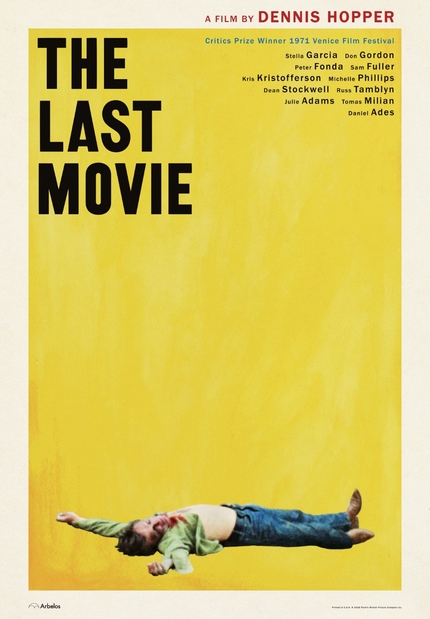
The Last Movie (1971)

When I was really young, I loved to visit the high school library that my uncle ran. Today, it would probably seem small, but in my ten-year-old mind, it was huge. That said — now that I’m a grown-up, I realize just how many cool books my uncle would hide in his library for kids to find. There were collections of EC Comics and stuff like The Fifty Worst Films of All Time (And How They Got That Way) by Harry Medved, Randy Dreyfuss and Michael Medved.

When I first read that book, back when I was twelve, I thought it was the greatest thing I’d ever laid my eyes upon. I got all of their Golden Turkey Awards books and loved the quasi-documentary It Came from Hollywood But as I grew older, I began to realize that many of the movies that were decried by these books — such as the work of Ed Wood, for example — held artistic merit that superseded anyone making light of them.

Reviewing some of The Fifty Worst Films today, I realize how many of them I actually enjoy, like Airport ’75, the Matt Helm movie The AmbushersBring Me the Head of Alfredo Garcia, Godzilla vs. Hedorah and Valley of the Dolls. One of the films on this list really fascinated me, though: Dennis Hopper’s The Last Movie.

After Easy Rider became a surprise success, Dennis Hopper could do anything he wanted. And sure, maybe what he wanted to do was take near inhuman levels of drugs. But let’s be serious — he had the soul of an artist and $1 million dollars from Universal bankrolling him, as well as the understanding that he had free rein with little to no intervention from the studio. After all, that had paid off with Easy Rider, right? And Hopper had been trying to get this movie made since he was in Rebel Without a Cause.

For most of 1970, Hopper and his crew shot hours upon hours of footage. And then Hopper went to New Mexico and started editing. And drinking. And doing drugs. And editing. And doing more drugs. I’m not exaggerating — just watch Lawrence Schiller and L.M. Kit Carson’s (yes, the same person who wrote The Texas Chainsaw Massacre 2The American Dreamer.

Hopper had a cut that was pretty conventional. In the Alex Cox documentary Scene Missing, Alejandro Jodorowsky watched this cut and mocked Hopper, telling him that he had the opportunity to create true art. The visionary director would give Hopper a cut of the film, which he didn’t use, but inspired him to craft the disjointed film that exists today. Another interesting fact: when this was first screened, the projectionist loudly said, “This movie has the right title, because it’s going to be the last movie Universal ever makes.” An enraged Hopper attacked the man, ending the screening. Hopper’s career would take a long time to recover — which we covered way back when we discussed Chainsaw 2.

After being a lost film for decades — it had a short two week New York run and ran in some drive-ins as Chinchero — Arbelos, a new boutique distributor focusing on the release of both new and restored classic art house titles, has re-released a 4K restoration of The Last Movie as their first official product.

The main premise of The Last Movie is that films are dangerous. You can interpret that metamorphically or physically, as the indigenous natives of Peru keep making a movie as a ritual long after the camera have stopped rolling. Hopper based this story on things he saw as he filmed the movie that would be the first of his many comebacks, The Sons of Katie Elder, where he saw locals do the very same thing.

Kansas (Hopper) has stayed behind in Peru after a movie ends shooting after an actor is killed in a stunt. A stuntman by trade, Kansas decides to quit making movies and stay behind with a Maria, local prostitute, in what feels like paradise.

There’s a subplot with a couple who wants to buy a mine that doesn’t have much to do with what happens next, but the woman in the couple is Julie Adams from Creature from the Black Lagoon. It really feels like it gets in the way of what the movie should be about. It also feels like Hopper shot so much footage that he could have edited twenty different movies out of the results.

Yet the real narrative of the film is that the natives have turned sticks into cameras and are filming a movie that will never exist filled with real violence. That’s when The Last Movie begins to touch on the issues of reality versus fiction and how we perceive storytelling, as well as using behind the camera terminology as a storytelling tool.

Despite its downbeat theme, there’s a true beauty to this film, made even more gorgeous by the painstaking restoration process the film has gone through. The final scenes of the wooden false cameras attempting in vain to film Kansas’s sacrifice are breathtaking.

“It ends in fire. All my movies end in fire.” Hopper may have said that about Easy Rider, but it’s true about nearly everything he touched. This comes from Some Kind of Genius, a 30-minute one on one talk with Hopper that’s also on the blu ray release. It’s exactly the kind of extra I was hoping for — a rambling discussion of career and art by Hopper. I wish I’d have the opportunity to speak to the man, someone I feel was a true icon of American art, but never will get the chance to. This doc gets me close.

You need to see this for yourself. You can grab it on the Arbelos store now.

DISCLAIMER: I was lucky to get a copy of this from Arbelos, but that didn’t impact my review. I was already enthusiastic about buying a copy of this and was happy they sent it my way. 
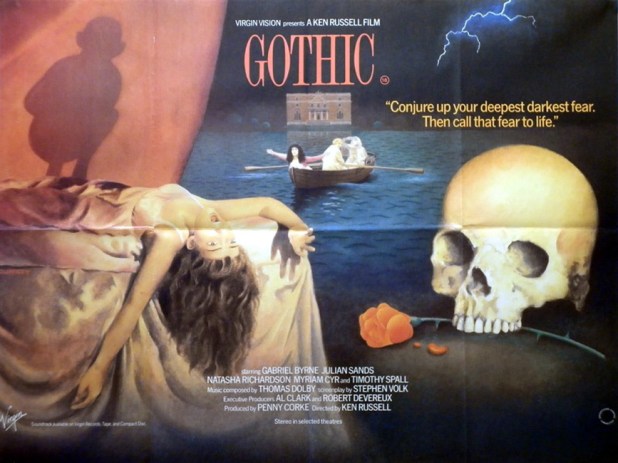
CHILLING CLASSICS MONTH: Gothic (1986)

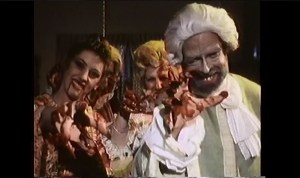
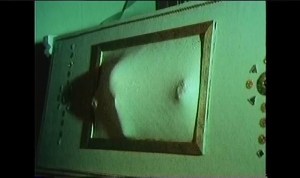
Back in my teenage days of haunting Prime Time Video, the case to this movie would call out to me. It featured a photo inspired by Henry Fuseli’s painting The Nightmare, with a near-nude Natascha Richardson being menaced by a goblin who has decided to squat on her chest. And while this is an arty film directed by noted director Ken Russell, it was known in my high school as the movie where “a lady has eyeballs for nipples.”

The film is a semi-fictionalized retelling of the Shelleys (Julian Sands and a debuting Richardson) visiting Lord Byron (Gabriel Byrne) at Switzerland’s Villa Diodati to do opium and the horror stories that resulted, with Mary Shelley writing Frankenstein and John Polidori creating The Vampyre.

You may be wondering: Why is an arty film about Lord Byron and the Shelleys on a box set of mostly kitschy horror films? Because Mill Creek is either awesome, insane or takes whatever public domain films they can get. Actually, the right answer is all three.

After a reading of the book Phantasmagoria, the party guests conduct a séance around a human skull, during which Claire, Mary Shelley’s stepsister has a seizure. These happened throughout their childhoods whenever the supernatural reared its head. Here’s a real otherworldy event: Lord Byron goes down on Claire and she has a miscarriage during his ministrations. And oh yeah, Polidori claims a vampire has bitten him. He also tries to poison and hang himself because he can’t deal with his homosexuality.

What follows are a series of visions in which, yes, breasts do grow eyeballs, a shadowy figure rides on horseback, Claire disappears and Mary sees her future son William in a coffin and visions of her miscarriage. She tries to throw herself off the balcony but is saved by Percy.

As we fast forward to modern times, we learn the truth via voiceover: Mary’s son, William, did die just three years later, followed by Percy’s drowning in 1822. Byron would die two years after Percy, and Polidori would kill himself in London. Mary wanted to raise her child from the dead, so she created Frankenstein and The Vampyre came from Polidori’s homosexuality and suicidal thoughts. 

Your willingness to enjoy this film will depend on how much you enjoy Victorian writers and Russell’s visual style. It’s always amazed me that this was stocked in the horror section of most video stores. Chilling Classics continues that tradition by putting it into this set.

Want to watch it? The newly reminted Vestron Video released it earlier this year and you can find it at Diabolik DVD.

CHILLING CLASSICS MONTH: Hands of a Stranger (1962)

Concert Vernon Paris’ hard work has finally paid off. He’s become the biggest star there is. That’s when his hands are ruined in an auto accident and Dr. Gil Harding amputates them — with no authority — and replaces them with the hands of a murderer, all in the hopes that Paris can play piano again. Sure, the transplant is a success, but Paris becomes unhinged and increasingly violent toward those he blames for him needing his killer new mitts.

Sure, this is based on the 1920 novel Les Mains d’Orlac by French writer Maurice Renard, but the real draw is the absolutely over the top slasher like violence — well, as good as it gets in 1962 — throughout the film. First, Paris argues with his former girlfriend Eileen, who can’t love him as a normal man and craves the limelight that dating him gave her. Her dress catches on fire as they fight and she burns alive. Later, Skeet, the son of the taxi driver who caused the accident, enrages Victor by being able to play the piano when he cannot. He crushes the child’s hands, then smashes his head open.

Keep your eyes peeled for a very young Sally Kellerman and Irish McCalla, who was TV’s Sheena: Queen of the Jungle. This isn’t a great movie, per se, but it’s over the top and filled with brimming menace. It’s also anything but boring!

It’s available on Amazon Prime for free with a subscription.

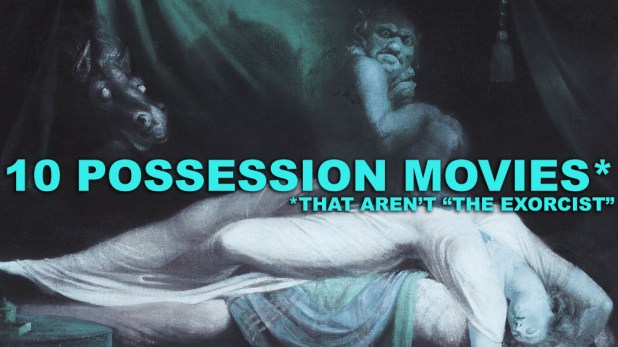
Ten Possession Movies That Aren’t The Exorcist

There really hasn’t been a horror movie that has taken over people’s minds quite like The Exorcist. That doesn’t mean that plenty of movies haven’t tried! The power of the internet compels you to read through this list, share it and comment on your favorites!


1. Cathy’s Curse: Bill from Groovy Doom and Drive-In Asylum remarked to me the other day just how much he wished this movie was based on a true story. Let’s just start telling people it is, that never stopped Earl Warren! Any movie in which a young Canadian girl is possessed and starts swearing before she torments old people with her rudeness must be witnessed!


2. Amityville II: The Possession: If you talk to me any longer than ten minutes, chances are I will bring up how much I love this piece of schlock. When I was a kid, the Catholic Church gave this movie an O rating for morally offensive. It achieves that mark in a little under ten minutes and then uses the rest of its running time to batter you senseless.


3. Enter the Devil: Also known as The Eerie Midnight Horror Show, this spaghetti Satanic possession film is, of course, based on a true story. It also features a statue of one of the men crucified next to Jesus getting off its cross and making love to the film’s heroine before she becomes the tool of Satan, played here by the steely eyes of Ivan Rassimov. Pure scumtastic joy herein. Beware.


4. Evilspeak: You don’t get on the Church of Satan’s list of approved films by half-assing it. Clint Howard stands up and says, “Boys can be possessed too” after a lifetime of getting treated like a dog (and having his dog murdered). The last ten minutes of this film are every Catholic school gone metal kid’s twisted dreams come true.


5. The Car: With this movie, we learn that cars can be possessed too. But not just any car. No, this is the car that Anton LaVey used to drive around in. You will believe that a car wants to murder a marching band!


6. Magdalena, Possessed by the Devil: The German exploitation community stood up and said, “Why do the Italians have the trademark on Pazuzu ripoffs that are in horrible taste?” It’s as if someone was having a contest to see how much blasphemy they could fit into one movie as young actress Dagmar Hedrich goes absolutely verrückt im Kopf, spends most of the movie nude and screams “I despise the dead!” at her own grandfather’s funeral.


7. Abby: Warner Brothers seized all prints of this film and I’ll never forgive them. Imagine if a good churchgoing girl was possessed by Eshu, the West African trickster god. Dream no more — this is a reality! Carol Speed is Linda Blair here, if Linda wasn’t confined to a bed and out and about picking up and killing men all over Louisville, Kentucky’s finest after hour clubs. I have this on a double disk with Magdalena, Possessed by the Devil and when life gets me down sometimes, I just stare at the cover art and hug the box and everything ends up being OK.


8. The Witch: If your kids tell you that the goat in the backyard is Satan, you should listen to them. This is probably the only movie on this list where the heroine makes the right move by giving in to the dark, as her life is pretty horrible otherwise. After all, who wouldn’t love the taste of butter in one’s mouth?


9. Beyond the Door: This film rips off The Exorcist with such shameless zeal that the most evil of all beings, copyright lawyers, were called in to take the profits for Warner Brothers. And if you loved TV’s Nanny and the Professor, well, Nanny is having some real problems in this movie!


10. Alucarda: And this is what the devil does. If you think Italians have the copyright on sacrilege (actually Italians hate copyrights, if we’ve gleaned anything from their movies), allow the Mexican contingent to speak on this. This isn’t just a strange film about Satanic nuns; this is a fever dream from another dimension that will engulf your mind.

Honorable mention goes to the Italian sleazefest/b-roll travelogue The Return of the Exorcist, the giant penis having demon and shock ending fun of The Incubus, Jamie Lee Curtis’ sister Kelly avoiding giving birth to the Antichrist in The Sect, Joan Collins’ baby being possessed by the little person she spurned in I Don’t Want to Be Born, mirror possessing goth oddball Rainbow Harvest in Mirror Mirror, Fulci’s borderline incoherent melding of Egyptian lore and American possession films Manhattan Baby and the hand of a demon possessing people in Demonoid. Then there’s Spain’s Paul Naschy with Exorcism, aka Exorcismo, from 1975, that he claims isn’t a ripoff because he wrote it before the release of The Exorcist.

What’s your favorite? Did we miss it? Did you notice that we didn’t really feature any modern possession films? Dare we say…the devil made us do it!

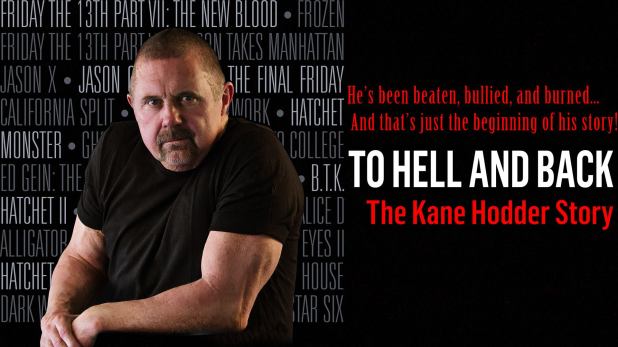
To Hell and Back: The Kane Hodder Story (2017)

If you’re seen a Friday the 13th movie from 7 to 10, you know who Kane Hodder is. He’s pretty much the man that made Jason into an icon — even after stepping into the successful series after several films (you can argue that Jason doesn’t appear in the first film and only appears in hallucinations in Friday the 13th Part V: A New Beginning, so Hodder only missed out on four chances to be Jason). But who is the man behind the iconic hockey mask and makeup?

After surviving a childhood filled with bullying and an early career near-death burning, Hodder worked his way up in the stunt game before getting the roles of Jason and Victor Crowley from the Hatchet films. There’s a nice balance here, as Hodder faces the camera and explains how close to death he got, particularly being moved by how he upset a child when she saw his burns.

There’s a lot in here that reminds me of pro wrestling, as Bruce Campbell remarks that most of the heroes from movies end up being the worst people and the worst villains, like Hodder, are the ones that treat their fans and other people the best.

There’s also a wonderful little moment where Cassandra “Elvira” Peterson shares how she and Hodder bonded over their shared survival of being burned. I would have never guessed in her case and felt that was a pretty brave thing to do for this film.

For being the guy who has probably killed more people on screen than any other actor, Hodder comes off as a likable fellow, a great family man and someone willing to discuss his failing, like his OCD that nearly ruined his connection to his family. Plus, the fact that he’s always willing to push himself into new roles and new places in his career is pretty inspiring. It’s well worth a watch!

Want to see this for yourself? It’s on Amazon Prime.

CHILLING CLASSICS MONTH: The Game (1984)

Is Bill Rebane a horrible filmmaker or a secret genius? If we’re to go by Blood Harvest, I lean toward the latter. However, every single other one of his films that I’ve watched so far has left me feeling like that movie is his lone success, his moment where the hundreds of monkeys all writing scripts for him finally got one that approached Shakespeare. Will 1984’s The Game (also known as The Cold and we all know how much Mill Creek cares about getting the correct title on their films or letting you know that the same movie has multiple names) convince me otherwise?

It’s a good conceit. Imagine if three millionaires gather nine people in an old mansion and give task them to conquer their biggest fears. If they make it, they each get a millon dollars in cash. That’s the idea. What follows is a gaseous cloud that chases people, a 1980’s looking amateur band rocking out, people sharing pickles at dinner, an Alien ripoff, people drinking tea with spiders in it, tennis playing, a hunchbacked mental patient who ends up being a British thespian, singalongs of “Jimmy Crack Corn” and so many endings, you’ll feel like you’re watching The Return of the King on LSD.

I haven’t seen a movie that makes less overall sense that didn’t come from the hands of an Italian director. Seriously, this movie is bonkers. Come for the swimsuit models, stay for the meta reference to Rebane’s other film, The Giant Spider Invasion. I really need to watch this like twenty-five more times to really appreciate it and its not-so-subtle nuances.

Which Rebane made this, the schlockmeister or the auteur? I’m thinking the genius, but then again, some people think Claudio Fragasso is one of those too.

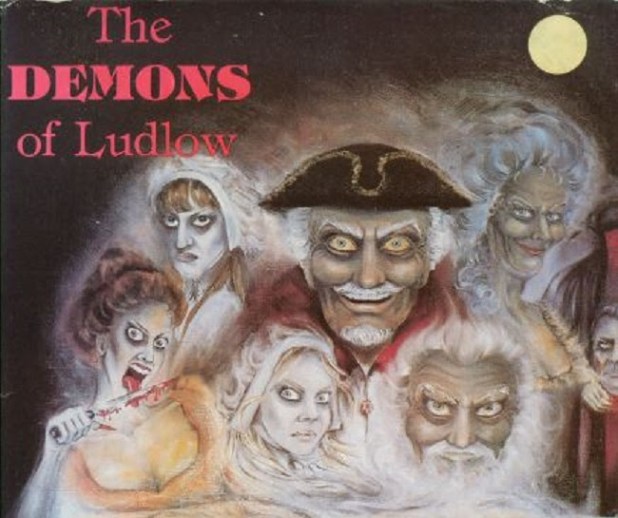
CHILLING CLASSICS MONTH: Demons of Ludlow (1983)

Thanks to Dustin Fallon from Horror and Sons for this entry. He’s been instrumental in helping us get writers for this project and is one hell of a nice guy. Also, his site is great!

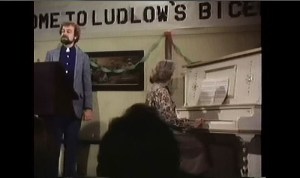
As the population of a small, quiet town prepares to celebrate the bicentennial anniversary of its founding, the literal ghosts of its past return to seek retribution for the actions of their forefathers long, long before. If you think that this plot synopsis sounds like it’s for John Carpenter’s 1980 film The Fog, you are right! It sounds a whole Hell of a lot like The Fog.

In this case, the film in question is Bill Rebane’s 1983 release, The Demons of Ludlow. However, in Demons, it is the town’s founder himself that has returned with a supernatural bloodlust. And while Blake and his men may have sailed into Antonio Bay in spooky style in The Fog, Demons of Ludlow‘s Ephram Ludlow comes to town by way of a haunted piano. Somehow, that just doesn’t seem as “grand” an entrance.

The most significant difference between both films is undoubtedly in the quality of the production. Simply put, The Fog had a budget, while Demons clearly does not. By no means is that to say that Demons of Ludlow is not worth watching. In fact, it’s these same budgetary limitations that gives all of Rebane’s films whatever appeal they may have.

Being a major studio release, Carpenter was able to enlist the acting talents of heavyweights such as Hal Holbrook, Janet Leigh, and John Houseman to help lend his film some “credibility” (as well as some highly entertaining performances). However, the cast of Demons is comprised almost entirely of actors native to Rebane’s home of Wisconsin, most of whom had no previous or future film credits to their name.

Expectedly, performances here aren’t as “polished” as those in Carpenter’s film, but the majority of Demons‘ cast give respectable performances. A few scenes do feel like community theater performances, and this feeling is further enforced by a couple of the sets looking like just a backdrop on a stage. Overall, the film has a very “made for early 80’s syndication” look to it, which may provide some additional appeal for audiences alive during that era.

While The Fog undoubtedly provided more than a few chills and shocking deaths, Demons of Ludlow is much more gleefully sadistic with its underworldly carnage. Demons unabashedly presents scenes featuring a beheading, severed hands, an old woman pelted in the face with stones, and (most notably) a pack of ghouls possibly sexually assaulting a mentally handicapped woman while ripping her to pieces and eating her. Interestingly enough, the forthcoming scene featuring the Mayor’s complete lack of empathy about the girl’s death (with her mother present) is the film’s biggest comedic moment.

Gore is quite light in Rebane’s film, presumably due to budget. However, what is implied is just as effective as a pile of blood and guts on the screen, if not more so. There is one quick moment of nudity during the attack on the handicapped woman, and one character spends the majority of her screen time in sexy lingerie despite being the minister’s wife, so the film may not be appropriate for audiences of all ages. As there’s little to no outdoor lighting used in this film, it probably fits best as a late night viewing.

Much like Rebane’s most successful film, The Giant Spider Invasion, Demons of Ludlow is far from polished, but shines as an example of local filmmaking. What makes this film work is that all parties involved are trying their best to make it work. Special effects really aren’t all that “special”, but are wisely kept secondary to the story itself. The story is fairly ambitious, but the film never tries to be bigger than it is.

Demons of Ludlow is definitely not the best film on Mill Creek’s 50 Chilling Films collection, but it’s also far from being the worst. (I feel sympathy for the poor bastard stuck reviewing either War of the Robots or The Witch’s Mountain.) I’ve owned this set for quite a few years now and highly recommend it to any fan, new or old, that may want to freshen up a bit on their older horror films.

Jodorowsky’s Dune (2013)

“My ambition with Dune was tremendous. So, what I wanted was to create a prophet. I want to create a prophet… to change the young minds of all the world. For me, Dune will be the coming of a god.” With those words, Alejandro Jodorowsky starts our journey toward Dune.

Alejandro Jodorowsky is a force of nature. The creator of El Topo and The Holy Mountain faced a new challenge: he wanted to adapt Frank Herbert’s novel for the screen. Never mind that Hollywood studios said that this movie had to be under two hours. Jodorowsky wanted his to be fifteen.

He’d also never read the source material, but he didn’t let that stop his journey toward creative nirvana. In fact, he planned numerous changes that Herbert hated, like turning the book’s spice (in the books, this is the most essential and valuable commodity available, a drug that gives the user a longer life span, more vitality and heightened awareness) into a blue sponge.

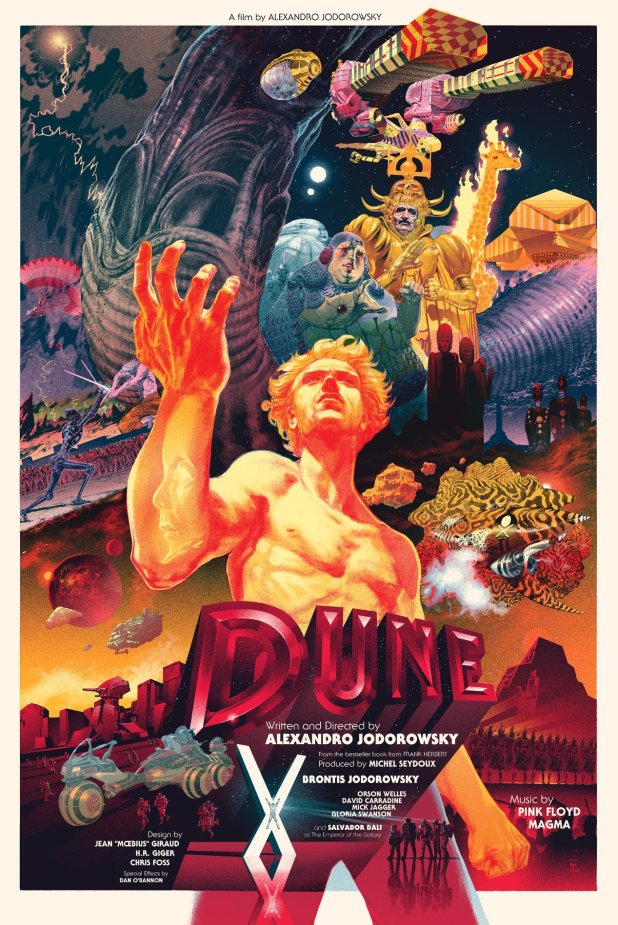
He and Jean “Moebius” Giraud storyboarded every single frame of the film in a gigantic bound book before one shot was lensed. And there was also a team of artists and special effects technicians ready to bring the book to life, including H.R. Giger, Chris Foss and Dan O’Bannon. It’s no accident that this team would go on to create Alien or that the design sense of this unfilmed Dune would be part of the look of Star Wars, as Jodorowsky claims that the storyboard was circulated throughout Hollywood (O’Bannon worked on the computer animation and graphic displays for Lucas’ film).

The cast of the film would have been borderline insane: Salvador Dalí as the Emperor (sitting on a throne where he would urinate and defecate into porcelain swans while making more money that Marlon Brando did for Superman), Brontis Jodorowsky as the hero of the story Paul, Orson Welles as the Baron (paid by having his favorite French chef on set at all times), David Carradine as Duke Leto and Gloria Swanson as the Reverend Mother. Each house in the film would have its own soundtrack, with Pink Floyd as the heroic House of Atreides and Magma as the House of Harkonnen.

That said, a $15 million dollar 15-hour movie in 1975 is a ludicrous notion. Yet if anyone could do it, argues this film, this was the team to beat the Hollywood odds. They didn’t. And perhaps if they had succeeded, as Nicolas Winding Refn wonders in the opening of the film, perhaps the blockbuster world that Star Wars wrought — and the end of the New Hollywood — would never have happened.

This documentary has an intriguing theory: Even thought Jodorowsky never made Dune, the film was as influential on future science fiction as if it would have been really made. Its creator’s dream of changing consciousness was a success. You can see its influence everywhere. Can you win while losing?

Want to watch it for yourself? Here’s the official site.

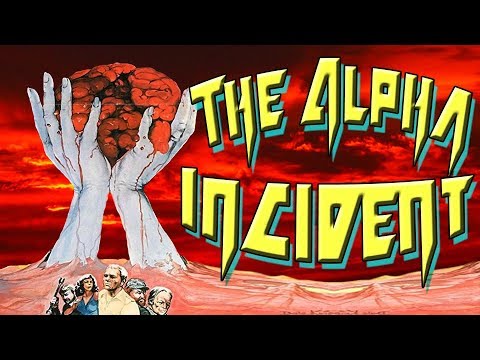
CHILLING CLASSICS MONTH: The Alpha Incident (1978)

The first Bill Rebane movie I saw was the berserk Tiny Tim vehicle Blood Harvest. Once I realized that The Alpha Mission — one of his older efforts — is on the Chilling Classics box set — I jumped on it.

Much like Night of the Living Dead, a space probe has returned, this time from Mars. It’s brought back an organism that can kill all life on Earth. As it’s being transported by train, an employee accidentally releases it and the entire station is quarantined and must wait endless hours for the government to find the cure. There’s only one problem — if they fall asleep, the organism will kill them.

Basically, this is a movie about a bunch of people drinking coffee. doing amphetamines and making horrible decisions. Ralph Meeker (Without Warning) stars here, bringing along several unknowns and George “Buck” Flower (who shows up in nearly every John Carpenter film). It’s basically a movie where people stand around, upset one another and stand around some more.

With a better team of actors, this could be a much better film. That said, it’s enough to keep me interested. My disclaimer is that I’m exactly the kind of person who loves watching horrible movies with bad transfers from a $9 box set with fifty movies on it.

“What year is this from? Is this foreign?” asked Becca. No, this movie is magically made in this country, unless Wisconsin is really a foreign country. “Is this the end of the movie?” she also asked. Yep, that’s the kind of film this is.

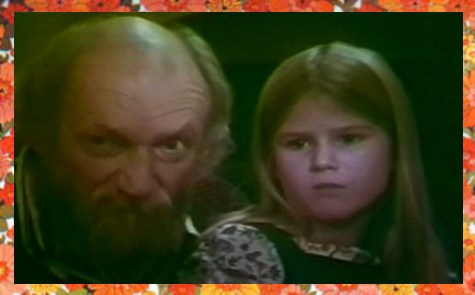
CHILLING CLASSICS MONTH: Cathy’s Curse (1977)

John S Berry is back with another entry in this month’s Chilling Classics event. He’s been watching a lot of Big Japan wrestling, which I can totally respect, and has a lot of cool things to say about one of my favorite movies ever. Seriously, I could watch this one every single day of the year. You can read more of his words on his Twitter


Even Linda Blair possessed

Was a more likable kid

Than when Cathy was not cursed

***Gamberlaku 7-7-7 format created by the dude Raven Mack***

I think I have seen Cathy’s Curse multiple times. Similar to the sense of I think I have had that dream before that was out of order and at times it has a pink or sepia tone and characters appeared that I instinctively knew who they were. Also acceptable comparisons are: driving late into the night with heartburn from gas station coffee and your eyes drying up, falling asleep with on a Saturday night where it switches from edited movies to Byron Allen to infomercials about non-stick egg pans and a two hour hayride in the cold Midwest night with not a lot of pay-off.

I do not mention these comparisons in a negative sense, or for that matter a positive one. Cathy’s Curse is its own sense, its own grainy huh? magic. I have watched it several times and am pretty sure even if I have a sudden change of lifestyle and emulate Old Paul I am guessing I will view at least a few more times before I shuffle into a possessed doll or an old lady specter that lives in a cold ass attic.

There is an aura about this film and all of the gaps and plot holes just add to all the speculation fun you can have with it. My original viewing of this was with my nephews on a Christmas visit and it makes me proud that the movie is often quoted and will probably live on the next generation and maybe even further. Our family may not have jewelry to pass down but we have plenty of warped.

This is French Canadian film and it looks like most of the actors didn’t really go on to do a whole lot (watch for the scene at the 27-minute mark when Mummy moans “My Baby!” and police investigator puts his hand over his mouth to prevent himself from laughing). A lot of the acting is flat and Mummy seems to be filming two different movies, one where she is a doting mom and the other when she is ready to lock her daughter in an attic and go on vacation with an escaped convict. But this unevenness just adds to the film.

The film starts with a flashback scene to 1947 when a scorned husband decides to wildly drive off with his left behind daughter to catch up with his wife and son. They lose control and meet their end in an awful way in a snowy ditch. Also, this is the start of the great lines which I will not ruin, best to experience them in the moment (I actually envy those who get to hear them for the first time).

Flash to current day and the son that got away actually decides that after his wife’s breakdown it is a good idea to move into his drafty, cold ass childhood home. George just marvels about all the good memories from the house. Maybe he was too young when his mother took him away to remember all the bad times or maybe he is just a clueless putz. I am leaning towards the putz angle.

George never seems to put two and two together and have an Ah-ha moment linking his family history and all the horrible things that are happening around him. He is one of those business as usual guys, housekeeper plunged to her death? Well looks like I better put another ad in the paper tomorrow. Wife having a breakdown in a bloody bathtub and back is all lashed up? She will be fine with some soup and rest.

There is something about this film that just feels cold and also has that spare cold room you have to stay in when you visit a grandma or aunt’s house feel. Maybe you will see your breath when you wake up and for sure you are going to go thru those comforters and blankets stacked on the rocking chair next to the bed. Only thing colder is Mummy’s affection towards the Prince Valiant flat delivery Daddy. Maybe the cold and musty old house smell is not as much of an aphrodisiac that Paul thought it would be (see putz).

It doesn’t take long for the bad vibes to arrive in many forms. Creepy dolls are found, mediums (or extra rares) show up and Mummy’s sanity slides down the cold slippery ditch embankment. Luckily she has a housekeeper to help things run nice and tidy. Well, actually she may be the worst housekeeper since me in college. After for no reason, Cathy shatters a bowl against the wall the housekeeper picks up about 4 pieces and announces “there it is all done.” Shortly after the tidying up, Cathy’s doll plays some Wolf Eyes and Mummy is home just in time to see the lady go out the window.

Mummy is the only one who seems to be kind of shook up about this. Everyone else seems pretty flat and emotionless about it. Mummy has questions and suddenly Cathy can teleport and control objects and Mummy is scared and screaming. Paul seems more upset about having the ambulance out to his place for the second day in a row than his wife being sent away for another breakdown. As the ambulance pulls away I honestly thought the shrill siren was Mummy wailing and crying out. Yup, her voice and screaming and voice is that bad.

I am not sure if Old Paul and the housekeeper lady were married. Paul didn’t seem that broken up by the lady’s stage dive out the window. Maybe that is why he started hanging out with Cathy. I am not sure how or what exactly you did but I owe ya one for getting rid of that old cow. Paul’s home that was once tidy and proper is now a mess with plates piled in the sink, smut mags on the coffee table and piles of old holy underpants now that the lady is gone and he loves it.

He ties one on Cathy is way ahead of the curve in encouraging others to binge drink. The psychic just decides to pay a visit and the duo drives her to stumble to the hills. Paul drinks more and snakes appear. Cathy is going to really be fun at parties when she gets older.

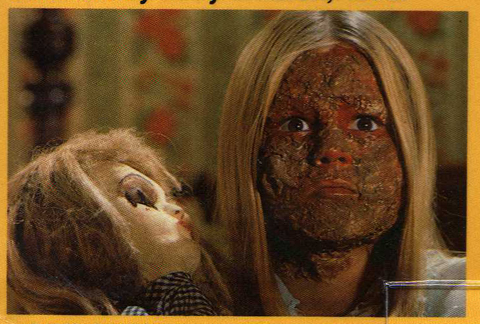
Mummy comes home and immediately trouble brews. Paul tries to sober up and protect her but well let’s just say that did not end up well for poor old Paul. Mummy has a final showdown with the doll and a burned up specter of her husband’s sister. The house chuckles shakes and bellows and George never really figures out that the haunting is by Laura his crusty faced dead sister.

But Mummy smiles at Cathy and the clueless putz strikes again. See everything is fine. I often wonder what life would be like for characters after the movie wraps up. I imagine that things would be back to normal for hmm… maybe an afternoon. By the next cold morning, Mummy is back to screeching and Cathy will never be the same again. George probably completed the cycle of life and ran off with Cathy leaving their mom behind. Hopefully, George put snow chains on and is a better driver than his dad. If not, well they do make a lot of sequels and reboots these days. I’m game.