Man, these student teachers. They’re changing the old ways of high school and making it better — well, maybe more interesting — for the hip now generation. The sequel to Roger Corman’s The Student Nurses, this movie is all about the issues, man.
Directed and co-written by Jonathan Kaplan, who would go on to direct The Accused, this movie follows three student teachers: Rachel who wants to teach the good parts of sex education after school (that is, birth control and that sex isn’t this alien, frightening thing); Tracey dates an art teacher who cheats on her; and Jody works with an inner-city education effort but also gets involved in selling drugs.
Chuck Norris made his debut in this film as a karate instructor. In his autobiography, he revealed that he knew nothing of the film other than the scene he was in. When the movie was released, Norris and his family went to see it and were shocked by the explicit sex and nudity. In fact, Norris almost changed his mind about becoming an actor!
To say this movie is dated is an understatement. That said, it’s packed with the earnestness of the end of the 1970’s and the feeling that young people would change the world. They all ended up repeating the same cycle as their parents by the early 80’s. But for now, they would be the student teachers.
Day 17 of the Scarecrow Psychotronic Challenge is 17. Die Laughing. “Hello?” “I don’t think comedy belongs in horror.” “You got the wrong number, pal.” I’ve picked a movie that got a bad rap when it came out but time seems to have been kinder to, Jennifer’s Body. I missed it on the first go-round, so let’s get into it.
Jennifer’s Body was written by Diablo Cody, who became known for the blog and book Candy Girl: A Year in the Life of an Unlikely Stripper, as well as the screenplay for Juno. Since then, she’s done script revisions on the new Evil Dead as well as writing Ricki and the Flash and Tully.
Named for the Hole song, this is a film about not just demonic possession, but dealing with high school and the changes that childhood friendships go through. Anita “Needy” Lesnicki (Amanda Seyfried) and Jennifer Check (Megan Fox) have been friends since childhood, but times are changing.
Yet at the very start of the film, Anita is locked in a mental institution and unafraid to attack anyone in her way. She flashes back to her high school days with Jennifer, who was her the exact diametrical opposite. Where Anita is quiet, rude and withdrawn, Jennifer is loud, snide, sexy and popular.
Everything changes on the night that they attend a concert at the local dive bar, Melody Lane, to see Low Shoulder. While the band plays, a fire explodes across the bar and kills everyone inside, except the band, Jennifer and Anita. The band leaves with Jennifer over Anita’s protests. Later that night, she shows up bloody and shaking, devouring the inside of Anita’s mom refrigerator and spewing black fluid all over the linoleum.
Yet the next day, Jennifer is just fine. But things aren’t fine any longer. The town is devastated by the fire and the captain of the football team has been devoured in the woods. The only people who are doing well are Low Shoulder, whose heroism in the fire has been noted. Now, they want to make a charity performance at the school.
A month later, Jennifer is growing paler and needier, accepting a date with the school’s most emo kid, Colin, to see The Rocky Horror Picture Show. While Needy is losing her virginity to Chip, Jennifer is murdering her date.
Needy finds Jennifer drenched in blood and that’s when the secret comes out: Low Shoulder had tried to sacrifice her for fame and fortune, but since Jennifer wasn’t a virgin, she remains permanently possessed. Her first victim was the foreign exchange student that night after the fire. When she has eaten someone, she can survive any injury, feel no pain and becomes even more beautiful.
Needy does her research and learns that Jennifer is a succubus who can only be killed when she is hungry. She warns Chip not to attend the school dance, where she feels that Jennifer will feed on everyone. She even breaks up with him, but he comes anyone to his doom. The two girls battle in Jennifer’s bedroom before Needy is able to stab her best friend in the heart with a box cutter, ending her reign of terror.
Unfortunately, Jennifer’s mother only sees her daughter being killed, which is why Needy is in the asylum. As we come back to the beginning, Needy learns that a non-fatal bite from Jennifer has given her powers. She soon escapes, hitchhikes to Low Shoulder’s motel (of all people, Lance Henriken gives her a ride) and gets revenge for her and Jennifer.
Personally? I liked it. There’s a great moment during Needy’s first sexual encounter with her boyfriend where she notices all of Jennifer’s victims watching, much like the theater of corpses from An American Werewolf in London. I liked the relationship between the girls and am glad they didn’t follow through on the original plans to have a sex scene between them, as I felt that would have jumped too far into pure titillation.
It’d be interesting to see how this film would fare if made today. In a February 2016 New York Times interview, director Karyn Kusama (Girlfight, The Invitation) said that the studio’s all-male marketing department had no idea what to do with the movie, even suggesting that Megan Fox do live sex chats on amateur porn sites to drum up interest in the film. Obviously, the #metoo moment came at the right time.
The only downer to this film for me is how close it is to Ginger Snaps. It hits so many of the same story beats that one wonders exactly how many times Diable Cody watched it. That said, the music is decent and this movie will keep you entertained for 90 minutes.
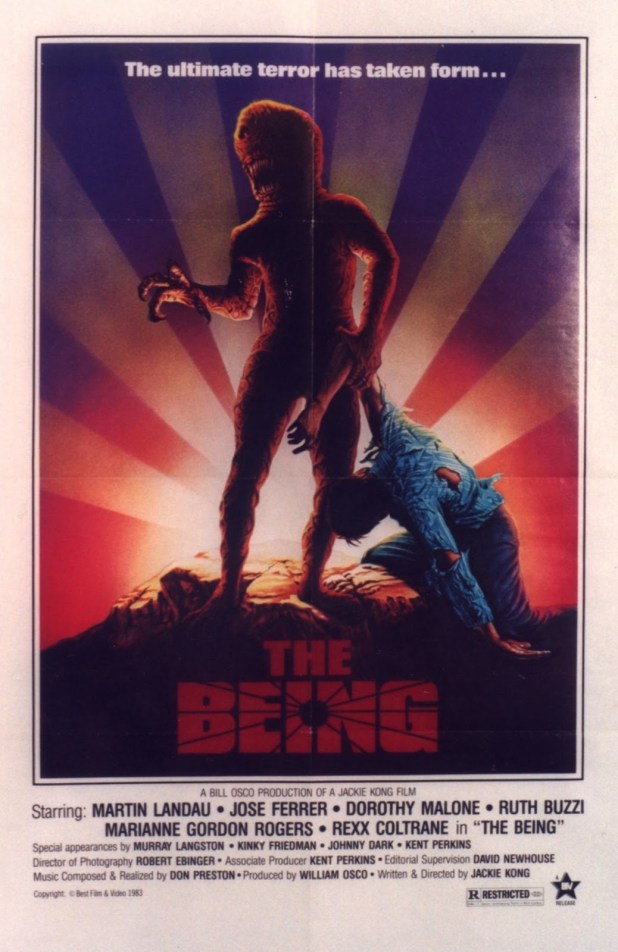
Pottsville, Idaho has some problems. A massage parlor is coming to town and the local conservatives are going insane battling it. And oh yeah — children are disappearing and people are being horribly murdered. Oh boy, 1983 was a magical time to be alive, because this movie may have seemed stupid to critics when it came out way back when, but I loved every single minute of this.
Much like Jaws, the authorities — including Mayor Lane (José Ferrer, The Sentinel) are covering everything up so that they don’t damage the town’s potato crop. That said, he hired chemical safety engineer Garcon Jones (what an amazing sentence that was to write), who is played by the always dependable Martin Landau. Detective Lutz is also on the case, played by Rexx Coltrane, who is in fact exploitation producer Bill Osco. Osco produced this film, as well as plenty of more adult titles like Flesh Gordon and Alice in Wonderland: An X-Rated Musical Fantasy. He also worked with Jackie Kong, who directed The Being, to bring Night Patrol to the screen.
Toss in Kenny Rogers’ wife (at the time) as a love interest and a mutant who is totally influenced by Alien and we’ve got ourselves a movie. This also curiously takes place during Easter, which has nothing to do with anything at all, other than inspiring its original title, Easter Sunday.
It turns out that the mutant has been exposed to radioactive materials in one of the town’s dumps. And luckily, the mutant is light sensitive, so it only attacks at night. Will Martin Landau and the film’s producer be able to stop it in time? Also, don’t you want to see this even more when I tell you that Ruth Buzzi is in it? Or that in addition to Ferrer, this film has another Oscar winner in the cast, Dorothy Malone? What if I told you that Murray Langston, the Unknown Comic himself, was in it? Or that at the end of the movie, we get to learn what happened to every character after the film with title cards and then get to see every major character with a super of who played them (and anyone who has died, we get to see them die all over again)? For these reasons and so many more — like a creature that has one eye and hundreds of teeth, this movie is a must see.
You can watch it yourself on Amazon Prime Video. It’s free with your membership. You can now thrill to my favorite scene in the film, where a cat scares the hero so much that Martin Landau has a laughing fit.
Day 16 of the Scarecrow Psychotronic Challenge is 16. Petey Wheatstraw presents. Watch a movie featuring African-Americans in the starring roles. Bonus if it’s written and/or directed by an African-American. We’re happy to answer all of those challenges with a brand new movie — Rusty Cundieff and Darin Scott’s sequel to their 1995 film Tales from the Hood.
This was a difficult movie for me to write about, to be perfectly honest, for several reasons. First, I love the original. Often, it’s hard for me to warm up a band’s new album because I am so into what came before and I need to push past that. I had this DVD sitting on my to watch pile for some time until I could be ready to watch it. And I’ll be frank: it is not nearly as good as the original. But in the twenty plus years since the original came out, a lot of good — and bad — has happened in the American experience.
Which leads me to the second part that makes this movie hard for me to share my opinion on: I’m a white male that was born in a small town with a handful of black people in it. This is very much a horror movie made for a post-black lives matter and #metoo world. And yes, I can have an opinion on the actual film, but when there are moments that may feel heavy handed and obvious to me, they may also feel incredibly poignant and earnest to others.
Keep this in mind when I bring up points in this article. Because I really liked parts of this film. I know why they did what they did. I think my major issues with it were the lower budget, which can’t really be helped, and that there’s an inconsistent morality through the stories. Yet I found a lot of things to like in it. I’ve used the Frank Capra quote “There are no rules in filmmaking. Only sins. And the cardinal sin is dullness.” before. And this movie is anything but boring.
The movie starts with Robo Hell, where we meet Dumas Beach, a rich white prison owner who is creating an army of artificial intelligence Robo Patriots that can learn from firsthand experience, as well as secondhand stories so that they can become predictive.
He hires Mr. Simms (Keith David here, instead of Clarence Williams III who has retired from acting), a storyteller who will use his collection of tall tales, legends and parables to better teach these robots and prepare them to police America’s neighborhoods and borders.
Dumas asks him to tell the robots about the people who will fill his prisons, so the first story is all about black lives mattering. In Good Golly, two friends, one white and one black, visit the Museum of Negrosity, which features a history of racist propaganda, books and dolls. The white girl wants a golliwog doll named Golly Gee for her collection, but the owner refuses. Nothing there is for sale, it’s there to teach a lesson. That night, the kids come back and try to steal it, but everyone is killed by Golly Gee and the other golliwogs, other than the one girl. She is impregnated with Golly Gee’s horrible children, who burst forth from her stomach, killing her. Also, one of Miss Cobbs’ dolls shows up from the original, but he really serves no storytelling purpose other than fan service.
Here’s where my issues begin: every character in this scene other than the museum owner is a stereotype. Yet this is a chapter about stereotypes and how racist characters are the first marketing characters, a subject I found fascinating as I come from an advertising background. When the owner says to Golly, “How dare they call you a stereotype? You’re just the creation they designed you to be!” it resonates.
That’s where I have to figure out how to discuss this film. Parables are simple stories that need stereotypes and easily understood iconography to impart a moral message. They share some employment of those storytelling tools with exploitation films, which use stereotypes to create sensationalized narratives that make money, morals be damned. My issue here is trying to figure out when Tales from the Hood 2 wants to be a morality play and when it wants to titillate and entertain.
The next part, The Medium, feels like it’s on the side of the latter. A pimp named Cliff Bettis has given up the life, giving five million dollars to a foundation and building two magnets schools in the hood he once used for his own ends. Three criminals try to extort and torture him to find the money, but after Bettis accuses one of them of being a willing bitch in prison, it goes too far and he’s killed.
That’s when we meet TV psychic John Lloyd (obviously John Edward, the TV cold reader) who uses trickery and eavesdropping to make money from an audience that thinks he can speak to the dead. The three men think that they can get the money from the other side by kidnapping Bettis’ girlfriend and using Lloyd’s psychic powers.
However, the seance goes wrong and Lloyd discovers that he really has the power as Bettis possesses him. That’s when Bettis begins using mental powers and murders the three men before taking over Lloyd’s life, using his pimp mindset and real psychic powers to become even more successful.
Here’s my issue with this segment over every single other one in this film. As you’ll discover, this movie wants people to understand the sacrifices of the generations before them and make better choices. If Bettis really has made a foundation and is helping improve his neighborhood, he quickly abandons that plan and simply murders everyone in his path before becoming an even bigger swindler. Nobody learns anything. No lives get bettered. It’s just revenge for revenge sake and seems to feel morally hollow versus other moments that will follow.
Date Night is a much simpler affair, where internet predators end up facing vampires after a game of Cards Against Humanity that goes on way too long. It’s one thing to have fun and play it at a party. It’s another thing to spend endless time on it in a film when it doesn’t really move the plot forward. This story is by the numbers and doesn’t raise the questions that the other stories do.
The Sacrifice is the longest and most troubling part of the film. It concerns a councilman, Henry Bradley, whose white wife has had several difficult pregnancies. She fears that her visions of a boy about to be lynched will make all the difference, as she thinks that boy doesn’t think her child deserves to be born.
It turns out that Bradley is a Republican who is helping William Cotton run for governor. To ensure that less black people will vote, he’s working on shutting down voting sites in their neighborhoods. Bradley’s mother is aghast and as time goes on the baby begins to slowly disappear.
The black child is, of course, Emmett Till, and the theme of this episode is that the black people of today must honor the sacrifices of those who have gone before. At one point, the world makes a startling narrative shift, where we see what the world would be like if Till, Carol Denise McNair (who was killed in the 16th Street Baptist Church bombing), James Chaney, Andrew Goodman, Michael Schwerner, Medgar Evers, Dr. Martin Luther King Jr. and Mamie Till had not made their sacrifice.
Now, instead of running on a platform to return Mississippi to its old values, Cotton leads a paramilitary KKK to Bradley’s house. The doctor and Bradley’s white wife have turned against him. And the only way out is for him to die the same way as all of these martyrs if he wants the world to be better and his child to live.
This is where the morality/exploitation question really hit me. It’s an audacious gambit here and really a grandstand that demands to know why black people, knowing the past, would vote for people that want to “make America great again.” You can say that you’re taking the race out of things, but if we’ve learned anything from Golly Gee, it’s that racism is so ingrained in our American DNA, you can never take race out of anything else ever again.
Like I said earlier, I can have an opinion on the quality of the film but not on the content of this scene. I can say that it feels exploitative to me, but the truth is, this segment may empower someone. Or it may make them think. It certainly did that for me. So often we forget everything that everyone has worked so hard to change. I try not to get political on this site, but my constant real life worry is that the last two years have erased so much progress. And often, I use horror movies as an escape. But exploitation can often be morality and vice versa and perhaps they can both serve the same purpose. This movie doesn’t have a square up reel ala IIsa, She Wolf of the SS, so I think it really wants to be more sermon than sensationalism.
Finally, the framing device, Robo Hell, ends with the Robo Patriot showing how it can identify ex-cons and illegal immigrants. But now, it’s predictive abilities, powered by Mr. Simms’ stories, allow it to see the most immediate clear and present dangers to American civilization. And that threat is obviously Dumas Beach and his people, who are so complicit in his crimes that they must die as well. We get Old Testament justice mixed with low comedy wordplay (Dumas Beach is really Dumbass Bitch) and Mr. Simms reveals that he is Satan as he takes the evil white rich old man to Hell.
The fact that the devil has a higher moral standing than someone who seems to be a red hat wearing Republican is not lost. It’s just another of the interesting stances that this movie takes.
Executive produced by Spike Lee and written and directed by the same team who produced the original, Rusty Cundieff and Darin Scott, this one really is much more of a mixed bag than the first film. I wanted to love this and ended up left with more questions than answers. That isn’t to say I hated the film. I can see why other critics would attack this film. It’s not subtle at all. It has noticeable flaws, like the cheesy robot in the wrap around. And the vampire story could be removed and make this a much better movie. Yet Keith David is great. And I actually thought a lot more about the issues raises here than I have in any other movie I’ve watched this year. That’s what a good moral story should do, right? I just wish this had a better point of view of whether it wanted to educate or entertain when it struggles to straddle the line and do both.
Thanks to Paul Andolina, whose website is Wrestling with Film, for sending this to us!
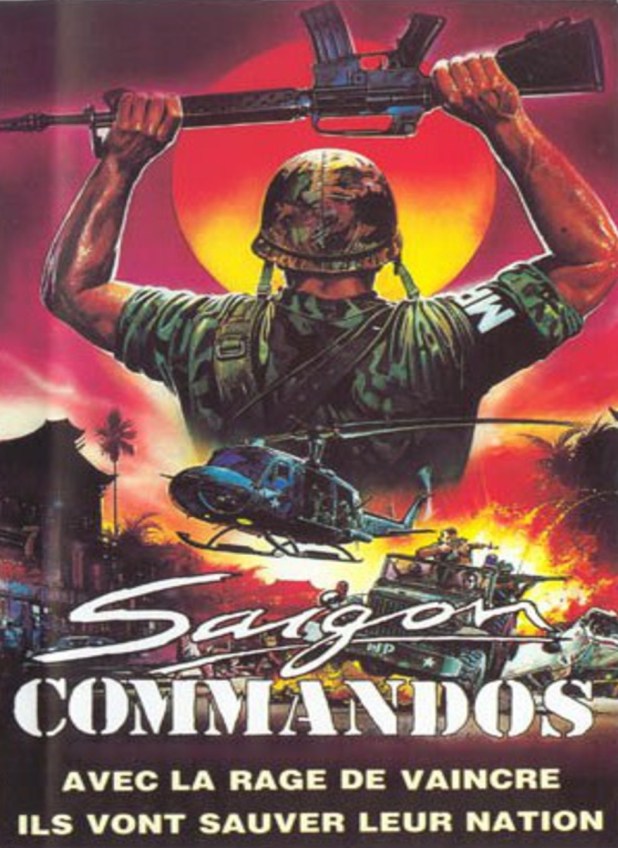
Every October since about 2014, I’ve participated in a friendly movie watching competition called the Halloween Horror Movie Marathon Madness. The first couple years I joined in I tried to stick to horror movies as much as possible. However since certain actors and directors are considered Wild Cards during the Madness I can get away with non horror fare. Such is the case with today’s film, Saigon Commandos. I came across this film while searching for movies starring P.J. Soles, who most will recognize from Carpenter’s film Halloween.
Saigon Commandos centers around a Military Police officer named, Stryker, during a drug war, a series of murders and an election happening in Saigon, Vietnam during the Vietnam War. It is based on a book in a series of novels written by Nicholas Cain, who served as an MP in Vietnam. He couldn’t get his memoirs published but was told they would publish his works if he fictionalized them with more violence and sex. The series ran for twelve novels, Saigon Commandos being an adaption of the ninth one.
Released in 1988 and starring Richard Young as Stryker, and P.J. Soles as a journalist, Saigon Commandos is not too easy to find. This is a shame as I found it to be a decent film concerning the Vietnam War that didn’t solely focus on what was going on in the jungles but more on what was happening in Saigon. Corruption is running rampant, heroin flows freely in the city streets, and someone is going around killing people with hollow point rounds. I knew I was in for a treat when it opened with a Vietnamese band singing House of the Rising Sun in a bar/stripclub. At times it felt like it was unintentionally funny especially when an AWOL soldier is shot in the ass by drug dealers. As he is on the examination table in the medic’s office in Camp Pershing, he screams in a manner that has to be heard, I found myself cracking up.
There are quite a few plot points happening at once in this film, with Stryker dealing with an AWOL Specialist who has made it his mission to get vengeance when some of the corrupt politician Trui’s men kill his fiancee when trying to get to Stryker. There is also an investigation into who exactly the hollow point killer is, as well as Trui and his men trying to win the election by fear mongering.
This film has a bit of action and even a small skirmish in the jungles of Vietnam when Stryker is forced to head into the shit to get two of his friends to sign a disposition backing up his alibi when his commanding officer of the military police turns up shot in the head in his bed after a night of Stryker’s heavy drinking.
I had very low expectations for this film and it turned out to be quite fun. If you can manage to track down a copy, I highly recommend it. I bought a German DVD that has both German, and English audio tracks. The picture quality isn’t the greatest but I think it adds to the enjoyment of it.
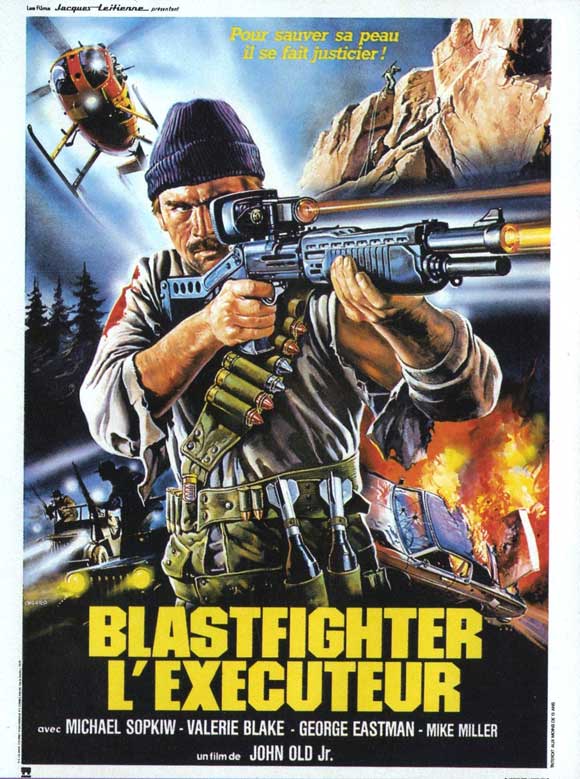
Around a minute into Blastfighter, ex-cop and con Jake “Tiger” Sharp (Michael Sopkiw, 2019: After the Fall of New York) is given the weapon that this movie is named for, a SPAS-12 shotgun that can shoot everything from darts and rockets to tear gas and grenades. He’s promised that every law enforcement officer will have this gun in a few years, but it’s his now. At this point, I was, as they say, all the fuck in.
Tiger was in jail because after his wife was murdered, he shot his wife’s killer at point blank range right in front of his lawyer. Yeah, it turns out that the suspect was the gay lover of the corrupt and sleazy lawyer — because Italian movies — and when he tries to kill that lawyer after his release, he still can’t bring himself to do it. Because deep down, he’s a good guy — because Italian movies. So he decides to go to the mountains to live in peace, burying the Blastfighter.
At this point, Tommie Baby’s “Evening Star” plays. The song was written by Barry, Robin and Maurice Gibb of The Bee Gees and you will hear it in its entirety several times throughout the movie. Please read this paragraph as a dire warning.
Tiger enjoys the wild game that runs past his cabin and adopts a baby fawn, but when local rednecks capture it alive and keep it in pain so a Chinese herbalist can benefit, he tracks down the deer and puts it out of its misery. At this point, the film goes from a revenge film to a remake of Rambo: First Blood.
A girl named Connie randomly moves in with Tiger and ends up being his long-estranged daughter. Yep, our hero didn’t even recognize his own kid. Luckily, they bond and become close, just before the town’s redneck population rises up to get revenge.
Also, to hammer home the redneck town, Billy Redden, the kid who “played” banjo in Deliverance, shows up.
The poachers show up in force, despite the truce between their leader Tom (George Eastman, who starred in Antropophagusand Warriors of the Wastelandand wrote Stagefright) and Tiger. The guys were childhood pals, so Tiger agrees not to kill Wally, Tom’s brother and get over it. But Wally is, well, Wally. You know how Wally is, always killing everyone around someone, even their grown teenage daughter. Yep. Don’t get attached to anyone not named Tiger in this one.
It’s at this point that the Blastfighter is brought back and all revenge is taken. Glorious bloody, awesome revenge.
Blastfighter is packed with Italian genre stars taking a step away from horror and visiting Georgia to make a movie. Like Ottaviano Dell’Acqua, the worm eyed and most memorable zombie in Zombi. And Michel Soavi, director of the aforementioned Stagefright and Cemetary Man, who plays Tiger’s daughter’s boyfriend. And there’s even a score by Fabio Frizzi!
This film was originally intended to be a science fiction film with Lucio Fulci directing, but budgetary issues led to it becoming a strange hybrid of Deliverance, Rambo, Mad Max and a Charles Bronson movie. Dardano Sacchetti (The Beyond, Demons, Manhattan Baby) wrote the changed script, which was originally part of a two-movie deal along with Fulci’s Warriors of the Year 2072. Lamberto Bava (son of Mario, of course, and director of Demons) stepped in to direct this one.
I don’t know if this has come through in this piece yet, but Blastfighter is a weird movie. If you go by the poster, you’re expecting that gun to be used over and over, but it’s kept out of action until the end. With the talent on hand, you’re expecting pure craziness, but that doesn’t really happen until the end. That said, I wasn’t bored at all during this and I’ve endured countless Stallone clones and this is way better than nearly all of them.
That said, I can’t even imagine seeing Fulci try his hand at a film like this. His version of Blastfighter would blow someone’s eyeball clean out of their head!
You can get the Code Red reissue of this at Ronin Flix.
Day 15 of the Scarecrow Psychotronic Challenge is 15. Easterns. The Asian continent has produced so many exotic cinema treasures. Watch one. I’ve been dying to dig into this movie, which was inspired by the Tōru Shinohara manga.
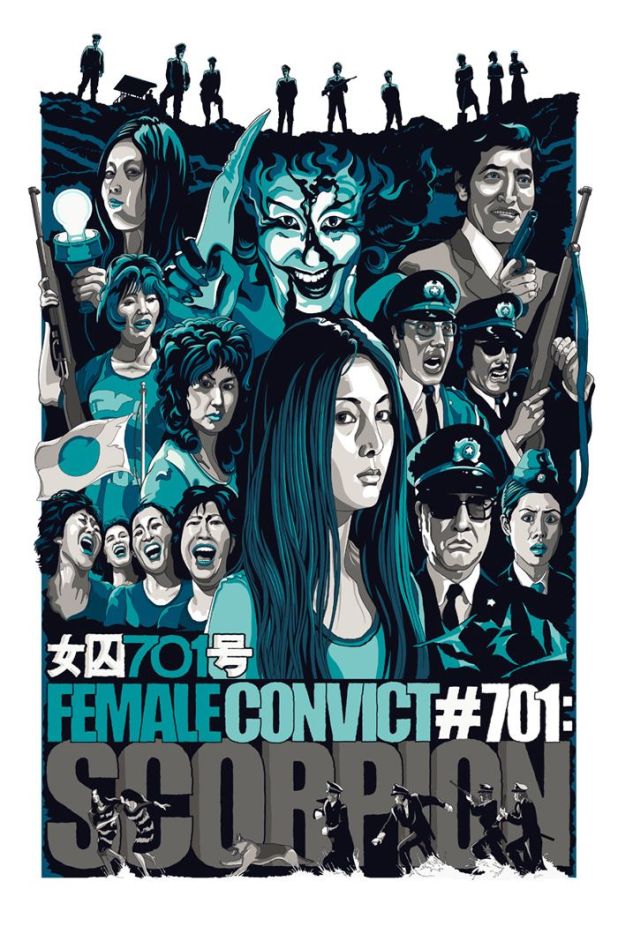
Nami “Scorpion” Matsushima has been dealt the absolute worst of hands. Her boyfriend, the crooked cop Sugimi, has used her body to curry favor with the Yakuza. When she tries to murder him on the steps of the Tokyo Metropolitan Police Headquarters, she is sentenced to hard time and given the number 701.
The films opens with a failed escape attempt between Scorpion and Yuki. However, one knows that Scorpion’s revenge is inevitable. It’s been said that Meiko Kaji decided to play this role using only her face, without speaking a word, and that choice would create an iconic role for her.
This is the kind of jail Roger Corman movies dream of being. Nude female prisoners are forced to walk up and down stairs while hooting guards watch from below and threaten them. And while Matsushima deals with dehumanization behind bars, a Yakuza and police plan to murder her is underway, blackmailing fellow convict Katagiri into making an attempt on her life.
But Matsushima won’t be broken. After being attacked and defending herself in the shower, she spends days tied down in solitary confinement, with hot miso soup being poured all over her and she’s still managed to injure her captors. Then, she is forced to dig holes for two days and nights, yet never tires, even digging against the entire combined mass of the prison.
There’s an insane moment of magical realism here where another convict finally makes an attempt on Matsushima’s life and her face transforms into a Kabuki-like as our heroine deftly steps aside and the warden’s eye pays the price. Soon, the female prisoners have taken over, raping the men and setting the entire building ablaze. Only one body can’t be found at the end. If you guessed Scorpion, you’d be correct.
Soon, she’s an angel of death, gliding into and out of the real lives of the men who thought they could destroy her, effortlessly and wordlessly dispatching them with neon red arcs of blood before calmly walking back into the prison.
This is a film of zooms, of neon, of horrible men and a woman who is willing to endure anything it takes to return their violence a thousand times. It’s also an incredibly stylish film and inspired Kill Bill. It’s director, Shunya Ito, has Scorpion character as “the ultimate rebel.” I’d describe this film as the art house and the grindhouse making violent, bloody, ultra technicolor love in slow motion.
With three direct sequels and several remakes, this is a film series you can really get plenty out of. Luckily, it’s now easy to find, as it’s streaming on Shudder.
Earlier this year, we featured Who’s Watching Oliver and really enjoyed it. We’re really excited to report that it’s now even easier to watch this movie as it’s free with an Amazon Prime membership and is also on Hulu! Check out the new teaser trailer, too!
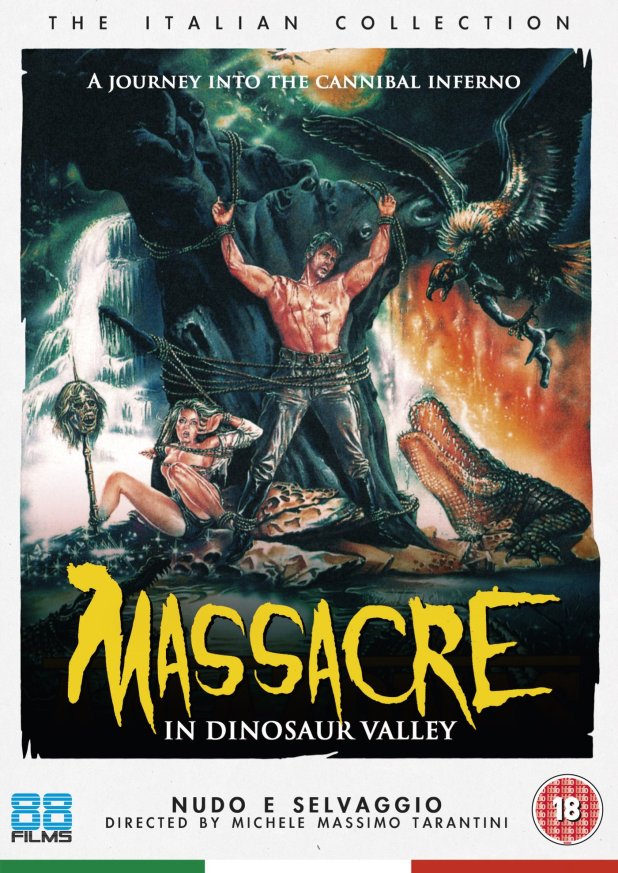
First off, there are no dinosaurs in this movie. There is, however, plenty of happy go lucky island music, a large amount of nudity, cannibals and gore. It’s also called Cannibal Ferox 2, but isn’t this a better title?
Michael Sopkiw, the star of 2019: After the Fall of New York, plays an American paleontologist who likes to fight, fuck and find archaeology. He somehow cons his way into a professor’s voyage to the green inferno that is Dinosaur Valley. Along for the ride? A Vietnam vet and his housewife, a fashion photographer and plenty of hot models. Holy shit, this cannot go well.
Directed by Michele Massimo Tarantini, written by an uncredited Dardano Sacchetti and featuring music recycled from Blastfighter, this movie is everything I love in movies. It rips off the high heel cutting scene from Romancing the Stone. It’s wildly uneven in tone, going from comedy to horror in the same scene. There’s a lesbian rape scene, subverting notions while fully being pure exploitation. And in all honestly, all this movie is missing is a “based on a true story” tag at the beginning.
This is a movie that delivers everything that it promises. Well, except dinosaurs. There are a lot of escapes from cannibals. And lots of sweet, sweet lovemaking, Sopkiw style. That’s how you can tell I’m not an 80’s action star. When I’m getting chased by cannibals, I don’t stop to make whoopie inside the footprint of a dinosaur.
There’s some slavery too that our hero and heroines need to deal with if they want to get out of Dinosaur Valley alive. Yes, that’s one way out — give yourself up to a lesbian slave owner. That doesn’t work too well, though, as the heroine who tries that gets shot in the back. And then that dude, China, who runs the slaves? He rapes the other heroine before Sopkiw saves her and makes a joke about the mile high club as a helicopter rescues them. Dude. I guess comedy equals tragedy plus time, but maybe wait a little before making with the funny. At least until we get out of Dinosaur Valley, right? Also, China looks like an indy wrestling promoter.
You can get this from the fine folks at Severin, complete with interviews with Sopikw and Sacchetti. And hey — they quoted us in the sale copy!
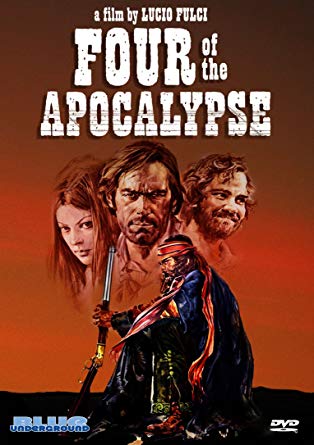
Day 14 of the Scarecrow Psychotronic Challenge is Westerns. Hats and boots are a must on this trail, y’all. Yeehaw! I chose Lucio Fulci’s Four of the Apocalypse…, which was made years before he became known as the Godfather of Gore.
Salt Flats, Utah. 1873. Professional gambler Stubby Preston (Fabio Testi, Contraband) is arrested the moment he steps off the stagecoach, thwarting his plans to win money from the town’s casino. It turns out that he’s actually lucky, because the town has become a vigilante mob that burns that den of iniquity to the ground, leaving only Stubby and three other criminals alive: Bunny (Lynne Frederick, Phase IV), a pregnant prostitute, a black man named Bud and the alcoholic Clem (Michael J. Pollard, Bonnie and Clyde).
The four are given safe passage out of town by the sheriff, who gives them a wagon and horses for all of their remaining money and possessions. Soon, they are traveling with a Mexican gunman named Chaco (Tomas Milian, Don’t Torture a Duckling) who saves the group from lawmen, only to torture one of the remaining lawmen in front of the group.
Nevertheless, everyone agrees to take peyote together. The four wake up tied up as Chaco (Milian claims he based his performance on Manson) taunts and beats them, shooting Clem and raping Bunny in front of the entire group.
There have been rumors for decades that Frederick and Testi were having an affair during this film. Testi was dating Ursula Andress at the time, who was incredibly jealous. Some evidence is that even when Frederick’s scenes were all wrapped, the two actors improvised scenes that would include the two of them, including a love scene that has been lost. During the aforementioned rape scene, Milian was so into character and so rough that Testi’s reaction in that scene is real.
The four manage to get the gravely injured Clem onto a makeshift stretcher and follow Chaco and his gang as they kill everything in their path. Finally, they find a ghost town where Clem dies, Bud loses his mind and Stubby and Bunny admit that they love one another — just in time for her to die in childbirth and Stubby to leave her son to a town made up of only men.
Stubby hunts down Chaco, learning that the sheriff set up the events of the entire movie. Enraged, he murders every single person there, leaving Cacho alive so that he can torture him. When Chaco reminds him that he raped Bunny, Stubby shoots him without a word, as he walks into the sunset with only a stray dog as a companion.
Four of the Apocalypse… is influenced by Easy Rider and attempts to offer up a journey of redemption, but you have to understand that Fulci is at the helm. That means that as soon as you have a tender, feel-good moment, you’re going to be given moments of pure gore, like people skinned alive or used for food. Yet there’s also art to be found, thanks to Fulci’s first of ten collaborations with cinematographer Sergio Salvati. It’s also the first time Fulci would work with Fabio Frizzi on the soundtrack. The result is unlike anything you’ve heard in a spaghetti western.





 B&S About Movies
You must be logged in to post a comment.