Ten Antichrist Movies That Aren’t The Omen

From Luca Signorelli’s “The Sermon and the Deeds of the Antichrist”/multiple sites.

During the earliest days of the site, we put together a loose, in no particular order, Top Ten listing of “Ten Possession Movies that Aren’t The Exorcist.” We’ve since teased, on a few occasions, we’d do a list to honor the Italian and Spanish film industry’s next favorite horror film to copy: The Omen.

Well, it took the power of the Internet three years to compel us to finally make up the list. Feel free to share it on your social media and comment on your favorites, below.

1. The Tempter, aka The Antichrist (1974) — Okay, so the business model here is The Exorcist — with a dash of Rosemary’s Baby. Yes, this was made before The Omen, but this was also made under, and originally released as, The Antichrist, so there you go. Alberto de Martino (behind one of our favorite Giallos with Strange Shadows in an Empty Room) weaves a tale about a Mia Farrow-cum-Rosemary lookalike who, under a psychiatrist’s care, goes into past-life regression therapy and becomes possessed by a Spanish Inquisition ancestor. Yes, the ancestor is the feared Antichrist. Yes, the nudity and swearing is mind-numbing in is ferocity. Yes, this movie is out of control in its crazed ripoffery. And it only gets stranger with de Martino’s next ode to the Dark Prince.

2. Holocaust 2000, aka The Chosen (1977) — We still haven’t figured out how Stanley Donen convinced Kirk Douglas to star in Saturn 3, and here’s the three-time Oscar nominee starring in an Antichrist romp directed by Alberto de Martino, back for another bite of the Crucifix after giving us The Tempter. So what’s this Italian-British co-production all about? Well, it seems the dreaded beast of the book of Revelation . . . is actually a nuclear power plant built near a sacred cave in the Middle East by Kirk’s industrialist, Robert Caine. Oh, and as in Saturn 3, regardless of his age, Kirk’s a virile young buck shacking up with a woman half his age. Oh, and his son, the aptly named Angel Caine, turns out to be the Antichrist.

3. Fear No Evil (1981) — Sure this is a low-budget Omen rip, but this tale of a high school student who, upon turning 18, discovers he is the prophetized Anitchrist is oh, so good. In a pinch taking from Carrie: Andrew is a dorky, weirdo bookworm who spends his days as a bully punching bag. Before you know it: Andrew has paralyzed his mother, his dad is in the booby hatch, and his mortal enemy, Tony Idavino, spouts breasts. Yes, the baby Jesus is murdered — don’t worry — its during the town’s annual Passion Play. Then Andrew — looking more like an ’80s glam rocker than a demon — lays waste to the town with a zombie apocalypse. Yes. It is as awesome and strange as it sounds.

4. The Inquisition, aka Inquisición (1977) — Okay, so this is more about “witch hunting” than the rise of the Antichrist. However, unlike Michael Reeves’s Witchfinder General (1968), Michael Armstrong’s Mark of the Devil (1970), and Ken Russell’s The Devils (1971), the sexually depravity and spiritual corruption of Witchfinder Bernard de Fossey (Paul Naschy, who writes, but also in his directing debut), actually conjures a reincarnation of Satan. And when Naschy conjures an “Antichrist,” rest assured that his Ol’ Scratch enjoys (plenty) of naked women and nipple-ripping.

5. The Visitor (1979) — Did you hear the one where Ovidio G. Assonitis (Tentacles) and Giulio Paradisi (who worked with Fellini on 8 1/2 and La Dolce Vita!) decided to cash-in on The Omen with a cross between Chariots of the Gods meets Rosemary’s Baby? So goes this tale regarding the soul of a telekinetic young girl at the center of a war between God and the Devil. Franco Nero is a space god? Check. Sam Peckinpah — yes, the director of western classic The Wild Bunch — as an abortionist who removes one of the space babies? Check. John Huston — yes, the director of The Maltese Falcon and The African Queen — as an angel to stop Zathaar, aka Satan, the “bad alien” from succeeding? Check. Lance Henriksen (Near DarkAliens) as an ersatz Ted Turner media mogul who wants the power? It’s all there . . . and it just goes on and on . . . The Bad Seed meets Close Encounters of the Third Kind? Okay, if you say so. And we thought Jodorowsky’s El Topo was a chore to interpret.

6. Bloody Sect, aka Secta siniestra (1982) — Spain’s “Roger Corman,” Ignacio F. Iquino — in his only horror film — takes no chances with his take on the birth of the Antichrist as he clips scenes not only from The Omen, but Rosemary’s Baby and The Exorcist, as well as The Shining, Suspiria, and Rabid, along with stylistic soupçons from Dario Argento, Joe D’Amato, Ruggero Deodato, Jess Franco, and Bruno Mattei. It’s a tale of a woman artificially inseminated with the sperm of Satan (!) by a fertility doctor. It’s also a tale that never lets up as it piles on the plot absurdities — refer to your favorite Mattei opus — amid the gore and the sleaze.

7. The Late Great Planet Earth (1978) — Narration by Orson Welles intersperses the biblical reenactments, as chicken-little-the-sky-is-falling talking-head academics babble to stock footage of war and starving children, then tell us about planetary alignments and supercomputers running Ronald Reagan through numerology algorithms to determine if he is the dreaded Antichrist. Nuff said, for we love you, Hal Lindsay: you frightened us kiddies unlike no other Spanish or Italian ripoff purveyor before or since.

8. Prince of Darkness (1987) — Basically, John Carpenter did a remake-retool of Hammer Studios’ Quartermass and the Pit (1967) for $3 million dollars. As the characters prattle about theoretical physics and atomic theory, we learn that a canister of green liquid discovered in an abandoned church is the essence of The Antichrist. Yeah (yawn), before you know it: we are back in Carpenter’s old 13th precinct haunts with another variation on Rio Bravo as we hear about theories that Jesus is actually an alien and the Catholic Church covered it up and the world will end in 1999. (For the record: I’m the “yawner”; Sam likey. We are still friends, canisters of green goop, be damned.)

9. God Told Me To (1976) — According to Larry Cohen (The Stuff): God is one of the most violent characters in literature. Take that insight, then concoct a police procedural drama about a cop mixed up in some ancient astronaut tomfoolery à la Chariots of the Gods as a series of killings sweeps New York City in which the perpetrators claim, before their own suicide, that “Gold told me to.” Of course, it’s not “God,” but Bernard Phillips, the Antichrist, who according to his mother, was a immaculately concepted aliens, you know, just like Jesus.

10. The Sect (1991) — Is there a real life, worldwide Satanic “army of evil” responsible for the Manson Family and Son of Sam murders? Well, Michele Soavi (Stage Fright, The Church) answered the call with this story about a German schoolteacher impregnated by a giant bird that opens a glowing, blue gateway to Hell in a basement that will unleash the Antichrist to Earth. And that’s the short version synopsis, which doesn’t even begin to describe this film’s crazed, biblical non non sequiturs.

Never say “ten” movies. Never.

11. Reborn (1981) — Okay, so we are cheating one more . . . and there’s no actual “exorcism” . . . but it’s all for the love of Bigas Luna. Mixing the erotic with the spiritual, it’s a religious fantasy piece that questions faith, explores Luna’s own Catholicism, and the mysteries of one’s acquiring healing powers. Then things go bonkers, more so, as Dennis Hooper shows up as the maniacal Rev. Tom Hartley — our “Antichrist” — an American televangelist-head of a racketeering revivalist church who wants to exploit a young woman’s abilities of “hearing” the Holy Ghost, for his own, greedy purposes.

12. Raging Angels (1995) — Okay, so we are cheating two . . . and this is actually a “Satanic Panic” flick about the Devil using rock music to control the world. Released in the ’90s but made during the end of the Hair Metal ’80s, Michael Paré stars as a religious rocker fronting an organization pushing for a one-world government. An aspiring rocker played by Sean Patrick Flanery of The Boondock Saints fame tries to stop the Rapture and the rise of the Antichrist. Hey, Christian metal band Holy Soldier shows up to belt out Ronnie James Dio-era Rainbow with “Gates of Babylon” . . . as you ponder the awful CGI of it all amid Shelly Winters and Diane Ladd doing what they can to battle the evil.

13. The Judas Project (1993) — Okay, three. While many modern-day set religious flicks have an apocalyptic setting concerned with the return of the Antichrist, this film dares to be a sci-fi Jesus movie . . . where, well, how can the Antichrist rise if Jesus hasn’t arrived yet? Oh, yes, this movie is a fictionalized retelling of the story of Jesus Jesse: it’s told as if The Holy Savior arrived in our late 20th century. The “message,” however, is the same ol’ salvation trope: Humanity is in peril, so God sends forth his son in the form of a man named Jesus Jesse to save mankind from the impending terror that will destroy the Earth.

Honorable Mentions
Roman Polanski’s pre-Exorcist/Omen game changer that is Rosemary’s Baby, Al Pacino’s tour de force as the Antichrist in The Devil’s Advocate, James Glickenhaus’s debut oddball, The Astrologer, aka Suicide Cult, and the Richard Matheson TV movie-penned The Stranger Within. Does The Godsend fit in here? It has a creepy devil kid, but it’s more sci-if . . . eh, why not? Can we toss William Girdler’s The Manitou — with it’s tale of a gigantic growth on a woman’s neck that ends up being the reincarnation of the Native American spirit Misquamacus? That’s short of “Antichristy,” right? Eh, The Next One with Keir Dullea and Adrienne Barbeau? Yeah, Keir may or may not be an alien washed up on a Greek island — and he may or not be Jesus Christ (or the Antichrist; been so long, I don’t recall, fully) — but that’s a sci-fi flick and not the least bit horror.

What’s your favorite? Did we miss it? Let us know in the comments, below.

A deeper exploration on the influences of Christ in cinema.

About the (hyperlinked) Review Authors: Sam Panico is the founder, Chief Cook and Bottle Washer, and editor-in-chief of B&S About Movies. You can visit him on Lettebox’d and Twitter. R.D Francis (who wrote this piece) is the grease bit scrubber, dumpster pad technician, and staff writer at B&S About Movies. You can visit him on Facebook.

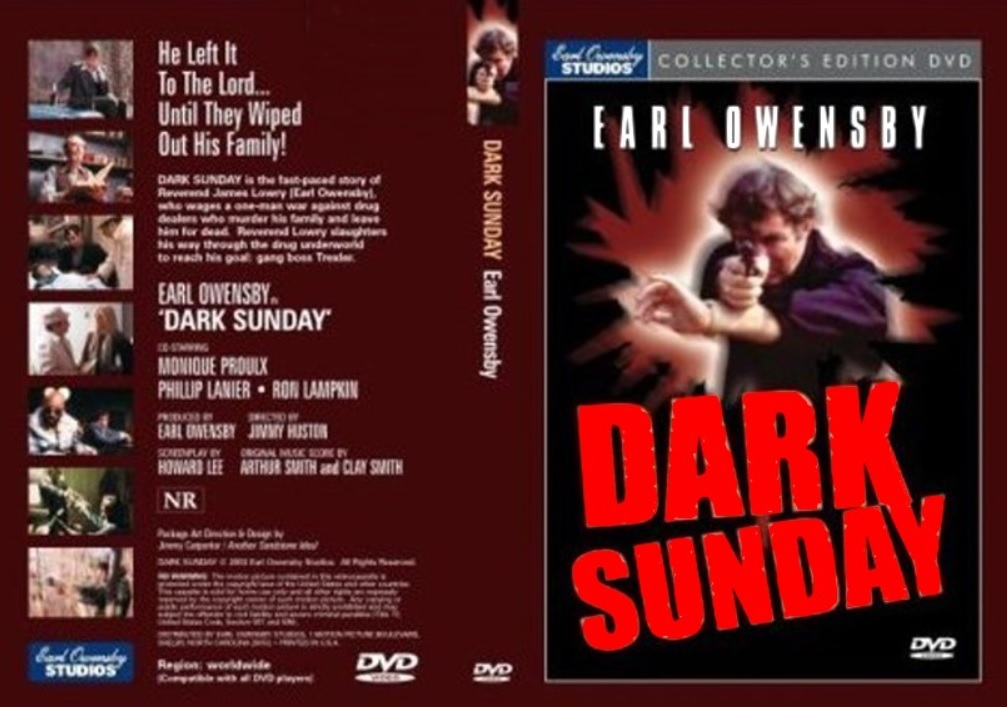
Dark Sunday (1976)

Grindhouse and drive-in purveyor Earl Owensby, who made his producing-acting debut with the 1974 one-two punch of a Walking Tall (1973) ripoff called Challenge and its sequel, The Brass Ring, tossed a clergy collar on his ersatz Buford Pusser — and changed his name to the Reverend James Lowery — for this, his third movie: a Death Wish (1974) rip off. Since the film has a priest dolling out the justice, Dark Sunday ends up as a weird, obscure sidebar on many a Christploitation, aka Godsploitation, lists.

Courtesy of kenyatabks/eBay.

Regardless of Dark Sunday ending up on those critical lists, Earl Owensby will always be known best for his fifth film, Buckstone County Prison (1978), a film which crossed the chain-gang classic Cool Hand Luke with the biker-karate-Indian actioner Billy Jack. There’s fourteen more films to chose from Owensby’s vanity-producing resume — of which he acted in eleven. Sure, none of them have a lick of originally between them, but Owensby is always committed to his leading man role and his films are never not entertaining. And, most importantly, they always made bank in the big city, sticky-floored in-doors and backwater drive-ins — Buckstone being the most successful of the bunch.

The Maltese Falcon? Uh. . . . Well, WRPL, aka “Ripple Radio” was a real station in Charlotte, North Carolina, so if that’s what Lloyd Rose saw, an ersatz Sam Spade, it is.

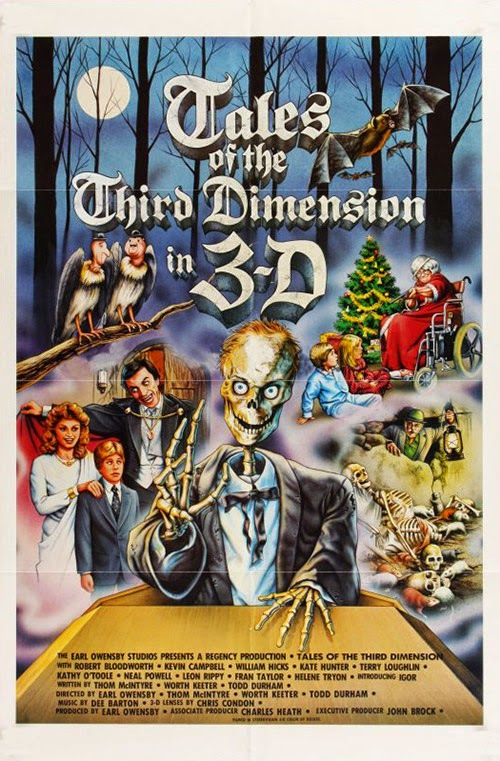
You need need a ripoff of Burt Reynolds’s Hooper when that’s missing from the rental shelf? Earl’s got one: Death Driver (1977). Smokey and the Bandit rented out? Pick up a copy of Hit the Road Running (1987). Need a wolfman flick? Check out as Earl as the cursed Colin Glasgow in Wolfman (1979; co-starring R.C. Nanney, aka North Carolina-famed disc jockey “Curly Lee,” also of 1979’s Knobby the Belwood Wampus Cat). In the mood for a killer dog flick? Check out Earl as a backwater sheriff fighting off government-bred mutts in Dogs of Hell (1983). Need another Cool Hand Luke rip to fill the void of Clint Eastwood’s Escape from Alcatraz being rented out? Grab a copy of Chain Gang (1984). Heck, Owensby has done it all: even portraying (a faux) Elvis — with a Roy Orbison vocal assist — in Living Legend: The King of Rock and Roll (1980). Yeah, Earl also jumped on the slasher bandwagons to the lands of Carpenter with Day of Judgement. You need a retro-horror omibus, well, a “3-D” bandwagoner? Earl’s got one: Tales of the Third Dimension in 3-D (and both are also very “Godsploitation” and Christ exploity).

Okay, enough with the Earl Owensby love. Let’s unpack Dark Sunday.

Reverend James Lowery is a skid row reverend helping young junkies to a better life through his homegrown flophouse and rehab center. Needless to say: a cured and Chirst-saved junkie is one less customer for “the Candyman,” a local drug dealer. So ol’ Candy sends his goons after the good minister for cutting in on his action — and they blow away the Reverend’s wife and kids at a riverside picnic. His wife and son, Eric, are dead. His son Jody, survives. And the Rev is left mute with a bullet-shattered voice box.

Let thou the seven seals of revenge be broken.

As with Death Wish (1974), as well as Dirty Harry (1971) and Magnum Force (1973), inspiring the Italian film industry with a series of gritty, brutal revenge films, aka Poliziotteschi, this Jimmy Huston-directed and Early Owensby-produced Bronson-Eastwood amalgamate — due to its way over-the-top violence — actually pinches from the Italian knockoffs. In fact, due to its ultraviolence, the revenge proceedings play as a “white” version of a blaxploitation actioner.

Yeah, sure, while well-shot and edited, everything about this against-the-budgeter from the Owensby House of Flicks is cheap and ripped off from other, better known movies. But Earl Owensby is an engaging, passionate actor on screen and he keeps you watching. And you can’t not stick around to see how much more violent this southern-baked grindhouser can get: for that “NR” rating on the DVD sleeve just ain’t whistlin’ dixie, Cletus.

After four films with Owensby — Dark Sunday being his debut, along with The Brass Ring, Death Driver and Buckstone County Prison — Jimmy Huston went off on his own. As with Owensby, Huston ripped off everyone, as well, starting with the (very) Carpenter-inspired Final Exam (1981), and the ’80s de rigueur vamp-comedy, My Best Friend Is a Vampire (1987). The last time we heard from Huston in the director’s chair was the Lou Diamond Phillips and Judge Reinhold-starrer, The Wharf Rat (1995). His greatest success was writing the Lethal Weapon variant Running Scared (1986) starring Gregory Hines and Billy Crystal.

If you love the grindhouse and drive-in cinema of old, make a point of watching at least one of Earl Owensby’s films in your travels — but more than one, if you can. You can watch Dark Sunday on You Tube. You’ll be glad you did.

You can learn more about the still-active Earl Owensby Studios (James Cameron’s The Abyss was shot there) and purchase Earl’s films direct from the studio’s website. There’s also a nicely written Wikipage on Earl’s accomplishments. In 1997, longtime Owensby associate Noel T. Manning produced a touching, feature-length documentary, Earl Owensby: The Man, the Myth, which is legally available on You Tube via Manning’s personal page.

About the Author: You can learn more about the writings of R.D Francis on Facebook. He also writes for B&S About Movies.

Girls In Trouble (1971)

This is a tricky movie to review.

First, it’s confused with German director Eberhard Schröder’s Die Klosterschülerinnen, aka The Convent Students, which also made the rounds as Sex Life in a Convent, but is also known as . . . Girls in Trouble.

Second, that film, and this Sybil Danning vehicle (well, not really) is not only co-directed by Schröder: both star German glamour model and Euro-sex kitten Doris Arden (1968’s So Much Naked Tenderness and 1972’s Nurse Report).

Third, while it’s a softcore skinflick (uh, not really), it ends up on “Christploitation” lists due to its anti-abortion and pro-life slant in its chronicle of several pregnant women on their way to get abortions.

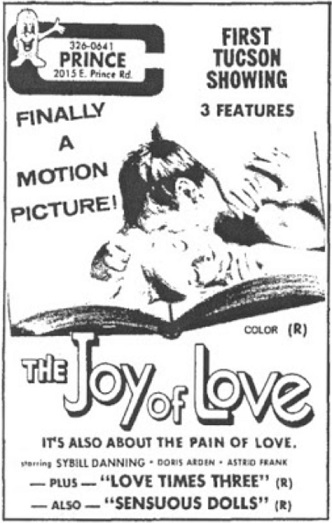
Finally, while it played across Europe in 1971, it finally made it to America during the height of the “Golden Age of Porn”* on U.S. shores as The Joy of Love.

But this ain’t no porn . . . or the least bit golden. And there’s no joy in watching it. And it’s not a Christian flick . . . or the least bit saving. Everybody got duped with this one. No one was entertained by it and everybody hated it. But what else would you expect from a film that markets both the porn and God-believing markets?

Lacking a fluid narrative, the film actually plays as a series of documentary-styled vignettes. So what we really have here is an omnibus films of seven tales on the dangers and horrors of abortion. And now you see why it ends up on Christploitation lists.

In the first tale, two women are in court over a botched kitchen-abortion. Then, we meet a kidnapped and raped 13-year old girl forced to keep her baby because the law doesn’t allow abortions. In the third tale, a knocked up young lady has a miscarriage forced upon her. Then, we’re inside a mobile — and illegal — abortion clinic. Then a secretary is raped by her boss, who then send her to the U.K. for an abortion. We also meet a woman who visits an abortion doctor who drugs her and takes porn-pictures of her to make some pocket change. And in the final, seventh tale, a young, pregnant girl begs a doctor for an abortion; he calls in priest to read her the riot act.

So, what happened back in that opening court room scene?

Well, the old bag with the kitchen knife who almost murdered the young woman, gets three years. The girl — who was almost murdered, mind you — gets six months in jail because, well, she’s a “slut” that already had a child previously that she gave up for adoption.

As you can see, this West Germany ditty is far from being a skin flick. And it’s just one of those oddball flicks you spotted behind the green curtain* during the video store ’80s because Sybil Danning’s presence sells the tape — then you discover she’s only the wife of the judge from the first segment, she’s not an aborter or abortee, and she shows us no skin. And the whole movie is actually pretty disgusting and you start to wonder what the big deal was about you finally aging-in to get behind the green curtain.

Obviously, there’s no trailer to show you or links to stream it online. But make no mistake: this offensive lesson in tedium that would give Ed Wood pause, exists. Sybil Danning fans can skip this — we implore you, skip this — and go directly to Malibu Express or They’re Playing with Fire.

Oh, and beware of Eberhard Schröder skin flick rabbit holes. It’s a sexually twisted filmography you’d rather not know about. Trust us. Don’t do it. (But you know you will.)

* We delve into the “Golden Age of Porn” and “Behind the Green Curtain” eras with our joint review of Forced Entry (1973) and The Last Victim (1975), along with Spine (1986) from our “SOV Week” of reviews.

About the Author: You can learn more about the writings of R.D Francis on Facebook. He also writes for B&S About Movies.

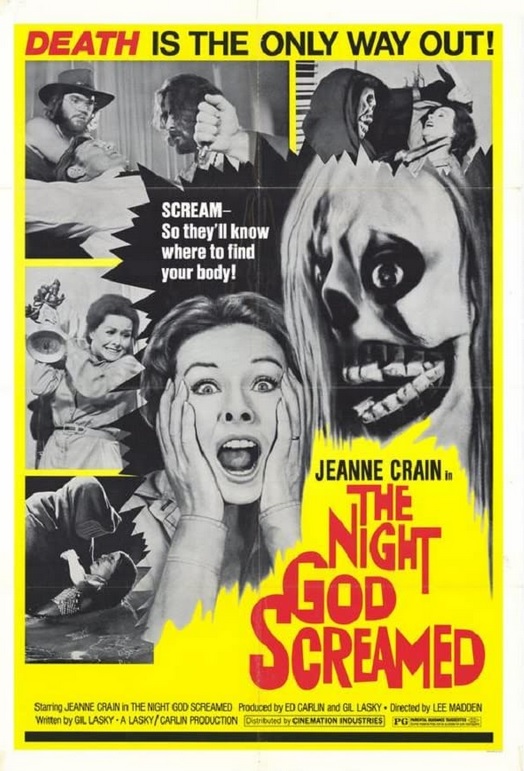
2021 Scarecrow Psychotronic Challenge Day 19: The Night God Screamed (1971)

DAY 19 — CAN’T YOU HEAR ME KNOCKIN’?: When you let an unexpected guest in, you may be in for a long night.

Editor’s Note: While we’ve included this — controversial — film as part of our Christploitation genre cataloging, we’ll also briefly delve into the Hagsploitation genre, turn you on to a few “hippie flicks,” as well as discuss other, analogously lost, U.S. made Drive-In horrors released around the time of this film.

Christ, Hags, Manson, and rubber skull masks, oh, my!

I know. I know. Why is an exploration of ’70s Christian Cinema including a crime-horror romp that advises “death is the only way out,” courtesy of Cinemation Industry — the Drive-In shingle that gave us the likes of Teenage Mother (1967), Female Animal (1970), The Man from O.R.G.Y (1970), I Eat Your Skin (1971), Teenage Sex Report (1971), Son of Dracula (1973), Dynamite Brothers (1974), and an X-rated cartoon in the form of Fritz the Cat (1972).

Hey, this ain’t no trope-laden site ensuing with cliched, generalized lazy thinking, buddy pal-o-mine: this is freakin’ B&S About Movies in Pittsburgh, baby: we don’t write for stinkin’ food or for reissue DVD/Blu swag. We choose our God-Christploitation reviews the fracked up way because we dig the film at hand: no reissue promo-campaigning required.

Besides, it can’t always be about Estus Pirkle and Ron Ormond (The Second Coming will get you there, brother), which, if they kept making movies together, a proto-slasher about a serial killer twistin’ the Good Book probably would have been the next, logical celluloid-Pirkle step. Don’t forget: he’s the guy who jammed sharpened bamboo sticks into children’s ear canals. And when he’s not inducing them to puke, he cuts them down from hanging trees onto a field of buried pitchforks, then tosses them in mass graves. (no, really; we’re not making it up). The folks at Mondo Stumpo summed Pirkle’s psychotronic years, brilliantly: Christian Gore.

So, yeah. Estus Pirkle vs. Lee Madden. No contest. Pirkle wins. Hands down.

The Pirks’ celluloid triad If Footmen Tire You, What Will Horses Do?, The Burning Hell, and Believer’s Heaven (well, it’s a little bit more positive; but kids are still being tossed in mass graves) are still more gag-inducing and horrifyingly sick than this faux-Manson ditty brought to you by Cinemation — again, the studio that gave you the likes of the not-even-close, exploitative bile-inducer, I Eat Your Skin. As Sam the Bossman has opined in his Pirkle-Ormond opuses: all three films are stuck in our collective minds way longer than any blockbuster — or Christian film or horror film — we will see this year. Or any other year. Digital streaming or hard-copy reissues. Period.

Eh, well. Maybe not.

Madden really scraped the offensive bottom of — and broke through the rusted bottom of — the Christploitation barrel. And people lost their minds over The Exorcist and The Omen? I mean, a Catholic Priest crucified on his own cross? Top that, Mr. Friedkin and Mr. Donner. Well, actually — in terms of quality — you did.

Anyway, long before you youngins were exposed to Charles Manson by way of Quentin Tarantino’s Once Upon a Time . . . in Hollywood, there was a mini-cottage industry of “hippie flicks” that borrowed from the Manson myth — courtesy of instilling the idea that all of Haight-Asbury’s flowery-denizens were blood-thirsty killers. So, we got the likes of the hippie-crime romps Psych-Out (1968), the double bill to I Eat Your Skin with I Drink Your Blood (1970), The Cult (1971), The Love-Thrill Murders (1971), the document/reenactmentary of The Other Side of Madness (1971), the Andrew Prine with a goat insanity of Simon, King of the Witches (1971), the really fine Deathmaster (1972), Thumb Tripping (1972), the “Manson as a filmmaker” with Snuff (1976), and, of course, the incredible Steve Railsback as Manson in the exquisite TV movie, Helter Skelter (1976).

Yeah, there’s a “Exploring: Charles Manson on Film” feature to be had . . . someday.

Now, back to the Godsploitation, aka Christploitation, portion of today’s programming: a weird genre to begin with, depending on the critical whims of the writer (in the case, Sam Panico and yours truly), the films included, can be controversial choices. Even B&S contributor Bill Van Ryn of Drive-In Asylum questioned today’s movie choice. And when BVR furrows his brow, well, you’ve just hit celluloid pay dirt. And only God knows what the dude who hates it when we use the word “trope” in our reviews (and takes a moment from his day to let us know), will think. . . . The night the critic screamed, indeed.

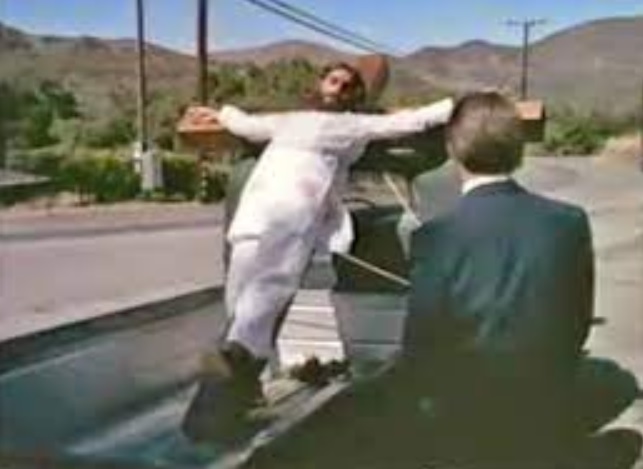
Offensive: When a priest purchases a cruciform for his church, transports that sign of Christ in the back of a pick up truck, stops at a gas station, and a white-robbed hippie takes a siesta on said cruciform, you’ve just exploited the Holy Savior.

Now, one would never consider a British horror film starring Christopher Lee as a “Christploitation” piece: but when your film is based upon the works of occultist author, paranormalist, and “secret society” founder Dennis Wheatley — himself a friend and collaborator of fellow occultist and Thelema religion founder Anton LeVey — the movie based on his book, The Devil Rides Out (1969), a book in which the big guy of the underworld, Baphomet, and his buddy, the Angel of Death, shows up — both ultimately defeated by the power of Christianity — the film ends up on the (my) list.

The same could be said for Die! Die! My Darling! (1965). Although it’s part of the psychobiddy sub-genre (i.e, old, crusty women terrorizing “sinning” young women, aka “hagsploitation”), when you have Tallulah Bankhead in crazed, full-on religious hysteria exorcising a corrupt Stephanie Powers, that films ends up on the stone immaculate perimeters of Christ/Godsploitation (my) lists. And our speaking of Tallulah Bankhead attempting to reignite her career in a horror film brings us to — gulp — Jeanne Crain, the star of The Night God Screamed.

Remember how the Smithereens’ Pat DiNizio lamented about British model Jeannie Shrimpton in the lyrics of “Behind the Wall of Sleep”; how he’d gleefully commit a murder if she so purred the request? Yeah, for me, it’s like that with the Academy Award for Best Actress-nominated Jeanne Crain — for her title role in 1949’s Pinky.

Yeah, I had it bad for Jeanne Crain. Sigh. Remember how Superman time-travel willed himself back to the past to hook up with Jane Seymour in Somewhere in Time (1980): Calling Dr. Gerard Finney, time-hypnotize me to a Jeanne Crain romance.

As with Veronica Lake making her final bow with Flesh Feast (1970), Joan Crawford appearing in Berserk! (1967) and Trog (1970), and Wanda Hendrix (zoinks!) closing out her career at the age of 44 with a Gothic, Civil War tale, the really fine The Oval Portrait (1972), ex-20th Century Fox studio-starlet Jeanne Crain attempted an early ’70s comeback — her last film was Hot Rods to Hell (1966) — with a horror film: inspired by Charles Manson. Sadly, it was not meant to be. When her “big horror move” failed to spark interest, the divine Ms. Crain called it a day after working with — fifth-billed, mind you — Charlton Heston in Skyjacked (1972).

So, with Alex Nicol — an actor/director in The Screaming Skull (1958) and director for Peter Carpenter’s Point of Terror (1971) — thespin’ it up with an early James Sikking (Outland, Star Trek III: The Search for Spock) — Jean Crain stars as family matriarch Fanny Pierce in a tale directed by Lee Madden.

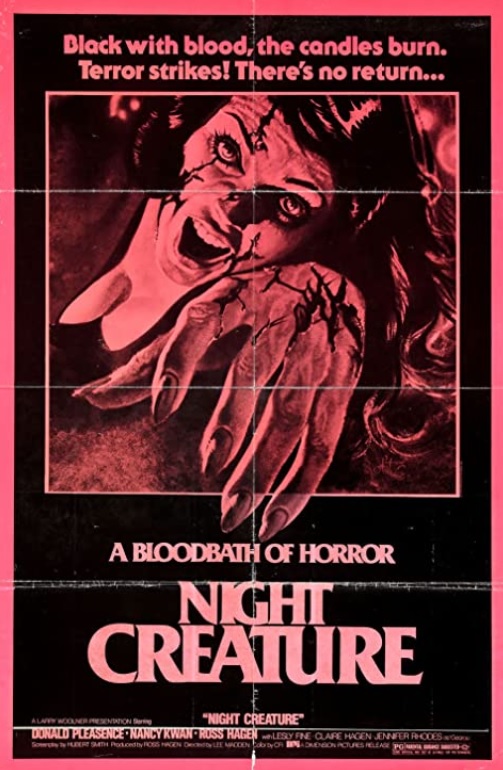
Wait? Not Lee Madden of the biker flicks Hell’s Angels ’69 (1969) and Angel Unchained (1970), and the hunter-on-private island romp Night Creature (1978).

Oh, hell, yes. Strap on the popcorn buckets. Let’s unpack The Night God Screamed.

Lee Madden’s second — and final — horror film, which he also wrote, during his all-too-short, six-film career. His others were the sexploiter The Manhandlers (1974) and, get this: the abysmal horror-comedy, Ghost Fever (1986), with Sherman “George Jefferson” Hemsley.

The reason this offensive, yet stunning movie failed: it’s a slow-burn, psychological thriller that, instead of the shocking gore and violence you’d expect from a Manson-inspired film, it’s all about the atmosphere. Another reason: due to its provocative title, small town and rural communities with theaters refused to carry the film; they acquiesce to the alternative title of Scream. The third reason: Jerry Gross was against-the-sprokets and Cinemation was going under . . . while barely releasing it in 1971, the film stumbled around as a second-biller until 1974, never to find its well-deserved audience. The same marketing snafus happened to the youth-seeking devil worshipers romp, Brotherhood of Satan (1971), the exquisite gaslighter, Let’s Scare Jessica to Death (1971), the dreamy The Velvet Vampire (1971), William Girdler’s debut Asylum of Satan (1972), the weirdly, Clint Eastwood-connected and released-stalled Die Sister, Die! (1972), the toy-making Devil worshiping of Necromancy (1972), Jean-Marie Pélissié’s art house-beauty, The Bride (1973), the utterly bonkers and also questionably-rated, The Baby (1973), the stellar post-Romero craze of Messiah of Evil (1973), and the flawed but captivating Warlock Moon (1973).*

Eh, so what else is new in the puritanical bread baskets of America?

So, rightoff the bat, the Fundamentalists are loosing their nuts: we open with a monk-hooded figure dragging a six-foot tall cruciform through the woods. And our faceless monk looks down from a hill upon a lakeside baptismal ceremony conducted by our ersatz Jesus, aka our ersatz Charles Manson, i.e, “Billy Joe,” as he complains to God about “the man” coming down on his faux-Chuckness because they dig Jesus, and do dope only to “turn on to” Jesus, and that they’re not a phony, money-grabbing ministry, lying and stealing from their flock. . . .

Oh, and the dude in the robe: he’s The Atoner. And the baptism? The Atoner drowns you, the “Judas,” into the afterlife.

So, with that bit of Christ exploiting out of the way; we finally get to this review’s raison d’étre: Jeanne Crain is Fanny, the put-upon wife of Pastor Willis Pierce (Alex Nicol) who oversees a small chapel and soup kitchen in a rundown, crime-ridden neighborhood.

The prim n’ snobby Fanny hates her life and wants out. And I want her to move in with me.

Anyway, the “path” to the way out leads the Pierces to run afoul of Billy Joe and his sidekick, The Atoner. And yes, they crucify Pastor Willis to a cross inside his church because, well, God has advised Billy Joe that the Pastor is a false prophet.

So, a year passes: Fanny is PTSD’d (I’d still put up with her; I’ve cohabited with far worse), hearing her husband’s and Billy Joe’s voices — even though hubby’s dead and our faux-Manson is in prison.

Then, taking cues from Charles Manson seeking revenge on Beach Boys associate Terry Melcher for reneging on a “deal” to record his music**, Billy Joe’s clan descends on the convicting Judge Coogan’s house to extract revenge: instead, they find Fanny, who came to work as a housekeeper and assistant to the judge, his wife and four teen (well, casting older-than-teens, natch) children.

Well, not really. Do we really have to explain “gaslighting” to you?

My poor, dear Jeanne really goes through the ringer in her final, leading role. Put your head on my shoulder, let me whisper in your ear, baby.

While not exactly graphic-bloody in A Bay of Blood (1971) sense, The Night God Screamed is, never the less, like The Baby before it, still a pretty brutal and intense movie — filled with religious imagery — for a PG-rated film. The trailer isn’t doing the film justice. As for “exploitation” critical descriptors, aside: Jeanne Crain is still a friggin’ hotter-than-hell MILF. Paging Dr. Gerard Finney, R.D Francis is seeing rainbows and skyrockets, again.

It’s hard to believe that, in a ’70s UHF-TV world that played A Bell from Hell (1973) — a movie with human-sized puppets playing pianos and women hanging upside down in an abattoir — The Night God Screamed never playing on TV is a crime against the ultra-high frequencies that white-noised my brains with the Drive-In delights that I was too young to see back in the day. Thank god for the VHS ’80s.

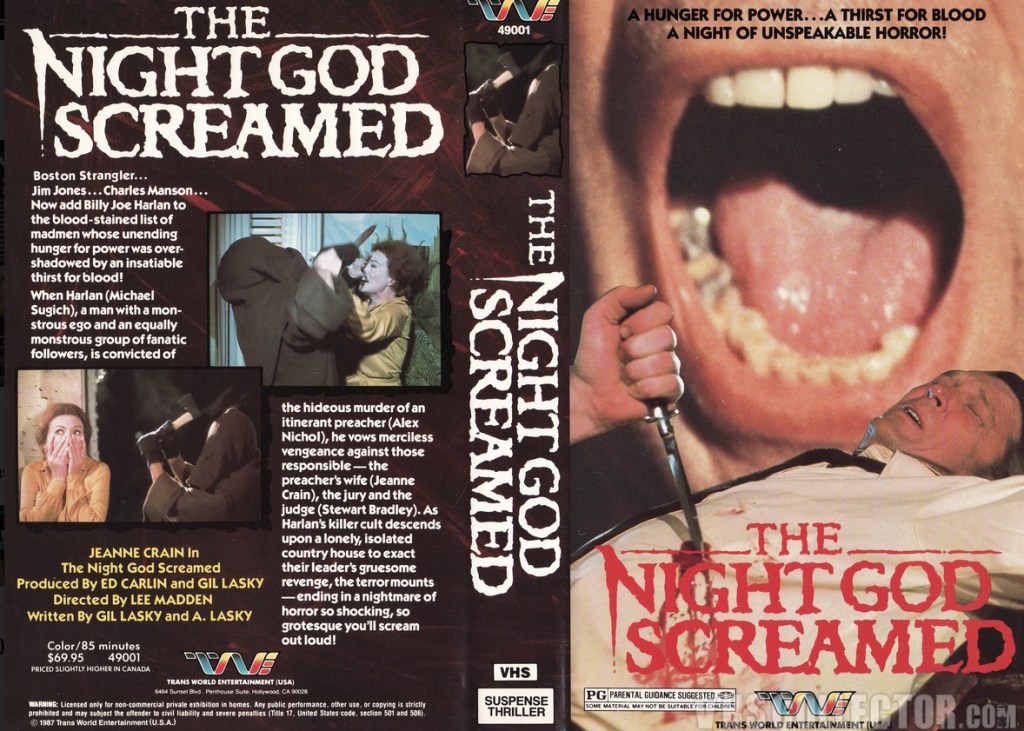
Although there’s earlier issues, the Trans World Entertainment 1987 VHS reissue was the best-distributed/courtesy of Paul Z at VHS Collector.com.

Sorry, kiddies. There’s no freebies or with-ads streams to share. But the DVDs are all over the online marketplace, VHSs are out there, for the ever-the-analog purist. And if there’s one, pure ’70s horror DVD to add to your collection, The Night God Screamed comes highly recommended. Do it.

* Other early-70s, poorly-distributed and lost, U.S. Drive-In horrors to venture — each with their own, special bit of crazy — are Touch of Satan (1971), Legacy of Satan (1974), and Satan’s Children (1975).

** That’s finally been all squared away with Tom O’Dell’s stellar, 2019 documentary, Manson: Music From an Unsound Mind (Tubi).

More films from the genre to explore.

About the Author: You can learn more about the writings of R.D Francis on Facebook. He also writes for B&S About Movies.

Secta Siniestra, aka Bloody Sect (1982)

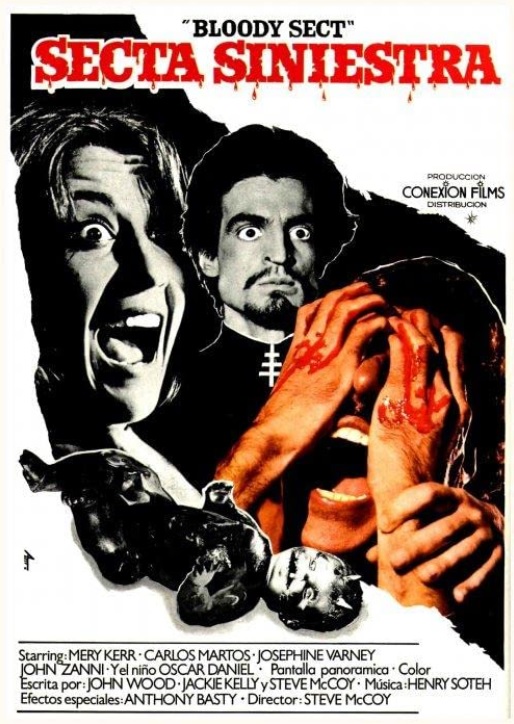
There’s ripoffs of The Omen (The Visitor, The Tempter, Holocaust 2000), then there’s Spain’s “Roger Corman,” Ignacio F. Iquino — anglicized, here, for U.S. drive-in consumption as “Steve McCoy” — bringing on the double-live gonzos, Antichrist weirdness. (I’ll forever pair Iquino’s horror opus with Bigas Luna’s Anguish. I’m weird that way, anyway. . . .)

In his only horror film, Iggy wastes no time in serving up the gore and the sleaze — remembering his back resume is mostly softcore skin dramas that jumped on the Jess Franco sex-wave band wagon — in a tale of a woman pregnant with the Antichrist pursued by a Satanic cult (led by the sinister-good, yet one-film-and-gone Henry Ragoud). It’s a film that, as you watch, you’ll feel the proceedings are more Roman Polanski than Richard Donner — but there’s no arguing that Lucio Fulci’s gag-inducing influence is afoot in the frames. So yes, if you know your Fulci: eyes are gouged out. And the gallons upon gallons of blood belched would give Sam Raimi pause . . . heck, even Joe D’Amato threw-up in his mouth (and he knows a thing or two about inducing gags with his own, 1974 Antichrist romp, The Tempter, and 1979’s Blue Omega).

It all begins with Frederick, an ex-mercenary stuck in a loveless marriage with Elizabeth, his home bound, mentally and physically scared wife — an injury caused by his own misadventures with the bottle. He comes to fall in love with Helen — and loses his eyes via a red-hot fire poker (not before offing the maid) wielded by his now institutionalized wife. Now married and wanting to raise a family, Fredrick and Helen discover they can’t conceive (poor Fred . . . he loses his eyes, now he’s shootin’ blanks). Consulting a fertility doctor, they discover — too late — the good doctor is part of a Satanic cult . . . and he’s artificially inseminated Helen with “Satantic Sperm” to birth the Antichrist.

Yeah, the proceedings sometimes go down like a Bruno Mattei cheapjack joint (1980’s Hell of the Living Dead comes to mind) lacking in atmosphere that inclines more laughs that scares (the rubber bats! the devil baby!). The proceedings, however, are — without a doubt — outright mean and brutal with its eyeball operation (to at least fill in Fred empty sockets), abortions (the cult tracks down and kills the abortionist that kiboshed the last two Antichrist pregnations), and the big “Ruggero Deodato” move — only this time, it’s a (real) frog — in lieu of a river turtle — that gets the dagger holocaust. Then Elizabeth escapes the nuthouse (Diana Conca is off-the-chain and scene-chewing excellent throughout), Frederick’s obnoxious nephew is on the Damien fringes, there’s more nudity than a Paul Naschy joint, the cameras zoom and swirl, and the plot absurdities (also kitchen sink-clipping from The Shining, Suspiria, and Rabid) pile on and on and on as the pounding soundtrack sends Dario Argento screaming from the theater!

Remember how you felt when you witnessed the bat shite craziness of Magdalena, Possessed by the Devil (1974) and the great (!) Armondo de Ossorio’s Demon Witch Child (1975)? Well, Bloody Sect, as with those two post-Exorcist possession ditties, is never — ever — dull. And you get an Omen-Antichrist birth in the bargain, so what’s not to likey, here? Nothing. I love it all! Sure, we all remember Paul Naschy and Jose Ramon Larraz, but raise a pint for Ignacio F. Iquino giving it the genre-hoping, post-John Carpenter try, will ya?

Once very hard to find outside of Europe on VHS in the ol’ brick and mortar days — but the local comic book shop and VSOM/Video Search of Miami had the (poorly subtitled) greys for the taking — and utterly impossible to find on DVD, Vinegar Syndrome did this up right with a DVD/Blu-ray combo (that’s now out of print; but not to worry, Amazon has vintage copies).

About the Author: You can visit R.D Francis on Facebook. He also writes for B&S About Movies.

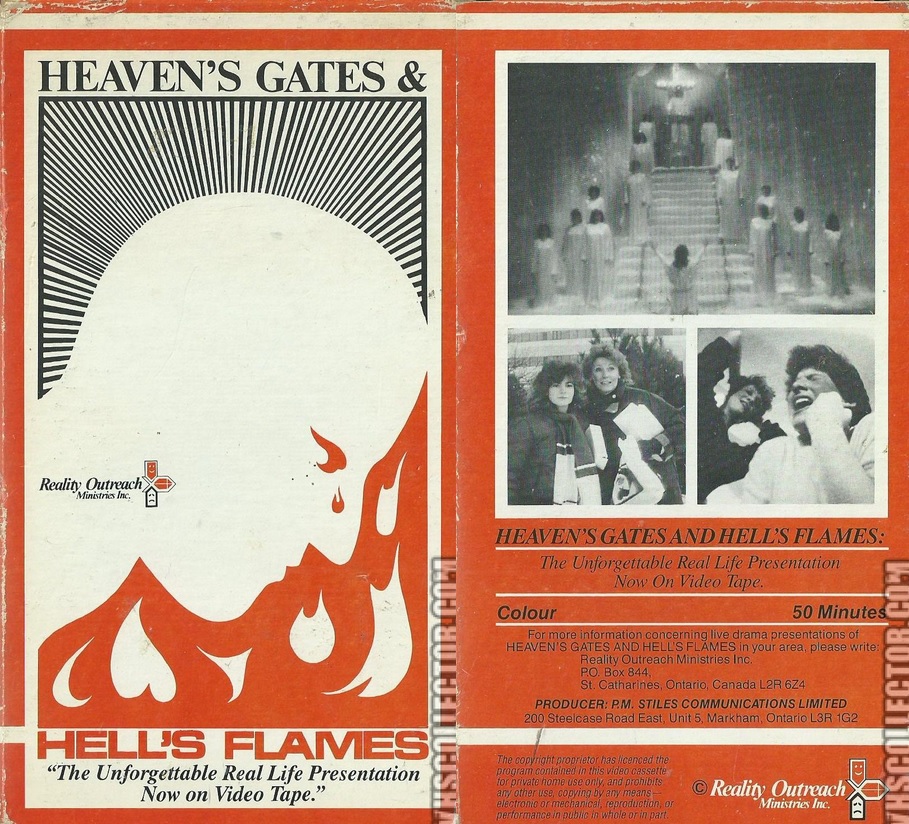
Heaven’s Gates and Hell’s Flames (1986)

You can’t lie to us.

There’s no breaking of the Ninth Commandment, allowed. Not this time.

We know you’ve never seen or heard of this beautiful collision of a Christploitation flick and an ’80s SOV’er for the most epic, greatest SOV in the horror realms committed to video tape. And yes, video store owners, who had no friggin’ idea of what was distributed to them (see the great Spine shelving snafu), gandered at the words of “Heaven’s Gates” and “Hell’s Flames” and, instead of placing the tape in the “Family/Children’s” section (and this is not child appropriate in the least) where it belonged, they tossed it on the horror section shelves.

And there it was for me to score: in the horror section of the video store, a store sandwiched between a Falafel joint and an accident-attorney office. Yes, those hour-long “Christian Scare” documentaries you would see during the sleepless overnights and lazy weekends as you channel surfed past TBN – The Trinity Broadcasting Network* in the ’80s ended up on VHS for distribution on your home video shelves.

Yes, I was a truly blessed, metal-head and VHS lovin’ youth that day of yore . . . courtesy of Paul and Jan Crouch.

So . . . this 50-minute Canuck Christploiter made in St. Catharine’s, Ontario by Reality Outreach Ministries portrays people of various ages and walks of life who die in a variety of unexpected ways (e.g., drug abuse, the bottle, car accidents, muggings-gone-bad, steel girders falling). The way they lived on Earth determines where they will spend eternity: Heaven or Hell.

Oh, and a warning: this is a stage play produced by the ministry and committed to tape.

BUT IT IS STILL EPIC! ROLL THE TAPE!

Thanks, Paul Z, at VHS Collector for the clear image.

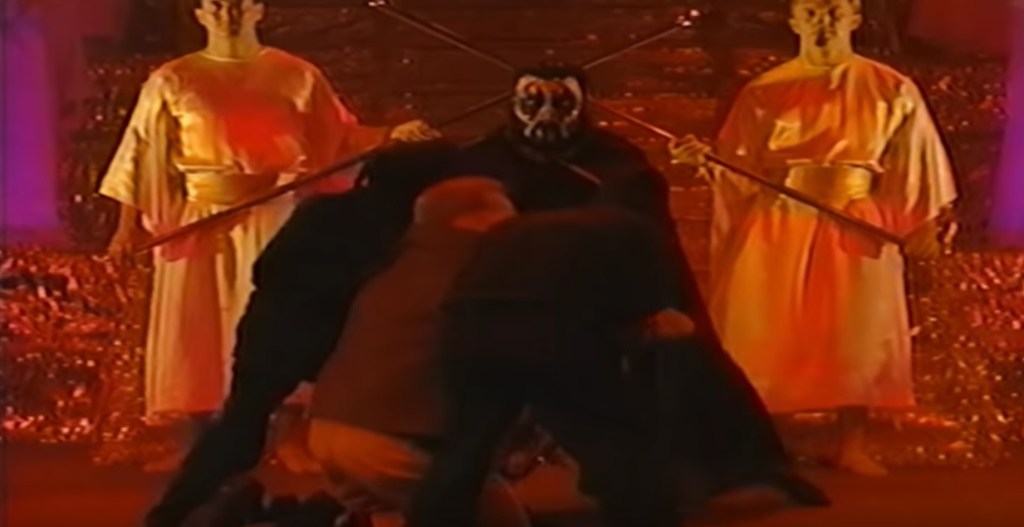
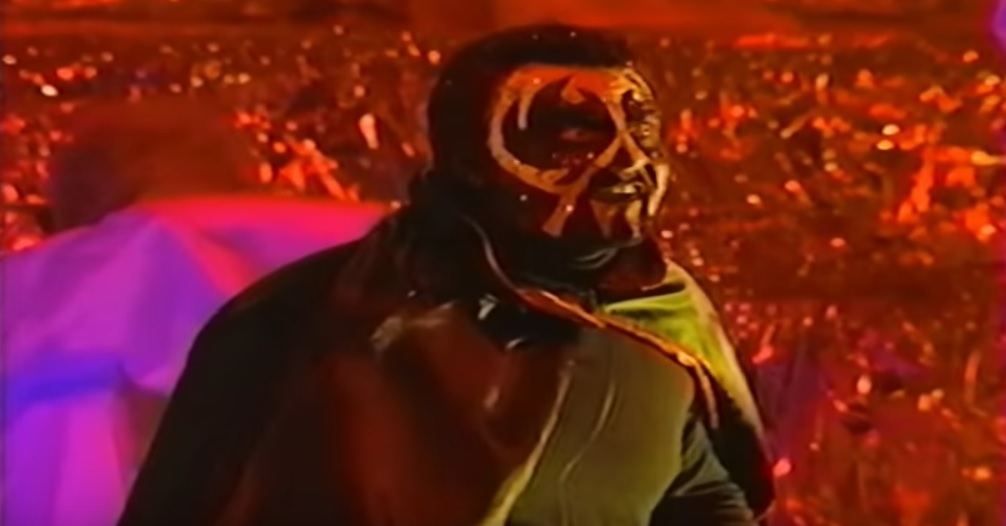
Dude . . . when this play’s depiction of Heaven kicks in, it is right out the Estus Pirkle playbook — but HGHF has nothing on The Believer’s Heaven and beats it by a few clouds. Then, when Hell kicks in — complete with a bastardized Gene Simmons-meets-King Diamond-cackling Satan — it holds no candle to Jose Majica Marins’s Coffin Joe depictions of Hell in This Night I’ll Possess Your Corpse. Oh, ye reader, forget about Estus Pirkle’s multi-colored Rubic’s Cube face-painted Satan in Ron Ormond’s The Burning Hell, for Reality Outreach Ministries has just blessed you with the Satan you always wanted in your nightmares.

Oh, yeah. The rest of the plot.

Well, it’s a bunch of vignettes, as “actors” do “scenes” that warn, you, on the various horrors awaiting those who do not accept Jesus Christ. For example: We have a young couple on a nice, romantic evening in the park (two folding chairs on stage, natch). She speaks about “her psychic said romance is in the air” as her Christian boyfriend warns her on the dangers of “deceptive physics.” Then, a mugger shows up, steals her purse, and shoots both. Dead.

For reals. I am not making this up.

Now, we’re at the “Pearly Gates” and the boyfriend gets in. The girlfriend says, “Wait, why am I here? I’m supposed to be reincarnated!”

Cue King Diamond.

The King and two of his minions grab Blondie and drag her into the red-cellophane fires. Meanwhile, the best part, is the boyfriend pulls the ol’ I-told-you-so gag — with a glean in his eye. Why? Because Christians get off on the ol’ I-told-you-so-and-seeing-you-go-to-Hell gag.

Next vignette.

Two construction worker-buds are on top of a high building (again, folding chairs on the stage). The saved worker witnesses to his troubled work-bro and turns him to Christ. Suddenly . . . a girder (actors, awfully, selling the drama) falls. Both die. Both go to Heaven. But, since the one guy just got saved . . . there’s a paperwork snafu, since there wasn’t time to write his name down in the Book of Life. But don’t worry. Jesus shows up to set the Angel in charge of the book, straight.

For reals. I am not making this up.

Okay, just one more. . . .

A little girl begs her busy, career-driven and charity-committed mom to go to church. “Next, week, Sweetie,” mom brushes her off. Suddenly . . . a car (again, actors — awfully — selling the drama), hits them. Mom and daughter are dead.

Then, mom gets the shock of her life: being a good parent, a loyal wife, and doing good deeds, alone, won’t get her into Heaven. But since the daughter went to church, she goes to Heaven. So, to Hell mom goes. Why? Because working with the homeless and the handicap wasn’t good enough for God — and you turned your back on His son. Yes, King Diamond shows up and takes away mom — to the girl’s screams and cries, begging Jesus to save her mom. Seconds later, Jesus shows up and touches the girl. All is well. The girl skips up the silver and gold staircase.

For reals. I am not making this up. It’s not a fever dream. It’s real.

And you thought Estus Pirkle’s sharpened bamboo into the ear canals of children was sick. We told you this tops a Pirkle joint six days a week and twice on Sundays. It’s pure insanity — stage production, be damned — so how can you not want to watch this? Okay, so it’s not as bonkers as Pastor Kenneth Okonkwo’s two-part, papier-mâché production, 666: Beware, the End is at Hand, but what zero-budget soul-saving epic, is?

I want the boy! Throw him to the pits of Hell!
“Forget about your mommy, little girl. She’s mine, now! Ooh, it’s cold gin time again!”
“To Hell with him! Bring the black box to the altar!”
“Like father, like son! For my real name is Kim Bendix Petersen!”

Anyway, it goes on and on and on like this for a glorious 50-minutes, well, near 75-minutes, since the festivities are front and backended with a Pastor’s service. But name your sin: Abortion. Drugs. Sex. Not going to church. Reincarnation. Fortune tellers. The dangers of every and any sins, are depicted, here. Lovers and families are torn apart. People hug Jesus and go to Heaven without a tear or care of their loved one being dragged to Hell.

Yes. Jesus greets you, personally, each and everyone, with a hug . . . as you walk through a literal door, aka gate, under the Angel that’s perched on top of a golden pedestal, on top of the silver and gold staircase — you know, the Angel who makes sure you’re in the Book of Life, sans any paperwork snafus where you died two-second later, after just “being saved” by a buddy.

Now, hear me out for a second: Wouldn’t it be the “Christian thing” to do, that, when your loved one is about to be dragged to Hell by faux-Gene Simmons, that your “Christian Heart” would make the ultimate sacrifice and take your loved one’s place, so they can enter Heaven?

Oops. Sorry for allowing logic into the plot. Never pick at the plot holes. Especially not in Christian Cinema.

Look, it’s a fun and frolicking “SOV Week” at B&S About Movies, so we can poke (sorry) a little fun, here. However, honestly, for a stage play, the production values are pretty decent. The stage is one, single dressing. A simple lighting change is all it takes to transform the silver and gold of Heaven into the red and orange fires of Hell. Sure, it’s not an Oscars-level production, but still, for a church auditorium-cum-chapel gig, it leaves you impressed. Yeah, credit where credit is do: the stage manager, or audio visuals manager for Reality Outreach Ministries, really makes this all work, brilliantly. I wonder if he ever did a film, proper? I’d rent that movie.

However, what is not impressing, are the “actors,” who we assume are volunteering for the cause. The way they jump around, screaming and “rejoicing” on stage with their “I’m in Heaven. Woooo! This is awesome. Angel, is my name in the Book of Life? Yes, I’m in. I’m going to Heaven!” would be a flailing, arms-akimbo thespian tragedy if it wasn’t so gosh darned funny.

Oh, hell yeah, pardon the vernacular, it’s on You Tube and You Tube.

The caveat: The uploads are of two, different productions of the same play. In my opinion, the first version (with faux-King Diamond) — the one I watched on tape all those years ago, is the stronger production of the two. The second version (with Gene Simmons; the second still, above) — which I didn’t know existed until this review — runs a bit longer at 90 minutes, due to it having more Pastor preaching than the first.

Both are still epic. Watch ’em both! Hell, yeah! Also watch this. . . .

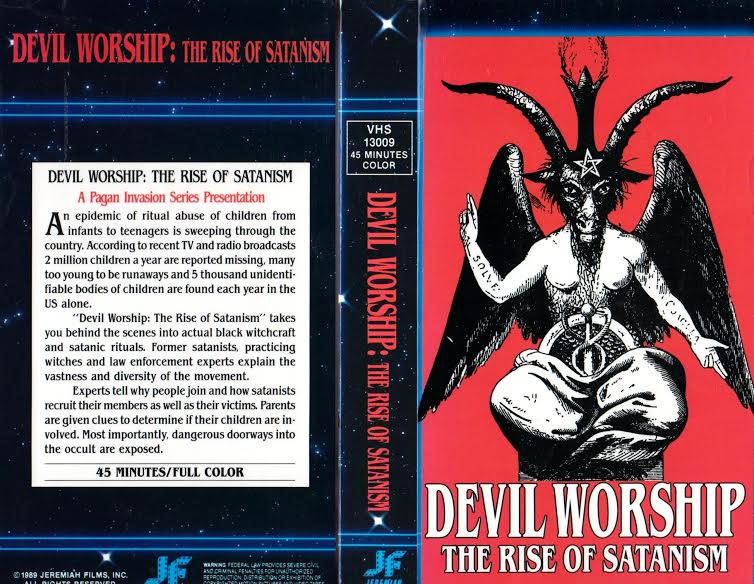
Another direct-to-video release from the ’80s “Christian Scare” era.

* We also discuss the “Christian Scare” era within our review of the Paul and Jan Crouch-produced Six: The Mark Unleashed and its metal music-is-evil component with the fictional film, Raging Angels.

About the Author: You can learn more about the writings of R.D Francis on Facebook. He also writes for B&S About Movies.