Prior to becoming an actor, Nicole Maines was the anonymous plaintiff in the Maine Supreme Judicial Court case Doe v. Regional School Unit 26. She argued her school district could not deny her access to the female bathroom for being transgender, with the court deciding that barring transgender students from school bathrooms consistent with their gender identity is unlawful. It was a landmark decision, in fact, the first by a state court.
She and her twin brother Jonas have also been the subject of several articles in regards to how one identical twin can be transgender and one can be cisgender. She also played Nia Nal, a distant relative of Legion of Superheroes member Dream Girl on Supergirl and Legends of Tomorrow.
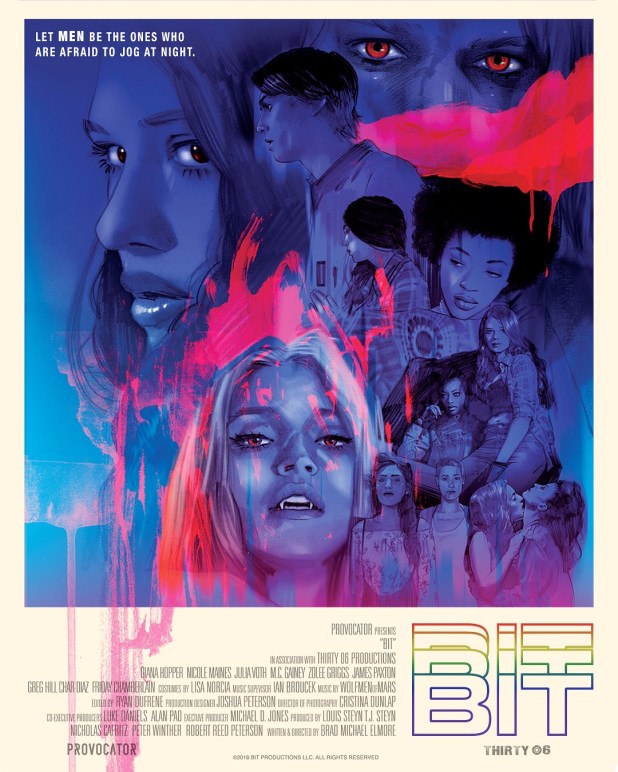
In Bit, she plays Laurel, an eighteen-year-old with a troubled past who has moved past it and is off to the big city to live with her brother Mark (James Paxton, son of Bill). On her very first night out, she meets music video director Izzy (Zolee Griggs) and a pack of bloodsuckers made up of Frog (Char Diaz) and Roya (Friday Chamberlain), led by Duke (Diana Hopper).
While this movie has queer and trans characters, it never shoves them in your face. Instead, it presents them as they are, you accept them and you simply enjoy the unique and fun spin that this puts on vampires, in particular the fact that all male vampires are destined to be cruel. If Vlad, the man who turned Duke is any indication, you can see why the female vampires at the beating heart of this movie work so hard to destroy predatory men.
Director and writer Brad Michael Elmore — who also worked with Paxton, MC Gainey and Greg Hill when making Boogeyman Pop and also directed The Wolfman’s Hammer— was able to surprise me by the choices that his characters make throughout the film. The entire section of the film with Duke’s origin is so well-staged and shot by Cristina Dunlap that it takes a moment that could have just been spoken by the actress and gives it bloody and brilliant life.
And I absolutely loved the music of Wolfmen Of Mars!
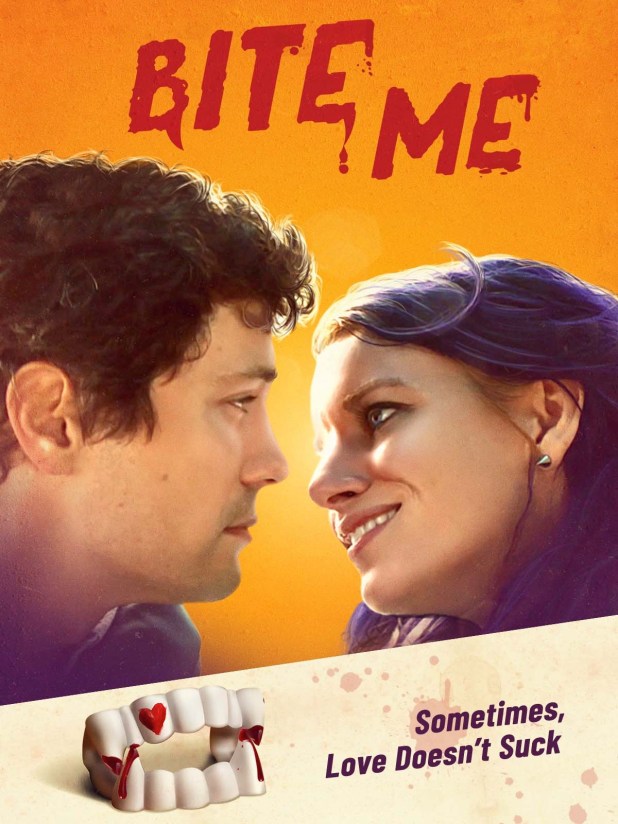
Writer/director duo Naomi McDougall Jones and Meredith Edwards made 2014’s Imagine I’m Beautiful and this is the follow-up, with Jones starring as Sarah, a real-life vampire who finds herself getting audited.
I never saw that in any of the Hammer movies.
She’s soon helped by IRS agent James (Christian Coulson, who played Tom Riddle in Harry Potter and the Chamber of Secrets and gets in a cute line about muggles in this), who is incredibly understanding of the secret world of bloodsuckers, who in this movie ave very ordinary origins, being born with a condition that requires regular blood consumption.
Sara once was married to a vampire king and the man who inked her face at age sixteen — and who claims to be the social media voice of vampires — and now lives in a house of female vamps that she hopes to turn into a church, the House of Twilight, with roommate Chrissy going on reality TV to explain how the vampires aren’t fiction. They also have another roommate named Lily, who as a Muslim vampire really breaks stereotypes.
Bite Me isn’t a horror movie, unless you’re afraid of romcoms. It’s a quick and breezy film, with much of its humor perhaps better done by What We Do in the Shadows, but the leads are so likable that this is a rewarding film. It’s not going to replace any of the vampire films that you love most — Near Dark remains the best vampire movie ever — but it’ll pass the time and may even make you laugh a few times.
Bite Me is available as a digital download from Adventure Kid and Blue Firefly Films.
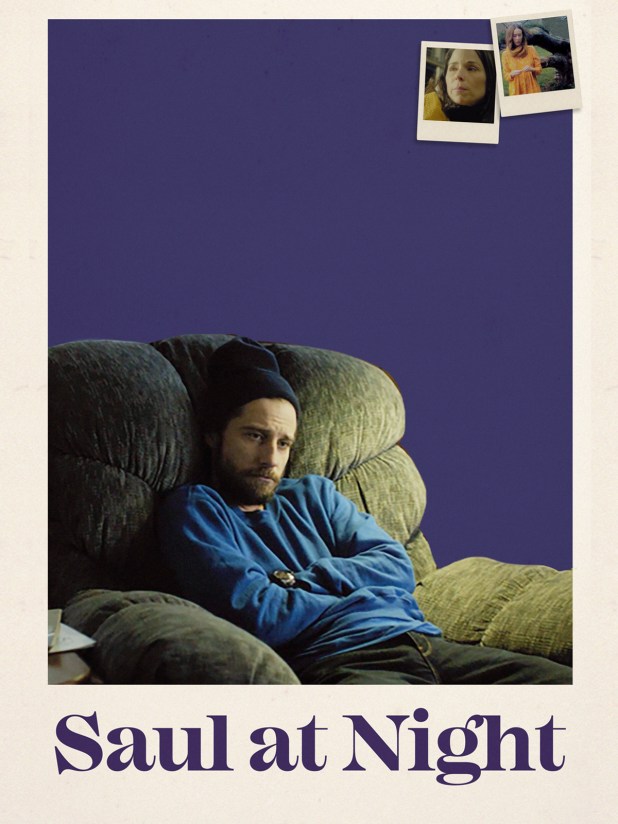
As a result of a bizarre experiment, Saul Capgras ihas become used to a life of isolation at night, while the rest of the city — and his family — all sleep under a mandated curfew. Saul is the only person left awake at night — perhaps by choice or sacrifice — and he yearns to experience the lives of his family, despite never seeing them awake ever.
Then, he meets Amalur, who avoids her family because she doesn’t want to know that life has gone on without her.
From 10 PM to 6 AM, the world sleeps while Saul and Amalur roam the world, the only connection left with others being the notes left in a basket for them. And, at times, a beeping monitor forces them to take pills and answer the questions of a computer.
Unfortunately, Saul and Amalur speak different languages and can’t understand one another, which is better than the life Saul has been leading, which finds him using large dolls to take the place of his loved ones.
The first full-length movie from director and writer Daniel Miska, Saul at Night uses science fiction to tell us all a story about being alone, about loss and about how our worlds can be so far apart. There’s a lot to try and understand here, with no easy answers, but I found it especially poignant given the trapped world that we’re all living in, then escaping briefly, then living in again.
Saul At Night is available on AppleTV, Amazon and Altavod from Utopia.
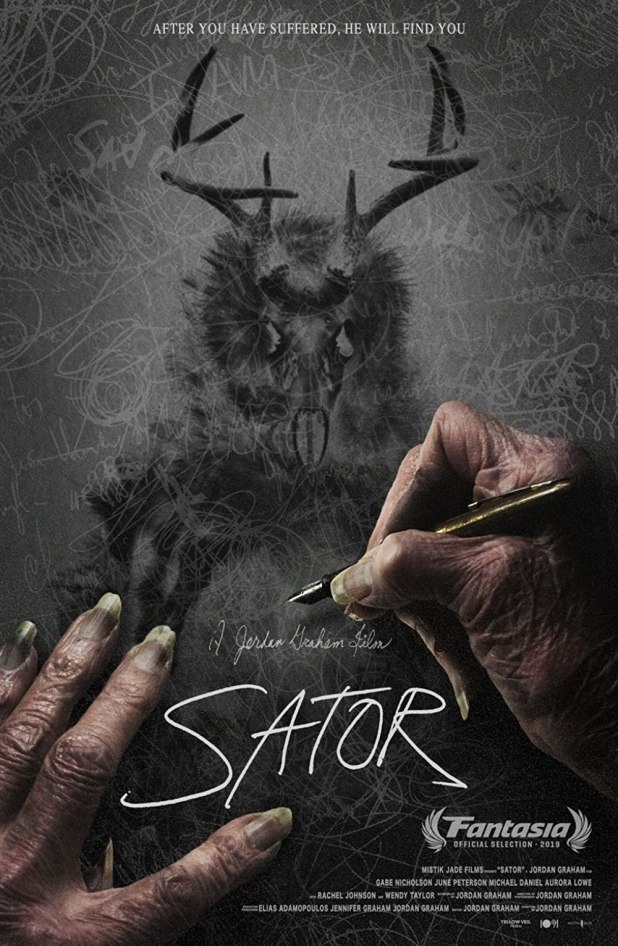
Jordan Graham took seven years to make this movie, thanks to the limits of its budget, but he also built the cabin that it takes place in, did nearly every job of making the film and cast his grandmother, June Peterson, who has been haunted by the demon Sator since 1968 in real life, automatically writing a lot of the words that are shown in the film. She spent time in a mental hospital, which makes you wonder if this movie was just exploiting her mental illness or could potentially be the story of a real demon that might, you know if you’re a Christian fundamentalist, be using this movie as a way to get into your mind.
Director, writer, editor, producer, cinematographer and editor Graham told Flickering Myth “In 1968, she brought home an ouija board and conjured up Sator. She then spent the next three months talking with him through something called automatic writings. She sat in a chair with a pen and let Sator speak through her. She wrote thousands and thousands of pages across the course of three months. And then, at the end of those three months, she ended up in a psychiatric hospital.”
Deciding to use her home as a location and having her act in a scene where she’d discuss Sator, she began sharing things she’d never told him. Over the shooting of the film, Peterson’s dementia got worse and she was taken to a care home, where Graham would visit and interview her, as well as study thousands of pages of her automatic writings and a diary where she explained how Sator guided her, using those interviews to write and then rewrite the movie based on what she told him.
In the film, her grandson has disappeared into the woods, obsessed with Sator. Perhaps his grandfather sacrificed himself to the demon, but definitely, there are other followers in the woods, wearing skulls and eventually, the protagonist becomes lost in the timeless world of the woods and the call of a demon.
It’s a slow build, but if there’s a movie that proves that folk horror doesn’t exist simply in the past. The truly frightening thing is that Sator itself is so powerful that even as the ravages of age made Graham’s grandmother forget her family, she didn’t forget the demonic spirit that dominated her life. It makes me wonder if mental illness is real or is demonology or both?
This isn’t a perfect film, but it’s a singular work by an auteur and there are times that it works perfectly and other times that it feels like it’s going nowhere slow and then it rewards your patience. I can see some loving it as equally as I can understand people hating it.
Inspired by Ray Bradbury’s “The Fog Horn,” which was also made as The Beast from 20,000 Fathoms, this movie features a creature called Nebula, which was designed by Keizo Murase, who has sculpted everything from Varan, Mothra, Matango, Gamera, Yongary and numerous appearances of Godzilla. He’s still working, getting ready to direct a movie called Brush of the God about a magical brush that can save reality. It’s the first movie he’s ever directed and he’s had the idea ever since he worked on The MIghty Peking Man.
At some point in 1909, a boy named Eiji moves back home with his mother to Kyushu and must unravel the secrets of his family, including his blind cousin, Takiri, who is supposedly dead but appears to him and has the ability to bring Nebula up from the deep.
Meanwhile, some land developers don’t care that the family owns this land and threaten them with violence, even kicking Takiri into the lake. The monster’s rampage destroys most of the town, but opens the doorway to freedom for the young adults.
Howl from Beyond the Fog feels like a spiritual side movie to Yokai Monsters, as Nebula just wants his peaceful life and people to be left alone, as Japanese pushes itself into the modern era, one that wants to explain away the monsters that create the elements.
Here’s to Daisuke Sato, who was the director, director of special effects, writer, producer and cinematographer along with Murase, as well as the editor, art director, recording engineer, lighting technician, compositor and puppet creator.
Yes, every character in this movie is a puppet.
What a gorgeous movie and such an achievement in our era of computer animation. I’ve watched this several times and if it had been made in my youth, as I devoured every Japanese monster movie that made it to UHF TV, I would have yelled during every frame.
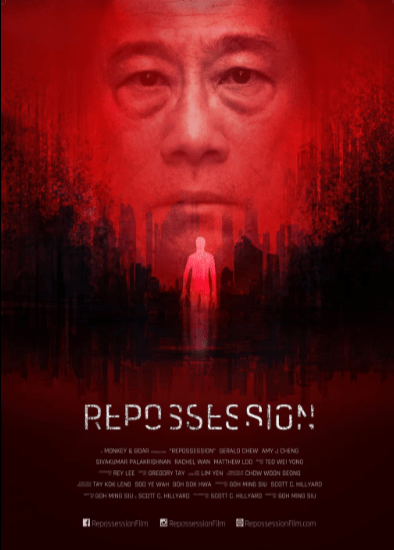
Jim hits fifty and then is told that he can either quit or get fired from his high-end job in status-conscious Singapore, yet ego and pride cause him to keep the truth from his wife Linda (Amy Cheng, Crazy Rich Asians) and daughter Ashley (Rachel Win), only telling his best friend and clinging to the material goods that came from his past success. Yet as his life keeps falling apart, the bank attempts to take everything he has of value while a demonic force tries to take everything else.
Directed and written by GOH Ming Siu with Scott C. Hillyard, Repossession is sold like a horror movie. Yet while there are supernatural elements, the truly frightening things is that I know men like Jim. You do as well — if you ask any man to tell you about themselves, chances are the first thing they will do is tell you what they do for a living. So much of our identity is not who we truly are. Instead, we share what we do. Once that has been taken away, so many men just keep following the motions, going through the motions like a Romero zombie in a shopping mall, walking past their old jobs and unable to find their next story.
The film doesn’t easily explain the demon that is within Jim’s life. Is it a murderous side that always existed? Or is it a real demon that has cursed his family? Regardless, the central theme that your errors and hubris will corrupt the others in your life is one that cuts to the bone. You can see just how easily a life can fall apart, how a once proud man now hides in an Uber hoping he never has to pick up a friend or someone from his old job. The idea of that — and trust me, I went from running my own business to unloading trucks a few years ago, so I understand — is more horrifying than any mere monster.
Repossession is available from Gravitas Ventures and Kamikaze Dogfight.
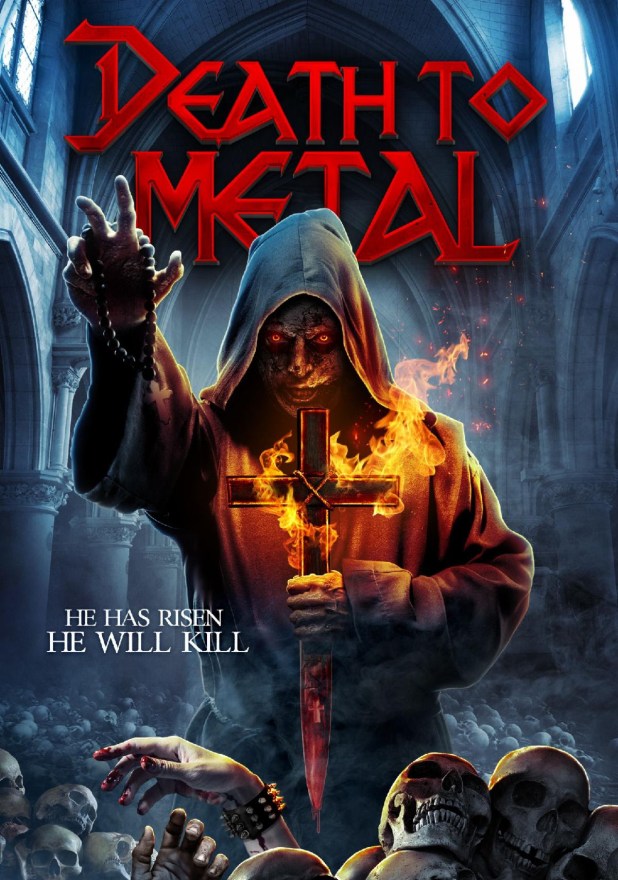
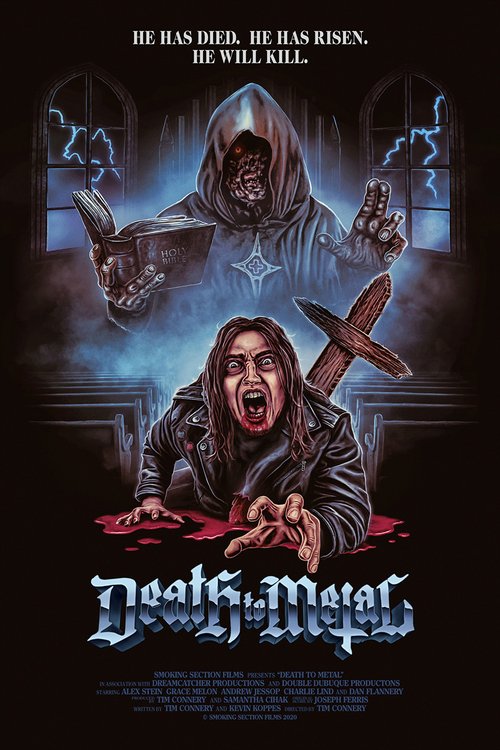
After a freak accident, an already disturbed priest is transformed into a mutated killing machine on a mission to wipe out anyone that loves heavy metal. I mean, with a concept like that, how can I not watch — much less not love — this movie?
The tagline is the nail in the upside down cross upon the coffin:
He has Died. He has Risen. He will Kill.
Director, co-writer and co-producer Tim Connery made Black Web in 2012, but that probably won’t prepare you for this blast of, well, blast beats and gore and blasphemy.
Zane (Alex Stein) has lost his girlfriend Tracy and his band Withered Christ in the same day and basically wants to die. This was supposed to be his moment, singing for the local band opening a major festival in his hometown.
Meanwhile, toxic waste gets dumped outside of town just in time for the disgraced priest Father Kilborn (Andrew Jessop) drives into it and becomes something much darker and more willing to destroy everything in his path for the Word of the One True Lord.
So when Zane gets back into the band and takes the stage, maybe he should have listened to his friend Mariah (Grace Melon) about setting Bibles ablaze.
Look, any movie that ends with the line “I think I’m just going to keep running him over until the cops get here” is going to win me over.
If you love extreme metal and/or gore, which seems like something that goes together like whiskey and weed and Black Sabbath, you’re going to love this. It’s streaming now from the fine folks at Wild Eye.
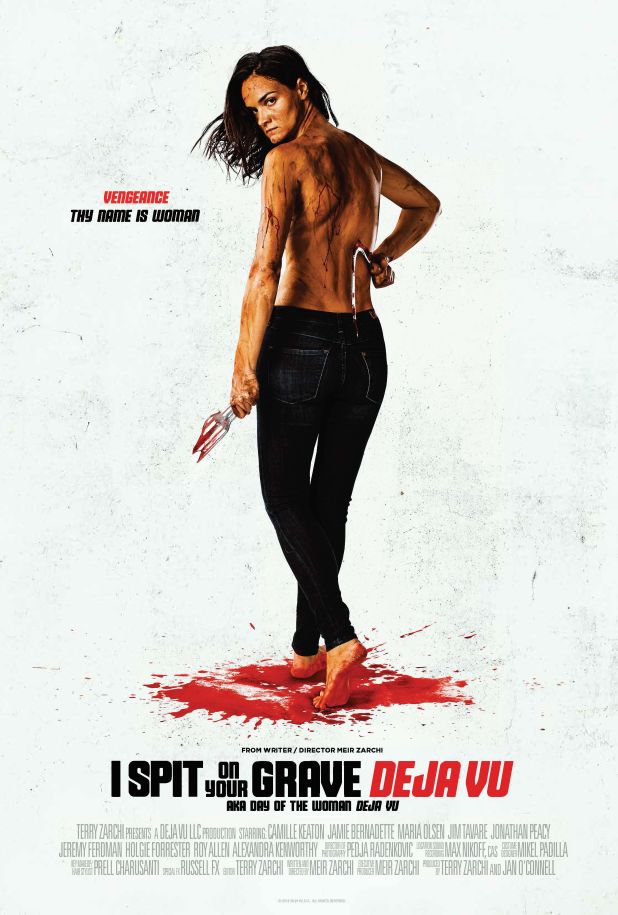
Forty years after I Spit On Your Grave, this film promises the return of Jennifer Hills (Camille Keaton).
This starts with a quote that says if you plan on revenge, dig two graves and spit on one, which is funny. I find it even more humorous that people have attributed that quote to Confucius for years and it’s probably from Japan, not China.
Since we last saw Jennifer, she’s been acquitted of all charges and wrote a bestselling book based on her ordeal and has also become a successful rape counselor. Meanwhile, her daughter Christy (Jamie Bernadette) has been modeling since she was ten years old.
Meanwhile, the families of Jennifer’s revenge have not forgotten what she did to them and plan on getting their own eye for an eye. Johnny’s wife, Becky (Maria Olsen, Starry Eyes), Johnny’s mother, Millie and father Henry, Matthew’s grandmother Beady Eyes and father Herman, Andy’s cousin, Scotty and Stanley’s brother Kevin have had years to plan.
The big surprise in this — spoiler warning — is that Jennifer dies quite early and we instead spend much of the movie watching her daughter get revenge, going way further their her mother ever did. There’s another revelation coming even after that which didn’t surprise me, but what happens after did.
That said, this movie was a really rough watch. Original director Meir Zarchi came back after several sequels and this feels unwieldy, particularly with a two-and-a-half-hour length. It has some of the worst performances I’ve seen in some time and I felt bad for both Keaton and Bernadette, who really was trying in this.
If you’re going to stage a burial plot using props from a Halloween store, maybe you shouldn’t set them up in an actual cemetery alongside actual headstones that cost upward of $10,000. Plus, we’re supposed to believe that our lead character is trapped in a backwoods town peopled only by people that want her dead, but we also just see people walking around like nothing bad is happening*.
This is the kind of Rob Zombie movie that even Rob Zombie wouldn’t make.
You can get this from RoninFlix. The blu ray extras include audio commentary by Joe Bob Briggs, cast interviews, a making-of feature and the trailer. I feel bad that they sent me a copy of this and I beat it up so badly, so in return for their generosity, I can recommend a few better movies from their site like Haunt, City of the Living Dead and The Sect.
*Kudos to Mike Justice for both of these salient points.
As Sam put together his “Exploring: Ouija Boards” feature, we came to review screenwriter John Oak Dalton’s directing efforts The Girl in the Crawlspace and Scarecrow Country. Delving into his resume then exposed us to his joint efforts with fellow Ohio-based writer/director Henrique Couto. Making his debut in 2003, Couto finally made a splash in the indie-horror streaming realms with the well-received Babysitter Murders (2013).
Starring the familiar and thespin-just-fine Erin R. Ryan and Joni Durian from that Couto effort, as well as Oak Dalton’s two directing efforts, which also starred John Bradley Hambrick, screenwriter Dan Wilder crafts an intelligent feature film debut that refreshes the overdone “Ouija” genre.
So lets crack open Ouija Room written by Dan Wilder and directed by Henrique Couto.
A perky Joni Durian shines as Sylvia: a lonely, agoraphobic woman who also suffers with autism. To occupy her time, her brother picks up a stack of used board games from an old brick and mortar video store (complete with a wall of ’80s arcade games!): one of the games is a Ouija board. Pining for friends, Sylvia, like Regan MacNeil before her, quickly falls under the spell of the spirits summonsed: a ’60s “rat pack” gangster, an alcoholic, rebellious goth chick (an obvious fan of the Misfits), and a morbid, Shirley Temple-esque little girl.
As usual, the hypercritical streaming hoards come into this expecting an A24 or Blumhouse shock-scare fest. Well, I enjoyed Durian’s realistic portrayal of the psychiatrist in The Girl in the Basement and I equally enjoyed her tempered journey of Sylvia’s child-like innocence into her slowly improving mental state, and deteriorating that innocent side as the spirits make their real intentions, known: they need her and her brother’s blood in a murder-suicide ritual. Equally solid are John Bradley Hambrick and Erin R. Ryan (opposite of her troubled woman in The Girl in the Basement) as the put-upon brother and girlfriend in their dealing with the career and relationship pressures attributed to Sylvia’s spiraling illness.
As with John Oak Dalton’s scripts for his own directorial work, Dan Wilder’s work also eschews CGI special effects and cheap, major studio shock-scares for a psychological tale that allows its fully-arched characters to shine (Hambrick struggles with unemployment and writer’s block; he struggles with placing Sylvia in an assisted care facility). Sure, when Hambrick’s Sammy comes to have a realistic vision of his dead mother warning of the coming danger to Sylvia, it doesn’t have the scope of Lin Shayne battling computer-generated spirits. Then again: these indie-horror streamers are against the budget, so how can they and why are Amazon-to-Tubi streamers expecting such? (Sammy’s bedroom scene, and another bedroom scene with Sylvia, reminds of Dennis Devine’s Dead Girls: so all is streaming-fine, over yonder.)
In the end, guys like John Oak Dalton, Dan Wilder, and Henrique Couto were raised on the same shot-on-tape and released-to-video era of the analog ’80s that we lament and pontificate about at B&S About Movies to your ad nauseam chagrin. Their joint ambitions to raise the bar on the celluloid horrors of the analog old in these digital days gives me the warm, retro-fuzzies with a streamy, hot coco chaser.
Initially making the festival rounds in 2019 as Haunting Inside, the film was picked up for worldwide streaming and DVD through ITN Distribution in 2021. So now, after its initial Amazon stream, you cand enjoy Ouija Room as a free-with-ads stream on Tubi.
An ’80s SOV legend: Jon McBride.Come explore, won’t you?
And be sure to visit our reviews of the SOV-era under our SOV category . . . and we stuck a few 16-to-35 mm drive-in flicks in there, as well, for one delicious, nostalgic home video-shelved stew.
About the Author: You can learn more about the writings of R.D Francis on Facebook. He also writes for B&S About Movies and Medium.
“I made movies I wanted to watch myself. I didn’t care what anyone thought. Instead of writing for somebody else, I happily found [my films] in WalMart and Family Video — finally ending their natural lives in a Dollar Tree, after thinking I would sell them from a card table at a con myself. A lot of people are discovering my Wild Eye films that way, I’ve found, at Dollar Tree.” — Screenwriter John Oak Dalton to B&S About Movies
Muncie, Indiana-born filmmaker John Oak Dalton is a screenwriter and director that’s drifted down the waters, under the girders of the Monongahela’s Smithfield Street Bridge that we don’t mention enough, here, at B&S About Movies. As a screenwriter, we’ve primarily reviewed Dalton’s work with the oft-reviewed Mark Polonia by way of the films Black Mass (2005), Amityville Death House (2015), Amityville Island(2020), Shark Encounters of the Third Kind (2020), and, most recently, the absolutely bonkers, Noah’s Shark (2021).
Oak Dalton’s later travels with Polonia Entertainment began in 1987 when he became the first scriptwriter to win a David Letterman Telecommunications Scholarship from Ball State University. By 1999, Dalton sold his first screenplay to the direct-to-DVD market and numerous screenplays over the next 20 years to various indie-genre directors. He made his screenwriting debut for director Jon McBride (be sure to check out our “Exploring” feature on Jon) with Among Us (2004).
One of those genre-directors Oak Dalton works with often is fellow Dayton, Ohio-based Henrique Couto, noted for directing the well-received Babysitter Massacre (2013). Oak Dalton wrote Couto’s equally well-received horror-indie Haunted House on Sorority Row (2014), as well as the western-drama Calamity Jane’s Revenge (2015). Couto most recently directed Ouija Room (2019; written by Dan Wilder) (both Tubi-linked). Dalton’s also written for Joe Sherlock, who’s been at since 1999 with 28 films of his own. Coming soon from the pair is Things 666 (2022). In our talking with John, we’ve come to learn that Joe Sherlock grew up on a steady diet of Don Dohler (Fiend) and Don Coscarelli (Phantasm), and whatever was on late-night cable, so Sherlock’s films just might be what your streaming platform, ordered (and you may want to check out his 2014 writing-directing effort, Drifter, on Tubi).
After writing twelve screenplays for others, John Oak Dalton decided to make his thirteen writing effort — a twisted, psychological horror set in a small town — his first directing effort. Assisting John — in their seventh overall collaboration — as a producer and cinematographer, is Henrique Couto (which he also accomplishes in Scarecrow Country).
A perfectly-metered, realistic Joni Durian (Babysitter Massacre, Haunted House on Sorority Row, Calamity Jane’s Revenge, Scarecrow Country) is Kristen: the psychiatrist wife of Johnny, a failing screenwriter (an on-the-spot John Bradley Hambrick of Henrique Couto’s Ouija Room). Their marriage failing — due to each other’s infidelity — they’ve returned to Kristen’s rural Indiana roots. While she’s quickly set up a new psychiatry practice, a bitter, L.A.-pining Johnny battles his alcoholism as he argues with his agent on the latest sequel to the popular Sorority Graveyard franchise. As the story unfolds, we come to learn of Kristen’s wanting to return home: she wants to write a book about her hometown’s dark past regarding a local serial killer. When Kristen begins sessions with Jill (a well-tempered Erin R. Ryan, who also appears in several films connected to Oak Dalton), a homeless local teen, they come to discover she’s an escaped victim of an infamous child serial killer.
While I am not privy to have seen all of John Oak Dalton’s twenty-one writing efforts, and while I certainly respect the retro-SOV efforts of his frequent collaborator in Mark Polonia, based on the films I have viewed, I can tell you the reason why (even though each may have the expected, indie-filmmaking shortfalls) a film like John’s most recent effort, Noah’s Shark, works. It is the result of Oak Dalton’s creative, what-the-hell-why-not plotting and clever character exchanges.
Needless to say: As with most of the indie-streamer I’ve reviewed: most reviewers haven’t been kind to John’s directing debut, as streamers seem to be coming into this small town-with-quirky-residents-and-even-dark-secrets tale expecting the Coen’s brothers Fargo. Oh, how many times must I say, “Don’t do that,” as we are dealing with filmmakers up-against-the-budget? (You’re just not “getting it” and never will, so que sera sera, bitch.) Even with the comes-with-the-territory budgetary issues: The Girl in the Crawlspace is above the fray of most of the indie-streamers I’ve watched (via the with-ads Tubi platform) as Henrique Couto has delivered us a well-shot film.
As I mentioned with Oak Dalton’s joint-Polonia resume: the script is the thing. Here, as with the Coen’s ode to small town, Midwestern mayhem: we have an expertly crafted, multi-layered script rife with complex characters. Each have something to communicate beyond a major studio bayos ‘n bayhem romp rife with clunky one-liners and screams of “Look Out!” and urges to “Run!” as the San Andreas cracks and CGI buildings fall. It’s inherently obvious Oak Dalton’s script for Crawlspace comes from a place of erudition: his love of films, fan fiction, and other geek-driven pursuits shines through with the banter of his humorously engaging, community-center D&D-style gaming group that quickly reconnects the writing-unfocused Johnny to his nerdy, fantasy-game loving college days: Johnny is John Oak Dalton. Unlike most small town-dom scripts, ones where everyone comes across as hicks and oafy buffons, Oak Dalton has lived this life; he loves his roots and treats all of his characters with respect.
If The Girl in the Crawlspace was shot as an A-List feature film with center-of-the-radar actors — such as Clint Eastwood’s murder-mystery thrillers Midnight in the Garden of Good and Evil (1997) Mystic River (2003) — you’d be singing the film’s praises courtesy of its story. So take off the snobby indie-streamer glasses and take your time to watch this well-written, multi-layered mystery that comes in at a quick 70 minutes.
John Oak Dalton is back with his second directing effort from his own screenplay about an Amish-populated, Indiana small-town where Winnie (a thespian-solid Chelsi Kern), a librarian, is gifted the diary of Joey Gibbs: gay and bullied, he committed suicide by driving his car into Hour Glass Lake. She comes into possession of the book when his mother passes and her daughter donates her brother’s collection of sci-fi novels. Once opened, the diary revives a blood thirsty scarecrow from the town’s dark past that kills members of Joey’s old basketball team.
As with Oak Dalton’s previous small town opus: the plot is multilayered with fully-arched characters. As in those larger-studio films we’ve cross-referenced: the once-teen-and-now prominent folk on the town’s counsel (one is the lovable town drunk, one runs a classic car dealership, the other a bar-club that once hosted The Dead Milkmen under his dad’s tutelage) were responsible for Joey’s death and cover up. While we may get the familiar plot twists that brings everyone’s sins of the past full circle, we also — refreshingly, unlike most horror indie-streamers — get a tale that’s not about the blood: this is a story about real people, their small town tales, and the quirks and mystery that follow suit.
One of those refreshing elements is the engaging subplot — that more than likely comes from Oak Dalton’s erudition — is Zoe (Rachael Redolfi): the agoraphobic, “old school” underground comic book artist sister of Winnie. Her reluctant fame for creating the Fantomah series leaves her at odds with her agent: she wants Zoe think bigger. Zoe wants to continue self-disturbing as a Xerox’d ‘zine. Oh, and Zoe’s creations “talk” to her and lead to solving the mystery.
Again, there’s those naysayers looking for a John Carpenter joint that moan about the film being “familiar” because the film centers around a revenge-driven scarecrow — stirred to life by a homemade Ouija board (the same one that opened Henrique Couto’s Ouija Room; it’s only a recycled prop and neither film is a sequel-prequel to the other). Speaking of props and set design, again, as with Crawlspace: the production-set design is solid and above-the-fray of most budget-conscious streamers. And it comes in at another tight 70 minutes.
For me, John Oak Dalton’s two directing efforts of Midwestern-bred horror are everything Don Coscarelli’s California-based mayhem (well, we are basing that on the fact the film shot at Oakland’s famed Dunsmuir Mansion) could have been. Think of a Phantasm with rich, character back stories (and flashbacks) of Mike and Jody’s parents, of how Jody, Reggie, and Tommy came to form their high school band, and how Jody ended up on the road with the Rolling Stones. (Say, a scene with Jody backstage at a gig pushing an amp and his Aunt Belle calls to tell of his parents’ car accident. In fact, the novel gets into Tommy’s “suicide”: his body is discovered in a basement: he jammed a knife-in-the-slats of an unfinished wall and thrust himself upon it.)
Well, those Oak Dalton-styled back stories — and scenes — existed, but were ultimately deleted from Coscarell’s final film (either shot, then cut; or cut from the script prior to filming). In the ultra-rare novelization by Don’s mother, romance novelist Kate Coscarelli, we learn such tidbits as the town where The Tall Man began his slave cultivation operation was known as China Grove. (Of course, if you watched the later-issued DVD outtakes to the film, you know there was more to Jody’s and Mike’s lives.) In the novelization, we learn that, after their death, the brothers inherited their parents’ small-town bank. The film-undeveloped sisters of Suzy and Sally (remember, they were kidnapped by The Tallman’s dwarfs) not only owned an antique shop (inherited from their convalescent-homed mother, Mrs. Glunter): Suzy and Jody became a couple as result of her working at the bank. There’s additional family drama with Jody: instead of taking on the family business, he goes on the road with the Rolling Stones and expresses his frustration having to remain in China Grove to take care of Mike.
Remember the one-scene Mrytle the maid: she’s more fleshed out in the novel. The old psychic lady in the wheelchair: her name is Mrs. Starr — and she speaks and discusses her granddaughter’s disappearance (and her name is Sarah; remember she opened the door to the “Space Gate Room,” then screamed). Then there’s the brothers’ doting Aunt Belle — who sees her war-casualty son in Mike. There’s Mr. Norby, the bank’s new manager at odds with Jody’s involvement with the bank. Then there ol’ Sheriff Wade who gave the roustabout Jody, Reggie, and Tommy hard times as teens — but he now leaves Jody alone via a bank loan blackmail gag (thus why the ‘Cuda always races around town without consequence); Jody even cracks a joke about “repossessing” Reggie’s ice cream truck (and Sally works at the ice cream shop). We also learn about the mysterious murder of Charlie Hathaway, the previous owner of Morningside.
Now, imagine a rebooted Phantasm with all of those twisty character elements. That’s what John Oak Dalton brings to the screen with these two films: real people with real lives and real problems that invest your interest. He gives reason beyond the screams.
So, Don, if you’re reading this: reboot Phantasm and give John a crack at the screenplay.
“I made Crawlspace after going a while without being offered any screenplays, or any I wanted to write, so I thought I would write a movie I wanted, make it at my house, and then sell it on a card table at conventions. Nobody was more surprised than me when it got picked up for distribution and ended up in Family Video, WalMart, and more.
“Literally, the day we sent the deliverables on Crawlspace, I was asked what I had next, which was nothing: I had intended on just making [Crawlspace]. So I started writing Scarecrow Country that very day in January 2019, we shot it in March 2019, and it screened October 2019 at a dusk-to-dawn horror festival in Iowa City.” — John Oak Dalton to B&S About Movies about the connection between his two directing efforts
You can follow John Oak Dalton at his official blog — where, in his entry “Talking in Our Bed for a Week,” he goes into detail on his mutual, recent three-picture deal through Wild Eye Entertainment with Mark Polonia. You can also learn more about John’s wares courtesy of his recent August interview with Richard Gary at the Indie Horror Films blogspot.
You can learn more about Henrique Couto and his films at his official website.
You can also delve into the twisted world of Joe Sherlock at his official site, Skullface Astronaut.
If you’re fan of ’80s-era shot-on-video films and you’re burnt out on the genre’s classics (many which we’ve reviewed at B&S About Movies, so check out our SOV tag), John Oak Datlon, Henrique Couto, and Joe Sherlock, as well as Mark Polonia, are doing a great job at keeping the era alive and viable with today’s technology-driven, shot-on-digital streamers.
We’ve since reviewed Henrique Couto and Dan Wilder’s Ouija Room.
About the Author: You can learn more about the writings of R.D Francis on Facebook.He also writes for B&S About Movies.




 B&S About Movies
You must be logged in to post a comment.