APRIL MOVIE THON DAY 30: Wired (1989)

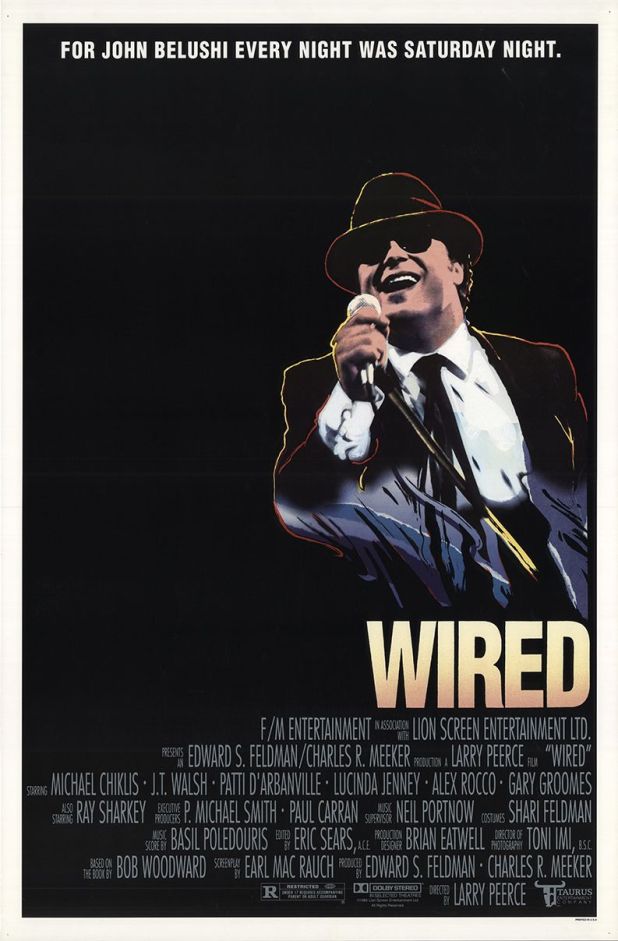
Judith Belushi, the widow of comedian John, and his manager Bernie Brillstein asked Robert Woodward — the writer of All the President’s Men and the man who joined who Carl Bernstein to break the story of Watergate — to write a book about Belushi to counter the many rumors that had started after the comedian’s death on March 5, 1982.

I can remember that day. I was ten years old, came home from school and we heard the story on the radio on the way to dinner. I’d been a fan of Saturday Night Live since it started, even if in Pittsburgh we watched it on a different channel that the NBC affiliate as Chiller Theater was such a big deal.

Woodward and Belushi were from the same town in Illinois and had friends in common. Belushi was even a fan. But after the writer interviewed numerous people and wrote his book, he never showed it to John’s widow. What followed was Wired. a sensationalist book that painted exactly the picture that Judith and Brillstein wanted to never be known.

Tanner Colby, who had co-authored the 2005 book Belushi: A Biography with Judith, said of Woodward’s book: “It’s like someone wrote a biography of Michael Jordan in which all the stats and scores are correct, but you come away with the impression that Michael Jordan wasn’t very good at playing basketball.”

A major example that critics cite is that in the book, John Landis has to guide Belushi by the hand in how to perform the cafeteria scene in Animal House. Those there content that Belushi did the scene in one improvised take all on his own.

Belushi’s best friend and fellow Blues Brother Dan Aykroyd beyond hated the book and said that Woodward “spoke with me about an hour and a half, and you know there’s things in the book I don’t remember saying to him…”

He went on to say “He certainly has avoided the issue of what a funbag John was, what a great guy he was, what a warm, humorous, really, you know…concerned, and bright, educated, well-read individual this guy was. How did he get to be so successful? He was smart, you know, he wasn’t just given his break, and he had to work for what he had, and Woodward completely skirts that, and it’s a depressing, sordid, tragic book…and for my part I just think that it’s really depressing reading.”

Woodward wanted to sell the movie rights as soon as the book was published, but found no buyers. He said, “A large portion of Hollywood didn’t want this movie made because there’s too much truth in it.”

Producers Edward S. Feldman (the man who got both Hot Dog…the Movie and Hamburger the Motion Picture made; he also produced The HitcherThe Truman Show and Witness) and Charles R. Meeker were the folks brave enough to fund the film. It was written by Earl Mac Rauch — yes, the same writer of The Adventures of Buckaroo Banzai Across the 8th Dimension — and directed by Larry Peece, who also made AIP’s The Big T.N.T. Show, The Other Side of the Mountain and A Woman Named Jackie.

The movie makes a wild departure from the book by having Belushi be followed by a guardian angel (Ray Sharkey!) who is leading him to either Heaven or Hell. They had to do something, as they were given no rights to anything connected to Saturday Night Live. If that something was a The Seventh Seal pastiche with pinball instead of chess, that was what they did.

Wired had problems finding a distributor as many of the major studios refused to distribute it. Now was that because of the conspiracy that people didn’t want the public to know how bad drugs were or because the movie is so insufferably bad? The jury is out but leaning toward the latter.

Brillstein believed that the filmmakers made up the controversy to sell this movie like William Castle would, saying “The only thing that the producers have to hang on to is the image of Wired as “the movie that Hollywood tried to stop.” When it played Cannes, the reception was hostile, with reporters attacking Woodward with questions about why he was a character in the movie.

John Landis threatened to sue and he’s not even named in the movie but suggested. Then again, helicopter noises play when he appears to hammer home that this is the same person who killed Vic Morrow and two children on the set of The Twilight Zone: The Movie. And Aykroyd pulled no punches, saying “I have witches working now to jinx the thing. I hope it never gets seen and I am going to hurl all the negative energy I can and muster all my hell energies. My thunderbolts are out on this one, quite truthfully.” A year later, he got J.T. Walsh, who plays Woodward in this movie, fired from the movie Loose Cannons.

You know who got the worst out of this? Michael Chiklis, in one of his first roles, who isn’t horrible as Belushi. He was picked out of tons of actors for the role and it took years for his acting career to recover. That said, he personally apologized to Jim Belushi when they met and the two embraced, as Belushi was always under the impression Chiklis was deceived as well by the producers. For his part, Jim visited the office of Feldman and trashed his desk.

As for the film itself, it moves through Belushi’s life in a non-linear fashion, with made up sketches like “Samurai Baseball,” the Blues Brothers singing Wilson Pickett’s “634-5789” and Belushi as a bee singing Slim Harpo’s “I’m a King Bee” invented for the film — again due to Lorne Michaels refusing to allow the movie to use any of Saturday Night Live‘s IP — and then a close where Belushi sings Joe Cocker’s “You Are So Beautiful to Me” alongside the real Billy Preston, the only person from that era to be involved with this film.

It also totally takes a few pages from Sid and Nancy by having a cab ride symbolize the boat across the river Styx and having Joe Strummer’s song “Love Kills” play.

There’s a great story about the life and death of John Belushi, one of triumph and tragedy, intelligence and sadly, stupidity. But this? This will never be it.
APRIL MOVIE THON DAY 14: Le porte dell’inferno (1989)

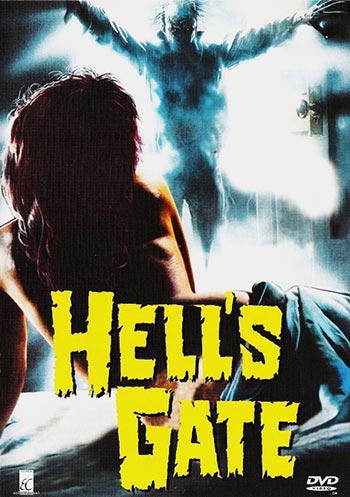
Dr. Johns (Giacomo Rossi-Stuart, Emanuelle in BangkokWar of the Planets) has spent 78 days in a hole and set a record, but now he’s claiming that everyone will die if they come down to rescue him.

Umberto Lenzi directed five movies in 1989 and of those, this is the weakest (in case you want to know, I’d rank the others in this order: Nightmare BeachHitcher In the DarkHouse of Witchcraft AKA Ghosthouse 4 and House of Lost Souls/AKA Ghosthouse 3). Maybe he was beyond busy, so busy that he thought no one would noticed if this movie was endless cave exploration and the end from Nightmare City.

Maybe he really loved his wife Olga Pehar and wanted to encourage her as this was her first script. She’d go on to write Hitcher In the DarkAfter the Condor, Karate RockBlack DemonsHunt for the Golden ScorpionNavigators of the Space and Karate Warrior 3 – 5.

I really wanted to love this movie. It has caves, it has gore, it has Lenzi. That said, he made some other movies that I’d totally recommend, such as OrgasmoSo Sweet…So Perverse, A Quiet Place to KillSpasmoGhosthouseCannibal FeroxSeven Blood-Stained Orchids and Oasis of Fear.

APRIL MOVIE THON DAY 13: Return of the Swamp Thing (1989)

I find it incredibly humorous that after Alan Moore, Stephen Bisette and John Totleben reinvented comic books with Saga of the Swamp Thing, director Jim Wynorski and writers Neil Cuthbert and Grant Morris were making this sequel to the original Swamp Thing and went nearly full camp.

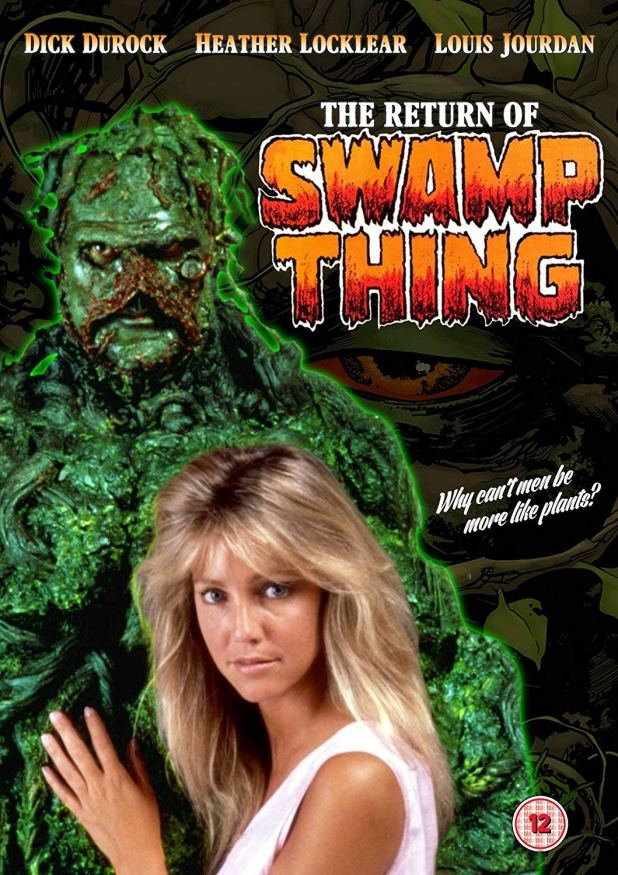
After her mother’s mysterious death, Abigail Arcane (Heather Locklear) has come to confront her wicked stepfather Dr. Arcane (the returning Louis Jordan) who has somehow come back from the grave and is working to stop the aging proccess with Dr. Lana Zurrell (Sarah Douglas). Oh yeah, he’s also making an army of monsters.

Luckily, Swamp Thing is around and still played by stuntman Dick Durock, who wore a seventy plus pound suit in the humid swams so we’d have a movie to watch. This being a Wynorski movie, Monique Gabrielle shows up as well.

I love that in the midst of this wackiness — I mean, Swamp Thing drives a jeep at one point sending me into fits of laughter — the movie takes the time to recreate the love scene between its hero and Abby from “Rite of Spring,” which appeared in Swamp Thing #34. In the hands of the comic creative team, it’s poetic, gorgeous and full of deep meanings about man’s spiritual place in nature. In the hands of Wynorski, it’s Heather Locklear eating a cucumber out of a swamp person.

In my youth, I used to look down on the director’s movies as fluff. As I’ve grown older, I appreciate them for their entertainment value and how well made they are. Not everything has to be so deadly droll all the time.

You can watch this on Tubi.

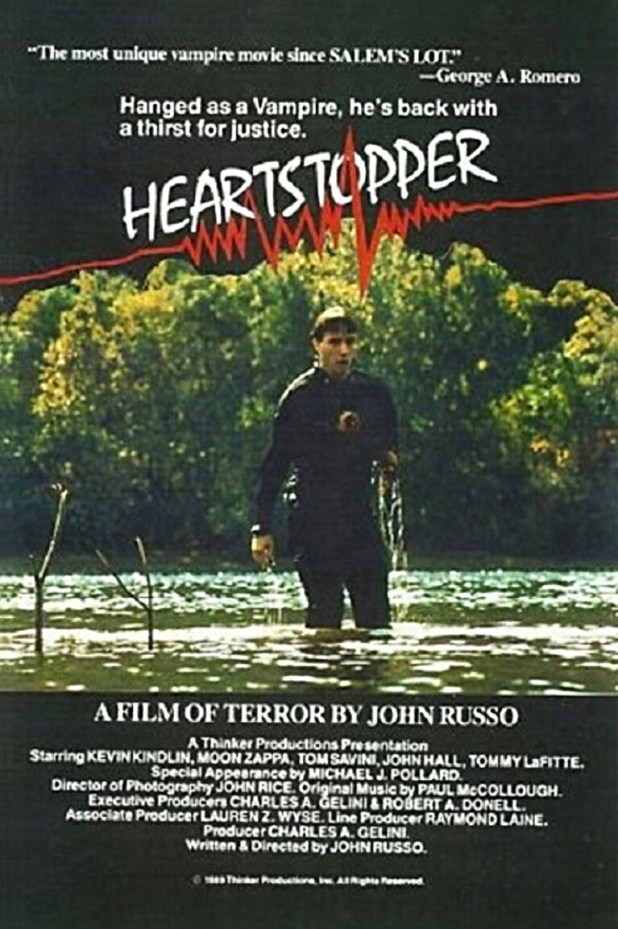
APRIL MOVIE THON DAY 12: Heartstopper (1989)

Back in my Fangoria fanboy mania, I kept seeing the Pittsburgh-made Heartstopper get listed and it supposedly had tons of Savini gore, as well as a role for him as a police detective. Every con Savini was at, I asked, “Is Heartstopper coming out yet?” And he’d laugh and say, “I hope so.”

It took me 33 years to see it.

Pittsburgh has seen more than one vampire movie get made here, from the lo-fi Fist of the Vampire to the big budget Innocent Blood and perhaps one of the best vampire movies ever made, Martin.

And oh yeah, Heartstopper.

Benjamin Latham (Kevin Kindlin, The Majorettes) was a doctor back around the Revolutionary War who was experimenting with blood when his sister-in-law and brother proclaim him a vampire. He’s hung and not just lynched, but held down by her, his heart has a stake put through it and he’s covered with garlic. And two hundred years later, he rises in Pittsburgh’s Point State Park. Unlike your run of the mill vampire, he lives by day and has poisonous saliva that either kills or brings people to his side, such as his lover Lenora Clayton (Moon Unit Zappa!?!), who introduces him to our modern world while having a tie to the past, as she’s a museum curator.

Meanwhile, one of Benjamin’s descendants has become a serial killer himself and he’s conflicted over saving him or destroying him. There’s also the matter of Lt. Ron Vargo (Savini), whose daughter was killed by someone who had a very vampiric MO, so all he does is talk about it and refuses knocking up his wife again because he’d rather work out down in the basement, so if you want to watch Savini grunt it out and do sets, trust me, this is your movie.

It also has a tremendous metal soundtrack and by that, the kind that will earworm you. The band N.M.E. (metal is not always clever) is a power/thrash band from the City of Bridges made up of David Paul Snyder on drums, C.E. Robinson on bass, Brian Keruskin and Michael Weldon on guitars and Jirus on vocals. They had two songs in the movie, “The  Gates of Hell” (“Walk On”) and “Heartstopper” (“Eat Me Alive”) and they’re pretty decent, along with a solo Jirus song called “Killer In the Park” and two songs by The Sound Castle, “What Kind of Love Is This?” and “In Principio,” which sound like progressive metal by way of Meat Loaf and I’m all for that, too.

“Heartstopper” (“Eat Me Alive”) was released on the VHS Horror Rock, which also has Hurricane’s “Over the Edge,” Wrath’s “Children of the Wicked,” The Pandoras’ “Run Down Love Battery,” The Dickies’ ” Booby Trap,” Elvis Hitler’s “Hot Rod to Hell” and The Del-Lords’ “Judas Kiss” all playing over clips of Night of the Living DeadThe MajorettesMidnight and Heartstopper, which as you may have put together are all movies owned by this film’s writer and director John Russo  (or public domain, as is the case with Night).

Heartstopper is an interesting film at the level of The Majorettes in quality. It tries to be a different take on the vampire story and for that, it succeeds, while also being a great time capsule of 1989 downtown Pittsburgh. And of Tom Savini’s workout. Seriously, the dude made gains while making this.

APRIL MOVIE THON DAY 4: Our Friend Power 5 (1989)

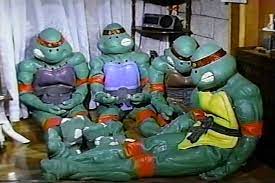
Five humanoid turtles from the planet Battlestar and Princess Yesular have crash landed on Earth after a battle with the dreaded Shark Gang, who are all rats, but it’s a cool name. So yes, this Teenage Mutant Ninja Turtles remix asks us to imagine an alternate universe where Master Splinter is the bad guy, that there are five turtles that can transform into human beings and that Go-Bots is in the same time and space as our heroes in the halfshell.

This was not the first time that Shin Hyun-hwan had teamed with Popeye Science, a toy company in South Korea, to make a movie directly based on toys. Of course, none of the toys he made movies about were unique. According to How the World Remade Hollywood, he started by reverse engineering Japanese mech toys to look close to other films that were coming out, including Space Gundam V, which has nothing to do with Gundam and instead a remix of Space Dimension Fortress Macross.

This time, the turtles are using a Bandai Machine Robo design while the Sharks have Galactic Gale Baxingar as their weapon. You have to love that level of sheer bul-al, right?

Also, this movie does not care at all about giving kids nightmares, as the moment the Sharks hit Earth, they go to the woods and outright murder some children.

Not only does this movie jump between live action and traditional animation, it has a robot to shoots lasers out of its pelvic area, which is also a good power to have.

Imagine how strange it would be to grow up with Our Friend Power 5 and then learn that it’s all a lie. Kind of like how we played with Transformers without realizing that they were multiple lines of mechs all remixed for Western sensibilities. Kind of like Robotech, which took the aforementioned Macross and mixed that show with Southern Cross and Genesis Climber MOSPEADA, two entirely unrelated shows, to make a new narrative for U.S. audiences. Or how Voltron combined Beast King GoLion and Armoured Fleet Dairugger XV to create one Americanized cartoon continuity. 

You can watch this on YouTube.

MONDO MACABRO BLU RAY RELEASE: Sukkubus (1989)

Sukkubus – den Teufel im Leib (Sukkubus – The Devil In the Body) is a Swiss/German co-production that takes you into the snow and ice-covered mountains as three men — Senn the leader (Peter Simonischek), Hirt (Giovanni Früh) and teenage Handrbub (Andy Voß) — as they drive their herd through the treacherous Swiss Alps, starting the story by finding the ravaged and frozen bodies of a past team of farmers just like them that didn’t make it. As they melt in the sun, birds land on them and begin feasting on them.

The three men pray for protection as their journey continues.

This journey has no women and all work, which leads Hirt to non-stop obsession about pleasure, starting with bothering young Handrbub, which is dealt with swiftly by Senn. Then, after a day in which the boy finds a piece of wood that looks like a face, Hirt and Senn get drunk and assemble a body around the face, conducting rituals through their words as Hirt mounts the straw doll they have made and basically thrusts it into life, revealing the titular Sukkubus nearly halfway through the film.

Played by Pamela Prati (Lith in Ironmaster and Aracne in The Adventures of Hercules, as well as Transformations, another film in which she plays a succubus) the doll becomes a bright blue eyed living creature in front of the men’s eyes, ominously inching toward Handrbub who can only scream in horror. And while he and Senn want to avoid this demon as she appears in their weakest moments, Hirt wants to feel her touch.

Mondo Macabro, who keeps putting out movies that shock and surprise me, says, “This film is the real deal, based on a gruesome and ancient story, much retold by people who live in the Alps – the huge mountain range that spans six European countries.”

I agree. This just feels odd in the best of ways, showing the isolation and madness of the men while they face death every single step of their journey, all while living in lust, fear and some sadistic combination of the two as the epitome of male desire stalks their every move.

Based on the fable The Guschg Herdsmen’s Doll, which was also filmed in 2010 as Sennentuntschi: Curse of the Alps, this Mondo Macabro release features a 1080p presentation from a 4K restoration of the original camera negative, a German audio track with optional English subtitles, an exclusive interview with actor Peter Simonischek and the film’s trailer. You can get it from Mondo Macabro.

JESS FRANCO MONTH: La Chute des Aigles (1989)

Night of the Eagles is kind of amazing, at least for its cast, because can you believe that Luke Skywalker, Jess Franco, Charlie Sheen’s brother and Count Dooku all made a movie together?

After the success of their two previous movies, Dark Mission: Evil Flowers and Countdown to Esmeralda Bay — both directed by Franco — Eurociné’s boss Marius Lesoeur pushed this movie to get done as soon as possible, thinking it would be a blockbuster. It would lead to a feud between Lesoeur and Franco that would last for the rest of Franco’s life.

Lee plays Walter Strauss, who has a daughter named Lillian (Alexandra Erlich) who has to decide between two men, a soldier named Peter (Hamill) and a composer by the name of Karl (Ramon Estevez), which brings her from being a cabaret singer to the front lines to tragedy, pretty much like everyone and everything in this movie.

With war scenes taken from Alfredo Rizzo’s Heroes Without Glory, Alain Payet’s Hitler’s Last Train and Nathalie: Escape from Hell, as well as Convoi de filles, a movie that Franco co-directed with Pierre Chevalier.

It’s fine — it’s not my kind of movie, but I can respect that Franco was making big movies — well, for him — after Faceless did well. Am I a bad person if I prefer to watch movies where Jess zooms the camera right into the middle of the love of his life?

You can watch this on Tubi.

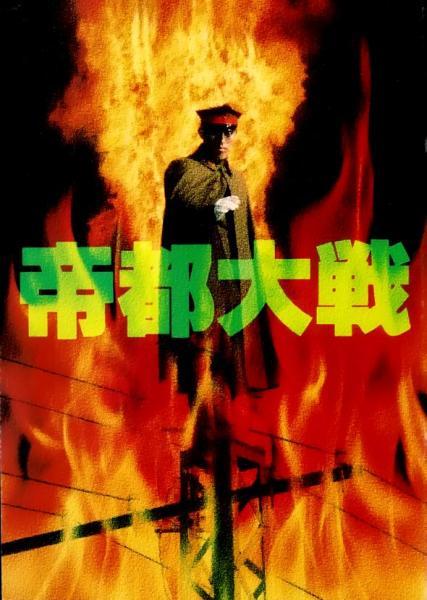
Tokyo: The Last War (1989)

Teito Monogatari (The Tale of the Imperial Capital) was the first novel to popularize onmyōdō — a system of natural science, astronomy, almanac, divination and magic that developed independently in Japan based on the Chinese philosophies of yin, yang and the five elements — and fūsui mythology – Japanese feng shi of the energy flow and exchange both within and external to our bodies — in modern Japanese fiction. It’s also written by natural history researcher and polymath Hiroshi Aramata and re-imagines the 20th century of Tokyo as influenced by the occult. It also has ties to mythology and the story of Taira no Masakado, a 10th-century samurai warlord who has since become something of a demigod thanks to his stand against the central government. However, his malevolent spirit must constantly be looked after and as such, the cities of Edo and Tokyo have felt a debt to keep him happy even a thousand years after his death. His shrine remains well-maintained, even as occupies some of the most expensive land in the world and faces Tokyo’s Imperial Palace.

A sequel to Tokyo: The Last Megalopolis, this is an adaptation of the eleventh book (Great War in the Capital) in the series. In its center, we discoer Yasunori Katō, a mysterious former lieutenant of the Imperial Japanese Army, killed twenty years ago but just like Taira no Masakado he’s become a vengeful oni. Yet he is devoted to the destruction of Tokyo*.

There’s also an anime adaption called Doomed Megalopolis.

In 1945, American forces are unleashing bombs over Japan and to stop this, the Buddhist shaman Kan’nami Kouou has been given the mission of cursing the Allied leaders through magic, but that’s when the innocents killed in the war combine their souls and reincarnate Yasunori Kato, who wants the war to continue and Tokyo to finally be destroyed, and must battle the psychic Yuko Nakamura, who is empowered by the love of a nurse, Yukiko Tatsumiya, who was abused in her youth by Kato.

Obviously, a multi-book epic that draws on centuries of Japanese history is not going to be an easy watch for American audiences. That may be why the second adaption of these stories stays away from the more occult-based magic and sticks to ESP and psychic powers.

And yes, M. Bison from Street Fighter was based on Yasunori Kato, as well as Eagle Cape from Riki-Oh

*The movie is different than the book, where Kato is still alive and never destroyed. The target of his spiritual assassination is not Hitler, but Franklin Roosevelt, who is cursed with polio which allows Truman to become President and drop the bomb on Tokyo.

Black Past (1989)

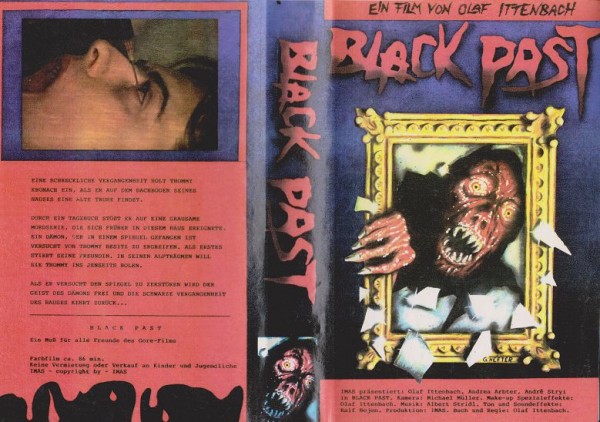
Olaf Ittenbach did everything on this and stars as Thommy, whose family moves into a new house, upon which he discovers a cursed mirror and diary. Man, this is why I was glad my family never moved, because I was barely able to deal with the revelation that the family that lived in our house before kept one of their kids locked in one of the rooms upstairs so that no one would discover that they had had a mentally challenged child.

So anyways, this mirror and diary turn young master Thommy into a crazed killer and then, unrelated but we can assume that the wheels of fate and karma and movies have connected column A with column B, we soon watch his girlfriend Petra die in a car accident and then rise from the dead.

If you dug Olaf’s The Burning Moon then you’re going to love this. Spoiler warning: a cock gets nailed to a board and sprays a lot of blood. The more tender of the menfolk out there may want to skip that.

Warlock (1989)

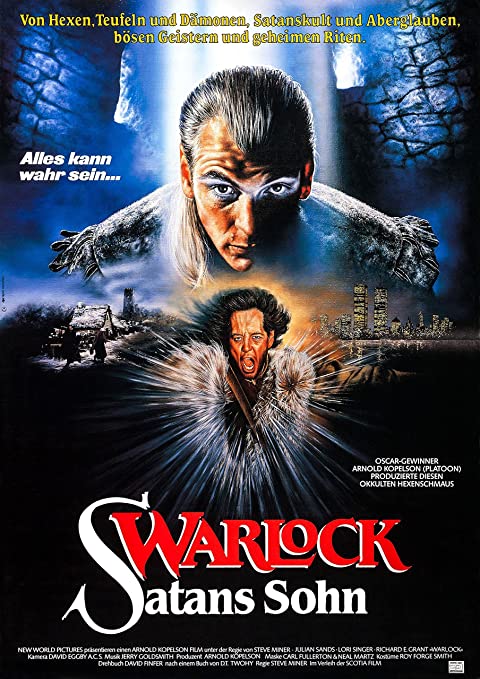
Steve Miner is a secret success story, between directing Friday the 13th Part 2, Friday the 13th Part III, House and yeah, sure, Lake Placid and Halloween H20. Here, he’s working from a script from Pitch Black creator David Twohy and telling the story of a male witch who has come to our time to destroy our world for Satan. He’s blasted through a time portal and is followed by the witchhunter Giles Redferne (Richard E. Grant).

Julian Sands is that Warlock and man, the movie is great because of him, as well as some deft writing and a great cameo by Mary Woronov.

Satan has told the Warlock to reassemble The Grand Grimoire, a spell book separated into three pieces which can unmake Creation when united, because that seems like a good idea. In his way is not just Giles, but Kassandra (Lori Singer), a woman who the magician has rapidly aged.

If you watch this and think, “Man, that age makeup is horrible,” you’re not alone. Singer was allegedly hard to deal with and turned down the makeup of FX artist Carl Fullerton, despite it being fully tested and approved. On the day of shooting, she refused to be made up as a forty-year-old woman and would not wear any prosthetics, so Fullerton had to use stippling, shadowing and a gray wig. The sixty-year-old makeup needed prosthetics, which Singer agreed to, but refused to have any near her nose or eyes.

New World Pictures was suffered financial difficulties when this was made and that led to the movie being shelved for two years. It was released by Trimark and ended up making them some cash.

You can watch this on Tubi.

You know what blew my mind? There was a video game!