BASTARD PUPS OF JAWS: Devilfish (1984)

Call it Monster Shark. Call it Monster from the Red Ocean. Or Devouring Waves. Even Shark: Red in the Ocean. By whatever name you call Lamberto Bava’s (credited as John Old Jr.) undersea monster film, it’s still pretty ridiculous. But then again, you’re not coming to an Italian shark movie to get high art.

Based on a story by Luigi Cozzi (Starcrash, Contamination) under the name Lewis Coates and producer Sergio Martino (who is so beloved here that we devoted an entire week to his films), Devilshark was written by…you guessed it, Dardano Sacchetti, who wrote pretty much every great 1980’s Italy scumfest.

Along the Florida coast, a place where Italian beercans are still imbibed by our hero Peter (Michael Sopkiw, Blastfighter), there’s a monster loose that’s a mutant mash-up of an octopus and the prehistoric deep sea Dunkleosteus. Of course, that monster is loose because of a military experiment and has been set loose on a tourist town, but that’s how these things go.

Peter and Dr. Stella Dickens (and yes, Luigi Cozzi names every one of his heroines Stella) have to stop the monster before it grows, while the military wants to stop them and recapture the Devilfish. There’s also a sheriff on the job who is played by Sartana himself, Gianni Garko.

Cinzia De Ponti, the bicyclist we last saw get eviscerated by The New York Ripper (she’s also the aptly named babysitter Jamie Lee in Fulci’s utterly bizarre Manhattan Baby), shows up here, as does Dagmar Lassander from Hatchet for the Honeymoon and The House by the Cemetery.

For those that enjoy these things, there’s a flash of man meat. There’s also plenty of synthesizer soundtrack music, knife fights in the water, a goofy monster, flamethrowers vs. monsterfish, women screaming “PETER!” and plenty of bad dubbing.

Lamberto Bava takes every nice thing I ever said about his father and throws it in my face with every movie that he makes, but I still give him chance upon chance. Still, I kind of adore that there was a time when Italian filmmakers would come the whole way to America to make horrifyingly inane films.

Oh yeah — one time in 1977, Luigi Cozzi made his own version of Godzilla by redubbing 80 minutes of the original Godzilla, throwing in some footage from the U.S. 1956 version and then added in nearly 25 minutes of World War II newsreels and various other films like The Day the Earth Caught Fire and The Beast from 20,000 Fathoms.

If that wasn’t enough, then Cozzi artist Armando Valcauda spent three months placing colored gels over the black and white film, colorizing the movie in a way that approaches pop art that was called Spectorama 70. Then, there was a new soundtrack by Vince Tempera (under the pseudonym Magnetic System) that was mixed in Futursound, an 8-track magnetic sound system based on Sensurround. Imagine Goblin with super loud explosions that could, would and did rock entire theaters with blasts of noise.

You can learn more about this moment of cinematic craziness here and watch the video below:

Anyways, Devilfish. You can watch it on Amazon Prime with a subscription or get it from Cult Action.

CHILLING CLASSICS MONTH: The Game (1984)

Is Bill Rebane a horrible filmmaker or a secret genius? If we’re to go by Blood Harvest, I lean toward the latter. However, every single other one of his films that I’ve watched so far has left me feeling like that movie is his lone success, his moment where the hundreds of monkeys all writing scripts for him finally got one that approached Shakespeare. Will 1984’s The Game (also known as The Cold and we all know how much Mill Creek cares about getting the correct title on their films or letting you know that the same movie has multiple names) convince me otherwise?

It’s a good conceit. Imagine if three millionaires gather nine people in an old mansion and give task them to conquer their biggest fears. If they make it, they each get a millon dollars in cash. That’s the idea. What follows is a gaseous cloud that chases people, a 1980’s looking amateur band rocking out, people sharing pickles at dinner, an Alien ripoff, people drinking tea with spiders in it, tennis playing, a hunchbacked mental patient who ends up being a British thespian, singalongs of “Jimmy Crack Corn” and so many endings, you’ll feel like you’re watching The Return of the King on LSD.

I haven’t seen a movie that makes less overall sense that didn’t come from the hands of an Italian director. Seriously, this movie is bonkers. Come for the swimsuit models, stay for the meta reference to Rebane’s other film, The Giant Spider Invasion. I really need to watch this like twenty-five more times to really appreciate it and its not-so-subtle nuances.

Which Rebane made this, the schlockmeister or the auteur? I’m thinking the genius, but then again, some people think Claudio Fragasso is one of those too.

WATCH THE SERIES: A Nightmare on Elm Street part one

I’ll admit it. I’m guilty. I’ve unfairly maligned this franchise because of where it ended up versus where it began. And it’s time that I rectified that situation. Over the past few weeks, I’ve been watching them all over again from the beginning and have come to change my opinion. Well, at least until the fifth film.

The original film was based on a lot of director/writer Wes Craven’s life, as well as Asian Death Syndrome, a medical condition that impacted a group of refugees who had left behind Laos, Cambodia and Vietnam, yet were still trapped by nightmares of war. Many of them refused to go to sleep as a result and some even died while sleeping.

He also was inspired by a satirical horror movie his Clarkson University students made in 1968 which was filmed along Elm Street in Potsdam, New York. And the film’s villain, Freddy Krueger, is based on an incident where a young Craven felt like an elderly neighbor was coming after him. The name comes from a childhood bully that kept beating on Craven and it’s not the first time that he used that name, as Krug from The Last House on the Left is also named for this past teenage demon.

Freddy Krueger doesn’t look like any of his slasher brethren. With every other slasher wearing a mask, Craven wanted a villain who could talk and threaten his victims, while striking even more fear into their hearts with his burned and scarred visage. He also based his soon to be iconic sweatshirt on the pattern of DC Comics superhero Plastic Man, but changed the colors to red and green as he learne dd that those were the colors that clash the most in the human retina. And his weapon wouldn’t be a knife, but an entire glove made of them.
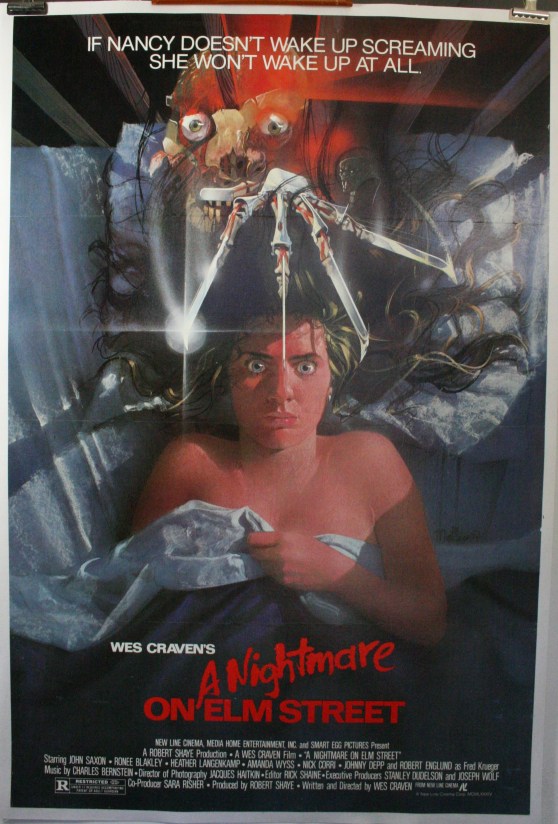
A Nightmare on Elm Street – 1984

Upon watching this again for the first time in probably thirty years, I was struck by how European the movie feels. Perhaps it’s the color tones throughout, suggesting the patina of Italian horror cinema (both Fulci and Craven cite surrealist filmmaker Luis Buñuel as an influence). It could also be John Saxon having lead billing. Or just that it doesn’t feel like any horror cinema that was currently being made in the United States.

The real villain of this piece is not Freddy Krueger — more on him in a bit — but the parents of Elm Street who have allowed secrets and their assumed authority over their children to do unspeakable and unspoken things. All of them are haunted by it, divorced, depressed and self-medicating with over-dedication to their jobs or their addictions.

There are stories that David Warner was originally going to play Freddy, but that’s been disproven. After plenty of actors tried out and failed to win the part, it went to Robert Englund, who darkened his eyes and acted like Klaus Kinski (!) to get the part.

The other feeling I have about this movie is that it owes a major debt — as all horror movies post 1978 do –to John Carpenter’s Halloween. Much like that film, the true horror happens within the foliage of the suburbs, with shadow people showing up and disappearing. Much of the action on the final night happens within two houses. One of the main characters has the ultimate authority figure, a policeman, for a father. And the cinematography by Jacques Haitkin glides near the characters and around them, much like the Steadicam shots that start Carpenter’s film.

The film starts with Tina Gray (Amanda Wyss, who puts the events of Better Off Dead into motion by breaking up with Lloyd Dobler) waking up from a nightmare where a disfigured man chases her with a bladed glove. I loved the way this scene looks, as you could almost consider Freddy off brand here, as his arms grow comedically long and he moves way faster than he would in the rest of the series. Yet by keeping him in the shadows, he’s absolutely terrifying.

When Tina awakens, her nightgown has been slashed and she’s afraid to go to sleep again. She learns that her friends, Nancy (Heather Langenkamp, who left Stamford University to be in this), Glen (introducing Johnny Depp) and Rod (Jsu Garcia, credited as Nicki Corri) have all been having the same dream. To console Tina, they all stay at her parent’s house overnight. But when Tina falls asleep, Krueger is waiting. Rod awakes to find Tina flying all over the room and up the walls — an astounding effects sequence in the pre-CGI era — and he flees the scene after her death.

Soon, Rod is arrested by Lieutenant Don Thompson (Saxon), Nancy’s father. Freddy now starts pursuing her, chasing her as she falls asleep in class (look for Lin Shaye as the teacher) and later in the bathtub, as his claw raises like a demented and deadly phallus between her thighs. Rod tells her how Tina dies and now she knows that the same killer is definitely after her (Garcia’s watery eyes and lack of focus made Langenkamp think he was acting his heart out; the truth is he was high on heroin for real in this scene). She tries to find the killer, with Glen watching over her, but he’s a lout and easily falls asleep. Only the alarm clock saves her, but no one can save Rod, who is hung in his sleep while rotting in a jail cell.

Nancy’s mom Marge (Ronee Blakley, who was married to Wim Wenders, sang backup on Dylan’s song “Hurricane” and is also in Altman’s Nashville) takes her to a sleep clinic, where Dr. King (Charles Fleischer, Roger Rabbit’s voice) tries to figure out her nightmares. She emerges from a dream holding Freddy’s hat to her mother’s horror. Soon, she reveals to her daughter that the parents of Elm Street got revenge on Freddy Krueger, a child murderer after a judge let him go on a technicality. In a deleted scene, we also learn that Nancy and her friends all lost a brother or sister that they never knew about.

While Nancy is barred up in her house by new security measures, Glen’s parents won’t allow him to see her. Soon, he’s asleep and is transformed into an overwhelming fountain of blood. Nancy falls asleep after asking her father to come in twenty minutes. He doesn’t listen and she pulls Freddy into our world. On the run, she screams for help until her father finally comes to her aid, just in time to watch a burning Freddy kill his ex-wife and them both disappear.

This is an incredibly complex stunt where Freddy is set ablaze, chases Nancy up the stairs, falls back down and runs back up — all in one take! At the time, it was the most elaborate fire stunt ever filmed and won Anthony Cecere an award for the best stunt of the year.

Nancy then realizes that if she doesn’t believe in Freddy, he can’t hurt her. She wakes up and every single one of her friends is still alive, ready to go to school. As the convertible hood opens up in the colors of the killer’s sweater, she realizes that she’s still trapped by Freddy, who drags her mother through a window.

In Craven’s original script, the movie simply ended on a happy note. Producer Robert Shaye wanted the twist ending so that the door was open for a sequel, something Craven had no interest in. Four different endings were filmed: Craven’s happy ending, Shaye’s ending where Freddy wins and two compromises between their ideas.

Obviously, the series would continue. And the follow-up would be one that left many unsatisfied.

A Nightmare on Elm Street Part 2: Freddy’s Revenge – 1985

With Craven stepping aside, Jack Sholder (Alone in the Dark, which was the first New Line movie before the original Elm Street and The Hidden) was selected as the director and David Chaskin was selected to write this (it was his first Hollywood script and he’d go on to write I, Madman and The Curse).

Chaskin’s theme for the film — which until the documentary Never Sleep Again: The Elm Street Legacy he would always say was just subtext — is the main character Jesse (Mark Patton) coming to grips with his homosexuality. Patton struggled with his anger over this film for years, as he felt betrayed as the filmmakers knew that he was in the closet. Between this role and playing a gay teenager in Come Back to the Five and Dime, Jimmy Dean, Jimmy Dean, he feared being typecast at best and labeled at worst. Yes, in 1985, this was the world that we lived in.

Chaskin claimed in interviews that Patton just played the role too gay, but Patton bristled at that claim. The emotional stress led Patton to quit acting for some time to pursue a career in interior design. That said, Chaskin claims that he has tried to reach out and apologize to the actor over the years.

Director Sholder has said that he didn’t have the self-awareness to think that the film had any gay subtext, but an unfilmed scene almost had Krueger slide a knife into Jesse’s mouth. Makeup artist Kevin Yagher talked Patton out of filming that scene for the sake of his career.

Years later, Patton would write Jesse’s Lost Journal, a series of diary entries that would set his feelings — and his character’s — straight, pardon the horrible pun.

The sequel starts with a dream sequence where Jesse Walsh (Patton) dreams of being stuck inside a school bus with Freddy at the wheel. Jesse’s circle of friends include Lisa, who he’s friends with but too shy to ask out, and Grady (Robert Rusler, Sometimes They Come Back), a frenemy that seems more like a crush.

Jesse has moved into Nancy Thompson’s home, which was on the market for five years after she was institutionalized and her mother killed herself. His family has Clu Gulager from Return of the Living Dead as his dad, Hope Lange from Death Wish as his mother and a little sister that he bothers when she’s trying to sleep.

Lisa and Jesse discover Nancy’s diary, which explains how ridiculous the house is to live in. It’s always 97 degrees, birds attack you at will before they spontaneously combust and your parents accuse you of setting it all up.

Meanwhile, Jesse is dealing with all sorts of strangeness, like a sadistic gym teacher who really likes to go to punk clubs and get whipped. One night, a dream takes him to that bar and the gym teacher makes him run laps in the middle of the night. That gym teacher is played by Marshall Bell, who was George in Total Recall, the host for Kuato. Freddy possesses our hero and the coach gets clawed up in the shower. The cops find Jesse wandering the highway naked, which doesn’t seem all that weird to his mother.

Lisa and Jesse go to Freddy’s lair in an abandoned factory, then she has a pool party. Yes, I just wrote that sentence. At the party, they kiss and have perhaps the most awkward make out session ever, until Freddy causes changes in Jesse’s body that make him run to Grady for help. Yes, he gets so upset about making up with a girl that he runs to his male crush, only to transform into Freddy in an astounding practical effects sequences and kill Grady. He returns to the pool party and lays absolute waste to the partygoers as Freddy before getting chased off by multiple shotgun blasts.

Only Lisa’s love — and kisses — can bring Jesse out of Freddy. But it’s all for nothing, as the nightmare from the beginning becomes real and their schoolbus turns into a deathtrap. Even though their friend Kerry (who has the best outfits in the movie) tries to calm them down, Freddy’s claw emerges from her chest.

A Nightmare on Elm Street 3: Dream Warriors – 1987

After the much-criticized second installment (I actually really enjoyed it, as it has a lot of European flair and its subject matter seems like a middle finger in the face of teenage boys who would seem to be its biggest audience), Wes Craven returned to write the inspiration for this script, which was originally about the phenomenon of children traveling to a specific location to commit suicide (think Japanese murder forests).

Frank Darabont and Chuck Russell took that direction and convinced New Line that the series should go further into Freddy’s dream world. The success of this film proved that A Nightmare on Elm Street would be a franchise, as this film made more than the first two movies put together. The team would go on to create 1988’s remake of The Blob before Darabont went into making Stephen King adaptions and Russell would direct The MaskThe Scorpion King and Collateral.

Kristen Parker (Patricia Arquette) is obsessed with the abandoned house on Elm Street (which one assumes is the last house on the left), making papier-mâché sculptures (which makes for a great compressed credit sequence, showing headlines of what has gone on before) and dreaming of Freddy chasing her. She awakens from her nightmare to discover that she’s slicing her own wrists as her mother Elaine (Brooke Bundy) has to interrupt her sleepover date to save her daughter’s life.

Kristen ends up in Westin Hospital, run by Dr. Neil Gordon (Craig Wasson, Body Double), battling the orderlies and doctors who want to sedate her. Check out a young Laurence Fishburne here as orderly Max Daniels! She’s eventually helped by the new therapist — Nancy Thompson! — who recites Freddy’s nursery rhyme to her. Continuity be damned, Nancy’s grey streak is now on the opposite side of her head.

We meet the rest of the patients, who will soon become the Dream Warriors: Phillip the sleepwalker (Bradley Gregg, Class of 1999), wheelchair-bound Will  (Ira Heiden, Elvira, Mistress of the Dark), streetwise Kincaid, actress Jennifer (Penelope Sudrow, After Midnight), the silent Joey and Taryn, a former drug addict (Jennifer Rubin, who is also in a movie that totally rips off this one, Bad Dreams).

The Dream Warriors is pure entertainment. Freddy makes his move toward being more of a joking character while transforming into a snake, a TV set, a gigantic puppet master and even turns his fingers into drug-filled hypodermic needles. Kristen can pull the rest of the teens into her dreams, which they’ll need as Freddy and all of their doctors are pretty much against them.

Dr. Neil learns from Sister Mart Helena the true origins of Freddy, the bastard son of one hundred maniacs, and how he can stop him. Enlisting Nancy’s dad (John Saxon returns!), Neil digs up Freddy’s bones, which are still deadly, while Nancy tries to save as many of the kids as she can within the dreamworld.

The film puts an end to Nancy’s saga while setting things up for a new cast of characters to do battle with Freddy. At least that’s what you’re supposed to think, as A Nightmare on Elm Street 4: The Dream Master pretty much wipes the slate clean within the first ten minutes. We covered it not long ago, so follow the link to read more.

We’ll be back soon to cover the rest of these films! Don’t fall asleep!
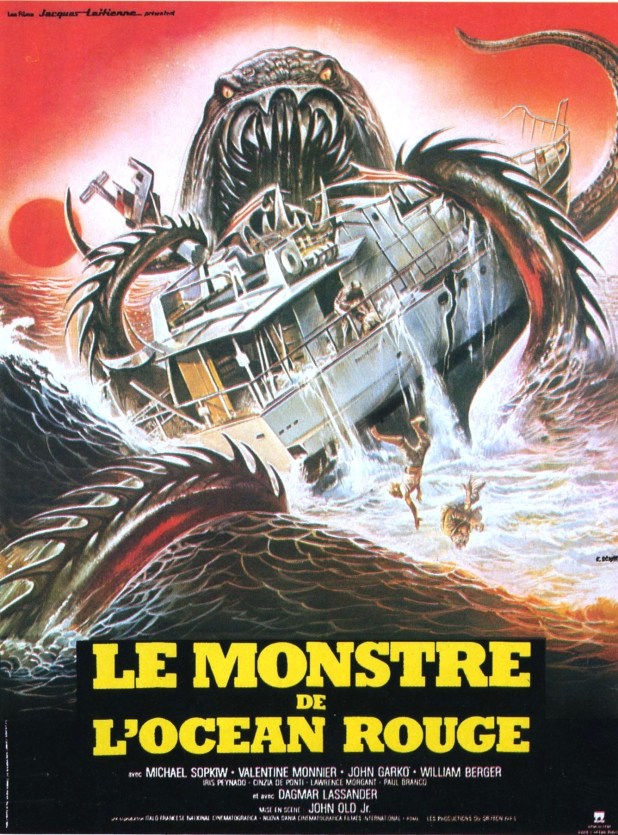
Blastfighter (1984)

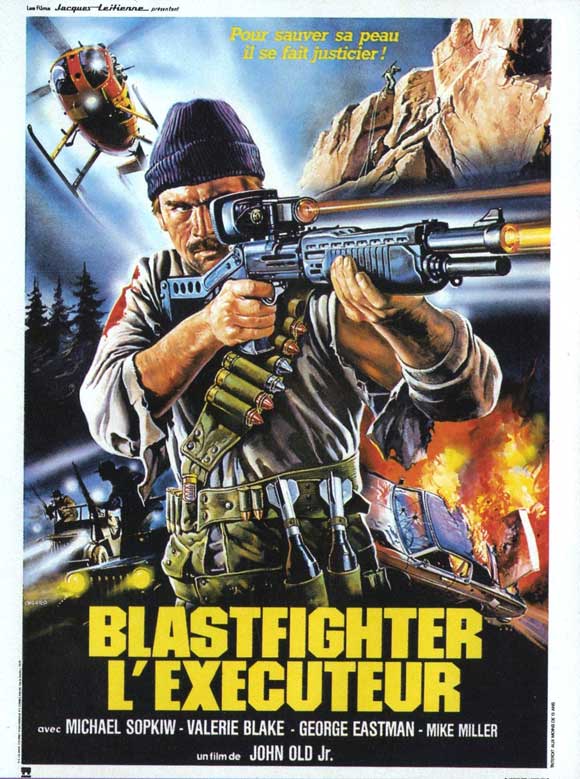
Around a minute into Blastfighter, ex-cop and con Jake “Tiger” Sharp (Michael Sopkiw, 2019: After the Fall of New York) is given the weapon that this movie is named for, a SPAS-12 shotgun that can shoot everything from darts and rockets to tear gas and grenades. He’s promised that every law enforcement officer will have this gun in a few years, but it’s his now. At this point, I was, as they say, all the fuck in.

Tiger was in jail because after his wife was murdered, he shot his wife’s killer at point blank range right in front of his lawyer. Yeah, it turns out that the suspect was the gay lover of the corrupt and sleazy lawyer — because Italian movies — and when he tries to kill that lawyer after his release, he still can’t bring himself to do it. Because deep down, he’s a good guy — because Italian movies. So he decides to go to the mountains to live in peace, burying the Blastfighter.

At this point, Tommie Baby’s “Evening Star” plays. The song was written by Barry, Robin and Maurice Gibb of The Bee Gees and you will hear it in its entirety several times throughout the movie. Please read this paragraph as a dire warning.

Tiger enjoys the wild game that runs past his cabin and adopts a baby fawn, but when local rednecks capture it alive and keep it in pain so a Chinese herbalist can benefit, he tracks down the deer and puts it out of its misery. At this point, the film goes from a revenge film to a remake of Rambo: First Blood.

A girl named Connie randomly moves in with Tiger and ends up being his long-estranged daughter. Yep, our hero didn’t even recognize his own kid. Luckily, they bond and become close, just before the town’s redneck population rises up to get revenge.

Also, to hammer home the redneck town, Billy Redden, the kid who “played” banjo in Deliverance, shows up.

The poachers show up in force, despite the truce between their leader Tom (George Eastman, who starred in Antropophagus and Warriors of the Wasteland and wrote Stagefright) and Tiger. The guys were childhood pals, so Tiger agrees not to kill Wally, Tom’s brother and get over it. But Wally is, well, Wally. You know how Wally is, always killing everyone around someone, even their grown teenage daughter. Yep. Don’t get attached to anyone not named Tiger in this one.

It’s at this point that the Blastfighter is brought back and all revenge is taken. Glorious bloody, awesome revenge.

Blastfighter is packed with Italian genre stars taking a step away from horror and visiting Georgia to make a movie. Like Ottaviano Dell’Acqua, the worm eyed and most memorable zombie in Zombi. And Michel Soavi, director of the aforementioned Stagefright and Cemetary Man, who plays Tiger’s daughter’s boyfriend. And there’s even a score by Fabio Frizzi!

This film was originally intended to be a science fiction film with Lucio Fulci directing, but budgetary issues led to it becoming a strange hybrid of DeliveranceRamboMad Max and a Charles Bronson movie. Dardano Sacchetti (The BeyondDemonsManhattan Baby) wrote the changed script, which was originally part of a two-movie deal along with Fulci’s Warriors of the Year 2072Lamberto Bava (son of Mario, of course, and director of Demons) stepped in to direct this one.

I don’t know if this has come through in this piece yet, but Blastfighter is a weird movie. If you go by the poster, you’re expecting that gun to be used over and over, but it’s kept out of action until the end. With the talent on hand, you’re expecting pure craziness, but that doesn’t really happen until the end. That said, I wasn’t bored at all during this and I’ve endured countless Stallone clones and this is way better than nearly all of them.

That said, I can’t even imagine seeing Fulci try his hand at a film like this. His version of Blastfighter would blow someone’s eyeball clean out of their head!

You can get the Code Red reissue of this at Ronin Flix.

GRANDSON OF MADE FOR TV MOVIE WEEK: Sins of the Past (1984)

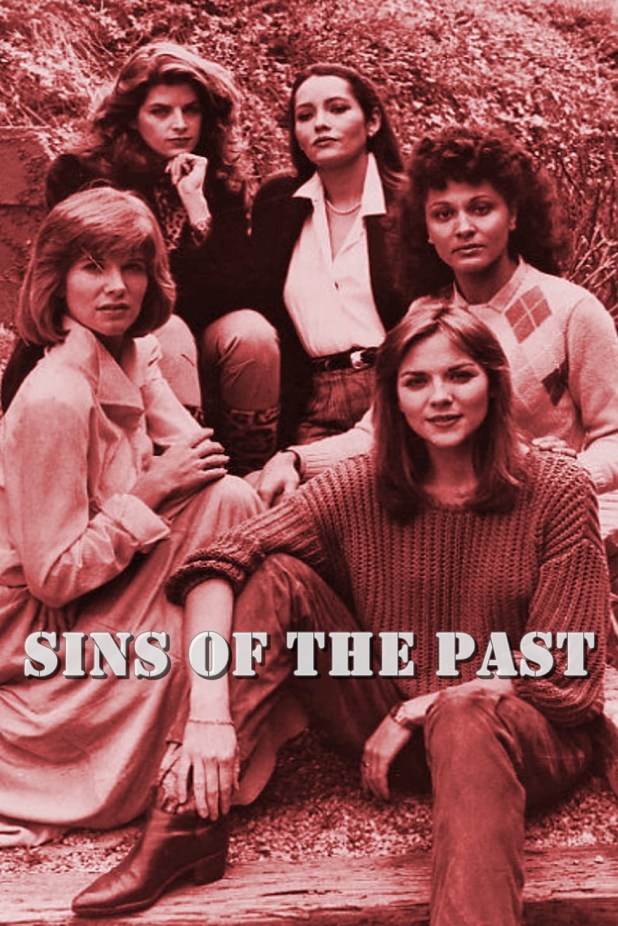
A group of call girls all decide to quit the business when one of them is killed. They change their names, leave town and make lives for themselves over the next 13 years. Then, one of them is killed and the rest soon learn that her killer is looking for the rest of them.

Originally airing on April 2, 1984, this TV movie is pretty much a giallo without black gloved hands or tremendous amounts of gore and nudity. But stylistically, it’s very close in tone.

Terry (Barbara Carrera, Never Say Never Again) was once the leader of the girls, but now she’s fighting for custody of her son. The other girls have all grown into different lives, like Paula (Kim Cattrall), who is a doctor that is being considered to run a hospital, Patrice (Kirstie Alley), an actress and Clarissa (Debbie Boone), who sings gospel music as part of a televangelist’s ministry. None of them can afford to lose their station in life by the — SINS OF THE PAST — coming back.

Anthony Geary from General Hospital is also on hand as a detective that somehow worms his way in Barbara Carrera’s pants. This is one of those films where cops can be total pricks and still lead with the heroine because it was the 1980’s and that’s how writers thought women acted.

Director Peter H. Hunt also directed adaptations of Danielle Steele’s Secrets. This is a very similar type of story, with plenty of red herrings, like the father who killed his daughter that caused all of the girls to go into hiding. This is difficult to find, but there’s always YouTube if you want to check it out.


GRANDSON OF MADE FOR TV MOVIE WEEK: Invitation to Hell (1984)

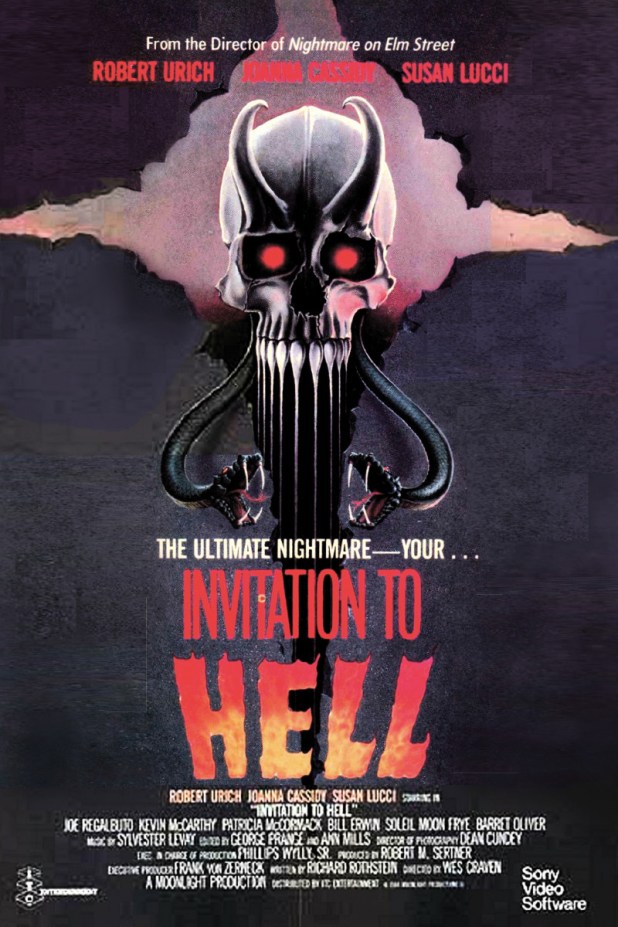
If seeing the names Robert Urich, Joanna Cassidy, Susan Lucci and Wes Craven all together on one movie doesn’t get you interested, I have no idea why you’re reading this site. This movie is everything ridiculous and awesome and wonderful about why I watch these kinds of movies. To wit, Robert Urich donning a spacesuit so that he can see who is a demon and who isn’t as he descends to hell through the country club he probably shouldn’t have joined.

Originally airing May 24, 1984 on ABC, this is the kind of movie that starts with Susan Lucci’s character Jessica Jones getting run over by a limo driver distracted by bikini girls, rising to her feet and roasting the man alive. It gets better from there.

Just watching the credits is enough to make one get excited. Kevin McCarthy from Invasion of the Body Snatchers! Joe Regalbuto from Murphy Brown! Michael Berryman from, well, every 80’s direct to video movie and The Hills Have EyesThe Bad Seed herself, Patty McCormack! And look — Punky Brewster herself, Soleil Moon Frye!

We’re not done yet! Here comes the hero of The Never Ending Story Barret Oliver! Sid Fields, who Jerry adopted on Seinfeld, also known as character actor Bill Erwin.

If this looks better than a run of the mill TV movie, that’s because it has Wes Craven in the director’s chair, during the same year he made A Nightmare on Elm Street and The Hill Have Eyes Part II. It was written by Richard Rothstein, who also brought us Universal Soldier and Human Experiments. Dean Cundy was the cinematographer, so again, this makes the movie look way better than you’d think.

How did this all come about? Well, when Lucci renewed her contract with ABC in 1983, she was guaranteed a movie of the week in the hopes that after years of her gimmick of being always nominated for the lead actress daytime Emmy and not winning, she’d get to win a real Emmy. This film was specifically written just for her.

Whoever saw this movie as award fodder had to have been doing the best drugs that 1984 could produce. Aerospace engineer Matthew Winslow (Urich), wife Patricia (Cassidy) and their two young kids (Oliver and Moon Frye) are reaping the benefits of his big promotion for inventing a fireproof spacesuit that will take man to Venus.

So, of course, his family wants that good life, which includes the Steaming Springs Country Club that keeps you young forever, possesses young children to destroy their toy bunnies and turns wives into sex-crazed maniacs.

Lucci is Lucci in this, out of control and dressed like a character out of V, as Urich dons that suit — it’s actually a G.I. Joe figure for most of the effects — and battles her. That suit comes from the MGM Studio collection, the only one of its like that had official NASA suits at the time. The suit they got was missing a backpack, which had to be designed and made so that Urich didn’t overheat. For this and more insane behind the scenes stuff, this movie’s IMDB trivia page shames nearly every other IMDb trivia page.

Why would the Devil be Susan Lucci? Why would they put the gateway to Hell in a health club? Why wouldn’t Urich just leave his wife when she callously kills the family dog? Why is everyone close to him getting replaced and he’s just fine with it? Why doesn’t anyone realize that the grown up and more dangerous than Satan Rhoda Penmark is in their midst? Aren’t 80’s computer graphics the best?

Most importantly — why are you not rushing to Amazon to buy this?

EVEN MORE FUCKED UP FUTURES: Mad Warrior (1984)

Remember when I said, we’ll get to the sequel to W Is War in the future? The future is now. And in this future, everyone will ride a tricycle with armor and flames all over it.

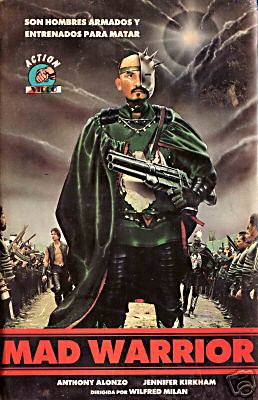
After World War III, the planet is destroyed. But on an island in the Pacific, some survive in a fortified colony and are led by Maizon, a one-eyed cyborg bad guy who makes everyone fight in gladiator battles. Rex, our hero, tries to escape with his son, but he is caught and his son is killed. Oh yeah — Maizon also killed his father and wife, too!

Rhea helps him escape, taking him to the scientist colony Ophelos, where her father, Zeus, leads a peaceful people.

Let me tell you a few other things about Maizon. He often takes off his armor to reveal that his face is all scarred up. He can’t give up on his dream of seeing Rex’s blood stain the sands of his arena red. He has armies of gladiators ready to die for him. He raw dogs a black girl in the dirt while his entire army turns their back. And oh yeah. He’s a werewolf.

Look — any movie that starts with a two-minute long nuclear explosion set to disco music is going to be one that I grow obsessed by. This movie is bonkers. Every outfit is great. Every character is awesome. Every line of dialogue is unhinged.

There’s a scene where a gladiator salesman tells Maizon all about his gladiators that is full of wonderfully bad acting, sparklers and maniacal goofball laughter.

The final scenes of this movie are everything you want a film to be: explosions, tricycles, gladiator fights, machine guns, militaryesque hand signals, an army of dudes with mashed spiked mohawks, literally bad guys by the thousands getting mowed down by machine gun fire to the sounds of disco synth, people on fire, more explosions, a nice wood fence, a subterranean cave base, slow death reactions, leaping martial arts, axes, running, even more explosions, one hit kills, guns that shoot knives, a lightsabre duel, a bad guy blowing up real good, sparklers, a makeout session over the dead body of the previously mentioned bad guy and so much more.

The love interest closes the film by telling our hero, “You’re really crazy. Crazy like a mad warrior.” He rides his horse off into the sunset and I start screaming like a maniac. This movie. This movie!

Cult Action has this. I would advise getting it now and starting your own gladiator army!

STEPHEN KING WEEK: Children of the Corn (1984)

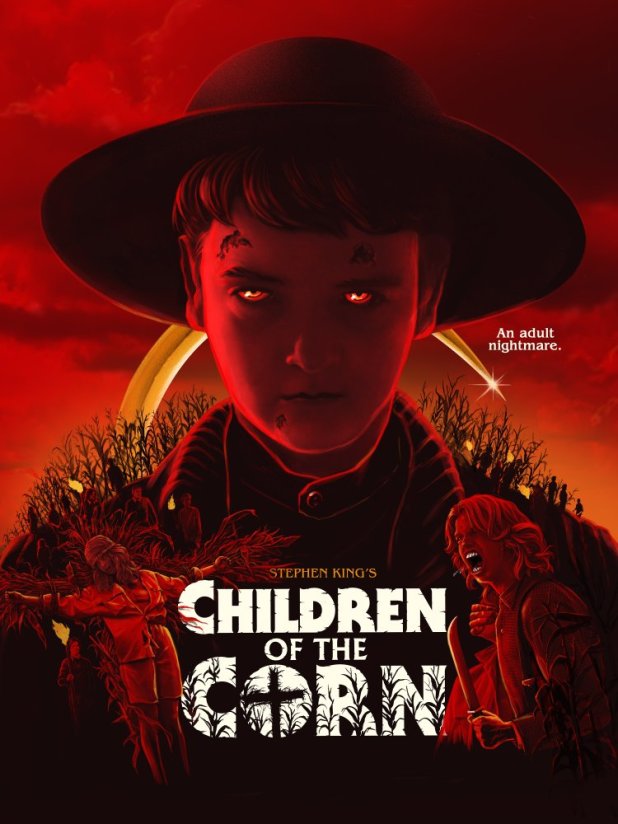
Children of the Corn started as a short story first published in Penthouse Magazine that was later collected in the 1978 book Night Shift. It’s a story incredibly similar to Tom Tryon’s novel (and the film) The Dark Secret of Harvest Home. You could also draw parallels to Narciso Ibáñez Serrador’s Who Can Kill a Child? or Village of the Damned.

Did you know that Children of the Corn was filmed once before? A short film called Disciples of the Crow was made in 1983 that’s an abridged version of this story.

This one was produced in 1984, with Gor and Tuff Turf director Fritz Kiersch at the helm. Burt and Vicky (Peter Horton and Linda Hamilton) are on their way to California when they drive through the cornfields of Nebraska and accidentally hit a young boy. However, when Burt exams the kid, it turns out that his throat had already been slit. Uh oh.

As they examine the boy’s suitcase, they discover a crucifix made of twisted corn husks. They head to the next town, Gatlin, to alert the authorities.

They come across a mechanic who refuses them service. The truth is that he is the last adult in Gatlin. He’s agreed to supply the children with services and fuel for his life, but the enforcer of the town, Malachai breaks the pact and murders him, angering their leader Isaac.

When Burt and Vicky get to town, everything is out of date and there’s a bad feeling in the air. Even worse, no one seems to be in town. They find a little girl named Sarah alone in a house, where Vicky stays while Burt explores. Malachai soon appears, capturing Vicky and taking her to be sacrificed in the cornfield.

The only thing in town that’s in shape is the church. Inside, Burt learn the truth of Gatlin — twelve years ago, everyone over nineteen was killed and the children took Biblical names after their murders.

Now, they live under this religious order that demands that everyone over nineteen must be sacrificed. During a blood-drinking ritual, Burt starts to yell at the children. They chase him until another young boy named Job rescues him and they hide in a fallout shelter.

Isaac and Malachai argue, with the older boy taking over and ordering his leader to be sacrificed. Isaac warns that this will anger their covenant with He Who Walks Behind the Rows and the children will be severely punished.

That night, Burt goes to rescue Vicky and a horrible special effect devours Isaac. Seriously, this weird chroma key fuzz looks incredibly dated.  Anyways, Burt fights to save his wife and a possessed Isaac reappears and breaks Malachai’s neck.

A storm appears as Burt, Vicky and the two children decide that they must destroy the cornfield with gasoline and fire. They escape the town, taking the kids with them, their marriage somehow saved and they even discuss adopting the kids (but not before a sneak attack by Ruth is foiled).

This overly happy ending stands in marked contrast to the downbeat tone of the novel, where Vicky is sacrificed and Burt is killed by the creature in the cornfield. The creature punishes the town by lowering the sacrifice age to eighteen, so Malachi and the elders all walk into the cornfield to die as Ruth wishes that she could kill He Who Walks Behind the Rows.

If you’re wondering where Gatlin is in regards to King’s connected universe, the next town over is Hemingford Home, where Mother Abagail gathered her forces in The Stand.

There are eight sequels to this film, as well as a Sy Fy remake that aired in 2009 with an ending much closer to the King novel. Seeing as how we have every single one on DVD, it seems like I’ll be reviewing those soon.

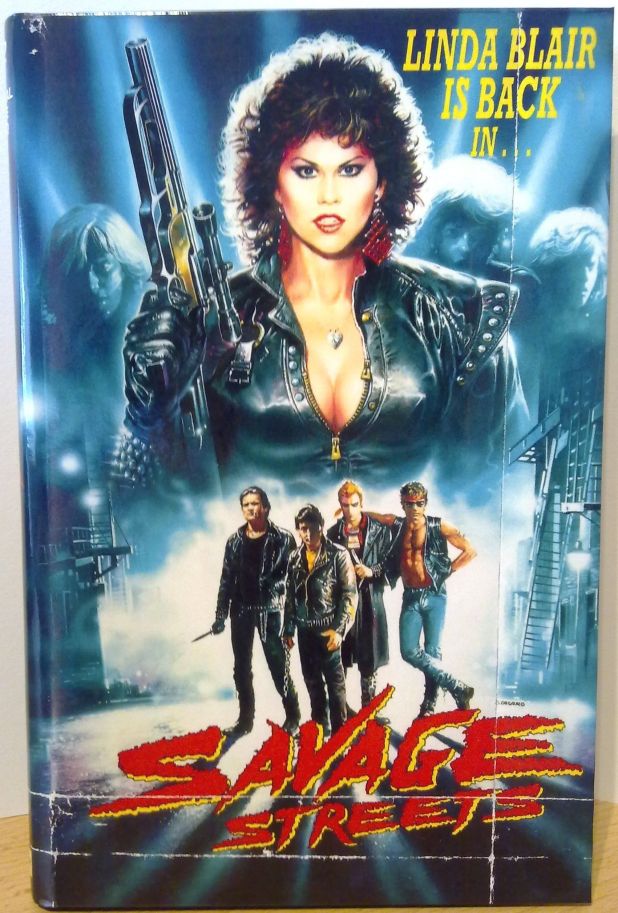
Savage Streets (1984)

If I were writing this review at any time other than 4:40 AM and had more than two hours sleep in the past two days, I wouldn’t be full of hyperbole, pacing through my house, mumbling to myself things like, “Savage Streets is the greatest movie ever made!” and “Why did they make any more movies after this?”

I often discuss movies with my dad and I often describe ones I love as “a piece of shit, but an entertaining piece of shit.” Was I more lucid, that’s probably how I’d describe this film. But seriously, this movie has everything you want to watch in the middle of the night. It is unapologetically 1980’s exploitation filmmaking, a roughie that would never hit the scream today, small or large.

I was trying to suffer through Dude Party Massacre 3 on Shudder. It’s a movie that’s getting a lot of buzz. And I can see why some folks would like it. It’s very Adult Swim in tone, execution and humor. It also reminds me of a Troma movie and my sense of humor is one that enjoys the strangeness that comes from an earnest yet deranged slasher like Don’t Go in the Woods more than something that sets out to be silly for the sake of being silly. To be honest, I was a bit depressed, because I was hoping for something more.

I’ve had Savage Streets in my Amazon Prime queue for some time. It was time for it to rescue me from my doldrums.

Imagine if Pat Benetar’s “Love is a Battlefield” lasted for 93 minutes.  Also, imagine if Pat didn’t use dance to defeat the rival gang, but instead had a crossbow. That is the best summation of this movie that I can give you.

Brenda (Linda Blair, and if I have to tell you what other films Linda has been in, you can never read our site again) and her deaf-mute sister Heather (Linnea Quigley, the only scream queen I know who put out a workout tape) are wild in the streets with their gang the Satins, looking at Playgirl Magazine while dressed as only folks in the 80’s could dress. They keep getting into scuffles with a gang called the Scars, ending with the girls stealing and trashing the gang’s car. Jake, their leader, vows revenge after Brenda goes even further by scratching his face.

Well, he and the gang waste no time. While Brenda is fighting another girl in a locker room brouhaha, the gang isolates her sister and rapes her. You may notice that the gang seems to be more interested in touching one another than touching her sister. Two of them even embrace one another and kiss. These are the kinds of things that you will unexpectantly see in this film. It’s one that rapidly switches tone, going for the darkness of man on woman crime to a wacky scene where the students put drawings of penises on a health room chart. It is a movie that will change that tone on a dime, ensuring that you are never ready for what happens next.

The Scars up the ante by killing Brenda’s soon to be married and pregnant friend Francine (Lisa Freeman, Back to the Future). There’s a Pretty Woman like scene of the girl trying on her wedding dress while everyone watches and again, you aren’t ready for the tonal 180 when the gang throws her off a viaduct.

Meanwhile, policing all of this insanity at the high school is John Vernon as Principal Underwood. He seems like he is barely containing himself from killing every child that is in his educational system.

Earlier in the film, Brenda and her girl gang notice bear traps are on sale. This seems like something that totally makes no sense. Not so. Because when Brenda hunts down the Scars, she uses one of those traps to kill one of the gang members by snapping it onto his neck. Then she takes a crossbow after the rest of the gang.

Sure, Jake escapes. But he really should have stopped when he could have. Brenda douses him in paint and sets him ablaze, just in time for a cop to pull up and watch the guy die. What school do these girls go to?

All of the girls visit Francine’s grave and Brenda comments, “At least we set things right.” Her friend Stevie earnestly looks at her and says, “No Brenda. You set things right.” I almost set my couch on fire in pure joy.

Danny Steinman has few movies on his resume but, chief among them Friday the 13th: A New Beginning, a film I described as “the scummiest, vilest Friday of them all,” as well as The Unseen and this film. And now I’m sad, because I wish he made a hundred movies, ninety-nine of them being sequels to Savage Streets. It also has uncredited direction from Tom DeSimone, who crossed over from porn to make movies like ChatterboxHell Night (also with Linda Blair!), Reform School Girls and Angel III: The Final Chapter.

PS – I am loving this long interview with Steinman that you can find right here.

Cherie Curie from the Runaways shot at least one day of footage as the lead in this film before Linda Blair took over, but I can see no one else as Brenda in this movie.

There’s also a subplot that doesn’t matter much at all, with Brenda facing off with cheerleader Cindy over her boyfriend Fadden. Also — Faden owes Jake tons of money for coke.

I really need to let you know how great Robert Dryer is as Jake. He’s pure menace, bringing an edge to this film that shocks you with its brutality.

Also — the dialogue! From the principal yelling, “Go fuck an iceberg!” to Jake intoning ” I am going to cut your heart out and eat it!” and nearly everything Brenda says, this movie is packed with quotable quotables.

This is on Amazon Prime, which is great, because the DVD and blu-ray releases are out of print. It’s the kind of movie that feels so good before the sun comes up. Go Brenda! Shoot those Scars up! Use the beartrap!

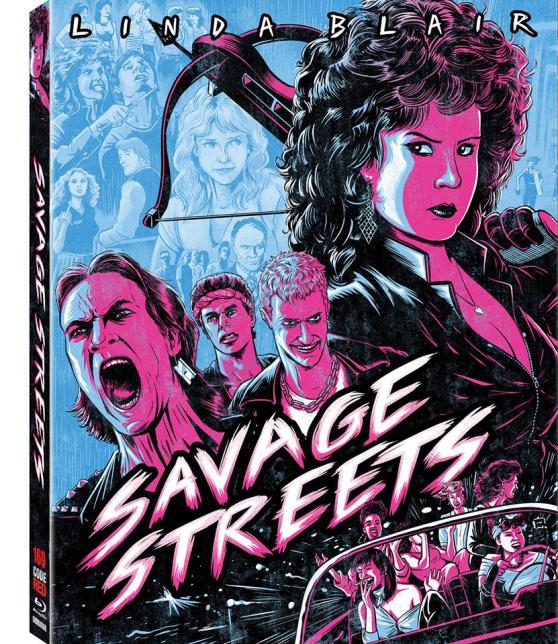
UPDATE: Kino Lorber will re-issued Savage Streets on January 5, 2021, with pre-orders generally sent several days in advance of street date. The Blu-ray is loaded with extras featuring audio commentary tracks by actors Robert Dryer, Johnny Venocur, and producer John Strong, along with actors Robert Dryer and Sal Landi discussing the film with cinematographer Stephen L. Posey. In addition, director Danny Steinmann and producer John Strong, along with actors Linda Blair, Linnea Quigley, Robert Dyer, Johnny Venocur, Sal Lindi, and Scott Mayer each offer their own interview segments.

You can also pick up DVDs from RoninFlix! Check out this awesome new cover!

44373166_2154966901182925_1040811150100398080_n

MESSED UP AND MUSICAL: Streets of Fire (1984)

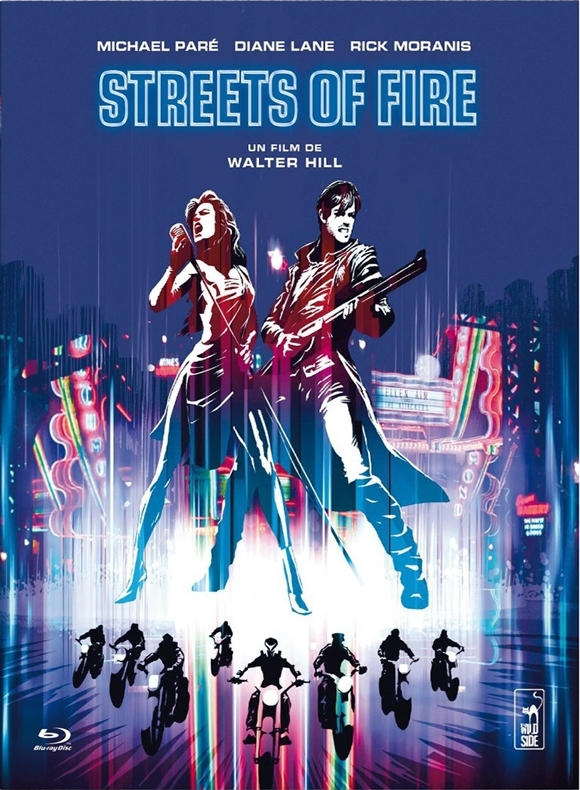
Streets of Fire is no ordinary movie. It is, as the poster promises, “a rock ‘n roll fable.” It also feels like it comes from a reality unlike our own, a place of perpetual night, thanks to a majority of the film being shot on two large sets that were covered in a tarp 1,240 feet long by 220 feet wide. Outside of night shoots in Chicago, it’s basically a soundstage film, which adds to its otherworldly feel.

The Chicago in Streets of Fire is a world where it rains all the time, where neighborhoods have their own color palette and people speak in an exaggerated tough guy language that led Roger Ebert to say that this was the way “really mean guys would have talked in the late 1950s, only with a few words different — as if this world evolved a slightly different language.”

Director and writer Walter Hill (48 HoursThe Warriors) wanted to create a new action hero, something that felt like a comic book that wasn’t based on any existing character, the first in a new franchise of films about a character called The Stranger (who became known as Tom Cody). Oh yeah. It was also going to be a musical.

Hill’s vision was to create a film that had everything he loved as a teenager: “custom cars, kissing in the rain, neon, trains in the night, high-speed pursuit, rumbles, rock stars, motorcycles, jokes in tough situations, leather jackets and questions of honor.”

He had other rules: no one under the age of 30 and because he saw the film as a fairy tale, the violence was to be stylized. No one was to die.

After clashing with Paramount head Michael Eisner over the film feeling similar to an Indiana Jones film (no one would have that argument after seeing the final product), Hill sold the film to Universal. Named for the Bruce Springsteen song, you’d think that Bruce would be included on the soundtrack. Indeed, music is incredibly essential to the final film, so Meatloaf and Alice Cooper co-conspirator Jim Steinman came in to write the song that closes the film, “Tonight is What it Means to Be Young.” The song was so good — it was written in two days, believe it or not — that it led to a $1 million reshoot, as the film had the Springsteen song already shot as the ending.

Again, the final product is just strange. Co-writer Larry Gross (the writer of 48 HoursTrue Crime and Prozac Nation)  had a moment late in the production where he realized that “this movie is somewhat weirder than we thought.” He said the failure of the film was because “our commitment to be stylized was thorough and conscious and maybe too extreme for the mainstream audience.”

In another time, another place, in an unnamed city, rock star Ellen Aim (Diane Lane, known to today’s moviegoers as Martha Kent in the DC Comics movies) returns home to put on a show with her band, the Attackers. However, The Bombers, a motorcycle gang led by Raven Shaddock (Willem Dafoe, The Last Temptation of Christ, 2009’s Antichrist, not the one with the goat licking), kidnaps her.

Reva Cody (Deborah Van Valkenburgh, Mercy from The Warriors) hires her brother Tom (Michael Paré, The Philadelphia ExperimentEddie and the Cruisers) to rescue Ellen (who also happens to be his ex-girlfriend). He brings in McCoy (Amy Madigan, The Dark Half), a fellow ex-soldier who can drive anything. And Reva brings in Billy Fish (Rick Moranis, GhostbustersStrange Brew), Ellen’s manager and boyfriend.

What follows is stylized action with Cody and McCoy breaking into the gang’s base and rescuing Ellen, all while the rock star argues with Cody as to why he saved her. She thinks it was about money and he tells her that at one point in his life, he would have done anything to save her. But now, it’s all changed.

Finally, Cody decides to leave Ellen behind, as he can’t see a future where he can be what she needs him to be. He has a final battle with Raven, which he wins, and Raven is carried away by his gang. After one final goodbye, Cody and McCoy ride off into the neon, rain-soaked night. Basically, the movie ends like Casablanca.

Streets of Fire is packed with great minor characters that populate its strange world. EG Daily (Dottie in Pee Wee’s Big Adventure and the voice of Tommy Pickles on Rugrats) plays Baby Doll. Richard Lawson (Sugar HillPoltergeist and the stepfather of Beyoncé and Solange Knowles) plays a police officer who tries to keep Cody and Raven apart. Bill Paxton plays a bartender. And Lee Ving from Fear is even in the film (he also played Mr. Boddy in Clue, which is a great trivia question if you ever want to use it). There’s even a fake band, The Sorels, made up of actors Stoney Jackson, Grand Bush (Balrog in Street Fighter), Mykelti Williamson and comedian Robert Townsend.

You can see the influence of Streets of Fire in some interesting places, mainly in the video games and animation of Japan. Capcom’s Final Fight owes a big debt to the film. And the anime Bubblegum Crisis has featured musical sequences and songs that were taken almost 100% from the film. Here’s a great distillation of the Western influences that shaped that anime:

I can’t speak objectively about this movie. I love it. I love that it’s so completely off the rails, that it is not tied to our real world at all, that it’s a musical, that it appears to be based on something but it’s actually an original story. I remember watching it on VHS as a teenager and wishing that everyone in the film was a real person that I could spend more time getting to know.

There were plans to do two more Tom Cody films — The Far City and Cody’s Return, but the failure of the film ended those plans. However, Albert Pyun (The Sword and the SorcererDollman) directed 2008’s Road to Hell, an unofficial sequel that has Paré as Cody.

Shout! Factory has finally come to the rescue of everyone who wanted this on blu-ray and released what is the definitive version of the film. I suggest that you purchase it immediately, as I need more people to talk about this movie with!