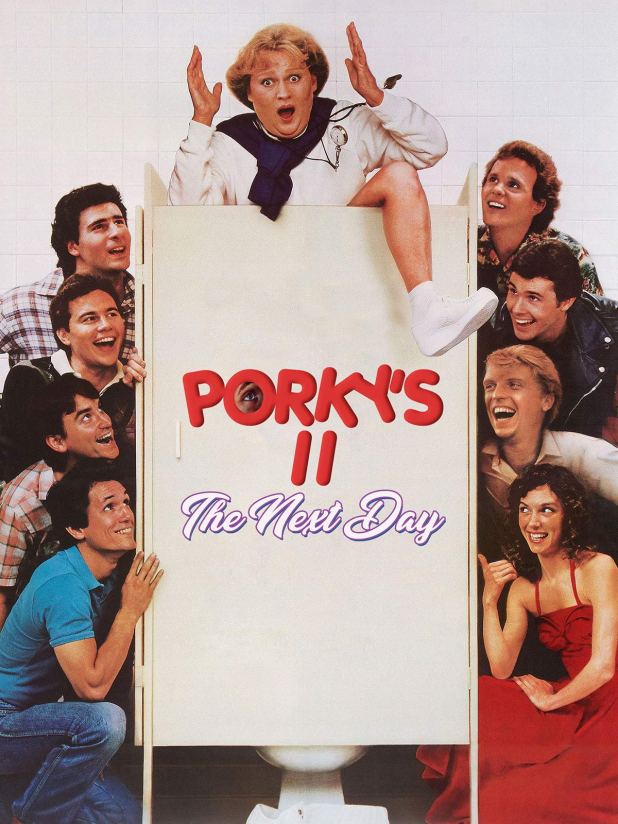
APRIL MOVIE THON DAY 2: Porky’s II: The Next Day (1983)

After the success of Porky’s — success is a small way to describe how influential it was on the movies that would follow in its wake, even if it owed so much to Animal House and Lemon Popsicle — the next film was in production quickly. Directed and co-written by Bob Clark, who worked with Alan Ormsby and Roger Swaybill, the results may not live up to the original, but it’s way better than the teen sex comedies that would arise after the first movie.

It also made much less than the first movie, but when you’re bringing $33-50 million, depending on source, from a $7 million budget, you can consider this a financial if not artistic success.

So why would Clark come back and make this? Because the producers didn’t want to make A Christmas Story. If Clark made this, he could make that movie, so things worked out pretty well.

The sequel gets its start with “Pee Wee” Morris (Dan Monahan, who is also in Joe D’Amato’s Paradisio Blu) bragging about losing his virginity. Yet that won’t stop his friends Tommy Turner (Wyatt Knight), Billy McCarty (Mark Herrier), Tim Cavanaugh (Cyril O’Reilly), Brian McCarty (Scott Colomby) and Anthony “Meat” Tuperello (Tony Ganios) from pranking him at every opportunity. They’re also part of the Angel Beach High School Drama Club, which is in danger of being canceled before they can produce their Shakespeare Festival thanks to religious leader Bubba Flavel, his “Righteous Flock” which includes Balbricker (Nancy Parsons) and the Klan, who are all upset that the actor playing Romeo — John Henry (Joseph Runningfox), a Native American — will be kissing the white Juliet — played by Wendy Williams (Kaki Hunter, who was also an architect and left acting to teach white water rafting, which is a shame, because she’s really good in this).

I know that these movies are looked down upon as low culture, but the scene where Graveyard Gloria acts dead after Pee Wee touches her, leading to him being chased as a grave robber, man — I confess I couldn’t stop laughing.

Porky may not be in this, but it tries to increase the social commentary — well, from nothing to something — and I love sequels that begin the very next day. Horror fans should look for Richard Liberty (Dr. Logan from Day of the Dead) as Commissioner Couch, Art Hindle (Black Christmas) as Officer Ted Jarvis, William Kerwin (Blood FeastTwo Thousand Maniacs!) as Boa Man and a brief cameo by Seth Sklarey, who was Orville in Children Shouldn’t Play With Dead Things. Even better, the love scene between Pee Wee and Wendy has music from Curtains in it.

Lovers of Clark’s movies will enjoy the appearance of another mannequin leg, this time used in a comedic sword fight instead of as lighting.

You can watch this on Tubi.
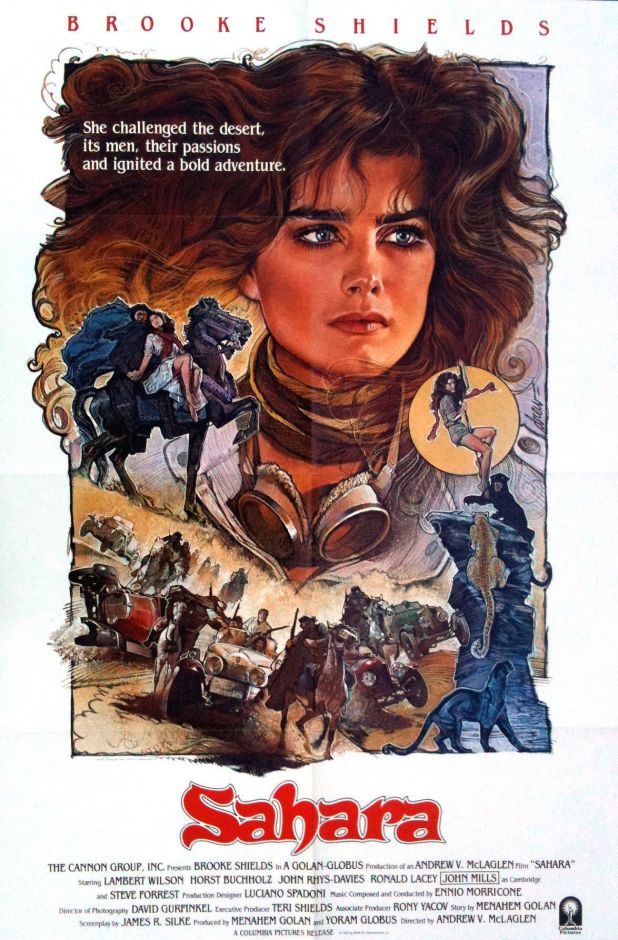
CANNON MONTH: Sahara (1983)

What gets this movie made?

Could it be that British Prime Minister’s son Mark Thatcher got lost in North Africa during an auto rally? Maybe the idea that Brooke Shields could be the next Indiana Jones? Or did Menahem Golan love The Sheik so much that he’d pay for this and Bolero?

That meant bringing in Brooke’s manager mother — momager — Teri, who would say, “I don’t want anyone looking at her like a woman yet. It’s not time.” She also asked for eight rewrites and two directors — John Guillermin was one — quit before the cameras rolled.

As for Menahem, he said, “Brooke is the most beautiful creature on earth She is the genie of the desert and Lambert (Wilson, who plays her love interest) is a wildman, but educated. He wants to rape her, but he controls himself. We are not afraid here of clichés. I want a beautiful romantic blockbuster where all American kids will identify.”

Yes, American kids identify with sexual assault.

With costumes by Valentino and no expense spared, this didn’t really it the screens. It just kind of made its way two months late — and only west of the Mississippi — after poor previews.

Gordon (Steve Forrest, Mommie Dearest) has created a new racing vehicle for the Trans-African Auto Race but dies before he can enter. His daughter Dale (Shields) disguises herself as a man — I mean, as much as she can — and enters the race as her father with the help of his friends.

So yes, to get Brooke Shields in a Cannon movie, one that she’d dress like a man and not be the sexy Brooke audiences wanted for the entire movie, cost Cannon $1.5 million just to get her in the film. Her mom got $250,000 to be an executive producer.

Menahem had written the original script and wanted to direct it, but Teri claimed that it had “too many rape scenes and too much gore.” As it was, Menahem kept overruling director Andrew McLaglen and tried to direct the movie. This led to an accident where Golan pushed Brooke to drive a convertible faster and faster. The car flipped, launching him, her and a cameraman from the vehicle. No one was seriously hurt, but that’s an example of how nuts this movie was to make.

But hey — it has a score by Morricone!

So many of the movies this month were researched with the help of Austin Trunik’s The Cannon Film Guide Volume 1: 1980-1984. You need to buy this book.

You can listen to The Cannon Canon episode about Sahara here.

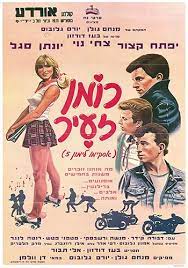
CANNON MONTH: Baby Love (1983)

If you’re going to do every Cannon movie, you’re going to end up doing nearly every Lemon Popsicle movie.

Somehow, this is the fifth movie in the series — Lemon PopsicleGoing SteadyHot Bubblegum and Private Popsicle proceed this, with Private Maneuvers being a side story, and then you follow that with Up Your AnchorYoung LoveSummertime Blues and Lemon Popsicle: The Party Goes On — and for some reason, I feel like I need to see every one of them.

Dan Wolman, who also directed Nana and Up Your Anchor for Cannon, steps in for Boaz Davidson, who co-wrote the script with Wolman and Eli Tavor, who was involved with nearly all of the movies in the series.

Benzi/Benny (Yftach Katzur), Momo/Bobby (Jonathan Segal) and Yudale/Johnny (Zachi Noy) are back and this time, Benzi is in love with Momo’s sister Ginny (Stefanie Petsch) and that means the two friends soon turn into enemies. Bea Fiedler, who was in Jess Franco’s Linda, plays a dental hygenist who is, of course, as into sex as the boys. As a former centerfold for German Playboy, one imagines that she’s in these movies because they were as big in that country as their native Israel.

As always with these movies, there’s a huge soundtrack to go with all of the sexual shenanigans, with everything from “Tiger” by Fabian, “The Girl Can’t Help It” by Little Richard, “Apache” by The Cherokees and “Only Sixteen” by Sam Cooke in the movie. If those last two songs sound problematic to you, you may not want to watch any of this movie.

CANNON MONTH: The Wicked Lady (1983)

Michael Winner.

Oh, Michael Winner.

He called the film “Bonnie and Clyde in the 17th century” and sure, I guess it is, but it’s also filtered through the lens of, you know, Michael Winner.

And Faye Dunaway, the star of this movie agreed, saying “I really feel it will be a fun picture. A period romp, it’s a mixture between Bonnie and Clyde and Tom Jones.” She also claimed that it was “the only film I’ve ever enjoyed making,” but hey, she was coming off Mommie Dearest, a movie that she found “harrowing” and critics destroyed.

Cannon sealed the deal by purchasing a film that Dunaway and her husband — and Winner’s friend — Terry O’Neill had wanted to make, Duet for One, which Cannon would still make with neither involved.

As for Cannon head Menahem Golan, well it all came down to money. “Stars who would never have worked with us before are now happy to sign. We pay them peanuts — but we give them big percentages. Faye, Alan and John were happy to sign for The Wicked Lady because they have 50% of the film. And we have small overheads, so they’ll get their money.”

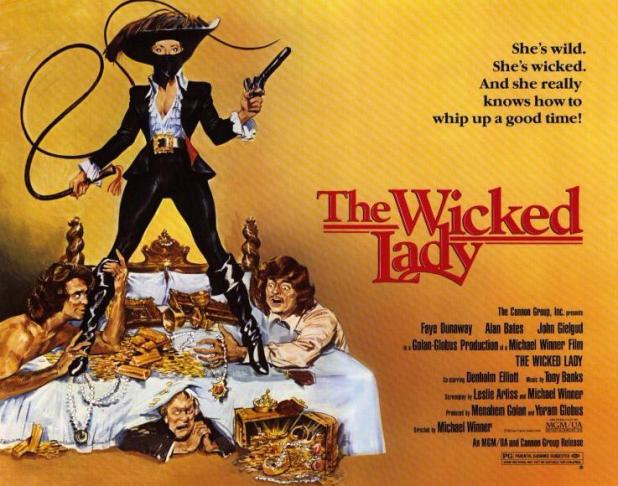
Caroline (Glynis Barber) is about to be married, so she invites her sister Barbara (Dunaway) to be her maid of honor, but within seconds she’s scooped up Caroline’s man, Sir Ralph Skelton (Denholm Elliott). But money don’t matter tonight. She wants the thrill, so she soon hooks up with a highway robber Jerry Jackson (Alan Bates) and starts alternately having rough sex with him when she isn’t stealing from the very upper crust that she’s part of.

Of course, she also has a whip fight with future Deanna Troi Marina Sirtis that so upset British censors that they demanded it be removed. Winner refused to cut the notorious sequence, gathering luminaries such as Lindsay Anderson, Karel Reisz and John Schlesinger, as well as author Kingsley Amis to defend his movie. And it worked!

None of these folks had seen Winner personally cutting Sirits’ costume with scissors to ensure the most skin possible.

But hey, it was Winner’s dream to make this movie since he was a kid, as he’d loved the 1945 original but thought it needed more than to be set in a studio. He probably also wanted more woman on woman whip violence.

In the documentary Electric Boogaloo: The Wild, Untold Story of Cannon Films, Sirtis would say that she felt that this movie could have been Winner’s grab for respectability, but then he wanted so many nude women in the film.

This is the kind of movie that Sir John Gielgud picked after winning a Best Supporting Oscar for Arthur. That said — it did seem like it had some class. Some. And Winner would shoot it with cinematographer Jack Cardiff, who upset Dunaway at one point because of a camera angle issue. Cardiff got mad and demanded that Winner fire her, but Winner told him that Dunaway was the lead. So he sucked it up and made the movie. I mean, this is the man who shot The Red ShoesThe African QueenGhost Story and directed The Freakmaker. More class? How about a soundtrack by Tony Banks from Genesis? No?

So close to the original that that film’s writer Leslie Arliss is credited as a writer, this all starts over losing a brooch in a bet and turns into a life of crime. And by crime, I mean killing villagers and both poisoning and suffocating Gielgud, who is Rasputin-like in his ability to stay alive. There’s also a public hanging that — spoiler — Jackson survives, only to be murdered moments later by our female antagonist. And then she gets her heart broken.

Dunaway joked about making a sequel — Daughter of Wicked Lady — in which she would be an older and wiser Lady Barbara Skelton, who is raising a wicked daughter.

I’d watch that.

You can watch this on Tubi.
So many facts about this movie we referenced from Austin Trunick’s perfect The Cannon Film Guide Volume 1: 1980-1984. Buy this book.

You can also listen to The Cannon Canon episode about this movie here.

CANNON MONTH: Revenge of the Ninja (1983)

Sam Firstenberg’s second movie after One More Chance, this movie is way better than someone’s sophomore movie should be. In fact, it’s the kind of movie that makes me leap off my couch like some kind of maniac and scream dialogue back at my TV.

After all, “Only a ninja can kill a ninja.”

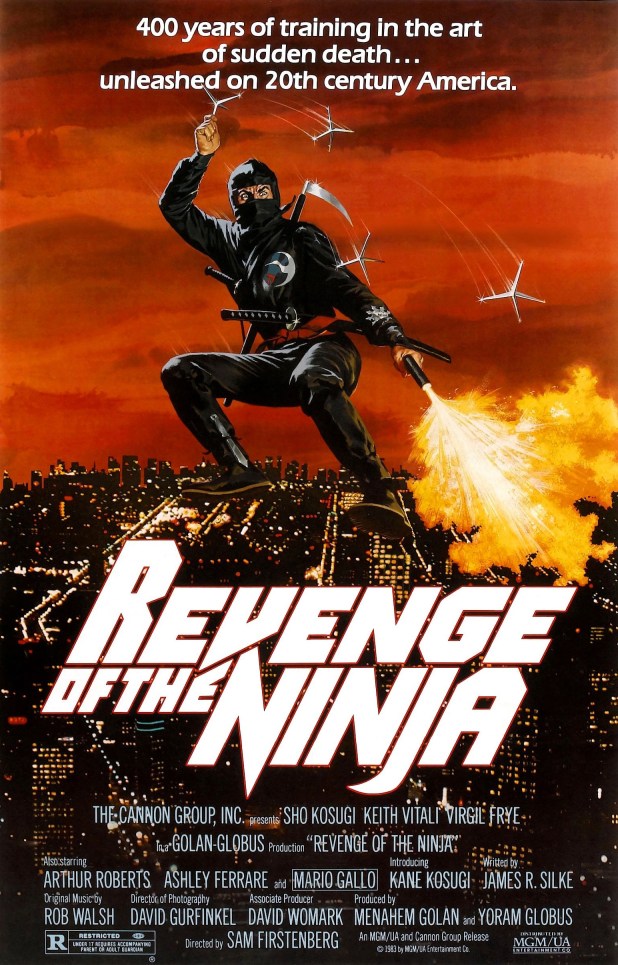
Made with the assistance of the Utah Film Commission, who promised no permits, location fees or union deals as well as lower salaries for local crews, Revenge of the Ninja starts in Japan, where Cho Osaki (Sho Kosugi) is attacked by ninjas who kill everyone in his family other than his mother and son (Sho’s son Kane while his other son Shane is the child who is killed with a throwing star right to the head). After killing everyone who dared attack his home, Cho moves to America where he starts an Oriental art gallery with his friend Braden (Arthur Roberts) and their assistant Cathy (Ashley Ferrare).

The entire store is a lie, a fact that Cho has no idea about, as the dolls they sell are full of drugs. A mob boss named Caifano (Mario Gallo) is working with Braden, but when their deal doesn’t work out, Braden wears a silver mask and becomes an evil ninja crime boss. Dave Hatcher (Keith Vitali, once listed as the top fighter in the U.S.) is on the case, hoping that Cho can explain ninjas to him, but he’s retired and wants nothing to do with the world of assassination.

Caifano sends his men to attack the store and then Braden attacks the store afterward, which ends up with Cho’s mother dead and son kidnapped. He then hypnotizes Cathy, who breaks free and tells Cho that his best friend is his greatest enemy and a ninja. Cho must get over his vow to never be a ninja again and scale a building to fight ninja against ninja on the rooftop, a scene that took two weeks to film and every single second was worth it. How many movies have ninjas fighting with fire?

Revenge of the Ninja also breaks with reality to give us mob goons that dress like Native Americans (Don Shanks!), stunt coordinator Steve Lambert playing nearly every ninja that’s not Sho Kosugi and a bad guy who can hypnotize people, create duplicates and teleport. There’s also the absolutely berserk ending battle which can only end with blood spraying everywhere.

Let me tell you, as an eleven-year-old when this came out, school children non-stop talked about this movie. I would stare at the box in my mom and pop neighborhood video store and wonder, “Why does a ninja need a flamethrower?” I’d argue that this is the best movie that Cannon would make, a non-stop thrill ride that I’ll never get bored lining up for over and over again.

For more info on all things Cannon, get Austin Trunick’s The Cannon Film Guide Volume 1: 1980-1984.

Check out The Cannon Canon episode about Revenge of the Ninja here.

CANNON MONTH: Young Warriors/The Graduates of Malibu High (1983)

Intended as a sequel to Malibu High, which is itself an absolutely berserk film that has a poster that promises summer love and delivers a nihilistic blast of hatred, Young Warriors is possibly directed* by Lawrence David Foldes, the one-time teen wunderkind — or publicity machine, the jury is out — who made Don’t Go Near the Park before he turned twenty and produced the aforementioned Malibu High at the same time.

Produced by Victoria Paige Meyerink, who was once Danny Kaye’s TV daughter and at the time of this movie’s creation, the wife of Foldes and another twenty-something mover and shaker, the resulting film is like nothing before or since. I’m not sure if that’s a good or bad thing.

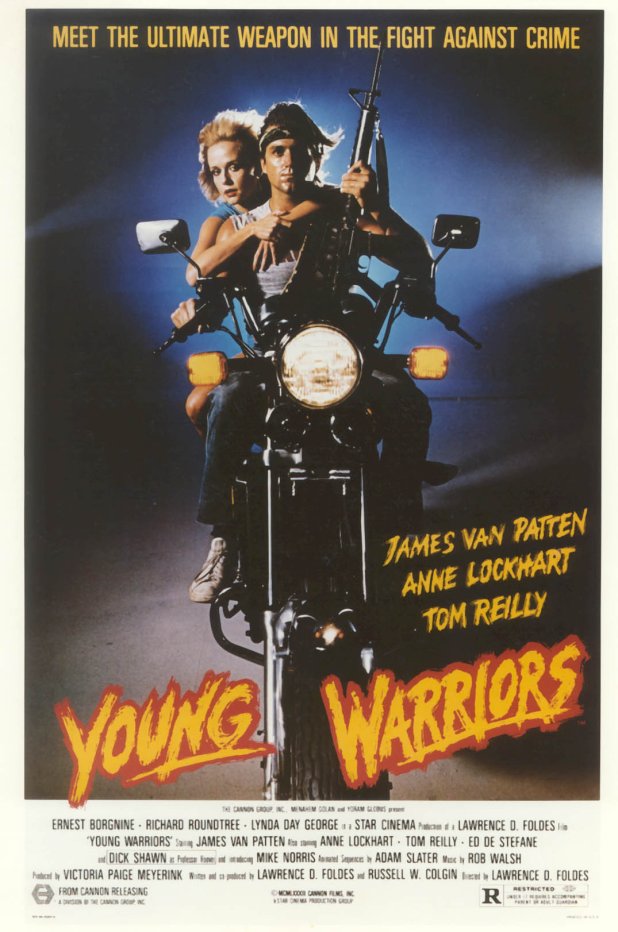
The first part of this movie seems like a teen comedy, with Kevin Carrigan (James Van Patten) and his frat buddies Fred (Mike Norris, brother of Chuck) and Stan (Ed De Stefane), chase Linnea Quigley nude from their bed and pull off pranks like tying pledge’s cocks to bricks and then tossing said masonry, appendages be damned. You may think that this entire movie is going to be a wacky story about their hijinks, but Young Warriors decides to rug pull you throughout the film.

So when another frat guy named Roger (Nels Van Patten) is getting a copy of Dr. Alex Comfort’s The Joy of Sex and re-enacting it with a librarian in the stacks, as well as the rest of the guys shaving a pledge’s ass and making him pick up a cocktail olive with his butt, drop it in some vodka and drink deep, that’s when we discover Kevin’s sister Tiffany coming home from the prom. As if the future ghost of Michael Winner is directing this with his ethereal perverted old man hand, she and her date are chased home from the prom and assaulted. This scene is intercut with the frat guys riding a horse through a party and then you remember, oh, this is a Cannon movie.

That’s when you may be led to believe that Kevin’s dad Lt. Bob Carrigan (Ernest Borgnine) and his partner Sergeant John Austin (Richard Roundtree) are about to become the leads of the movie, hunting down those who hurt Tiffany. But nope, not even these two movie tough guys can get through all it takes to get over police procedure — maybe Bob is too busy with his wife, played by my favorite tennis-playing undercover cop Lynda Day George — so Kevin and the frat guys go commando and grab guns, grenades and shades and become Bluto Blutarsky cosplaying as Frank Castle.

Somehow, this goes from being an Animal House film with cute dog named Butch wearing sunglasses reaction shots to a Death Wish film with cute dog named Butch wearing sunglasses reaction shots. I’m obsessed by sequels that change the narrative or genre of the original movie, so just imagine how wild I am about a movie that does it within the very same movie. It’s jarring and it’s also astounding that the movie becomes a sensitive indictment — well, sometimes — of the downward spiral of being a vigilante after so many dick jokes.

Also: Kevin’s path of revenge takes a break for some sweet lovemaking surrounded by an infinite number of candles, joined by his woman Lucy (Anne Lockhart from the original Battlestar Galactica and the first Troll).

Also also: major points for having Dick Shawn as a professor that debates the entire plot of the film with its protagonist. Shawn would follow this with his turn as Mae in Angel. Always great in everything, I always look for him to make movies better.

Also also also: this movie is dedicator to King Vidor. Yes, really.

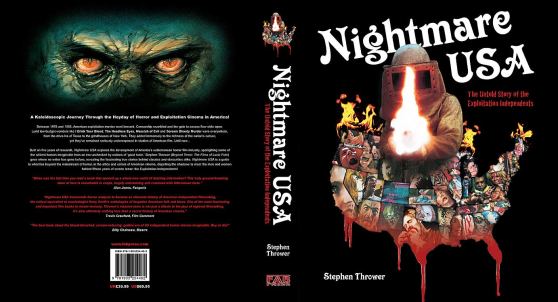
*Deran Sarafian claims to have ghost directed this movie. A former actor (10 to Midnight), he started making his own movies with The Falling and Interzone. As for Lawrence David Foldes, the must have Stephen Thrower book Nightmare USA has so many quotes in which nearly everyone that brings up the producer and director has nothing at all nice to say.

Irv Berwick said, “Apparently he was quite brilliant as a child, a genuine prodigy who graduated college by nineteen. But a prodigy is not always the best person to have as a producer.”

His son Wayne added, “Dad and Bill Diego worked together on some fifteen films, and they always had the same line for each other, “Wouldn’t it be funny if this was the one?” And after they did Malibu High, they said, “Would you fucking believe it — this was the one — with that asshole!” Because they hated Larry Foldes. Everybody hated Larry Foldes! He was just a total egomaniacal spoilt rich kid who thought he was a producer.” He also claims that a soundman on Don’t Go Near the Park knocked Foldes out.

Also, check out this pull quote from the August 14, 1983 Los Angeles Times: “Ghostdirector Deran Serafian is used to cleaning up messes but he says he never saw a mess like the Young Warriors.

While you’re looking for books on Cannon, turn to the one we used through Cannon Month: Austin Trunick’s perfect The Cannon Film Guide Volume 1: 1980-1984.

You can also listen to The Cannon Canon episode that discusses this movie here.

CANNON MONTH: Hercules (1983)

EDITOR’S NOTE: This originally appeared on February 1, 2019 but if anything, I somehow am obsessed with this movie even more now than then.

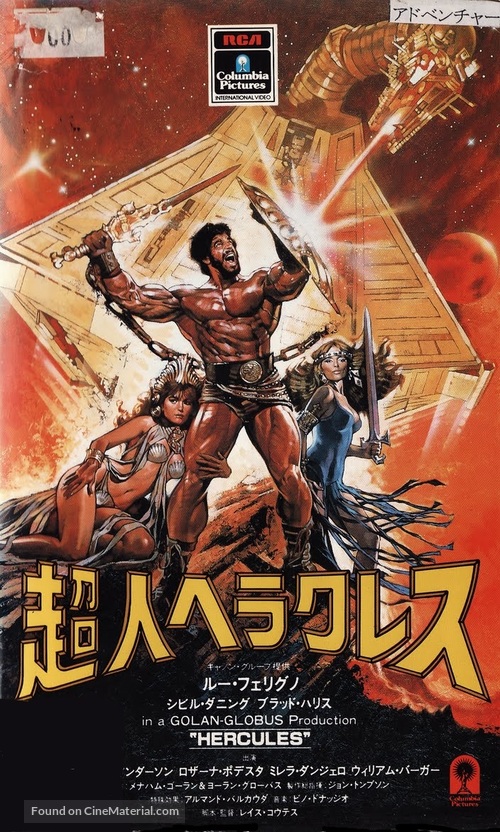
I love Hercules movies. From the Steve Reeves Hercules to the Bava helmed Hercules in the Haunted World, some of the most entertaining films I’ve watched have been about the adventures of the son of Zeus and Alcmene. I’ve probably already related how much I love the movies of Luigi Cozzi, too. From Starcrash to Contamination, his movies never let you down. They’re ridiculous spectacles, packed with stop animation, bombastic scores and increasingly insane plots. I feel bad for anyone who dislikes either Hercules or Cozzi movies. And woe be to anyone who dislikes this one!

Following the success of Conan the Barbarian, this was an opportunity for the Italian film industry to return to the peblum sword and sorcery films that they once did so well decades before.

Originally announced to be directed by Bruno Mattei from a Claudio Fragrasso script (it was shot at the same time as Seven Magnificent Gladiators, which does boast the talents of both), Hercules stars Lou Ferrigno from TV’s The Incredible Hulk.

You have to respect any movie that doesn’t start with people and instead is all about Pandora’s Jar. That’s right — it wasn’t a box. It was made up of all the elements — night, day, matter and air — which aren’t really elements. It blew up and made the planets. Look — if you’re going to start questioning logic, there’s no way you’re going to enjoy this movie.

Pandora’s Jar led to the creation of Earth, but it also led to evil being set loose to have its way on the world. So Zeus decides to create a symbol of goodness in his son Hercules. By the way, instead of living on Mt. Olympus, the Pantheon lives on the moon and are played by some of the heavy hitters of Italian cinema: Rossana Podesta as Hera, Delia Boccardo as Athena, Eva Robin’s as Dedalos and Claudio Cassinelli as Zeus himself!

Much like Moses, baby Hercules’ parents are murdered and he’s sent on a raft to safety. Unlike Moses, lil’ Herc kills two snakes with his bare hands. And then he’s raised in a simple village, where things are pretty simple until a bear kills his father. Hercules responds by throwing the bear into space and turning it into stars. I can’t do this scene any justice. You just have to see it for yourself.

Hercules ends up in conflict with King Minos (William Berger, who was in seven Jess Franco movies) and Ariadne (Sybil Danning!), who force him to do things like clean up horse stables. Our hero also falls in love with Cassiopeia while battling the mechanical monsters that Minos has under his command.

Hercules ends up getting help from Circe, a witch who is played by Mirella D’Angelo from Tenebre. She’s way more interesting and attractive than Cassiopeia, but she’s also a witch and therefore, doomed to fall in love with the big lug and die as a result. Oh yeah — Bobby Rhodes shows up as Xenodama, the King of Africa!

At the end of it all, Hercules must rescue his love from the fires of the Phoenix, as well as a clockwork centaur. He then doesn’t believe that she is Cassiopeia. He asks if she is Ariadne or Circe playing a trick. She responds that she is all of and none of those women and they embrace, with their silhouettes being framed against the heavens.

There are so many moments in this movie that are going to make you feel like you’re on drugs, like every time Hercules punches things lighting comes out of his hands. But man, there is so much awesome in here, like the whole ride across the river Styx, every single monster, the sets and the outfits that the ladies wear. This is a movie made for entertainment and shutting off your brain. It does its job very well.

For more info on all things Hercules in the universe of Cannon, get Austin Trunick’s The Cannon Film Guide Volume 1: 1980-1984.

Check out The Cannon Canon episode about this movie here.

CANNON MONTH: House of Long Shadows (1983)

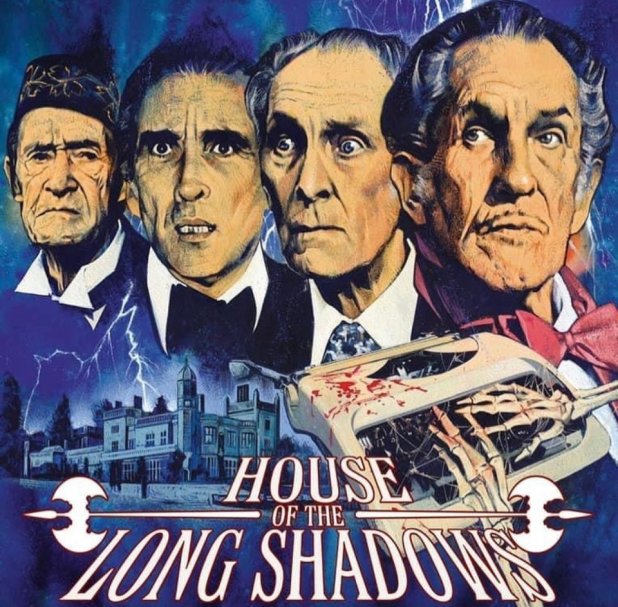
Vincent Price, Christopher Lee, Peter Cushing and John Carradine all in the same film? That’s the whole draw of Cannon’s House of Long Shadows, made by Pete Walker in one of the more chaste films of his career. He’d actually retired and was running a chain of theaters when Golan and Globus asked him to make a movie for them.

Taking cues from Seven Keys to Baldpate by Earl Derr Biggers, the Michael Armstrong (ScreamtimeMark of the Devil) script has writer Kenneth Magee (Desi Arnaz, Jr.) making a bet that he can write a great novel. To make it happen, he heads for the solitude of a deserted mansion that isn’t so deserted; after all, Lord Grisbane (Carradine) and his daughter Victoria (Sheila Keith, House of Whipcord) are living there.

By the end of the night, more guests — Grisbane’s sons Lionel (Price) and Sebastian (Cushing), Magee’s publisher’s secretary Mary Norton (Julie Peasgood), a buyer for the mansion by the name of Corrigan (Lee) and a young couple named Diana (Louise English) and Andrew (Richard Hunter) — all arrive.

The Grisbanes are really in the house to release their brother Roderick, who has been walled into his room for forty years after impregnating and murdering a local girl. But when they open his room, he’s already escaped, which gives Lord Grisbane a fatal heart attack. His demise is soon followed by Victoria being strangled, Diana washing her face with acid and Andrew being poisoned. Everyone’s tires are slashed, so they’re all stuck with a killer.

Roderick makes his way through everyone in the cast, leaving only Mary and Magee alive. But  of course, there’s a twist. Actually two of them. And no, I won’t spoil them.

As the only film in which Price, Lee, Cushing and Carradine appear together, this is a fun trifle. It was sold by Cannon as a straight horror movie when they should have leaned into its comedic side. Golan had dreamed of seeing these horror stars team up, so it’s great for us that he could make it happen, even if he had also wanted Bela Lugosi and Boris Karloff, both of whom were long gone.

You can learn more about House of Long Shadows in Austin Trunick’s The Cannon Film Guide Volume 1: 1980-1984.

You can listen to The Cannon Canon podcast about this movie here.

CANNON MONTH: Nana (1983)

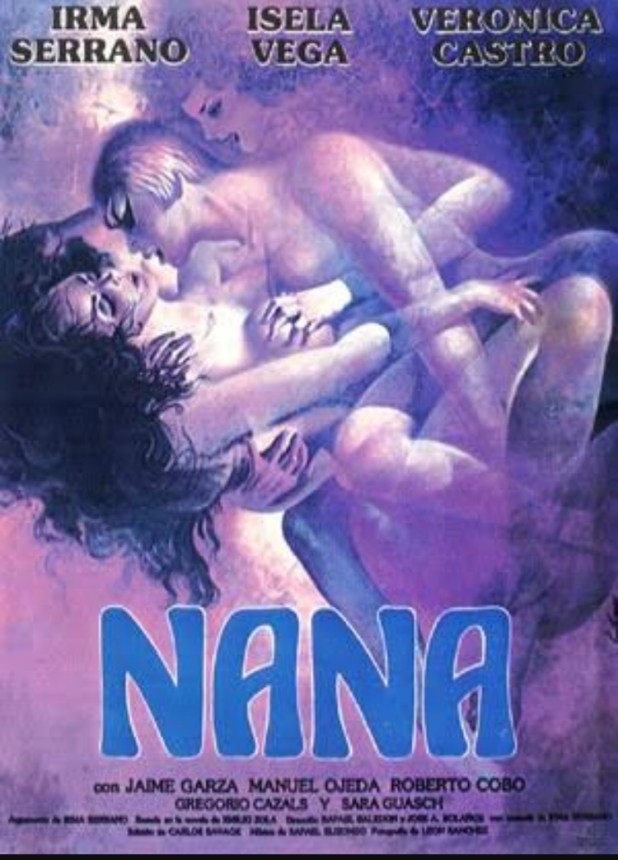
Oh Cannon. You make an Emile Zola movie and it ends up being directed by Dan Wolman, who also made Up Your Anchor for Cannon and written by Marc Behm, who would write X-Ray for the studio. He also wrote the novel that Eye of the Beholder was made from, as well as The Beatles’ Help!

And the result ends up being the type of movie that winds up on our site.

Katya Berger (who was in Absurd and is the daughter of William Berger; her half sister Debra is also in this and her resume is even more made up of movies that make our site, like Born for HellEmanuelle In BangkokThe Inglorious Bastards and another Cannon film, Dangerously Close) starts as a girl who has no idea how to use her carnal abilities, yet is in a bordello, but by the end, she’s destroying lives. Sleeping with bankers, dumping them for royalty, making counts act like human dogs, cucking them for their sons…what is this, a Joe D’Amato movie?

The thing is, if D’Amato had made this, it would have been way better. Sure, this looks classy, but it forgets that if it wants to be a classy literate film, it shouldn’t have so much nudity. Then it can’t put together that if it wants to be sleaze, it’s way slow and never really gets to the madness that a Mattei, a Franco, a Tinto Brass would remember.

But hey! 1960s Profumo scandal figure Mandy Rice-Davies — who is also in Black Venus — and Annie Beale from House on the Edge of the Park and D’Amato’s L’alcova are in this so it can’t all be boring. Plus, it has Ennio Morricone making the music, so that’s a positive, right? And then they spelled his name wrong!

Speaking of Franco, there’s a scene with rich people hunting naked women, which is the kind of thing that he would make an entire movie about. More than once, if you want to get down to facts. This scene also has all sorts of inserts and male and female full frontal, which the main actors seem to be kind of like, “What are we doing?” as it happens.

And really, the sleaziest part of this — and you’d have to watch the credits to get it — is that both of the Berger sisters end up having movie sex in this, which feels totally D’Amato in nature. William Berger had to be a bit shocked, right? I mean, aren’t you scandalized?

Armando Nannuzzi was the cinematographer on this movie and if his name sounds familiar, well, he’s the guy who Stephen King blinded in one eye while making Silver Bullet.

CANNON MONTH: One More Chance (1983)

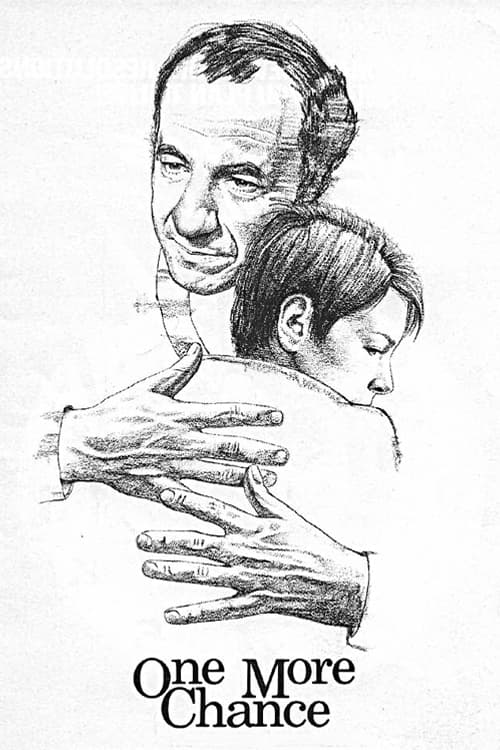
An amateur boxer and the nephew of famous boxer Jake LaMotta, John LaMotta shows up in a few other Cannon movies like Revenge of the NinjaNinja III: The DominationBreakin’ 2: Electric Boogaloo and American Warrior, which all come from director Sam Firstenberg, who made One More Chance his first movie.

Pete Bales (LaMotta) is a criminal fresh out of jail that’s lost track of his ex and son. She’s living in Arizona with their now teenage child and her new husband. His parole won’t let him cross state lines. But a former neighbor, Sheila (Kirstin Alley), knows were they are and sees something in Pete that no one else does.

Firstenberg made this as a student film at Loyola-Marymount University in Los Angeles before expanding on it and making it into a full feature. He also had two great leads to hang the movie on, as well as appearances by Michael Pataki and Logan Clarke.

This doesn’t have the wild action of his later films –both Ninja III and Breakin’ 2 seem to come from another universe so much more fantastic than the boring world that we stumble through — but as a lot of heart and an ending that is quite moving. Firstenberg also wrote the script, something he wouldn’t get to do again until Cyborg Cop II and I think this film may be closer to his heart.

You can watch this on Tubi.