Ladies and Gentlemen, The Fabulous Stains (1982)

ABOUT THE AUTHOR: Jennifer Upton is an American (non-werewolf) writer/editor in London. A member of the Society of Authors, she currently works as a ghostwriter of personal memoirs for Story Terrace London and writes for several blogs on topics as diverse as film history, punk rock, women’s issues, and international politics. 

For links to her work, please visit: 

An underappreciated gem of a film that plays almost like a documentary, Ladies and Gentlemen the Fabulous Stains stars a very young Diane Lane as Corrine “Third-Degree Burns”, Marin Kanter as Tracy and Laura Dern as Jessica. Three disenfranchised working-class American teenagers who start an all-girl punk band to escape their bleak, futureless lives in rural Pennsylvania. They quickly find themselves on tour with a past their sell-date English band The Metal Corpses and English punk support band The Looters, composed of real-life punk legends Paul Simonon (bassist for The Clash), Paul Cook and Steve Jones (drummer and guitarist from The Sex Pistols) and baby-faced Ray Winstone, who convincingly plays illiterate vocalist Billy in one of his earliest roles. 

The performances and scenarios are pitch-perfect in every way, accurately representing both how punk quickly overtook their over-produced metal predecessors and how management manipulation, and the potential to earn large sums of money caused bands like The Sex Pistols to self-implode. One of the film’s best characters–Lawn Boy, the Rastafarian bus driver played by Barry Ford. He represents not only conviction in the face of success, but the often-overlooked (by Americans, anyway) connection between Reggae and punk in its infancy in the UK. Kudos to director Lou Adler for doing his homework. The fashions (with help of consultant Caroline Coon) are as spot-on as are the nihilistic attitudes of the main three characters, who learn to navigate the perils of a rock ‘n roll lifestyle while gaining a cult teen-girl following. The band’s fans enthusiastically embrace their feminist message, “We don’t put out,” only to abandon them when it looks like they’ve been conned into buying a manufactured product. 

The film’s finale, where we see the Stains transform into something akin to the Go-Go’s (a band whose career followed a strikingly similar trajectory) was added two years after filming wrapped, giving it a happier ending than was originally intended. It’s a powerhouse of music and performances for a cast so young. More than worthy of its current cult status, the film holds up as a perfect fictional rendering of a true-life short time period that gave us some of the best music ever made. 

Death Screams (1982)

David Nelson broke out of his family’s show The Adventures of Ozzie and Harriet in the movie The Big Circus, in which he was a disturbed man who may be a murderer. He also directed a few episodes of the aforementioned TV show, as well as its spinoff Ozzie’s Girl, the Linda Evans movie Childish Things (co-directed with her husband at the time John Derek), and kept acting, showing up in movies like High School U.S.A. and Cry-Baby.

It might surprise some people therefore, when one of the Nelson kids ended up making a slasher.

During the last night of the carnival, the local kids decide to sleep down at the river, despite a bunch of murders just a few nights before. That killer — carrying a machete and a need to work out his past pain by killing everyone that he or she can — has followed everyone back to their campground and wants to make sure that no one leaves alive.

Waitress Lily Carpenter is played by Susan Kiger, a three-time Playboy cover girl (March 1977, November 1977 and April 1978) and January 1977 Playmate of the Year. She was also in plenty of great exploitation and horror movies throughout the 70s and 80s like H.O.T.S.Angels Revenge, SevenThe Happy Hooked Goes to HollywoodGalaxina and The Return. Several of the actors in this also appeared in Tales from the Third Dimension, like Helene Tryon (Edna Sharpe in this, the evil grandma in that 3D anthology) and William Hicks (who was a cop in this and is in “The Guardians” chapter of Tales) and a few were in other North Carolina movies like A Day of Judgement and Rottweiler 3-D (AKA Dogs of Hell).

This may seem slow, but stick with it. Nearly every kill is in the last fifteen minutes, as all manner of insanity goes does, like two decapitations, hands chopped off at the wrists, a throat-slashing and even someone chopped in half in a moment that had to have inspired Michele Soavi when he made one of the best slashers with the dumbest cops ever, Stagefright. Do not gather in an abandoned house by the cemetery and tell urban legends with twenty-something teens or you will die.

If you’re wondering, how good is this movie? It has the same cinematographer as Carnival Magic, Darrell Cathcart, who also worked on Trucker’s Woman and Final Exam. Speaking of that other slasher, it also shares several crew members with this movie, including editor John A. O’Connor, makeup artist Barbara Galloway, production manager Mike Allen, assistant director Dawn Easterling,  second unit director Charles Reynolds and stuntman Jere Beery. There’s also plenty of crossover with Savage Streets, as most of this film’s producers made that movie.

From that, you should see the pedigree of this. It’s junk, but great junk, the kind we checked off our slasher rental list in the 80s. Here’s to regional slashers! And for those looking for both full frontal female — and male — nudity you get some of that as well. Sure, the killer can teleport and do a lot of things in not so much time while not being terribly interesting when you discover who he or she is, but you know, it’s better than any slasher that will come out after you read this.

The music in this is bombastic and feels like it belongs to a way bigger and more expensive movie, too. It’s by Dee Barton, who also did the music for Play Misty for Me, Every Which Way But Loose, Thunderbolt and Lightfoot, High Plains Drifter and, there it is again, Tales of the Third Dimension.

The Arrow Video blu ray of Death Sceams features a brand new 2K restoration from the only existing 35mm print, as well as two commentary tracks, one by producer Charles Ison and special effects artist Worth Keeter moderated by filmmaker Phil Smoot Brand, as well as another commentary by The Hysteria Continues. There’s also a new making of documentary, radio and TV commercials, two versions of the screenplay and the alternate VHS House of Death opening titles. You can get this from MVD. Here’s to Arrow releasing more underseen slashers!

Death Screams will also be a future selection on the ARROW player. Head over to ARROW to start your 30 day free trial (subscriptions are available for $4.99 monthly or $49.99 yearly). ARROW is available in the US, Canada and the UK on the following Apps/devices: Roku (all Roku sticks, boxes, devices, etc), Apple TV & iOS devices, Android TV and mobile devices , Fire TV (all Amazon Fire TV Sticks, boxes, etc), and on all web browsers at https://www.arrow-player.com.
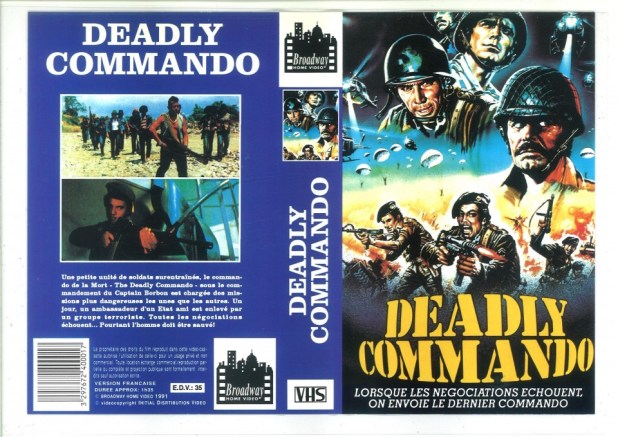
Philippine War Week: Deadly Commando (1982)

Also known as Suicide Force, this film comes to us from the dual directing team of Nick Cacas (Jungle Fighters and the Ron Marchini-starring Forgotten Warrior) and Segundo Ramos (who has fifty-six films to his credit, but let’s go with Eastwood and Bronson as an example, a movie that has Richard Gomez and Joey Marquez playing the two action heroes in a parody film).

An American general has been kidnapped by Muslim separatists and Captain Borbon and his Savage Six have been released from a military prison to bring him back alive. They’re joined by Adora, a rebel whose brother is the very person who kidnapped the general and wants nothing more than for the war to never end.

Every one of these Vietnam in the Philippines movies ends with a gigantic explosion and this one is no different, however, the last minute of this movie is completely wild.

You can watch this on YouTube.

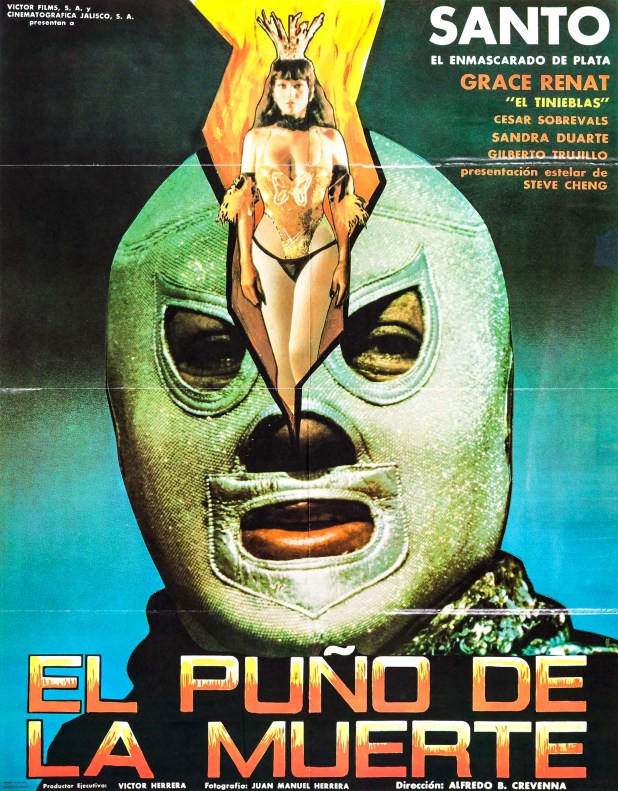
El Puño de la Muerte (1982)

I’ve gushed over La Furia de los Karatecas before and I have to tell you, the fact that there’s a first part only confirms the fact that — even years after his death — Santo is here to save every single one of us.

Grace “Goddess of the Night” Renat — a popular vedette (think burlesque) actress — plays the twin goddesses at the heart of this story. You can tell when she’s on the side of the tecnicos when she has on a white fur bikini and los rudos when she has on the black fur bikini. I like that they made it that simple for me.

They are battling over Niña de la Selva — Jungle Girl — a space princess who has come down to our planet to teach us something, but mainly this movie is about karate. Imagine if Mortal Kombat had lucha libre and you will understand the magic that is this movie. Also — the Jungle Girl was raised by wolves which look like the kind of dogs that you or I may own.

Tinieblas is in this too and he’s a bad guy. I mean, his name does mean Darkness. He and Santo have a fight that made me respect how hard that Tinieblas was working to not hurt the elder Santo and sad that Santo was so old. There are enough good things in this movie to make me forget that pain.

While set in the jungle, this was shot in Florida at the Vizcaya Museum and the Coral Castle, which itself is the kind of magical site that thousands of movies should be set in. We will settle for The Wild Women of WongoNude on the Moon and Jimmy, the Boy Wonder.

Any movie that has a bunch of non-Asian people who supposedly live in an Asian hidden country that worships a C3PO mask is going to be a film that I love. My needs are so simple, yet so few films live up to them.

This movie is on Shout! TV and it’s beyond badly dubbed which makes it even better. Make your life great. Watch this.

Tron (1982)

I was ten when this movie came out and it was — without a doubt — the biggest thing in my life. Talk about brand synergy — to walk into the GameTrek arcade and see an actual Tron arcade machine with all the same sound effects! I wanted to disappear into the video game grid and escape the bullies of my childhood. I’d much rather hang out with Sark and the Master Control Program — I had an affection for evil even then.

Writer and director Steven Lisberger (Bonnie MacBird* wrote the original story with him) had been inspired by the video games hed played in the 70s and dreamed of a movie based on them. He finally landed at Disney, where computer animation would join with traditional filming techniques and backlit animation to make this groundbreaking film.

Disney executives were uncertain about giving $12 million to a first-time producer and director using techniques that had never been done before. They did finance a test of the flying discs and it won them over, as long as the studio could rewrite and restoryboard the movie. At this time, Disney rarely hired outsiders to make films for them. They were given a cold reception and none of the animators would join the film.

Now for some geeky stuff.

Disney decided in 1981 to film Tron completely in 65-mm Super Panavision**, which makes the movie look way bigger and stranger in the best of ways. And as a result of this being a non-Disney Disney movie, the outside influences make it seem even odder. French comic book artist Jean “Moebius” Giraud, who had worked on Jodorowskys canceled Dune, designed the characters and costumes, while the machines were designed by Syd Mead (Blade RunnerAliens) and Peter Lloyd worked on the environments, yet all three would switch jobs and pitch in to create the overlook look of the film and even its logo.

However, none of the four studios hired to design the computer animation — Information International, Inc.; MAGI; Robert Abel and Associates and Digital Effects — collaborated on their art, which gives a variety of looks to the film.

Tron sees a world where we all have a computer version of ourselves inside the master grid, a place ruled by the Master Control Program and policed by David Warner’s Sark. It’s a world that Kevin Flynn (Jeff Bridges) helped created when he made a series of video games for ENCOM before growing disillusioned with the big business that those games became. Shades of Atari and Warner Communications, huh?

Programmer Alan Bradley (Bruce Boxleitner) and his girlfriend (and Flynn’s ex-girlfriend) engineer Lora Baines (Cindy Morgan) have learned that MCP is taking over their projects and is shut down by senior executive vice president Ed Dillinger (also Warner). It turns out that the businessman got so far by stealing Flynn’s games. In retaliation, Flynn has quit and runs an arcade when he isn’t hacking into ENCOM.

Of course, that allows the Master Control to blast Flynn into his reality, a place where Alan is Tron and Lora is Lori and all the video games that the creator loves have become life and death. I kind of love everything about this movie except for Flynn becoming the CEO at the end. We all know how business works and we’ll learn even more in the sequel.

Another part of my childhood was in the soundtrack to this movie, which was composed by Wendy Carlos. I never could quite figure out why my dad’s Walter Carlos albums just ended and wondered if his sister took over for him. It wasn’t until years later that I learned the brave truth. Two other songs — “1990’s Theme” and “Only Solutions” — came from Journey.

Unfortunately, Tron was originally going to be released during the Christmas season of 1982. When the chairman of the Disney board Card Walker found out that Disney expatriate Don Bluth’s film The Secret of NIMH was coming out in early July, he rushed Tron in an attempt to crush Bluth. This also meant that Tron would be going up against a summer of films that included Blade RunnerPoltergeistStar Trek II and E.T. While it would become Disney’s highest-grossing live action film for 5 years, it still lost the studio a ton of money, as they thought it would generate $400 million in profit.

The world has changed — the state-of-the-art computer used for the film’s key special effects had only 2MB of memory and 330MB of storage, for example — but Tron has remained a cult film that deserved a much wider audience.

*MacBird believes that she was the first screenwriter to edit a screenplay on a computer, but chose the industry-standard Courier font when she printed it, all so Disney would still think she used a typewriter.

**The computer-generated layers were shot in VistaVision — both anamorphic 35mm and Super 35 — and the real world scenes were as well, then blown up to 65 mm.

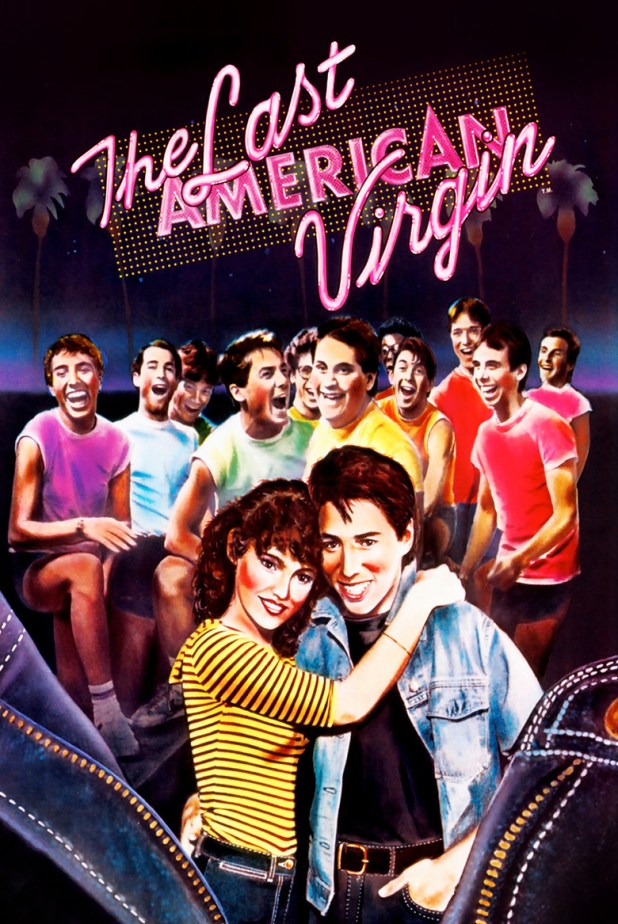
The Last American Virgin (1982)

This movie is a destructive force that still leaves hurt feelings decades after it’s been viewed. Sure, it’s a remake of director Boaz Davidson’s Lemon Popsicle and that movie ends the same way, but that movie came back with plenty of sequels. Once The Last American Virgin drops its bomb on you, it lets you watch everything burn and then that’s it. There’s no happiness, no hope, just the song “Just Once” and the destruction of the film’s hero in a way that there’s no coming back from.

When a movie has a title like Lemon Popsicle, you don’t know what to expect. It’s a foreign movie released in 1978 that could be about anything. But when the title is The Last American Virgin and the movie comes out in the middle of the teen sex comedy craze, you don’t expect things to go this way.

Gary (Lawrence Monsoon, Friday the 13th: The Final Chapter) is a pizza delivery boy with two friends, the cool ladies man Rick (Steve Antin, Jessie in the “Jessie’s Girl” video) and David (Joe Rubbo). Most of their hijinks revolve around trying to have sex, like telling girls they have cocaine — it’s really Sweet’n Low — or sleeping with a prostitute or Carmello, a Spanish woman who Gary meets while delivering pizza. Everyone gets their turn except for Gary, who is the titular character.

Yet he has better plans for his first time. He’s in love with Karen (Diane Franklin!), but she’s in love with Rick, who plans on sleeping with her once and dumping her. He does exactly that, getting her pregnant. She turns to Gary, who sells almost everything he owns and borrows money to pay for her abortion, then nurses her during the lowest moment in her life. They share a kiss and she invites him to her 18th birthday party.

That’s when the pain hits hard.

This film takes what Lemon Popsicle did on its soundtrack and transports it to the 80s, which is an incredibly smart move. The music is vital to this film’s success, featuring heavy hitters like The Cars, Devo, The Police, Journey, REO Speedwagon, U2, Blondie and the Human League. I mean, how do you think Bono felt when he saw this and his song “I Will Follow,” which is about his mom who died when he was only 14, is used over an abortion montage?

So much of this movie is very Cannon Films and that’s also the joy of it. It also leaves me with so many questions. Why does Gary bring Karen a bag of oranges when she’s lying in the hospital? Why would they make this seem like a teen movie and give it that ending, when if it was a date movie it’s filled with way too much raunchy sex? And how about the fact that the actors who played Gary and Rick, who come to blows in the movie over the girl who got between their friendship, have come out? How does Gary not realize that Karen’s friend Rose, who he gets set up with, is geeky hot (maybe this makes more sense in 2021 than 1982)? And how did cinematographer Adam Greenberg (who also filmed Terminator 210 to MidnightNear Dark and many more) feel about recreating so many of the same shots that he’d made in Lemon Popsicle?

Director Davidson also made Hospital MassacreSalsa and American Cyborg: Steel Warrior, movies that would not even hint at the art that he would make with this movie. If you’ve ever seen the poster for this and laughed it off as a simple teen comedy, I want you to take a chance on this movie. But be prepared for the final moments.

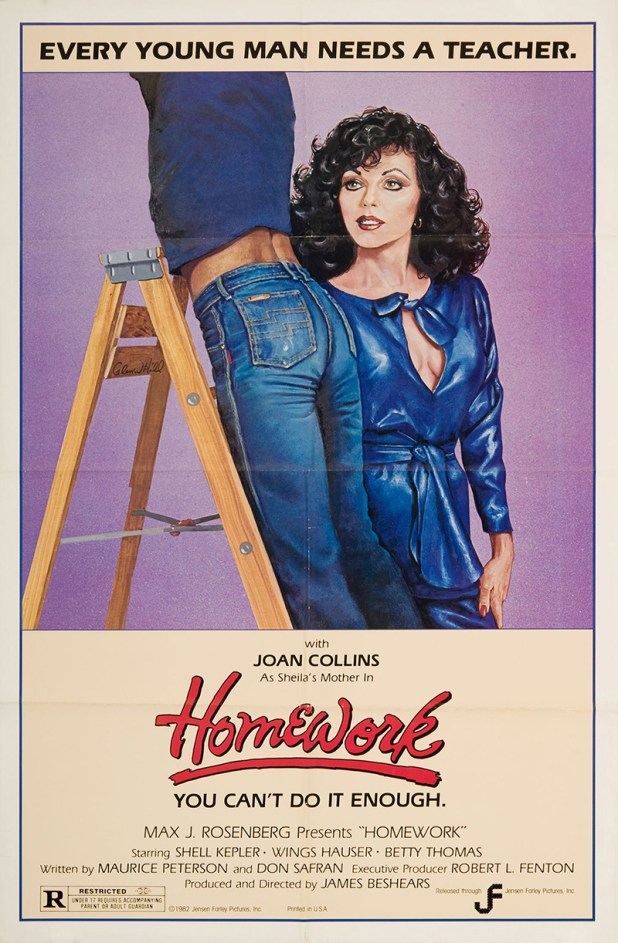
Homework (1982)

You know, I always thought that this movie had Joan Collins in it. And yeah, it does. But it also doesn’t. That’s because the day before the film’s premiere, Collins — along with Betty Thomas, Carrie Snodgress and Lee Purcell who said they made the movie under false pretenses, not knowing it was going to be a sex comedy — took legal action to get their names removed from this movie.

Collins claimed that the film’s advertising was misleading and she was right. That’s because she had only performed in a minor supporting role shot two whole years earlier in the time before Dynasty made her a big star. Homework now had her in a sex scene with an obvious body double and that image was featured in all of the advertising until a federal court ordered those ads to stop.

Jensen Farley Pictures, you did it again.

This may be the only movie that James Beshears ever directed, but he also edited Luigi Cozzi’s Hercules and The Incredible Melting Man. Recently, he’s served as the editorial and post-production executive on animated movies like The Boss BabyTrolls and the Shrek films.

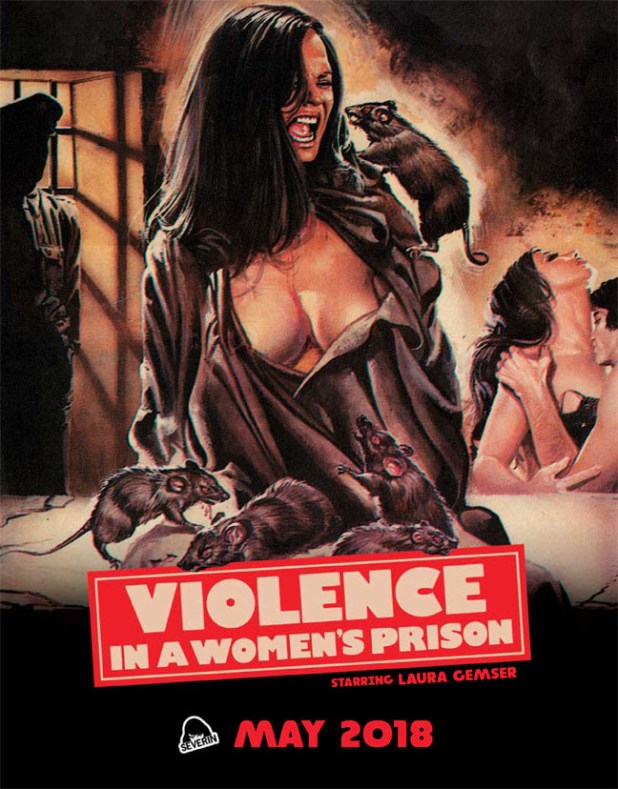
BRUNO MATTEI WEEK: Violence in a Women’s Prison (1982)

The seventh film in the Black Emanuelle series — and the first to be directed by Bruno Mattei — finds our heroine, still played by Laura Gemser, investigating the Santa Catarina Women’s Penitentiary for Amnesty International.

Wow. You might think that’s pretty woke for an Italian exploitation film. I am here to assure you — or upset you — and reveal that it’s the very last woke or progressive thing that will happen in this movie.

Released as Caged Women in the U.S., this film has Emanuelle pretending to be a drug dealer as she learns all about the horrific conditions within the prison, which consist of all the tropes of the women in prison genre as filtered through the demented minds of husband and wife writing dup Claudio Fragasso and Rossella Drudi.

Of course, our heroine falls for a kindly prison doctor — it’s her husband in real life, Gabriele Tinti — who is there because he euthanized his cancer-stricken wife. What you may not expect are catfights atop mounds of feces or a traumatic scene where Gemser is attacked by numerous rats. If this was an SAT answer it would be: Bruno Mattei is to rats with red glowing eyes as Lucio Fulci is to eyeballs.

Obviously, this movie used the Italian filmmaking trick of shooting two similar films at the same time on the same set with the same crew and actors. The other one would be Women’s Prison Massacre, which is just as demented.

Lorraine De Selle plays the brutal warden. If you’re like me, you’ll recognize her from The House on the Edge of the Park and Cannibal Ferox. Other recognizable performers include Maria Romano (Thor the ConquerorThe Final Executioner) and Franca Stoppi (The Other Hell).

I can’t believe that this actually played U.S. theaters and drive-ins, while being unable to fathom the feeling people had when they wandered into the wrong theater and were confronted by the excesses of Bruno Mattei. One doubts they ever could eat popcorn again.

You can get this from Severin, who really can be depended on for releasing the best-looking versions of movies that most people would wish would just go away. I love them with all my heart.

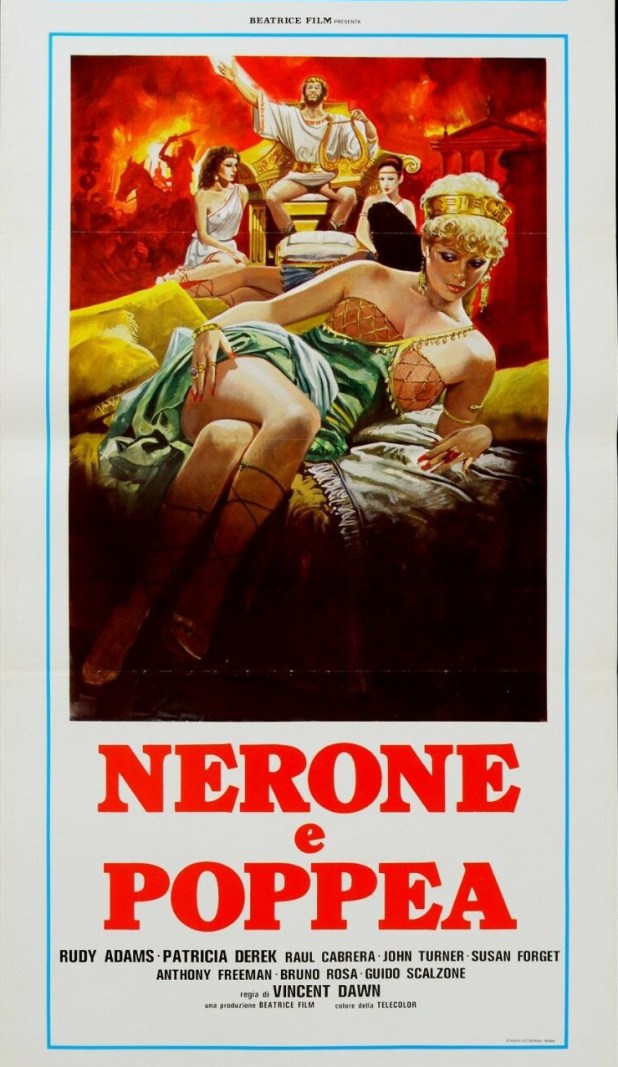
BRUNO MATTEI WEEK: Nerone e Poppea (1982)

Nero and Poppea – An Orgy of Power comes from a genre of film that doesn’t exist much anymore. I guess you could call it Romanspolitation or Nerospolitation or Caligulaploitation, films that came in the wake of Tinto Brass’ 1979 Caligula. Movies that took that piece of exploitation and said, “I can do it better.” Those folks who loudly screamed that included Joe D’Amato, whose Caligula… The Untold Story has an uncensored edition with animal/human fondling and unsimulated sex, and our friend Bruno Mattei, who not only made this movie, but also Caligula and Messalina a year before this film was made.

Also known as Caligula Reincarnated As Nero, this is Mattei at the unhinged level you expect from him, throwing copious male and female nudity at you, the viewer, along with Christians being devoured by lions, plenty of torture, incest and, in case you were getting bored, a graphic castration scene which would mark literally the third Mattei movie in a row that I’ve seen where someone’s gherkin gets pickled.

How do you know this is a Bruno Mattei movie? Is it the rampant thievery of peblum footage from  Goliath Against the Giants and The Last Days of Pompeii? Or perhaps it’s hearing the very same voiceover artists who dubbed those movies in the 50’s and 60’s having to say scatological dialogue? Or by having Antonio Passalia — the film’s co-director — play Claudius in his second Mattei opus in a row?

I watched this with some equal parts shame and fascination, but by the end of an entire week of nothing but Bruno’s movies, I really do feel like Max Ren looking for the next video drug to feed into my brain.

Cosmic Princess (1982)

British science fiction force Gerry Anderson is probably best known in the U.S. for his series Thunderbirds, which used Supermarionation to tell the stories of the team known as International Rescue. By the 70’s, he and his wife Sylvia were working together on shows like UFO and The Protectors, while being courted by Cubby Broccoli to write a treatment for Moonraker that was never used.

As part of the Andersons long and successful association with media impresario Lew Grade and his company ITC, Space 1999 was, at the time it was made, the most expensive British series ever made. Airing from 1075 to 1977 — man, they just missed the chance to be part of the Star Wars boom — the series is all about Moonbase: Alpha, staffed by 311 humans who are suddenly launched into deep space when nuclear waste stored on the moon explodes and sends them through the galaxy, in effect turning our moon into a spaceship. One imagines that the Earth itself did not survive, so everyone involved in this show really are the last human beings in the galaxy.

This all came about because the show UFO did better ratings when it was set on the moon. Anderson had been working on a show called UFO: 1999, but when the original show was canceled, he couldn’t get Grade interested in a follow-up. When he pitched this show, the producer demanded that there not be any Earth-bound settings. Anderson responded by blowing up the planet real good in the very first episode.

The issues on this show started when Grade demanded American leads and Sylvia, who usually handled the casts, wanted British actors. She would later say that she could have seen Robert Culp and Katharine Ross in the show, but the main characters of John Koenig and Helena Russell went to real-life couple Martin Landau and Barbara Bain, who had appeared on Misson: Impossible together and who were thought to have been a ratings draw for American audiences.

The show seemingly was always a battle, with writers leaving, budgets being overspent and ITC worried that the show would only run on American syndication and not a network, despite being sold to nearly every nation around the world. It also didn’t help that the Andersons split up between the first and second seasons.

All of this brings us to Cosmic Princess, which is basically two episodes from season 2 — “The Metamorph” and “Space Ward” — edited together. These stories introduce Maya (Catherina Von Schell, On Her Majesty’s Secret Service), an alien who would take up the “Spock” role that some felt would propel the show into being must see TV.

By the time of this story, Moonbase:Alpha had already made its way through two space warps and entered the orbit of Psychon, which just so happened to have the minerals that the crew needed to survive. There’s a theory throughout the show that the leaps that the planet made were predestined and guided by outside forces — like the writing team, maybe? — but that may also be to covered narrative lapses in logic.

That said, it’s all a trap by the planet’s leader Mentor (Brian Blessed!) who is using a machine to drain their souls and make his planet less like hell and more like heaven. His daughter Maya helps the crew escape and joins them. The second episode in here has an alien ship to be explored as Maya deals with a virus that makes her transform into all sorts of monsters.

Speaking of Star Wars, one of the aliens in the second part is named Vader, which is done in voiceover and certainly seems like a complete cash-in.

This movie aired in syndication and all over the world, including KTLA, where it was one of the original movies that Mystery Science Theater 3000 made fun of.

So yeah. I kind of loved Space: 1999 as a kid. I had the Mattel Eagle 1, the Power Records book and record sets and the Charlton comics. If you watch this today and think, “Man, this is really wooden and slow and somewhat boring,” I’ll just say that pre-Star Wars, science fiction fans did not have many choices other than watching Star Trek again and again.

Another of the TV movies/overseas threatricals — of which there were four, Cosmic Princess was the final film — was the first: Destination Moonbase Alpha. UFO, itself, was also culled into a series of TV movies and foreign theatricals with the first being Invasion: UFO.