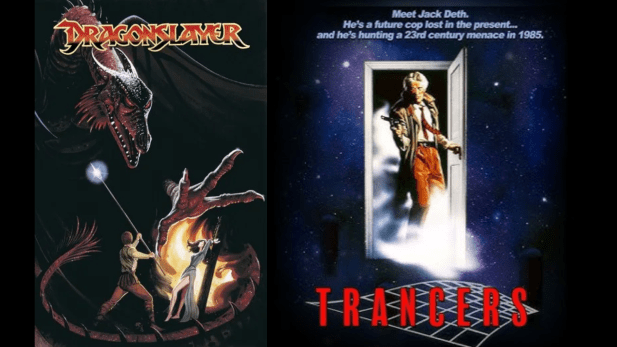
APRIL MOVIE THON 4: Dragonslayer (1981) and Trancers (1984): Two Great Film Scores but Only One in Service of Its Film

April 3: National Film Score Day- Write about a movie that has a great score.

ABOUT THE AUTHOR: Exploitation-film historian A.C. Nicholas, who has a sketchy background and hails from parts unknown in Western Pennsylvania, was once a drive-in theater projectionist and disk jockey. In addition to being a writer, editor, podcaster, and voice-over artist, he’s a regular guest co-host on the streaming Drive-In Asylum Double Feature and has been a guest on the Making Tarantino podcast. He also contributes to the Drive-In Asylum fanzine. His essay, “Of Punks and Stains and Student Films: A Tribute to Night Flight, the 80s Late-Night Cult Sensation,” appeared in Drive-In Asylum #26.

Dragonslayer (1981) and Trancers (1984): Two Great Film Scores but Only One in Service of Its Film

The mating of visuals to music can be transcendent. Think of how many movies, even stone-cold masterpieces, wouldn’t be as effective without their iconic scores by musical geniuses such as Max Steiner, Erich Korngold, Bernard Herrmann, John Williams, Miklos Rozsa, Henry Mancini, John Barry, Jerry Goldsmith, Vangelis, Danny Elfman, and, of course, the greatest film composer of all time, Ennio Morricone.* And we can’t forget groups who did scores, like Goblin, Tangerine Dream, The Beatles, Pink Floyd, The Who, Nine Inch Nails, and Queen. Music has always been a part of movies even in the silent era. 

A great score can elevate a movie or hurt it. My fundamental maxim for judging the effectiveness of a score is whether I’m paying more attention to the score than the film itself. During my prime theater-going days, I went to see Dragonslayer, a now-forgotten film from 1981, a year packed with classics like Raiders of the Lost Ark, The Empire Strikes Back, Superman II, Altered States, Flash Gordon,** The Evil Dead, An American Werewolf in London, The Howling, Ms. 45, and Possession. I’d read in reviews before buying my ticket that the score by legendary composer Alex North was exceptional. My expectations were high.

So there I sat on opening day in a Philadelphia grindhouse—not one of the scarier ones—enjoying Dragonslayer, a decent enough film. And the reviewers were right: Alex North’s score was fantastic. (It was later nominated for an Academy Award.***) The score was so good that it took me right out of the film’s universe. The music had transformed this urban shithole, with urine-stained floor, broken seats, and tattered velvet curtain, into Carnegie Hall. (If only it could have literally done that—and changed the wino snoring next to me into a tuxedoed high-society type offering me a single malt Scotch.)

It was then that I realized that this was not a good thing. All the effort that had gone into creating that awesome-looking dragon had been lost on me. I’d closed my eyes and was zoning out to the music. While it was a classic symphonic score, it wasn’t the usual rousing John Williams stuff. Instead, it was more brooding. North had incorporated complex lines with counterpoint and some atonality. It’s not that the score was inappropriate to the action. It’s just that it was so much better than the film itself that it became a distraction and put a damper on my viewing experience. Dragonslayer’s score, though outstanding, does no service to the film it supports.

But sometimes—more accurately, rarely—a film with a few good elements that would otherwise be forgotten is improved so much by an unexpectedly great score that both the film and its score live on, each beloved. Case in point: Trancers (1984) a film I first watched on home video. 

On paper, Trancers doesn’t look like much: a low-budget mash-up of Blade Runner and The Terminator that Charles Band and his Empire International Pictures dumped into Chicago and LA theaters to make a few bucks before the VHS cassettes hit the shelves at Blockbuster. But Empire made exploitation films that were a cut above the rest, so it looked good, courtesy ace cinematographer Mac Ahlberg. And it had some other good things going for it: stand-up comedian Tim Thomerson, perfectly cast as Jack Deth, the futuristic gumshoe; future Best Actress winner Helen Hunt as his juvenile love interest; and a funny, clever screenplay from Danny Bilson and Paul De Meo. That duo went on to write even more great stuff, including Zone Troopers (1985), Eliminators (1986), and The Wrong Guys (1988) for Empire; The Flash (1990) for television; The Rocketeer (1991) for Disney; and Da 5 Bloods (2020) for Spike Lee, which was released after De Meo’s death. These things make Trancers memorable, to be sure, but you’ll be blown away by the score by Phil Davies and Mark Ryder.

Like the score in many 80s films, the Trancers score used the premier electronic instrument of the day, the Fairlight synthesizer. The main theme, which serves as the musical motif throughout the film, is simplicity itself: an initial burst of synthesizer whine, followed by a slow, haunting melodic line in a minor key supported by swelling harmonies. It’s mournful mood music that stands in contrast to the film’s action scenes. The film may be part science fiction, part noir, but the music emphasizes the noir. Like the Dragonslayer score, it calls attention to itself, but does so in a way that doesn’t violate my rule. Instead of distracting, it engages.**** George Bernard Shaw once said, “Music washes away from the soul the dust of everyday life. To this day, I can’t listen to the Trancers soundtrack without being moved.

Trancers was so successful on home media that it became a franchise with seven installments.***** Charles Band’s brother Richard, Empire’s house composer, reworked Davies and Ryder’s compositions through Trancers III before the uneven series turned to other composers and music with lesser effect. Recently, there’s even been talk of a Trancers TV series. Jack Deth may live on, abetted, I hope, by the original Trancers score.

But, you ask, “Isn’t the Trancers soundtrack just a knock-off of Vangelis’s opening theme from Blade Runner?” It’s true that Trancers and Blade Runner are both science-fiction films with synthesizer scores. The difference is that the Trancers score, even if it was inspired by Blade Runner, is better. If you weren’t scorched by my hot take there, here’s a molten-lava take: The Trancers score is among the best movie scores of all time. If you don’t believe me, some kind soul has put together a 10-hour loop of the theme, which you can listen to on YouTube.

There you have it: two genre films, Dragonslayer, a big-budget studio film with high ambitions, and Trancers, a low-budget exploitation film with modest ambitions, both with excellent scores. But only one score does what it’s supposed to do, and it does so beautifully. I want the Trancers theme played at my funeral as I head down the line to the next life.

* For my money, the scene in The Good, the Bad and the Ugly with Eli Wallach as Tuco running through the cemetery to “Ecstasy of Gold” by Maestro Morricone is the greatest music cue in any movie ever. If perfection can exist in this world, this is it. 

** If you read any discussion of movie soundtracks mentioning the rock group Queen, you’ll always sing aloud “Flash! A-ah… Savior of the universe!” See? You did just now. It’s an immutable law of the universe.

*** North received 15 Academy Award nominations, including one for the American standard “Unchained Melody,” which he wrote early in his career for the film Unchained. If that was the only thing he’d ever written, I’d say he had an amazing life.

****  Just last month, Band released to YouTube a black-and-white remastering of Trancers. The noirish score complements the monochrome images even more brilliantly.

*****Six features and one 20-minute short. The short, originally intended as a segment of the Empire portmanteau film Pulse Pounders, was shot in 1988 but was unreleased until 2013. It fits between Trancers and Trancers II on the series’ timeline and is lovingly called “Trancers 1.5” by fans.

 

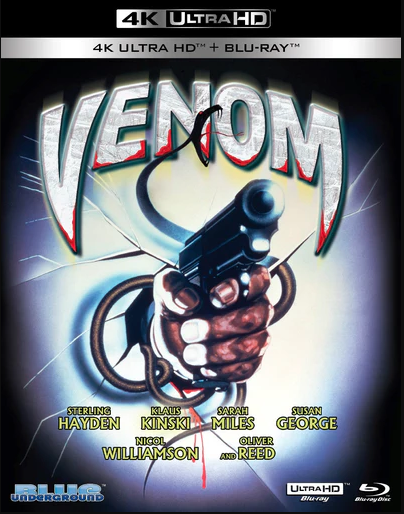
BLUE UNDERGROUND 4K UHD RELEASE: Venom (1981)

Seriously, what drugs is this movie on? How can we return in time and get them, and how great will the high be?

International criminal Jacques Müller (real-life maniac Klaus Kinski) and his lover Louise Andrews (Susan George) kidnap Philip Hopkins (Lance Holcomb), the grandson of hotel chain owner and great white hunter Howard Anderson (Sterling Hayden). It’s easy — Louise works as a maid, seduces chauffeur Dave Averconnelly (Oliver Reed), and gets him into the team without ever thinking through the psychosexual dynamics of the triad that she’s created.

The problem — well, one of many — is that Phillip meant to bring his snake and grabbed a black mamba ready to kill anything and everything. Still, toxicologist Dr. Marion Stowe (Sarah Miles) was late, the switch was off and well, now we have a deadly snake that bites Louise’s face until she dies, leaving the cucker and the cucked to deal with the emotional fallout, as well as Dave just blasting cops when he gets too nervous.

Commander William Bulloch (Nicol Williamson) arrives- you can’t shoot a cop in England without this happening, go figure- and Müller demands a million in different bills and transportation. At the same time, Dr. Stowe brings a case of anti-venom she just whipped up.

That snake wipes out all the bad guys, and the end, well, it bites Müller repeatedly, then they both get shot so many times that you’d think they were a black criminal trying to outrace a white cop on foot, then they both fall off the building. Truly a death that was earned by Kinski.

As you can imagine, Kinski and Reed measured dicks this entire film, constantly trying to outdo each other. This was going to be a Tobe Hooper movie, which is blowing my mind right now, before he was replaced by Piers Haggard, who made The Blood On Satan’s Claw.

Haggard told Fangoria, “I took over that at very short notice. Tobe Hooper had been directing it, and they had stopped for whatever reason. It hadn’t been working. I did see some of his stuff,f and it didn’t look particularly goo.dPlus,s he also had some sort of nervous breakdown or something. So anyway, they stopped shooting and offered it to me. Unfortunately, I had commitments; I had some commercials to shoot. But anyway, I took it over with barely ten days of preparation – which shows. It doesn’t become my picture, it’s a bit in between. . . Oliver Reed was scary at first because he was always testing you all the time. Difficult but not as difficult as Klaus Kinski. Because Oliver actually had a sense of humor. I was rather fond of him; he could be tricky, but he was quite warm, really. He just played games and was rather macho and so on. Klaus Kinski was very cold. The main problem with the film was that the two didn’t get on, and they fought like cats. Kinski, of course, is a fabulous film actor, and he’s good in the part; the part suits him very well. They were both well-cast, but it was a very unhappy film. I think Klaus was the problem, but then Oliver spent half the movie just trying to rub him up, pulling his leg all the way. There were shouting matches because Oliver just wouldn’t let up. None of this is about art. All the things that you’re trying to concentrate on tend to slip. So it was not a happy period.”

Once, at a party at Elaine’s, Kinski bragged about how he and other cast members and crew ganged up on Hooper a couple of weeks into the shoot to get him fired. It must have been a horrific set, as cinematographer Anthony B. Richmond quit simultaneously, and Haggard claimed that the Black Mamba was the nicest person on set.

And oh yeah — Kinski took this movie instead of Raiders of the Lost Ark, telling Spielberg that his script was “moronically shitty.”

As for Susan George, after a career of being menaced by ninjas in the movie that kicked off the craze Enter the Ninja, sharks in Tintorera (while enjoyed a throuple), the locals of Straw Dogs, the dark ending of Dirty Mary, Crazy LarryThe House Where Evil Dwells, the babysitting nightmare Fright and so many other wonderful roles, well, she’s earned our love.

The Blue Underground Ultra HD Blu-ray and HD Blu-ray release of this movie is slithering with extras, such as two audio commentaries (one with director Piers Haggard and the other with film historians Troy Howarth, Nathaniel Thompson and Eugenio Ercolani); new interviews with editor/second unit director Michael Bradsell, makeup Artist Nick Dudman, author and critic Kim Newman and The Dark Side’s Allan Bryce; trailers; TV commercials; a poster and still gallery and a collectible booklet with an essay by Michael Gingold.

You can order it from MVD.

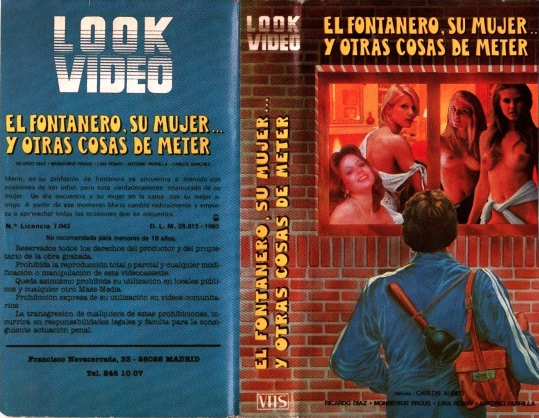
JESS FRANCO MONTH: El fontanero, su mujer, y otras cosas de meter… (1981)

El fontanero, su mujer, y otras cosas de meter… (The plumber, his wife, and other things to mess with…) is not a Jess Franco-directed movie, but it does feature his muse, Lina Romay and was directed and written by Carlos Aured, the director of Horror Rises from the Tomb, The Mummy’s Revenge and Blue Eyes of the Broken Doll. If you watch Euro horror, sooner or later, the same actors and filmmakers that you enjoy will inevitably do adult films. You should not be offended and be happy they could keep making films and money from them).

Mario (Ricardo Díaz) is a plumber continually offered favors by every woman he works for. He loves his wife (Montserrat Prous, Un silencio de tumbaDemon Witch Child), so he turns them all down. Then, he catches her in bed with his best friend and decides to start taking what is offered. And when one of the ladies is his best friend’s wife (Lina), this seems like the best way to get back at those who did him wrong.

Imagine an Italian sex comedy, only with Lina wearing a man out so completely that she has to use a toilet plunger to get off.

Aured also made Apocalipsis sexual with Sergio Bergonzelli (Blood Delirium), which was shot in both explicit and R-rated versions. Aured discovered that the Spanish porn industry had not yet learned the secrets of staying performer ready and rigid; these days, Viagra solves this.

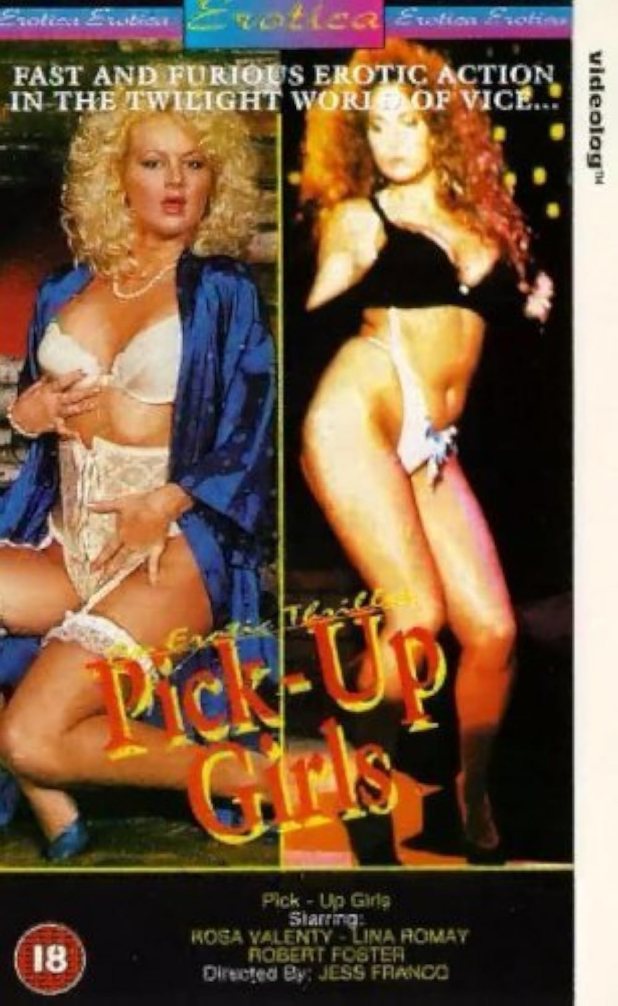
JESS FRANCO MONTH: La chica de las bragas transparentes (1981)

La chica de las bragas transparentes (The Girl In the Transparent Panties) is also known as Pick-Up Girls. It’s yet another detective tale for director and writer Jess Franco as private eye Al Crosby (Antonio Mayans) has been hired by a wealthy man named Harry Feldman to take his place at a meeting with a crime figure named Emilio (Miguel Ángel Aristu).

Nothing goes right. He’s drugged and photographed with two sex workers, Suzy (Lina Romay) and Bijou (Doris Regina), then nearly murdered by his client’s wife, all before he’s beaten up by even more women and ends up getting his rich patron killed. Maybe Mrs. Carla Feldman (Rosa Valenty) isn’t all that innocent. That means that Al will team up with the dead man’s mistress, Coco (Mari Carmen Segura), and Suzy and Bijou, who have been sent to prison, to get them out of the way to learn the truth.

So many questions. Is Al Crosby another name for Al Pereira? Why are there no diamonds being taken in this, like in every other Jess Franco plot? With their spy experience, are Suzy and Bijuo related to the Red Lips? And how many detectives find out that they’re looking for the missing penis of their actual client?

As always, I feel the urge to look deeper into a Jess Franco movie than anything else. Why does he do that to us? Was it intended? Or are we compelled to find something where there may be nothing?

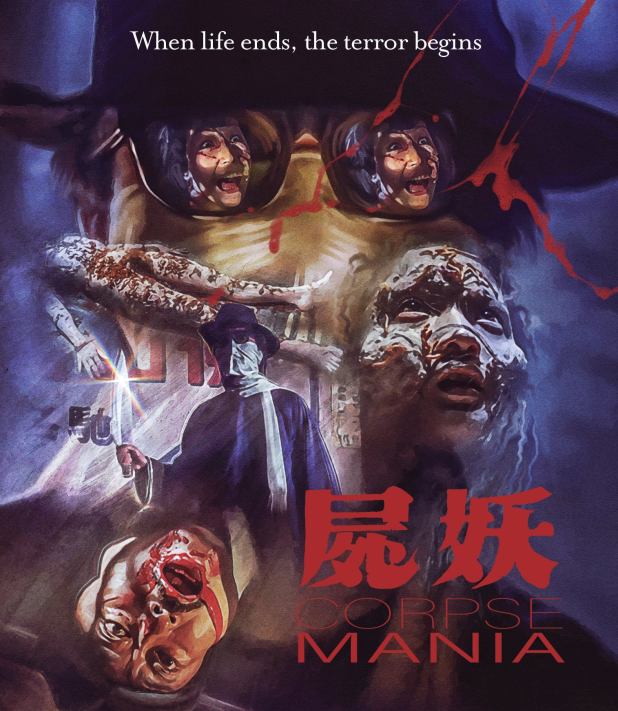
Cinematic Void January Giallo 2025: Corpse Mania (1981)

Editor’s note: Cinematic Void will be playing this movie on Monday, January 20 at 8:00 p.m. at the Music Box Theater in Chicago, IL. You can get tickets here. For more information, visit Cinematic Void.

Not all slashers are domestic, as we again test the “Is it Giallo or is it a slasher?” game with the Shaw Brothers-produced 1981 film Corpse Mania. It was directed by Chih-Hung Kuei, who would go on to create the strange Curse of Evil and the “I don’t have a word good enough to properly convey the level of strange” film The Boxer’s Omen.

Inspector Chang is beginning to figure out that all of the dead bodies in his area were visitors to Hong House, the brothel of one Madam Lan, and all fingers point to Mr. Li, a man who has already been jailed for defiling corpses, which really doesn’t seem like the kind of crime you get out of jail for due to good behavior. And he’s just bought one of Lan’s girls, the dying Hongmei. He pours flour and maggots all over her as she passes on, a feat that gives him a Category III boner.

Set in the 19th century, this starts with a house across from the brothel giving off the worst smell possible, leading the authorities to find a home filled with spiderwebs and a long-dead body that had been sexually used before it was murdered.

Sure, you might know who the killer is from the moment the movie starts, but give this points for his bandaged get-up, inventive stalking scenes and not shying away from the gore, including a scene where the killer gets a corpse ready for sweet lovemaking and then admires it the more it draws maggots.

From real maggots crawling all over its actresses and astounding blasts of blood to a dummy thrown off a roof that’s so fake that Lucio Fulci would stand up and laugh out loud, this movie has it all. Its fog and mood suggest a Hong Kong version of Blood and Black Lace with Bava taking a break from all the sexualized violence to deliver a kung fu sequence and an underwater throat slashing that reaches out for a gory glamour. As they said of his seminal Giallo, a pornography of violence.

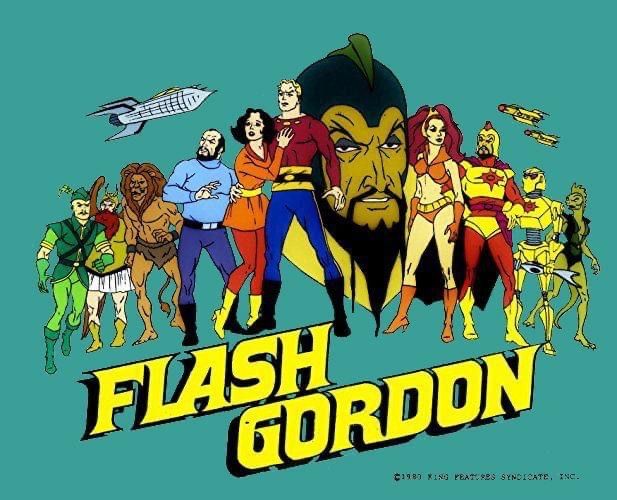
Flash Gordon: The Greatest Adventure of All (1981)

Directed by Gwen Wentzler, written by Samuel A. Peeples and animated by Filmation, this was inspired by the success of Star Wars and intended to be a TV movie. When NBC saw the finished film, they turned it into the 1979 Saturday-morning animated TV-series Flash Gordon. The TV movie version is, obviously, a lot more adult and even has a moment where Ming shows that he has been giving weapons to Hitler.

Robert Ridgely plays Flash, Diane Pershing is Dale and David Opatoshu is Zarkov. This is closer to the newspaper strip, as Flash works alongside lionman King Thun (Ted Cassidy) while Ming’s (Bob Holt) daughter Princess Aura (Melendy Britt) attempts to possess Flash. They’re soon joined by Prince Barin and King Vultan of the Hawkmen to attempt to stop Ming from marrying Dale and destroying Earth.

The animation looks so much better than Filmation’s Saturday morning work, as it is rotoscoped. This is a process of animating over live action to ensure that movements appear like real people.

Mattel would make Flash, Ming, Thun, a Lizard Woman, Zarkov, a Beast Man, King Vultan, Captain Arak and a rocket ship for Flash and Ming’s shuttle. Flash’s ship was inflatable and looked like a zeppelin; it’s one of my favorite toys I ever got to play with.

This finally aired three years after the cartoon and NBC definitely aired it on the NBC Late Movie, playing on September 5 and 26, 1982. I was ten and totally watched it the whole way through both times it aired on a black and white TV on my parent’s inside porch.

You can watch this on YouTube.

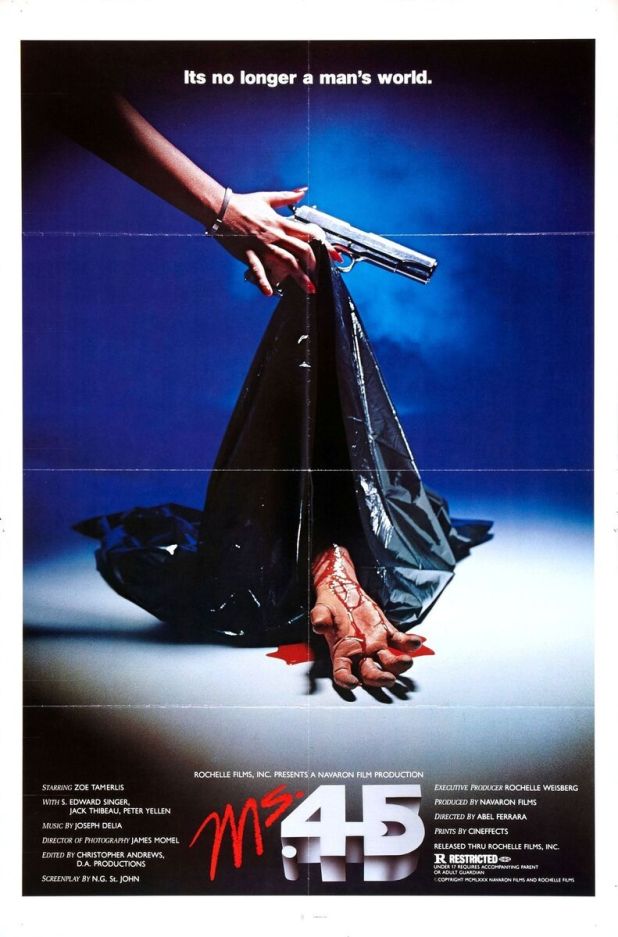
MOVIES THAT PLAYED SCALA: Ms .45 (1981)

Thanks to the British Film Institute, there’s a list of films that played Scala. To celebrate the release of Severin’s new documentary, I’ll share a few of these movies every day. You can see the whole list on Letterboxd.

Thana (Zoë Tamerlis, who also wrote director Abe Ferrara’s Bad Lieutenant, is a mute seamstress working in New York City’s Garment District.

After she’s assaulted twice — once at gunpoint in an alley by a masked man and then again in her own apartment by a burglar — Thana lives up to her name, which is inspired by Thanatos the Greek god of death. She attacks the second man with a glass red apple and then beats him to death with an iron and leaves him in her tub. After dealing with her horrible work situation, she cuts her rapist apart and dumps him all over the city.

She keeps the man’s gun and soon uses it on another man who corners her, then runs up her steps and throws up in an echo of Paul Kersey’s first night of vigilantism in Death Wish.

Soon, she’s a literal Angel of Vengeance, which was the film’s other title. She targets a series of men who have treated women wrong and even causes one of them to kill himself when her gun jams. Finally, her vengeance reaches the point where she unleashes her full fury on her horrible boss and every man who attends her party as she whirls around, full action heroine, repeatedly shooting everyone while dressed as a nun.

Ms. 45 is better regarded than I Spit On Your Grave, perhaps because it doesn’t dwell in its rape scenes or have them take up much of the movie’s running time. Or maybe, just maybe, because it’s a much better movie.

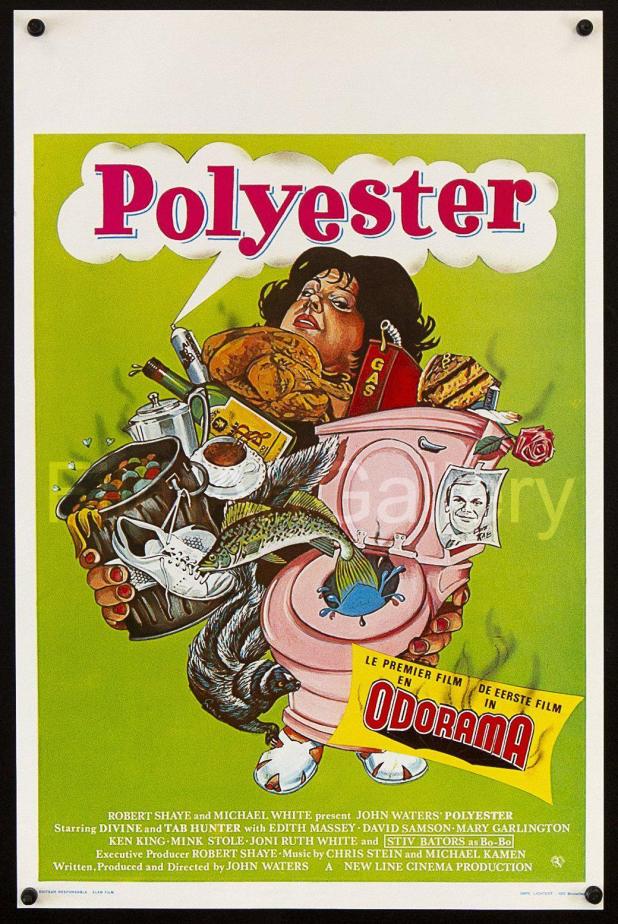
MOVIES THAT PLAYED SCALA: Polyester (1981)

Thanks to the British Film Institute, there’s a list of films that played Scala. To celebrate the release of Severin’s new documentary, I’ll share a few of these movies every day. You can see the whole list on Letterboxd.

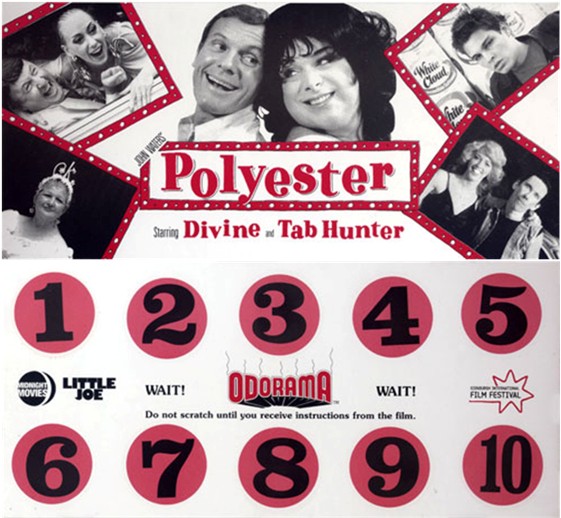
John Waters inched toward the mainstream here, making a Douglas Sirk movie, yet also adding in a William Castle gimmick with Odorama. Similar to the cards handed out when Scent of Mystery played theaters in 1960, the smells in this movie are:

  1. Roses
  2. Flatulence
  3. Model airplane glue
  4. Pizza
  5. Gasoline
  6. Skunk
  7. Natural gas
  8. New car smell
  9. Dirty shoes
  10. Air freshener

On the DVD commentary track of this movie, Waters said he was so happy that he got audiences to “pay to smell shit.”

Francine Fishpaw’s (Divine) middle class life is going to shit. Her husband Elmer (David Samson) is showing porn at his movie theater, leading protestors to camp out on their lawn. She’s tried to raise her children in a Christian household, but her daughter Lu-Lu (Mary Garlington) is sleeping with everyone and her son Dexter (Ken King) sniffs glue and gets off by stomping on women’s feet, finally being chased by police and given the name the Baltimore Foot-Stomper. And her mother La Rue (Joni Ruth White) hates poor people and lives off cocaine.

Then, everything cracks as her husband shacks up with Sandra Sullivan (Mink Stole) and she starts hitting the bottle. Lu-Lu tries to have an abortion but is attacked by protestors, so Francine sends her to a Catholic girls town. Lu-Lu’s boyfriend Bo-Bo (Stiv Bators) breaks in but is killed by La Rue and the cops finally catch Dexter. Lu-Lu has run away, coming home in time to see her boyfriend’s dead body. She tries to hang herself and fails. Bonkers the dog, however, has better luck and even leaves a suicide note.

Yet things get better. Francine kicks the habit, Dexter gets his life back together, Lu-Lu loses the baby but finds macrame and Todd Tomorrow (Tab Hunter) comes into her life. Yet the world is dark and he’s really dating her mother, and they want to drive her crazy, take her money and sell the kids into slavery. Then Elmer and Sandra break in, trying to kill her. The villains end up cancelling one another out and Lu-Lu uses her craft supplies to strangle Sandra. Oh yeah — Francine’s best friend Cuddles (Edith Massey) gets rich, marries her chauffeur Heintz (Hans Kramm) and runs over Todd and La Rue.

Dreamlanders show up, just not in the main roles like in the past. Susan Lowe is a mall victim; Cookie Mueller is Betty Lalinski; Mary Vivian Pearce and Sharon Niesp play nuns. But this is still all Waters, including a scene where Todd takes Francine to an intellectual drive-in that’s playing “Dusk To Dawn – 3 Marguerite Duras Hits” that are The Truck, India Song and Destroy, She Said. Meanwhile, her husband is playing My Burning Bush at his dirty movie theater.

Like I said, this flirts with the mainstream, but doesn’t stay overnight.

SEVERIN BOX SET RELEASE: All the Haunts Be Ours: A Compendium Of Folk Horror Vol. 2: From the Old Earth (1981)

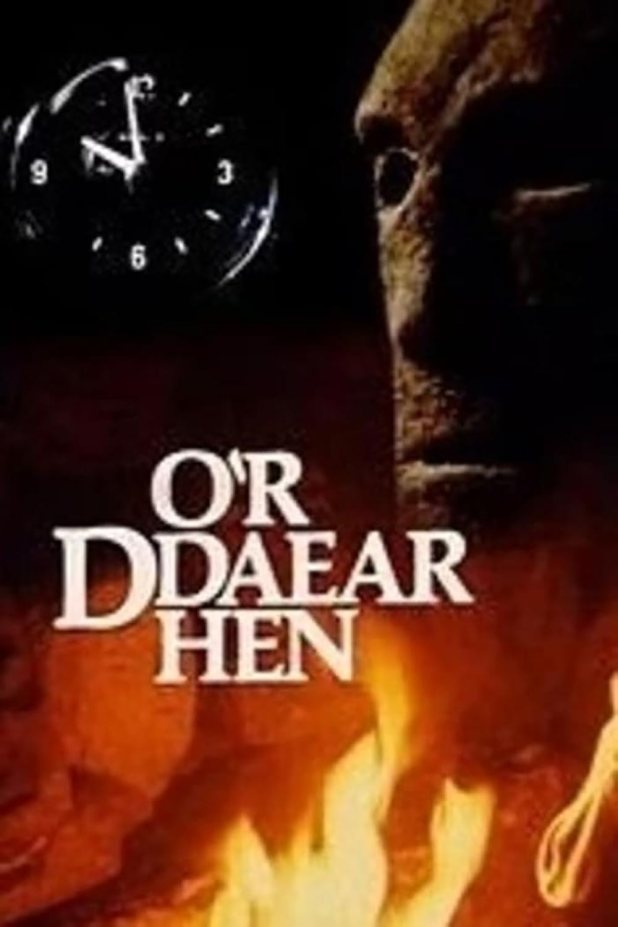
Directed by Wil Aaron and written by Gwyn Thomas, this film was played in primary schools thanks to Bwrdd Ffilmiau Cymraeg, the Welsh Film Board, who produced it. While it seems odd and a bit scary to us as adults, imagine watching this if you were under ten years old and a captive grade school audience. One of the extras for this film, in the Severin All the Haunts Be Ours Volume 2 set, has Aaron discussing how the movie was made and how he learned years later, through Facebook, how many Welsh children were absolutely destroyed by his movie.

In its native tongue, this is called O’r Ddaear Hen. A man named William Jones (Charles Williams) is toiling in his garden when he discovers a stone head. It’s so frightening to his wife that it causes her nightmares and she forces him to give the head to a female archaeologist at a local university. An expert on the Celts, she brings it back to her own home, where it starts to infect her family with fear, including a monstrous animal that keeps showing up. It all leads to a car wreck that seems beyond the budget of this feature.

O’r Ddaear Hen has led to childhood traumas, such as this quote I found from Mari Williams, who watched it when she was a student: “Whose opinion was that this was a film for children? It has created hours of lost sleep, years and trauma, and close to an accident a few times – you turn around to see if there is a man with horns in the back of the car, while driving – not to be advised.”

It’s films like this that are the reason why this box set exists. It’s just such a singular and strange film, one that created a stir in a country you may never get to and soon, you learn so much that you never expected to know.

From the Old Earth is part of the new Severin box set, All the Haunts Be Ours Volume 2. It has extras including an introduction by musician Gruff Rhys, an interview with director Wil Aaron and featurettes on Welsh folklore and Welsh Film scholar Dr. Kate Woodward on the Welsh Film Board. There are also two shorts, Blood On the Stars, that has an introduction by Gruff Rhys and a cast reunion, and The Wyrm of Bwlch Pen Barra.

You can order this set from Severin.

SEVERIN BOX SET RELEASE: All the Haunts Be Ours: A Compendium Of Folk Horror Vol. 2: Sundelbolong (1981)

The title of this movie means “prostitute with a hole in her” and comes from Indonesian myth. It refers to a dead sex worker who has either given birth inside her grave or had a child that was born through a hole in her back that is concealed by her long black hair. Wearing a long white gown, this vengeful spirit castrates men and takes children to replace the one that she has lost.

Directed by Sisworo Gautama Putra, this stars Suzzanna, the Queen of Indonesian Horror. She plays Alisa, who learns during her wedding reception that her new husband Hendarto (Barry Prima!) must go out to sea. As she waits alone, she decides to take a job as a model for a clothing store. To her horror, she learns that it’s really from her old boss — back when she was a call girl — Mami (Ruth Pelupessi) and Rudy (Rudy Salam), the scummy owner of the store who attempts to assault her.

As she runs from this, she’s forced off the road as a stationwagon is broken down in the middle of it. Four thugs and Rudy soon emerge to attack her, raping her multiple times. She gets no justice from the courts and a doctor refuses her when she tries to get an abortion, so when she tries to do it herself, she ends up dying, as her maid Bi Ijah (Marlia Hardi) finds her in a pool of blood, along with a fetus.

When her husband returns home, he puts flowers on her grave that mysteriously appear on her bed. He also meets her near-twin, Shinta, who is truly her and able to transform into a cat. Now comes revenge.

The revenge! Trees falling on men, a scumbag impaled by the tombstone of the woman he put on this path, even hands emerging from a wall to kill someone.

How classic is this movie and its lead? When it was remade in 2018, it — and the main character — were retitled Suzzanna: Bernapas dalam Kubur in tribute.

You will believe a ghost can eat all the food and drink all the soup in a restaurant before everything she has consumed drains from the hole in her back. You will hear “Night on Bald Mountain” many times. And your mind will be destroyed in all the best of ways.

Sadly, this is a film that perhaps speaks just as much to our world today as it did when it was made, across the world and forty years ago. A woman cannot get justice in any traditional way, much less rid herself of a child born through sexual assault. Only the supernatural and the other world can give her what she deserves.

Sundelbolong is part of the new Severin box set, All the Haunts Be Ours Volume 2. It has extras including Hantu Retribution, a featurette on the female ghosts of the Malay Archipelago and the short film White Song.

You can order this set from Severin.