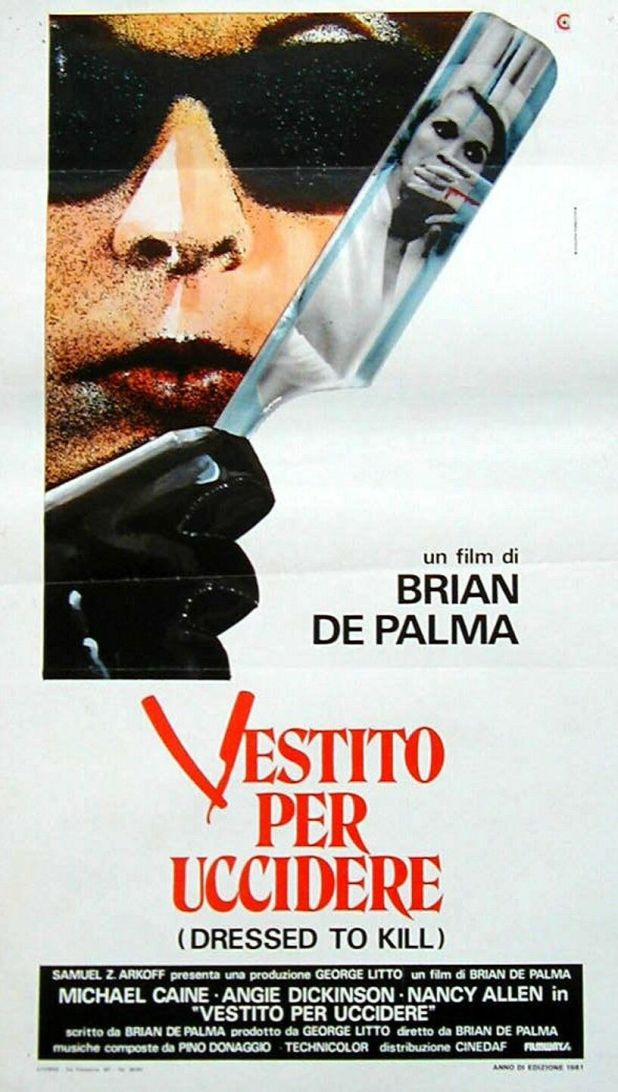
WEIRD WEDNESDAY: Dressed to Kill (1980)

Let’s get this out of the way: Brian De Palma, much like Giallo, was heavily influenced by Hitchcock. In fact, when an interviewer asked Hitchcock if he saw the film as an homage, he replied, “You mean fromage.” That said — Hitchcock died three months before the film was released, so that story could be apocryphal (it’s been said that the famous director made this comment to either a reporter or John Landis).

What is true is the interview that De Palma did after Dressed to Kill (Rolling Stone, October 16, 1980).  The director claimed, “My style is very different from Hitchcock’s. I am dealing with surrealistic, erotic imagery. Hitchcock never got into that too much. Psycho is basically about a heist. A girl steals money for her boyfriend so they can get married. Dressed to Kill is about a woman’s secret erotic life. If anything, Dressed to Kill has more of a Buñuel feeling.”

However, I’d argue that this film has more in common with Giallo than anything the “Master of Suspense” directly created. That’s because—to agree with DePalma above—this film does not exist in our reality. Much like Argento’s The Bird with the Crystal Plumage, it exists in its dream reality, where the way we perceive time can shift and change based on the storyteller’s whims.

Yet what of DePalma being dismissive of Argento in interviews, claiming that while he saw the director as having talent, he’d only seen one of his films? Or should we believe his ex-muse/wife Nancy Allen, who claims that when she told DePalma that she was auditioning for Argento’s Inferno, he said, “Oh, he’s goooood.”

Contrast that with this very simple fact (and spoilers ahead, for those of you who worry about that sort of thing, but face facts, this movie is 37 years old): DePalma rips off one of Hitchcock’s best tricks from Psycho: he kills his main character off early in the film, forcing us to suddenly choose who we see as the new lead, placing the killer several steps ahead of not just our protagonists, but the audience itself.

And yet there are so many other giallo staples within this film: fashion is at the forefront, with a fetishistic devotion to gloves, dresses, spiked high heels, and lingerie being displayed and removed and lying in piles all over an apartment or doctor’s office. This is the kind of film that makes you stop and notice an outfit, such as what Kate Miller (Angie Dickinson, Big Bad Mama, TV’s Police Woman) wears to the Metropolitan Museum of Art or the blue coat that Liz Blake (Nancy Allen, CarrieStrange Invaders) wears to meet Dr. Robert Elliot (Michael Caine, how could we pick any movie other than Jaws 4: The Revenge).

Then there are the music cues from Pino Donaggio, who also scored Don’t Look Now, Fulci’s The Black Cat, and Argento’s Do You Like Hitchcock? The film not only looks the part, but it has intense sound, too.

We also have characters trying to prove their innocence, investigating ahead of the police. Or the son of the murder victim who wants to discover why his mother really died. Or her doctor, who has an insane patient named Bobbi who has stolen his straight razor and demands that she give him more time than the rest of her patients. All of them could be the killer. Giallo gives us no assurances that just because we see someone as the protagonist, there’s no reason they couldn’t also be the antagonist.

Let’s toss in a little moral ambiguity here, too. Kate is a woman who is bored with her life. She’s raised a son and seen her marriage lose any hope of sexual frisson. Liz is a prostitute — no slut shaming here, she’s a strong businesswoman more than anything  — but she’s also a practiced liar, as a scene shows her deftly manipulating several people via phone to get the money she needs to buy stock based off an insider tip she receives from a client. Dr. Elliot is obviously attracted to Kate but claims that his marriage prevents him from having sex with her. Yet it seems like he has secrets beyond informing the police of the threats of his obviously unbalanced patient, Bobbi. And then there’s Peter, Kate’s son, who has no issues using his surveillance equipment to spy on the police or Liz. If this character seems the most sympathetic, remember that he is the closest to the heart of DePalma, whose mother once asked him to follow and record his father to prove that he was cheating on her.

Finally, we have the color palette of Bava’s takes on giallo mixed with extreme zooms, split screens and attention to the eyes of our characters. The blood cannot be redder.

The film opens with Kate in the shower. While the producers asked Dickinson to claim that it’s her body, it’s really Victoria Johnson (Grizzly) as a body double. Her husband comes into the shower to make love to her, but she finds it robotic and not the passion she feels she deserves. Directly after, she tells Dr. Elliot that she’s frustrated and attempts to seduce him, but he rejects her.

More depressed than before the appointment started, she heads to the Metropolitan Museum of Art. Despite being surrounded by inspiration, such as the statue of Diana by Saint-Guadens, West Interior by Alex Katz and Reclining Nude by Tom Palmore (a tip of the hat to the amazing I Talk You Bored blog for an insightful take on the film and the research as to what each work of art is), she absentmindedly writes entries in her schedule. Planning the holiday meal gets her through the mindlessness of her life, flowing penmanship reminding her to “pick up turkey” instead of slowing down and appreciating not just the artwork around her but the people. There’s a young couple in lust if not love. There’s a young family. And then, a man with dark glasses catches her eye before brazenly sitting down next to her.

We are used to male characters chasing after female characters who aren’t defined by anything other than being sex objects. Instead, we have Kate pursuing the man, making the first, second, and even third moves until we realize that she was just following the man’s breadcrumbs.

Of note here is that color plays an essential role in the scene, as do expected manners. Kate is a wife and mother. She is who society expects to have virtue, and she is clad in all white, but her intentions are anything but pure. She finally has what she wants—the thrilling sex life that she may have only read about in trashy paperbacks.

This scene is a master class in pacing and movement. Imagine, if you will, the words on the page: Kate follows a mystery man through the museum. And yet, those are just eight words. We get nearly nine minutes of wordless pursuit, yet it never grows dull.

Finally, Kate follows the man out of the museum, but she loses him until she looks up and sees her glove dangled from a taxi. But blink, and you miss death in the background as Bobbi blurs past the camera.

When we catch up with Kate, it’s hours for her but seconds for us because this movie is a dream universe. She wakes up in bed with a stranger. There’s a gorgeous camera move here as DePalma moves the camera backward, an inverse of how a lesser director would have treated this scene. Instead of showing the two lovers tumbling through the apartment and removing clothes at every turn, we see Kate reassembling herself to move from her fantasy world to reality and toward her real world, which will soon become a nightmare. The camera slides slowly backward as she gets dressed, remembering via split-screen and sly smile how she doesn’t even remember where her panties have gone. She’s still wearing white, but under it all, she’s bare, her garments lost in a strange man’s house. A man whose name she doesn’t even know.

So now, as she emerges from realizing her sexual fantasies, she feels that she must make sense of it. She wants to write a note to say goodbye but doesn’t want to overthink it. Maybe she doesn’t even want it to happen again. And then she learns more about the man. It starts with his name and then becomes more than she ever wished to find out: his health report shows that he has multiple STDs.

Kate leaves the apartment and makes her way to the elevator, where she tries to avoid anyone’s eyes. In the background, we see an ominous red light, ala Bava. Bobbi—death and punishment for sin—is coming.

The death scene — I hold fast to my claim that The New York Ripper is close to this film but made by a director who doesn’t have the sense to cut away from violence — DePalma stages his version of the shower scene. But more than Psycho, we’ve come to identify with Kate. She’s a woman fast approaching middle age who wants a thrill, and yet, she’s punished by disease and death. She didn’t deserve this, and her eyes pleaded not to the killer as much as they did to the camera. And to us.

Here’s where we have to wonder aloud about DePalma’s long-discussed misogyny. This film was protested by women’s groups, who stated in this leaflet that “FROM THE INSIDIOUS COMBINATION OF VIOLENCE AND SEXUALITY IN ITS PROMOTIONAL MATERIAL TO SCENE AFTER SCENE OF WOMEN RAPED, KILLED, OR NEARLY KILLED, DRESSED TO KILL IS A MASTER WORK OF MISOGYNY.” Is DePalma guilty of the slasher film trope of “you fuck, and you die?” Maybe. Perhaps if she had remembered her marriage, at best, she wouldn’t be here. At worst, she wouldn’t have forgotten her ring in the stranger’s apartment and would have survived.

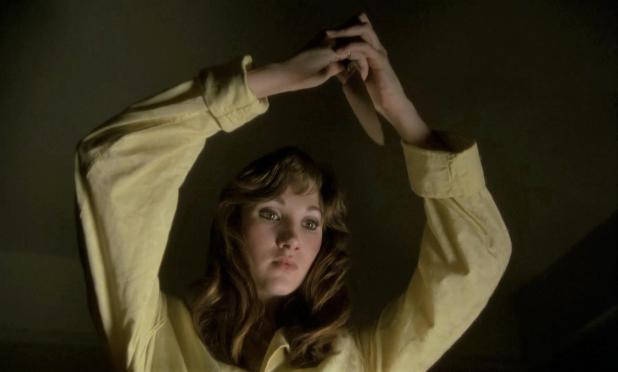
The way I see it, the death of Kate allows us to make the transition from past protagonist to new heroine, as the doors open post-murder to reveal a grisly scene to Liz and her john. The older man runs while Liz reaches out to Kate, their eyes meeting and fingers nearly touching. Kate’s white purity has been decimated by the razor slashes of Bobbi, the killer. As their transference is almost complete, Liz notices Bobbi in the mirror. Remember that we’re in a dream state? Time completely stops here, so we get an extreme zoom of both the mirror and Liz’s face. She escapes just in time, grasping the murder weapon and standing in the hallway, blood on her hands as a woman screams in the background, figuring her for the killer.

At this point, the film switches its protagonist. Unlike the films of David Lynch, like Mulholland Drive, this transference is not a changed version of the main character, but her exact opposite. Kate wore white, was older, and had a marriage and child, yet she slowly came to feel like an object to the men in her life. Liz wore black, was young and single, but was wise to the games of sex and power. She isn’t manipulated, turning the tables on men by using their needs for personal gain. Kate may have seen sexual fantasy as her greatest need, but for Liz, it’s just a means to an end.

Kate and Liz are as different as can be. For example, Kate goes to the museum to find inspiration. Liz only sees art as commerce, and she spends plenty of time explaining to Peter how much money she could make by acquiring a painting.

Dr. Elliott discovers a message from Bobbi on his answering machine (these machines and the narrative devices they enable must seem quaint and perhaps even anachronistic to today’s moviegoers). Once, Bobbi was his patient, but he refused to sign the paperwork for their (as the pronoun hasn’t been defined, so I’ll use they/their) sex change. In fact, Dr. Elliot has gone so far as to convince Bobbi’s new doctor that they are a danger to herself and others.

The police, however, have arrested Liz, and Detective Marino (Dennis Franz, TV’s Hill Street Blues and NYPD Blue) doesn’t believe a word she has to say. There’s a great moment here where Liz goes from wide-eyed ingenue to knowing cynic in the face of Marino’s misogynistic tone. Meanwhile, Kate’s son Peter (Keith Gordon, Jaws 2Christine) uses his listening devices in the station to learn more about his mother’s death than the police are willing to let on.

He begins tracking Liz, obsessively noting the times that she comes and goes from her apartment. He’s doing the same to Elliot’s office. But he’s not the only one tracking people. Bobbi has been stalking Liz, including a sequence where our heroine goes from being chased by a gang of black men to talking with an unbelieving police officer to Peter saving her from Bobbi with a spray of mace.

Because Peter has seen Bobbi also emerging from Dr. Elliott’s office, so he joins forces with Liz to discover who she is. That means that Liz uses her chief weapon — sex — to distract the doctor long enough to discover Bobbi’s real name and information. We learn that Liz’s mental sex game is as strong as her physical attributes here — she says that she must be good to be paid as well as she is. She knows precisely the fantasy Dr. Elliott wants to hear. But perhaps she also knows the fantasy that the mainly male slasher/giallo viewer wants: the woman submitting to the killer holding the knife.

Peter watches outside in the rain when a tall blonde pulls him away. Has he been taken by Bobbi? No — Liz returns to have sex with Dr. Elliott; he has been replaced by the killer. Bobbi lifts the razor as Liz helplessly crosses her arms in front of her face for protection. But at the last minute, the blonde who grabbed Peter outside is revealed to be a police officer, as she shoots Bobbi through the glass. That shattered pane also breaks Bobbi’s illusion and mask, revealing that Dr. Elliott is the man under the makeup and clothes.

The killer is arrested and goes into an insane asylum; Dr. Levy explains that while the Bobbi side of his personality wanted to be free, the Dr. Elliott side would not allow them to become a true woman. Therefore, whenever a woman broke through and aroused the male side of the persona, the female side would emerge and kill the offending female.

Inside the mental asylum, a buxom nurse attends to the male patients. The room is bathed in blue light, a cool lighting scheme that echoes Mario Bava’s films. The movie has moved from a dream version of reality to a pure dream sequence. It intrigues me that Carrie and Dressed to Kill both start with a shower scene and end with a dream threat to the surviving secondary heroine.

Within the asylum, Dr. Elliott overcomes the nurse and slowly, methodically, folds her clothing over her nude form. As he begins to either dress in her clothes — or worse, molest her dead body — the camera slowly moves upward as we realize that there is a gallery of other patients all watching and screaming. This scene reminds me of the gallery of residents watching a doctor perform surgery, yet inverted (have you caught this theme yet?) and perverted.

Bobbi emerges once again, and because she is dead, she cannot be stopped. Liz is bare and helpless in the shower, and nothing can protect her from being slashed and sliced and murdered — except that none of this is real. She awakens, screaming in bed, and Peter rushes in to protect her. And for the first time in the film (again, thanks to I Talk You Bored for noticing), she is wearing white.

Many find this a hard movie to stomach due to its misogyny. I’ll see you that and tell you it’s a misanthropic film that presents all of humanity, male and female, negatively. The men in this film are actually treated the way women usually are in films, as either silent sex objects (Warren Lockman), sexless enemies (Kate’s husband), shrill harpies that need to be defeated (Detective Marino) or sexless best friends who provide the hero with the tools they need to save the day (Peter). Seriously, in another film, one would think Peter would have a sexual interest in Liz, but despite her double entendres and come-ons, he remains more concerned with schedules and numbers and evidence.

Bobbi, the combination of male and female, comes across as a puritan punisher of females who benefit from sex, either emotionally or monetarily. Or perhaps they are just destroying the sex objects that they know that the male side of their brain will never allow them to become. Interestingly, Bobbi’s voice doesn’t come from Michael Caine but from De Palma regular William Finley (The Phantom of Phantom of the Paradise).

What else makes this a giallo? The police seem either unwilling to help at best or ineffectual at worst until they tie things up neatly at the end. And the conclusion, when the hand emerges not from the doorway — but the medicine cabinet — to slash Liz echoes the more fantastic films in the genre, such as SuspiriaAll the Colors of the Dark and Stagefright, where reality just ceases to exist. At the end of all three films, the heroine has confronted the fantastic and may never be the same.

In the first, Suzy narrowly escapes from hell on earth and emerges laughing in the rain. Is she happy that she survived? Has she achieved a break from reality? Is she breaking the fourth wall and laughing at how insane the film has become, pleased that the torture is finally over?

In the final scene of All the Colors of the Dark, the fantasy world is all a ruse, yet our heroine, Jane, is now trapped in the dream world. She can tell what will happen before it does; she knows that her husband has both slept with and killed her sister, but he has saved her from a fate worse than death. Yet all she can do is shout, “I’m scared of not being myself anymore. Help me!”

In Stagefright, the final girl walks out of the scene and out of reality as she defeats the killer. She has transcended being an actress to removing herself from fiction.

In all these films, the characters are not unchanged by their experiences with the dream world. In Dressed to Kill, the final dream sequence renders Liz truly frightened for the first time in the film. It’s the only time we see her as vulnerable — even when faced with an entire gang of criminals on the subway, she retains her edge. As Peter reaches out to comfort her — the only sexless male in the film and not just a sublimated one like Dr. Elliott — she recoils from his touch before giving in to his protective embrace.

In the same way, the film changes us. It has thrilled us, made us think, or even made us angry. True cinema—true art, really—makes us confront what we find most uncomfortable. Sure, we can deride and decry many of this film’s choices, but the fact that I’ve devoted days of writing and over three thousand words to it speaks to its potency. Thanks for reading if you’ve made it this far.
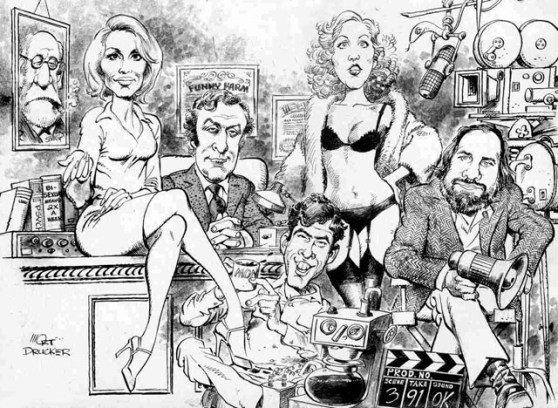
PS—I’ve often discussed—in person and on podcasts—that I experienced so many R-rated movies for the first time via Mad Magazine. I’m delighted I could find the Mort Drucker illustration for his skewering of Dressed to Kill.
MILL CREEK LEGENDS OF HORROR: Cataclysm (1980)

Have you ever seen Night Train to Terror and wondered — what would one of that film’s portmanteau sequences be like if they were expanded to an entire movie? Good news! Well, maybe. Your wishes have come true.

The final story of Night Train, “The Case of Claire Hansen”, was really a film called The Nightmare Never Ends (alternatively known as Cataclysm and Satan’s Supper). It boasts three directors. Amazingly, it was written by Philip Yordan, who not only won the Academy Award for Broken Lance in 1954, but also provided a front for blacklisted Hollywood writers (he was Bernard Gordon’s front for The Day of the Triffids)!

This is my favorite kind of movies — a film I discover at 5 a.m. when the rest of the world is asleep, and I wonder if it can really be true and if I am not still asleep. To say that this is a batshit insane film is to do a disservice to the phrase batshit insane. I feel ill-prepared to share its wonder with you, but I’m sure going to try.

Two stories are going on here:

Nobel Prize-winning author James Hansen (Richard Moll of TV’s Night Court and House) and his devoutly Catholic wife Claire (who is a surgeon, which totally comes into play later) decide to go to Vegas to both celebrate James’ new book and to get away from Claire’s nightmares. Wondering what James won the Nobel Prize for? He wrote a book that proved that God is dead. Now, he’s planning a TV special to tell the whole story to the entire world (he’s preaching the bad news!). Well, alright. And that Claire — seems that she’s been dreaming about volcanoes. They decide to go see a magician, who puts Claire into a trance in seconds.

That’s when we learn the real secret of what has been bothering Claire — Nazis! She dreams of a handsome young officer who kills a room of other officers and an all-female string orchestra. After the show, Claire invites him to dinner after he tells her that a demon is after her. He never makes it — he is killed and a 666 tattoo is left on his scalp.

Remember when I said there was a second story?

Mr. Weiss is super old and out of it, but totally recognizes a Nazi when he sees one. Pretty and rich Olivier is being interviewed during the intermission of the New York Ballet, and he looks exactly like the Nazi officer who killed Weiss’ parents at Auschwitz (and he’s also the Nazi from Claire’s dream). Weiss is a Nazi hunter, believe it or not, and he calls in his neighbor, Lieutenant Stern (Cameron Mitchell, who has been in more movies than there have been movies, but let’s call out Blood and Black Lace as one of the best of his films). They go to the ballet and follow Olivier to his extravagant mansion, all the while Stern tries to convince the old man that this cannot be the man who tormented his childhood. Weiss grabs his Luger and goes to kill Olivier, but an unseen demon kills him and leaves a 666 on his body.

Oh yeah, there’s also a homeless priest named Papini who tries to protect James and Claire, even telling her how to kill Olivier.

Numerous characters show up and just die, like Stern’s partner and Claire’s nephew. Even better, there are multiple disco scenes, which feature some wonderfully horrid songs and Olivier seducing Claire’s nephew’s fiancée (so many degrees of separation) until he takes off his shoe to reveal a furry hoof!

As to not skip any exploitation genre — we’ve already had Nazis, tough cops, disco and the occult — Claire goes to visit a black spiritualist who unexpectedly goes off on a rampage, pushing the film toward blaxploitation!  “I am a black man–a (N WORD) in your country. You are a rich woman; I’m sure you have many powerful friends… but they couldn’t help you! You had to seek the help of a (N WORD)!” It’s so insane and doesn’t fit into the movie at all.

Neither does the scene where Papini is killed by Ishtar, Olivier’s assistant (who is only in this one scene). It’s the chance to add some skin to the film and even more blasphemy.

Seriously — this film has blasphemy in spades. If you’re in a metal band that needs samples about religion and the devil, you should totally give this a watch. You’re going to find tons of samples.

Every single actor in this film either reads their lines in monotone or screams them as loudly as possible — sometimes within the same sentence. The lone exceptions are Richard Moll, who is the best actor here and Mitchell, who is the gruffest cop of all time.

Nearly everyone in this movie (and the related Night Train to Terror) was also involved in another film that destroyed my brain cells, Cry Wilderness, which was featured on the latest season of Mystery Science Theater. A Bigfoot meets E.T. epic of pure maniacal weirdness, it was also written by Yordan and was directed by Jay Schlossberg-Cohen, who created the wraparound story for Night Train to Terror. Seems that Visto International Inc., a small theatrical motion picture production and distribution company, produced these films in the early 80s, a magical era of cheaply made independent films. Plus, both films (or all three, if we can cross over between Night TrainNightmare and Wildernessfeature the acting skills, if you will, of Tony Giorgio, Maurice Grandmaison and Faith Clift.

Let me see if I can summarize the ending of this — after Oliver kills everyone else, Claire hits him with her car. She throws the body in the trunk and takes him to surgery, where she and her nephew’s girlfriend give him open heart surgery, complete with blood spraying and puking. Oh yeah, there’s also stabbing and slapping and screaming. And the bad guy wins!

Holy fuck — this is certainly a slice of cinematic goofball awesome that I won’t soon forget. Make no mistake — it’s a horrible film. But at the same time, it’s also a great one!

You can watch this on Tubi.

UNSUNG HORRORS HORROR GIVES BACK 2025: The Beast In Space (1980)

Each October, the Unsung Horrors podcast does a month of themed movies. This year, they will once again be setting up a fundraiser to benefit Best Friends, which works to save the lives of cats and dogs across America, giving pets second chances and providing them with happy homes.

Today’s theme: 1980s

Italy, you’re my favorite.

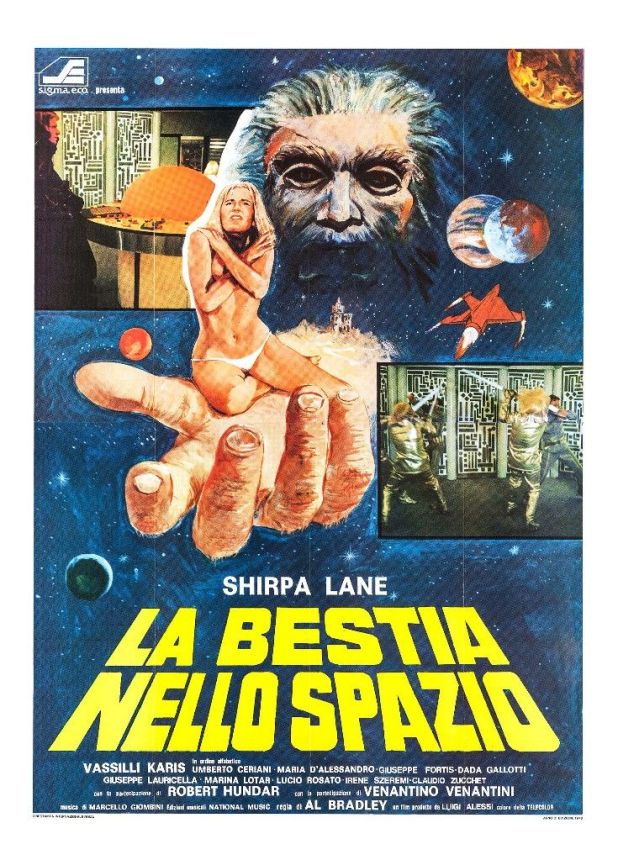
La Bestia nello Spazio earns its The Beast In Space title because it features Sirpa Lane, a star of The Beast (and Immoral Tales, the movie that it was initially part of), in a story reminiscent of Beauty and the Beast. Roger Vadim saw Lane as the next Bardot, a vision that led her to  Papaya: Love Goddess of the Cannibals. Tragically, she passed away from AIDS in 1999.

Captain Larry (Vassili Karis) may live in the future, but there are still bars and still women to pick up in bars, like Sondra (Lane). He steals her from another man, just as a vial he also took ends up containing Antalium, a very important McGuffin that can be used to make bombs. Larry gets a crew and heads off to Lorigon, which is where this element is from, to get as much of it as he can.

The man that Larry fought at the bar, Juan Cardoso (Venantino Venantini), is on his way to this planet and sends a giant robot — the one that has been in Sondra’s dreams — after them. And the planet is run by a computer, Zocor, which makes everyone have sex because this is an Italian movie.

There are light sabers, space horses having space horse sex, dudes in gold body paint, a space satyr penis and all of the costumes and effects from Alfonso Brescia’s other space films, Cosmos: War of the Planets, Battle of the Stars, War of the Planets and Star Odyssey. But this is more The Black Hole than Star Wars. I’m not just saying that because it has an XXX cut.

Brescia also went by the name Al Bradley, the name he used to make the wild Ator remix film Iron Warrior, the Richard Roundtree-starring Miami Cops, the David Hess-starring giallo Omicidio a luci blu, Killer Caliber .32If One Is Born a SwineNaked Girl Murdered In the ParkSuper Stooges vs. the Wonder Woman, and so many more. I’m just shocked that he somehow went from Lucas rip-offs to suddenly making a porny science fiction movie. But you know Italy. Whatever sells.

I watched this with inserts, but you can watch an edited version on YouTube.

UNSUNG HORRORS HORROR GIVES BACK 2025: Guardian of the Abyss from Hammer House of Horror (1980)

Each October, the Unsung Horrors podcast does a month of themed movies. This year, they will once again be setting up a fundraiser to benefit Best Friends, which works to save the lives of cats and dogs across America, giving pets second chances and providing them with happy homes.

Today’s theme: Series episode!

ABOUT THE AUTHOR: Adam Hursey is a pharmacist specializing in health informatics by day, but his true passion is cinema. His current favorite films are Back to the FutureStop Making Sense, and In the Mood for Love. He has written articles for Film East and The Physical Media Advocate, primarily examining older films through the lens of contemporary perspectives. He is usually found on Letterboxd, where he mainly writes about horror and exploitation films. You can follow him on Letterboxd or Instagram at ashursey.

Don’t you know you must never give a black magician bread or wine or salt in your own home?

Say what now? Is this common knowledge? I’ve never heard of such. Of course, I immediately went to Google for answers. Even their AI was no help in determining where this proclamation may have originated.

Perhaps it is just from the mind of David Fisher, a writer on Doctor Who (during the years of the Fourth Doctor Tom Baker), and our scribe here in this installment of Hammer House of Horror.

This anthology series was created by Roy Skeggs, a man who climbed the Hammer Films corporate ladder, eventually becoming chairman. Unfortunately, Hammer had hit upon hard times by the late 1970s, particularly after the departure of Tony Hinds in 1969. The company was unable to keep up with the gore and graphic violence displayed in many of the American films of the 70s, putting their hopes on an increase in sexual content to bring in audiences. As the films of the 70s tried to bring in modern sensibilities to their typical gothic tales, most viewers found the entire Hammer endeavor to border in self-parody rather than interesting storytelling.

When Skeggs took over, he shifted the focus of Hammer Films away from producing films using their stable of familiar monsters and characters, and toward television, creating the 13-episode series Hammer House of Horror. Each installment ran close to an hour in length, featuring different sorts of horror, and typically ending with a plot twist. 

Guardian of the Abyss follows the basic template. Laura (Barbara Ewing) is the winner of an auction for an interesting mirror. When a stranger seems very interested in purchasing the mirror from her, her friend Michael (Ray Lonnen) suggests that she have the mirror appraised to determine its true value. Unbeknownst to Michael and Laura, the mirror is a scrying glass that, if it falls into the wrong (or right) hands, could be used to summon the demon Choronzon. Michael crosses paths with a woman named Allison (Rosalyn Landor, most likely known from her role in Hammer’s The Devil Rides Out), who says she has escaped from a cult. But could she be the key to the entire mystery behind the mirror?

Guardian of the Abyss is the fourth segment I’ve watched so far in this series. They are all very enjoyable for what they are. Nothing terribly deep. Again, you typically get a twist ending that sticks the landing. A nice, quick watch for this time of year. I’m looking forward to watching the rest of these over time. I’m always happy to plug one in this slot every year during this challenge.

THE IMPORTANT CINEMA CLUB’S SUPER SCARY MOVIE CHALLENGE DAY 22: The Agency (1980)

22. A Horror Film That Can Be Found on a 50-Movie DVD Collection

I’ve worked in advertising for thirty years. So this is more of a horror movie for me than for nearly anyone else.

Based on The Agency by Paul Gottlieb, directed by George Kaczender and written by Noel Hynd, this film follows a burned-out creative director, Philip Morgan (played by Lee Majors), who uncovers a sinister use of subliminal advertising at his ad agency. The agency owner, Ted Queen (played by Robert Mitchum), is the mastermind behind this electoral manipulation. Valerie Perrine plays Brenda Wilcox, the love interest of Philip, and Saul Rubinek is the copywriter, Sam Goldstein.

This follows The Norseman, Steel and Killer Fish in attempts at Majors becoming a movie star; he would soon be back on the small screen, making TV movies and starring in The Fall Guy. He doesn’t look like any ad guy I’ve ever seen, even though he wore a long, fashionable coat at one point. He does seem burned out, and hey, I can relate.

Goldstein thinks that the new Chocolate Planet drink powder ad campaign is all about taking over the hearts and minds of America’s youth, even if this was shot in Canada. Yes, it’s going to make kids make America great forty years early.

But hey — Lee Majors not playing a stuntman or a cyborg, just an ad guy who sleeps with normal women like Valerie Perrine. Plus, the ad for No Sweat deodorant is excellent, like a hellspawn musical dance that would make me buy the product.

Mitchum vs. Majors in Montreal. It happened. I watched it.

You can watch this on YouTube.

USA UP ALL NIGHT: American Gigolo (1980)

EDITOR’S NOTE: American Gigolo was on USA Up All Night on December 27, 1997.

American Gigolo was always fascinating to me as a kid, as my mother wouldn’t let me in the room when it was on. As a result, knowing that it was “dirty” made me want to see it even more.

Directed and written by Paul Schrader, it’s about Julian Kay (Richard Gere), an escort for rich older women. Now, we know this is a fantasy, and I’m sure that affluent elderly ladies like to have a man, but I think we all know that most male escorts are for other men. But let’s get over that and explore the movie.

Along the way, he starts to fall for a senator’s wife, Michelle Stratton (Lauren Hutton), but soon finds himself being hired for a job he never does: BDSM sex with Mr. Rheiman’s (Tom Stewart) wife Judy (Patti Carr) while the old man watches. Julian tells fellow sex worker Leon (Bill Duke) that he never wants another call like that; Leon tells him that when he ages, these affluent old ladies won’t like him any longer.

Meanwhile, as Julian satisfies Lisa Williams (K Callan), Mrs. Rheiman is murdered. Detective Sunday (Héctor Elizondo) believes that Julian did it, but his alibi — sleeping with another man’s wife — puts his sense of morality to the test. He refuses to say where he was, and at each turn, evidence is planted, and he starts to realize that he’s being set up.

I love this quote from Schrader: “The character in Taxi Driver was compulsively nonsexual. The character in American Gigolo is compulsively sexual. He is a man who receives his identity by giving sexual pleasure but has no concept of receiving sexual pleasure.” Indeed, in one sscene-Julian is full frontal nude, a rarity even today, and he goes on about how being able to please women is the one thing that he knows makes him worthwhile. Schrader would revisit the themes of male sex workers in 2007’s The Walker.

The main reason I wanted to see this as a child was the music. Giorgio Moroder and “Call Me” by Blondie? Amazing. This also set the tone for style for the new decade, as Gere’s Giorgio Armani suits and Hutton’s Aldo Ferrante outfits established the look that so many would emulate.

USA UP ALL NIGHT: The Awakening (1980)

EDITOR’S NOTE: The Awakening was on USA Up All Night on June 30, 1990.

Based on Bram Stoker’s The Jewel of Seven Stars — which was also filmed as an episode of Mystery and Imagination as “The Curse of the Mummy,” Hammer’s Blood from the Mummy’s Tomb and the 90s movie Bram Stoker’s The Mummy — this movie places Matthew Corbeck (Charlton Heston), his pregnant wife Anne (Jill Townsend) and his assistant Jane Turner (Susannah York) in Egypt searching for the tomb of Queen Kara. One could argue that the most exploring Matthew is doing is between the thighs of Jane, but there you go.

When you see a sign that says “Do Not Approach the Nameless One Lest Your Soul Be Withered,” you may want to turn back. Nope, Matthew goes in hard — again, much like with his assistant — while his wife goes into labor. She’s dropped off at a hospital so he can get back to digging, and their stillborn child comes back to life once he unearths and opens a sarcophagus.

Eighteen years later and that daughter, Margaret (Stephanie Zimbalist) is looking for her father, who is now married to Jane and still obsessed with the mummy that he found. It’s being destroyed by bacteria, so he gets it sent to England so that he can save it. Of course, the mummy queen wants to be reincarnated inside his daughter, who starts to believe that she really is Queen Kara.

Directed by Mike Newell (who went on to direct Four Weddings and a Funeral and Donnie Brasco) and written by Clive Exton, Chris Bryant and Allan Scott, The Awakening is a big dumb mess. It was recut by Monte Hellman after Newell lost final cut. The best thing I can say is that this was shot in Egypt with actual locations.

USA UP ALL NIGHT: The Unseen (1980)

EDITOR’S NOTE: The Unseen was on USA Up All Night, but I can’t find a date when it aired. Do you know?

Danny Steinmann started his directing career with the adult movie High Rise and worked on the films Savage Streets and Friday the 13th Part V: A New Beginning along the way. After that film, he was injured in a bicycle accident and was unable to return to directing. He also produced the Gene Roddenberry made-for-TV movie Spectre. Today, though, we’re here to discuss his 1980 effort The Unseen.

Keep in mind — Steinmann had his name removed from the movie as he was upset with the final cut. He’s credited as Peter Foleg.

Jennifer (Barbara Bach Lady Starkey, the wife of Ringo Starr who also was in The Spy Who Loved MeBlack Belly of the Tarantula and Short Night of Glass Dolls) and Karen (Karen Lamm, the wife of Beach Boy Dennis Wilson), along with their friend Vicki, are in Solvag, CA to cover a folk rock show and town festival. A mix-up over their reservations leads the girls to stay with Ernest Keller (Sydney LassickSkate Town U.S.A.Lady in White), the owner of a museum.

Jennifer is in town to report on the town’s parade and festival, but has to deal with her soon-to-be ex-boyfriend Tony (Douglas Barr, TV’s The Fall Guy‘s Howie, as well as Deadly Blessing), who wants to talk about their relationship. Ugh.

Meanwhile, Vicki just wants to get naked while creepy old men stare at her through vents. Sadly for her, The Unseen pulls her through one of those vents and slams it down on her neck, killing her. Soon after, Karen is also killed. Their bodies are discovered by Ernest’s wife, Virginia (Lelia Goldoni, who was in Cassavetes’ Shadows and the 1978 remake of Invasion of the Body Snatchers).

That’s when we learn the secret: Virginia and Ernest are husband and wife, as well as brother and sister. He killed their father two decades ago, and they’ve lived here ever since, along with Junior (Stephen Furst, the guy from Animal House in the role one wonders if he was born to play), their inbred son. Ernest is keeping up the cycle of abuse that his father started, beating his son and keeping his wife/sister in submission. Now, Jennifer must die to keep the secret.

Ernest lures her into the basement, where she finds her friends’ bodies. She panics and runs into Junior, who she discovers probably didn’t mean to kill anyone. Ernest tries to kill her, but Virginia tries to save her. This leads to a family fight, and Ernest kills his son with a board with a nail through it.

Just as Ernest is ready to off Jennifer with a hatchet, her stupid ex saves her. Well, he tries to, but an old leg injury flares up. Oh, you inept moron! It’s up to Virginia to save the day by shooting her husband/brother and going back into the house to hold her dead son.

The Unseen was initially written by Kim Henkel and Michael Viner. While Henkel is best known for The Texas Chainsaw Massacre, Viner was a producer and audiobook pioneer who also assembled the Incredible Bongo Band, whose song “Apache” is one of the most sampled songs ever. Their screenplay was adapted into the book Deadly Encounter by Richard Woodley.

Bluntly put, this movie is all over the place. The reveal of The Unseen stays on the monster so long that you wonder why this movie is called The Unseen. It starts with so much promise, but by the end, you may find yourself staring at the time left, hoping that it ends quickly.

USA UP ALL NIGHT: Caddyshack (1980)

EDITOR’S NOTE: Caddyshack was on USA Up All Night on November 16 and 17, 1990 and October 12, 1991.

I ask you this: why did they keep making movies after Caddyshack? This is as perfect as film gets, quite literally a movie that you can drop into and out of at any time without damaging the timing or spirit of the film. It has never failed to lift my mood or improve my outlook on life. It is all that movies should endeavor to be.

It’s based on the memories of writer and co-star Brian Doyle-Murray, as he worked as a caddy at the Indian Hill Club in Winnetka, Illinois, alongside his brothers Bill and John. Director Harold Ramis had also worked as a caddy and even been hit in the genitals with a golf ball once, just like the film. Even better — that Baby Ruth candy bar in the pool came directly from Murray’s high school.

Is there a plot? Sure, Danny Noonan is supposedly the hero, and it’s all about how he wants to escape his huge family and attend college. But really, it’s the personalities that this movie is all about, like Ty Webb (Chevy Chase), the son of one of the club’s founders who has turned slack into zen. Then there’s, Judge Elihu Smails (Ted Knight), who is perhaps the best bad guy ever in a comedy. Or newly rich construction boss Al Czervik (Rodney Dangerfield) who is a buffoonish man out to annoy every , wealthy person in the club. And of course, there’s Carl Spackler, the groundskeeper who is at war with a gopher.

It’s also the only movie where Chase and Murray appear in a scene together. Famously brawling on the set of Saturday Night Live once, where Murray referred to Chase as “medium talent” before punching him — the best insult ever — they got along here and wrote a quick moment where Ty’s golf ball ends up in Spackler’s ramshackle hovel.

Murray’s dialogue in the film is completely unscripted, including his Cinderella scene. There, he was told only to act as if he were a child announcing his own imaginary golf moment. He was only on set for six days.

The constant improv really bothered Knight, an actor who prided himself on knowing his lines. Dangerfield never did the same take twice, so their continuous battling has its roots in reality. In fact, Rodney would never begin doing anything when Ramis yelled “Action!” Instead, he had to be told, “Rodney, do your bit.”

The original cut of this film was approximately 4.5 hours long, with Bill Murray’s Cinderella speech lasting around half an hour. No one was happy with the second cut, so the gopher was added at the last minute to give the movie some structure. It was shot on a soundstage, which is why the film stock in these scenes appears completely different.

Caddyshack was a commercial failure upon release and was widely disliked by critics. It’s gone on to show them all the error of their ways.

Sadly, writer Doug Kenney would never see this movie be embraced. At the press conference for this film, he drunkenly yelled at reporters, convinced it would be the end of his Hollywood career. A trip soon after to Hawaii with Chase lifted his spirits, but only for a brief time. He either slipped on a rock or jumped while there and was dead at 33, leaving behind work with the National Lampoon and the film Animal House, along with this one. You can learn more about Kenney in the movie A Futile and Stupid Gesture.

WEIRD WEDNESDAY: Cuba Crossing (1980)

I don’t trust the media. I mean, tonight, my YouTube was all about how bad Cuba is and I kind of distrust it now.

Anyways, this is Kill Castro or Cuba Crossing, a 1980 movie in which Hud (Robert Vaughn) holds a grudge since the Bay of Pigs and wants to kill Castro. Using bar owner, boat captain Tony (Stuart Whitman), and funded by Mr. Bell (Raymond St. Jacques) and Rossellini (Michael V. Gazzo), this isn’t going to end well, because the money men just want to move drugs.

This is the kind of movie that has Robert Vaughn on a beach shouting, “Damn you, Kennedy!”  It’s also the kind of release that has many alternate titles, such as The MercenariesKey West Crossing, and Sweet Dirty Tony.

A drag queen sings “Diamonds Are a Girl’s Best Friend,” Sybil Danning shows up, as does Woody Strode and Albert Salmi, man-eating turtles, a homoerotic wrestling match (spoiler: all wrestling is homoerotic), a shark attack, a fake Marilyn Monroe singing “I Wanna Be Loved by You,” iguanas getting involved in a bar fight and, well, it’s way more boring than this paragraph would lead you to think. Oh yeah — Caren Kaye, who was the mom on the sitcom It’s Your Move and was the attractive mom in My Tutor, she’s in this. She seduces Stuart Whitman. Yes, it’s a man’s world.

IMDB BS ALERT: “Captain Tony’s Saloon is a real bar in Key West, FL, and was owned by the real Captain Tony, who was also mayor of Key West for a time. He appears in the film as a watcher on horseback in one of the scenes when “Tony” visits the Cuban coast.” Actually, it’s real and here’s the website.

Director Chuck Workman used to edit all the Oscar montages. How did he make such a messy movie? The script, maybe? It was written by Robin Swicord, who get this, went on to write the 1994 Little WomenThe Curious Case of Benjamin ButtonPractical Magic and Memoirs of a Geisha. That’s right — she wrote all of your wife’s favorite films. Producer and co-writer Peter Barton went on to Reading Rainbow and man, I’m out of facts.

Thanks to Through the Shattered Lens, I can share the long — and hilarious — opening titles with you:

“From 1961, the year of the Bay of Pigs to today, the Government of the United States has been embroiled in a series of events which have continually led our nation to crisis after crisis and to the brink of war.

ASSIGNMENT — KILL CASTRO, a true story is one of the most confusing and frustrating historical events that might have led to a world power showdown.  It happened yesterday!  It happened today!  It can happen again!

Names of persons and places have been changed to protect the individuals who were called upon to aid their country and in doing so placed their lives in jeopardy.

“I WILL GIVE ALL FOR THE LOVE OF MY COUNTRY … RIGHT OR WRONG! — G.W. Bell, Chief of Caribbean Operations, Central Intelligence Agency”

This motion picture is dedicated to all people who desire to live in a free democratic society.”

You can watch this on YouTube.