June 21: Junesploitation’s topic of the day — as suggested by F This Movie— is Aliens! We’re excited to tackle a different genre every day, so check back and see what’s next.
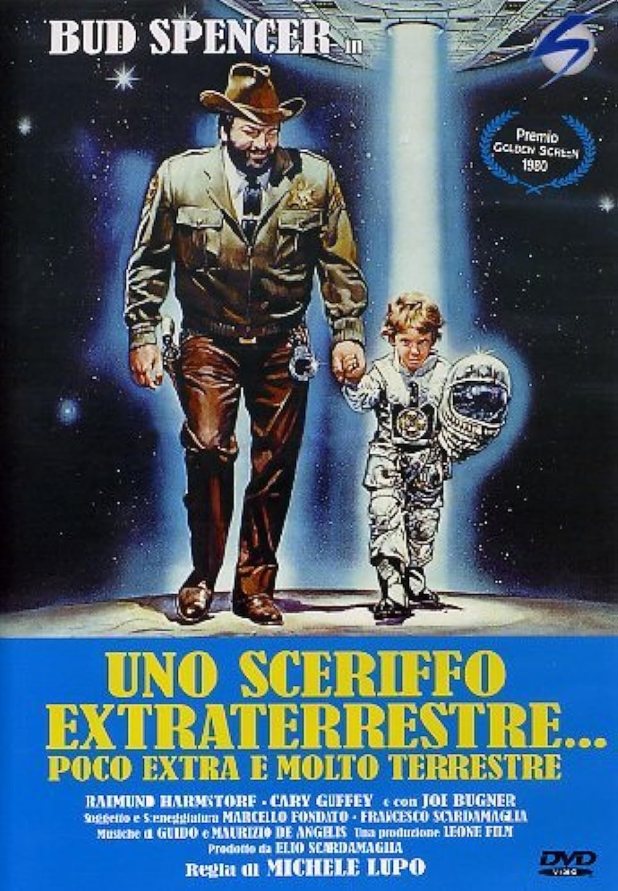
Shot in Newnan, GA* — look for a scene outside Stone Mountain — Uno sceriffo extraterrestre… poco extra e molto terrestre (An extraterrestrial sheriff… a little extraterrestrial and very terrestrial) is exactly what I want out of the movies that I watch. I got more enjoyment out of this film than probably anything new that I will watch this year. What can I say? Movies where Bud Spencer punches people and Oliver Onions are on the soundtrack are my true joy in life.
Directed by Michele Lupo (The Weekend Murders, Arizona Colt) and written by Marcello Fondato (Blood and Black Lace) and Francesco Scardamaglia (Kill Them All and Come Back Alone), this starts as the town sees a UFO touch down, which means that everyone loses their mind. Everyone but Sheriff Hall (Spencer), who doesn’t believe in aliens. So let crooks like Brennan (boxing champ Joe Bugner) use aliens to try and break the law. The big burly Sheriff will keep things normal.
Until later that night, when he gets the call to save a lost kid at Six Flags Over Georgia. He easily finds him but also finds another who calls himself H7-25. He’s played by Cary Guffey, who was Barry, the little boy in Close Encounters of the Third Kind. And this is also why I love Italian cinema, because they put him on the poster and can make it seem like this movie is connected in some way to that blockbuster.
H7-25 convinces Hall that he’s an alien by healing his deputy’s rheumatism, repeatedly saving him with his alien weapon and even blasting him with enough bio-magnetic energy that he can catch gigantic fish and speak with horses. He returns the friendship by teaching H7-25 the wonders of baked beans. Yes, it really is a Bud Spencer movie.
At the same time, Air Force man Briggs (Raimund Harmstorf) is trying to take in H7-25 for dissection. Even Brennan ends up helping the sheriff and the alien escape. By the end, the alien child likes Earth so much that he decides to stay for a little longer, which would be the sequel, Everything Happens to Me, which is a lot like Stranger Things and was made 36 years before it.
June 6: Junesploitation’s topic of the day — as suggested by F This Movie— is Free Space! We’re excited to tackle a different genre every day, so check back and see what’s next.
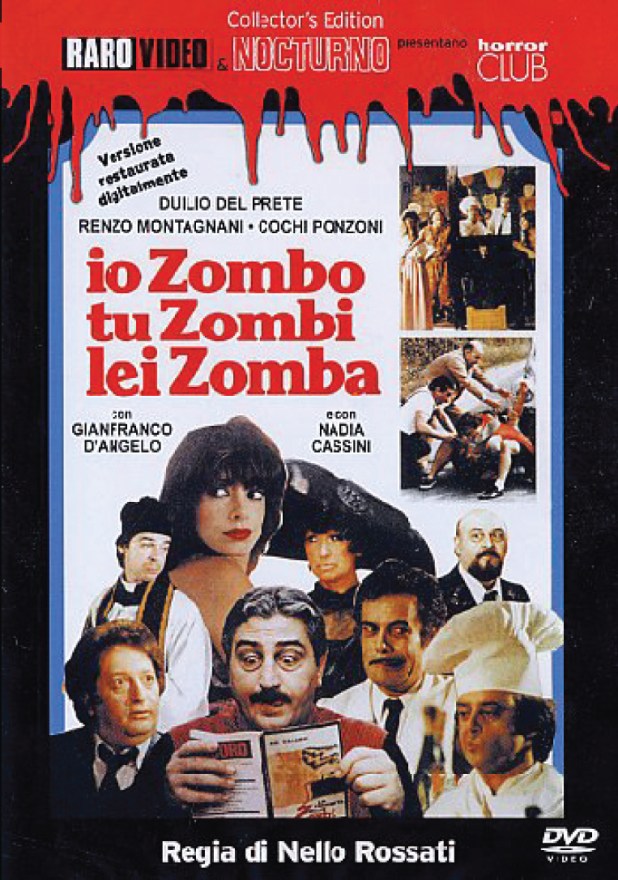
The power of Zombi — or as we call it in the U.S. Dawn of the Dead — in Italy is unquestioned. Not only did Lucio Fulci take it further, grosser and harder with Zombi 2, it led to an entire industry of films that were inspired by it, fueled by both the past mondo and cannibal films inside their DNA.
Becchino (Renzo Montagnani, Joe D’Amato’s Il Ginecologo Della Mutua, Maluc in When Women Had Tails and When Women Lost Their Tails) is working in a graveyard when he finds a book of voodoo, which seems to place this as much in the realm of Evil Dead — or as they call it in Italy, La Casa except it’s a few years early — as it does the works of Romero, which always beat around the bush as to what caused the outbreak.
The spell he reads brings back an entire group of the dead back from the brink, including Ciclista (Cochi Ponzoni), Buonanima (Gianfranco D’Angelo) and Mercante (Duilio Del Prete). They soon kill Becchino and bring him back as one of them. All head off to a hotel where they drink and sing old songs like “The Captain’s Testament” while luring people into their hotel and, well, eating them.
We never see any of that, by the way. The budget probably didn’t allow for it. It’s probably for the best, as nearly every scheme never pays off, like a traveling salesman that is missing most of his internal organs because of various illnesses or when they accidentally bring back a woman’s first wife — with the help of her son, no less, what is this, Burial Ground? — and she dies of a heart attack.
She being Nadia Cassini (the Woodstock, NY born actress that somehow came to Italy and ended up being in a lot of movies only I would care about, such as When Men Carried Clubs and Women Played Ding-Dong — yes, Italian sex comedies were fixated on cavemen for some reason — as well as Starcrash, one of the Schoolteacher movies once Edwige Fenech quit making them, Sergio Martino’s Spogliamoci così, senza pudor (Sex With a Smile 2) and, strange enough, two 2Pac videos, “California Love” and “How Do u Want It”), who the zombies bring back to life to have some of the pleasures of the slowly turning green flesh, at which point she does one of the wildest bump and grinds you’ve ever seen as she can barely stand up and do a zombie shuffle at the same time. It’s honestly worth watching this entire movie just for this scene.
At this point, the army — alerted by the boy who tried to bring Cassini’s first husband back to life — attacks the hotel, forcing the dead to head off to what is supposed to be a shopping mall but really looks like a grocery store.
If you’re keeping a list of zombie movies with grocery store scenes, you can always start with this, Messiah of Evil and Pathogen.
Anyways, it all ends as a dream, with the gravedigger still digging that same grave.
Once you watch Nello Rossati’s other films, like the absolutely deranged Top Line, this all makes a lot more sense. The script comes from one of that movie’s writers, Roberto Gianviti (who also wrote Murder Rock, The Psychic, Five Women for the Killer, The Sensuous Nurse, A Lizard In a Woman’s Skin and so many more), Paolo Vidali (the second AD on The Sister of Ursula and the writer of Don’t Touch the Children! and A Woman In the Night) and Rossati, who I always forget was the man who directed and wrote Django Strikes Again. How did a guy who mainly made sex comedies get two movies out of Franco Nero?
This is a curiousity but there are no subtitles and if you’ve never watched commedia sexy all’italiana, the chances that you will hate every moment are quite high. Then again, I say take a chance. You never know what movies may work for your taste.
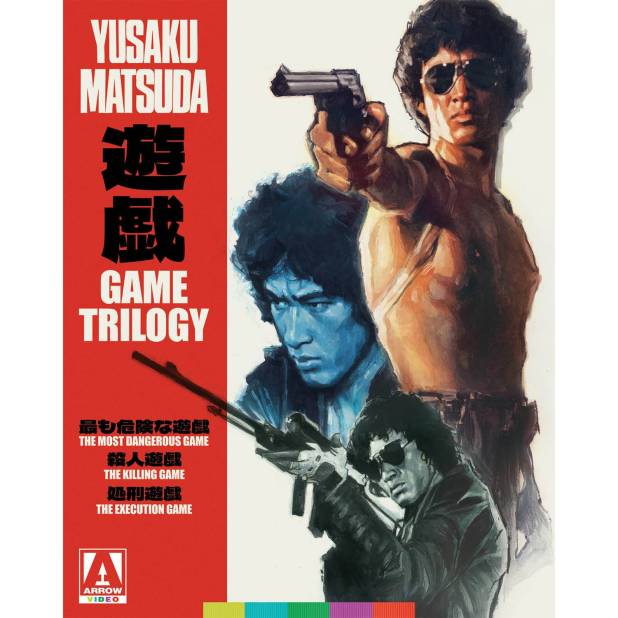
At the end of the 1970s, Toru Murakawa’s Game Trilogy launched actor Yusaku Matsuda as the Toei tough guy for a new generation. Sadly, he would die from cancer at the way too early age of 40 after appearing in Black Rain.
As Shohei Narumi, he’s a killing machine who speaks little, shoots often and never falls for anything. The new Arrow Video set of these films is the first time these movies have been released outside of Japan and man, I loved every minute of these movies.
The Most Dangerous Game (1978): You first meet Shohei Narumi when he’s being roughed up after he contests a game of mah-jong. mah-jong game. He recovers from that in time to find and rescue a kidnapped businessman, at least for a few minutes before that guy is killed in the middle of a gun battle. Narumi is saved by Kyoko (Keiko Tasaka), the mistress of one of the men he’s trying to stop. He gets another job once he’s back on his feet: kill the boss of the kidnappers, which he does. Twice.
How twice? The guy has a public double, so they both have to go. But even the cops are on the take, setting an ambush, but he escapes and, well, kills everyone except one car of criminals who kidnap Kyoko and drive her across Tokyo while somehow, incredibly, Narumi keeps up while wearing cowboy boots. Look, I’ve been on Japanese streets and even though they are clogged with traffic, there’s no way you can chase a car on foot.
The one issue I have with the movie is that it’s kind of hard to like the hero. I mean, he isn’t even a hero, for one. He wins over Kyoko by assaulting her. But then, the film almost demands that you become a fan of him, what with the cool as cool gets clothes, him drinking gin when shot in the stomach instead fo going to the hospital and just being an all around amoral killing machine. Because you never see anything the bad guys do or plan because the movie moves from action moment to action moment like an ADHD kid playing with his toys, you eventually have to concede that he is the protagonist that you must be in favor of.
Directed by Tôru Murakawa and written by Hideichi Nagahara, this film has literally a slam bam pace that never slows down. Ever.
The Killing Game (1978): Shohei Narumi has been in hiding for five years after a major assassination assignment. He’s poor, no longer able to afford his fancy lifestyle. He can’t even get a drink at the hostess bar he gets pulled into.
We don’t have anything like a hostess bar in America. They aren’t places of prostitution but instead a modern version of geishas, providing entertainment and flirtation to lonely salarymen.
While there, Shohei Narumi runs into two women from his past. A hostress named Akiko (Kaori Takeda) was the daughter of the man our protagonist killed five years ago. Yet she doesn’t hate him for it. The other is the mama-san — the boss of the place — named Misako (Yutaka Nakajima). As he shot everyone he could five years ago, she is the one person he let live. Now she’s dating another boss, Katsuda (Kei Sato), and he wants Shohei Narumi to start killing for him. So does another boss. That means that everybody is going to die, many of them from bullets that Shohei Narumi shoots.
What comes across at the end of this film is the fact that without someone to kill, his existence is pointless. He’s like an unfired gun. All he knows in this life is how to end others.
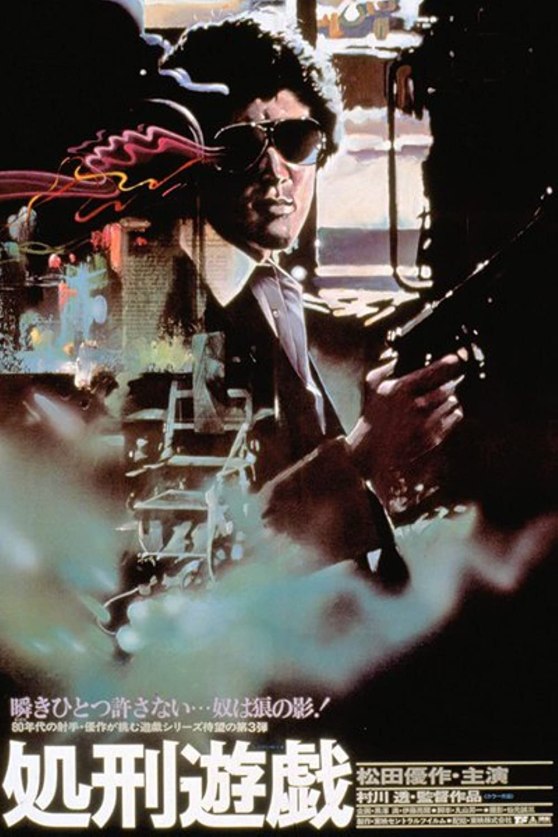
The Execution Game (1979): Shohei Narumi wakes up alone in a filthy room. All he can remember is a girl, a car and a hit to the head, but now he’s hanging from a ceiling and finds out that this is all a trial to test his skills for a new client. They want him to kill their current hitman, who has started acting strangely, but that’s just the start of his new work.
He also has a relationship in this movie, even if she betrays him, and tells a young woman to avoid shady men at one point. This is in contrast to how he acted in the first film, so is this growth? I believe so, as is the idea that he sees the ocean as where he wants to return, growing up close to it and its ebbs and flows symbolize the way his life goes: bloody bursts of ultraviolence mixed with solitude, sometimes for years.
The past films have seen him exhausted and nearly passed out as women strip around him or frantically trying to pay for everyone in a hostess club, knowing that he has nearly nothing. Here, he’s a man that knows his job and what he has to do. That means always being ready to be sold out, always prepared to be in the sights of someone’s weapon and constantly willing to kill someone, anyone, at any time.
The limited edition Arrow blu ray box set of The Game Trilogy has a high definition blu ray version of each movie with new English subtitles. You get a reversible sleeve featuring original and newly commissioned artwork by Tony Stella, a double-sided fold-out poster featuring original and newly commissioned artwork by Tony Stella and an illustrated collector’s booklet featuring new writing on the films by Hayley Scanlon and Dimitri Ianni.
The Most Dangerous Game has new audio commentary by Chris Poggiali and Marc Walkow, a 30-minute interview with director Toru Murakawa, the original Japanese theatrical trailer and an image gallery.
The Killing Game has commentary by Earl Jackson and Jasper Sharp. The Execution Game has new commentary by Tom Mes. Extras include an interview with Yutaka Oki, film critic and personal friend of Yusaku Matsuda; an interview with screenwriter Shoichi Maruyama, the original Japanese theatrical trailers and image galleries for both films.
VIDEO ARCHIVES NOTES: This movie was discussed on the January 17, 2023 episode of the Video Archives podcast and can be found on their site here.
I have no idea how this site has had a recap of drag race docs and a week of drag race movies and this doc never made it in. How many drag racing movies did the 70s have? How many did it need?
Directed by Bill Kimberlin, an Industrial Light and Magic visual effects editor, this was shot at Fremont Raceway and really has a lot of great footage of that era’s racers, as well as an interview with Ed Pink about the oil fire incident that claimed the life of John “the Zookeeper” Mulligan at the U.S. Nationals in 1969.
Drag racing used to be such a big thing in the 70s. I remember commercials for it and getting beyond excited. There was even a 1977 arcade game called Drag Race and the Activision game for the Atari 2600 Dragster. That’s how much people loved it. Just look at all the films on our list above. While I’m not a fan of the sport, it was fun to take a spin through its past.
I always think of the term “nitro burning funny cars” and hear the screaming voice of the monster truck ads of my youth. These guys literally strapped themselves to a Korean War-era jet engine and spat in death’s literal skull face.
This also has Jungle Jim and Jungle Pam in it. Russell James Liberman took on the Jungle Jim name after starting drag racing right out of high school. He and Pam Hardy came from West Chester, Pennsylvania — the hometown of Suburban Sasquatch — and after he took her away from college and small town life, she made sure his car was lined up, that his parachute was packed and his oil was all topped off.
Sadly, all that fast racing didn’t end well. Jim took a curve too fast and hit a bus head on in his Corvette back home in West Chester and it took two hours to cut him out of the car. He didn’t make it. Jungle Pam was never part of the sport again.
But here, in American Nitro, we can see them as flies in amber, as Jim waits for the tree to count down, to go faster than any human being can or should, all while Pam rocks out her knee high boots, young and alive and free forever in the drag strips of our minds.
VIDEO ARCHIVES NOTES: This movie was discussed on the April 15, 2023 episode of the Video Archives podcast and can be found on their site here. There’s another take on this movie here.
I seem to really enjoy the movies of Steve Carver, which are all over the place when it comes to genre, like the peplum The Arena, the gangster films Big Bad Mama and Capone, his two Chuck Norris movies An Eye for an Eye and Lone Wolf McQuade and most definitely this movie. He knows how to make a movie that entertains.
Steel starts off by introducing us to Lew “Big Lew” Cassidy (Goerge Kennedy), a real man’s man, the kind of business owner that goes up on the skyscraper when it’s being built just like his men. What’s shocking is that he’s dead five minutes into the movie, falling when things go wrong thanks to substandard equipment. The rest of the film is literally an attempt to live up to the standards that he set.
Sadly, on September 21, 1978, stuntman A.J. Bakunas died in this scene. Not only does it set up the danger of these heights in the movie, it also set them for the creation of Steel. The saddest thing about that is that the scene had already been shot safely. Then Dar Robinson beat the record for highest fall that Bakunas set on the movie Hooper, so the stuntman asked to reshoot the fall. He fell perfectly on to the airbag. The airbag split and that cost him his life. That’s why the credits say “This film is dedicated to A. J. Bakunis, a man whose zest for life was admired by all who knew him.”
That fall is the one in the movie. A.J.’s dad, who was with him on set, told them to use it.
His daughter Cass (Jennifer O’Neill, the best dressed woman in genre cinema) decides she’s going to do thingsher fatther’s way, no matter what her uncle Eddie (Harris Yulin) has to say about it. But to live up to the deal her father made, she’s going to need the kind of leader that can get men to do impossible things. That would be Mike Catton (Lee Majors), a guy who lost his nerve on his last job and has taken to being a trucker. She meets him on the road and convinces him that he needs to get back up in the sky.
It’s impossible to explain just what a big deal Lee Majors was in the mid 70s. Sadly, by 1978, the show that made him a success — to be fair, he was already a star from The Big Valley — The Six Million Dollar Man was cancelled. In the three years between that show and finding another hit in 1981 with The Fall Guy, Majors made a few movies like The Norseman, Agencyand Killer Fish. And yes, this movie, which puts him in the lead of the Dirty Dozen of steel. His crew is made up of Pignose Morgan (Art Carney), Valentino (Terry Kiser, not yet dead), Lionel (Roger E. Mosley, not yet TC ), Surfer (Hunter von Leer, not yet a Haddonfield cop), Tank (Albert Salmi, not yet a cop investigating ghosts), The Kid (Ben Marley, not yet battling Jaws), Cherokee (Robert Tessier, not chasing Charles Bronson in this movie) and Dancer (Richard Lynch, not a villain in this, amazingly). Oh yeah — this also has great parts for R.G. Armstrong and Redmond Gleeson.
This might be the most manly movie that I’ve ever had on this site, a film that starts with Kennedy saying, “The sight of a tall building still gives me a hard-on” and ends up with an American flag being lifted high above the streets below. You’ll want to celebrate with the rest of the crew, feeling like you’re part of them. This movie is a success for me and it’s just as much the guys on screen as it is the script by Leigh Chapman (Truck Turner, Dirty Mary, Crazy Larry) from a story by Peter S. Davis, Rob Ewing and William N. Panzer.
VIDEO ARCHIVES NOTES: This movie was discussed on the December 13, 2022 episode of the Video Archives podcast and can be found on their site here.
Directed by Arthur Hiller (Silver Streak, Love Story, The Out-of-Towners, Nightwing and See No Evil, Hear No Evil amongst many others) and written by Andrew Bergman (Blazing Saddles, Big Trouble, The Freshman), The In-Laws puts together dentist Sheldon Kornpett (Alan Arkin) and businessman Vince Ricardo (Peter Falk). Kornpett instantly distrusts Ricardo and warns his daughter Barbara (Penny Peyser) not to marry Tommy (Michael Lembeck) as a result.
He was probably right, because Vince is a rogue government agent who sees no problems in getting Sheldon mixed up in a plot to steal printing plates from the U.S. Mint. Before you know it, a trip to Scranton to set things straight ends up in Tijata, where the in-laws are shot at by snipers and almost end up in front of a firing squad thanks to General Garcia (Richard Libertini) and his hand puppet.
This was remade in 2013 with Michael Douglas and Albert Brooks, who are fine, but come on. Are they Arkin and Falk? After that movie came out, Arkin called Falk to congratulate him on all the bad reviews the remake got, as each poison pen diatribe recognized how great they were.
This movie gets a lot right, including the idea that the action has to be action and the comedy has to be comedy. If you’ve seen modern action comedies, you may know what I mean. Also: James Hong should randomly show up in every movie.
Marlon Brando was a huge fan of this movie, able to recall and imitate most of Arkin’s dialogue. That’s one of the reasons why Bergman was able to get him to be in The Freshman.
VIDEO ARCHIVES NOTES: This movie was discussed on the April 4, 2023 episode of the Video Archives podcast and can be found on their site here.
In 2013, when the Alamo Drafthouse presented the uncut version of this film for the first time in the United States, they referred to it as an “unforgettable assault on reality.” Those words best describe what is otherwise an indescribable film.
But I’m going to try.
Maybe a recipe will help.
Take Chariots of the Gods, and some of Rosemary’s Mary, then a little bit of The Omen, throw it in a blender and then pour the whole thing down the sink.
No? Maybe a synopsis.
We start in Heaven, or somewhere very much like it, where Franco Nero (the original Django) is one of those space gods that Erich von Däniken wrote about. He tells the bald children who surround him that there was once a war between two aliens, one good and one bad. The bad one — who is either called Sateen or Zathaar — was defeated, but not before he slept with a whole bunch of Earthwomen. Cue the Book of Enoch in the Lost Books of the Bible. Or cue the Scientology myth of Lord Xenu. Or Xemu, because he has two different spellings, too.
Only one child is left — a young girl — and a vast conspiracy wants her mother to have another child — a brother this time — so they can mate. The Christ figure sends John Huston — yes, the director of The Maltese Falcon and The African Queen — and the bald children to a rooftop somewhere in Atlanta to stop this plot. To do that, the children become adult bad men and dance around a lot while Huston walks up and down the stairs to triumphant music. If you think I’m making that last sentence up, you’ve never been blessed with this movie.
Meanwhile, Lance Henriksen (Near Dark, Aliens) is Ted Turner, pretty much. His name is Raymond Armstead and he owns the Atlanta Rebels basketball team that plays at the Omni and is dating Barbara (Joanne Nail, Switchblade Sisters), who of course is the woman who has the seed of the gods inside her. Her daughter Katy is 8 years old and already using her powers to help the Rebels win their games. But that isn’t all the help Raymond is getting. The rich, powerful and ultra-secretive Zathaar cult control the world and are helping his team become winners. All he has to do is marry Barbara, knock her up and let their kids fuck. Hopefully, they have a boy, or Raymond is gonna have to get in the saddle all over again.
Raymond can’t even do that right and the leader of the bad guys, Mel Ferrer(The Antichristand Eaten Alive!) is upset and ready to quit on Raymond. Barbara doesn’t want more kids and certainly doesn’t want another child. But who can blame her? Her daughter is one creepy little girl. Her daughter knows all about the conspiracy and begs her mom to get married so she can have a brother (and this is where, in person, I’d throw in “…to have sex with” but I’d use the f word). How creepy is Katy? Well, she kills a bunch of boys with her mental powers because they make fun of her while she ice skates. And then she accidentally shoots her mother at a birthday party. Yep, it’s as if The Bad Seedmet Carrie!
Then, as all 70’s occult movies must, the stars of Hollywood’s golden age make appearances!
Glenn Ford, the actor, plays a cop that Katy curses out and uses hawks to make wreck his car!
Shelley Winters plays Barbara’s nurse who once had one of the space babies and killed it, but can’t bring herself to kill Katy! According to interviews, Winters really smacked around Paige Conner, the actress who played Katy!
Sam Peckinpah, the director (!), plays an abortionist who removes one of the space babies from Barbara after the conspiracy pays a bunch of things to artificially inseminate her. Turns out Peckinpah had trouble remembering his lines, which is why we never learn that he’s Barabara’s ex-husband! Then is he Katy’s dad? Who knows! His voice is even Peckinpah’s! They had to ADR all of his dialogue.
In response to the abortion, Katy shoves her mom through a fish tank. She also decides to throw her down the stairs, Whatever Happened to Baby Jane?-style. And by throw her down the steps, I mean do it over and over and over again.
Meanwhile, John Huston is still going up and down the stairs. Finally, they HAVE HAD ENOUGH (I like to emphasize that so you get the gist) and sent their John Woo-ian flock of doves to fight the hawks. And meanwhile, Mel Ferrer and all his men show up dead with black marks on their bodies.
And Katy? Well, as Huston tells us, kids can never be evil. She gets her head shaved and goes to space to meet Instellar Jesus Christ. The title comes up as insane music blares.
Writer/director/insane man Michael J. Paradise (Giulio Paradisi) also was in Fellini’s 8 1/2 and La Dolce Vita. What inspired him to this level of cinematic goofiness? He was helped along by Ovidio G. Assonitis, whose resume includes writing Beyond the Door, Madhouse and Forever Emmanuelle before becoming the major stockholder and CEO of Cannon Pictures in 1990. That may explain some. But not all.
I know I often write things like “I don’t have the words to describe this” when I do these reviews — especially after I write a few hundred words all about said subject. But this is one time that that statement is not pure hyperbole. Just watch the trailer and be prepared to lose your grasp on normalcy!
The Visitor defies the logic of good and bad film. It can only be graded on the is it an absolute film, ala Fulci or Jodorowsky. It is something to be experienced.
VIDEO ARCHIVES NOTES: This movie was discussed on the September 27, 2022 episode of the Video Archives podcast and can be found on their site here.
Piranha almost never made it to the theater. Universal Studios had considered obtaining an injunction to prevent it from being released, particularly as they had Jaws 2 out that year, but the lawsuit was called off after Steven Spielberg himself gave the film a positive comment (he also called the film the “best of the Jaws ripoffs”).
Joe Dante is my favorite type of filmmaker. Even when you think you know what to expect, he zigs and zags, giving you genuine surprises and fun at every turn.
The action starts with two teens swimming in the waters of an abandoned military base — as you do. Of course, they’re instantly obliterated by an unseen creature.
Skiptracer Maggie McKeown (Heather Menzies, who beyond being the wife of Robert Urich was Louisa Con Trapp in The Sound of Music and even appeared in an August 1973 Playboy pictorial entitled “Tender Trapp”) is looking for those missing teens and she’s hired Paul Grogran (Bradford Dillman, who battled many an ecological horror in Bug, The Swarmand Lords of the Deep) for help. He’s a drunk and surly mountain man, which in the 1970s makes you a sex symbol.
Why is Grogan so multi-layered? It turns out that Bradford Dillman wasn’t pleased with how flat his character originally was, so he asked writer John Sayles why. The response was that producer Roger Corman never hired good actors, so he rarely wrote nuanced characters. However, Dillman offered Sayles the opportunity to do something deeper, if you’ll pardon the pun.
They discover the abandoned compound where the teens died and discover that it’s a militarized fish hatchery. Maggie drains the outside pool and discovers too late that she’s released Operation: Razorteeth, a strain of piranha made to survive the cold North Vietnamese rivers and win the war in Southeast Asia.
That’s when Grogan realizes that if the local dam is somehow opened, the piranha will attack the Lost River water park and the camp where his daughter is spending the summer. Everybody pays the price for the piranha, like their now crazed creator Dr. Robert Hoak (Kevin McCarthy from Invasion of the Body Snatchers). Soon, the military is involved and our heroes are on the run, trying to warn the media and anyone that will listen that these killer fish are on their way. Nothing will stop them, not even the poison that Colonel Waxman and Dr. Mengers (Barbara Steele!) think will do the job.
Of course, the fish survive and attack the summer camp, wiping out nearly everyone but Suzie thanks to her fear of water. Now, they’re on their way to Buck Gordon’s (Dick Miller, perfect as always) waterpark, where they end up killing Waxman.
Grogan and Maggie come up with a totally ridiculous plan: to use the hazardous waste from the smelting plant to kill off the fish before they spread into the ocean. Our hero, such as he is, must go deep underwater to make this happen and he barely survives, left in a catatonic state at the end of the film.
Dr. Mengers gives the government’s side of the story, downplaying the danger of the piranha and saying there’s nothing left to fear, but as we see another beach, we now hear the sound of the deadly school of fish.
Beyond Dick Miller, this film features plenty of actors that Dante would work with again and again, like Belinda Balaski, the film’s writer John Sayles and the always welcome Paul Bartel. Plus, Francis Xavier Aloysius James Jeremiah Keenan Wynn shows up, but we all know him better as his stage name, Keenan Wynn. And another Invasion of the Body Snatchers alum, Richard Deacon, is here as well.
Piranha is the rarest of films — one that rises above being a simple ripoff and comes close to eclipsing the source material. It’s quick, bloody and fun as hell, with awesome effects from Phil Tippett and the debuting Rob Bottin, who was only 17 at the time.
VIDEO ARCHIVES NOTES: This movie was discussed on the August 2, 2023 episode of the Video Archives podcast and can be found on their site here.
EDITOR’S NOTE: To see the review that Severin quoted on the back cover of this release, click here.
Delirium is kind of about Vietnam vet Charlie Gunther (Nick Panouzis).
It’s also kind of about a secret society of vets bringing together other vets — kind of like my VFW, but with less drinking and amazing barbecue on Fridays and Saturdays, shout out to Terry and his amazing chops — to murder those that they think deserve it. Led by Eric Stern (Barron Winchester), they’re remaking St. Louis in the image of cleanliness and order, one gory murder at a time.
Those two stories come together as Stern hires Charlie, trying to bond with him. They’re both Vietnam vets, right? Well, where Stern gets rid of his trauma through doing what the cops can’t, Charlie gets rid of his PTSD by killing women.
Sterns’s group feels a lot like the people that hired The Punisher in his first mini-series. Or The Star Chamber. Both of those came long after this.
You know what didn’t? Magnum Force.
While Charlie is murdering young ladies and Stern and his men kill anyone who could turn them in, cops Paul Dollinger (Turk Cekovsky) and Larry Mead (Terry TenBroek) are on the case, wondering who could have killed so many people on the streets of St. Louis.
This movie was stitched together, starting with an “an unfinished urban conspiracy thriller” and then adding on slasher story beats, because, well, John Carpenter happened to make a movie in 1978 that a lot of people seemed to enjoy.
What emerges is a movie that honestly makes no sense and every time you’re about to point out a lapse in logic, the movie responds to you by showing bare breasts or having someone get violently chopped up with a meatcleaver or shot, stabbed or impaled in the most messy way possible. That’s how you make movies: throw everything at the wall and what doesn’t stick, well, cover it with squibs and spray everyone with red food coloring and Karo syrup.
Director Peter Maris also made Alien Speciesand Land of Doom, two movies that did not end up as memorable as this. Nor did they end up on the Section 2 Video Nasty list. This movie has an alternate title that makes no sense — which makes it great. That title? Psycho Puppet.
It also has a conspiracy group of Vietnam vets who kidnap criminals who got away with it, kill them and then stage suicide scenes. That’s planning. You have to respect that level of thought.
VIDEO ARCHIVES NOTES: This movie was discussed on the August 9, 2022 episode of the Video Archives podcast and can be found on their site here.
Could James Bond be relevant in a post-Star Wars world? If Moonraker had anything to say about it, yes. Up until GoldenEye, it was the highest-grossing of the series, making $230 million worldwide.
But wait — didn’t the end credits of the last film promise James Bond will return in For Your Eyes Only? Sure they did. However, the producers chose the novel Moonraker because of the aforementioned Jedi-starring George Lucas film.
One could also argue that Hugo Drax’s plan is exactly the same plan as Karl Stromberg’s in The Spy Who Loved Me: blow up the world and go away to build your own civilization. This time, it’s in space versus underwater.
Here’s the weird thing: for such an iconic British character, this movie’s shooting was moved from the tax heavy UK to France. This is also why Michael Lonsdale was cast as Drax instead of James Mason and Corinne Clery was cast instead of Corinne Dufour. Ah, the 1965–79 film treaty in action. Well, I have no complaints about Clery, who is also in Yor Hunter from the Future and Fulci’s The Devil’s Honey.
Lois Chiles (Creepshow 2) had originally been offered the role of Anya Amasova in The Spy Who Loved Me, but was in temporary retirement. In actuality, bad reviews had sent her back to acting school and she ended up getting the role of Holly Goodhead when she was seated next to director Lewis Gilbert on a flight. Jaclyn Smith had almost signed for the part but had to turn it down due to scheduling conflicts with Charlie’s Angels.
This is perhaps the silliest of the Moore movies — well, there’s also him bedding Grace Jones in A View to a Kill — and it’s nearly overflowing with effects and gadgets. But hey — Jaws turns good, gets a girlfriend and opens a bottle of champagne by biting into it. So there’s that.
There remains an urban legend that Orson Welles was making his own version of this movie, as Fleming intended it to be filmed as early as 1955. The rumor is that 40 minutes of raw footage exists with Dirk Bogarde as Bond, Welles as Drax and Peter Lorre as Drax’s henchman.
You must be logged in to post a comment.