Man, in 39 Stripes, Tim Ormond nearly makes a roundtrip, going from the young kid protecting a convict in Girl from Tobacco Road to playing a criminal himself, portraying Ed Martin, former chain gang convict who converted to Christianity in prison in 1944 and formed the HopeAglow Prison Ministries.
A life of petty crime led Ed into prison, a place where they whip you 39 times — there’s an old Jewish tradition that if you get hit 40 times, you die — when you screw up. But a letter from Ed’s sister’s friend Alfreda Enders saves Ed’s soul.
This is sadly the last film that Ron Ormond would make. He directed the film and co-wrote it with Tim. It isn’t berserk like his early work and is very settled down versus the excesses of movies like The Believer’s Heaven. But man, I love Tim as an actor. He’s like a bad Jerry Mathers, sounding like the Beav while speaking about how heavy Christ’s cross was as the music gets way too loud over him.
The poster for this is great, but I think Ron was getting tired. But when you succeeded in making movies that non-stop blow minds, from your time making quasi-mondo movies about hypnotism to films where swamp monsters, the mob and strippers all live in the same swamp, you get a last movie pass.
Then again, Tim pretty much makes this movie. The film sets him up to be a major preacher and when he gets the mic, he kind of warbles his way through it. But again, the Ormond family has so much good will in my life that I would make dinner for them and give them a room in my house and they wouldn’t even have to ask.
Just look at that poster. You may be led to believe that this is a cute little teen sex comedy.
You will not expect a single thing that happens in this movie.
If you want to be surprised, seriously, stop reading now, because the world needs more surprises.
Still with me?
Kim Bentley is played by Jill Lansing, who only made this one movie. That’s a shame because she’s completely the most incredible part of this movie, a girl who is so sick of life by her teen years that she just sits on her bed naked, smoking, staring at the mirror and angry at even being alive. When she smokes her way through breakfast, her mother starts to yell at her and she point blank tells her that if only mom had sexed it up a bit more, her husband wouldn’t have killed himself.
At school, she gets dumped before class even starts, as Kevin leaves her for a rich girl (Tammy Taylor, Nancy from Meatballs II). Then she finds out that she’s failing every class and has no money. So she does what any of us would — she starts sleeping with every teacher in school and improves her marks. Then she blackmails them and when the one female teacher and the principal figure it out, she strips in the old man’s office and kills him with a heart attack.
Kim somehow makes the move from hooker to fancy call girl to a killer in self-defense and finally a hitwoman for the mob. I have no idea how a movie named Malibu Beach that seems like it’s going to be a fun beach movie or a sex comedy ends up being so dark. But I love it. I seriously love every single minute of this film.
This movie has the oddest soundtrack ever to make it even weirder, with off synth pieces coming out of nowhere, including the music that starts off SCTV’s broadcast day. It also has the theme from The People’s Court, “The Big One” by Alan Tew, used throughout the movie. Perhaps the more prurient of us also recognize that it was used in Barbara Broadcast before that.
Director Irvin Berwick also made The Monster of Piedras Blancas, The 7th Commandment, Strange Compulsion, Ready for Anything!, The Street Is My Beat, Suddenly the Light and the incredibly scuzzy Hitchhike to Hell.
Perhaps the greatest thing about this movie — which originally had the title Lovely but Deadly before those maniacs at Crown International Pictures gave it the name that hides its menace and mayhem — is that Lansing was asked to pose for the poster. She demanded to be paid an outrageous sum of money, so Mary-Margaret Humes got the job.
Caligula is a movie that several wanted to make their own, but only its producer could fully own.
Scriptwriter Gore Vidal had intended to call it Gore Vidal’s Caligula, writing a script that had a strong focus on homosexuality and only one heterosexual scene. That one was between Caligula and his sister Drusilla. He was paid $200,000 for his work and received the credit that the movie was adapted from his script, but he wanted nothing to do with the film.
Tinto Brass ended up being the director, selected after elaborate sets, costumes, jewelry, hairstyles, wigs and makeup were created by production designer Danilo Donati. John Huston and Lina Wertmüller had already turned down the movie, but after Salon Kitty, it was decided that Brass would be a good fit, despite the knowledge that he was difficult to work with. He would only do the film if he could rewrite Vidal’s script, which is hilarious to me, and added plenty of orgies, female nudity and male genitalia pretty much in every scene.
In an interview for Time, Vidal called directors parasites and claimed that screenwriters are the true makers of the film. Brass demanded Vidal not be allowed on set and Vidal filed a lawsuit against the film. The battle between Brass and Vidal is, quite frankly, better than the movie, as Vidal wanted ten percent of all profits, calling the director a megalomanic while Brass would say, “If I ever really get mad at Gore Vidal, I’ll publish his script.”
The real power we alluded to earlier?
This was the only feature film produced by the men’s magazine Penthouse. The magazine’s founder, Bob Guccione, dreamed of making an erotic feature film narrative with high production values and name actors. He’d helped fund Chinatown, The Longest Yard and The Day of the Locust, but now it was time to make the Citizen Kane of adult films.
Vidal wanted the idea of absolute power.
Brass saw Caligula as a born monster.
Guccione wanted to see hardcore coupling on the big screen, something that neither Vidal or Brass wanted.
Well, Bob got what he wanted, locking Brass out of the editing process and shooting his own hardcore inserts — hell, most of the movie — with his Penthouse Pets as extras and using cameraman Giancarlo Lui as the director.
Caligula (Malcolm McDowell) is the next in line for the throne of the Roman emperor, but his uncle Tiberius (Peter O’Toole) is still on the throne, despite being absolutely mad due to advanced venereal disease. He wants to kill the boy, who is protected by Marco (Guido Mannari), who ultimately kills the old man to hasten Caligula’s path to power.
Caligula is proclaimed the new Emperor, then tells all that his sister and lover Drusilla (Teresa Ann Savoy, Salon Kitty) is his equal. To prove that he is his own man, he has Marco killed, which should show the world that maybe this kid is not alright.
His sister, who he cannot marries, picks one of her Isis priestesses — Helen Mirren! — to wed her brother, who soon goes wild, assaulting husbands and wives on their wedding days and coming up with all manner of off the wall tortures and gladiator affairs. After barely surviving a fever and enduring the death of his sister, Caligula fully gives in to the madness inside and destroys everything about Roman society before he is killed, his blood washing down the marble steps as the film closes.
The big disagreement between Brass and Guccione was over each person’s taste in women. Yes, this really happened.
When the film came to America, it battled pornography laws in nearly every place it played. It’s also one of the few movies that Roger Ebert ever walked out of.
Here’s a fact that I love about this movie: According to McDowell, Peter O’Toole’s first words to Sir John Gielgud were, “Hello, Johnny! What is a knight of the realm doing in a porno movie?” When McDowell first saw Gielgud, he asked him if he’d seen the set, to the reply of “Oh, it’s wonderful. I’ve never seen so much cock in my life.” Gielgud later told McDowell that he liked the movie so much, he paid to see it twice.
This movie was legendary in my high school days, as there was only one copy available in our very small Western Pennsylvania town and it was in the dreaded back room of Prime Time Video. Kids who may — or may not — have seen it spoke breathlessly of the wonders and horrors that it contained.
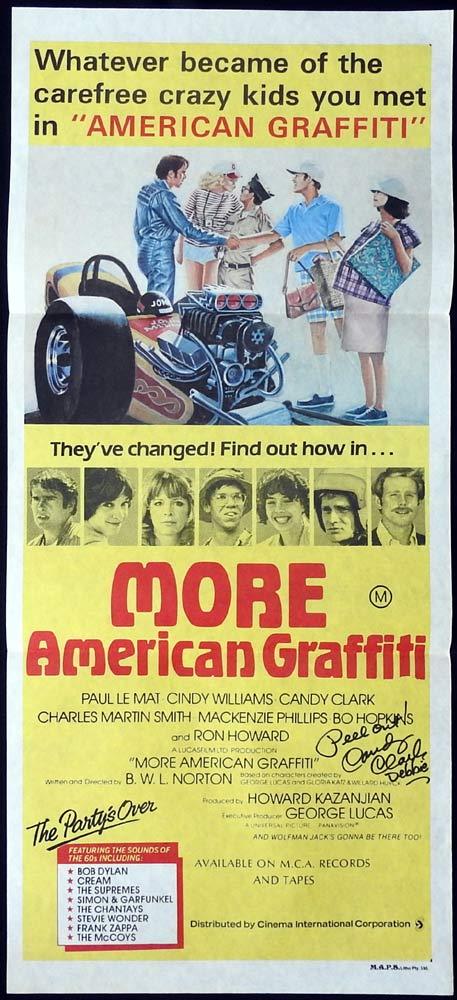
Where George Lucas’ American Grafitti showed the last few days before college for a group on American teenagers, the sequel — written and directed by Bill L. Norton, who was an actor in Messiah of Evil and also directed Baby: Secret of the Lost Legend— is about what happens next to the characters played by Candy Clark, Ron Howard, Paul Le Mat, Cindy Williams, Mackenzie Phillips, Charles Martin Smith, Bo Hopkins and Harrison Ford. Of them all, only Richard Dreyfuss didn’t show up. And this is Howard’s last role as a credited and named character in a movie.
As for George Lucas, who created the first film, well, he was a little busy, what with starting Lucasfilm, developing Radioland Murders with Willard Huyck and Gloria Katz, planning Raiders of the Lost Ark and writing The Empire Strikes Back. Of the film, Lucas would say that it failed miserably and critics disliked how much fun it made the end of the 60s — not to mention all the cutting between film genres — seem.
Despite that negative critical reception, this film wasn’t the commercial failure Lucas claims that it was. Some filmmakers would be happy with making $15 million on a budget of $3 million.
Set during several New Years’ Eve celebrations, during which the times of that year are remembered, this follows the cast from the original. Each year is a different style of film, with 1965 being a grainy war newsreel of the Vietnam War and 1966 looking a lot like the movie Woodstock. Norton thought that cutting between four different time frames would be too jolting for the audience. Years later, Lucas would agree.
But hey — the drag race scenes, shot in a low aspect ratio like an exploitation movie? Those are pretty great. There’s a huge crowd of extras, who were all given Star Wars toys to show up.
George Lucas, who directed the original American Graffiti, wanted to make a sequel. However, Gary Kurtz and Francis Ford Coppola, who produced that film, talked Lucas out of it because, in their opinion, “sequels weren’t well received.” So Lucas vested his time on Star Wars and Raiders of the Lost Ark.
Lucas should have listened: for he ended up with another Howard the Duck.
For his writer and director, Lucas picked Bill L. Norton, who gave us one of the best, if not the best, of the CB trucker romps of the ’70s — as well as one of the best films based on a song*, Convoy. And the Smokey and the Bandit knock off**, Outlaw Blues, with Peter Fonda was pretty good.
Besides, this will work because Ron Howard, Cindy Williams and Harrison Ford — who were nobodies when the first movie was released and now big stars as result of their respective TV and film successes — were returning to do the sequel.
Lucas should have heeded the words of Kurtz and Coppola.
Keep on Truckin’.
Also on board from the original are Candy Clark, Paul Le Mat, Mackenzie Phillips, (our beloved) Bo Hopkins, and Charles Martin Smith (of the “No False Metal Classic” Trick or Treat). Richard Dreyfuss, who had Jaws and Close Encounters of the Third Kind under his belt, knew enough to stay away from this critical bomb that, while it make $15 million against its $3 million budget, is still considered a box office flop.
Set over the course of four consecutive New Year’s Eves from 1964 to 1967, the viewer is tossed to and fro from Woodstock to Vietnam to Haight-Asbury, and protests and draft card burning — and Steve and Laurie’s perpetual bickering as their marriage fails (proving why Cindy Williams vanished after TV’s Laverne and Shirley and Howard, wisely, went into directing. Their scenes are just painful to watch). Rewatching this — well, skimming — to review was not enjoyable and the last time I’ll ever look at it. The old Woodstock-era split-screen narrative technique (if you’re familiar with that 1970 concert document) is annoyingly dated in 1979.
Ah, but why we are here — if you haven’t guess by the theatrical one-sheets and our theme week — is the drag racing. In this case, Paul Le Mat’s John Milner — who, it turns out, didn’t die in an insinuated car crash during the word-on-screen epilogue of American Graffiti: he became a struggling drag racer. The scenes (we care about) were shot at the since long gone (it’s a car dealership, of all things) Fremont Raceway, later known as Baylands Raceway Park, (before it being torn down) in Fremont, California.
The rail ain’t helpin’.
Luckily, for us, it’s all original shot footage and not cheap-jacked film clips from other sources. But the shot-for-the-film dragging doesn’t help, here. This is a boring film. Drag Racer and Burnoutfrom Crown International Pictures — with their mutual stock footage drag inserts — are more entertaining, since they’re about drag racing and not treating the racing as subplot fodder. Where’s my copy of David Cronenberg’s drag romp,Fast Company?!
More American Graffiti is easy to find in the online marketplace on vintage VHS and LaserDiscs. It finally came out on DVD in 2003 as a single release and as a double feature disc with American Graffiti in 2004. It hit streaming platforms in 2011, Blu-ray (Europe only) in 2012, and eventually in the U.S. on Blu-ray in 2018. Here’s scene-clips to enjoy on You Tube and You Tube.
The four-sided double album is easily found on CD and worthy, unlike the film it promotes, of your purchase.
Oh, and Sam the Bossman offers his take on the film because, anyone who is connected to the majesty that is Messiah of Evil — in this case, Bill L. Norton, who acted in that Lucas-Star Wars sidebar – – always needs another take. Always, as guys Bill L. Norton is what B&S About Movies is all about!
The man who gave ex-pornographic actress Marilyn Chambers a vampiric armpit. The man who made us lifelong fans of Micheal Ironside (John Saxon, Part Deux!) when he exploded his head via psychic brain waves. The man who knew we couldn’t pass up a film where Oliver Reed causes Samantha Eggar to “birth” an asexual dwarf-child. The man who turned James Woods into a human VCR. The man who dared adapt William S. Burroughs. The man who gave us “Brendel-Fly,” James Spader sexually aroused by car crashes, and made us lifelong Jeremy Irons fans by splitting him into twin gynecologists.
There wasn’t a body part, bodily function, brain wave, or hunk of technology Cronenberg didn’t like — and worked into his scripts. And when you take the mad Canadian’s “body horror” oeuvre into consideration, it’s not a wild stretch to realize that, in his spare time, he loved cars, racing bikes, and machinery. In fact, over the years, Cronenberg was — following in the burn marks of Steve McQueen and Paul Newman (and Tom Cruise) — a part time race car driver.
Directing a screenplay written by Phil Savath (Big Meat Eater and Terminal City Ricochet), Cronenberg quenches his love for the scent of well-weathered leather, hot metal and oil in this tale of veteran drag racer Lonnie “Lucky Man” Johnson (William Smith). Driving for the Fast Company Oil team, Lucky deals with Phil Adamson (John Saxon), the “corrupt” team owner who’s more concerned with sponsor dollars and could care less who drives the car — provided he’s winning.
The always divine Mr. Jennings is the screenwriting androgyny-troped “hot chick with a guy’s name” (e.g., Alexandra = Alex, Charlotte = Charlie, no, not another “Frankie,” please!, etc., here, it’s Samantha = Sammy) playing up the romantic angle. The always-welcomed Nicholas Campbell (who went onto appear in Cronenberg’s The Brood, The Dead Zone, and Naked Lunch) is the ubiquitous protégé, Billy “The Kid” Brooker, who ignites a new sense of competitive spirit in Lucky to take on Adamson’s new hotshot driver, Gary “The Blacksmith” Black (iconic Canadian actor and voice artist Cedric Smith).
While this was filmed a few years earlier — around the time Cronenberg made Shivers(1975) and before he gained notice outside of his native Canada for Rabid(1977) — courtesy of Burt Reynolds’s redneck rally Smokey and the Bandit (be sure to check out our “Top 70 Good Ol’ Boys Film List: 1972 to 1986“) creatin’ a need for that good ol’ southern speed, Fast Company, made its way to receptive Drive-In audiences in 1979. And while Roger Corman’s Deathsport (1978) served as her final casting, this Cronenberg race tale served as Claudia Jennings’s final film; she perished in a car accident a few months after the film’s release.
I was funny car crazy in ’79, with centerfold tear outs of Don “The Snake” Prudhomme and Tom “The Mongoose” McEwen on my walls, right alongside magazine rips of champion motorcrosser Roger De Coster. So I got my dad to take me to see Fast Company at the local-quad Drive-In. So — as with all of my reviews for these “classics” from the bygone days of UHF-TV and VHS-shelved dust bunnies — take my nostalgia into consideration when I say that, when compared against most of the ’60s “Fast and Furious” precursors we reviewed this week, this exhaust thrower is one the better racing flicks from the lost Drive-In era.
We found a very clean, four-part upload to enjoy on Daily Motion. You can also get this on a nicely packaged Blue Underground DVD. And be sure to join us for our “Phil Savath Night” as part of our weekly Drive-In Friday featurette.
By the way: When it comes to racing — on all types of tracks — no one does it finer than the folks over at Demaras Racing. Check ’em out and keep it on the redline!
About the Author: You can learn more about the writings of R.D Francis on Facebook.He also writes for B&S About Movies.
We originally reviewed this drag flick on August 2, 2020, as part of our reviews for Mill Creek’s Savage Cinema collection. Then it came back on February 5, 2021, as part of Mill Creek’s B-Movie Blast pack. So, for this “Drag Racing Week” tribute, it’s time for a new, second look at this ’70s time capsule homage to those rails and funny cars of the ’60s and ’70s.
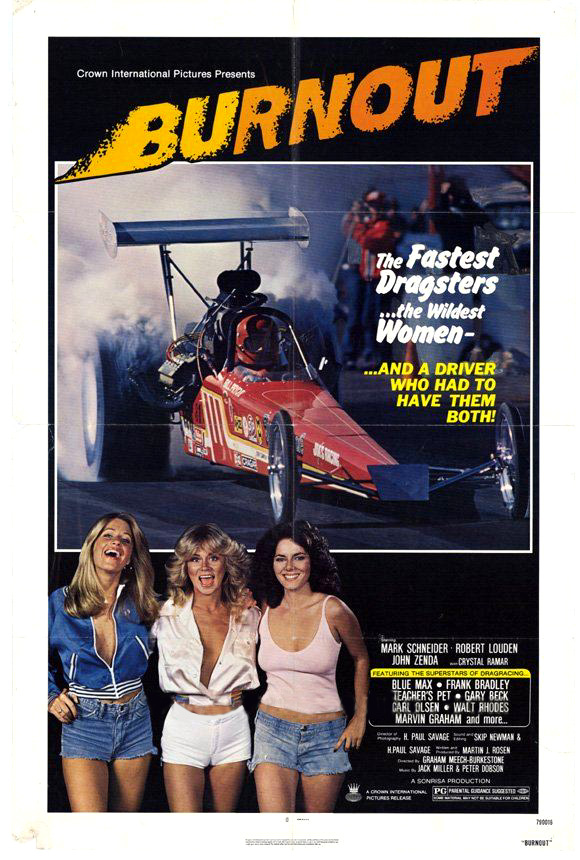
Hey, when you’ve got faux-Charlie’s Angels that look like they’re out of a The Dukes of Hazzard crossover episode . . . and rails on the poster, we aint’ hatin’, Hoss.
This one really is for the drag junkies, for this isn’t just a T&A comedy fest with a hotrod in it. This is hardcore: Don Garlits, Marvin Graham, Gary Beck, Don Prudhomme, Raymond Beadle, Tony Nancy and Shirley “Cha Cha” Muldowny (who earned her own hot roddin’ drag flick with Heart Like a Wheel) appear.
So, we have Mark Schneider from Supervan as Scott, with aspirations to be a drag racer. Of course, his affluent businessman pop is against that career choice, even though his dad is a fellow drag fan. In spite, Scott signs up as a gopher for a driver and hits the road. Don’t worry: Dad and Scott come to find a common ground.
That’s the movie.
For this flick isn’t about the drama. Or Scott. Or pop. It’s about the drag racing padding. But, not footage shot for the film. It’s all stock footage creatively written into the “plot” of the film. Truth be told, there’s decent story here — even though it’s 80% stock and 20% real actors. Take Tom Cruise’s Days of Thunder, give him a pop instead of team captain, take out the stock cars, put in rails, and you’d have a box office hit flick about drag racing.
Yeah, this is one budgetary Crown flick I really like. Then again, I grew up watching weekend sports show on network TV in the pre-cable days for those drag racing “events,” so your own nostalgia mileage may vary from mine.
As for director Graham Meech-Burkestone: this was his only film. He entered the business as a hairdresser and makeup artist on Burnt Offerings, Day of the Animals, The Manitou, The Exterminator (we know that’s the Part II link!), Day of the Locusts, and The Amsterdam Kill. Wow. If he was a director on all of those films, that’d be a tribute week right there for the B&S About Movies’ schedule alongside Mark L. Lester and Michael Fischa.
But jam on this: Unlike most Crown International actors who vanish from the biz, Mark Schneider is still in the business. He worked his way up to being a regular on TV’s Matt Houston and had a long, successful career with the U.S. TV daytime dramas Santa Barbara and Days of Our Lives. In addition to a recurring role in the syndicated sci-fi’er Babylon 5, Mark recently appeared in the indie horrors Obscura (2017) and Remains (2020).
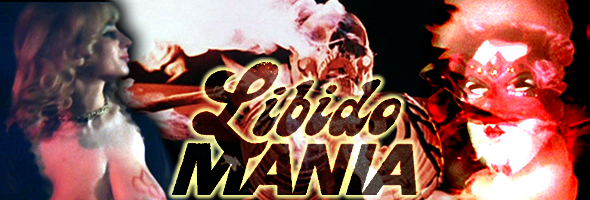
Ilona Staller was born in Hungary but came to Italy and found fame as a salacious radio hostess, taking the name Cicciolina or “Little Cuddly One.” Her show on Radio Luna, Voulez-vous coucher avec moi?, found her speaking on, well,mostly matters of sex and referring to her male fanbase as cicciolini or little tubby boys.
Cicciolina went out of her way to be sexually ahead of her time, appearing topless on regular TV in 1978 and doing her first adult film, Telefono Rosso (Red Telephone) in 1983 and then traveled to the United States to appear in The Rise and Fall of the Roman Empress, a movie that featured an HIV-positive John Holmes.
That’d be enough to be a pretty big star, but she also entered the world of politics, getting elected to the Italian parliament from 1987 to 1991. She also started a political party, Partito dell’Amore (Party of Love) with fellow porn star Moana Pozzi. Then, in 2012, she formed the he Democracy, Nature and Love Party (DNA), which advocated reopening brothels, a minimum wage for young citizens and the legalization of same-sex marriage.
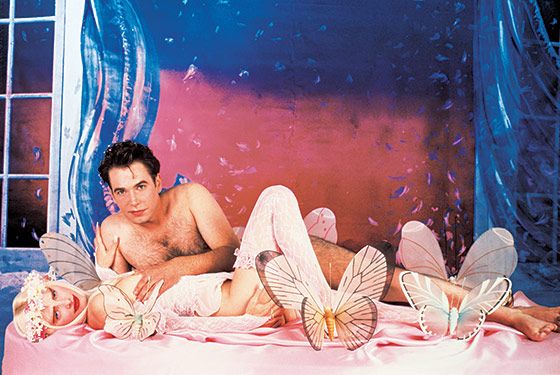
She also released several albums and was famously married to pop artist Jeff Koons, which ended with her taking their son and him destroying all of the sexually explicit Made In Heaven sculptures of her.
In this film — directed by Bruno Mattei as Jimmy B. Matheus!* — Cicciolina makes fantasies come true through her radio show. One of her biggest fans, Riccardino, is obsessed with her and it begins to destroy his relationship with his girlfriend Gianna. However,Cicciolina decides to being all three of them together to fulfill everyone’s fantasies.
Nearly every time we see our heroine, she’s bathed in neon light or riding a horse nude or making love to men with no faces while some wonderful jazz plays. There’s also a scene where she’s nearly assaulted by three men, after which she says that rape is the fault of women who allow it to happen, which, well…woah. I mean, this movie has a very strange relationship with women who are forced to make love and then end up liking it.
Sure, we’ve had sex symbols in the United States, but we never had Cicciolina.
Man, when you get Bruno Mattei to make a mondo, you get something that’ll shock even the most jaded of us. Like me.
Working under the name Jimmy Matheus and basing his work on German psychiatrist Richard von Krafft-Ebing’s Psychopathia Sexualis — which had already been made into a film by Albert Zugsmith — you may think, hey, this could very well be a well-thought-out exploration of man’s carnal side. I mean, the opening even gives credit to Sigmund Freud, the Marquis De Sade and Masters and Johnson.
Then you realize, hey, it’s Bruno Mattei.
This movie was so upsetting on release that 38 minutes of the film was cut in its native Italy. This is the same country that gave birth to movies like Giallo In Venice and Salò. It did, however, run uncut in Germany. They got to see everything from a sex maniac cutting off a girl’s leg and a sex change operation to flirting with farm animals and priests making sweet, sweet love to dead people.
Now, that’s the stuff I felt comfortable discussing in this review. Just imagine what got left out. Nope, it’s worse than that.
Mattei also made a sequel, Sesso Perverso, Mondo Violento, bringing on Claudio Fragasso to direct the second unit.
Anyways, there’s also a lot of stock footage and, if you’ve never seen a mondo in your life, plenty of scenes taken from other movies and outright fake moments presented as being real. There are also experts debating what we see, lending an air of scientific meaning to what one can only assume is footage that someone, somewhere finds inordinately arousing.
Editor’s Note: The original Battlestar Galactica series that debuted on ABC-TV on September 17, 1978, was cancelled on April 29, 1979. As part of our “Space Week” tribute this week — which was inspired by our most recent “TV Week” tribute in April — we’re reflecting back on the 42nd anniversary of the show’s cancellation with a look at the two overseas theatrical films culled from the series: Mission Galactica: The Cylon Attack and Conquest of the Earth. We’ll also take a look at the additional twelve telefilms culled from the series’ episodes in this review.
Even at its cheesiest and lowest of budgets, the production values of ’70s and ’80s American telefilms and TV series rivaled most Asian and European productions. Thus, many of the TV movies and series-pilot films reviewed at B&S About Movies — such as The Six Million Dollar Man (1973)* — became theatrical features in the overseas markets.
In Britain, the series UFO and Space: 1999 became Invasion: UFO and Destination Moonbase Alpha, while the 1973 Canadian TV production The Starlost was rebooted with a series of films beginning with The Starlost: The Beginning. In addition, two-part episodes of popular U.S. series — such as the Season 5 episodes of The Six Million Dollar Man (1976), “The Secret of Bigfoot” and “The Return of Bigfoot” — were cut into foreign theatricals. And those U.S. TV productions became significant box office hits that turned their actors — however brief — into “movie stars.” Just ask American TV actors Nicholas Hammond and Reb Brown, both who became overseas stars as result of their respective, short-lived Marvel/CBS-TV series, The Amazing Spiderman (1977; Columbia Pictures) and Captain America (1979; Universal Pictures), being cut into blockbuster theatrical films (each reached #1 in Japan). And Lou Ferrigno, thanks to those The Incredible Hulk series-to-films reduxes, he did alright and carved out a decent overseas theatrical career with Hercules, The Adventures of Hercules, The Seven Magnificent Gladiators, and Desert Warrior.
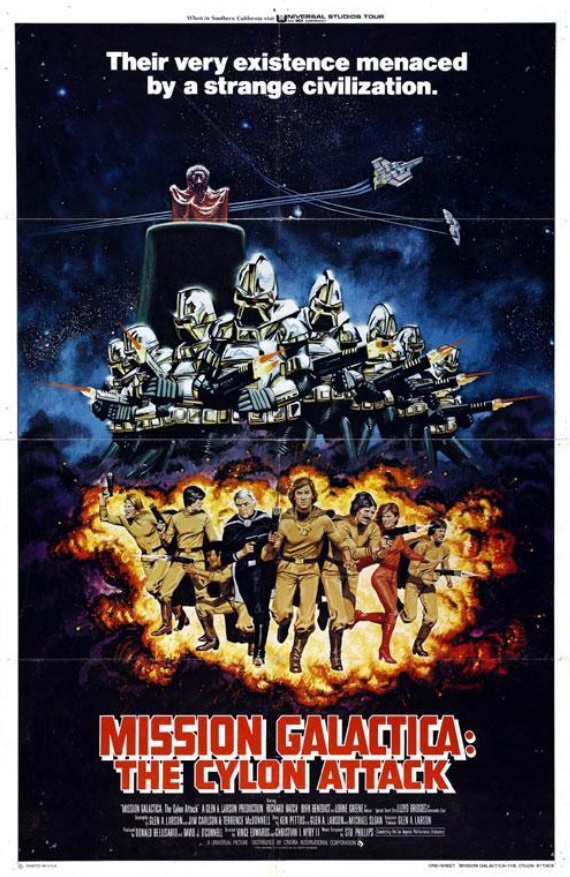
Overseas theatrical one-sheet/multiple sites.
While us post-Star Wars lads n’ lassies were mesmerized by the initial Battlestar Galactica TV movie/theatrical in 1978 (recut into the syndicated three-episode arc, “Saga of a Star World”), we quickly grew weary of the subsequent ABC-TV series, as its blatant stock footage recycling from the initial film — with very little, new SFX shots produced — bored us pretty quickly. And, as the ratings dipped each week as result, the stories and the effects only got cheesier and cheaper, and repeated and recycled, which only led to more boredom.
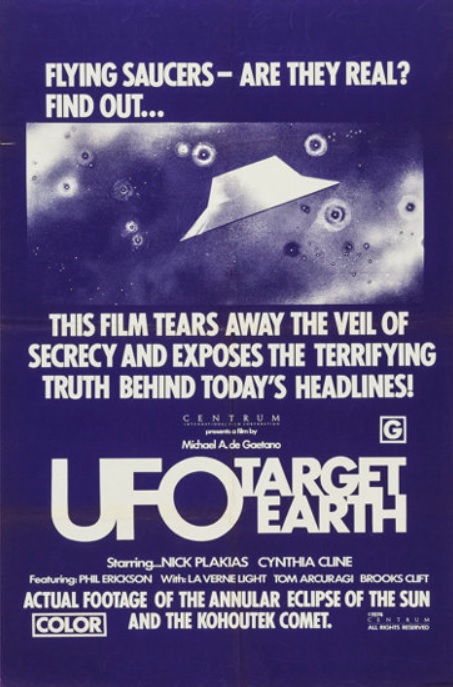
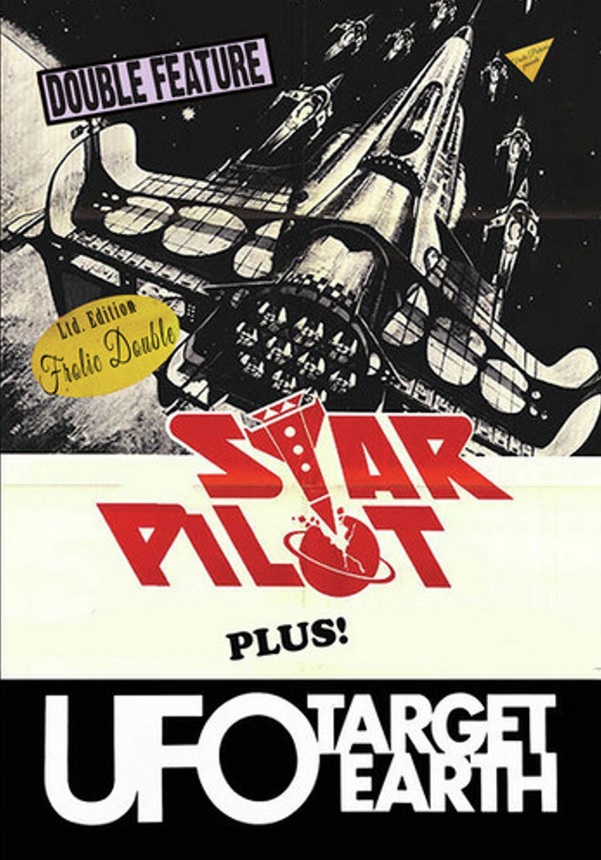
Oh, man. My Star Wars Fever and the Boogie-Woogie Battlestar Galactica Flu was so bad . . . I even made the drive to see the late ’70s theatrical repacks of Star Pilot (1977), aka the decade-old reboot of Mission Hydra: 2+5 (1966), and UFO Target Earth (1974). Yeah, I got punked for my hard-earned lawn money. But I digress. . . .
When the series was cancelled after one season, the reason given was that the ratings didn’t justify the reported production cost of one million dollars per episode. One million? Seriously? And how many times did we see those same SFX shots of the barrel-rolling vipers to screen left and a Cylon Raider flying into screen right before it was blasted into space dust? And did you, Mr. Producer, not think we wouldn’t notice the Terran shuttle in “Greetings From Earth” was a stock shot from (the even more god awful) Buck Rogers in the 25th Century? And the ol’ “space Nazis” trope from Star Trek from over decade ago, really?
The epitome of Star Wars droppings.
So, uh, if the series wasn’t cancelled, would Adama and friends encounter a “gangster world” and a “gladiator world” in quick succession? And why not, you’d already stuck us with “western world” (“The Lost Warrior”) and “knight world” (“The Young Lords”) episodes. Did you learn nothing from the stock prop room and wardrobe adventures of the Starship Enterprise, Mr. Producer? What was next, retreading the Star Trek episodes with Starbuck forced into an arena battle by aliens with a Gorn? How about Starbuck and Apollo flying through a space anomaly that spits out their evil doubles — and giving Apollo a beard and Starbuck a Sulu face scar? And why not? BSG’s sister series, Buck Rogers, became a Star Trek pastiche with Hawk as Spock, Buck as Kirk, and Wilma as Uhura in its second — and final — season. And what was the friggin’ deal with Boxey and the Daggit skirting the Battlestar’s security protocols every week?
British newspaper theatrical advertisement via multiple sites.
Ugh. So, yeah, of course many of us wee lads abandoned the show halfway through its 24-episode run (17 original episodes of the series were made, five were two-part shows). Sure, the first two episodes (4 and 5) that ran as “The Lost Planet of the Gods” were certainly up to the standards of the initial movie, but things got a bit dopey by the time of “The Gun on Ice Planet Zero” (8 and 9) with its clone buffoonery. And again, the single-night episodes in between the two-parters, with their even dopier western and knights of the round table tropes, were worse (by the Lords of Kobol . . . Fred Astaire, are you frackin’ kidding?).
Ultimately, the series failure — a series that we all wanted to succeed — was the result of corporate greed; a greed that also resulted in the creation and failure of Buck Rogers, natch, for rival network NBC. (Today, the once ABC-aired series is now the property of NBC-Universal. You can watch BSG: TOS online at NBC.com.)
The initial plan was to rollout BSG (as with Buck Rogers) across 1978 as four annual, miniseries sequels to the three-hour (3-part) pilot film. The other planned films were “Lost Planet of the Gods (4-5),” “The Gun on Ice Planet Zero (8-9),” and “War of the Gods (15-16)” — the aforementioned space Nazis mess that was “Greetings from Earth (19-20)” was developed later, when ABC-TV decided it wanted to go to a weekly series. That decision, in turn, not only strained the show’s budget (and resulted in raiding the prop and costume departments and the stock shot boondoggling), but left the writers scrambling for quickie episodes to fill out the series (thus the western, knight, and Nazi tropes). It also resulted in the three mini-series suffering cuts to fit into a two-part, hour-long format.
And that brings us to the source material behind the series’ finest hour courtesy of a story arc and characters (Lloyd Bridges on his A-Game as Commander Cain) that rivaled the initial TV movie pilot — an arc that, like the two-part “Greetings from Earth,” was developed as result of going-to-series. (An honorable mention goes to Patrick MacNee as Count Iblis in “War of the Gods.”) For the overseas folks in the U.K., continental Europe, and Japan, what we enjoyed as “The Living Legend,” they enjoyed as Mission Galactica: The Cylon Attack. And while our overseas sci-fi brethren didn’t know any better at the time — to get the BSG: TOS DVD set and watch TV the version of “The Living Legend” instead — we sure did.
Frack me!Washed up vaudevillians Bobby Van and Ray Bolger embarrassing themselves — and doing their part to get BSG cancelled — as Hector and Vector in “Greeting from Earth.” Again, frack me.
Why? Because this overseas theatrical cut is a load of feldercarb; the broadcast version is better (even more so with the DVD series pack, instead of its syndicated commercial run).
It’s one thing to add footage to the two 40-minute episodes to create a theatrical-length piece, but the editors on this daggit-dung decided to take out the Cylon attack footage from “Living Legend” and replace it with attack footage from “Fire In Space (14).” Why not use both scenes? Why take out the romantic triangle subplot between Starbuck, Cassiopeia, and Cain? And really, you went all the way back to the clearing of the space mines scene from “Saga of a Star World” to beef up the film? And yes, that’s footage from The Towering Inferno in there. (And footage from Earthquake shows up in Galactica: 1980, natch.) And, in addition to the plot holes, character’s hairstyles change without reason. And character voices change. And Sheba — remember, the whole purpose of the “Living Legend” arc was to add her character to the cast — is mostly left on the cutting room floor. It’s a frackin’ editorial and continuity mess.
While you may be able to find used copies of the VHS (which were eventually made available in the U.S.) in the online marketplace, beware of the DVD reissues — even the region-free presses — which do not play on U.S. decks (or computers). Another problem: the DVD runs five-minutes shorter than the VHS (at 103 min. vs. 108 min.). Why cut those five minutes? Why are scenes — such as the Cylon fuel depot attack — truncated, missing dialog and plot explanations? And why the different sound effects for the Vipers and Raiders?
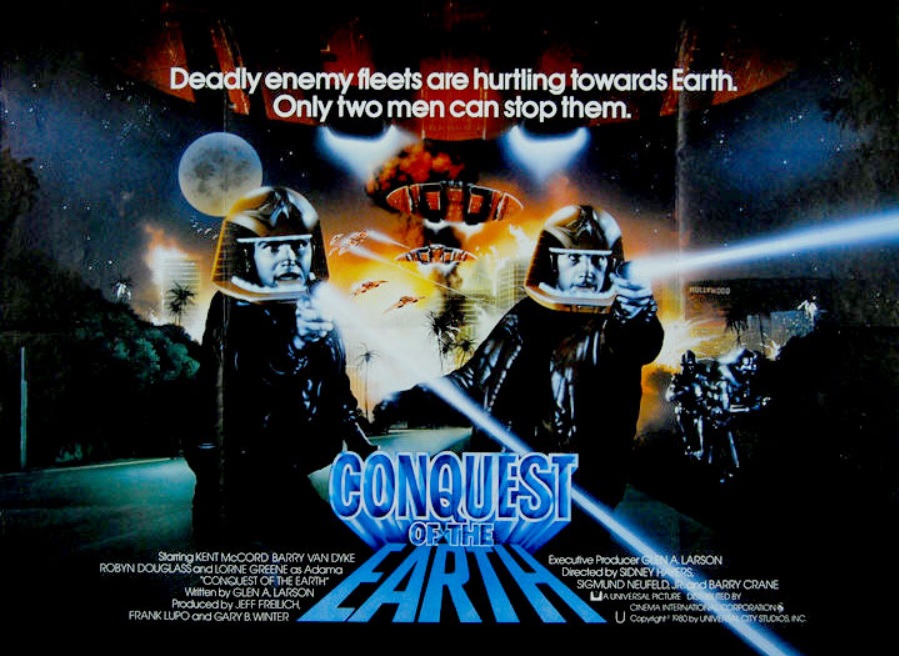
And speaking of the series-cancelled-and-returned second season Galactica: 1980: Our overseas brethren known the three-part “Galactica Discovers Earth” pilot as the third, official Battlestar Galactica film, Conquest of the Earth (1980), aka Galactica III, in some Euro-countries, Japan, and Australia.
Ah, but did you know there were 12 more BSG films issued after the three theatrical features? And no . . . Space Mutiny isn’t one of them!
A ripoff of a ripoff. Frack you, Mr. Lucas.
In 1988, this frackin’ South-African pile of daggit dung was added to the BSG-verse, an abomination that makes the Universal telefilm hodgepodges look like Oscar winners. Oh, feldercarb, it makes Dünyayi Kurtaran Adam, aka Turkish Star Wars, look like a statuette recipient. So, frack you, Action International Pictures*˟, for manipulating those foreign copyright loopholes and giving us an Ed Woodian Star Wars that you should have titled Battlestar 9 from Outer Space.
But I digress, again.
As with the aforementioned UFO, Space: 1999, and The Starlost finding a new, overseas life as theatrical, television, and home video features: After Conquest of the Earth, the third and final BSG foreign theatrical film, and prior to the syndication of the series’ 24 episode-installments, Universal Pictures edited the BSG series episodes to create 14 telefilms (two went theatrical, natch) for foreign distribution in 1981. (It’s said that some local U.S. UHF stations aired the TV movie versions of the series. I never saw them myself during their original 1981 run and only on VHS after the fact.) As you can see from the pairings of the vastly different episodes, these movies — as with Mission Galactica: The Cylon Attack — also suffer continuity and editorial faux pas. The highlights — well, the worst of the films (depending on personal opinions) — are:
Experiment in Terra: An edit of “Experiment in Terra” (22) cut with content from Galactica: 1980‘s best episode, “The Return of Starbuck” (2.10), along with a chunk of “Saga of a Star World (1.1). But we do get a pretty cool, never-before-seen prologue explanation from Commander Adama about the Cylons — learned from Adama’s Galactica logbook discovered floating in space by an Earth astronaut.
Murder in Space: An edit of “Murder on the Rising Star” (18) with scenes from “The Young Lords” (11).
Space Prison: An edit of “The Man with Nine Lives” (17) and “Baltar’s Escape” (21).
Phantom in Space: An edit of “The Lost Warrior” (6) and “The Hand of God” (24).
Space Casanova: A combination of “Take the Celestra” (23) and “The Long Patrol” (7).
Curse of the Cylons: A hodgepodge of “Fire in Space” (14) with scenes from “The Magnificent Warriors” (10).
The rest are based on their multi-episode series counterparts:
Saga of a Star World: An all-new, third edit of the series that differs from the three-part syndicated series installments and the overseas/U.S. theatrical release.
Lost Planet of the Gods: Features restored scenes cut from the series version.
The Gun on Ice Planet Zero: Features restored scene cut from the series version.
The Living Legend: This is the third version of the Commander Cain tale, after the initial series episodes and the Mission Galactica: The Cylon Attack theatrical repack.
War of the Gods: After “The Living Legend,” the second best episodes of the series, again, thanks to Patrick MacNee’s turn as Count Iblis.
Greetings from Earth: The absolute worst episodes of the series. And even the makers knew: they (thankfully) deleted the abysmal vaudeville soft-shoe routine by the plastic-headed/white-faced robots Hector and Vector.
Conquest of the Earth: An all-new, third edit of the Galactica: 1980, aka BSG Season 2, three-part pilot arc “Galactica Discovers Earth,” which also includes footage from the season’s two-parter “The Night the Cylons Landed.” And look out for Baltar and Lucifer in this version — bought in from the old BSG: TOS episode, “The Young Lords.”
The theatrical one-sheet for the third Battlestar Galactica overseas feature film.
Each of these telefilms are given their own, unique open and closing credits, along with new scenes (both newly shot and leftovers not used) and alternate, unused SFX shots. Outside of watching these movies, U.S. audiences seen most of these scenes as deleted outtakes included as “bonus features” on the BSG DVD/Blu-ray box sets of the series. But be on the lookout for plenty of Universal stock footage pillaging throughout, such as the Fembot footage from The Six Million Dollar Man timeline being incorporated.
While the always-the-pro Lorne Greene performed a number of voice-overs for these movies by providing narration to help link the unrelated episodes flow, Dirk Benedict, Herbert Jefferson, Jr., John Colicos, Patrick MacNee, and Jonathan Harris also pitched in with voice-overs and dialog loops. Richard Hatch opted out of the project (it seems he was pissed over the Galactica: 1980 mess) and another actor — that sounds nothing like him — looped his lines (and it’s as a bad as it sounds). (Don’t forget: Later on, Hatch was pissed that Universal passed on his Galactica novels and film reboot*).
Starlog #39 (Oct. 1980) that gave us a rundown on the upcoming Galactica movies.I wish I still had my Starlogs. Damn you, adulthood.Image courtesy of the Starlog Internet Archive Project.
But truth be told: Even with their faux pas, these hodgepodge films are a fun watch for two reason: First, for the inventiveness of the screenwriters in somehow creating continuity between such varied episodes. They were certainly up against it, kudos to them! Second, these series-to-film repacks exist in a universe unto themselves — outside of the original series’ plotting — with their “alternate” timeline. Again, it’s fun to compare the series to the films and (as a screenwriter myself) be fascinated by the creative process to maximum Universal’s bottom line.
Sadly, unless you’re able to track down any VHS taped-from-TV or VHS home video repacks (foreign or domestic), these telefilms are lost to the cathode ray snows of yore. Fans of the original series have been clamoring for DVD and Blu-ray box sets of these movies for years, myself as well, as I’ve only seen half of them as result of discovering their used VHS-versions years after the fact. As for Mission Galactica: The Cylon Attack: we found four extended scenes (one in German) on You Tube (posted below) from the film for you to enjoy that gives the story arc from beginning to end.
Uh, oh. Here come the black boxes of death. One video down. The others will probably follow suit.
The blogspot site, The 100the Planet (which helped in our research and memory jogging; so grazie, fellow warrior), did an absolutely magnificent job watching all 14 films and breaking down their respective plots. So, if you’re a die-hard fan of the original BSG series, it’s a great read. And we also thank BattlestarWiki.org for their assistance in preparing this review. And don’t forget, we went Star Wars crazy with our month-long review of the films (over 50!) that inspired — and were inspired by — Star Wars with our Exploring: Before Star Wars and Exploring: After Star Wars featurettes.
* Be sure to check out week-long tribute to the film career of Lee Majors! All the review links — and more — can be found with our “Lee Major Week Wrap Up” featurette.
** Did you know Richard Hatch made his Galactica: The Second Coming pitch film with low-budget, direct-to-video auteur Dennis Devine sidekick Jay Woelfel? True story. Check out our “Drive-In Friday: Dennis Devine Night” to learn more.
*˟ We kid. We love David A. Prior, David Winters and Peter Yuval’s AIP films around here. Why do you think we reviewed The Silencer and Firehead (just to name a few) in the B&S offices?
About the Author: You can learn more about the writings of R.D Francis on Facebook.He also writes for B&S About Movies.










 B&S About Movies
You must be logged in to post a comment.