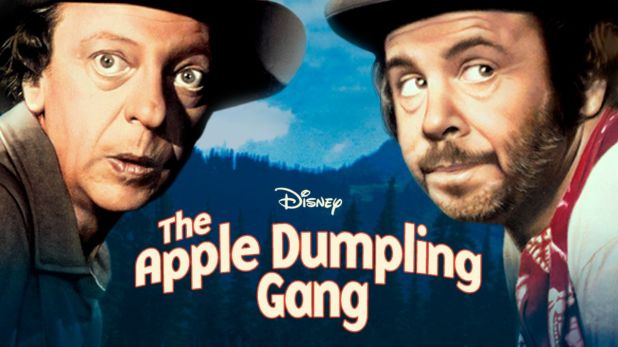
Based on the novel by Jack Bickham, this was the first movie to team up Don Knotts and Tim Conway, who grew up in Morgantown, West Virginia and Willoughby, Ohio respectively, and became beloved for their goofy comedic skills. In fact, Conway was the sidekick to Cleveland’s original Ghoulardi — Eric Anderson, later the voice of ABC and father of Paul Thomas — and would even come back home to appear on Hoolihan and Big Chuck and Big Chuck and Lil’ John.
Gamber Russell Donovan (Bill Bixby) has agreed to sign for some valuables from an old associate named John Whintle. Turns out they’re three orphans named Bobby, Clovis and Celia Bradley, a bunch of kids who destroy so much that they make Donovan poor. Soon, he’s nearly robbed by Knotts and Conway, who have left their gang after accidentally shooting Slim Pickens in the leg. Hijinks ensure involving a gold mine and bandits.
Only Knotts and Conway would come back for The Apple Dumpling Gang Rides Again, along with Harry Morgan who plays a different character. Disney also made a TV movie called Tales of the Apple Dumpling Gang, which had John Bennett Perry in Bixby’s part, Ed Begley Jr. instead of Conway and Arte Johnson in the Knotts role. They also made a six episode TV series, Gun Shy, with Barry Van Dyke in the Bixby part.
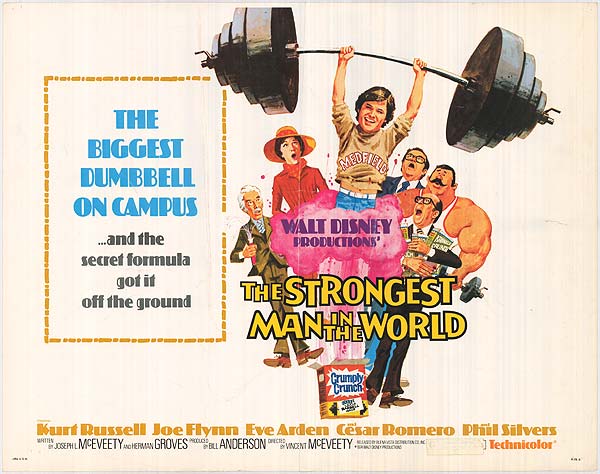
The second sequel to The Computer Wore Tennis Shoes, after Now You See Him, Now You Don’t, The Strongest Man in the World continues the story of Dexter Riley and the students of Medfield College.
Dean Higgins (Joe Flynn, who sadly died from drowning after filming was complete; the Youngstown native had also completed voicing over The Rescuers and was a major advocate for more equitable distribution of TV residual payments) is about to be fired for financial mismanagement due to the extreme overspending by Prof. Quigley’s science class. Higgins fires the professor and threatens to have his entire class kicked out of school, but when he slams the door on the classroom, he knocks Dexter’s experiment into another student’s vitamin cereal. Then the cow — which cost so much money in the first place — eats the cereal, Dexter drinks the milk and then we have Kurt Russell gaining super strength.
This movie had to have been cast by me in a past life. Can we get Eve Arden? How about Phil Silvers? Can Cesar Romero come back? How about Dick Van Patten as the main villain?
Director Vincent McEveety was a Disney directing mainstay, making stuff like Gus, Superdad, The Apple Dumpling Gang Rides Again and Herbie Goes to Monte Carlo.
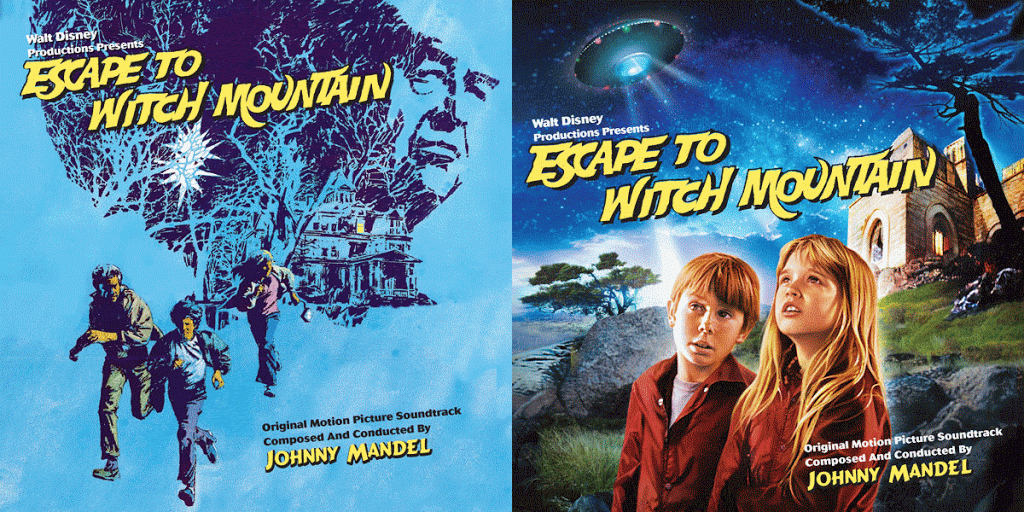
Based on the science fiction novel by Alexander H. Key, Disney has had great success with Witch Mountain, making two movies in the seventies, a Disney Channel sequel in the 80s, a 1995 remake and a 2009 cannon sequel that was marketed as a remake, despite the fact that Tia and Tony kind of cameo and are played by Kim Richards and Ike Eisenmann*. Now, there are plans to make a new series for the Disney+ channel.
Back to the past and the original film and we find our heroes in an orphanage. They’re not like the other kids — Tony controls inanimate objects with the aid of his harmonica — yes, really — and Tia can communicate telepathically with Tony, feel the emotions of animals and see the future. They have a star map that they can’t figure out as well as memories of an uncle who saved their lives, but otherwise, they are both a blank slate.
One day, one of Tia’s premonitions saves the life of attorney Lucas Deranian (Donald Pleasence!), which he reports to his millionaire boss, Aristotle Bolt (Ray Milland), a man obsessed with the paranormal. While acting as their uncle, Lucas adopts the children, but it is only so that Bolt can study them. They run away, meet RV-driving widower Jason O’Day (Eddie Albert) and convince him to take them to their destiny at Witch Mountain, all while being pursued by Deranian, Bolt and their henchman Ubermann (Lawrence Montaigne, The Great Escape sure, but also the chauffeur in Young Lady Chatterley).
The Witch Mountain films were the result of Disney looking to reinvent itself after the death of founder Walt. They wanted movies that were a little edgy and when they saw director John Hough’s The Legend of Hell House, they knew they had the right person. Hough also made The Incubus, Twins of Evil, American Gothic and Dirty Mary Crazy Larry. The end result was a big success and they’d bring the characters back three years later for Return from Witch Mountain.
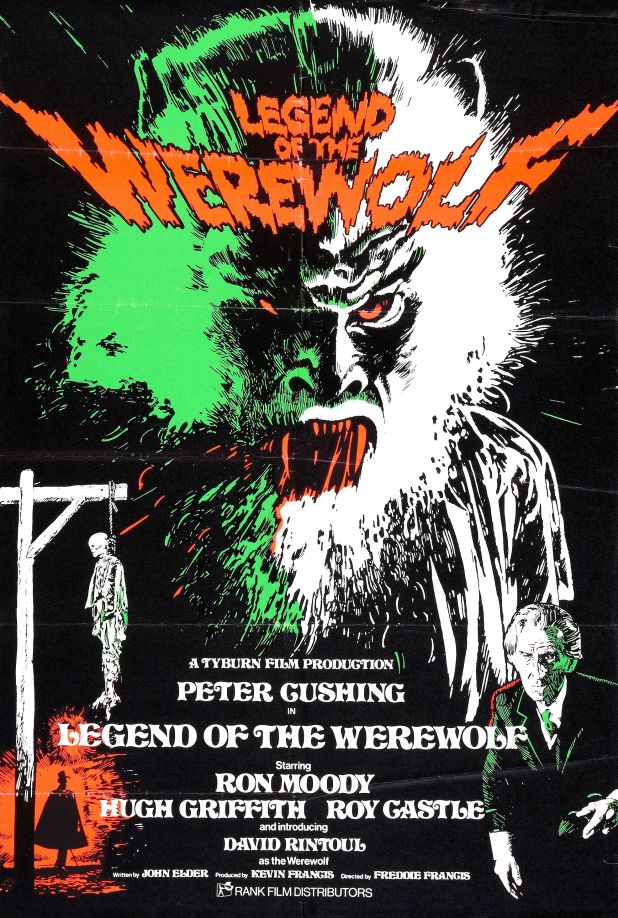
No matter what you think of this movie, you have to give it up for the poster. This is truly one of my all-time favorite movie posters of all time, one that punches you in the face and says, “You’re gonna watch this werewolf movie!”
It has a different origin story than a normal werewolf film, as here Russian werewolves kill a man who has just watched his wife die in childbirth and then raise the dead parents’ son to become a human wolf.
He’s known as Etoile the Wolf Boy in the circus, but soon loses his lupine look until the full moon rises. When that does — and he kills a member of the traveling carnival — he goes on the run.
This is really the sad tale of a wolf boy — a wolf young adult, I guess — who falls in love with a courtesan with a heart of gold who keeps on entertaining her clients, who soon get devoured by said wolf young adult.
Enter Professor Paul Cataflanque (Peter Cushing). He’s a forensic pathologist, who quickly figures out that a wolf is behind all the murders. And seeing how Etoile now takes care of the wolves in the zoo, he’s going to have to deal with putting every one of them to sleep under the orders of the police.
There’s no way he isn’t going to turn into a werewolf and kill just about everyone, right?
Legend of the Werewolf is one of seven Tyburn Film Productions, a studio that tried to fill the void felt after Hammer stopped producing new movies. Their other films include The Ghoul, Persecution, Sherlock Holmes and the Masks of Death, Murder Elite, G’olé! and Peter Cushing: A One-Way Ticket to Hollywood.
Directed by Freddie Francis, this was written by Anthony Hinds under his pseudonym John Elder. Under that name, he also wrote Hammer’s werewolf film The Curse of the Werewolf as well as Frankenstein Created Woman, Scars of Dracula, The Reptile and many more.
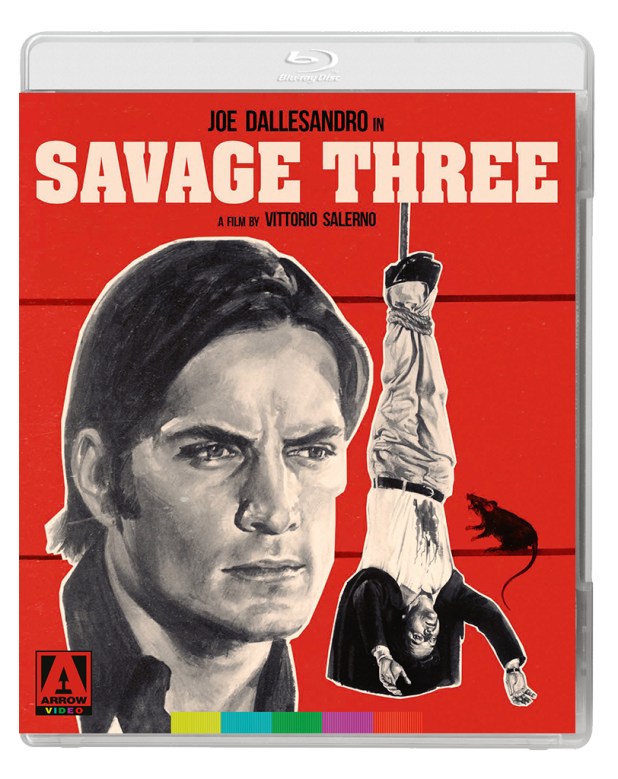
Released in Italy as Fango Bollente (Boiling Mud), Savage Three is a brutal example of the Italian crime and murder genre known as poliziotteschi. It stars Warhol superstar Joe Dallesandro as Ovidio Mainardi, a man who pushes buttons all day in a factory and endures a marriage that finds his wife (Martine Brochard) giving her body to her boss to get ahead. There’s a scene early on where someone in his office explains why they keep the rats in a lab divided, as otherwise they will always attack one another. And there’s always one rat that starts biting the others.
He and his co-workers Giacomo (Gianfranco De Grassi) and Peppi (Guido Di Carli) go from starting riots at soccer matches to stealing cars to acts of outright insanity, including one scene where a nude Dallesandro chases a woman while driving a forklift, impaling her against a wall. Before long, the three of them are doing pretty much anything they want, as the police think the killings are politically motivated or the acts of southern Italians, exposing the racism within the country at the time.
The film tries to explain that blame away. Much like Ovidio and his marriage, Giacomo is overwhelmed by his crumbling home and abrasive neighbors, while Peppi is trapped in a home with generations of relatives living on top of each other. The film doesn’t make them seem innocent. But it does show how the modern world has dehumanized them and force them to explode into violence in a world that simply does not care.
Inspector Santagà (Enrico Maria Salerno, Inspector Morosini in The Bird with the Crystal Plumageand the Italian voice of Clint Eastwood in Sergio Leone’s films) is a cop who has been demoted for his violent way of dealing with crime and is also a man on his way toward retirement. Only he’s able to see exactly who the killers are, which is a surprise to him, as he knows Ovidio from computer lessons he’s been taking to try to remain relevant as the world passes him by.
Vittorio Salerno only directed three other movies (No, the Case Is Happily Resolved; Libidoand Notturno con Grida), but I really enjoyed this and can’t wait to track down the rest of his films. This was written by Salerno with Ernesto Gastaldi (The Whip and the Body, The Sweet Body of Deborah and more than one hundred more movies).
Savage Three is a powerful and brutal film. It’s like a fantasy-free A Clockwork Orange that could happen at any time, even today.
Savage Three is one of five movies on Arrow Video’s Years of Lead: Five Classic Italian Crime Thrillers 1973-1977. These films are great examples of the Italian poliziotteschi genre and the set includes high def versions of this movie, Like Rabid Dogs, Highway Racer, Colt 38 Special Squadand No, the Case Is Happily Resolved. This disc has an interview with director Vittorio Salerno and actress Martine Brochard about Savage Three. You can get it from MVD.
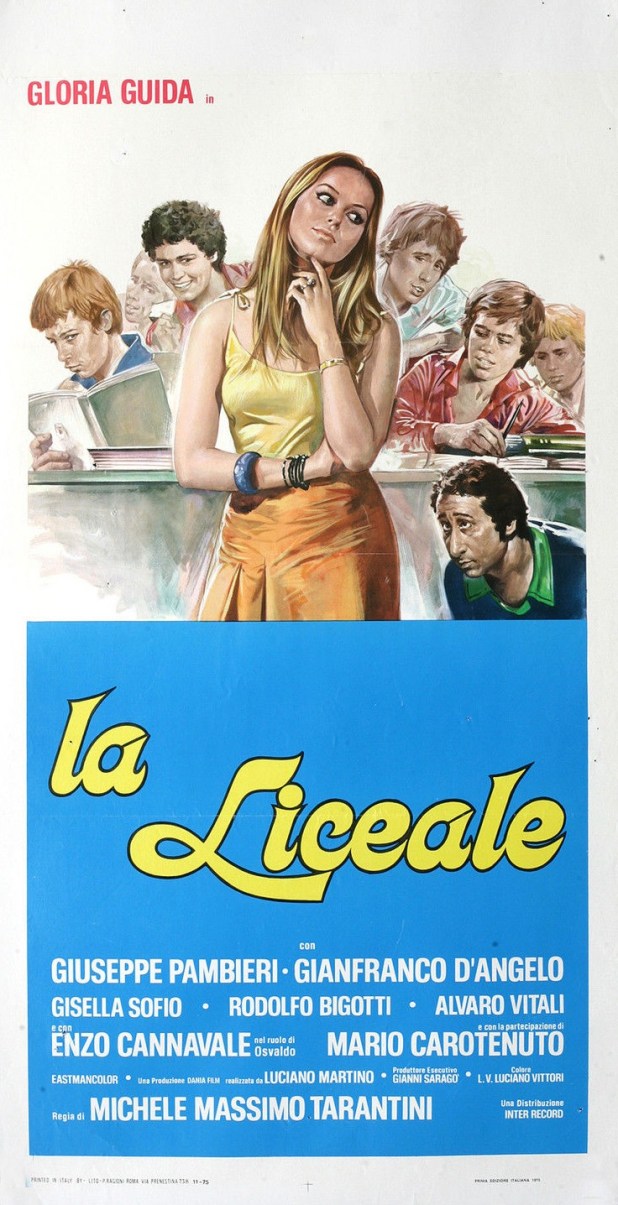
The High-School Student was released internationally under the titles The Teasers, Under-graduate Girls, Sophomore Swingers and Teasers. It’s a commedia sexy all’italiana that introduced Gloria Guida, who would appear in four out of the five films in this series. She’s also in the movies Being Twenty and The Bermuda Triangle.
She plays Loredana d’Amico, a girl for whom sex is a tool to get better grades for herself and her classmates. Otherwise, it complicates her life, as her father is cheating with a series of younger women and her mother is with another man. Despite losing her virginity to an older man, she remains unable to determine what men want other than what all men want.
One of the girls in this movie, Monica, is played by Ilona Staller, who would eventually become Cicciolina, a world-famous adult film star and Italian politician.
The tagline may be “Banned in 36 Countries. You Can See It Now Without a Single Cut!” but other than the nudity, this is a pretty innocent coming of age teenage movie, albeit one with the relaxed morals of the Italian film industry.
This was directed by Michele Massimo Tarantini, who also made Confessions of a Lady Cop, the Edwige Fenech movie Taxi Girl and Massacre In Dinosaur Valley.
June 8: Junesploitation’s topic of the day — as suggested by F This Movie — is Blaxploitation.
FYI: This would also qualify for their upcoming June 14 topic of the day: Kung Fu(we did 1992’s Ninja Zombies, by the way).
The tale is a simple one: A jive-cool New York crime lord’s prized African artifact—a mystical voodoo doll—is stolen. And he wants it back. So he hires an all-black squad of martial artists to retrieve it at all costs, because, well, “it can’t fall into the wrong hands.”
The awfulness of this kung-fu battle begins with acting by graduates of the Ed Wood Thespian Academy, and goes downhill from there . . . with inept fight chorography, out-of-sync dubbing, and sound effects more ludicrous than all of the “punches” and “blows” in all Asian Kung-fu flicks combined. Basically, all the things you want in a Drive-In Kung fu marathon. Is this just inept or a homage to the films from the Orient? You decide.
Also known as Black Force, this big screen debut of Tanzania also served as the second and final movie of director Michael Fink, who made his debut with Velvet Smooth. And in a twist only a B&S About Movies reader can appreciate: Fink went on to become an acclaimed visual effects supervisor, choreographing the fight scenes in Stallone’s Tango & Cash and Mel Gibson’s Golden Globe and Oscar-winning Braveheart.
We reviewed the entire, unofficial “Nisei Goju-Ryu” karate trilogy, since all three films utilize the martial arts form developed by Hanshi Frank Ruiz, in our “Drive-In Friday: Karate Blaxploitation” feature with the sequels Velvet Smooth and Devil’s Express. Oh . . . we got inspired this Junesploitation month courtesy of the folks at F This Movie, so we reviewed, get this, another Karate Blaxploitation’er produced and directed by Al Adamson Cirio H. Santiago: Dynamite Brothers. Yes, by Uncle Al and Uncle Cy. And it rocks, watch it.
As for Force Four, you can watch it as a free-with-ads stream on TubiTV.
About the Author: You can read the music and film reviews of R.D Francis on Medium and learn more about his work on Facebook.
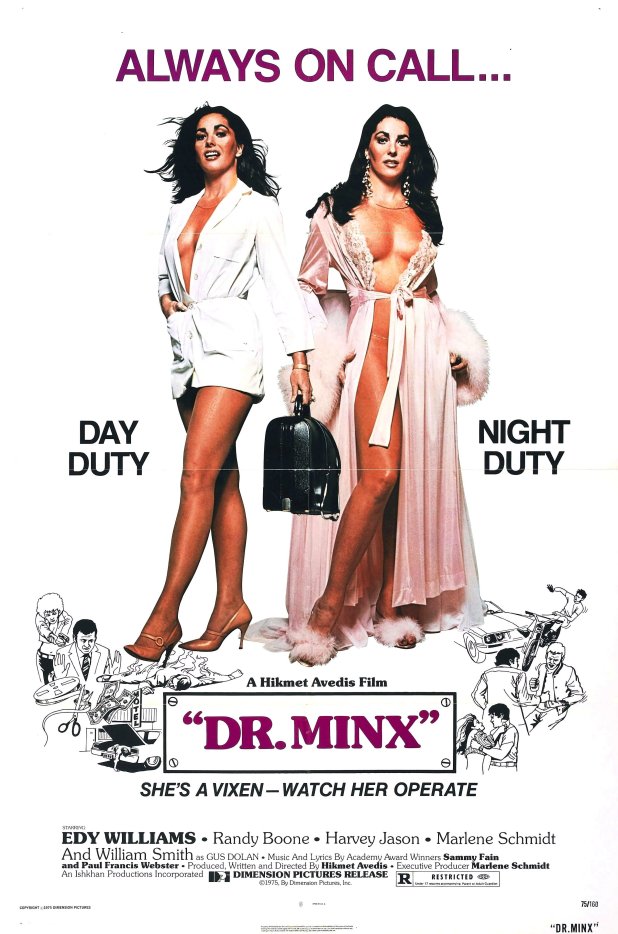
Dr. Carol Evans (Edy Williams!) keeps having these short affairs but they leave her unsatisfied. She’s just dumped her latest boyfriend (William Smith!) but ends up injuring two kids — David (Harvey Jason) and Brian (Randy Boone) — who somehow end up falling for her. There’s also the bulldozer death of her husband to deal with and a blackmailer as well. And yeah, Smith is not pleased at all that she’s sleeping with a teenager.
But yeah. Most people just watched this to gawk at Edy Williams.
Director Howard Avedis loved making movies about older women deflowering teenage boys. This is also 1975, so get ready for a bleak ending! I think by the 80’s, Avedis figured out how to make thrillers that really thrilled. But here, he’s doing what he can to entertain the audience.
Dr. Minx was Avedis’s follow up to The Teacher (1974), which starred Jay “Dennis the Menace” North. He also released the Adam West-starring The Specialist in 1975 and followed that with Connie Stevens in Scorchy (1976).
Editor’s Note: This review ran on February 8, 2021, as part of our Mill Creek B-Movie Blast month of reviews. We’re bringing it back for our “Hikmet ‘Howard’ Avedis Week” of reviews.
Mill Creek fans have listed Sly Stallone’s The Specialist from 1994 directed by Luis Llosa (of Crime Zone and Anaconda fame) on their lists for Mill Creek’s B-Movie Blast 50-Film pack. Others noted on their lists — uh, oh, there’s that friggin’ plural “S” again, the same “S” that bit me in the arse during out big, British-produced Satan’s Slave (1976) vs. the Indonesian-produced Satan’s Slaves (1982) snafu with our Mill Creek Pure Terror Month review back in November 2019 — that the film included on the B-Movie Blast set is Sergio Corbucci’s The Specialists (1969; starring French rock singer Johnny Hallyday (French rock singer; later of 1987s Terminus) — a film that we didn’t get around to during our “Spaghetti Western Week”* of reviews.
So, plural “S,” damn you, for ye almost deprived us of an Adam West . . . yes, THE ADAM WEST . . . spy thriller directed by Howard Avedis, he who gave us the epics of Connie Stevens as a rogue cop in Scorchyand ex-Waltons frolicking through the supernatural in Mortuary. Yeah, you know us all to well: we feel a “Howard Avedis Week” coming on, too. I mean, with film titles like The Stepmother and The Teacher (sexploitation time!!!!), and movies starring the B-Movie elite of Sybil Danning, Karen Black, Bo Hopkins, Patrick Wayne, Edy Williams (Dr. Minx!!!), and Angel Hopkins (!) with Jay “Dennis the Menace” North — how can we NOT have a “Howard Avedis Week” of reviews?
But. let’s get back to Adam’s West’s B-Movie milieu (Omega Cop, One Dark Night) in the Avedis schlock oeuvre.
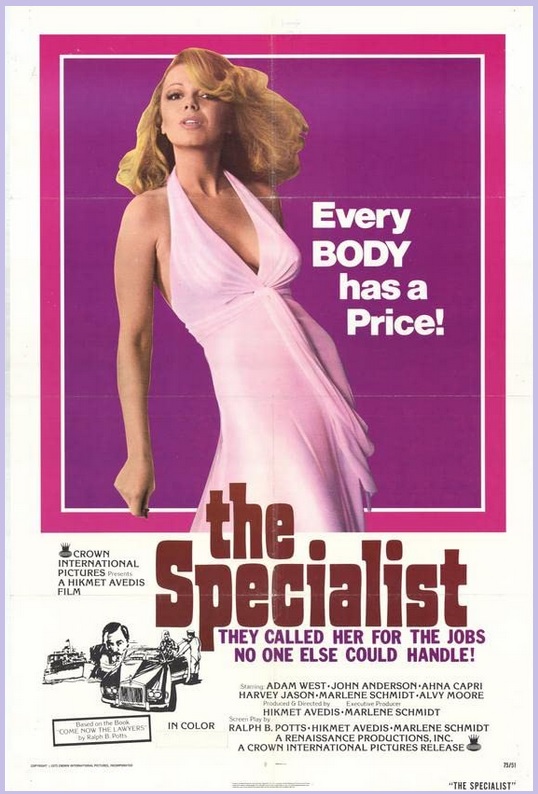
As you can see from the theatrical one-sheet, this is all about Budapest, Hungary-imported bombshell Ahna Carpi, who blazed through 70-plus U.S. TV credits (The Man from U.N.C.L.E. is my fondest Carpi-ory) before retiring from the business. But you know her film work in . . . YES . . The Brotherhood of Satan and Piranha (oops, the 1972 one that Joe Dante didn’t direct — damn you, multiple titles) and . . . YES . . . as Tania in Enter the Dragon. And, would you believe she was a child actor in two episodes of the now Antenna oft-run ’60s series Leave It to Beaver (I just got done watching “Beaver’s Sweater” a few days ago!), but, back then, she was “Anna Capri” and not the more porny-reading Ahna, which is the proper, Euro-ethnic spelling of her first name. Oh, and to continue that Brotherhood of Satan degree of separation: Alvy “Hank Kimbel” Moore is in The Specialist (as blackmailing court bailiff) as well, and Avedis’s Mortuary (and a few others) . . . and Cotton Candy (but no Avedis or Capri on that one).
So, there’s your movie trivia for today: What two movies starred a Hungarian child actor and a Green Acres cast member?
See? Reposting that old Sly Stallone review, in error, would have robbed us of all this fun! But, alas . . . I know, I know . . . get to the friggin’ movie, already, R.D. Hey, I’ve haven’t seen this one either, so, let’s go, Adam West fans! Hit the play button!
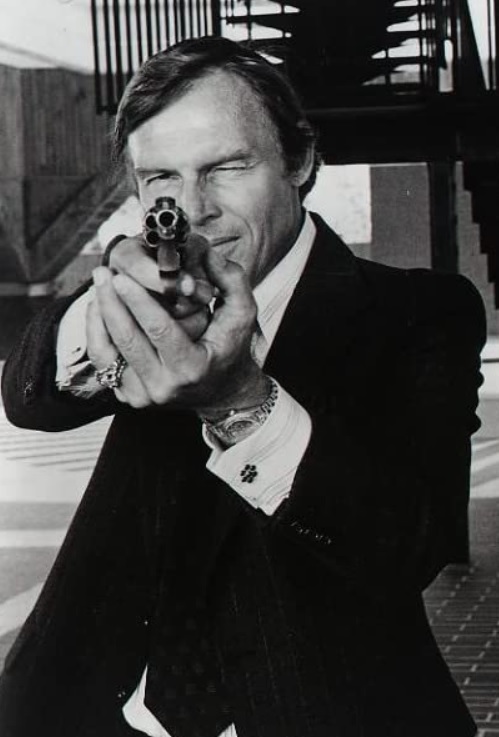
Now, based on this still from the film (or promo pack from the film) posted by the Digital Content Management Team at the IMDb, you’d think you’re getting a spy thriller with Adam West as a B-Movie James Bond or as an ex-war vet now a kick ass private eye. Oh, ye Mill Creek grazer of the digital divide, how wrong are ye. For this is a Crown International Pictures — serious — court room drama. I know. I never thought I’d type that sentence in a review either. This from a studio that gives us a steady stream of boobs, vans, cheerleaders, female basketball coaches who have sex with male students, and any -sploitation variant you can imagine.
But this ain’t your granddad’s or great grandad’s Perry Mason, Owen Marshall: Attorney at Law, or Matlock (especially not with Nancy Stafford in the cast). This court room caper, again, looking at the rendering of Ahna in that dress, is an R-rated potboiler. But a Joe Eszterhas Jagged Edge neo-noir legal thriller this is not, Motion Picture Association Ratings to protect us youngins, be damned.
West is “The Specialist,” aka defense attorney Jerry Bounds, who’s in a court battle against fellow attorney Pike Smith (western actor John Anderson), an attorney who wants his job back on the board of a (corrupt) water company. So, to assure he wins the case, Pike recruits a sleazy P.I. (is there any other kind), Alec Sharkey (aka Howard Avedis aka’in as actor Russell Schmidt), who, in turn, recruits Londa Weyth (Ahna Carpi), his blonde-n’-hot operative serving as a juror-ringer on the trial, to seduce Bounds and get a mistrial declared.
So, in case you haven’t figure it out: The “Specialist” isn’t West as a cool-as-steel spy or ex-Special Forces-now-an-Attorney (or P.I.) bad-ass; the well-endowed Londa is the special forces sex kitten in these proceedings. Another sultry kitten in our midst is Playboy and Max Factor model Christiane Schmidtmer, you remember her as the hot stewardess from Boeing Boeing (1965) that got Jerry Lewis and Tony Curtis all hot-n-bothered.
I am sure West, looking to be taken seriously as an actor (and deserved, IMO), was hoping this adaptation of the best-selling novel Come Now the Lawyers, would become a box office hit and thrust him into a legit theatrical career with the bigger studios. As did author Ralph Bushnell Potts, himself a Seattle-based Attorney-at-Law (learn more about Potts’s interesting life with his 1991 obituary in the Seattle Times). But, alas . . . Potts’s serious book about Washington State’s early courts system was turned into a Crown International exploitation fest that is not the least bit titillating and fails on the salacious scale that Crown in known for via these Mill Creek box sets. In the annals of Crown International public domaindom, The Specialist is a truly odd duck in the Crown celluloid pond.
There’s no freebie rips online to share, but you can check out the trailer and a scene clip on You Tube. Of course, you can enjoy The Specialist as part of Mill Creek’s B-Movie Blast 50-Film Pack.
About the Author: You can read the music and film reviews of R.D Francis on Medium and learn more about his work on Facebook. He also writes for B&S Movies.
This movie is quite literally the Batman and Superman of Italian sleaze filmmaking uniting to create some art. Those two men have many, many names, but for the purposes of this article, we’ll use the names that they used most often: Joe D’Amato and Bruno Mattei.
Producer Franco Gaudenzi wanted to bring the movie The Wild Pussycatto Italy, but it would have never made it past the Italian censors. For some reason, if the movie was made in Italy, it would pass. This is the country where it’s legal to call your movie Zombi 2, but illegal to use Mrs. Ward’s name. Let’s forget the complexities of law when it comes to exploitation cinema and move on.
D’Amato and Mattei took up the challenge of remaking this movie for Italian audiences with both writing the script and co-directing the picture, even if only D’Amato got directing credit. What was important for the producers was that the film could play theaters and it passed the Italian censorship board on November 5, 1975 after some lesbian elements and scenes with sodomy were removed.
Ironically, when this was brought to Switzerland by Erwin C. Dietrich, he added in actual hardcore scenes with French actress Brigitte Lahaie (who is inFascination) and dubbed it into German, releasing it as Foltergarten der Sinnlichkeit (Torture Garden of Sensuality) and Die Lady mit der Pussycat (The Lady with the Pussycat).
Truly, scumbag pictures bring all the nations of the world together, do they not?
Francoise (Patrizia Gori, The Return of the Exorcist) has had enough of the abuse from her gambler cad of a husband Carlo (George Eastman!), so she jumps in front of a train. Her sister Emanuelle — no, not Laura Gemser just yet, she’s played here by Rosemarie Lindt from Salon Kitty — gets revenge by drugging Carlo and restraining him in a soundproof room. There, she teases him through two-way mirrored glass as he’s forced to watch her make love to numerous men and women, all while he’s repeatedly dosed with LSD.
Finally, Emanuelle enters the room and attempts to castrate Carlo, who has been repeatedly fantasizing about killing her and finally does so for real. His joy is short-lived as while he’s hiding in the secret room, he gets locked in and the police closed down the crime scene for thirty days, basically leaving him to die.
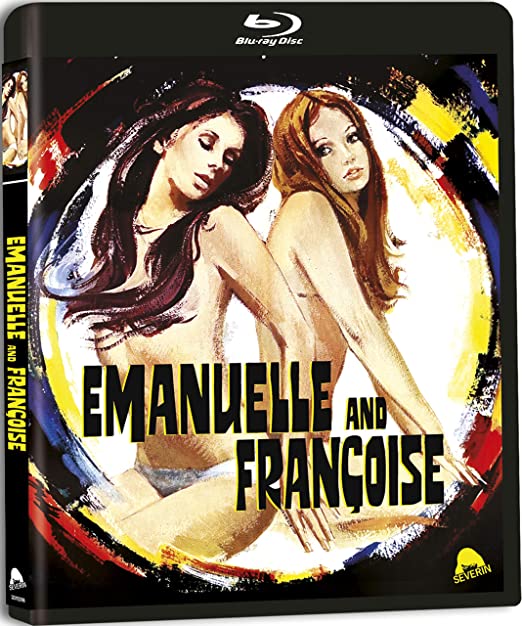
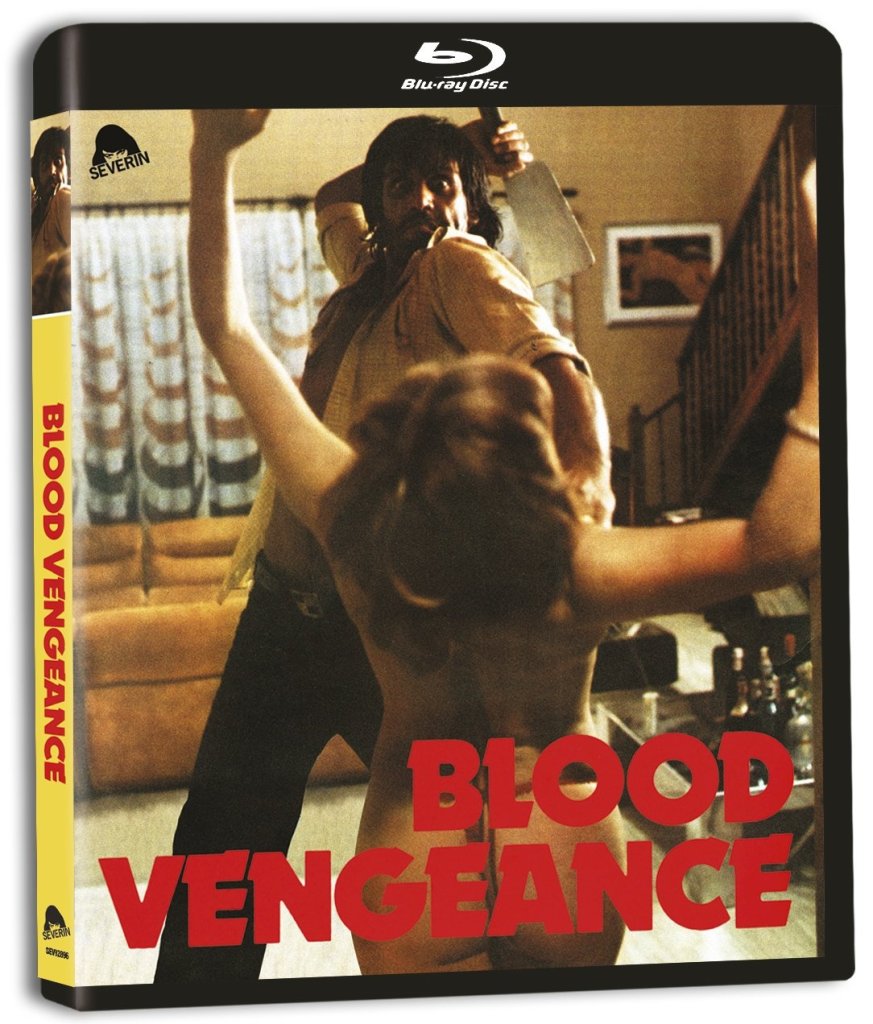
Also known as Emanuelle’s Revenge, Blood Vengeance and Demon Rage, this is exactly the kind of movie that you’d imagine D’Amato and Mattei would make together, filled with numerous sex scenes, frequently spinning and zooming camera angles and a cannibalistic feast sequence.
Back when we reviewed Emanuelle In America, the guys at Severin said, “If you thought that was rough, watch this one.” Their release has a great George Eastman interview in which he says that D’Amato had the ability to do bigger and better things, but preferred doing ten B movies a year than one A film. You can get the Severin edition of this film and see just how good-looking a completely irredeemable piece of trash — I say that with love — can look.






 B&S About Movies
You must be logged in to post a comment.