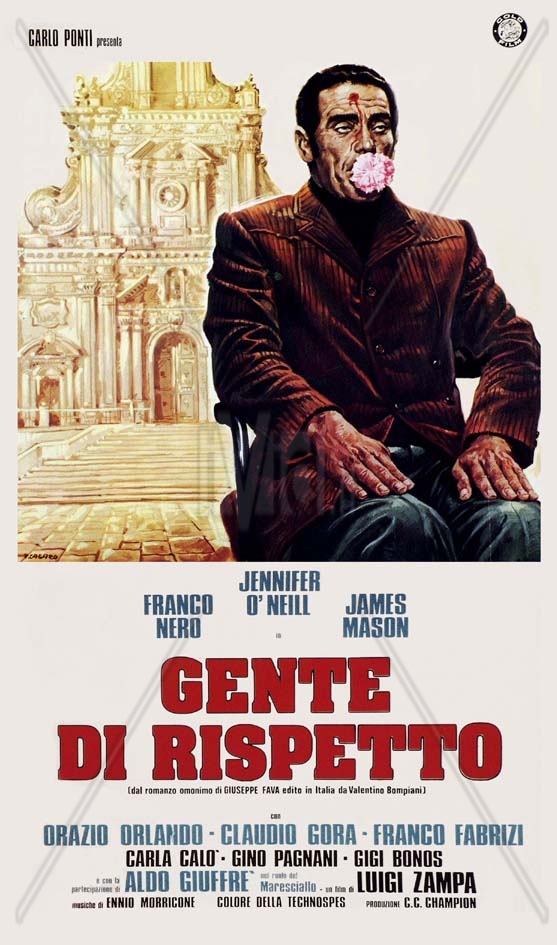
The Flower in His Mouth (1975)

Elena Bardi (Jennifer O’Neill, The Psychic) has moved to a small Sicilian town to teach, but on her first day she’s harassed by a man and no one helps her. The next day, that man is dead and she’s a suspect. Everyone in town treats her with near contempt except for Bellocampo (James Mason, absolutely incredible in this)m a lawyer who teaches her all of the secrets of the city, such as how she can change the laws about students evading school. The only other person she grows close to is Professor Belcore (Franco Nero), but he won’t even appear in public with her.

When a second person insults her and also winds up dead, the superstitious people of the small town believe that she has a secret power. She uses this belief to give grants to poor families and then further uses it to send their children to school. Even powerful senators begin to listen to her and change the laws to fix up the neighborhoods where the most cash-strapped citizens live.

The real reasons why Bellocampo has led her to improve the city is incredibly shocking, so much so that I’d like you to discover it for yourself, as well as Mason’s astounding work in this motion picture.

This may be discussed as a giallo, but beyond the murders, it is truly a story of human nature.

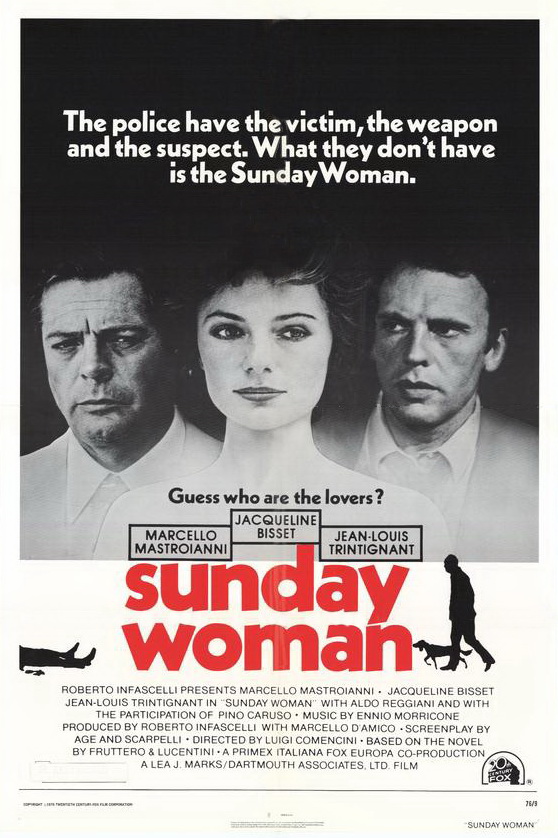
La donna della domenica (1975)

Commissioner Santamaria (Garrone, an architect who was playing an intellectual game of murder within a series of letters to his friend Massimo Campi (Jean-Louis Trintignant). While investigating, Satanamaria falls for one of the suspects, Anna Carla Dosio. Can we blame him when she’s played by Jacqueline Bisset?

It seems that Garrone has been killed for his blackmailing, but now that Campi’s boyfriend Lello has also been killed — amongst others — the plot is thickening.

Luigi Comencini is usually the director of more high brow things than we cover here. But hey — there’s a Morricone soundtrack to tether us to the tenuous connections to the giallo genre that we hold so dear. I guess I shouldn’t say too high brow, as after all the main victim is murdered with a stone penis, so there’s that.

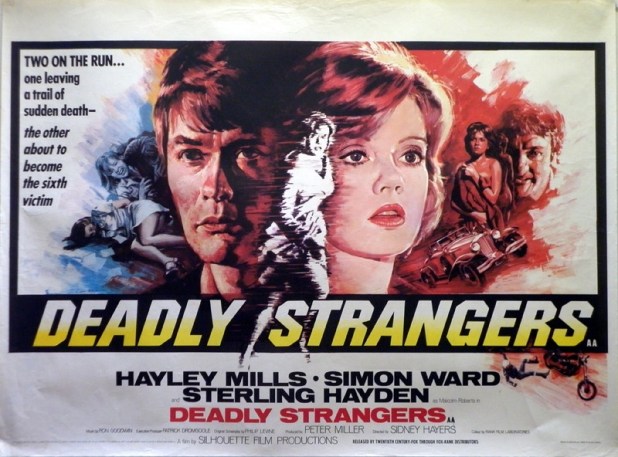
Deadly Strangers (1975)

Someone has escaped Greenwood Mental Hospital, broken into someone’s home and stolen a car. And now, they’re on the loose.

Could it be Stephen Slade? He has the same car as the one that has just been stolen. And why is he stalking Belle Adams (Hayley Mills!) when she heads home from the bar with a truck driver that assaults her? He saves her and then keeps telling her less than truths to stay in her company.

The evidence keeps piling up, as through flashbacks gradually reveal that Stephen is a voyeur — and Belle is an abused orphan whose uncle used to watch her, so maybe they aren’t meant to be — and when they stop for gas, the one lone female employee ends up dead.

As they avoid roadblocks — at first because Stephen’s been drinking and later because they may have injured a motorcyclist who was bothering them — it seems like they’re growing closer. But is that the worst possible thing for Belle? Or Stephen?

Directed by Sidney Hayers (Burn, Witch BurnAssault), this film definitely has the giallo vibes of red herrings, mistaken identity and a question of who the killer is well in hand. This doesn’t get discussed much but it’s definitely worth a watch.

You can watch this on Tubi.

Diary Of An Erotic Murderess (1975)

As far as I’m concerned, Marisa Mell can be in every giallo. She can be in every movie, actually.

In this one, originally called La encadenada, she plays the live-in psychologist of millionaire widower Alexander’s (Richard Conte, wow what a get!)  slightly — well, perhaps completely — insane silent son. Within a few moments of plot time, she’s marrying the father, disposing of him and then moving on to his son. But then, of course, her evil ex (Anthony Steffen, who somehow played Django more than Franco Nero) shows up to ruin everything.

There are some wild ideas here — Alexander owns the Holy Grail, the real cup and it’s treated with all of the excitement that another Alexander gets when he shows off his magic window — but the film suffers from a lack of style. It needs the sex, the sizzle, the score, the everything that makes a giallo a giallo.

But man, the ending is slam bang great and Mell is awesome in this, an actress in search of a movie. And it’s got a really great supporting cast. Manuel Mur Oti never really directed that I’ve seen before, but his style here seems very point and shoot. That could be the result of the horrible print that is out there. But hey, let’s be honest: you could do worse than to watch Marissa Mell ruin men for 87 minutes.

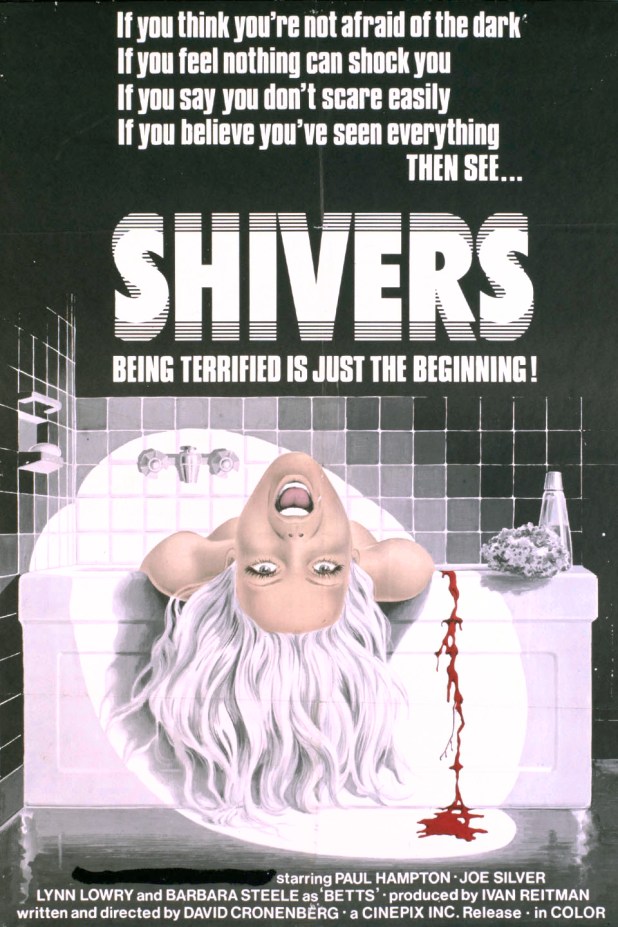
Shivers (1975)

Also known as Orgy of the Blood Parasites (written title), The Parasite Murders (it was filmed under that name), They Came from Within and Frissons, the themes of David Cronenberg third film — debated in Canadian Parliament at the time of its release due to its blend of sex and violence — are still beyond relevant today.

The initial reviews were so brutally against this movie that one high-profile hit piece by Robert Fulford (writing as “Marshall Delaney” for the magazine Saturday Night) didn’t just hurt the director’s chances of getting funding. It got him kicked out of his apartment thanks to a moral cause. owing to his landlord’s inclusion of a “morality clause” in the lease.

Starliner Towers — actually Tourelle-Sur-Rive, a 1962 apartment building designed by Mies van der Rohe, who was on the same level as Frank Lloyd Wright — is where Dr. Emil Hobbes and Dr. Rollo Linsky have been working on a project that has a parasite that can take over the function of a human organ. Why are they working on something like this?

Hobbs had the belief that modern humans had become over-intellectual and estranged from their primal impulse, so he created “a combination of aphrodisiac and venereal disease that will, hopefully, turn the world into one beautiful mindless orgy” and reassert humanity’s true sexually aggressive instincts.

Hobbes has killed a young woman named Annabelle by cutting open her stomach and pouring acid into it and then killing himself, which is like taking a page right out of the works of Herschell Gordon Lewis. Whatever they made, it’s giving people stomach convulsions and making them throw up bloody parasites which they go on to infect others like an STD.

Before long, everyone in the building — including Lynn Lowrey and Barbara Steele — is infected. Unlike zombies, these creatures retain their intelligence on some level and just want to have violent sex.

Cronenberg hasn’t been shy about the fact that other movies have ripped off his film: “I have to say that some of my images like this [parasite] ended up in things like Alien, which was more popular than any of the films I’ve ever made. But the writer of Alien has definitely seen these movies, Dan O’Bannon. The idea of parasites that burst out of your body and uses a fluid and leaps on your face, that’s all in Shivers.” He said the same thing in 2015, nearly doubling down by stating: “…Alien, for example, which totally ripped off things from my movie Shivers…”

Dan O’Bannon rip something off? Hmm.

You can watch this on Tubi.

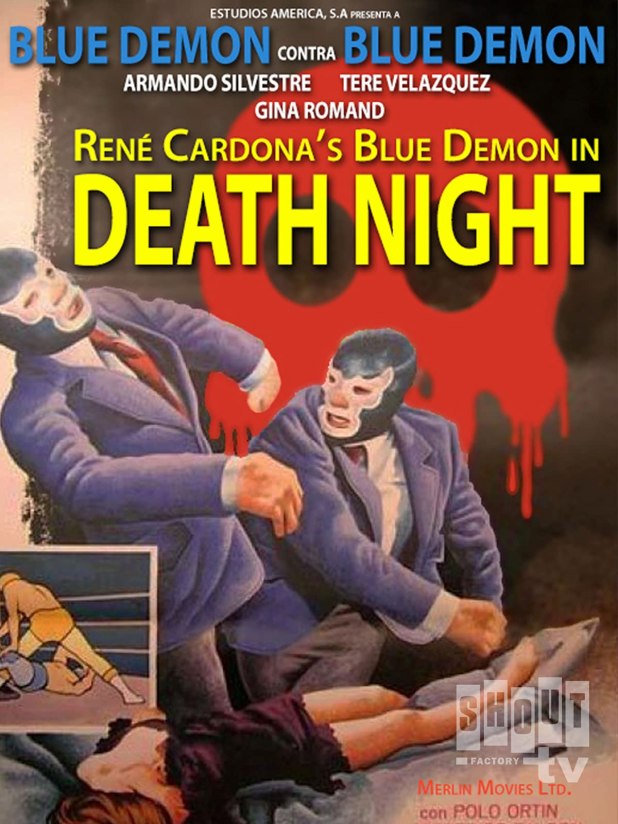
Noche de Muerte (1975)

René Cardona directed 146 movies and I’ve made it my lfie’s work to watch as many of them as possible. This one stars Blue Demon and it establishes a conceit that makes a lot of sense: how can anyone tell who is under that blue mask? And what if someone else also wears the mask and starts killing people and robbing banks and jewelry stores?

It’s all the work of the evil Count and El Cosaco, a luchador with a grudge against our hero. But the cops don’t know that. I really love the fact that Blue Demon challenges his evil version to a mascara contra mascara mask and puts his enemy in a submission that doesn’t allow him to move. He yells for the detective who has been tracking him down to take off the man’s mask and prove his innocence. It’s a great way to get across Blue’s grappling skill and makes for a fun ending.

I mean, I did tell you how this ends, but that doesn’t mean you shouldn’t watch it. The version that’s on Shout! TV has some of the best and worst dubbing I’ve ever listened to, which is really how it should be.

The Apple Dumpling Gang (1975)

Based on the novel by Jack Bickham, this was the first movie to team up Don Knotts and Tim Conway, who grew up in Morgantown, West Virginia and Willoughby, Ohio respectively, and became beloved for their goofy comedic skills. In fact, Conway was the sidekick to Cleveland’s original Ghoulardi — Eric Anderson, later the voice of ABC and father of Paul Thomas — and would even come back home to appear on Hoolihan and Big Chuck and Big Chuck and Lil’ John.

Gamber Russell Donovan (Bill Bixby) has agreed to sign for some valuables from an old associate named John Whintle. Turns out they’re three orphans named Bobby, Clovis and Celia Bradley, a bunch of kids who destroy so much that they make Donovan poor. Soon, he’s nearly robbed by Knotts and Conway, who have left their gang after accidentally shooting Slim Pickens in the leg. Hijinks ensure involving a gold mine and bandits.

Only Knotts and Conway would come back for The Apple Dumpling Gang Rides Again, along with Harry Morgan who plays a different character. Disney also made a TV movie called Tales of the Apple Dumpling Gang, which had John Bennett Perry in Bixby’s part, Ed Begley Jr. instead of  Conway and Arte Johnson in the Knotts role. They also made a six episode TV series, Gun Shy, with Barry Van Dyke in the Bixby part.

The Strongest Man in the World (1975)

The second sequel to The Computer Wore Tennis Shoes, after Now You See Him, Now You Don’t, The Strongest Man in the World continues the story of Dexter Riley and the students of Medfield College.

Dean Higgins (Joe Flynn, who sadly died from drowning after filming was complete; the Youngstown native had also completed voicing over The Rescuers and was a major advocate for more equitable distribution of TV residual payments) is about to be fired for financial mismanagement due to the extreme overspending by Prof. Quigley’s science class. Higgins fires the professor and threatens to have his entire class kicked out of school, but when he slams the door on the classroom, he knocks Dexter’s experiment into another student’s vitamin cereal. Then the cow — which cost so much money in the first place — eats the cereal, Dexter drinks the milk and then we have Kurt Russell gaining super strength.

This movie had to have been cast by me in a past life. Can we get Eve Arden? How about Phil Silvers? Can Cesar Romero come back? How about Dick Van Patten as the main villain?

Director Vincent McEveety was a Disney directing mainstay, making stuff like GusSuperdadThe Apple Dumpling Gang Rides Again and Herbie Goes to Monte Carlo.

Escape to Witch Mountain (1975)

Based on the science fiction novel by Alexander H. Key, Disney has had great success with Witch Mountain, making two movies in the seventies, a Disney Channel sequel in the 80s, a 1995 remake and a 2009 cannon sequel that was marketed as a remake, despite the fact that Tia and Tony kind of cameo and are played by Kim Richards and Ike Eisenmann*. Now, there are plans to make a new series for the Disney+ channel.

Back to the past and the original film and we find our heroes in an orphanage. They’re not like the other kids — Tony controls inanimate objects with the aid of his harmonica — yes, really — and Tia can communicate telepathically with Tony, feel the emotions of animals and see the future. They have a star map that they can’t figure out as well as memories of an uncle who saved their lives, but otherwise, they are both a blank slate.

One day, one of Tia’s premonitions saves the life of attorney Lucas Deranian (Donald Pleasence!), which he reports to his millionaire boss, Aristotle Bolt (Ray Milland), a man obsessed with the paranormal. While acting as their uncle, Lucas adopts the children, but it is only so that Bolt can study them. They run away, meet RV-driving widower Jason O’Day (Eddie Albert) and convince him to take them to their destiny at Witch Mountain, all while being pursued by Deranian, Bolt and their henchman Ubermann (Lawrence Montaigne, The Great Escape sure, but also the chauffeur in Young Lady Chatterley).

The Witch Mountain films were the result of Disney looking to reinvent itself after the death of founder Walt. They wanted movies that were a little edgy and when they saw director John Hough’s The Legend of Hell House, they knew they had the right person. Hough also made The Incubus, Twins of EvilAmerican Gothic and Dirty Mary Crazy Larry. The end result was a big success and they’d bring the characters back three years later for Return from Witch Mountain.

*They were so good at playing siblings that they do it again in Devil Dog: Hound of Hell.

You can check out Mark Begley’s review of this movie here.

Legend of the Werewolf (1975)

No matter what you think of this movie, you have to give it up for the poster. This is truly one of my all-time favorite movie posters of all time, one that punches you in the face and says, “You’re gonna watch this werewolf movie!”

It has a different origin story than a normal werewolf film, as here Russian werewolves kill a man who has just watched his wife die in childbirth and then raise the dead parents’ son to become a human wolf.

He’s known as Etoile the Wolf Boy in the circus, but soon loses his lupine look until the full moon rises. When that does — and he kills a member of the traveling carnival — he goes on the run.

This is really the sad tale of a wolf boy — a wolf young adult, I guess — who falls in love with a courtesan with a heart of gold who keeps on entertaining her clients, who soon get devoured by said wolf young adult.

Enter Professor Paul Cataflanque (Peter Cushing). He’s a forensic pathologist, who quickly figures out that a wolf is behind all the murders. And seeing how Etoile now takes care of the wolves in the zoo, he’s going to have to deal with putting every one of them to sleep under the orders of the police.

There’s no way he isn’t going to turn into a werewolf and kill just about everyone, right?

Legend of the Werewolf is one of seven Tyburn Film Productions, a studio that tried to fill the void felt after Hammer stopped producing new movies. Their other films include The GhoulPersecutionSherlock Holmes and the Masks of DeathMurder EliteG’olé! and Peter Cushing: A One-Way Ticket to Hollywood.

Directed by Freddie Francis, this was written by Anthony Hinds under his pseudonym John Elder. Under that name, he also wrote Hammer’s werewolf film The Curse of the Werewolf as well as Frankenstein Created WomanScars of DraculaThe Reptile and many more.