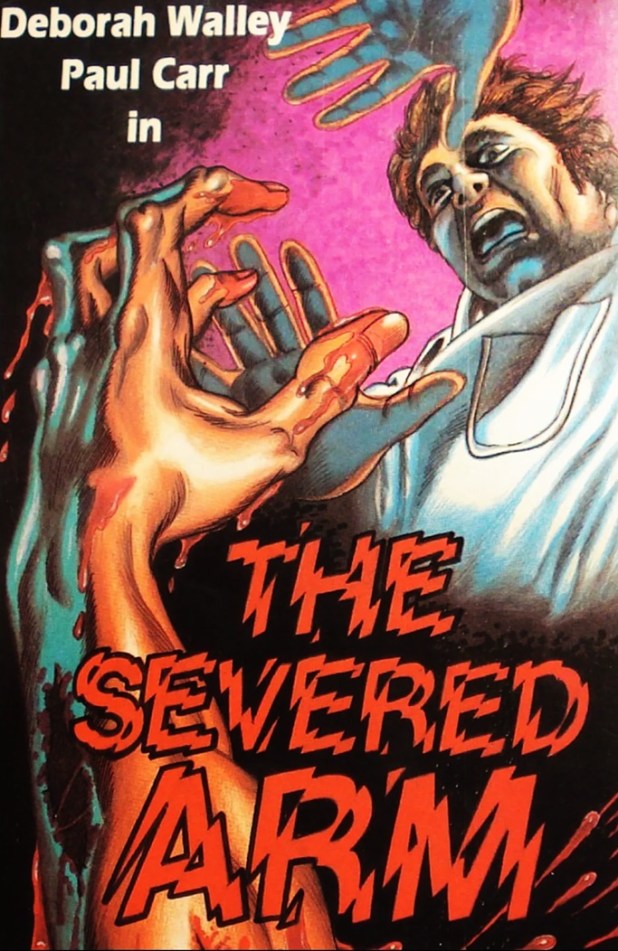
The Severed Arm (1973)

A few years in the past, Jeff Ashton (David G. Cannon), Doctor Ray Sanders (John Crawford),  “Mad Man” Herman (Marvin Kaplan) and Ted Rogers (Ray Dannis), among others, were caught in a cave-in. With the prospect of survival seeming zero, they agreed — well, everyone except the victim — to cut off Ted’s arm and eat it.

Now, Jeff has just received an arm in the mail and “Mad Man” is killed on the air during his radio show, his arm amputated by a crazy killer. With the help of Ted’s daughter Teddy (Deborah Walley), they look for Ted, who is missing. But ah — she’s been working with her Uncle Roger (Bob Guthrie) to lure Jeff into a trap where he’ll have to eat his own arm to live!

The lesson of this movie: Never trust the mail when it’s delivered by Angus Scrimm.

Directed by Thomas S. Alderman, who wrote the story with Darrel Presnell (from a story by Marc B. Ray and Larry Alexander and additional dialogue by Kelly Estill), this is a grimy thriller that has cannibalism at its heart.

You can watch this on Tubi or get it from Vinegar Syndrome.

Here’s a drink.

Cave In Cannibal

  • 1 oz. amaretto
  • 1 oz. high proof rum
  • 1 oz. peach schnapps
  • .5 oz. Southern Comfort
  • 2 oz. cranberry juice
  • .5 oz. orange juice
  1. Add amaretto, rum, schnapps and Southern Comfort to a glass filled with ice.
  2. Stir, then add cranberry juice. Stir and add orange juice.


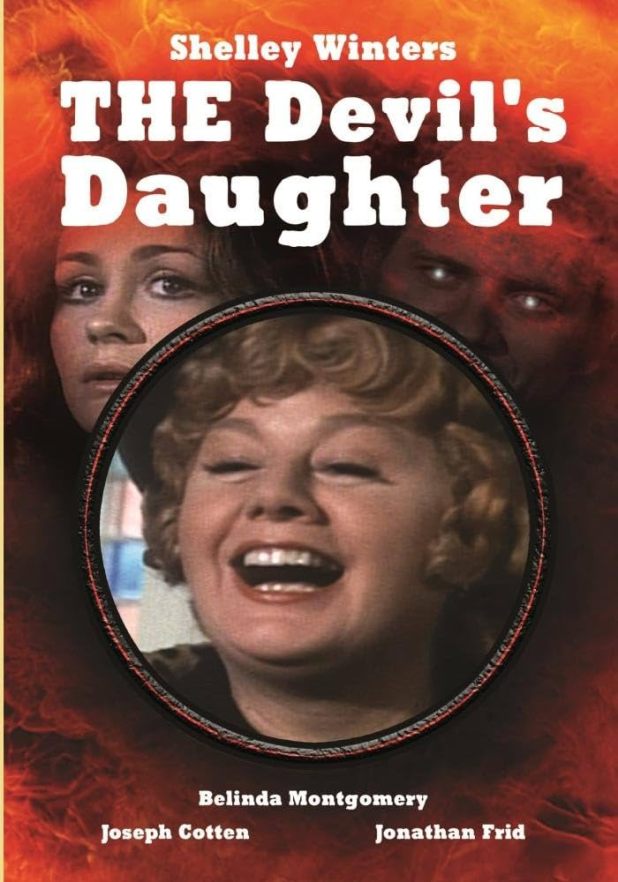
UNSUNG HORRORS HORROR GIVES BACK 2024: The Devil’s Daughter (1973)

Each October, the Unsung Horrors podcast does a month of themed movies. This year, they will again be setting up a fundraiser to benefit Best Friends, which is working to save the lives of cats and dogs all across America, giving pets second chances and happy homes.

Today’s theme: Made for TV Movie

The ABC Movie of the Week for January 9, 1973, The Devil’s Daughter, is very much Rosemary’s Baby, the home edition, and that’s perfectly fine. It gets so many of the 1970s occult rules right.

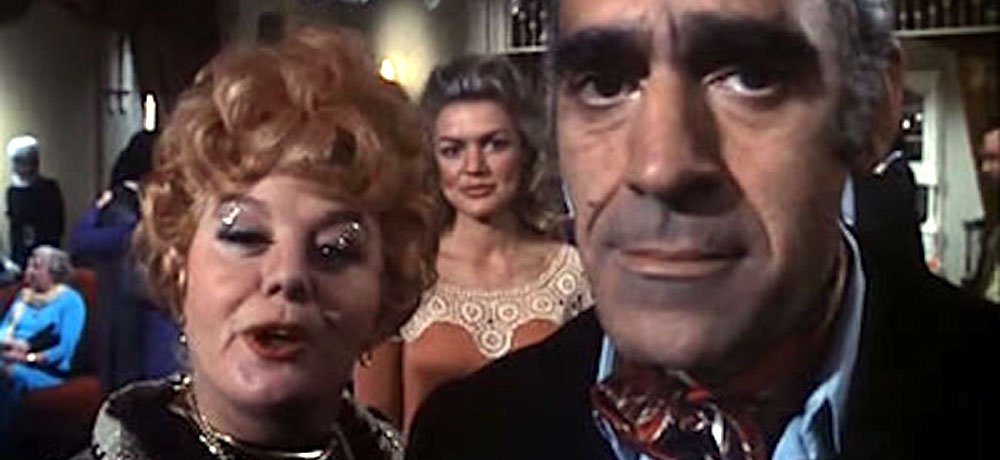
It stars Belinda Montgomery (Stone Cold Dead, Silent Madness, Doogie Howser’s mother) as Diane Shaw, a young woman who has just lost her mother Alice (Diane Ladd). At the funeral, she meets the rich Lilith Malone (Shelley Winters, fulfilling the most important law of Satanic film, that Old Hollywood wants to eat the young), who was a member of a cult with her mother, one that has been following Diane her entire life, ready for her to marry a demonic prince.

I’ve said it before, and I will say it so many more times but never come home to settle your parent’s estate after their mysterious death. Bad things always happen. As Diane works to settle down in a new town and work on the estate with Judge Weatherby (Joseph Cotten, yes, more Old Hollywood, a year fresh from Baron Blood). She gets a place to stay with Lilith, who gives her a ring that belonged to her mother. The symbol on this ring is the same one as a painting of Satan above the fireplace in Lilith’s home, as well as her baby book and even her favorite brand of cigarettes. Yes, even in 1973, Satan had a great marketing team. Or perhaps this is all predestined.

Diane even gets to go to elite parties. That’s not a good thing. There, she learns that she’s the Princess of Darkness who will marry the Demon of Endor. Yes, the place where Ewoks come from. You knew they were nefarious. At that party — shot very much like Rosemary’s Baby — you’ll even see Jonathan Frid from Dark Shadows as the butler, Lucille Benson (who ran the Susan B. Anthony Hotel for Women on Bosom Buddies) and Abe Vigoda as Alikhine, probably named for noted chess player Alexander Alekhine, as these devil worshippers have checkmated poor Diane.

Also, Abe Vigoda is the same age as I am now, and he always looked ancient. Now, I feel quite old.

Diane runs and gets a roommate, Susan (Barbara Sammeth), who is the sacrifice in this, dying ata horse’s hoovese! As much as she tries to avoid Lilith, she can’t escape. Not even when she meets a nice man named Steve Stone (Robert Foxworth), an architect who soon marries her. But if you know your demonic films, you won’t be shocked to learn that he’s the demon that Wicket W. Warrick prays to every night, the Demon of Endor.

Director Jeannot Szwarc made plenty of TV movies and episodes of Night Gallery before directing Jaws 2Bug and Santa Claus: The Movie. I love that this was written by Colin Higgins. Yes, the same man who wrote Harold and Maude would go on to direct 9 to 5 and Foul Play.

Do you think your father is terrible? Diane’s dad is Satan. And her husband? He has blank eyes because he has no soul! The best part is the reveal that Satan, who we have seen in shadow and who has crutches, ends up being Joseph Cotten and he has cloven hooves for feet! I don’t know if I can love a movie as much as I love The Devil’s Daughter.

You can watch this on Daily Motion.

UNSUNG HORRORS HORROR GIVES BACK 2024: Night of Fear (1973)

Each October, the Unsung Horrors podcast does a month of themed movies. This year they will once again be setting up a fundraiser to benefit Best Friends, which is working to save the lives of cats and dogs all across America, giving pets second chances and happy homes.

Today’s theme: Australia

Terry Bourke made both this and Inn of the Damned for the Fright TV show, but there’s no way either could air on TV. He would go on to make Lady Stay Dead.

A girl (Briony Behets) riding a horse stops to take a break. A man (Norman Yemm) unties her steed and it runs away. As she chases after it, he attacks her and locks her in his home as the credits play, giving a brief fast forward of the evil to come.

Another woman (Carla Hoogeveen) finds herself going off the road and trapped in a dead end. The man returns and smashes her windshield with a shovel and chases her, finally forcing her into his home where he appears nude with a bloody skull over his cock. He then pulls a lever and a rain of rats covers her, an act which excites him to the point that he gets off watching her die.

And that’s it! An hour of a chase and a horrifying ending with no punishment for the man. This feels like the Sawyer clan but was made a few years before Tobe Hooper’s film was shot nearly a world away.

No dialogue, no names and a movie that almost didn’t make it into theaters because of censors. This is how Australian exploitation got its start.

You can watch this on Tubi.

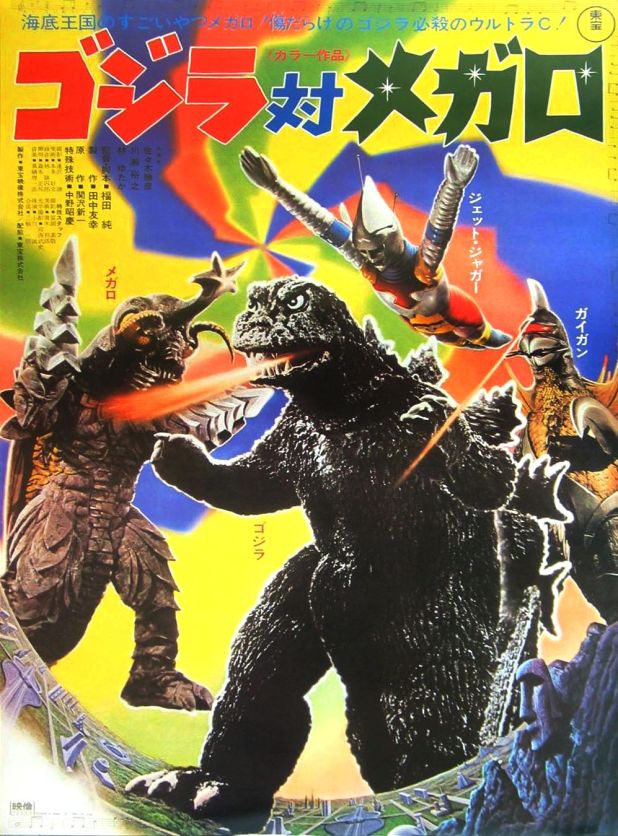
CHILLER THEATER MONTH: Godzilla vs. Megalon (1973)

EDITOR’S NOTE: Godzilla vs. Megalon was on Chiller Theater on Saturday, November 10, 1979 at 1:00 a.m., Saturday, October 11, 1980 at 1:00 a.m. and Saturday, August 14, 1982 at 1:00 a.m.

This film came out in the U.S. when I was four years old and for a kid that watched Godzilla films every time they aired, I was so excited to see something new. Yes, Jet Jaguar was accidentally called Robotman and Gigan was Borodan but I didn’t yet super anal retentive about kaiju movies and need to see the originals in Japanese.

On March 15, 1977, this was the first Godzilla movie that aired on American network TV in prime time. It was cut down — nearly in half, come on! — but it was hosted by John Belushi in a Godzilla suit. However, no one saved any of this footage. For decades, I thought I had just had a dream about it.

197X: Humans keep nuclear testing, which ends up causing earthquakes on Monster Island, nearly killing Godzilla and taking out Anguirus. The undersea city of Seatopia has had enough of humanity and unleash their greatest monster, Megalon, cleaning their hands of surface people forever.

Inventor Goro Ibuki (Katsuhiko Sasaki), his brother Rokuro (Hiroyuki Kawase) and Hiroshi Jinkawa (Yutaka Hayashi) have created a robot named Jet Jaguar. Seatopia does not wanted to die off like Atlantis, Mu (justified and ancient) and Lemuria. They steal the robot to guide their monster.

Once the inventor and his friends save Jet Jaguar, they team with Godzilla just in time for the Seatopia army to contact the Space Hunter Nebula M and send Gigan back to our planet. What follows is the monster fight of all monster fights, which ends as all must, with Godzilla shaking hands with his new robot friend. If you think this is goofy, we can never be movie friends.

Jet Jaguar was the result of a contest Toho had for children. Red Arone was a robot sent in by a child who was upset when his drawing became a monster. Toho redesigned him as Jet Jaguar and made him a hero.

This once had the title Insect Monster Megalon vs. Godzilla: Undersea Kingdom’s Annihilation Strategy. Japan forever.

If this is starting to all feel the same, this movie uses footage from Mothra vs. Godzilla, Ghidorah the Three-Headed Monster, The War of the Gargantuas, Ebirah, Horror of the Deep, Destroy All Monsters, Godzilla vs. Hedorah and Godzilla vs. Gigan.

The last fight in this is total pro wrestling. Godzilla even hits a dropkick.

You can watch this on Tubi.

CHILLER THEATER MONTH: Nightmare Hotel (1973)

EDITOR’S NOTE: Nightmare Hotel was on Chiller Theater on Saturday, March 24, 1979 at 1:00 a.m., Saturday, August 16, 1980 at 1:00 a.m., Saturday, September 26, 1981 at 1:00 a.m. and Saturday, August 20, 1983 at 3:00 a.m.

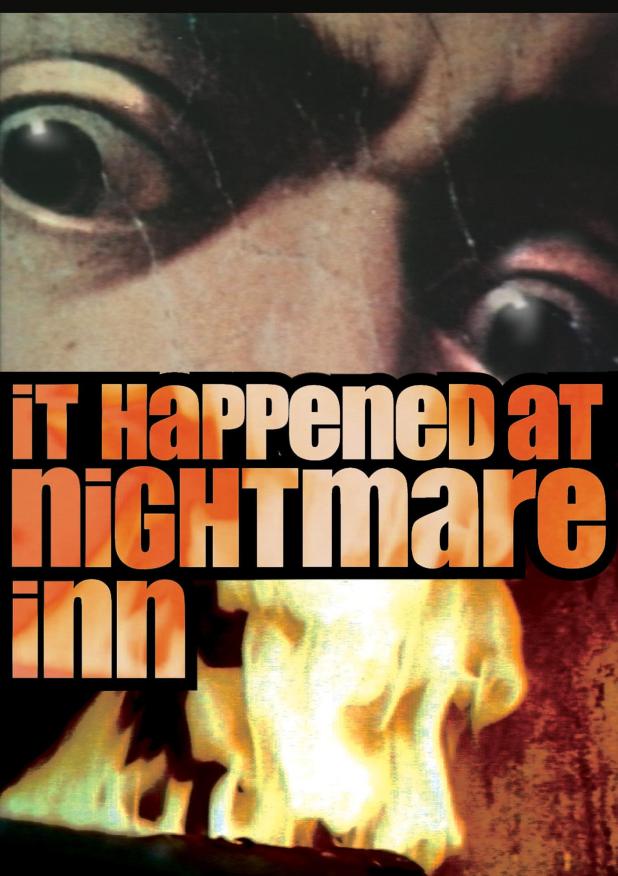
Nightmare Hotel is the TV title for A Candle for the Devil which is also known as It Happened at Nightmare Inn. Directed by Eugenio Martín, it begins with sisters Marta (Aurora Bautista) and Verónica (Esperanza Roy) confronting May (Loreta Tovar), one of the guests at their small inn. She’s sunbathing nude outside and in the middle of an argument, she’s shoved down the stairs and dies when she goes through a stained glass window. Just as the sisters start to get rid of the body, the dead girl’s sister Laura (Judy Geeson) shows up, wondering where her sister is. She decides to stay there until she can find her sister.

Things are steamy all over town. One of the guests, Helen Miller (Lone Fleming), is on the make and bringing men back to her room at all hours of the evening. Verónica is sleeping with the much younger Luis (Carlos Piñe) and stealing money to give to him. And every man in the village seems to be swimming nude, which excited and enrages Marta, who soon kills Helen.

An American mother named Norma (Blanca Estrada) comes to stay just as Laura leaves, worried for her safety after Helen disappears. She asks Norma to let her know when she leaves to ensure that she isn’t killed. Soon, the sisters covet the baby and start to believe that Norma is a sex worker and has no idea who the father is. Verónica grabs her baby as Marta stabs the woman. It turns out that she was in the middle of a divorce and this gives Verónica more reasons to doubt her sister; she gives Luis all of her money and says she no longer wants to see him, begging him to leave town.

Laura returns, after not hearing from Norma. She brings a man from town,  Eduardo (Víctor Barrera), who finds a container in the basement with mystery meat floating in red wine. As he finds Norma’s severed head, he’s murdered by Marta. At the same time, a guest gets sick from eating food made from people and her husband goes to the police.

Laura returns to her room and finds Eduardo’s body as the sisters attack her, dragging her to the room with the rotting meat. As she screams against a window, the police save her, but as her face and tears go through the credits, it seems like she will never be the same again.

When this played U.S. theaters as Dread Stop at Nightmare Inn, it got a PG rating. How?!?

I loved every moment, from the Blaise Pascal quote at the start — “There are only two types of men: The righteous who think they are sinners, and the sinners who think they are righteous” — to the final moments.

In 1985, this was remade in Turkey as Vahset Kasirgasi (Brutal Storm). And thanks to my friend Bill Van Ryn, I know that this played double features with Things From The Grave, which is a retitled Children Shouldn’t Play With Dead Things.

You can watch this on Tubi.

CHILLER THEATER MONTH: The Fury of the Wolfman (1973)

EDITOR’S NOTE: The Fury of the Wolfman was on Chiller Theater on Saturday, February 18, 1978 at 11:30 p.m. and Saturday, June 19, 1982 at 1:00 a.m.

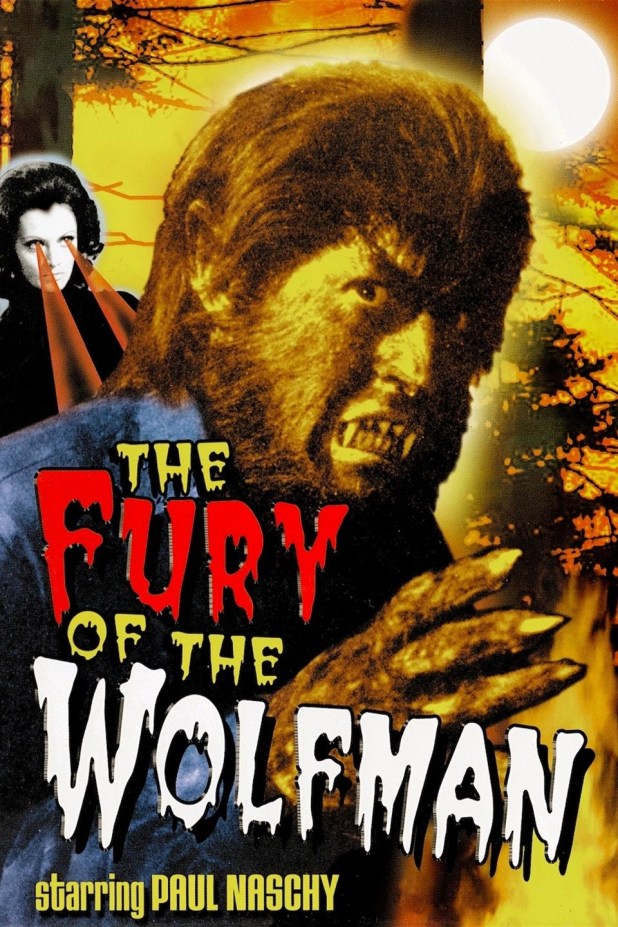
La Furia del Hombre Lobo is a 1970 Spanish horror film that is the fourth in the saga of werewolf Count Waldemar Daninsky, played as always by Paul Naschy. It was not theatrically released in Europe until 1975, yet an edited U.S. version played on television as early as 1974 as part of the Avco-Embassy’s “Nightmare Theater” package, along with Naschy’s Horror from the Tomb and The Mummy’s Revenge.

For those that care about these things — like me — the other films were MartaDeath Smiles on a MurdererNight of the Sorcerers, Hatchet for the HoneymoonDear Dead DelilahDoomwatchBell from HellWitches MountainManiac Mansion and The Witch.

This time, Daninsky is a professor who travels to Tibet, only to be bitten by a yeti which seems like not the werewolf origin that you’d expect. He then catches his wife cheating on him, so in a fit of passion, he murders them both before being killed himself. But this being a Spanish horror movie, that’s just the start of the trials that El Hombre Lobo must struggle through.

Daninsky is revived by Dr. Ilona Ellmann (Perla Cristal, The Corruption of Chris Miller), who wants to use him for mind control experiments. Soon, however, our hero learns that she has a basement filled with the corpses of her failed experiments. To make matters even worse, she brings back his ex-wife from the dead and turns her into a werewolf too!

There’s a great alternate title to this movie: Wolfman Never Sleeps. How evocative! That’s the Swedish version that has all of the sex that Franco’s Spain would never allow.

Naschy claimed that director José María Zabalza was a drunk, which may explain how this movie wound up padded with repeat footage from Frankenstein’s Bloody Terror and some stunt double continuity antics that nearly derail this furry film.

The Sizzlin’ Something Weird Summer Challenge 2024: Devil’s Due (1973)

BONUS WILDCARD WEEK (September 22 – 28) Go order something from the SWV website and watch it!

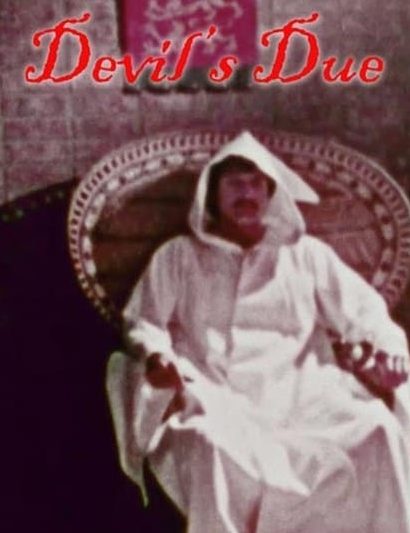
Cindy (Cindy West) is not having a good day. She’s been drugged and assaulted by Dean Carlson (John Buco), who has made her pregnant. She runs to tell her mechanic boyfriend Willie Joe (Davey Jones), but after making love and telling him that he’s the father, he dumps her. She runs to her father, the only man who never let her down, only to discover that he’s balls deep in her best friend Barbie (Lisa Grant). She screams so loud that she has a miscarriage and loses her voice.

Cindy runs again, this time to the big city, where she moves in with Dawn (Andrea True, who would go on to sing “More, More, More) and Nicky (Darby Lloyd Rains), two lesbians who say that she’s the best thing that ever happened to them.

This wouldn’t have this title if it wasn’t for Kampala (Gus Thomas, who would go on to become Cortland, New York District Attorney Mark Suben) and his sex cult. Cindy soon sees right through the leader, as men have ruined her life. The girls all conspire to take over the sex group — Jamie Gillis is also a member, along with Marc Stevens, Georgina Spelvin (the same year that she was in The Devil In Ms. Jones) and Tina Russell — and this movie rewards us with dialogue like,  “You may find this kind of strange, Cindy, but I work for the Devil!” and “You must kiss the cock of Satan!” Also: Death by poisoned nipples.

Devil’s Due is really influenced by the Church of Satan photo layouts that often appeared in men’s magazines. Directed by Ernest Danna and written by Gerry Pound, it’s not great but it is fun if you enjoy the occult of the 70s.

CANNON MONTH 3: The Bad Bunch (1973)

EDITOR’S NOTE: As the journey through Cannon continues, this week we’re exploring the films of 21st Century Film Corporation, which would be the company that Menahem Golan would take over after Cannon. Formed by Tom Ward and Art Schweitzer in 1971 (or 1976, there are some disputed expert opinions), 21st Century had a great logo and released some wild stuff.

Directed, written and starring Graydon Clark as Vietnam veteran Jim, this has his character run into a black gang in Watts led by Tom or Makimba (Tom Johnigarn) and saved by racist cops Sgt. Berry (Jock Mahoney) and Lt. Stans (Aldo Ray), who have the power of the badge and use it to knock everyone around.

There are also ladies showing up amidst the racial tensions, like Jacqueline Cole as Jim’s lover Nancy (she’s also Clark’s real-life wife) and Bambi Allen as Bobbi. In the short 34 years of her life, Allen was in pretty much the entire Something Weird catalog, including Space ThingDay of the NightmareSisters In LeatherThe Fabulous Bastard from ChicagoThe Ice HouseThe Erotic Adventures of Robin HoodMiss Nymphet’s Zap-InTerror At Orgy CastleHollywood BabylonLoce Boccaccio Style and Street of a Thousand Pleasures. Sadly, she’d die a year after this movie — according to Sam Sherman — due to health complications brought about by silicone breast injections.

While Jim tries to pick Nancy or Bobbi, Makimba is blaming him for all of his problems. The fuse has been list and things are about to explode, as they say.

Some people are going to tell you that the topless pool party is gratuitous. I’m going to tell you that it was shot at Severn Darden’s house.

This was released by Dimension Pictures and also used the names TomThe Brothers and ****** Lover. 21st Century re-released this after buying the Dimension film catalog.

You can watch this on Tubi.

CANNON MONTH 3: Seeds of Evil (1973)

EDITOR’S NOTE: As the journey through Cannon continues, this week we’re exploring the films of 21st Century Film Corporation, which would be the company that Menahem Golan would take over after Cannon. Formed by Tom Ward and Art Schweitzer in 1971 (or 1976, there are some disputed expert opinions), 21st Century had a great logo and released some wild stuff.

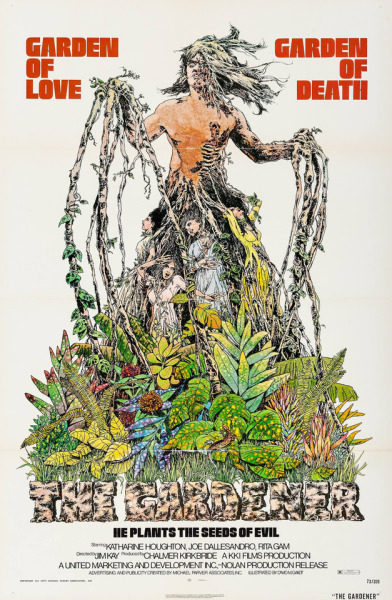
Ellen Bennett (Katharine Houghton, who brought Sidney Poitier to a supper in Guess Who’s Coming to Dinner) is a bored, rich white woman living in Puerto Rico. Her husband John (James Congdon) is barely around and even when he is, he’s a drunken lout. She’s always looking for things to do, like gossip with fellow elites like Helena (Rita Gam) and admire the lawns of other people in her caste. When one of them dies, her gardener Carl (Joe Dallesandro) becomes available.

Seriously, every time Carl appears, it’s like a magical woman in a beer commercial. Ladies just lose their minds, unable to speak. Maybe it’s because Carl is able to grow flowers that no one else can and faster than anyone else. It’s also because he never wears a shirt.

The only film directed and written by James H. Kay, this starts as an erotic thriller and becomes something wonderfully insane because — spoiler — Carl is really a tree person. Yes, it’s the best use of Joe Dallesandro there can be, just taking off his clothes and speaking in a — pardon this — wooden tone which for once matches the needs of the role.

Imagine a film where lush music plays as Little Joe leads affluent women to their doom, sometimes even turning them into plants. Sometimes, this is a soap opera. Other times, Carl is planting spy flowers all over the house and making party dresses that have thorns that strike bad husbands. It’s also a sex movie that is incredibly chaste, other than seeing Carl swim nude and then later become a plant himself. It has a mood, though, and for some reason, on a Tuesday late afternoon, I became enraptured by the idea of all these society affairs and champagne breakfasts at noon being ruined by a man who, for some reason, just showed up out of the leaves to manicure their hedges. And then they die.

This also turns into a detective giallo at one point and man, I think I love the idea of what this movie could be in place of what it is. I’m being charitable by saying this is a flawed movie. That doesn’t mean that I wasn’t wildly entertained by my experience with it. This is the kind of film that I’ll think about and try to work into conversation for years to come. It now joins my garden of film delights about killer foliage that contains The FreakmakerThe Woman Eater, From Hell It Came, The Crawlers and The Kirlian Witness.

Someday, Severin will do a boxed set of these movies that will come with seeds appropriate to plant for each movie, a branded pot and one of those 1970s plant biofeedback machines that allows you to communicate with your houseplant. It will cost too much for me to be able to convince my wife that I need it.

Filmed in 1973 and originally released by KKI Films in 1974 as The Gardener and then Seeds of Evil, this had several re-releases, including a 1977 Flora Releasing and 1981 New American films distributed run. It also played as Garden of Death. 21st Century also had this in theaters.

ARROW VIDEO UHD RELEASE: Torso (1973)

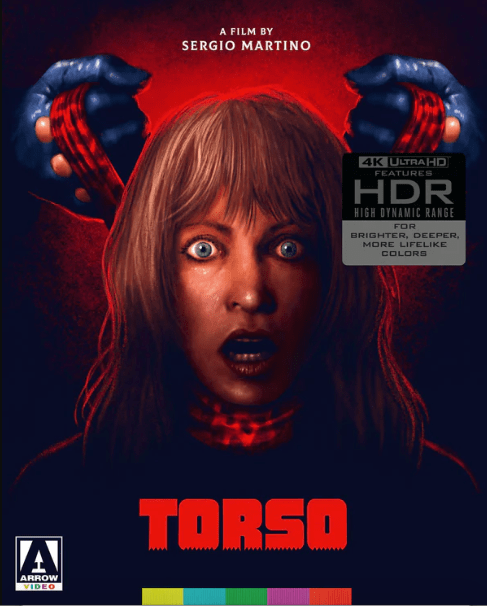
Torso is such a simple title. I’d rather call this film by its Italian name: I Corpi Presentano Tracce di Violenza Carnale, or The Bodies Bear Traces of Carnal Violence. Either way, it was directed by Sergio Martino and features none of the cast that he had come to use in his past films like George Hilton, Ivan Rassimov or Edwige Fenech.

It does, however, star British actress Suzy Kendall, who played the lead role of Julia in Dario Argento’s seminal The Bird with the Crystal Plumage. She’s so associated with giallo that she appeared as the main character’s mother in 2012’s ode to the genre, Berberian Sound Studio.

This is a film that wastes no time being strange. Or salacious. A photographer is shooting a soft focus lovemaking session between three women amongst creepy, eyeless baby dolls. By the time we register what is happening, we’re now in a classroom, where swooping pans and zooms refer us to the main cast of the film as we overhear a lecture and later a discussion about Pietro Perugino’s painting of Saint Sebastian. Did he believe in God? Or was he just trying to sell sentimentality? Could an atheist find himself able to translate religion to those with faith?

We cut to a couple making out in a car as a figure stalks them through the eye of the camera, making us complicit in the act of the killer. Quick cuts reveal the white-masked face of this maniac. The man runs after him while the girl doesn’t even care that they had a voyeur watching. As she waits for him to return to the car, but grows impatient. The headlights of the car cast her shadow large across the columns of a bridge. And their light is quickly extinguished by black-gloved hands. The camerawork here is really striking, keeping us watching for the killer, as we’re no longer behind his eyes. His attack is swift and ruthless, juxtaposed against the images of fingers penetrating the eyes of a doll.

The art professor (John Richardson, Black Sunday, The Church) and Jane (Kendall) meet by chance at a church where she challenges him to change his views on Perugino. As she returns from their somewhat romantic afternoon, Jane spies her friend Carol arguing in the car with a man who she believes is married.

Meanwhile, ladies of the evening walk the street, ending up with Stefano, a student who has been stalking Julie. He has trouble performing and the prostitute he’s with tells him that all the men with hang-ups always come her way. That said — even if he’s queer, he better pay the money. He flips out and attacks her, but she makes her escape.

We’re then taken to a hippy party that looks like it’s taking place inside Edward Lionheart’s Theater of Blood. There’s weed, there are acoustic guitars, there are bongos, there are dudes with neckerchiefs, there are motorcycles. Truly, there’s something for everyone. But after leading on two men, Carol just walks out into the mud. They try and chase her, but she makes her escape into the foggy night. We hear her footsteps through the swamp as she walks, exhausted and covered in mud. What better time for our white-masked killer to return? We see glimpses of him through the fog and then he is gone. Whereas in past films Martino ignored the murder scenes instead of story, here the violence is extended, placing the killer and his actions in full view. After killing the girl, he rubs mud all over her body before stabbing her eyes — again intercut with the baby doll imagery. Her blood leaks into the mud as the score dies down.

This scene really feels like what the first two Friday the 13th movies were trying to achieve, but of course several years before they were made.

A police detective is in front of the art class, showing images not of art, but of the crime scene. A piece of cloth has been found under the fingernails of one of the murdered students, Flo. And that same scarf was found on Carol’s body. It’s their duty to report seeing anyone who wore this scarf to the police, who want to cooperate with the students who normally riot and throw rocks at them.

Two of the men in the class — Peter and George — were the last two people to be seen with Carol, the ones who she turned down at the party. Meanwhile, Stefano continues to stalk Jane. The music in this film is so forward-leaning — tones play when the killer shows or during moments of tension.

A man calls Daniela and tells her that if she ever tells where she saw the red and black scarf, she’s dead. Fearing for her life, she tells her uncle, who lends his country home to her and her friends so that they can get away from the city while the killer is at large.

Oh yeah — I forgot the pervy scarf salesman, who the police are leaning on. Right after talking to the police inspector, he calls someone and asks for money to buy his silence. Whoever it is, they bought the scarf from him and wouldn’t want anyone else to know. They’ll also get out of town and head to the country. Coincidence? I think not!

Stefano is all over Dani, telling her that he needs her. She wants nothing to do with him. When she stares at him, she remembers seeing him wear the red scarf. She escapes — slamming the door in his face. She tells Jane that she remembers seeing him wear the scarf — and never again — the day Flo died. The whole time, the creepy uncle is watching the two girls. Jane offers to speak to Stefano, then meet the girls at the vacation home.

The street vendor is flush with cash, creeping along in the dark. A car starts to follow him. We see the black-gloved hands again as the car hits its victim again and again, bright red gore pouring all over the screen.

Jane goes to speak to Stefano, finding only strange baby dolls and letters to Dani asking her to love him and remember the promise that she made as a little girl. Jane is surprised by Stefano’s grandmother, who tells her that he left town.

The other girls are asleep on the train as someone watches them. A strange man enters their train car and sits down.

The camerawork in this movie feels as predatory as the perverts and killers that exist within it. Speaking of pervs, when the girls arrive in the countryside, the local men pretty much lose their minds, particularly over Ursula (Carla Brait, the man wrestling dancer from The Case of the Bloody Iris). She and Katia make out as a peeping tom watches, only for the killer to show up and off the leering man. There’s an amazing scene of the killer dumping the pervert into a well, shot underwater and staring upward as the body falls toward the lens.

Man, every man in this movie is scum. They’re either frightened boys or perverts wanting one chance to knock up a woman or scarred from past sexual encounters. None of them are positive, as even the uncle who gives Dani the villa seems way too interested in her. Every man is a predator at worst and a leering pervert at best.

Jane hurts her ankle when she gets overly excited about breakfast. A doctor arrives — the mysterious man from the train — and he gives her a pill, which knocks her out.

The girls go sunbathing while Jane recovers. Dani thinks she sees Stefano — complete with the red scarf — watching them. They return home and drink champagne, which Jane uses to wash down her sleeping pills.

A few minutes later, the door rings. It’s Stefano — the girls all scream — but he’s dead — the girls scream again — and the killer is behind him, holding the red scarf — now scream even louder! Instead of showing us the murders, Martino switches form, cutting to a ringing bell and Stefano being buried.

Jane wakes up, asking where her breakfast is. She’s obviously slept late as a result of the pills. She walks around the apartment, looking for Dani, Ursula and Katia, only to find a mess. Tossed chairs, bottles of beer and every single one of her friends murdered. Suzy Kendall is amazing in this scene, caught between fear and nausea. Unlike so many wooden giallo performances, she’s actually believable.

She hides as the killer comes back, forced to stay quiet and watch as he saws her friends into pieces. Even the ordinary world routine of the milkman arriving cannot stop the butchering of her friends, with her trapped just feet away.

This final act is completely unexpected, as up until now, the film had played by the rules of the giallo, the large number of victims versus a large number of red herrings.

In fact, this film is so packed with red herrings, even the cast had no idea who the killer was. Martino wouldn’t tell them who it was, so each of the actresses had her own theory as to who the killer was. And in the original script, the killer survived.

Now, instead of that traditional giallo structure as I mentioned above, it is the last survivor — a near prototype for the final girl — against a killer. Throw in that Julie can’t move well due to her leg and Martino has set up quite the suspenseful coda.

Trapped in the house, Julie tries to signal with a mirror, using Morse code. But it totally misses the heroic doctor’s sight. He places a call, but it doesn’t seem like it’s to Julie. She looks out the window and sees the killer coming back.

It turns out that the killer was the professor, who saw a childhood friend die trying to reach for a doll. He compares the other kills to dolls, with only Julie as a flesh and blood person. Everyone else was a bitch or played games with him or blackmailed him. He hacked Ursula and Katia to pieces like dolls as a result. Dani saw him. Carol may have seen him. And he killed Stefano when he saw him in the village. Death, he says, is the best keeper of secrets and then he sees Julie as a doll and tries to hang her. She’s saved at the last second by the doctor.

They battle into a farmhouse, across the yard and to a similar rock where we saw the younger professor watch his friend die. We hear a screen and have no idea who has been killed — but luckily for Jane, the doctor survives.  He discusses whether fate or providence had kept him in town, where he could save her. Perhaps it was written in the stars. Julie replies that Franz, the professor, would have been a realist and called it a necessity. Franz is dead and the dreamers live on.

The more times that I’ve watched this film, the more that I appreciate it and how it flips the genre conventions on their head and moves toward more of a slasher, with many of the giallo elements feeling tacked on somewhat to stay within the expected pieces of the form. A real clue that it’s really a slasher? The killings are more important than who the killer is.

Who are we to doubt the movie that Carlo Ponti brought us after Dr. Zhivago?

The Arrow Video 4K UHD release of Torso has a new 4K restoration by Arrow Films from the original camera negative. It has audio commentary by Kat Ellinger, author of All the Colours of Sergio Martino; interviews with Sergio Martino, Luc Merenda, Ernesto Gastaldi, Federica Martino and Mikel J. Koven, author of La Dolce Morte: Vernacular Cinema and the Italian Giallo Film. There’s also footage of the 2017 Abertoir International Horror Festival Q&A with Sergio Martino, alternate opening and closing credits from the US release, Italian and English theatrical trailers, a reversible sleeve featuring original and newly commissioned artwork by Adam Rabalais and an illustrated collector’s booklet featuring writing on the film by Adrian Smith and Howard Hughes. You can get it from MVD.