Last House on Massacre Street/The Bride (1973)

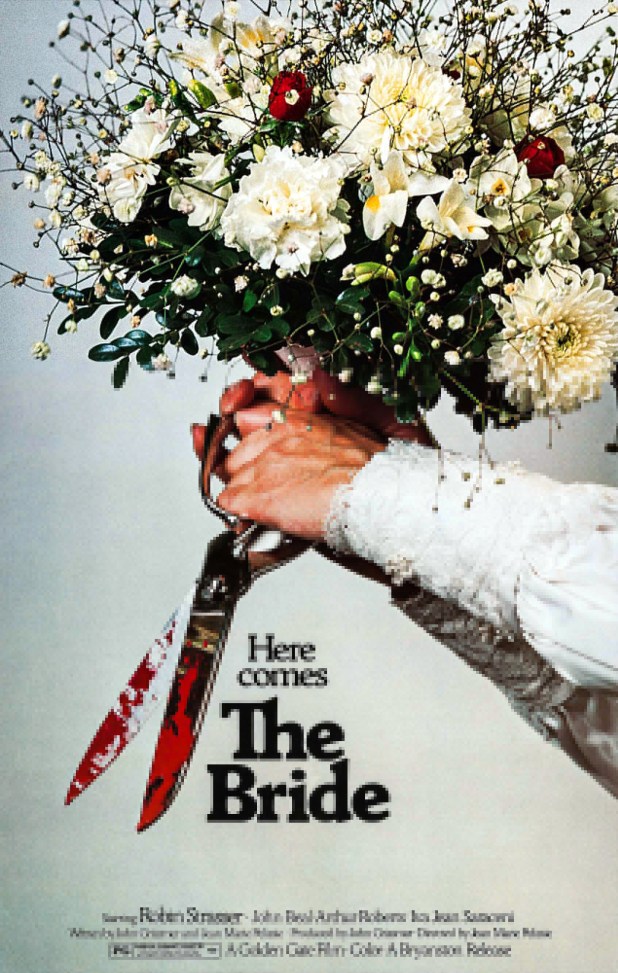
The Bride was once called just that — a title that makes a lot more sense. But after Wes Craven’s The Last House on the Left, we got a plethora of movies renamed to seem close to that film, even if they’re nothing like it at all. Like this one — which is about when you start getting weirded out by how your new wife seems like a borderline insane daddy’s girl, the best choice of action is to not bang a bridesmaid on your wedding day.

That’s exactly what David does. But he’s just a part of Barbara’s dream life: a perfect house that daddy just for her and a perfect man to fill it. There are a bunch of match cuts that show her kiss her new husband just like she kisses daddy, so if you’re starting to feel weirded out, stick around.

David decides to hook up with his old girlfriend Helen on his wedding day, which is in the very house that his wife has made for them. Barbara stabs the old flame with scissors, walks out in a blood-strewn wedding gown past all her guests and disappears.

David then does what anyone else would. He moves his new girlfriend into the house and keeps working for Barbara’s dad, who has a friendly meeting with him with no anger at all. Well, he does relate a story about how his daughter used to enjoy cutting the heads off of chickens as a child. Of course, a chicken head is soon in the bed he should have shared with his wife. Trust me, things are only going to get worse.

Also, it’s going to get much weirder. I mean it. This is a legitimately strange film. It’s not like Wes Craven, whose film inspired the retitling of this. With his films, I often see an academic studying weird people and making a film versus real weird people who gathered together to make a movie that confounds you on every level.

Those strange people are John Grissmer (who also did another weird movie, Blood Rage, which features Last House on Dead End Street/The Bride as the movie playing in the drive-in that starts the film) and Jean-Marie Pélissié, who only directed this singular movie. This is the kind of strange magic that could only come from the early 1970’s. And much like another freakout from that decade, The Baby, this movie is also rated PG.

You can watch this for free with your Amazon Prime subscription.

Malatesta’s Carnival of Blood (1973)

Released with The Witch Who Came from the Sea and The Premonition as part of Arrow Video’s American Horror Film Project, this movie is all about the Norris family looking for their lost son who got lost at an evil carnival. As a cover, they get jobs working in the carnival. And then things go wrong…

The carnival’s manager, Mr. Blood, is a vampire. Go figure, with a name like that. Meanwhile, the evil owner Malatesta is in charge of an entire army of goons who watch silent movies and eat human flesh. Hervé Villechaize from TV’s Fantasy Island is one of them.

After directing this movie, Christopher Eric Speeth went on to work in documentaries. This film is, well, a mess. You’re never sure when something is a flashback or a dream; things appear in a fuzzy multicolored haze, much like you’ve been staying up all night doing drugs and listening to overly loud jam bands. I’m not saying I don’t like it. I’m just trying to tell you how it is.

If your idea of a good time is watching people do autopsies while singing show tunes, then you’re on the right spectrum for this one. Want to see it for yourself? It’s on Shudder.

LOST TV WEEK: Poor Devil (1973)

Sammy Davis Jr. battled racism throughout his career, even from the wings of the stage as his Rat Pack cohorts would call him racist names like smokey.

In an interview with Roots author Arthur Haley in Playboy, the entertainer talked about the first time he came up against his race: in the Army. He was beaten for looking at a white female commanding officer while she was giving him orders, with his body covered with anti-black graffiti and covered in turpentine. That night, as in every night he served, he was still asked to perform for the troops. That’s when Davis learned he’d have to fight to be respected. And once he was in, he’d stay in by any means necessary — even coming off as insincere.

Despite being a member of the Hollywood crowd, Davis still could never be a full member. His romance with white girls like Kim Novak rubbed people the wrong way. And even though he was a large financial supporter of the Civil Rights Movement, he still had a complex relationship with the black community.

For example, he earned plenty of ire when he supported Nixon in 1972. Although he was originally a Democrat and supported JFK in 1960 and RFK in 1968, John F. Kennedy would go on to revoke an inauguration invitation to “Mr. Show Business” because he married white actress May Britt. So maybe his conversion makes sense because Nixon invited him to be the first black guest at the White House.

Once, Jack Benny asked Sammy about his handicap on the golf course. He answered, “Handicap? Talk about a handicap. I’m a one-eyed Negro Jew.”

That said — it’s also believed that Davis was introduced to Anton LaVey’s Church of Satan at an orgy at the nightclub that he owned, The Factory. This also makes sense. There are plenty of stories about how Sammy loved the free-swinging sex scene of the 70s, even learning how to deep throat from the woman who introduced it to the zeitgeist, porn star Linda Lovelace.

Anyways — I could go on about Sammy Davis Jr. He was a fascinating man — who could smoke four packs of cigarettes a day, draw and fire a Colt Single Action Army Revolver in a quarter of a second and was able to both be a parody of himself and parody himself seemingly at the same time. But today, we’re here to discuss a strange TV pilot that Davis was in, one that would lead to him accepting an honorary second-degree membership in the Church of Satan.

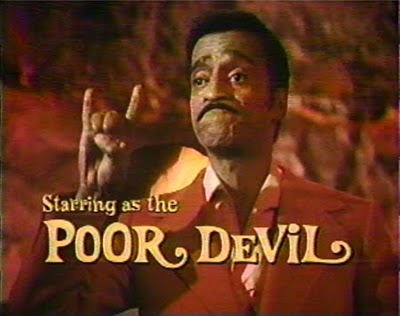
Originally airing on February 14, 1973, on NBC, Sammy would star as Sammy in this series pilot. He’s a demon who has screwed up for the last thousand or so years and now wants to succeed and prove himself to his boss Lucifer, who is played by Christopher Lee. If you don’t immediately stop reading this and go watch this show, allow me to share this photo of Sir Christopher Frank Carandini Lee CBE, CStJ, with a gorgeous head of hair.

To win over his boss, Sammy has to convince Burnett J. Emerson (Jack Klugman!) to sell his soul. In return, he’ll get revenge on his boss (Adam West!) and gain wealth for seven years (and then go to Hell for eternity, which is a lot like Miami, only less humid). 

Davis would flirt with The Church of Satan for some time, painting one fingernail red, wearing the Baphomet medallion and flashing the horns from time to time before dropping out by the mid-1970s (around the time that Anton LaVey went into seclusion).

One wonders where this show would have gone if it had become a weekly series. Would the Devil tempt a new celebrity every week? Would Klugman stick around? Would LaVey make a cameo?

All we have is this pilot, which is filled with Satanic imagery, a lack of a laugh track and plenty of early 1970s strangeness. What a weird time to be alive, one that we’ll never truly comprehend today. Still, if all that came of this was this photo of Davis with LaVey and future Temple of Set leader Michael Aquino, I’ll consider it a success.

LOST TV WEEK: The Norliss Tapes (1973)

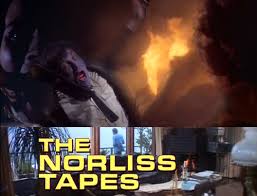
Occult investigator Norliss has disappeared, but his legacy lives on in a series of tapes that unfold the gripping narratives of his many escapades, such as his encounter with a widow and her undead artist husband. Originally developed as a series pilot by NBC, it was eventually broadcast as a TV movie on February 21, 1973.

Written by William F. Nolan (Logan’s RunTrilogy of TerrorBurnt Offerings) and produced by Dan Curtis (Dark ShadowsKolchak: The Night StalkerCurse of the Black Widow and pretty much any TV horror you’d see in the 1970s), this was initially entitled Demon.

Sanford Evans, our guide into the mysterious world of David Norliss (Roy Thinnes, Airport 1975, TV’s The Invaders), listens to the tapes that explain Norliss’s sudden disappearance.

A recent case concerned Ellen Cort (Angie Dickinson of TV’s Police Woman), whose husband has come back from the dead. It turns out that before his death from a mysterious disease, he had become involved with Mademoiselle Jeckiel (Vonetta McGee, Blacula), who gave him a scarab that he was buried with. Sheriff Tom Hartley (Claude Atkins!) doesn’t believe any of this, even when James keeps draining the blood of young women and a gallery owner who tries to break into his coffin and take his ring.

Bullets won’t stop the undead man, who’s also created a sculpture made of human blood that will bring the Egyptian deity Sargoth into our world. Our hero, Norliss, is kind of ineffectual, as the undead artist kills Jeckiel, killing Ellen’s sister and raising the demon. He finally stops the monster by setting the studio on fire with everyone inside, the dictionary definition of a pyrrhic victory.

That’s when Evans finishes the tape and wonders if this is Norliss’ last adventure. Nope. There’s another tape, even if the series never happened.  That didn’t stop this TV movie from being aired in syndication and on the CBS Late Movie.

LOST TV WEEK: Baffled! (1973)

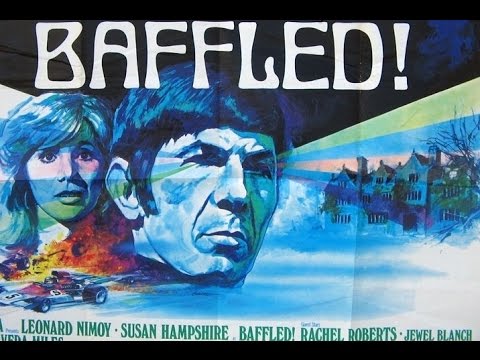
Believe it or not, there was once a time when Star Trek wasn’t a movie franchise and its stars had to find other projects. For Leonard Nimoy, that meant plenty of TV movies, including this pilot for a British show that wasn’t bought.

Race car driver Tom Kovack (Nimoy) begins to see psychic visions, causing him to crash. He meets up with Michelle Brent, a paranormal expert, to help him figure out what is happening. Soon, they find themselves part of an occult mystery in England.

It’s not all that great, to be honest. It’s mostly worthwhile to see Nimoy play against Spock type. Instead of being cold and emotionless, he’s a playboy. And given to wearing some natty fashion, like plenty of hats!

Before Star Trek: The Motion Picture, Nimoy would go on to scare the shit out of me repeatedly as a child by hosting In Search Of, which convinced me that all monsters were real and constantly trying to kill me.

Even better, the original specials — before the series — try to find out the truth about ancient astronauts (the 70’s!), aliens, mysteries and more. Other than the final one, which was released as Manbeast! Myth or Monster they’re narrated by Rod Serling.

Strangely enough, The History Channel is redoing this show. The host? Today’s Spock, Zachary Quinto.


CHILLING CLASSICS MONTH: Dr. Tarr’s Torture Dungeon (1973)

If all Juan López Moctezuma directed was Alucarda, he’d still be celebrated. Throw in the fact that he was behind the camera for El Topo and also created this little piece of strangeness and you can see that he’s someone to be celebrated.

A journalist has traveled to Dr. Maillard’s (Claudio Brook, AlucardaThe Devil’s Rain!) remote mental institution to write a story about the progressive treatment the doctor offers: patients are free to roam and fully live out their fantasies. However, when he gets there, the reporter learns from the doctor’s daughter Eugenie that he hasn’t met the real doctor, just one of the inmates that is quite literally running the asylum and randomly quoting Aleister Crowley. Even better — Susana Kamini, Justine from Alucarda, shows up as a cult priestess!

Imagine if Hammer or Amicus made a movie in Mexico, with all of the dialogue in English, and fed massive amounts of drugs to everyone involved. That’s pretty much how I imagine that this film was made. It’s also an Edgar Allan Poe story (The System of Dr. Tarr and Prof. Fether), but really, it’s also a costume drama with more powdered wigs than a British courthouse. And man, has there ever been so sensationalistic a title?

Will you like it? Not if you’re expecting a horror movie. Again, the Chilling Classics set confounds expectations, seeming like it will only feature the worst schlock and somehow embracing Mexican art cinema. I can only imagine that there’s a basement in the Mill Creek offices where the maniac that chose the films for this set signed off on it with a feather pen and a giant flourish, exclaiming, “I hope this makes someone’s brain melt!”

Beyond watching this on the Chilling Classics box set, you can also find it on Amazon Prime. If you want a much better looking copy of this film, Mondo Macabro released it as The Mansion of Madness, complete with a brand new digital transfer and Guillermo dl Toro discussing the director.

CHILLING CLASSICS MONTH: Messiah of Evil (1973)

Between great design, reviews of junk food and lots of great info on the artists behind horror movie posters, there’s a lot to love about the site Camera Viscera. Here’s one more: Doc, the creator of the site, has sent this article on Messiah of Evil!

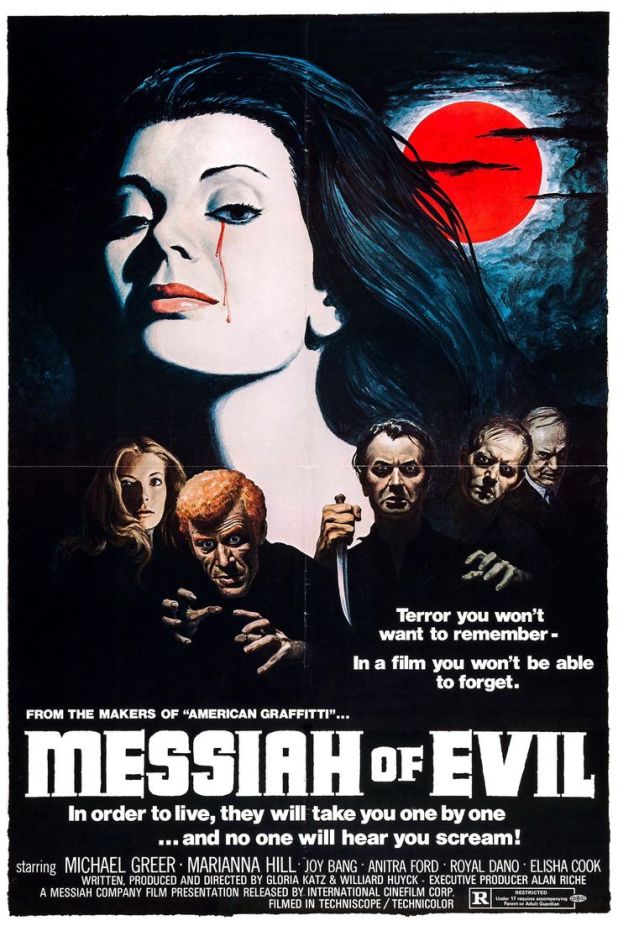
The best word to describe Messiah of Evil (really, the only word to describe the film) is surreal. With its vampire-zombie hybrid antagonists and rundown seaside setting (not to mention its pseudo-satanic undertones) it’s a movie less concerned with weaving a cohesive narrative than it is stringing together as many odd characters and bold set pieces as it can in its belabored 90-minute runtime. But what Messiah lacks in grace (and budget, and continuity, and comprehension, etc.) it makes up for in genuine curiosity.

When the film opens, a young woman named Arletty (Marianna Hill, who also acts as narrator) is driving to Point Dume, a sleepy seaside town along the California coast, in search of her artist father from whom she hasn’t heard in some time. When she arrives at his beach house, she finds no sign of him, but she does find a diary he left, seemingly for her to read. The journal entries are ominous and cryptic, warning her of not only the other-worldly dangers that seem to inhabit the town, but also unsettling changes that are happening to her father.

Through no real explanation, she eventually hooks up with a trio of fellow out-of-towners: Thom, Toni, and Laura (Michael Greer, Joy Bang, Anitra Ford). Thom seems to be on a similar hunt of his own, searching for answers surrounding the type of portents Arletty’s father’s diary warned about. Thom’s motivations are never clearly explained, but that’s par for the course with Messiah.

One of the signs Arletty’s father warned of is a blood moon, which eventually appears in the sky one night, setting off the chain of events described in his diary. Locals wander aimlessly on the beach, their heads transfixed skyward. Hordes of blood-thirsty flesh-eaters stalk the streets at night. People bleed from their eyes. Our titular Man in Black (who we come to learn was a member of the fated Donner Party) shows up to greet his disciples. No one seems to know what the hell is going on, including the viewer.

After a few inspired but poorly executed set pieces (the two best ones involving a supermarket and a movie theater), the film crescendos into a battle of survival for Thom and Arletty at her father’s bungalow. Despite its minuscule budget, the film manages to deliver some surprising action, including a few falls-through-a-skylight and even an extended full body burn. Alas, even these dazzling displays including the supermarket and movie theater scenes aren’t enough to make the film feel anything less than a slog. The highlights are too few and far between, sandwiched amid a shuffle of go-nowhere scenes and mostly sluggish performances.

Messiah was released theatrically in 1973, under no less than four different titles, and getting it to the big screen was no easy task. According to Ford, “…shot in 1971, this movie was originally titled The Second Coming. Towards the end of the filming, investors pulled their money out, and the film was never finished. A Frenchman bought the unedited footage, edited it and released the movie under the title of Messiah of Evil.” And indeed one of Messiah‘s greatest weaknesses is its editing. Scenes abruptly end, dialogue isn’t synced properly, jump cuts abound. It’s all very slapdash, and it shows.

The film was written and directed by husband and wife team, Willard Huyck and Gloria Katz, and to say they have had an interesting career in Hollywood would be an understatement. The same year Messiah was released, the duo who happened to be friends with George Lucas, serendipitously enough ended up being asked to write American Graffiti and later Indiana Jones and the Temple of Doom, as well as being tasked with writing and directing the unanimously derided bomb, Howard the Duck. It’s about as strange a journey as Messiah of Evil itself.

Messiah is arthouse exploitation. Equal doses of trippy visuals (for the pompous types) and goopy low-budget viscera (for the rowdy types). Though not as refined as its contemporaries, it still shares shelf space with the likes of Let’s Scare Jessica to Death, Burnt Offerings, The Witch Who Came from the Sea, and others. It’s a niche but important sub-genre, one whose entries flow with the languid, dreamlike pace that only a movie from this era could. Gauzy visuals and strange happenings like your brain after a long night of drinking.

While I’d recommend a few other titles before this one, Messiah of Evil is worth a watch if you’re an exploitation completist looking for a break from reality.
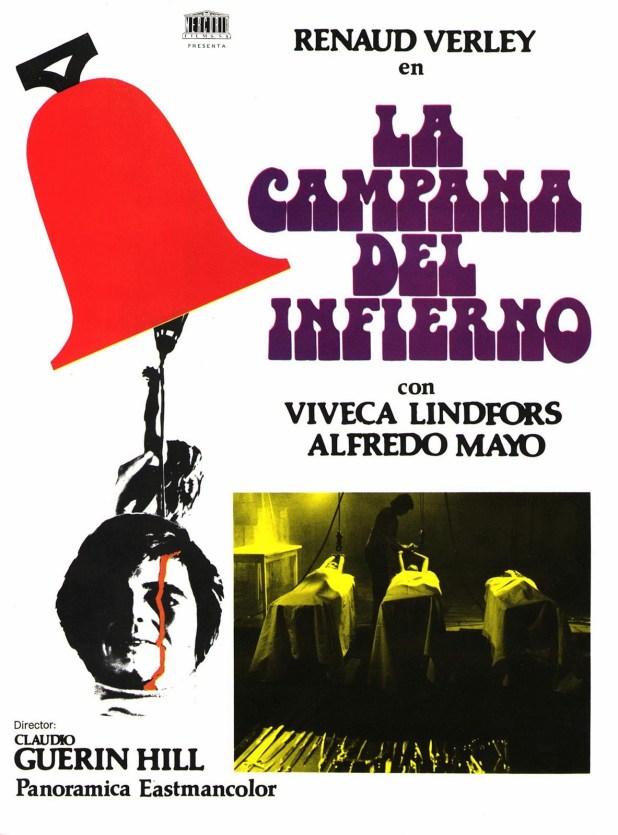
CHILLING CLASSICS MONTH: A Bell from Hell (1973)

What happens when a young man is released from an insane asylum and returns home? Well, he goes for revenge on his aunt and her three daughters, the ones who stole his insurance when they claimed he had gone crazy.

This is another part of the Avco Embassy’s Nightmare Theater package syndicated for television in 1975. The others are MartaDeath Smiles on a Murderer, Maniac MansionNight of the SorcerersFury of the Wolfman, Hatchet for the HoneymoonHorror Rises from the TombDear Dead DelilahDoomwatchWitches Mountain, Mummy’s Revenge and The Witch).

Bell from Hell isn’t an easy watch. It’s dreamy at times, brutally realistic at others, particularly the slaughterhouse scene. Juan wants revenge against Marta (Viveca Lindfors, Creepshow) and her three daughters (as well as anyone connected with them), but there are times when he could easily kill them and he lets them escape. A good chunk of this movie feels thrown together. But there’s a reason.

Director Claudio Guerín fell — or jumped — from the tower housing the title bell on the last day of shooting and was killed. The film was completed by Juan Antonio Bardem. One assumes that Bardem did the best job he could to combine all the many parts that Guerín into some whole. Throw in the fact that this movie is translated from Spanish to English and you get a swirling dervish of confusion.

Unknown

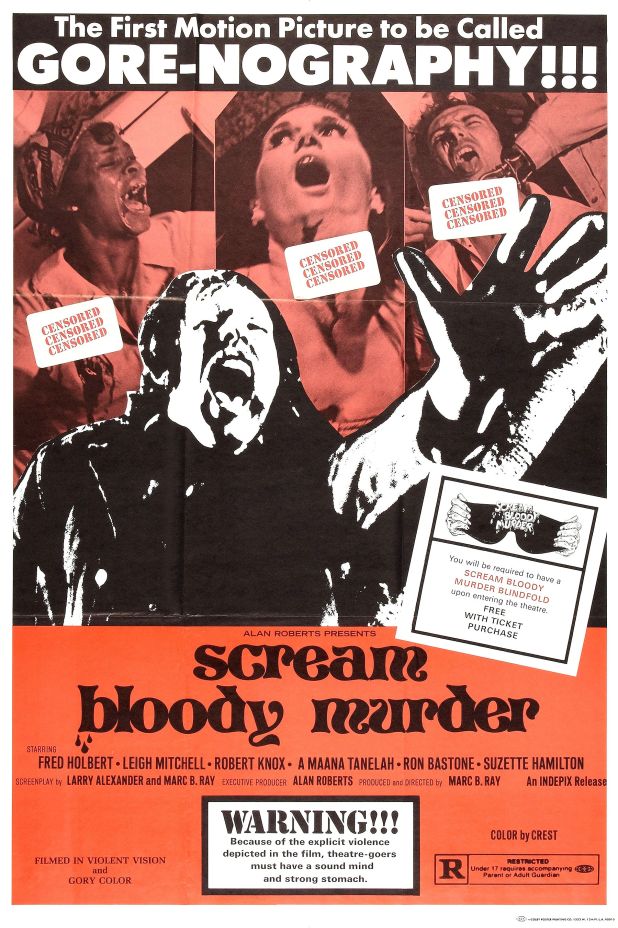
CHILLING CLASSICS MONTH: Scream Bloody Murder (1973)

As Matthew watches his father work on a tractor, he decides to turn it on and kill him with it, all at the cost of his own left hand. Yes, we’re not even at the credits yet and Scream Bloody Murder — the first motion picture to be called gore-nography! — is already insane.

Matthew grows up in a psychiatric hospital with a hook for a hand, returning home at the age of eighteen to live with his mother and her new husband, Mack Parsons. In addition to killing his father, Matthew might hate sex but wants to fuck his mother. He does the logical thing here and kills Parsons with an axe and shoves his mother to the ground and kills her when her head hits a rock. We’re about ten minutes into this movie, mind you.

Our hero takes a ride with a young couple, but soon, he’s seeing them as his mother and Parsons, screaming, “Don’t touch her!” and beating the man to death with a rock and drowning the woman. This movie feels less like a movie and more I am watching maniacs actually film their insane activities. And then the voices of his mom and new dad chase him everywhere!

Finally, Matthew makes it to town where he meets Vera, a painter and prostitute. He falls in love with her to the kind of degree that I would when it came to mean girls who smoked gloves and had asymmetrical haircuts in the early 1990’s. Except instead of making them mixtapes and doing their homework, Matthew is slicing the throat of one of her johns and violently taking over a mansion. Yes, he uses a pillow to kill the owner, a cleaver to kill the maid and even cuts off a dog’s head! Matthew!

Matthew then brings Vera to his new home, but she refuses to live there, so he takes her prisoner. Even when he gives her the life of her dreams and the chance to be an artist, she doesn’t want to stay.

Soon, a doctor comes to visit (Angus Scrimm!) but Matthew kills him. Vera is stuck inside with a killer, but she realizes that he’s disgusted by sex. She convinces him to let her take a bath and then tries to make him have sex with her. He starts to freak out and turns his head. She stabs him, but he survives and soon chases her down before cutting her throat with his hook.

With his love now dead, Matthew goes completely off — everything before was just a test, obviously — and runs through town, followed by the voices and phantom states of his victims as they lure him to his fate. He’s also followed by some swinging horns, baby! Everything descends into psychedelics, aided and abetted by the kind of horrible transfer that you know and love from your friends at Mill Creek. I don’t care! I don’t need a perfect blu-ray or 4K transfer to love the end of this movie! Dig that dolly roll back from the altar! Now that’s a shot!

Writer/director Marc B. Ray also wrote Stepfather 3, as well as an episode of Kids Incorporated, featuring Martika, Fergie and Jeff “Chunk from The Goonies” Cohen and Mario Lopez, and the 1970’s New Mickey Mouse Club, with Lisa Whelchel of TV’s Facts of Life. And co-writer Larry Alexander worked on plenty of 70’s TV, like Lucan and The Super Mario Super Show. None of this kid fare will prepare you for this movie.

This is one bizarre, dark and downright strange movie. It’s nearly an art film, filled with meanness toward the world and nearly everyone in it is murdered — horribly — for no reason at all. Actually, it’s too poorly shot to be an art film, but I wonder how audiences reacted to this upon watching it at the drive-in. There’s no real escape valve or comedy relief. It’s just unrepentant nihilism. In fact, it gets so dark that one wonders if it goes so far that it becomes comedic.

Also known as Claw of Terror, Captive Female and Matthew, this is yet another part of the Chilling Classics box set, which is equally packed with bad quality and great surprises.

You can watch the whole thing here:

CHILLING CLASSICS MONTH: Medusa (1973)

In Greece, a stewardess is murdered by a masked maniac, with the authorities feeling like it can only be one of two people: a drunken American playboy (George Hamilton) and a murderous gangster (Cameron Mitchell). Yes, the Mill Creek Chilling Classics set really knows how to give you quite the mix of films!

According to screenwriter Christopher Wicking, this film was only made because George Hamilton was willing to do it. He was about to marry Alana Stewart (she’s in the film in a small role) and he figured it was the chance to have a great honeymoon with all expenses paid, as well as an acting salary.

As for the film that emerged, well…it tries to be a giallo yet has none of the trademark verve and energy of that genre. It does have Luciana Paluzzi from The Green Slime as Harrison’s incestuous sister. So it has that going for it.

Man, I usually love Gordon Hessler’s films, like Scream, Pretty Peggy and Sho Kosugi’s Pray for Death. But this film plods like no other film has plodded before. It’s hour and thirty-nine minute running time may as well be three years and nine months.

I guess I can honestly say that this is both the best and worst George Hamilton vanity project that I’ve ever seen.