If all Juan López Moctezuma directed was Alucarda, he’d still be celebrated. Throw in the fact that he was behind the camera for El Topo and also created this little piece of strangeness and you can see that he’s someone to be celebrated.
A journalist has traveled to Dr. Maillard’s (Claudio Brook, Alucarda, The Devil’s Rain!) remote mental institution to write a story about the progressive treatment the doctor offers: patients are free to roam and fully live out their fantasies. However, when he gets there, the reporter learns from the doctor’s daughter Eugenie that he hasn’t met the real doctor, just one of the inmates that is quite literally running the asylum and randomly quoting Aleister Crowley. Even better — Susana Kamini, Justine from Alucarda, shows up as a cult priestess!
Imagine if Hammer or Amicus made a movie in Mexico, with all of the dialogue in English, and fed massive amounts of drugs to everyone involved. That’s pretty much how I imagine that this film was made. It’s also an Edgar Allan Poe story (The System of Dr. Tarr and Prof. Fether), but really, it’s also a costume drama with more powdered wigs than a British courthouse. And man, has there ever been so sensationalistic a title?
Will you like it? Not if you’re expecting a horror movie. Again, the Chilling Classics set confounds expectations, seeming like it will only feature the worst schlock and somehow embracing Mexican art cinema. I can only imagine that there’s a basement in the Mill Creek offices where the maniac that chose the films for this set signed off on it with a feather pen and a giant flourish, exclaiming, “I hope this makes someone’s brain melt!”
Beyond watching this on the Chilling Classics box set, you can also find it on Amazon Prime. If you want a much better looking copy of this film, Mondo Macabro released it as The Mansion of Madness, complete with a brand new digital transfer and Guillermo dl Toro discussing the director.
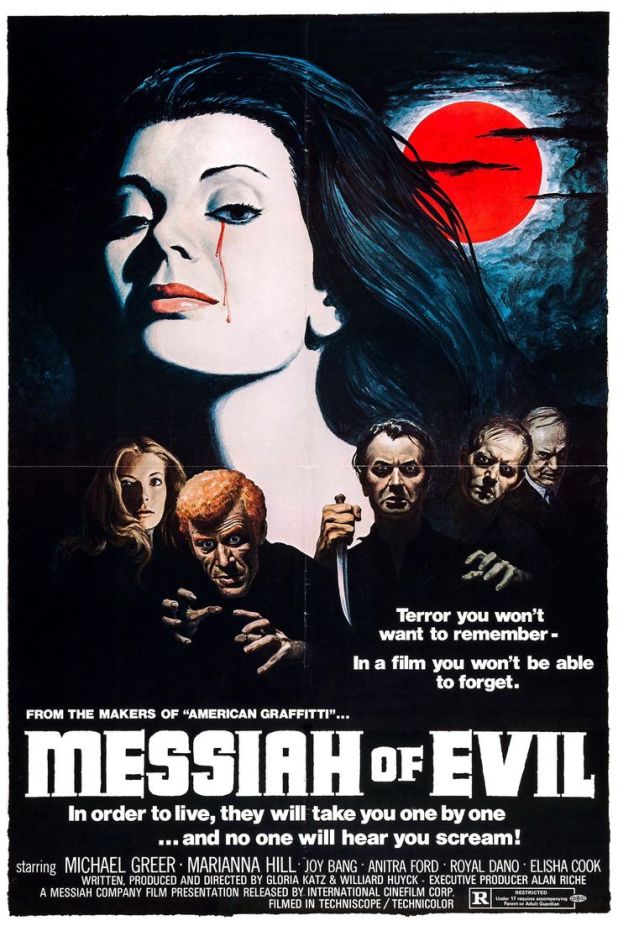
Between great design, reviews of junk food and lots of great info on the artists behind horror movie posters, there’s a lot to love about the site Camera Viscera. Here’s one more: Doc, the creator of the site, has sent this article on Messiah of Evil!
The best word to describe Messiah of Evil (really, the only word to describe the film) is surreal. With its vampire-zombie hybrid antagonists and rundown seaside setting (not to mention its pseudo-satanic undertones) it’s a movie less concerned with weaving a cohesive narrative than it is stringing together as many odd characters and bold set pieces as it can in its belabored 90-minute runtime. But what Messiah lacks in grace (and budget, and continuity, and comprehension, etc.) it makes up for in genuine curiosity.
When the film opens, a young woman named Arletty (Marianna Hill, who also acts as narrator) is driving to Point Dume, a sleepy seaside town along the California coast, in search of her artist father from whom she hasn’t heard in some time. When she arrives at his beach house, she finds no sign of him, but she does find a diary he left, seemingly for her to read. The journal entries are ominous and cryptic, warning her of not only the other-worldly dangers that seem to inhabit the town, but also unsettling changes that are happening to her father.
Through no real explanation, she eventually hooks up with a trio of fellow out-of-towners: Thom, Toni, and Laura (Michael Greer, Joy Bang, Anitra Ford). Thom seems to be on a similar hunt of his own, searching for answers surrounding the type of portents Arletty’s father’s diary warned about. Thom’s motivations are never clearly explained, but that’s par for the course with Messiah.
One of the signs Arletty’s father warned of is a blood moon, which eventually appears in the sky one night, setting off the chain of events described in his diary. Locals wander aimlessly on the beach, their heads transfixed skyward. Hordes of blood-thirsty flesh-eaters stalk the streets at night. People bleed from their eyes. Our titular Man in Black (who we come to learn was a member of the fated Donner Party) shows up to greet his disciples. No one seems to know what the hell is going on, including the viewer.
After a few inspired but poorly executed set pieces (the two best ones involving a supermarket and a movie theater), the film crescendos into a battle of survival for Thom and Arletty at her father’s bungalow. Despite its minuscule budget, the film manages to deliver some surprising action, including a few falls-through-a-skylight and even an extended full body burn. Alas, even these dazzling displays including the supermarket and movie theater scenes aren’t enough to make the film feel anything less than a slog. The highlights are too few and far between, sandwiched amid a shuffle of go-nowhere scenes and mostly sluggish performances.
Messiah was released theatrically in 1973, under no less than four different titles, and getting it to the big screen was no easy task. According to Ford, “…shot in 1971, this movie was originally titled The Second Coming. Towards the end of the filming, investors pulled their money out, and the film was never finished. A Frenchman bought the unedited footage, edited it and released the movie under the title of Messiah of Evil.” And indeed one of Messiah‘s greatest weaknesses is its editing. Scenes abruptly end, dialogue isn’t synced properly, jump cuts abound. It’s all very slapdash, and it shows.
The film was written and directed by husband and wife team, Willard Huyck and Gloria Katz, and to say they have had an interesting career in Hollywood would be an understatement. The same year Messiah was released, the duo who happened to be friends with George Lucas, serendipitously enough ended up being asked to write American Graffiti and later Indiana Jones and the Temple of Doom, as well as being tasked with writing and directing the unanimously derided bomb, Howard the Duck. It’s about as strange a journey as Messiah of Evil itself.
Messiah is arthouse exploitation. Equal doses of trippy visuals (for the pompous types) and goopy low-budget viscera (for the rowdy types). Though not as refined as its contemporaries, it still shares shelf space with the likes of Let’s Scare Jessica to Death, Burnt Offerings, The Witch Who Came from the Sea, and others. It’s a niche but important sub-genre, one whose entries flow with the languid, dreamlike pace that only a movie from this era could. Gauzy visuals and strange happenings like your brain after a long night of drinking.
While I’d recommend a few other titles before this one, Messiah of Evil is worth a watch if you’re an exploitation completist looking for a break from reality.
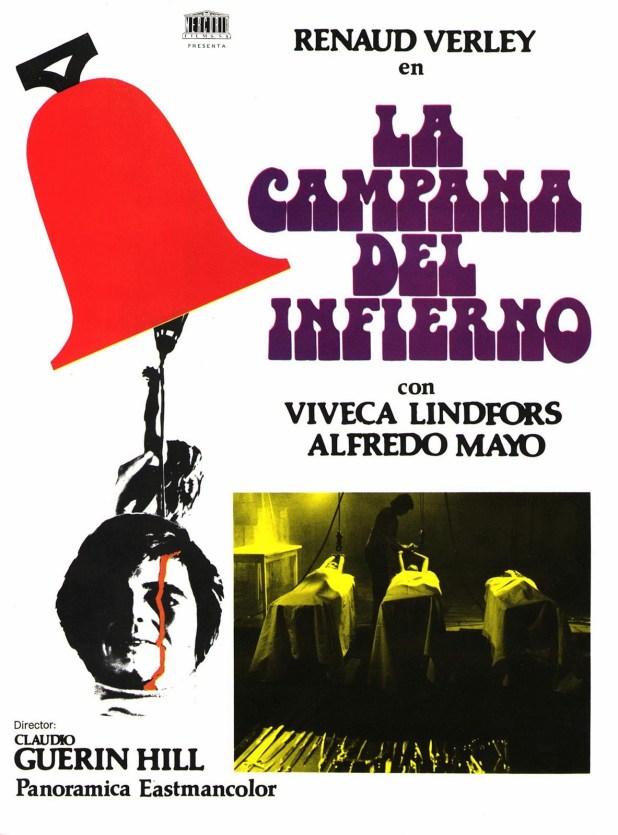
What happens when a young man is released from an insane asylum and returns home? Well, he goes for revenge on his aunt and her three daughters, the ones who stole his insurance when they claimed he had gone crazy.
Bell from Hell isn’t an easy watch. It’s dreamy at times, brutally realistic at others, particularly the slaughterhouse scene. Juan wants revenge against Marta (Viveca Lindfors, Creepshow) and her three daughters (as well as anyone connected with them), but there are times when he could easily kill them and he lets them escape. A good chunk of this movie feels thrown together. But there’s a reason.
Director Claudio Guerín fell — or jumped — from the tower housing the title bell on the last day of shooting and was killed. The film was completed by Juan Antonio Bardem. One assumes that Bardem did the best job he could to combine all the many parts that Guerín into some whole. Throw in the fact that this movie is translated from Spanish to English and you get a swirling dervish of confusion.
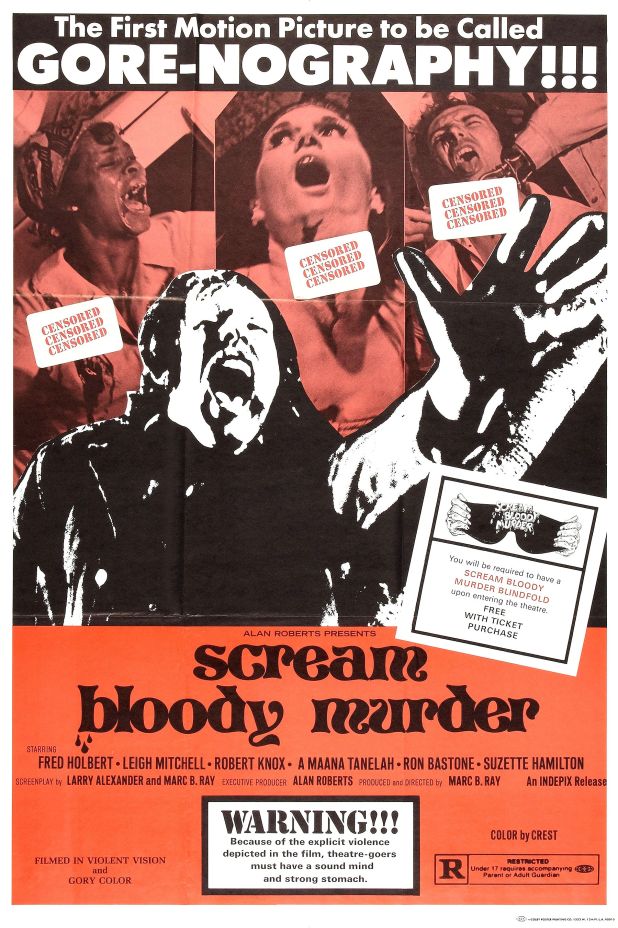
As Matthew watches his father work on a tractor, he decides to turn it on and kill him with it, all at the cost of his own left hand. Yes, we’re not even at the credits yet and Scream Bloody Murder — the first motion picture to be called gore-nography! — is already insane.
Matthew grows up in a psychiatric hospital with a hook for a hand, returning home at the age of eighteen to live with his mother and her new husband, Mack Parsons. In addition to killing his father, Matthew might hate sex but wants to fuck his mother. He does the logical thing here and kills Parsons with an axe and shoves his mother to the ground and kills her when her head hits a rock. We’re about ten minutes into this movie, mind you.
Our hero takes a ride with a young couple, but soon, he’s seeing them as his mother and Parsons, screaming, “Don’t touch her!” and beating the man to death with a rock and drowning the woman. This movie feels less like a movie and more I am watching maniacs actually film their insane activities. And then the voices of his mom and new dad chase him everywhere!
Finally, Matthew makes it to town where he meets Vera, a painter and prostitute. He falls in love with her to the kind of degree that I would when it came to mean girls who smoked gloves and had asymmetrical haircuts in the early 1990’s. Except instead of making them mixtapes and doing their homework, Matthew is slicing the throat of one of her johns and violently taking over a mansion. Yes, he uses a pillow to kill the owner, a cleaver to kill the maid and even cuts off a dog’s head! Matthew!
Matthew then brings Vera to his new home, but she refuses to live there, so he takes her prisoner. Even when he gives her the life of her dreams and the chance to be an artist, she doesn’t want to stay.
Soon, a doctor comes to visit (Angus Scrimm!) but Matthew kills him. Vera is stuck inside with a killer, but she realizes that he’s disgusted by sex. She convinces him to let her take a bath and then tries to make him have sex with her. He starts to freak out and turns his head. She stabs him, but he survives and soon chases her down before cutting her throat with his hook.
With his love now dead, Matthew goes completely off — everything before was just a test, obviously — and runs through town, followed by the voices and phantom states of his victims as they lure him to his fate. He’s also followed by some swinging horns, baby! Everything descends into psychedelics, aided and abetted by the kind of horrible transfer that you know and love from your friends at Mill Creek. I don’t care! I don’t need a perfect blu-ray or 4K transfer to love the end of this movie! Dig that dolly roll back from the altar! Now that’s a shot!
Writer/director Marc B. Ray also wrote Stepfather 3, as well as an episode of Kids Incorporated, featuring Martika, Fergie and Jeff “Chunk from The Goonies” Cohen and Mario Lopez, and the 1970’s New Mickey Mouse Club, with Lisa Whelchel of TV’s Facts of Life. And co-writer Larry Alexander worked on plenty of 70’s TV, like Lucan and The Super Mario Super Show. None of this kid fare will prepare you for this movie.
This is one bizarre, dark and downright strange movie. It’s nearly an art film, filled with meanness toward the world and nearly everyone in it is murdered — horribly — for no reason at all. Actually, it’s too poorly shot to be an art film, but I wonder how audiences reacted to this upon watching it at the drive-in. There’s no real escape valve or comedy relief. It’s just unrepentant nihilism. In fact, it gets so dark that one wonders if it goes so far that it becomes comedic.
Also known as Claw of Terror, Captive Female and Matthew, this is yet another part of the Chilling Classics box set, which is equally packed with bad quality and great surprises.
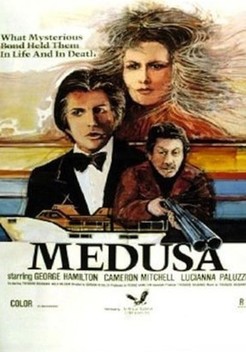
In Greece, a stewardess is murdered by a masked maniac, with the authorities feeling like it can only be one of two people: a drunken American playboy (George Hamilton) and a murderous gangster (Cameron Mitchell). Yes, the Mill Creek Chilling Classics set really knows how to give you quite the mix of films!
According to screenwriter Christopher Wicking, this film was only made because George Hamilton was willing to do it. He was about to marry Alana Stewart (she’s in the film in a small role) and he figured it was the chance to have a great honeymoon with all expenses paid, as well as an acting salary.
As for the film that emerged, well…it tries to be a giallo yet has none of the trademark verve and energy of that genre. It does have Luciana Paluzzi from The Green Slime as Harrison’s incestuous sister. So it has that going for it.
Man, I usually love Gordon Hessler’s films, like Scream, Pretty Peggy and Sho Kosugi’s Pray for Death. But this film plods like no other film has plodded before. It’s hour and thirty-nine minute running time may as well be three years and nine months.
I guess I can honestly say that this is both the best and worst George Hamilton vanity project that I’ve ever seen.
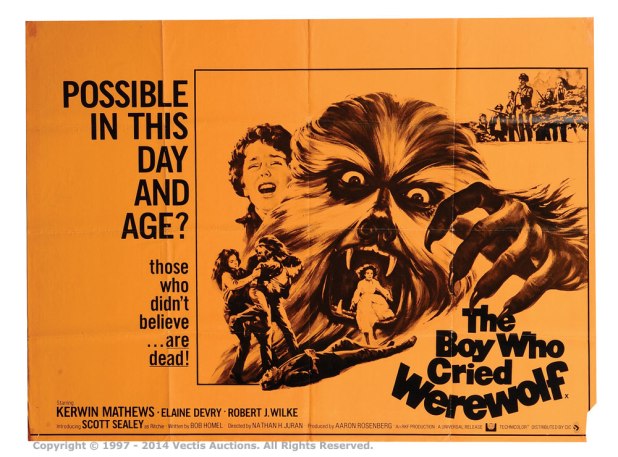
Nathan H. Juran directed plenty of films, but we probably know him best for Attack of the 50 Foot Woman, The Deadly Mantis, 20 Million Miles to Earth and The 7th Voyage of Sinbad. Becca and I had seen the trailer for years, but this was one of those films that you could only find on the grey market until Shout! Factory released it this year.
Robert Bridgestone (who starred in Juran’s aforementioned Sinbad film) is a divorced dad who tries to bond with his son, Richie, by taking him on a camping trip. On a midnight hike, the men are attacked by a werewolf, but Robert is able to toss it into a ravine where it’s revealed to be a human, impaled on a wooden fence. The sheriff and Robert are happy with the conclusion that the man was simply a drifter, but Richie isn’t so sure. And since his father was bitten in the attack, he’s worried about what will happen next.
Sandy, Robert’s ex-wife, insists that father and son go to counseling together, because Richie has become obsessed with lycanthropes. The psychiatrist (George Gaynes, Commandant Eric Lassard from the Police Academy series) believes that Richie has invented the werewolf story as he can’t deal with the knowledge that his father has killed another man. He suggests they go back to the camp, an act he believes will stop Richie’s fixation with werewolves.
As they return to the cabin, Robert finds himself in great pain and transforms into a werewolf that chases Richie — who has no idea that the beast is his father — across a highway. The werewolf attacks and massacres a driver while Richie hides with two newlyweds who are camping. Finding his father missing, Richie stays with the couple, but when Robert comes to get him in the morning, he’s ill-tempered and not about to listen to his son’s werewolf shenanigans.
The next night, Robert changes into a beast again, but Richie has already found a hiding space. No worries — the werewolf will kill the newlyweds instead, shoving their camper down a hill, then mutilating their bodies and decapitating them. Richie emerges just in time to see his father go from wolf back to man. As they drive back home, Richie grills his father, who doesn’t take kindly to it. When they get back to his mother’s house, he runs, telling her he doesn’t want to be alone with a monster.
After another visit to the psychiatrist, its determined that between the divorce and murders, Richie sees his father as a beast. The film would be much more interesting here were there any doubt as to whether Robert was the werewolf. But no — instead the entire family is put into harm’s way. Too bad they didn’t see the headline of today’s paper: Local Psychiatrist Murdered.
As the estranged family heads out to camp, they run across a hippie commune. Sandy enters their circle of power that wards away evil spirits, but when Robert tries to join her, he is stopped dead in his tracks.
Back at the cabin, that whole 1970’s liberated women need men and were all wrong for divorcing their spouses paradigm rears its ugly head. Sandy confesses how much she missed Robert, who starts transforming into a wolf.
Robert finds Richie in the shed and begs his son to lock him in. Sandy barges in, only to nearly be killed. They escape to the sheriff’s office, but no one will believe Richie. Even now. I mean, he may be the most annoying kid ever, but his logic is starting to add up.
Even after he attacks the hippies, they pray for his soul and watch him transform. That night, he rises again and a search party — read that as mob of angry townsfolk — give chase. The wolf grabs Richie and bites him on the arm before he’s shot and stumbles onto a stake in the ground, which pierces his heart.
Everyone is shocked as the werewolf reveals his true form: Robert. But Sandy is more concerned that her son is now a werewolf, thanks to his father’s bite.
The Boy Who Cried Werewolf can’t live up to the manic trailer that sold it to me. But it’s still an enjoyable yarn, mixing end of the 20th century problems — divorce and hippies, man — with the traditional werewolf mythos.
Man, these student teachers. They’re changing the old ways of high school and making it better — well, maybe more interesting — for the hip now generation. The sequel to Roger Corman’s The Student Nurses, this movie is all about the issues, man.
Directed and co-written by Jonathan Kaplan, who would go on to direct The Accused, this movie follows three student teachers: Rachel who wants to teach the good parts of sex education after school (that is, birth control and that sex isn’t this alien, frightening thing); Tracey dates an art teacher who cheats on her; and Jody works with an inner-city education effort but also gets involved in selling drugs.
Chuck Norris made his debut in this film as a karate instructor. In his autobiography, he revealed that he knew nothing of the film other than the scene he was in. When the movie was released, Norris and his family went to see it and were shocked by the explicit sex and nudity. In fact, Norris almost changed his mind about becoming an actor!
To say this movie is dated is an understatement. That said, it’s packed with the earnestness of the end of the 1970’s and the feeling that young people would change the world. They all ended up repeating the same cycle as their parents by the early 80’s. But for now, they would be the student teachers.
Originally airing on Wednesday, October 10, 1973 — and also known as Nightmare in Europe — 45 years have done nothing to hide to hide the weirdness and ability to frighten that this TV movie possesses.
Sally Farnum (Kim Darby, who started her career in True Grit and has appeared in memorable roles in Better Off Dead and Halloween: The Curse of Michael Myers) and her husband Alex (Jim Hutton, Psychic Killer) have just inherited an old mansion from Sally’s grandmother.
There’s this great fireplace that’s all bricked in and Sally wants to do something with it. However, the handyman, Mr. Harris (William Demarest, Uncle Charley from TV’s My Three Sons) refuses as Sally’s grandmother had him seal it after her grandfather died. It’s just better to leave things the way they are. Sally doesn’t listen and uses the tools the old man leaves behind to pry open a small side door. This isn’t a fireplace at all — it’s gigantic basement. Sally leaves without hearing the voices calling her name, happy that she has set them free.
Of course, those voices can only get louder. Soon, they are constantly whispering her name and all manner of things are being broken in the house. At a dinner party for her always way too busy husband, she sees a small creature under the dining room table. Then, three of them try to attack her in the shower with razors!
The creatures are played by Tamara De Treaux, who was one of three actors who played E.T.; Felix Silla, who was Cousin Itt on TV’s The Addams Family and Twika on Buck Rogers in the 25th Century; and Patty Maloney, Lumpy from theStar Wars Holiday Special. They are uniformly unsettling in apperance. Go ahead. Just take a look.
Alex goes away on business again and tells Sally to stay with her friend Joan (Barbara Anderson, Eve from TV’s Ironside). But before she can go, the creatures trip Sally down the stairs and kill her interior decorator! That’s when our heroine confronts them and asks what they want. The answer? They want her soul as payment for freeing them.
Sally’s doctor prescribes sleeping pills while Joan stays with her, slowly believing her tales. Alex, however, is a grump and unconvinced untol he speaks with the handyman. Sally is lured into slumber as the creatures have spiked her coffee and they cut the power (“What do you mean they cut the power? How could they cut the power, man? They’re animals!”).
The creatures drag Sally into the basement before she can be saved and the next time we hear her voice, she is one of them, waiting for the next people to move into the house.
A horror force no less than director Guillermo del Toro loves this film, going as far to produce and co-write the film’s remake. He claims that he and his brothers would follow one another around the house mimicking the creatures.
Directed by John Newland, who created and hosted TV’s One Step Beyond anthology and written by Nigel McKeand, who worked on TV’s Family and The Waltons, this movie still influences and frightens. Why? Maybe because Sally is stuck between the pre and post worlds of feminism and this movie was at the right time and place to comment on that. She wants to belong, whether to marriage or as someone who makes something, but in the end, these roles feel empty and shallow. The only thing she ends up belonging to is the house that causes her doom.
Regardless, the real testament here is that the film was created — including script approval by Lorimar, casting, special effects, voice-over and exterior shots — in two weeks, thanks to a looming writers’ strike.
I searched and searched for a copy of this movie and am happy to have it in my collection. You should do the same.
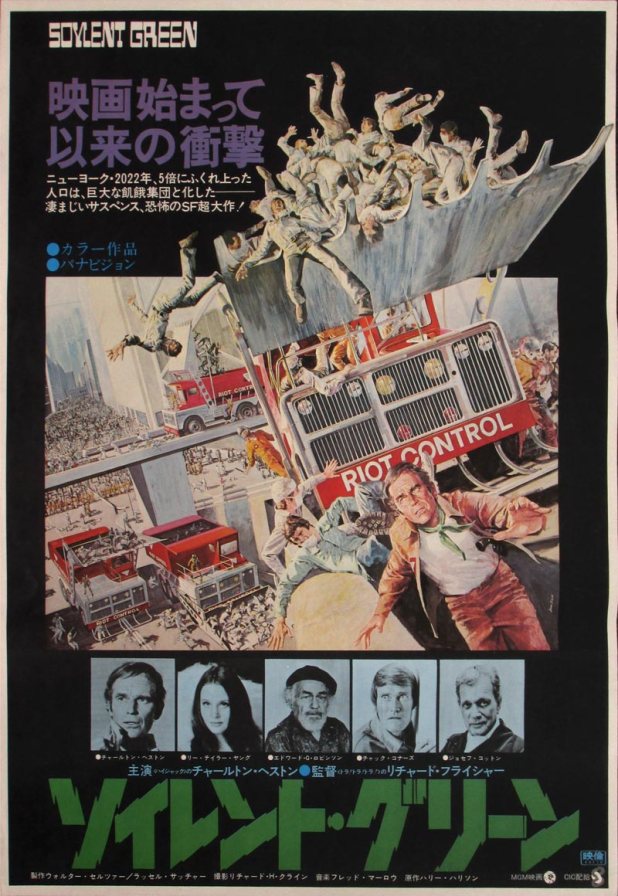
As we were rewatching this film last week, Becca said, “It always seems so hot in this movie, everyone is sweating all the time.” And I replied, “Yeah. We’re kind of living in it now.” Yep, other than turning people into food and my stairwells being filled with sleeping people, the world of Soylent Green feels like its getting closer every single day.
Was Charlton Heston the poster boy of the apocalypse? Between this, Planet of the Apes and The Omega Man, Chuck was in a ton of end of the war films. This is based on Harry Harrison’s book Make Room, Make Room. Harrison’s writing may seem like slam bang science fiction action, but it hides in its heart plenty of satire and a marked disdain for violence and the military.
Heston plays NYPD detective Frank Thorn, who lives with his elderly police analyst Solomon Roth, played by Edward G. Robinson in his final role. I can barely watch him in this movie without being moved to tears, as he died from bladder cancer 12 days after filming ended. Heston said, “He knew while we were shooting, though we did not, that he was terminally ill. He never missed an hour of work, nor was late to a call. He never was less than the consummate professional he had been all his life. I’m still haunted, though, by the knowledge that the very last scene he played in the picture, which he knew was the last day’s acting he would ever do, was his death scene. I know why I was so overwhelmingly moved playing it with him.” That scene decimates me every single time that I watch it, as Solomon realizes that his time, a time that remembers the past (he’s one of the few alive who can read from old books) is now gone. As he lies in state as part of the euthanasia process, Thorn tries in vain to stop him but is soon mesmerized by the footage of extinct animals and a once green world.
Outside of Sol, everyone in this film is corrupt. Thorn and his fellow cops steal everything they can from the murder scenes that they investigate when they aren’t being riot cops, using bulldozers to lift people and throw them in the air. He even takes advantage of murder victim William R. Simonson’s (Joseph Cotten!) live-in lover, Shiri (some women in the future are allowed to be concubines and live in luxury; Thorn refers to her as furniture). And Chuck Connors shows up as Simonson’s bodyguard.
This film frightens me because so much of it is prophetic. The Twin Towers are gone in this future. The things that Sol says to Thorn, like “Ocean’s dying, plankton’s dying” are happening as well. This movie is nearly fifty years old and predicts the greenhouse effect that so many people don’t want to see is happening.
Director Richard Fleischer would go on to have a career of ups and downs. The son of animator Max Fleischer, he’d also direct Amityville 3-D, Red Sonja, Conan the Destroyer, Fantastic Voyage, Madingo, 20,000 Leagues Under the Sea and the horrific Neal Diamond vehicle, The Jazz Singer. That’s probably the most all over the place directorial credits ever.
I love having people over to our house to watch movies. However, some folks don’t get to watch the really strange films in our collection. They have to make it through a test to see if they can hang. I’ve had the misfortune of trying to explain Beyond the Valley of the Dolls to people and get angry, then sad, then angry again when they just don’t get it. If you make it through my cinematic ring of fire, the journey through excess and madness and horror, then and only then are you greeted by the final challenge: 1973’s epic freakout The Baby.
This isn’t a movie that I’ve known about forever. Quite to the contrary — I discovered it two years ago when the trailer played during one of the all-night drive-in events at the Riverside Drive-In. The blast of strangeness in that trailer was enough to get Becca and I repeating the dialogue for weeks: “What have you done with my Baby?”
Luckily, Bill from Groovy Doom/Drive-In Asylum had a copy that he was only too happy to bring to our house. Too often these days, we’re greeted with too much hype for movies, with statements like, “If you don’t love this movie, you don’t understand cinema!” and “This movie shook me to my very core!” Well, I can honestly say that The Baby has destroyed my mind in a way that no film made before or since ever has.
Ann Gentry (Anjanette Comer, The Loved One) is a social worker who has just been assigned to the incredibly strange Wadsworth family. There’s Mrs. Wadsworth (Ruth Roman, who not only starred in Strangers on a Train, but survived the sinking of the Andrea Doria), the strong-willed mother. Her daughters Alba (Susanne Zenor, who was the original Samantha in the pilot of TV’s Three’s Company before Suzanne Somers took over the role), who teaches tennis, and Germaine (the transcendent Marianna Hill, Messiah of Evil, Schizoid, BloodBeach), who occasionally acts in TV commercials when she’s not looking like a maniac. And finally, there’s Baby (David Manzy), a twentysomething man who doesn’t walk or talk and who has been raised as an infantilized adult.
You just read that right. This is a movie about a grown-up baby that sits in a crib and cries, but not just as cries. The original track containing baby sounds that Manzy worked so hard to craft during the filming was lost, so the voice of an actual baby was used. It’s disconcerting to say the very least. Add in that the actor completely shaved his body for the role and you have the foundations for a movie that’s more than a little left of center.
Ann is driven to improve the lives of her cases, but Baby is a special case. Perhaps too special to Ann, as she’s recently recovering from a severe auto accident that had a serious effect on her husband. The Wadsworth family totally depends on Baby for most of their income and as a result, won’t allow him to grow into an adult. And it seems like Ann could change all that, as she discovers that Baby’s current state is the result of neglect.
“Baby doesn’t talk. Baby doesn’t walk.” Baby also isn’t allowed to do things by himself, either being beaten, cattle prodded or restrained when he does anything against the rules. Even when Ann shows the family that Baby has the capacity for growth, she’s instantly rebuffed.
If all of the above was all that this movie would be about, it would still rank amongst the oddest ever made. But it gets much stranger. You see, nearly every woman who meets Baby wants to possess him. And some often want to have sex with him, like the sitter who gets into his crib and allows him to nurse from her. The Wadsworths come back home to this scene and proceed to annihilate the young girl and beat Baby into further submission. And even Baby’s sisters may love him a little more than siblings should.
Finally, the simmering discord between Ann and Baby’s family comes to a head on the night of Baby’s birthday party — which is the strangest one committed to film since perhaps Jessabelle the cat’s celebration in The Sentinel. That said, any party that has Michael Pataki as a guest is one that I want to be at!
After escaping the murderous intent of the Wadsworths, Ann finally succeeds in taking Baby away. Rather than turning him over to an institution, she keeps him at her house and then sends his family photos of their manchild doing adult things like standing up straight.
This sends the Wadsworth clan into a murderous tailspin, as they head for Ann’s house with killing in mind. However, she and her mother-in-law aren’t willing to give up their new guest without a fight.
Even though this film was made over forty years ago, I’m not giving you the ending here. I want you to see it for yourself with no preparation whatsoever.
Now, after reading all of the above, you have to be thinking — surely The Baby is an unrated affair or at worst it got an R, right? Nope. This is a PG movie. The 1970’s did not care at all about children, blasting them with both barrels of bonkers with movies like this, The Little Girl Who Lives Down the Lane and It’s Alive all getting just a simple Parental Guidance suggested label.
Here’s the next surprise: The Baby wasn’t an underground film. Nope, it was a mainstream release directed by Ted Post, who directed numerous TV series like GunsmokeThe Twilight Zone and 178 episodes of Peyton Place, as well as Hang ‘Em High, Magnum Force, Beneath the Planet of the Apes and the TV movies Do Not Fold, Spindle, or Mutilate and Cagney and Lacey, which led to the series. The dark nature of this film kept Post away for a year before writer Abe Polsky was able to talk him into getting behind the lens.
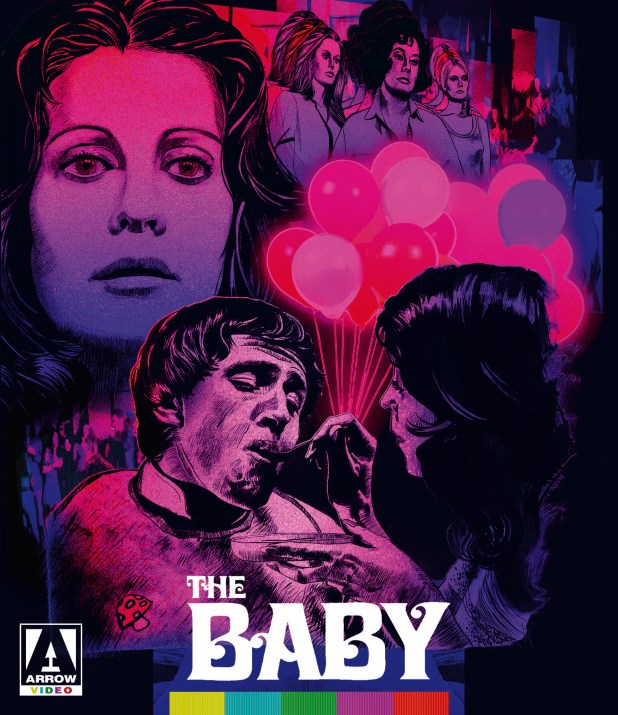
The Severin blu ray of this film was a great package, complete with informative interviews with Post and Manzy. Arrow Video is releasing a new version this week with even more extras, including newly commissioned artwork by The Twins of Evil, deep commentary by Travis Crawford, interviews with Marianna Hill and one of the set painters and a discussion with film professor Rebekah McKendry on the influence of the film. It’s a great package that truly does this movie justice.
Back to the hype engine that sours so many on so many movies. Often, you’ll read things about how movies have permanently changed lives and scoff. I’m telling you that the way that I view movies and live has been forever altered by this movie. It’s hard for me to find another film that can match it for sheer audacity and bizarre subject matter. However, no words that I write can do it justice. You must watch it for yourself and be changed by the act of viewing it.
You can grab the new Arrow Video release of The Baby from Diabolik DVD.
BONUS! Here’s the podcast where we discuss The Baby in detail with Bill!
Disclaimer: I was sent this movie by its PR team, but as you know, that has no bearing on my review.




 B&S About Movies
You must be logged in to post a comment.