In the early 1970s, Fredric Hobbs pioneered an art form that he called ART ECO, a combination of environmental technology, fine art, solar/nomadic architecture and interactive communications with an ecologically balanced lifestyle.
But more important to our studies, Hobbs also wrote and produced four films, the missing potentially forever Troika, Roseland, the incredibly strange Godmonster of Indian Flats and this movie. I am pleased to report that in the first minute of this movie, it somehow outweirds even the Godmonster. How is this even possible?
“Whilst storm clouds gathered over Europe in the years before the war, Hitler’s most brilliant and renowned young scientist, Dr. Kirsten Caligula, vanished suddenly from her laboratory in Berlin.
World press received unconfirmed reports that Dr. Caligula — an expert in robot technology — had been dispatched to Calcutta, India, on a top secret mission for the Fuhrer himself.
Her orders: to interview the world-famed magician and spiritualist Carter the Great at his Mountain retreat near Calcutta. There to study his most recent discovery a rare super-substance known as Raw-Zeta.
It was rumored amongst scientists of the time that Carter’s substance resembled a highly potent form of hashish known as Cartoon-Khaki. Other authoritative sources in the Far East reported that Raw-Zeta, when refined electronically, could result in the formation of Deadly-Zeta.
Carter — in ghost form — was introduced into a human body by Chinese acupuncture techniques. In his last public statement, Carter warned that any mortal wired to Deadly-Zeta could be used as a broadcasting catalyst to enslave all humans with the sound of his voice, thus becoming an unwitting tool for the most diabolical forces of evil known to man.
Soon afterward, Carter vanished forever whilst visiting his sister in San Francisco, perhaps a victim of his own prophecy.
Seven years later, when Carter was pronounced legally, dead his admirers held a spirit funeral over an empty black coffin.”
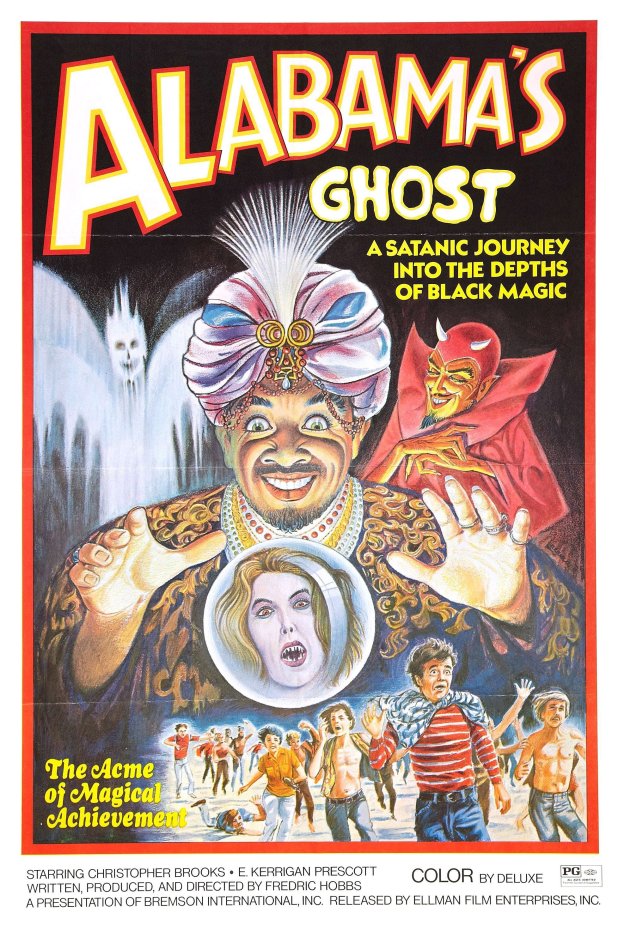
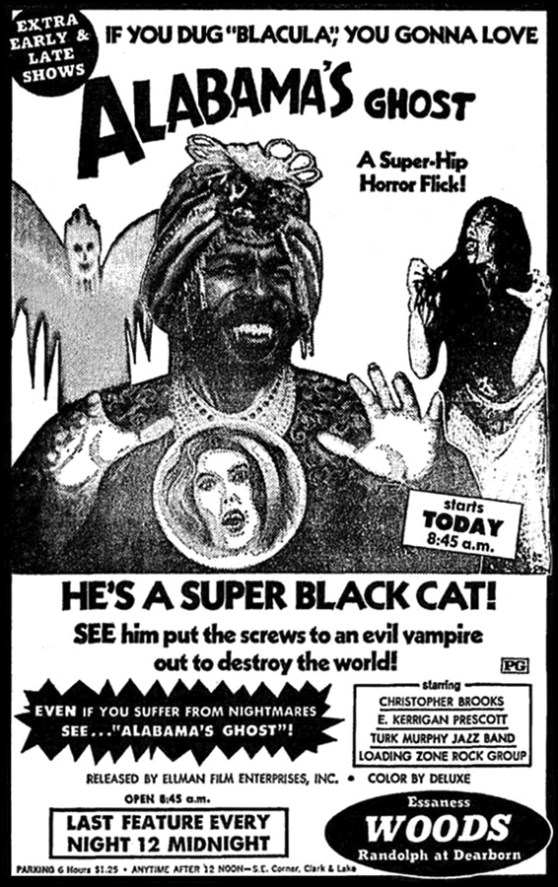
These words — originally transcribed by the site Taliesin Meets the Vampires — start the film and then we’re instantly slammed into a Dixieland band playing a song called “Alabama’s Ghost” that spoils most of the movie. That’s when we meet our hero, Alabama, who crashes a forklift into a room that is filled with the magical tools of Carter the Great. He decides to visit the magician’s sister in San Francisco and learn more about how he can become a great magician.
Alabama is played by Christopher Brooks, who also played Hieronymous Bosch in Roseland and Jesus Christ in The Mack. He also shows up in Godmonster of Indian Flats. He’s incredible in this movie, to the point that you could have really told me he really was the character and that they just filmed his crazy life and didn’t tell him that this was a narrative film.
She agrees to allow him to keep the Raw-Zeta, which he believes is hashish, and Zoerae — her granddaughter — will travel with Alabama, teaching him more of the ways of magic. However, when our protagonist leaves, we learn that the old woman is a man. And a vampire. And soon, we also discover that Zoerae is also a vampire, part of a coven that still follows Dr. Caligula and will use the media airwaves of a man named Gaunt to speak through Alabama, transforming the Raw-Zeta to Deadly Zeta and take over the world.
If you make it this far without wondering what the hell is going on, I’d be amazed. This movie is quite literally insane on every single level and I love it for whatever it is.
Meanwhile, Alabama is being managed by Otto Max, a rock and roll promoter, and learns that being a big star isn’t everything it’s cracked up to be. Oh yeah — he’s also mentored by the ghost of Carter the Great, who is trying to help him battle the vampires and become King of the Cosmos. But dude, those vampires have whole factories where they use young hippy girls as fuel.
Carter’s ghost is played by E. Kerrigan Prescott, who was also Prof. Clemens in Godmonster of Indian Flats and the lead character, Adam Wainwright the Black Bandit, in Roseland.
In 1973, $50,000, an elephant and possibly no small amount of drugs could create something this baffling and wonderous. It also has Turk Murphy, Dixieland jazz trombonist who ran the club Earthquake McGoons in San Francisco and also lent his voice to cartoons on Sesame Street.
There’s also a robotic version of Alabama, vampire bikers, the aforementioned elephant, lots of hippy freakout dancing, German undead scientists obsessed with marijuana and no small amount of musical numbers. I can’t even begin to explain how much I love Hobbs’ films and how much nearly everyone else will probably hate them. Nothing and everything happens all at once.
There’s a battle between Carter’s ghost and Alabama over the nature of magic. A real magician never reveals how they perform their magic and Otto demands that our hero reveal how an elephant can vanish.
This is a movie where the end credits come in at the beginning and a hippy singalong can bring a man back from the brink of death. The copy that I watched was beat up and appeared to be a VHS dub of a print that had run through every drive-in and grindhouse in the country, watched at 9 AM on a peaceful Sunday morning when most of the rest of the normal world was asleep. I can’t think of a better way to watch this movie.
I hope that when you watch this film, you feel the same magic and joy that I felt.
Director Leo Garren only made this one movie and his directing career is limited to an episode of I Dream of Jeannie and a short film called Hootpurr. He was better known as a writer, working on shows like Vega$, Quincy M.D. and T.J. Hooker. Plus, he wrote the Band of the Hand, a movie I keep trying to get to and write up for the site.
He was joined in the scriptwriting by Vernon Zimmerman, who wrote and directed The Unholy Rollers and Fade to Black, two of my favorite movies. He also wrote Bobbie Jo and the Outlaw and Teen Witch, so top that! They were also aided and abetted by Steve Katz, who wrote for The A-Team and Hardcastle and McCormick, as well as Doran William Cannon, who wrote the original story. His credits include Brewster McCloud, the 1980 TV version of Brave New World and a little film called Skidoo, which explains why this movie is just so strange.
The original screenplay was written in 1969 with the goal of being “the biggest piece of schlock,” combining two hot genres — biker films and supernatural horror.
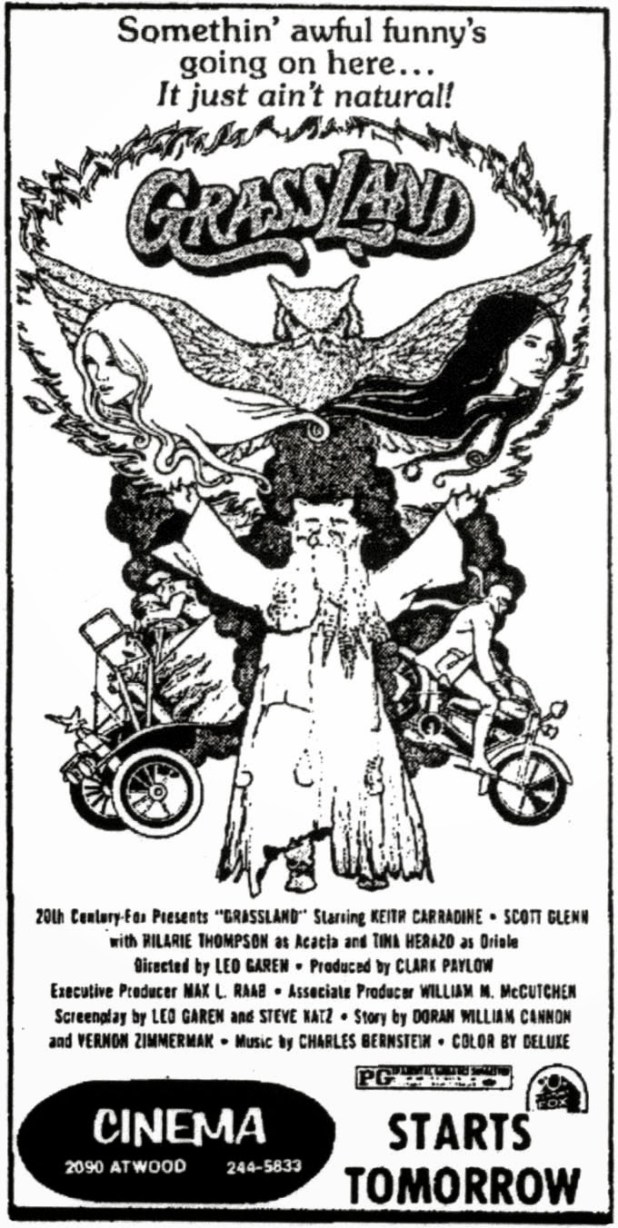
Set in 1919, this movie was shot on location at the Cheyenne River Indian Reservation in South Dakota. After being acquired by Twentieth Century Fox, it gathered dust on the shelf while the studio re-cut it into a more straightforward occult-themed horror film. Well, they tried, because this movie is still really odd.
It’s also been released under its working title, Grassland, as well as The Shrieking and Charms.
After the First World War, a loosely knit band of motorcyclists — let’s call them a gang — make their way across the U.S. on the way to California. Right now, they’re in rural Bingo, Nebraska, where they lose a hot rod race and flee after a dispute.
The gang includes Archibald “Whizzer” Overton (Keith Carradine, who I never realized was Martha Plimpton’s dad), Golly (Mike Combs, in his only acting role), Jimbang (Scott Glenn, The Right Stuff), Chupo (Robert Walker, Beware! The Blob, Easy Rider, The Passover Plot), Gibson “Giblets” Meredith (Gary Busey!) and a woman named China (Doria Cook-Nelson, the wife of Craig T. Nelson who shows up in The Swarm and Evil Town).
They hide on a remote farm owned by two sisters, Acacia (Hilary Thompson, the wife of Alan Ormsby and an actress who shows up in The Fury and Nighthawks) and Oriole (Cristina Raines, who of course starred in The Sentinel). Their Native American shaman father has just died and Oriole must run the farm with an iron fist. Despite letting the bikers stay, Giblets tries to assault Acacia. He gets hexed and an owl promptly rips out his eyes.
Oriole supplies them with a wheelbarrow and a shovel, as she does not want the man buried on her land. However, they supervise the funeral.
Soon, Acacia is falling for Golly. And Oriole and Whizzer grow close, but China soon reveals that the man is a liar. He was never a veteran but instead a mechanic who is trying to invent a better life story for himself.
So, you know, Oriole does what anyone else would. She takes some of China’s hair, sews it into the mouth of a toad and gives the girl horrific visions. Then, she begins to take out the gang one by one.
Jimbang attempts to shoot Oriole, but his gun lives up to his name, as it misfires and kills him instead. Chupo gets possessed and attacks Whizzer against his will. After he’s sliced with a sickle, Oriole makes love to Whizzer, who also kills the frog who is an effigy of China. Whew!
Acacia, tired of Oriole using their father’s magic for evil, renounces him, just as she shows up clad in his robes. But it all strangely works out — Golly stays behind with Acacia and on the only bike left, Oriole drives away with Whizzer riding on the back. Four fighter jets — it’s 1919? — pass overhead.
What did I just watch? Because I think I loved it.
Oh yeah! Dan Haggerty has a small role as Brother Billy and Iggie Wolfington, who represented actors in at least 10,000 equity cases as part of the Actors’ Fund of America, plays a bandmaster. John Carradine is in some of the production stills as an old gunfighter, but he never shows up in the U.S. cut of the film. Perhaps once someone like Vinegar Syndrome or Severin gets their hands on this, we’ll know more.
While Norman Mailer considered Hex one of the top-ten best films of 1973, it basically sat and sat in the valuts of 20th Century Fox. For his part, Garen was happy with the re-cut of the film that he completed, referring to it as “sort of carnival, snake oil, underground comic book entertainment. The only trick I tried to pull off was to keep the audience constantly shifting. When it gets serious, I pull the rug out. It goes from blatant farce to serious to scary to balletic to phantasmagoric.”
Trinity Home Entertainment released this on DVD way back in 2006 under its Charms title. Seeing as how this is near impossible to find today, I’ve decided to share it below. It comes from the Deranged VisionsYouTube channel, which always has so many completely berserk offerings.
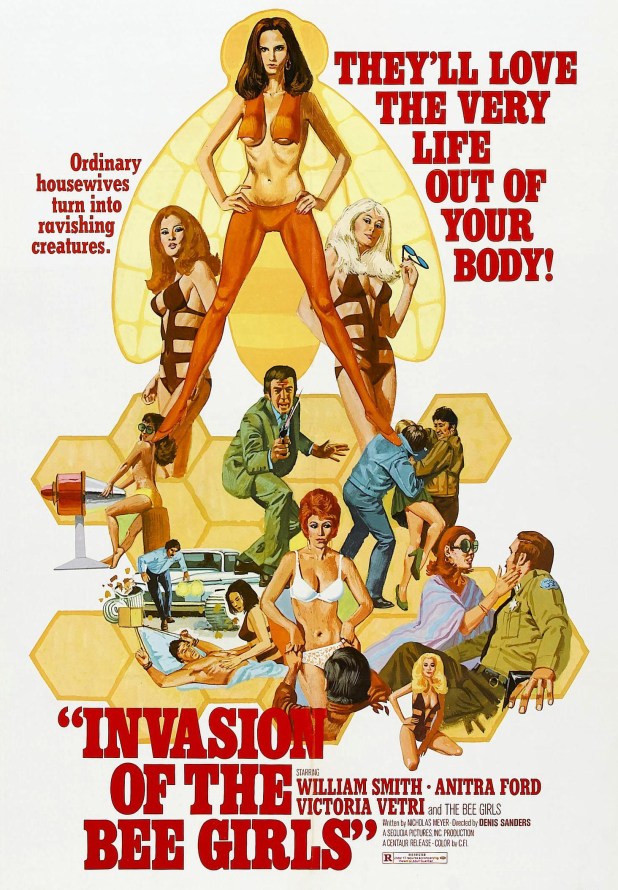
This was the first movie that Nicholas Meyer ever wrote. Yes, the same guy who wrote The Day After, Time After Time and the two good Star Trek films (two and four, if you’re playing at home) started right here. One day when he left to visit his parents, the script was altered and young Mr. Meyer wanted to take his name off of the project, but was convinced by his manager that he needed a credit.
Neil Agar (William Smith, Grave of the Vampire) is a special agent for the State Department sent to investigate the numerous deaths at government-sponsored Brandt Research.
It turns out that the scientists there are more obsessed with sex than their research to the point that some of them are literally getting balled to death. By the way, I’m on a quest to get the word balling and ball used in the vernacular again. Please help me.
The truth is the women of the research lab have all become Bee Girls through self-induced mutation. Now they have eyes that allow them to see like insects and the instincts of using and destroying men, several of whom totally welcome the end.
The main reason to watch this is Anitra Ford as Dr. Susan Harris. You may remember her from The Big Bird Cage and being a model on The Price Is Right. She’s in one of my favorite movies, 1972’s Messiah of Evil. If you haven’t seen that, you should probably just stop reading this right now and get on that.
Victoria Vetri plays the heroine, Julie Zorn. Using the name Angela Dorian, she was the Playboy Playmate of the Month for September 1967 and 1968’s Playmate of the Year. When Apollo 12 went to the moon, a photo of her and Playmates Leslie Bianchini, Reagan Wilson and Cynthia Myers was there, inserted into the activity astronaut cuff checklists.
She also appears in Rosemary’s Baby and When Dinosaurs Ruled the Earth. In 2010, nearly a quarter-century into her marriage to Bruce Rathgeb, Vetri was charged with attempted murder after allegedly shooting her husband at close range after an argument. She received nine years in prison on a charge that was finally reduced to attempted voluntary manslaughter. Her husband claimed that she had been saying, “No more Charlie, no more Charlie,” as she’d been convinced that Charles Manson wanted her dead ever since her friend Sharon Tate was killed. In fact, the gun that she used was given to her by Roman Polanski, who her husband claimed that she often slept with along with Tate. Vetri is in a halfway house now and working on making her way back to society.
This movie is also known as Graveyard Tramps, which has nothing to do with what it’s really about. You should watch it anyway.
Here’s a drink recipe.
Invasion of the Bee’s Knees
2 oz. gin
.75 oz. lemon juice
.75 oz. honey syrup
1 oz. egg white
Dash of honey
Place all ingredients in a shaker, then shake vigorously.
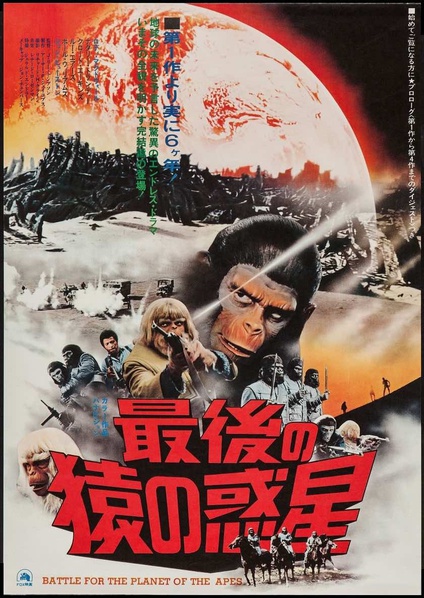
Paul Dehn wrote every one of the original Apes films, but after providing the story idea, an illness made him leave the project. John William and Joyce Hooper Corrington (The Omega Man) came in to write the movie, despite never seeing any of the previous films.
Dehn was unavailable for the initial rewrites, but was hired to come in and do one more pass. He was only given a story credit, despite an appeal to the Writer’s Guild of America for shared credit on the screenplay, despite rewriting 90% of the dialogue and adding a new ending.
While the original script ended on a playground with ape and human children fighting, now it would close on a statue of Caesar with a tear falling from its eye. Joyce Corrington called ythe new ending stupid and claimed that “It turned our stomachs when we saw it.”
The budget for this one was $1.7 million, a figure that director J. Lee Thompson felt wasn’t enough. He also wasn’t happy with the script, regretting that Dehn wasn’t on board throughout the entire process.
In the future — 2670 A.D. — a Lawgiver (John Huston!) explains that Caesar led the apes after mankind wiped itself out in a nuclear war. The ape leader, along with his wife Lisa (Natalie Trundy, reprising her role) and son Cornelius, are attempting to create a new society where human and ape can live together. Opposing this is the gorilla Aldo (Claude Atkins!) who wants to imprison the humans and make them do slave labor.
After an incident between Aldo and a teacher, Caesar doubts his leadership and wishes that his parents could have taught him more. MacDonald, Caesar’s human assistant and the younger brother of the similarly named character from the last film — played by Austin Stoker — knows that there is archived footage of them in the Forbidden City. So the two are joined by Virgil (Paul Williams, who of course had to end up in this series) on a quest to see this video.
However, there are mutants living within the city, led by Governor Kolp (Severn Darden), the man who once captured Caesar. Soon, Kolp declares war on Ape City despite his assistant Mendez’s trying to calm him down. Later in the film, Mendez is asked to set off an atomic bomb if the humans don’t win their battle against the apes. Mendez refuses, which is the start of the mutant cult that we saw in the Beneath the Planet of the Apes.
Speaking of people named Mendez, this is the film that inspired Tony Mendez to create the operation “Argo” during the Iran hostage crisis. The film Argo dramatizes this tale, as Mendez traveled to Iran in disguise as a film producer and had the hostages disguised as a film crew in order to flee the country. There’s a clip of this movie within that movie, showing the moment when Caesar, MacDonald and Virgil arrive in the Forbidden City.
Aldo plans a coup against Caesar and when Cornelius overhears, Aldo hacks off the tree branch he’s on, critically wounding the young ape. Kolp attacks, but the tide soon turns and he runs, leading Aldo to follow him and ruthlessly slaughter all of the retreating humans.
Aldo returns to try and take Caesar’s power, Virgil reveals that the milittary leader has broken the most sacred law – “Ape shall never kill ape.” Aldo falls to his death and he attempts to treat humans as equals.
In the future, the Lawgiver tells a mixed audience of young humans and apes, that their society still waits for a day when their world will no longer need weapons, as a closeup of a statue of Caesar cries a single tear.
Lew Ayres — who played Dr. Kildare in nine movies — also shows up as the orangutan Mandemus, the keeper of the weapons. The actor was a well-known pacifist, so there’s some resonance in how much the character believe that he must protect the weapons from the warlike gorillas. He believes that the guns are only for defense, not offense.
This would be the last theatrical Apes film for awhile, as producer Arthur P. Jacobs died a few days after the film’s release. As to the future of the Apes, stay tuned as we will soon get to the TV series that followed.
Author Note: This review was previously posted on September 28, 2019, as part of our September Post-Apocalypse Month. You can catch up with all of those reviews by visiting our Atomic Dustbin recap. We’re bringing it back to pay tribute to the work of George Lucas.
Okay. Let’s get this out of the way: This is the movie were you video fringe horndogs lose it over Mariette Hartley (as Lyra-A) in a two-piece bikini sporting two belly buttons (a dual circulatory system with two hearts) as a (network censored) “dominatrix” who breeds men for an oppressive, feminist regime.
Gulp.
Yes. Mariette Hartley: We’re talking Zarabeth in the Star Trek: TOS episode “All Our Yesterdays” where she cracked Spock’s emotionless Vulcan shell. She mixed it up with Gary Lockwood as Lisa Karger in Earth II (another failed TV movie pilot-to-series). She tempted Charlton Heston as Harriet Stevens in Skyjacked. She gave Dr. David Bruce Banner butterflies as Dr. Carolyn Fields in The Incredible Hulk. Yes. Mariette Hartley, with a resume of too many popular TV series to mention, all the way out to Fox TV’s 2018 hit series 9-1-1 as Patricia Clark.
Just one look at Mariette in Genesis II and you’ll forget all about the über-cool Sub-Shuttle that we all came for (and not a bogus CGI model . . . but a non-operational, full-sized prop pulled on a long-cable by an off-camera semi-truck) that pulls into a carved-out-of-the mountain sub-station (which Elon Musk has since pinched for his next millionaire-toy project). Oh, and did you notice the sterile, ultramodern-styled city looks suspiciously like the city in Conquest of the Planet of the Apes (20th Century Fox’s “Century City”)? And did you notice how many times the Sub-Shuttle footage was recycled in ‘70s sci-fi television?
Anyway . . . times were hard for ex-Star Trek creators.
In 1974, after the go-to-series failure with Genesis II, Gene Roddenberry developed another TV movie/series pilot with The Questor Tapes (1974). A thinly veiled reworking of the Gary Seven character and plot from the Star Trek: TOS episode “Assignment: Earth,” it was intended as a vehicle for Leonard Nemoy’s return to weekly television. The end product starred Robert Reed-doppelganger Robert Foxworth (1979’s Prophecy) who portrayed an android with incomplete memory tapes — in a pseudo The Fugitive storyline — searching for its creator and purpose (that also sounds like V’ger from Star Trek: TMP).
Then, after the additional go-to-series failures of the Genesis II reboots Planet Earth and Strange New World produced in the wake of The Questor Tapes, Roddenberry tried again — by jumping on the ‘70s “occult detective” sub-genre with 1977’s Spectre — by reworking another Star Trek element: the contemptuous friendship between Spock and Dr. Leonard McCoy, itself a homage to the relationship between Sherlock Holmes and Dr. Watson. Spectre starred Robert Culp (The Gladiator) as William Sebastian, a criminologist and occult expert assisted by Gig Young (1978’s Game of Death with Bruce Lee) as Dr. Hamilton.
Genesis II stars Alex Cord (who also journeyed into a “fucked up future” in Chosen Survivors) in the “future world” of 1979 as NASA scientist Dylan Hunt. Of course, he opens the post-apocalyptic proceedings with that all-too-familiar apocalypse (or psychological horror) cliché: “My name is Dylan Hunt. My story begins the day on which I died.” So goes the story a “20th Century Boy” (T Rex, anyone?) thrown forward in time by a suspended-animation earthquake-accident that damages his New Mexico/Carlsbad Caverns-housed “Project Ganymede” system for astronauts on long-duration spaceflights.
And we flash forward to the year 2133.
An archeological team of PAX (Latin for “peace”) descendants from the NASA personnel that lived-worked-were trapped in the Carlsbad installation when World War III (aka “The Great Conflict” because, well, the docile hoards of all post-apoc futures never seem to be able to preserve or retain a basic semblance of American history) broke out, discover Hunt’s buried chamber. And while they can’t seem to “remember” World War III, the PAX are smart enough to construct a subterranean rapid transit system utilizing a magnetic levitation rail operated inside a “vactrain-tunnel network” that spans the globe and saves the masses from air transportation attacks.
Anyway, here’s where Mariette Hartley comes in.
Lyra-A oversees the all-female totalitarian regime known as the mutated (natch) Tyranians that rule the lands once known as Arizona and New Mexico. In addition to their increased physical abilities, you can always spot a Tyran by their nifty, dual navels — that they seem to love to show off. (Schwing! Thank you, Gene!) Not that the wussy PAX-rats would do anything when they spot a Tyran: they let themselves be enslaved.
Lyra-A, in a grand alien fashion of the Star Trek variety, is enraptured by Roddenberry’s “Buck Rogers” and wants to harness Hunt’s knowledge of (among other things) nuclear power systems to fix the Tyranians’ dead power plant. But apoc-bitch Lyra-A double crossed him: it’s a ploy to reactivate a nuclear missile system to destroy the PAX. As a result, Hunt goes into Moses-mode (see the apoc-romps No Blade of Grass, Ravagers) and leads a revolt of the enslaved, sabotages the nuclear device, and destroys the reactor.
Sound pretty cool, right?
Airing to high ratings in March 1973 and encouraged by the network brass, Roddenberry worked up a 20-episode first season on the adventures of Alex Cord’s post-nuc Moses. Then CBS-TV dropped the bomb: they passed over Genesis II and gave the timeslot to another competing post-apoc series: the short-lived and low-rated Planet of the Apes.
Those mothballed Genesis II episodes featured recycled ideas from Star Trek: TOS and fueled the later Star Trek movies — with stories about suspended animation soldiers from the past (“Khan!!!”), a London ruled by King Charles X; NASA “evolved” computers and equipment left on Jupiter’s Ganymede returning to Earth in search of their “God” (“The Changeling” and the annoying Persis Khambatta-V’ger non-sense from Star Trek: TMP); men turned into breeders and domesticated pets (reworked for the second pilot, Planet Earth); the ol’ catapulted-through-a-time-continuum back to 1975 gaffe (“Tomorrow and the Stars,” an episode from Star Trek: Phase II, the proposed-failed post-Star Wars reboot), and a creepy priesthood who enslaves the masses via electricity used as a “God” (“Return of the Archons” from ST: TOS).
The reason the network passed on Genesis II: The series was “too philosophical” and Alex Cord’s portrayal was “too dark and brooding.” They wanted another handsome and charmingly arrogant Captain James T. Kirk. So Roddenberry and Warner Bros. rebooted Dylan Hunt into an action-driven and conflict seeking Kirk-like character embodied by John Saxon.
Cue for Planet Earth.
Now Dylan was one of three cryogenically-frozen astronauts who return to Earth to reestablish the PAX organization that sent them into space. And while we lost Mariette Hartley, we gained the equally fetching Diana Muldaur (again, from Cord’s Chosen Survivors), who rules the Amazonian, male-enslaving “Confederacy of Ruth,” along with cherished character actors Bill McKinney (Deliverance, Cannonball) and Gerritt Graham (Phantom of the Paradise, Used Cars) as “impotent males” in recurring roles.
This time, instead of CBS, ABC aired the Warner Bros. produced program in April 1974.
The network passed.
Cue a Strange New World.
To creative and legal reasons lost to the test of time, Warner Bros., who now owned the intellectual rights, reworked the premise a third time as Strange New World (pinching the title from Star Trek’s opening monologue) — sans Roddenberry’s involvement — dumped the PAX and Tyranians, and retained John Saxon as the same Kirk-like character, now known as Captain Anthony Vico, who returns from a suspended animation space trip with two other astronauts (as in Planet of the Apes TV series that screwed Genesis II in the first place).
The movie aired in July 1975.
The network passed.
And with that, between Roddenberry’s vision, and the failure of the Planet of the Apes TV series (episodes were cut into overseas theatrical and telefilms), the small screen’s attempt to jump on the major Hollywood studios’ post-apocalyptic bandwagon was over. Thus, us wee lads and lassies gathered around the TV on Saturday mornings and settled for Filmation’s Ark II, whose 15 episodes (it seems it had more episode and was on much longer), aired in 1976, then reran in 1977, then again in 1978. And that kiddie-apoc series stopped production because the network “wanted Star Wars” (and not a TV knockoff of 1977’s Damnation Alley). So Ark II was reworked and repurposed (the same “universe,” so to speak) as Space Academy and Jason of Star Command (Sid Haig, rules!).
There was also another, similar attempt at the Genesis II concept with, ironically, another Star Trek: TOS alum: Glenn Corbett (warp-drive creator Zefram Cochrane in 1967’s “Metamorphosis”). As with Roddenberry’s The Questor Tapes, The Stranger (1973) was another failed TV movie-to-series sci-fi twist on the ‘60s runaway TV hit, The Fugitive. This time, instead of returning to a post-apocalyptic society, our astronaut (Hey, Sam . . . he’s named “Stryker”!) returns to a totalitarian “twin” Earth run by the “The Perfect Order.” (And if it all sounds a bit like 1969’s Journey to the Far Side of the Sun byGerry and Sylvia Anderson of the fellow-failed, post-Star Trek series UFO and Space: 1999 . . . then it probably is: both series were movie-rebooted in the post-Star Wars universe as the telefilm/foreigner theatricals Invasion: UFO and Destination Moonbase Alpha, respectively.)
But wait . . . all was not lost with Genesis II.
Roddenberry’s widow, Majel Barrett (Nurse Christine Chapel in Star Trek: TOS and Lwaxana Troi on Star Trek: TNG and DSN) produced one of Roddenberry’s old pre/post-Star Trek dystopian-apocalyptic concepts, Andromeda (itself recycling from Genesis II and Planet Earth), a Canadian series that ran from 2000 to 2005 and aired in syndication on U.S television.
VHS rips ofGenesis II and Strange New Worldcan be enjoyed for free on You Tube, while Vudu has official, affordable streams of Genesis II and Planet Earth. For whatever “legal” reasons, no streaming platform offers Strange New World. However, copies of all three are widely available on DVD courtesy of Warner Home Video’s Warner Archive Collection.
Star Wars: Episode IX – The Rise of Skywalker is currently in theaters and was released theatrically on December 20 in the United States.
About the Author: You can read the music and film reviews of R.D Francis on Medium and learn more about his work on Facebook. He also writes for B&S Movies.
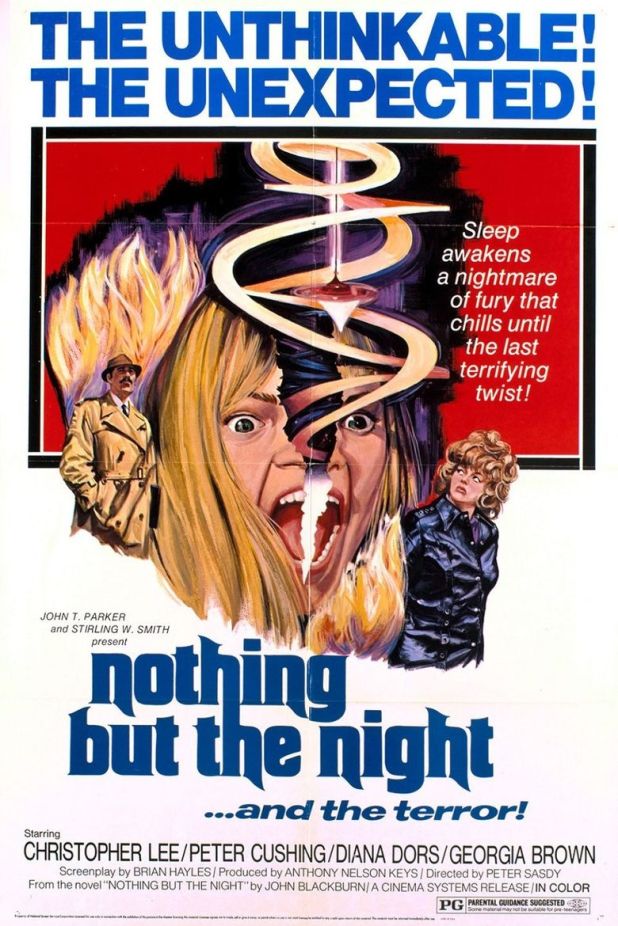
Peter Sasdy isn’t a household name, unless you live here in the palatial B&S About Movies estate, where he’s celebrated for movies like Taste the Blood of Dracula, Hands of the Ripper, The Lonely Lady and Welcome to Blood City.
Here, he has two dependable stars: Peter Cushing and Christopher Lee. You really can’t screw this up.
Three wealthy trustees of the Van Traylen fund have committed suicide during the last months. But after a mysterious bus accident claims the lives of the final three members of the fun and thirty orphans, Colonel Bingham (Lee) starts to wonder if it’s all a coincidence.
When one of the orphans gets treated by a psychiatrist who also ends up murdered, that brings in Sir Mark Ashley (Cushing), who agrees to join the case.
That’s right — Cushing and Lee, on the same side.
There’s also the matter of Mary, one of the orphans, having a prostitute mother who keeps begging to see her daughter. By the end, however, there’s a turn ala that year’s The Wicker Man, with the children being revealed as the real culprits, with their minds being replaced by the elderly rich people who want eternal life. The lemmings to the sea death of all the youngsters is pretty shocking today; I bet it was even worse in 1973.
This was the only movie that Charlemagne Productions, a company set up by Lee and famed British producer Anthony Nelson Keys, would release. They had optioned two other books by John Blackburn, Portrait of Barbara and Bury Him Darkly, as sequels to this movie with Lee in the role of Colonel Bingham, but it never happened. They also optioned some of Dennis Wheatley’s books. One of them, To the Devil a Daughter, was made by Hammer.
ABOUT THE AUTHOR: Bill Van Ryn is the man behind the website Groovy Doom and the zine Drive-In Asylum. I appreciate him coming in at the last second and helping finish up PURE TERROR MONTH.
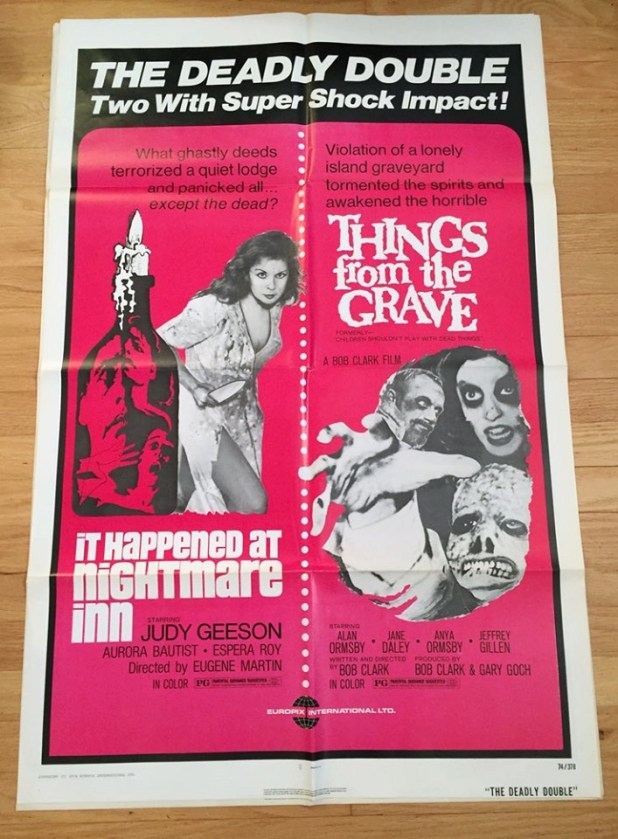
Originally released in 1973, Spanish horror thriller It Happened At Nightmare Inn (originally titled A Candle For The Devil) was a late night TV staple in the late 70s, but it did play US theaters at some point as a co-feature with Bob Clark’s Children Shouldn’t Play With Dead Things(which was retitled Things From The Grave for this run).
In a Spanish village, sisters Veronica (Esperanze Roy) and Marta (Aurora Bautista) run an old school inn that shelters tourists, also offering a restaurant patronized by both locals and visitors. The sisters both have a serious issue with what they consider to be declining morals, and their topic of conversation is a current guest named May (Loreta Tovar). When they are drawn to the roof by the sound of a ruckus, they realize May is sunbathing topless on the roof and drawing catcalls from men on a neighboring balcony. Marta angrily confronts her and orders her to leave, throwing a robe over her “shamelessness”. When Marta shoves May in front herself, she falls down the stairs and plunges into a stained glass window, which pierces her in all the wrong places, killing her instantly. Veronica is horrified and wants to call the police, but Marta sees it as “providence” and hides the body. Moments after, May’s sister Laura (Judy Geeson) shows up to rendezvous with her sister, and the sisters tell her May left; they are forced to give Laura a room to avoid suspicion, though, and Laura starts investigating the whereabouts of her sister.
With her religious mania seemingly justified, Marta figures it’s OK for her to start killing anybody she perceives as a sinner. When Helen Miller (Lone Fleming) shows up in short-shorts looking like Mary Ann from Gilligan’s Island, it’s a sure thing that she’s next. In one of the movie’s most bizarre moments, she comes home drunk and rather foolishly makes lesbian advances on Marta to upset her, not realizing she’s cornering a psychopathic woman who thinks she has the moral high ground to murder people without remorse.
It Happened At Nightmare Inn was directed by Eugenio Martin, just one year after he did Horror Express, and it’s got that same claustrophobic sound design, with seemingly all of the dialogue and sound effects added in post-production. There’s something compelling about its villains, trapped by the religious indoctrination of their parents — Marta constantly makes references to how shocked their parents would be to see women behaving like “hussies”, but her own motivations seem to be more closely related to being spurned in her youth.
There isn’t much mystery to be had in this film, since we know from the beginning who the murderer is, and the only real suspense is Judy Geeson’s insistence on hanging around to become knife-bait. I don’t know about anyone else, but I was really invested in seeing someone finally put Marta in her place. Martin short-circuits this tension, though, with an ending that tells you what happened without ever giving you what you really want to see. This is a small price to pay, though, for a film as atmospheric and unusual as It Happened At Nightmare Inn. The version on the Pure Terror box set is the public domain print, but Scorpion put out a blu ray that was highly recommended by George Reis of DVD Drive-In.
Milton Moses Ginberg started his directorial career with Coming Apart, a near-documentary which starred Rip Torn as a mentally disturbed psychologist who has been filming his sexual affairs. Sally Kirkland was also in the film, which was shot within a one-room, 15’x17′ set.
This movie is absolutely nothing like that movie.
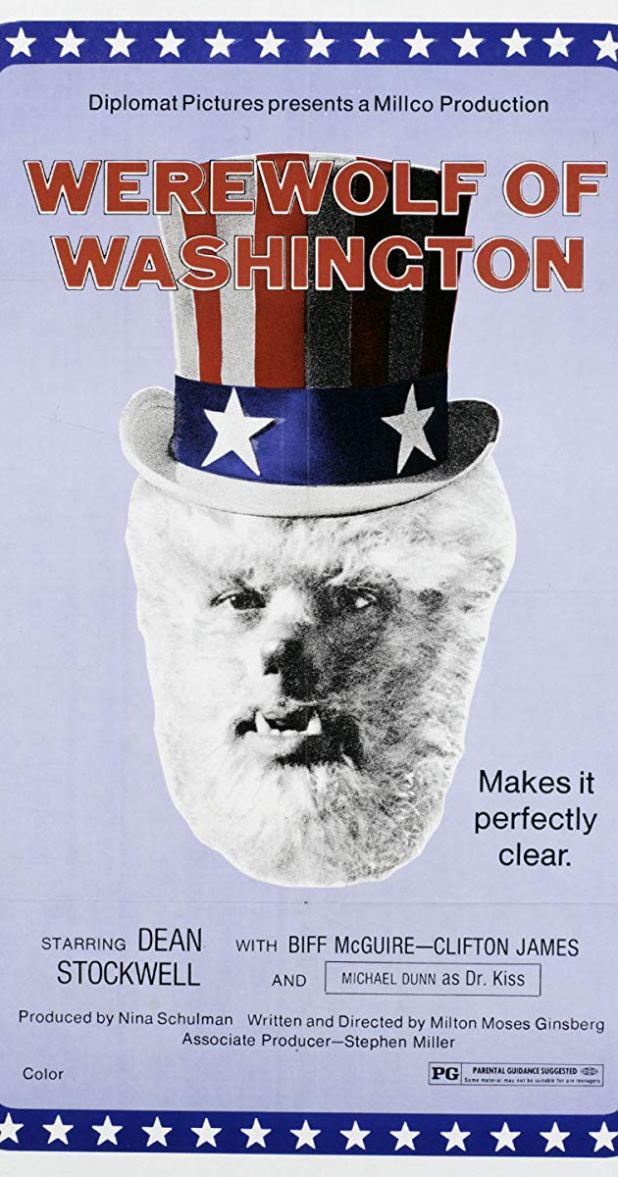
Jack Whitter (Dean Stockwell) is the press secretary for the White House. While he’s in Hungary, a Communist werewolf bites him, which is no help at all when he moves back to our nation’s capital and starts making time with the President’s daughter.
Of course, now he’s also killing members of the President’s Cabinet with all of the murders forming the shape of a pentagram. I guess it’s up to the Second Daughter to take him out with a silver bullet, eh?
You have to admire a movie that posits Clifton James, Sheriff J.W. Pepper from the 1970’s James Bond films, as our nation’s attorney general.
Beyond this being on the Pure Terror box set, you can also watch it for free on the Internet Archive.
In preparation for my review contribution to B&S Movies’ tribute to Mill Creek’s Pure Terror 50-film box set, which features Paul Naschy’s debut appearance as the devil worshiping knight Alaric de Marnac in Horror Rises from the Tomb, I wrote a June 2019 review of de Marnac’s second film appearance in 1983’s Panic Beats. In that review I pointed out that contemporary horror fans proclaimed: “Naschy is boring.” (You can learn more about Naschy’s oeuvre with his 1975 post-apocalyptic romp, The People Who Own the Dark, which I reviewed for B&S Movies’ September 2019 Apoc Tribute Month. See our “Atomic Dustbins” Part 1 and Part 2 for the complete list of reviewed films.)
(And yes: This “review” is also a Naschy dissertation that goes 18k words off the rails, so pull up a popcorn bag.)
Throughout his catalog, Naschy crafted films with admirable nods to Alfred Hitchcock, but Naschy didn’t craft scenes with a Hitchcockian eye. At the height of his Spain-based cinematic weirdness in the early 1970s, Naschy (and Italy’s Dario Argento) need not be concerned with the ultraconservative American standards and practices that shaped Hitchcock’s visions. Naschy let the tits fly and the colors run red—misogynistic outcries be damned.
Naschy doesn’t do bloodless cut-away murders shadowed on walls. Naschy doesn’t go “Nicolas Roeg” with artsy love-making (read: fucking) jump edits. If Naschy directed Paramount’s mainstream giallo move, Don’t Look Now (based on a Daphne du Maurier story; her story, Rebecca, inspired Naschy’s Panic Beats) . . . oh, what might have been, Julie Christie.
The charm of Naschy’s films, for us lovers of Spanish and Italian Euro-horror, is that logic and reality goes out the window—more so when they’re edited for “offensive content.” So with Horror Rises from the Tomb (aka, El Espanto Surge de la Tumba) it’s more of Naschy’s patented, cursed kitchen-sink mayhem with a vertigo-mixture of fortune tellers, séances, supernatural shenanigans, medieval warlocks, witch finder generals and executions, demon possessions, Satanism, vampires and bisexual vampiras, talismans (in place of crosses), a pinch of lesbianism and a dash a necrophilia, giallo-styled kills, disembodied heads, coffin-based revivals, and errant zombie attacks.
Also in classic Naschy style: exquisite women—the kind that makes Garth Algar feel like he climbed the rope in gym class—are at the forefront. In Euro-trash horror women are ubiquitously attired in graveyard-sensible mini-skirts, dresses, and hot pants. Here, in the snow-swept mountains of this Naschy bizzaro-universe, women sashay through the chilly halls of the estate’s unheated mansion-chalet in the sheerest of negligees.
Horror Rises from the Tomb served as the first of four collaborations between director Carlos Aured and Naschy: the screenwriter and star. Next was their Hammer/Universal tribute, Curse of the Devil (El retorno de Walpurgis; 1973), then their giallo entry, Blue Eyes of the Broken Doll (Los ojos azules de la muñeca rota; 1974), and their Spanish updating of Universal Studios’ The Mummy (1932): The Mummy’s Revenge (La venganza de la momia; 1975). The film also marks the first time Aured took on full directing duties, after serving as an assistant to Leòn Klimovksy, who also directed Naschy penned-and-starring horror romps. It’s always a family affair with Naschy’s company of Grand Guignol players.
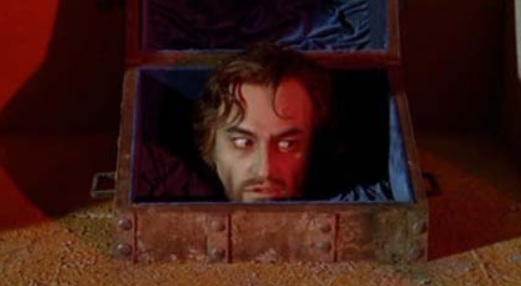
Naschy’s cinematic inspiration behind Horror Rises from the Tomb was Universal Pictures’ The Thing that Couldn’t Die, which played on a drive-in double bill with Hammer Studios’ Horror of Dracula during its initial release. In Thing, the resident damsel-in-distress discovers an ancient chest; opening the box with a belief it contained treasures, she unleashes the wrath-head of a 400-year old sorcerer. Seeing the double-bill in his youth, the film had such a profound effect on Naschy that he played a “disembodied head” a second time—instead transferred to a different body—in Crimson: The Color of Blood (1973). Naschy connoisseurs, however, debate whether The Thing that Couldn’t Die inspired Naschy at all: Naschy stated in interviews that the film was in homage to Luis Buruel’s Exterminating Angel (1962)—a tale about a group of narcissists “trapped” while attending an upper class dinner party at a remote chateau (which also fueled the plotting of 1975’s previously mentioned, The People Who Own the Dark).
As for Naschy’s historical Gilles de Rais inspirations: Not only did the serial killer knight appear in Panic Beats, Naschy utilized Rais to create an all-new lead character in his 1974 film, The Devil’s Possessed (El Mariscal del Infierno; full movie/You Tube), and the Rais-influence appears in Naschy’s giallo entry, Blues Eyes of the Broken Doll (1974; trailer/You Tube). (The infamy of de Rais also inspired Thomas Gabriel Fischer, AKA Tom G. Warrior, to write the extreme metal classic, “Into the Crypt of Rays.” Naschy movies and Celtic Frost? I’m in!)
Horror Rises from the Tomb appears in at least three-distributed versions: One is the “clothed version” that ran in its native Spain—but the gore is intact; and the shorter American-version—with both the gore and nudity cut (which appears in the Mill Creek box set), and the uncut international version (which appears as part of Anchor Bay’s “Spanish Horror Collection” series). So while the U.S version loses 8 minutes of sex and gore—to run at 1 hour 20 minutes—the Spanish version runs uncut at 1 hour 28 minutes. There’s also a rumored “unseen” fourth version at 1 hour 45 minutes floating around in the analog-cum-digital ether.
However, if this is your first time with the oeuvre of Paul Naschy, especially if you’re on a tight entertainment budget, then there is no better primer into his world—and the world of Spanish and Italian horror—courtesy of your copy of Mill Creek’s Pure Terror 50-film box set.
Well, okay kiddies. It’s time to grab your microwave popcorn bags and beware of the 7th moonrise—the head of Alaric de Marnac is coming for you!
Warning: The following film review contains multiple cut-through throats, torn out guts, heart rippings, lesbian sex, and decapitations. Well, maybe. . . .
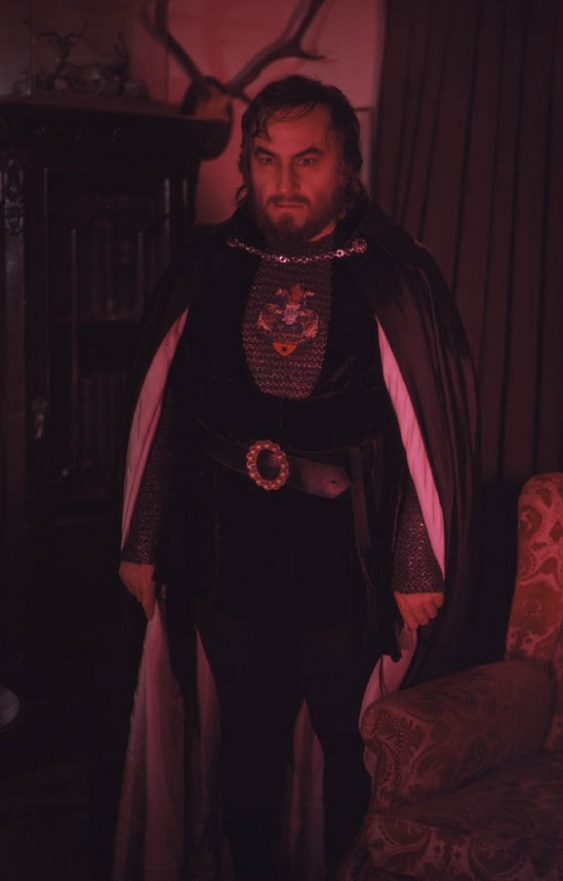
Paul Naschy—who wrote the screenplay under his real nom de plume, Jacinto Molina—stars as a 15th century medieval warlock-knight accused of witchcraft: the aforementioned Alaric de Marnac—based on the real life sexual-deviant French night, Gilles de Rais. In the film’s atmospheric execution-prefix shot in the dead of winter at Naschy’s country estate in the Lozoya Valley outside of Madrid, we meet Lord de Marnac. As is the case with any sociopath in any century or decade: Alaric is innocent. So he curses his witch hunting identical twin brother, Armand, (Naschy) and his executioner-sidekick, Andre Roland (Vic Winner), right before his beheading (edited; damn it). Alaric’s Elizabeth Bathory-inspired squeeze, Mabille de Lancré, (Helga Liné) is also executed—abattoir-style in a tree-by-feet hanging-dissection and burning (edited; double-dog damn it).
So, denied of our cherished tits and gore within the first five minutes, we fast forward to present day France: Naschy is now a skeptical-to-a-fault de Marnac descent, Hugo. Inspired by two swinging (red herring), new-age mysticism friends bragging about their visit to a fortune teller, Hugo decides to have a séance so Alaric’s “head” can tell him the location of the family’s legendary treasure. And the séance works: The cackling ghost-head of Alaric gives Maurice Roland, Armand’s descendant, an “artistic breakthrough” to finish his latest painting of some black-caped Dracula dude that’s been “haunting his mind.” So he paints the decapitated head of his buddy, Hugo, into the picture—and there’s de Marnac’s disembodied head looking down from the ceiling, dripping blood onto the picture.
So, do you cancel the trip to Marnac country? Nope. You pack your Scooby-snacks and load in the Mystery Machine. Going along for the ride is Maurice’s back-in-town-fuck toy, Paula (Christina Suriani), and (one of) Hugo’s squeezes, Silvia (Betsabé Ruiz). On the way to the remote Marnac chalet-estate, a couple of red herring road bandits attack and wreck the car; then a red herring posse of creepy townspeople serves up some on-the-spot vigilante justice with a gool ‘ol fashion tree hanging. Oh, and to show there’s no hard feelings: the creepy-posse sells Hugo a beat up shit-wagon to finish their trip.
Now, at this point: You’re attacked, you wrecked the car, witnessed backwoods vigilante justice by shotgun and rope—and you still got victimized via the posse-car deal for twenty times the vehicle’s Kelly Blue Book value. You’d say: “That’s it, let’s get the fuck out of here.”
Nope. Onward, brave Ulysses.
So the estate’s longtime, creepy red herring of a groundskeeper—complete with two requisite, stunning daughters designer-dressed for crypt-exploring action, Elvira and Chantal (Emma Cohen and Marie Jose Cantudo)—recruits two toothless wonders from town to dig for Marnac’s head-box for clues to the family jewels. And—big surprise—the groundskeeper and the toothless wonders are in cahoots to steal the Marnac head-jack-in-the-box. Dumbass groundskeeper: the dental-illiterates just double crossed you. When they break open the box; Marnac’s head possesses the sullen-skinny Frank Zappa lookalike of the duo, who subsequently performs a bloodless shadow-on-the-wall kill by pruning sickle (damn editing). Finally—we have our first two kills. No, wait. That’s four: the two roadside bandits by the creepy-posse. But Marnac wasn’t responsible. Kill tally: back to two.
Now what in the hell is this red hearing-cupcake in the requisite mini-dress and chunky Giorgio Brutini designer-loafers screaming about in the dead of winter? Oh, that’s Elvira—she found the two bodies. Oh, did you know that she and Hugo had a “thing” in their youth growing up together at the estate? (Jealous lover red herring. Check.) Was there a Hugo, Elvira, and little sis Chantal threesome? (Red herring ménage. Check.)
Now, at this point, you’ve dug up the box, there’s no family fortune, two guys were cut from asshole to elbows with a sickle, and Frank Zappa vanished like a fart in the wind with the jack-in-the-box. What do you do? Jump into the overpriced posse-jalopy and get the hell out of Marnac Country. . . .
“We need to bury the bodies in the swamp,” Hugo convinces Maurice. And cue the film’s repetitive-annoying rearrangement of Johann Sebastian Bach’s “Toccata and Fugue in D Minor,” so as evoke a little of Paramount’s Dr. Jekyll and Mr. Hyde (1931) and Universal’s The Black Cat (1934) into the proceedings.
So, you just covered up two murders and made yourself an accessory-after-the-fact. What do you do? Get in the car and get the fuck out of Marnac Country. . . .
Oh, Marnac, prince of darkness. Please kill these two dumb-fucks and the shitty organist already.
So Frank Zappa de Marnac the mortal-zombie shows up and gives Chantal a (edited; triple dog damn it) sickle-neck chop in the kitchen. Meanwhile, dopey Paula stumbles around in the unheated manor in the dead of winter in a sheer negligee clutching a candle. Hey, Paula, come on down. You’re kill number four on the Marnac Is Right!
Oops, and there goes big-sis Elvira for a header-by-trip wire down the stairs—kill number five denied; she survives. Did Silvia try to get Elvira out of the way? Or did Chantal-zombie do it? Or did Zappa de Marnac take a swing and miss and cause the fall? Can’t tell you; those crappy edits are back.
So, four people are dead (or six, if you’re still weeping for the road bandits), two of which you buried in the swamp, and there’s been one attempted murder. What do you do? Run?
Nope. You bitch about it.
So Freddie and the Mystery Machine gang assess (read: “ass” ess) the situation and Maurice is pissed that, somewhere along the line, the car—that’s been sitting there unused—ran out of gas (?), some off-camera storm knocked down the phone lines (?), and he’s pissed the townspeople won’t come into Marnac country to help them or investigate the murders.
Now, wait a minute Maurice? You walked into town (off camera) and now you’re bitching to Hugo about how “the town mayor wouldn’t even listen to you” and the “kids threw rocks at me.”? Why the fuck didn’t you get a can of gas or get another car? Why didn’t you hire a delivery truck driver to transport the Mystery Machine gang out of there? And why are you bitching about only having enough food for four days? You were in town, why didn’t you pick up some groceries?
So, while Silvia’s in the kitchen doing the dishes in the middle of a murder spree, and the just-fell-down-the-stairs Elvira is recuperating in bed, Hugo’s decided anytime is the right time for some off-camera, puritanical-edited nookie with Elvira. Yep. People are dying and daddy needs a chug-n-clug. What daddy really needs is a sickle-neck chop for being a dickhead. And you have to hand it to Elvira: she rolled down two flights of stairs unscathed and she’s sweet as a peach and fresh as daisy—and ready for a Hugo-deflowering.
“Shit,” says Naschy. “I ran out of bodies and red herrings and I can’t afford to hire another actor. Uh, Emma, can you come back to set? . . . No, you’re not a zombie. . . . No, the fall didn’t kill you.”
“Paula, Paula,” says whiny-bitchy Maurice as he goes off into the swamp to brood over Paula’s disappearance. Then, suddenly, the misty, come-hither voice of Paula beacons.
Okay. So, you’re in Marnac country. There’s a killer on the loose and now Paula’s in the middle of the fucking swamp—in a still Downy-soft negligee—without a scratch on her after missing for two days—and you’re going to have sex with her Marnac-possessed body?
“Damn straight,” brags Maurice. “I’m in the middle of a Paul Naschy movie.”
Pocket the rocket, Morey. Thanks to good ‘ol American editing, you and Paula pose for a Hallmark greeting card moment: with a sun-kissed silhouette embrace.
Well, the off-camera, possessed-ghost sex must have blown Maurice’s mind; now he’s a possessed zombie-mortal and does a punch out-kidnap of Silvia in the kitchen. . . . Again: murder and mayhem is afoot and your friends disappear. Shouldn’t you be cramping on the toilet and IBS-ing your brains out of your ass in fear? Who the fuck makes tea and crumpets and does dishes with a Gilles de Rais-inspired knight on the loose?
So Maurice and negligee-clad-in-the-dead-of-winter Paula deliver Silvia’s mini-dressed “warm body” to the family crypt where, with the help of Zappa de Marnac the zombie-mortal, busts open the tombs and Marnac regurgitates some mystical-babble about the “seventh full moon and propitious heavens.” Then the puritanical editing goes off the rails as the revived Marnac takes a sickle to Silvia and does an off-camera heart ripping and cape flip and, well, it seems he stuffed her heart into Mabille’s boney-coffin remains and she’s back. Kill number five: done.
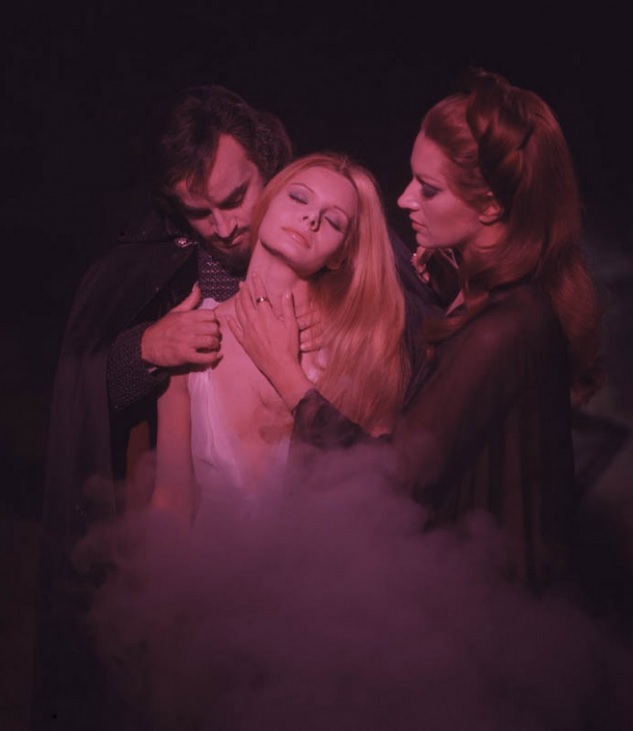
Well, sorry Mr. Zappa, we don’t need you anymore; Maurice sickles him for kill number six. Now it’s time for Alaric and Mabille to have a night on the town and feast on some Marnac descendants—and for Alaric to flip his cape and spin around in dry ice, you know, to evoke Dracula, even though Mardick’s a warlock and not a vampire. And we get two—one male and one female—townsfolk-edited kills: number seven and eight, done. And we’re moving on. I guess the townspeople freaked out over it. Don’t know: bad editing strikes again.
So while the de Marnac’s are having a feast of off-screen kills at the Golden Corral all-you-can-eat buffet, Elriva suddenly remembers . . . “Hey, Hugo, there’s a talisman—“Thor’s Hammers” (some crossed hammer-coin amulet-trinket)—hidden in the bottom the estate’s deus ex machina well.”
What? You lived on the estate your entire life; know the grounds and legend like the back of your hand—and you’re just now remembering—six kills in—there’s a vampire-killing amulet? Give me an axe; I’ll save Marnac the trouble.
Shit! Too little too late: Naschy cued an out-of-left field zombie siege!
Now we’re in George Romero’s Night of the Living Dead as the groundskeeper and the schlemiel dumped in the swamp—along with Chantal and Frank Zappa—lay siege to the estate as a Plan 9 from Outer Space fighting force. And when daddy calls out to his sweet Elvira, what does she do?
“Hi, Daddy. May I take your coat?”
So, one makeshift table-leg torch and back door furniture bonfire later: zombies defeated. All that’s missing is the Kelly Blue Book crap wagon making a failed run for the gas pumps.
And we cut back to the crypts: Mabille is in full PMS-lesbian vampire bitch mode; she’s “ravenous” and wants Paula’s heart. No, not yet. The seventh moon hasn’t appeared yet, so declares de Marnac. What the fuck ever, Mardick.
Now, Maurice shows up out of the blue—and he’s not possessed anymore? And what’s Hugo’s bright idea? Hand Maurice a shotgun and an axe, and trek to the swamp to dredge the zombies and burn them before they reanimate for a second attack. Oh, shit! Maurice is still possessed—and he blows Hugo away. You’re a real prick, Alaric the Mardick. And I thought the demons in The Evil Dead were assholes to Ash.
And why the fuck is Elvira trusting Maurice all of the sudden? Oh, yeah, she burnt him with the Thor amulet and excised Alaric once and for all . . . or something. Now that Maurice is a dezombied mortal, he discovers a deus ex machina operator’s manual to kill Mr. and Mrs. de Marnac—if they are ever revived.
Elvira. Again, you lived here all your life. Shouldn’t you have studied and memorized the “How to Kill de Marnac” manifesto cover-to-cover? Shouldn’t you be the resident Xena, the Marnac Warrior Princess by now?
“Oh, by the way, Elvira. We have to go back to the swamp (again) and burn those zombie-bodies,” declares Maurice. “You know the ones that I didn’t burn the last time because I gave my best friend a double-dose of buck shot.”
Uh, Maurice, excuse me, but some serious vampire-zombie shit’s been going down for four fucking days. Maybe if you weren’t so bitchy-whiny and wimpy-brooding in the fucking swamp, you would have found the book sooner—like on day one.
Finally, it’s time for the big show down and the D-grade Bach organ-festival is almost over.
So, Mabille finally has her lesbo-heart ripping moment with Paula. Is there a heart ripping? Is there a lesbo-vampire make out session? Yes. Do we see it? Nope. Cut to: Maurice battles de Marnac to the death in the woodshed and dies by an (edited) axe-to-the-chest—but not before “Thor’s Hammers” serious fucks up de Marnac. Cut to: Elvira, using some magic silver needle voodoo, kills Mabille the vamp-bitch. Cut to: Elvira gives de Marnac the Dick a second dose of “Thor’s Hammers”—and his head falls off. Then he bursts into some Christopher Lee-styled flames and his ashes blow away in the wind.
And sweet Elvira, in her still-perfect makeup and untarnished fashion wares, walks off into the snow drizzle along the estate’s lake and . . . tosses the legendary vampire-fighting weapon into the water. Didn’t you just say—upon the death of your dad and sister—that you have nothing and no one? Sell the one-of-kind ancient amulet; you need the cash to rebuild your life.
And that’s it? That’s the end? No! It’s Elvira’s fault that everyone is dead! Zombies should burst out of the cold lake waters and pull her into the depths of hell for a grand finale! What happened to those two red-herring townspeople the de Marnac’s feasted on? Oh, and while floating around the estate, the de Marnac’s performed an (edited) disembowelment on two more crooks hiding in the bushes conspiring to rob the estate. That’s four potential swamp-lake zombies, right there, to take down Elvira. Did those Marnac-infected victims release a zombie plague in the city? Won’t the townspeople need the amulet?
Great job, Xena of the land of Marnac. If you weren’t so friggin’ hot, I’d “Marnac” you myself.
Oh, shit. A drop of blood just fell on my keyboard from the ceiling. . . . It’s the 7th moonrise already? Where my “Thor’s Hammer”? Marnac!!!
You can also see Emma Cohen (Elvira) in Jess Franco’s Count Dracula (1970) and The Other Side of the Mirror (1973), Eloy de la Iglesia’s The Cannibal Man (1972), Leòn Klimovsky’s Night of the Walking Dead, and John Gilling’s Cross of the Devil (both 1975).
In addition to appearing alongside Barbara Steele in Nightmare Castle (1965), Helga Liné (Mabille) worked with Christopher Lee and Peter Cushing in Horror Express(1972), Leòn Klimovsky’s The Vampire’s Night Orgy (1973), and again with Naschy and Aured in The Mummy’s Revenge (1975).
A loyal member of Naschy’s Grand Guignol company of players, Victor Barrera/Vic Winner (Maurice) appeared in Javier Aguirre’s Hunchback of the Morgue and Dracula’s Great Love, and Leòn Klimovsky’s Vengeance of the Zombies—all penned by Naschy—in 1973. He also appears in Eugenio Martin’s It Happened at Nightmare Inn released that same year.
Armando de Ossorio cast Betsabé Ruiz (Silvia) in his Blind Dead sequel, Attack of the Blind Dead (1973). Maria Jose Cantudo (Chantal) made her debut alongside Ruiz in Juan Logar’s Autopsia (1973), and Christina Suraini (Paula), Helga Liné and Betsabé Ruiz worked together again in Leòn Klimovsky’s The Dracula Saga (1973).
“I want my UHF-TV!”
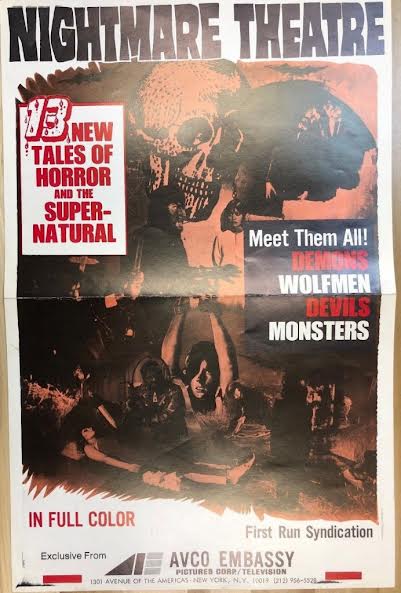
Update: July 2022: During the glory days of local UHF-TV channels, AVCO Embassy distributed Horror Rises from the Tomb as part of their Nightmare Theater television syndication package. Sam Panico, our Editor-in-Chief, explores the history behind the package and breaks down all of the films with his mighty fine “Exploring: Nightmare Theater” feature-homage to those lost UHF-TV days of snowy-analog yore.
Do you need even MORE Paul Naschy? Still? Yikes! Then check out these B&S Reviews to get you started down a Naschy rabbit hole. These reviews, of course, feature links to even more Naschy films.
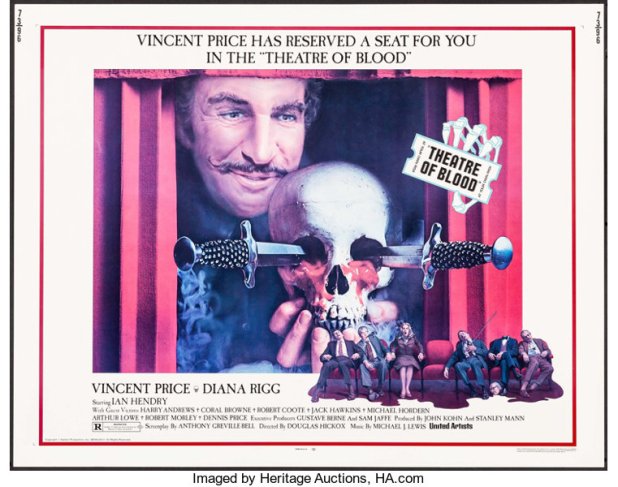
Douglas Hickox, who also directed this film, was the director of one of my favorite TV movies, Blackout. This is yet another — that’s not a bad thing — Vincent Price film where he’s done wrong and must avenge himself through increasingly odder crimes.
This go around, he plays Shakespearean actor Edward Kendal Sheridan Lionheart, who is treated poorly by the members of the Theatre Critics Guild, so he kills himself by jumping off a bridge into the Thames. Of course, he survives thanks to a group of vagrants who soon become his…Theatre of Blood.
The critics are killed according to the scripts of some of Shakespeare’s best-known plays. There’s a murder by a mob ala Julius Caesar, a horse dragging from Troilus & Cressida, a decapitation from Cymbeline, a heart being sliced out just like The Merchant of Venice, a drowning from Richard III, a murder right out of Othello, a scene like Henry VI: Part One and a critic fed her dogs just like a memorable death in Titus Andronicus.
The last critic nearly dies in a Romeo & Juliet fencing battle before he’s due to be blinded with burning knives, just like Gloucester in King Lear. However, his daughter Edwina (Diana Rigg), who has been helping him, is killed, so he takes her body to the roof where they both disappear in the flames.
This film was one of Price’s favorites, as he had always wanted the chance to act in Shakespeare. Before or after each death, he gets to recite speeches from each play. Diana Rigg felt much the same way about her work.
Ironically, she also introduced Price to his future wife Coral Browne, without knowing that Price was married. She would go on to be his third wife.
While no Dr. Phibes film, Theatre of Blood is quite enjoyable. Price is having the time of his life and his joy is infectious.






 B&S About Movies
You must be logged in to post a comment.