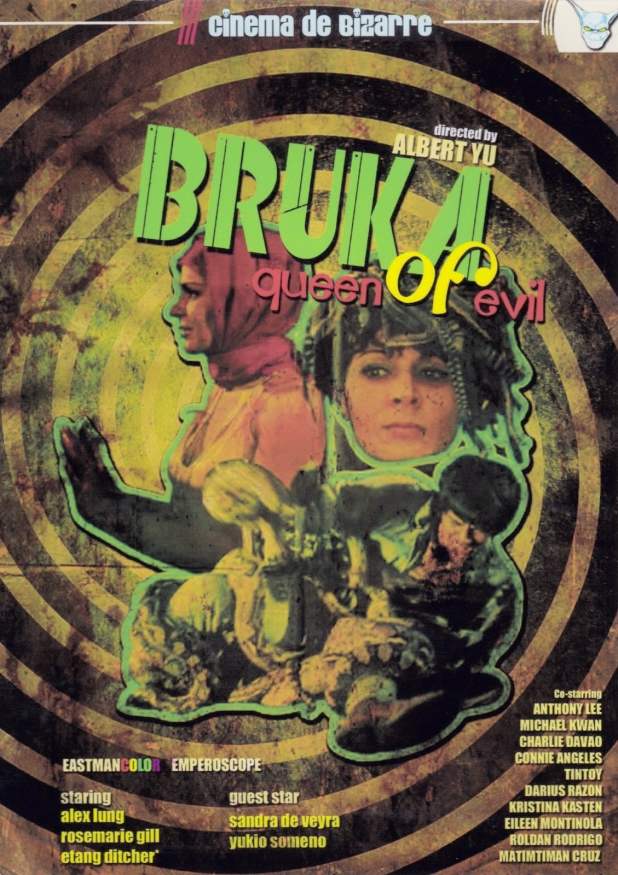
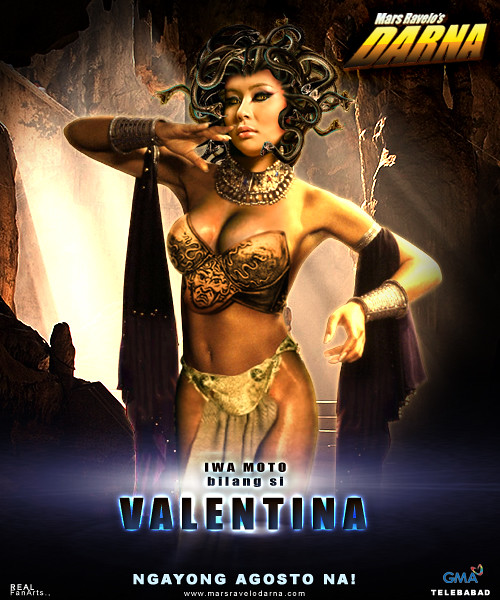
When Hong Kong and the Philippines team up, things will not be normal.
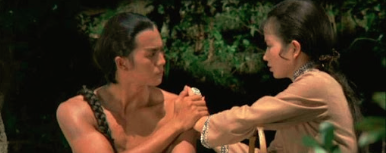
In Devi Woman, a young orphan returns from her parents’ grave and, oh yeah, she just so happens to have hair like Medusa, long flowing snake locks. She falls down a hillside, which is kind of a good thing for her, as she soon meets a sorceress with the body of a snake and the face of an old woman. She reveals that she is the girl’s ancestor and pledges to make Manda into a Queen of Evil.
Well, at the end of that movie, she was set on fire and died, but in this movie — a sequel that many felt was just a remix of the original for a long time — her witch grandmother brings her back from the dead. But more than that, she also gives her the power to call snakes to her side, an empress with power over bat people, demons, stone men, living trees and so much more.
To keep on being the Queen of Evil, Manda must destroy virgin women, which brings martial artist Shu Wen to the rescue.
Both of these films were inspired by the Filipino comic Darna, which was written by Mars Ravelo and drawn by Nestor Redondo. One of Darna’s villains is her former friend Valentina, who becomes the snake-haired Serpina.
Yeah, this movie is absolutely wonderful.
You can watch the first film on Tubi and the sequel on YouTube:
ABOUT THE AUTHOR: Jennifer Upton is an American (non-werewolf) writer/editor in London. She currently works as a ghostwriter of personal memoirs for Story Terrace London and writes for several blogs on topics as diverse as film history, punk rock, women’s issues, and international politics. For links to her work, please visit https://www.jennuptonwriter.com or send her a Tweet @Jennxldn
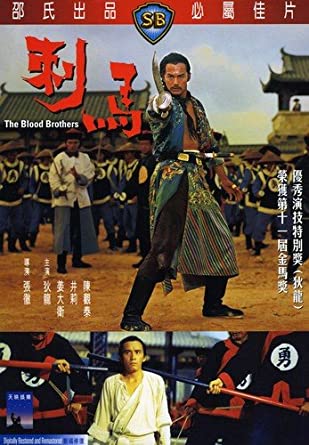
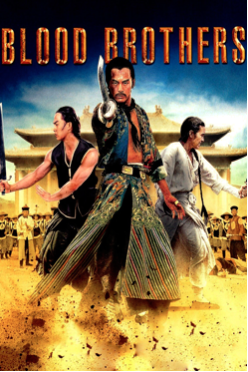
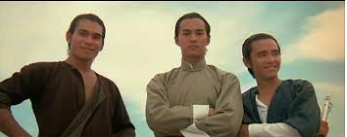
Three men, who are as close as brothers are forced to endure the ultimate test of friendship as one of them gives in to corruption and his love for his brother’s wife. Based on a purported true court case, the epic story is told via flashback.Chang, (David Chiang) is on trial for murdering General Ma Hsin I (Ti Lung.) Chang tells his story to the court of how he and his brother Huang Chung (Chehn Kuan Tai) met Ma during their days as bandits on the road. Unable to defeat Ma, the three of them quickly bond and become best friends. As the story progresses, Ma falls in love with Huang’s wife Mi Lan (played by Ching Li ) who reciprocates. Ma then leaves the group to join the Imperial Army.
Three years later, Chang, Huang and Mi Lan are called by Ma to join him in the field. During their time apart, Ma has changed. He’s become a corrupt, power hungry General who, following a successful battle, commences a secret love affair with Mi Lan. Who could blame her? Her husband Huang is a drunken boar who cheats on her regularly. Ma is educated and disciplined. When he takes his shirt off, he could charm the eyes of a rattlesnake.
The friendship of the three men soon takes a turn for the worse as Ma plots the death of Huang. Nothing will stand in his way. The film continues on to the end with aseries of betrayals and wonderfully executed fight scenes ending with the death of Ma at Chang’s hands.
The film is a showcase for Ti Lung’s exceptional acting ability. Ma starts out charismatic and loveable but transforms into a man blinded by his own ambitions.
Blood Brothers was shot during the glory days of Shaw Brothers Studios and has all the markings to show it. It is lavishly photographed using a rich color palette and fantastic outdoor locations. The interior sets and costumes are strikingly detailed.
Chang Cheh was Shaw’s Spielberg While this is largely considered his best work, during his time for the studio, he created one masterpiece after another for future generations to emulate.
Thematically speaking, John Woo’s Bullet in the Head owes a lot to this film. The comparisons are undeniable. Slow motion bloody death scenes abound in the work of both directors. Notably, Woo served as apprentice under Chang Cheh before moving on to direct his own films.
Ti Lung was one of Shaw’s greatest starts of the ‘60s and ‘70s along with frequent co-star David Chiang. He was born in 1946 and began studying Wing Chun under Master Chu Wan as a boy. In 1969 at the age of 23 he appeared with Jimmy Wang Yu in Chang Cheh’s Return of the One-Armed Swordsman. Shaw Bros. studio saw potential in the earnest young man and trained him in the arts of swordplay, acting and horseback riding. The investment paid off, as Lung’s relationship with the studio remained fruitful for many years to come. At the 11th Annual Golden Horse Awards, Lung won he Special Award for Outstanding Performance for his work in Blood Brothers. Following a career lull in the early ‘80s when Kung Fu films fell out of fashion, John Woo cast him in A Better Tomorrow whichserved to introduce him to a whole new generation of filmgoers. Blood Brothers is not to by missed if you are even a little curious about the Shaw Brother’s Kung Fu catalog. Amazon has the Celestial Pictures transfer which boasts a beautiful widescreen transfer. While I prefer the Cantonese version with English subtitles, the English soundtrack for this title is pretty decent compared to some. The true scope and beauty of a movie like this cannot be fully appreciated in a cropped, poorly dubbed version.
John Badham would one day make Stakeout, Short Circuit, Bird on a Wire, WarGames, Saturday Night Fever and the 1979 Dracula, but early on in his career he made this made-for-TV movie.
Dan Barnes (Alan Alda) is the police chief of Mt. Angel, Oregon. He’s trying to live a quiet life and all the senior citizen deaths and a motel owner trying to get him to marry her is keeping that from happening. And every one of them is found in the nude, smelling like turpentine.
Louise Lasser, who would play Mary Hartman in just three years, shows up as Barnes’ receptionist Blanche. And Magenta herself, Patrica Quinn, is in this, as is Edmond O’Brien from Dream No Evil, Dorothy Tristan from Rollercoaster, Ruth Gordon (and you better know who she is) and Will Geer (Bear Claw from Jeremiah Johnson).
It tries to be a black and white romantic whodunnit from the past and does a decent job along the way. You can watch this on YouTube.
My acting career pretty much begins with an appearance as Sergeant-Major Morris in The Monkey’s Paw and ends with my role as Dr. Green from this story. No, I was not in the movie. I was in a stage play version and the kiss that gave me a fatal heart attack was the first kiss I ever had from a non-family member girl. She said I tasted like a chili dog. A much cuter blonde girl offered to give me lessons after the play (and some mints).
Inspired by The Second Face, this was written by Joan Rivers and Agnes Gallin It was directed by Lee Phillips, who starred in Peyton Place and also made The Stranger Within and The Spell. It was the ABC Movie of the Week, first airing on November 6, 1973.
It’s also Stockard Channing’s first movie and she’s Miriam Knight, an intelligent young lady who is overlooked because of, well, her looks. Her roommate grows jealous when Miriam gets the lead in a stage play, so she sneak attacks her with roses. Miriam’s allergies send her running from the stage and into an accident which changes her looks and life forever.
Once the bandages come off her face, she’s a totally new girl. One who is now willing to do whatever it takes to get revenge — murderous revenge — on everyone who has ever wronged her.
The Girl Most Likely To… has a great cast, such as Ed Asner, Jim Backus, Joe Flynn from McHale’s Navy, Chuck McCann (a voice of a ton of animated characters), comedy magician Carl Ballantine, Fred Grandy from The Love Boat, CHiPs star Larry Wilcox, future director Dennis Dugan (who, before directing a LOT of Adam Sandler movies, such as Just Go with It, acted in films, such as 1980’s The Howling) and the man who would be Captain America and Yor Hunter from the Future, Reb Brown.
This is a comedy, but man, it’s a really dark one. How was my school allowed to put this play on?
Well, this TV sci-fi’er really is the whole enchilada when discussing the career of Lee Majors, isn’t it?
Colon’d and suffixed as “The Moon and the Desert” when it aired as a two-part episode during its syndication run (and served as its overseas title in some quarters), we meet Steve Austin, an astronaut that’s made three moon landings. During a test flight crash in a space plane prototype, he looses his right arm, left eye and both legs. His friend and personal physician, Dr. Rudy Wells (played by Marin Balsam, who did not return for the subsequent films or series), recruits Austin for an O.S.O project (O.S.I in the series) overseen by Oliver Spencer (played by Darren McGavin; the character and actor did not return for the subsequent films or series): creating a cyborg through the installation of bionic parts onto a human body. As the reluctant astronaut deals with his new body and recruitment as a government agent (he returned to space in few series episodes), he accepts his first mission to rescue a valuable hostage asset in Saudi Arabia.
The TV movie’s high ratings and overseas success quickly justified the production of two more prefixed U.S. telefilms (again, theatrical features overseas): Wine, Women and War and The Solid Gold Kidnapping. The concept then went to series and ran for five seasons from 1974 to 1978. All three telefilms would be reedited into two-part series episodes for its syndication (with scenes being re-filmed with Martin E. Brooks, who portrayed Rudy Wells in the series, and Richard Anderson, who portrayed O.S.I head Oscar Goldman).
Upon the 1978 dual-demise of The Six Million Dollar Man and its spinoff, The Bionic Woman, Majors returned for three more U.S. telefilms/foreign theatricals: The Return of the Six Million Dollar Man and the Bionic Woman (1987), Bionic Showdown: The Six Million Dollar Man and the Bionic Woman (1989; starring wheelchair-and-bionic Sandra Bullock!), and Bionic Ever After (1994).
Multiple Sites.
It all began back in 1972 when Cyborg, Martin Caidin’s best-seller, was optioned for a film adaptation by Harve Bennett for Universal Pictures — and, at first, the film retained the book’s title. Elements of Caiden’s subsequent sequels of the continuing adventures of Steve Austin — Operation Nuke, High Crystal, and Cyborg IV — while not directly adapted, had various elements worked into the subsequent series. (You can read an in-depth review of the book-to-film translation at ManaPop and get the lowdown on all of the wonderful toys inspired by the series at Toys You Had.)
Bennett’s first choice for the title roll was Monte Markham, who worked on Bennett’s previous sci-fi telefilm, 1972’s The Astronaut. To ease the sting of losing the part due to studio executive interference — in preferring Majors’s more experienced pedigree courtesy of his work in the well-received and highly-rated series The Big Valley and Owen Marshall: Counselor at Law — Markham appeared in two episodes as race-car-driver-turned-into-new-and-improved-cyborg Barney Miller/Hiller: “The Seven Million Dollar Man” and “The Bionic Criminal.”
After the 1978 series cancellation, and prior to their production of the three 1987 to 1994 U.S TV movies, Universal cut another another foreign-only theatrical in 1980 from the two-part 1976 episodes, “The Secret of Bigfoot” and “The Return of Bigfoot.” As with Battlestar Galactica before it, which was also cut into three foreign theatrical sequels, Universal licensed several paperback tie-ins based on the series’ episodes. (You can watch the series version of “Secret” at NBC.com with Part 1 and Part 2, as well as “Return” Part 1 and Part 2.)
During our “Lee Majors Week” review of Starlight One, we named dropped the 1969 Gregory Peck sci-fi’er Marooned. So we should mention that film was also based on Caiden’s 1964 novel of the same name. Buck Rogers in the 25th Century fans may have picked up Caiden’s 1995 Rogers sidequel/adaptation, A Life in the Future, in which Buck was refitted with bionic parts.
A big-budgeted theatrical — not only for Steve Austin, but Colt Seavers’s adventures in The Fall Guy — have been ballyhooed for years, with Mark Wahlberg as Austin. This Screen Rant article from May 2020 wraps up the film’s production history. Lee has stated that, if he’s given a significant part with substance, and not just a cameo walk on, he’s willing to be involved in both productions. So, it’s fingers crossed for Lee!
You can watch the 1973 theatrical cut of The Six Million Dollar Man on the FShareTV platform. In 2010, upon the release of the 40-disc, 100-hour DVD box set of the series (hey, it’s only $239.95!), Lee sat down with Vanity Fair for an extensive interview about the series and its lasting pop culture status.
About the Author: You can learn more about the writings of R.D Francis on Facebook. He also writes for B&S About Movies.
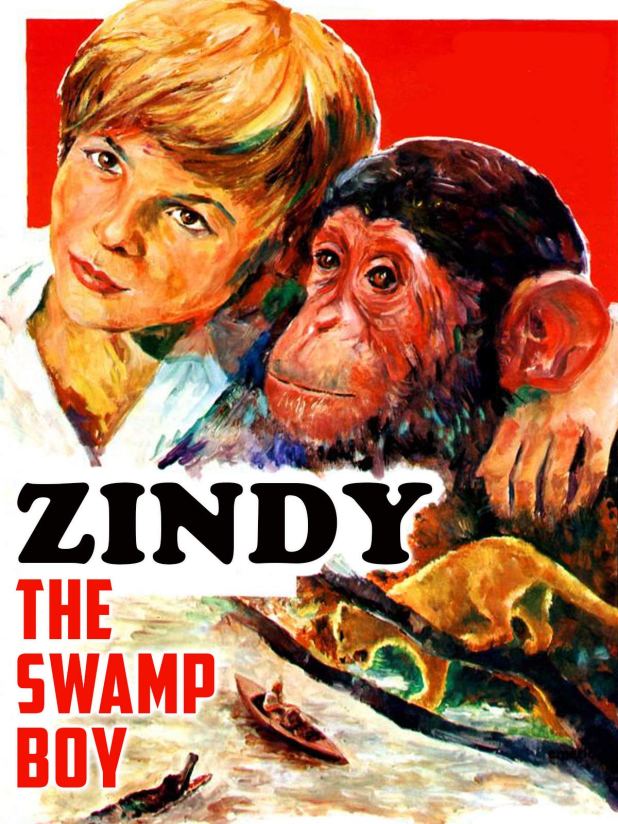
The entire Cardona movie must have come together on this one, because Sr. directed it (you may have seen his movies Night of the Bloody Apes, Santa Claus and Las Mujeres Panteras— at least I hope you have!), Jr. wrote it (you totally should see his movies Tintorera, Guyana: Cult of the Damned and The Bermuda Triangle) and III stars in it as Zindy. Our young friend would go on to make Vacaciones de Terror and show up in Cemetery of Terror, ensuring that his family’s history of bizarre movies would continue into the 21st century.
Sr. also plays Abuelo, a fugitive* who lives in the swamp with his grandson Zindy, who has a chimp named Toribio. He’s played by Chucho-Chucho, who was a trained animal who still lives in a zoo. You can also see him in The Holy Mountain, LasTarántulas and Chanoc contra El Tigre y El Vampiro.
If you’re tuning in for a feel-good family film, let me warn you. Grandpa drowns — in quicksand no less, a fate I was sure I’d have to deal with in my youth — and Zindy gets mauled to death by a puma. This being a Cardonna film, I am shocked that there isn’t use of heart surgery footage.
*He killed the people who killed Zindy’s parents, in case you wonder why.
You can watch the Rifftrax version of this movie on Tubi.
What I loved about the cherished Godzilla movies of the youth: Since I was old enough — and Mom and Dad had no interest — I could be dropped off at the theater and be my own man. That’s a pretty big deal . . . and back then, you could drop a kid off at the theater with no worries. So, there I was, in the summer of 1976 at the local twin cinema, getting my dose of not only Godzilla — but the introduction of the Ultra Man-esque Jet Jaguar. At the time, I was all about Ultra Man, which you could watch on Saturday mornings and watch during the weekdays after school in U.S. syndication.
Can you imagine being a kid and creating a character for a Godzilla film: Toho held a contest for children in mid-to-late 1972. An elementary student submitted a drawing of a mecha-robot called Red Arone, which Toho developed into Jet Jaguar. Awesome.
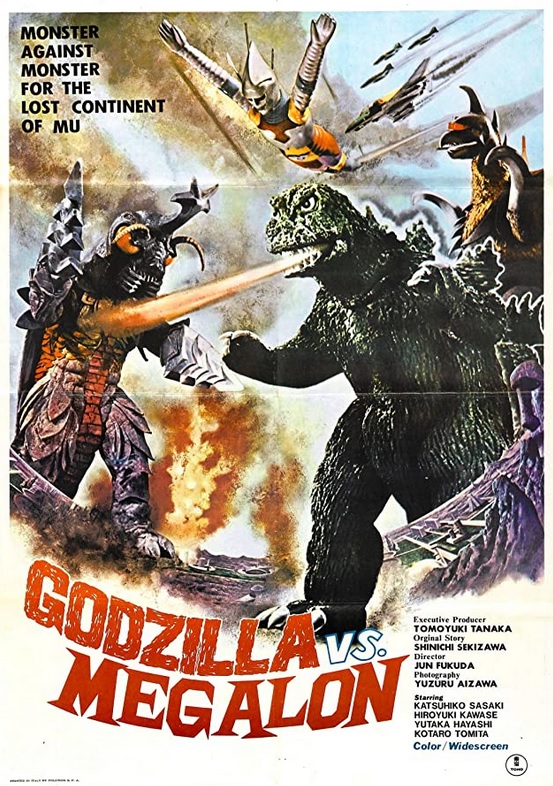
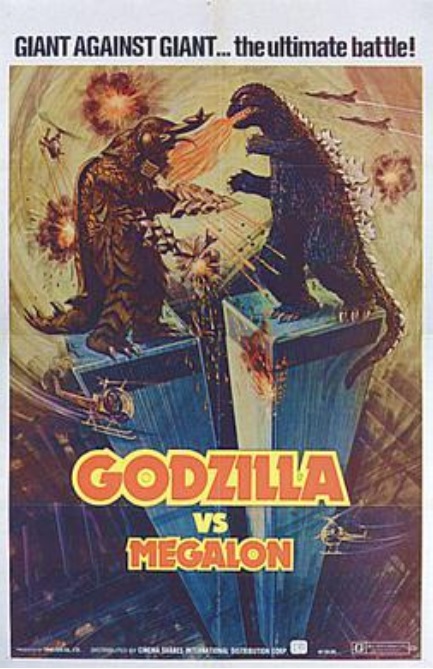
The 13th film in the franchise, the film also features the battle royale of ol’ Zilla with Megalon and Gigan as, once again, man suffers the err of their nuclear ways when a South Pacific underground nuclear test sends shockwaves across Monster Island that plummets Rodan and Anguirus into the depths of the Earth.
Just as the undersea kingdom of Seatopia call up their civilization’s beetle god, Megalon, to destroy mankind to stop the testing, the Japanese Self Defense Force has completed testing on the humanoid robot, Jet Jaguar.
Then all Kaiju breaks loose.
Megalon is no match for Jet Jaguar and Godzilla, so the Seatopians put out a distress call to their allies in the Space Hunter Nebula M (from 1972’s Godzilla vs. Gigan, which played in the U.S. in 1977 after Godzilla vs. Megalon) to bring in Gigan for the assist. Now, while Godzilla is off fighting Megalon, Jet Jaguar is left to contend with Gigan — and the match evens up as Jet Jaguar develops his own powers and can now enlarge himself to Kaiju size.
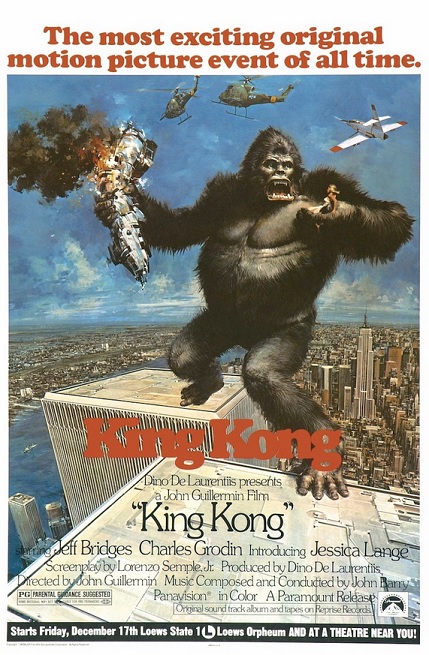
No, Godzilla nor Megalon — as did not King Kong in 1976 — ended up on top of the World Trade Center — at least not like in the theatrical one-sheets. You think I would know better after being bamboozled by the theatrical one-sheets for Yog – Monster from Space (1971) — with a giant space octopus clutching the Earth in its tentacles.
Live and learn, you hoped-up-on-Pixie Sticks-and-Mr. Pibb brat.
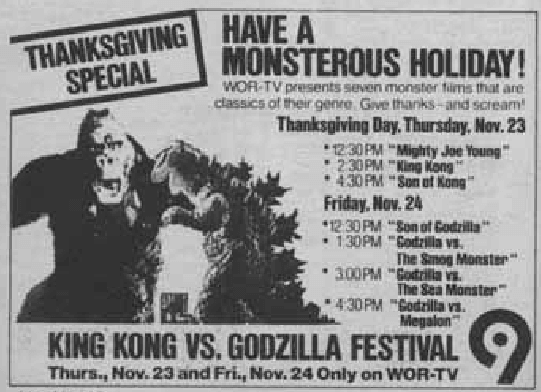
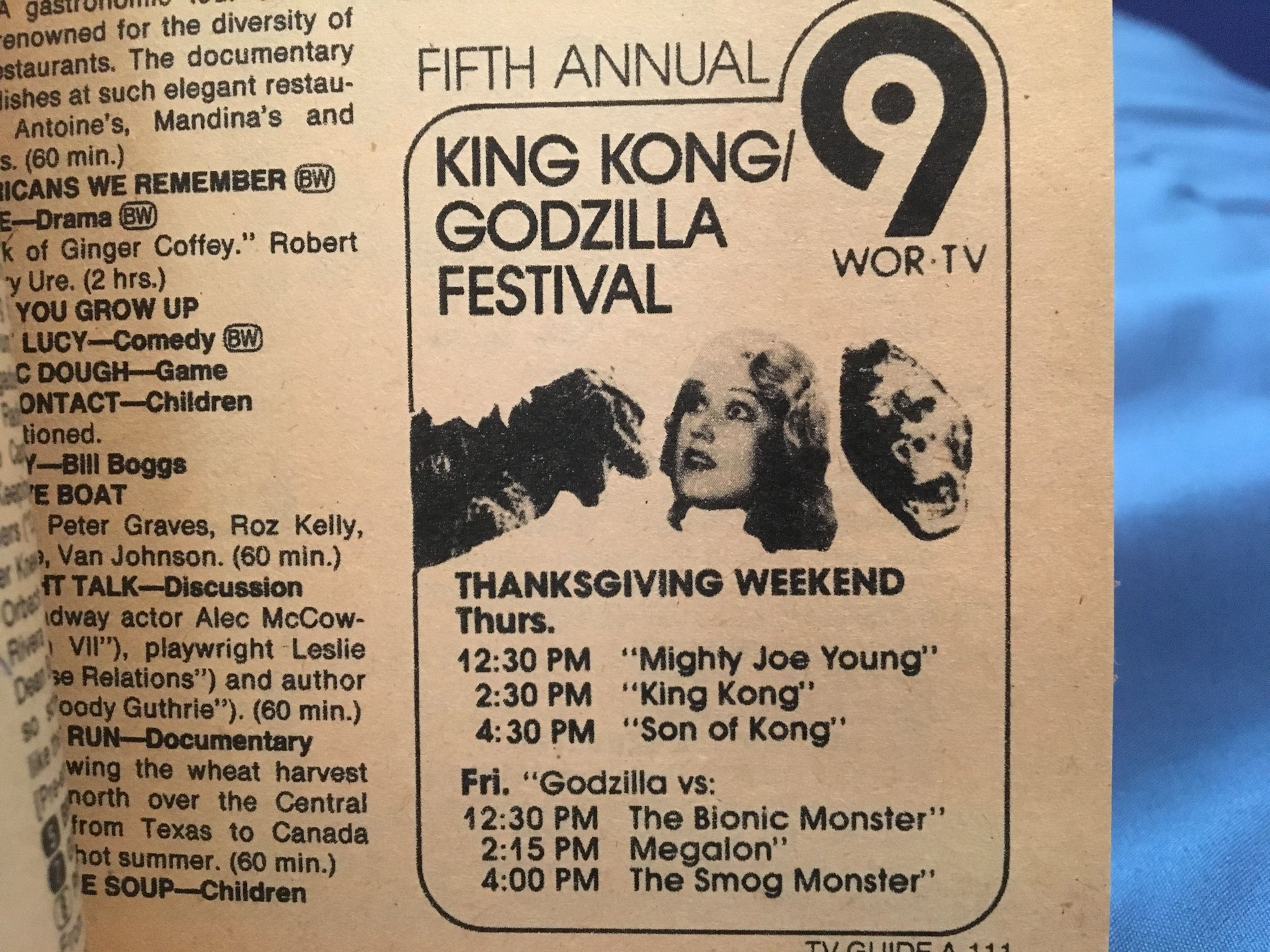
The more things change . . .. . . the more things stay the same/image from our review of The Asylum’s Shark Encounters of the Third Kind.Those were the UHF-TV days. . . .
Hey, wait! Do you need a little more Godzilla in your Kong?
Then check out our “Kaiju Week” reviews from last March 2020 for Godzilla: Final Wars (2004), Godzilla vs. Mechagodzilla (1974) and Terror of Mechagodzilla (1975), which also ran as a two-fer review from our January 2020 “Ape Week” blow out to celebrate Disney green-lighting their entry in the Planet of the Apes saga.
And that’s why were are here today: To celebrate the release of Godzilla vs. Kong — finally — in theaters on March 25, 2020.
Screw you, COVID!
About the Author: You can read the music and film reviews of R.D Francis on Medium and learn more about his work on Facebook.
Here’s some of the other Kaijus (and sort of Kaiju) that we’ve reviewed. For the rest that we’ve recently reviewed to commemorate the March 2021 release of Godzilla vs. Kong, enter “Kaiju Day Marathon” in our search box to the left to populate that list of films(you may see a few reposted Godzilla reviews, but many new film reviewsconcerning Godzilla, Kong, and other creatures from the Lands of the Rising Sun).
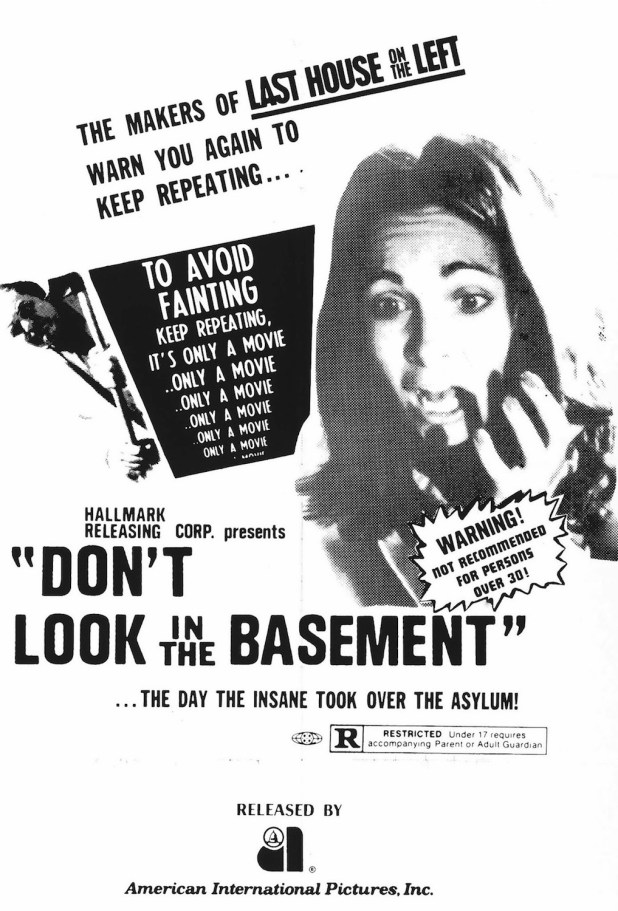
We often refer to movies as “Brownriggian” when we watch films on Saturday nights all night with the Drive-In Asylum Double Feature on Facebook Live. There’s no better example of what this word means than S. F. Brownrigg’s 1973 shocker Don’t Look in the Basement AKA The Forgotten AKA Death Ward #13.
Dr. Stephens, the main doctor at Stephens Sanitarium has a theory that patients should be able to freely act out their insanities in the hopes that someday they will snap back to reality. You know, if I’ve learned one thing about asylum doctors from, well, Asylum and Alone in the Dark, it’s that they’re all just as insane as their charges.
Before one of the older nurses can retire, we have the Judge (Gene Ross) chopping the doctor with an axe and Harriet (Camilla Carr) smashing the nurse’s head inside a suitcase. So when Charlotte Beale (Rosie Holotik, the cover girl of the April 1972 Playboy, as well as appearances in Horror High and the ghostly hitchhiker in Encounter with the Unknown) shows up for a new job and things seem weird. Or Brownriggian. In short, everything feels off. Hallways and stairwells seem like passageways to other dimensions and sweaty horror lurks sleeping like some kind of Southern gothic force of dread and menace.
This is a place filled with human children, killer women obsessed with sex, an elderly woman who thinks that flowers are her kids, a military man who lost his platoon in Vietnam and more. Even the sane are driven mad just by being in their presence.
There are plenty of people who decry Brownrigg’s movies, but I’m certainly not one of them. They invite you to worlds that are not our own and seem to come from a dimension far from here. For that and the vacation to the psychotronic that they offer, we should celebrate them.
For an added treat, check out JH Rood’s journey to the set locations, which you can download from the Internet Archive.
A Carolinas regional wonder by one-time director Jim Cinque, this is what happens when our blonde heroine — is her name Bev or Beth, because the audio in this is as bad as you want it to be — takes a few karate classes and puts on a black wig to avenge her sister, killed by her pimp Mr. Demmins.
So she’s kind of like a cat woman, but the movie doesn’t go so far as to challenge copyrights. Instead, she mostly battles a larger gentleman by the name of Doug. Now, the pimp supposedly has a fear of cats, but this never comes up after its mentioned once, which is very unlike Batman’s origin where a bat crashes through a rich man with PTSD’s window and he says, “You know, instead of trying to get to the root cause of crime, like systemic poverty, I’m just going to dress up in black and beat up street punks.”
I kind of love that they said that this movie had a $100,000 budget, which is around $600,000 in today’s money. Did all of that money go to hire Nick Dennis, who somehow went from Spartacus, East of Eden and A Streetcar Named Desire to being in films like this?
Let me tell you how weird this movie is. We never see our heroine dress up in her costume. She shows up in it after a few scenes and we are just to assume that it is her. This movie doesn’t have plot holes in that it just asks you to write your own story so that it all makes more sense.
If you ever want to get depressed, realize that sometimes your heroes need to get day jobs. For example, Orson Welles may have made the best movie ever first time up to bat, but he still had to appear in exploitation-level films, pseudo-science docs and play a Transformer in his last role.
Rod Serling is another hero who found himself lending his famous voice* to these films with movies like Encounter with the Unknown, The Legendary Curse of the Hope Diamond and this.
An edited version of Harold Reinl’s Erinnerungen an die Zukunft (Chariots of the Gods**), this movie lines up people like Wernher von Braun and Carl Sagan to discuss the theory that maybe we weren’t descended from apes.
It was also a pilot for the TV series In Search Of (so are two other one-hour specials*** made by producer Alan Landsburg, who made a series of books and fifty TV movies before retiring to breed and race horses). Sadly, Serling died before the syndicated series got picked up and Leonard Nimoy took the role.
If you saw the American version of Chariots of the Gods, you won’t get much else other than way better narration. Come to think of it, that’s a great reason to watch this.
*That’s also him saying, “Swan. He has no other name. His past is a mystery, but his work is already a legend. He wrote and produced his first gold record at 14. Since then, he’s won so many that he tried to deposit them in Fort Knox. He brought the blues to Britain. He brought Liverpool to America. He brought folk and rock together. His band, the Juicy Fruits single-handedly gave birth to the nostalgia wave in the 60′ s. Now he’s looking for the new sound of the spheres to inaugurate his own Xanadu, his own Disneyland the Paradise, the ultimate rock palace. This film is the story of that search, of that sound of the man who made it, the girl who sang it and the monster who stole it.” before Phantom of the Paradise.
**That will be on the site this week as well.
***The other ones are In Search of Ancient Mysteries and The Outer Space Connection.
You must be logged in to post a comment.