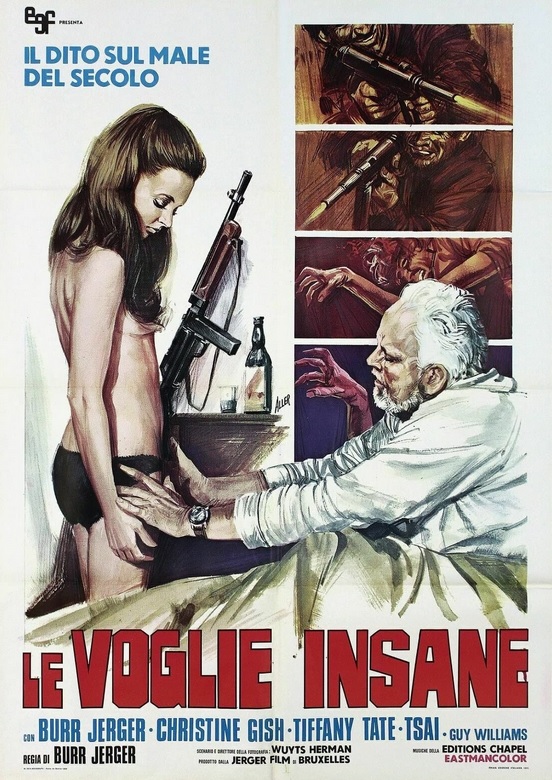
2021 Scarecrow Psychotronic Challenge Day 25: General Massacre (1973)

DAY 25 — SLEEPLESS IN SEATTLE*: Sleep deprived and still alive . . . for now. (*Does not have to be set in Seattle . . . so Belgium, works!)

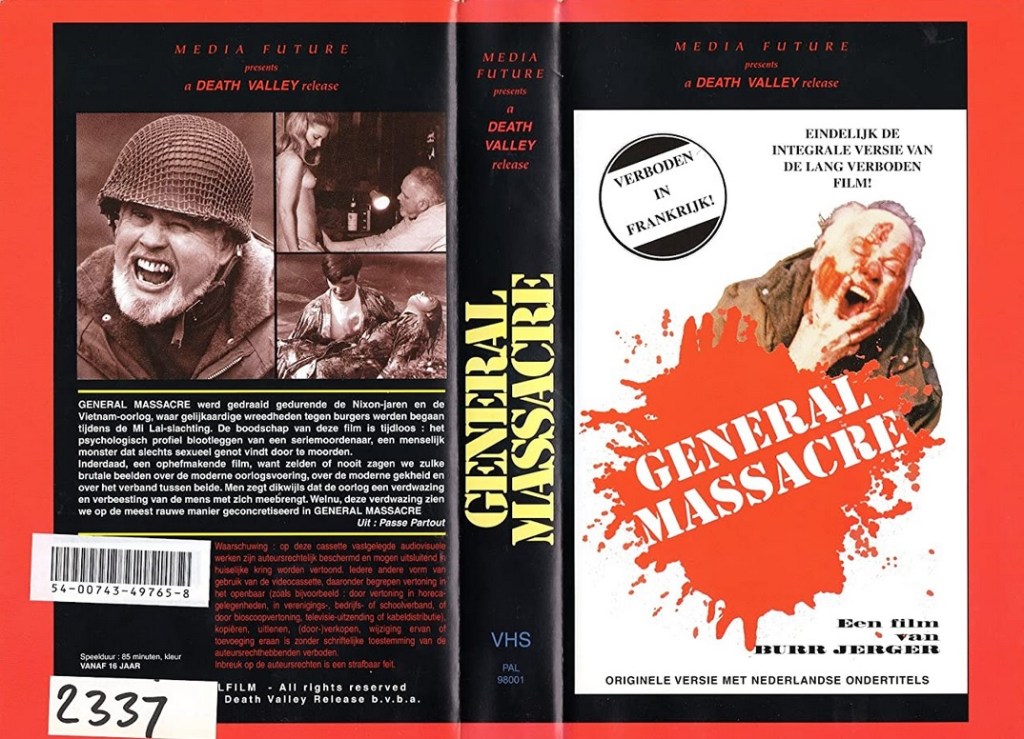
Just so you know what you’re getting into with this very odd, badly acted and poorly scripted tale about a deranged (our “sleep deprived” lad) American brigadier general (our auteur, Burr Jerger) living in Belgium as he awaits trial for his atrocities committed in Vietnam: General Massacre was deemed “unacceptable” by the American Humane Association for “animals killed during filming” (a cow and a couple of ducks), upon its release in 1976 on U.S. shores. The backlash so damaging to the film, Burr Jerger, the film’s director, writer, producer, and lead actor, sued the U.S. government for “conspiracy” against this film, which he described as a “cinematic protest against war.”

Okay. Well enough, Burr. But you still harmed, maimed and killed animals to make your anti-war statement. And those “auteur” excuses didn’t fly with Ruggero Deodato butchering squirrel monkeys and river turtles to make his “statement” film, either.

Animals were killed during the making of this movie.

Anyway, when Wilbur “Burr” Jerger filed suit in 1975 in the Los Angeles federal courts, he claimed the FBI and CIA maintained an illegal dossier on him for his “political activities.” Jerger also alleged in the lawsuit, after a conspiracy born out of those files, caused the release of General Massacre to be irreparably damaged and he lost $100,000.

Who is this Burr Jerger?

Well, the West German auteur also resides in those weird, hazy frames of celluloid resided by Peter Carpenter: a vanity auteur that went all out on his masterpiece, with Jerger managing one quadruple-threat to Carpenter’s two of Blood Mania and Point of Terror. And both vanished from the business after four films when their master works, failed. And, like Carpenter, Jerger passed through the Russ Meyer turnstiles. But unlike Carpenter, Burr also passed through Jean Rollin’s turnstiles. (For another lost soul of the celluloid turnstiles, check out our overview of Gene O’Shane’s career in our review of The Velvet Vampire.)

Jerger actually stuck around for more than four films as an actor: he made five: he appeared in Captain Sindbad (1963; a West German film edited into Quentin Tarantino’s Natural Born Killers), No Survivors, Please (1964; a black and white alien invasion tale), and an uncredited appearance (thus the four-to-five snafu) in Fanny Hill (1964) for Russ Meyer. Jerger made his final acting bow in Jean Rollin’s The Demoniacs (1974; a sexploitation, haunted island/pirate romp).

Jerger initially came to Europe in 1961 as a free-lance-reporter for Show Business Illustrate, Ebony and Globe Photos. That led to his making his cinematography and directing bones as the set photographer on Escape from East Berlin (1962), as well as working as a production assistant on A Cold Wind in August (1961), and as an assistant director on the French-made films Madame Sans-Gene (1961) by Christian Jague, and Cartouche (1962) by Philippe De Broca.

However, while Burr worked on all of those films in East Germany and France, he was actually born and raised in Chicago, Illinois. Married to Lieva Lone, his co-star in The Demoniacs, he died on May 12, 1982. It was after his failures in film, that he relocated from Belgium, to Paris, and back to the United States, working as he began: a freelance writer and photographer. He would go on to write an (unnecessary) novel based on General Massacre, as well as The Saga of April 6th, and a storybook, Four Letter Words.

The Review

As with all early ’70s drive-in flicks: it made it to ’80s video.

“Politics are the extension of war.”
“Civilians are as much the enemy as men in uniform.”

— the ravings of a warmonger

We learn of those ravings via a non-linear, flashback story as our U.S. WW II and Korean War veteran awaits his trial for the atrocities he committed in Vietnam. But what’s his excuse for killing his wife (whom he met-raped during a Nazi Germany tank raid) for cheating on him (he chases her into the forest around his estate and shoots her)? And killing his daughter — whom he has the incestual hots for — when he catches her with his hospital orderly?

In between, our General goes nuts on his Antwerp estate, where he “commands” his troops and straps on his weapons and hunkers down in the woods — woods now haunted by his wife on ghostly horseback. Oh, and our General has “recruited” his old Vietnam lackey, Corporal Tsai, to film his “war games,” his hateful and racist insights on the world, and his animal murders . . . which are graphic, ugly, and down right cruel as the camera lingers as the life leaves the cow. Then, to make matters worse: there’s the close up of the duck’s eyes as its life leaves the body.

Oh, yes, for there is a “statement” in the murder of cows and ducks . . . but the proceedings are just so clumsy across all of the inept disciplines that Burr Jerger kept for himself — on top of the art house pretensions deploying every sweeping and zooming camera trick in the book known to cinematography — as we flash to and fro from 1945 Nazi Germany to our fair General’s freakout in the Antwerp wood, the “anti-war” message Jerger intended, is lost.

Yes, Burr. War is awful. But your movie, even more so. And animals died for it. Certainly not one of the proudest moments of my little ol’ VHS home library.

There’s no freebie streams or trailers to share, but you can get DVDs from DVD Planet, if you must.

About the Author: You can learn more about the writings of R.D Francis on Facebook. He also writes for B&S About Movies.

2021 Scarecrow Psychotronic Challenge Day 22: Circle of Fear “Dark Vengeance” (1973)

22. BEASTS OF BURDEN: One where a horse/donkey/mule/ox etc is doing some serious work.

This was supposed to be Devil Story but I got so excited after I watched it that I jumped the gun and posted it, thinking that surely I’d find another movie to fit the bill.

I spent almost this entire month trying to find another one.

This is an episode of the show Ghost Story, which changed its name to Circle of Fear midway through its one season. Executive produced by William Castle, the original idea for the show was to have Sebastian Cabot play Winston Essex, the owner of a mysterious hotel called Mansfield House, which was really San Diego’s Hotel del Coronado where Wicked Wicked was filmed.

By episode 14 of 22, the show was retitled and Cabot was out and the show still suffered poor ratings, despite featuring writers like Robert Bloch, Harlan Ellison, D.C. Fontana and Jimmy Sangster.

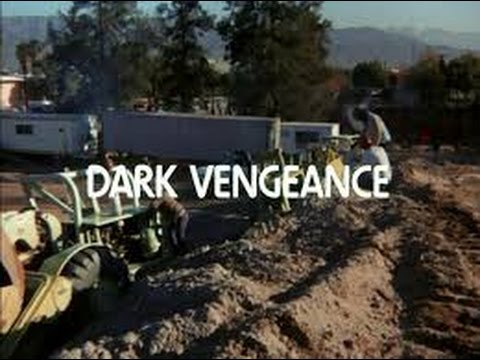
Episode 15 was Dark Vengeance, which was written by Peter Dixon (whose career was all over the place in TV, working on everything from the Superman 1950s TV series to the Masters of the Universe cartoon) and directed by Herschel Daugherty (The Victim).

While working at a construction site, Frank (an incredibly, near imposible young Martin Sheen) finds a box that can;t be opened. He becomes obsessed with it and finally is able to break into it, revealing only a broken mirror and a toy horse that upsets his wife Cindy (KIm Darby, queen of the TV movie supernatural heroines) to increasing mania.

Of course Cindy would have a past with the horse. But how do you get it back in the box or even destroy it when it can even survive being set ablaze?

There’s no way a goofy wooden horse should be so damned frightening, but everyone is beyond committed to making this happen. Man, after seeing this episode, now I have an entire series to devour. This show suffered comparisons to Night Gallery, but after all, shouldn’t every anthology show made ever after Serling’s masterwork suffer that fate?

You can watch this on YouTube.

SLASHER MONTH: The Psychopath (1973)

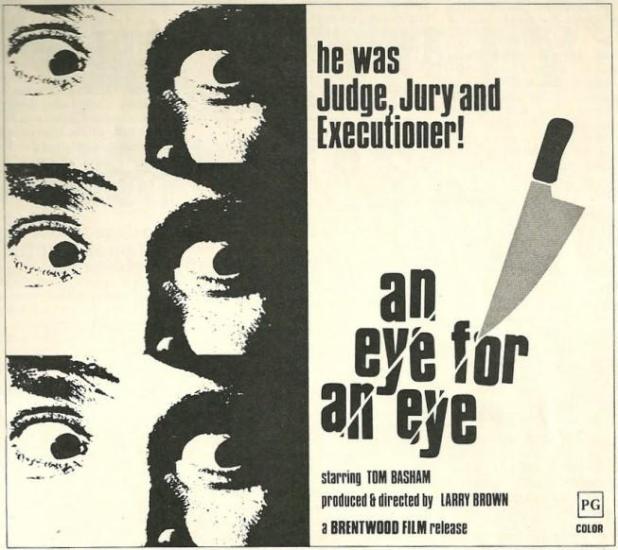
Alternatively titled An Eye for an Eye, this 1973 freakout is all about Mr. Rabbey, the host of a children’s television show. He’s so beloved by the children that they tell him all of their secrets, like when their parents don’t treat them well. To get back at them, well, he shows up and kills them. Strangely enough, one of the weapons that he uses is a blanket. Yes, a deadly blanket.

Mr. Rabbey is played by Tom Basham, who was in The Pink Angels, and I have to say that this movie is a much better use of his abilities. That said, that may be the lowest of low bars to ever be tripped over. More to the point, director Larry G. Brown made that movie, too. He also made Silent but Deadly, in which “America’s first black, Jewish and female president must save the nation from a smelly and lethal threat,” so I think we call all just say that The Psychopath is an aberration of gold from guano.

No movie today would dare have so many children be throttled and beaten about, much less have one of their mothers get their head run over by a running lawnmower.

Speaking of kid shows, two of the cops in this movie all had something to do with programming for youngsters. Lt. Hayes is played by Peter Renaday, who in addition to being several voices in Disney parks like Abaham Lincoln and Captain Nemo, was also Mickey Mouse’s voice for the cash-in album Mickey Mouse’s Splashdance and Master Splinter in the Teenage Mutant Ninja Turtles cartoon. And Jackson Bostwick was Captain Marvel in the live action Shazam! series.


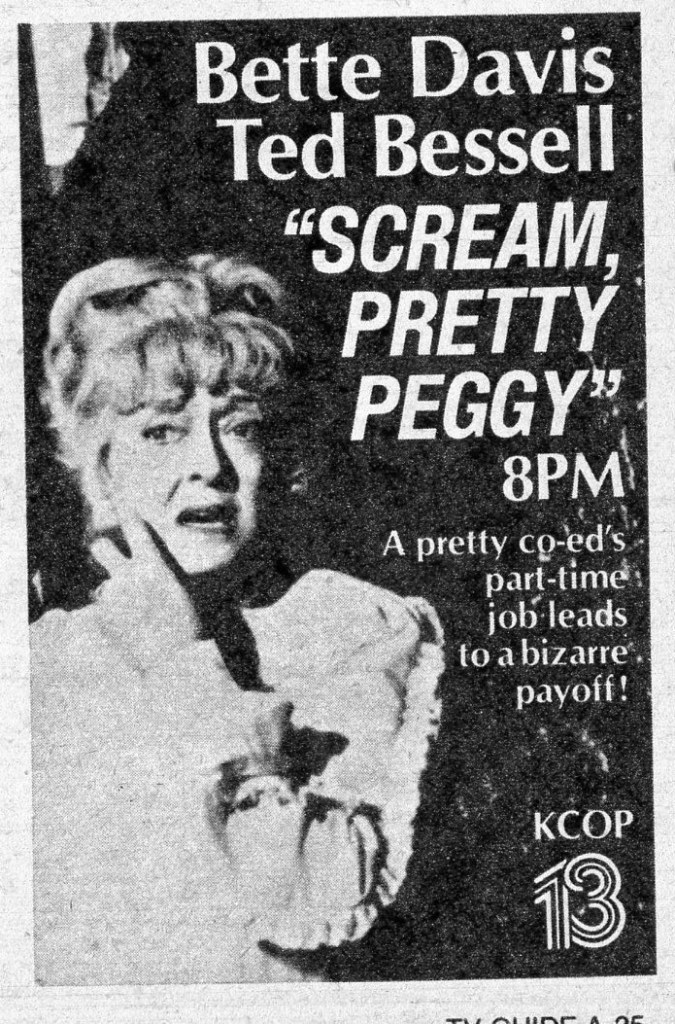
KINO LORBER BLU RAY RELEASE: Scream, Pretty Peggy (1973)

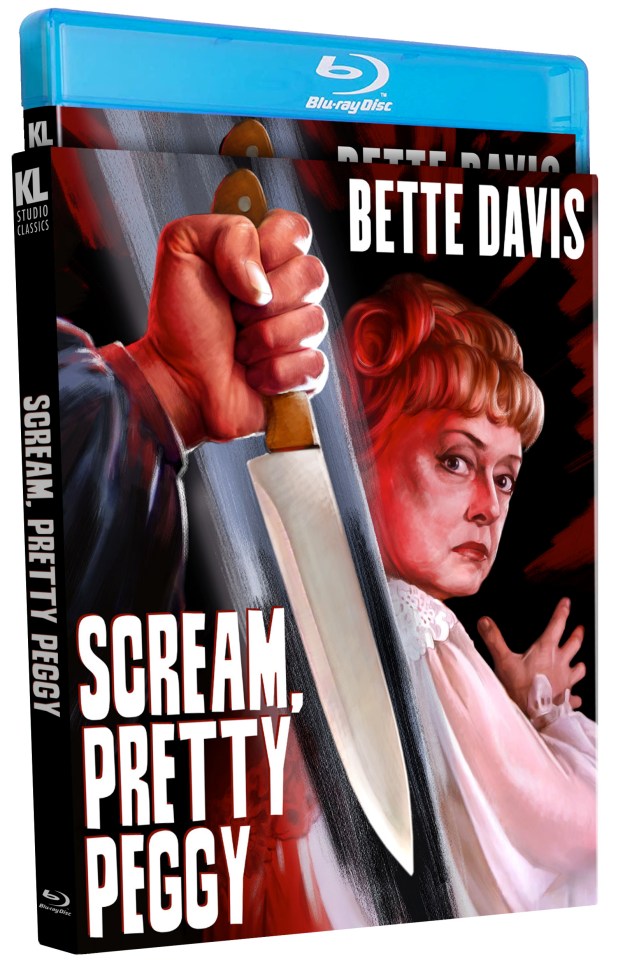
EDITOR’S NOTE: This movie originally ran on our site on March 8, 2018We’re sharing it again as Kino Lorber has released it on Blu-ray, and we’re beyond happy that more made-for-TV movies are coming out on home video and want people to buy and support the companies that are putting them out. This new release has a revised 2K master, commentary by Troy Howarth, a TV commercial and new art by Vince Evans.

The ABC Movie of the Week for November 24, 1973, Scream, Pretty Peggy was directed by Gordon Hessler, who was behind films as diverse as The Oblong Box, Kiss Meets the Phantom of the Park and Sho Kosugi’s introduction to the U.S., Pray For Death. It was written by Jimmy Sangster (who directed Hammer’s Lust for a Vampire and wrote The Curse of Frankenstein, Whoever Slew Auntie Roo? and many more), so this film has a much better pedigree than you’d expect.

The central character of the film is Peggy, a college student who aspires to become an artist. She applies for a job at the home of noted sculptor Jeffrey Elliott (played by Ted Bessell, TV’s That Girl) and his mother, the iconic Bette Davis. Peggy’s annoyingly chipper character adds a unique dimension to the story.

Let me give you some advice, in case you are a young girl looking for a housekeeping job and find yourself in a 1970s TV movie. If the house you’re working in has an Old Hollywood actress in it, run (refer back to my past rules of always avoiding Old Hollywood actors and actresses). And if you find out that there’s a room that you aren’t allowed to go into, don’t try to go into that room. Just get away as fast as you can.

However, Peggy’s curiosity gets the better of her. She stumbles upon Jeffrey’s collection of eerie demon sculptures, each more terrifying than the last. She also encounters George Thornton, whose daughter used to work in the house. This leads to a confrontation with the formidable Mrs. Bette Davis, a situation one should never find themselves in.

It turns out that Jessica, Jeffrey’s sister, is living in the room above the garage that Peggy isn’t allowed into. Again, get out. Now.

No, Peggy decides she wants to make a new friend. And what if that friend is really Jeffrey, who killed his sister and has split his personality with her inside his head?  Oh, Peggy. You brought this on yourself.

Scream, Pretty Peggy is a fine slice of 70s TV movie thrills. Any time you have Ms. Davis deigning to be in a TV movie, you will get something good. But seriously, I wish these girls would wise up. There are better things to do in this world than live in a house of maniacs!

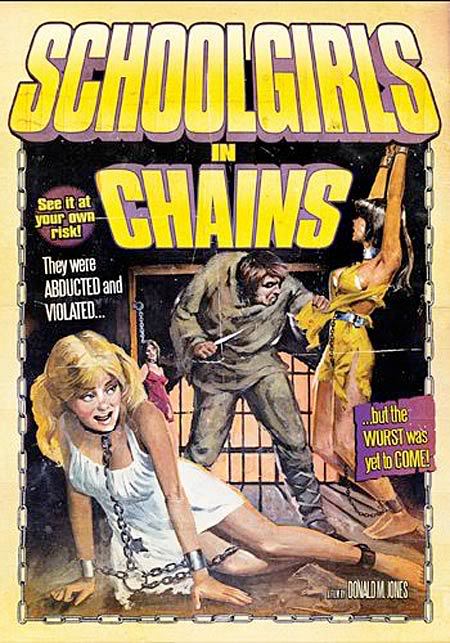
Schoolgirls In Chains (1973)

Also known as Abducted, Come Play with Us, Girls in Chains, Let’s Play Dead and The Abduction, this movie predates Mother’s Day to feature two crazed brothers — living under the wizened thumb of their mother — who kidnap women and force them to play increasingly depraved games that end up in death.

Inspired by an actual incident in which a missing woman’s car was discovered on the side of the road — but the woman was never found — this proves that 1973 was a very nasty — pardon the pun — time to be alive.

Shockingly, this is a well-acted affair, with Gary Kent (who appeared in many an Al Adamson film as well as having an entire film, Danger God, made about him) and John Parker as the Barrows brothers and Cheryl Waters (Macon County Line), Suzanne Lund and Merrie Lynn Ross (who appeared in Class of 1999, White House Madness and Bobbi Joe and the Outlaw) as their potential victims.

Don Jones would also direct Sweater GirlsThe Love ButcherWho Killed Cock Robin?Lethal Pursuit and, of course, the absolutely deranged The Forest, which also had Kent in a lead role. This was shot by Ron Garcia, who would go on to work on films like Twin Peaks: Fire Walk With Me and direct The Toy Box, which is another video nasty that we’ll be covering.

A section 3 video nasty, this is one of the many early 70s films that I wonder who was begging for in the UK before all the controversy began.

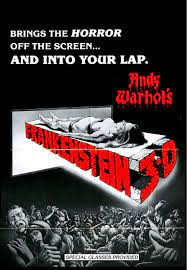
Flesh for Frankenstein AKA Andy Warhol’s Frankenstein (1973)

Joe Dallesandro is one of those nexus points for so many movies and parts of culture that I love. Born to a Navy man and a mother who was serving fifteen years in a federal pen for auto theft by the time he was five, Joe went from foster homes to knocking out his high school principal and stealing cars just like his mom. He got shot in the leg, and when his dad took him to the hospital, the cops arrested the fifteen-year-old and sent him to the Catskills, specifically the Camp Cass Rehabilitation Center. He escaped within a few months and made it back to New York City, where he went from nude modeling to being the star of Warhol’s films.

After roles in Lonesome Cowboys, Trash, Heat and Warhol’s two monster films, Joe decided to stay in Europe, where he made all sorts of movies in all the types of genres that I love. Yeah, there’s the American The Gardener, Serge Gainsbourg’s Je t’aime moi non plusSavage Three, Killer NunMadnessLe Marge with Sylvia Kristel and many more. He even shows up somehow in Theodore Rex. Yes, the same man whose bulge is on the front of the Rolling Stones’ Sticky Fingers, and the cover of The Smiths’ first album was in a movie about dinosaur cops.

This is the movie that Joe, who never once gave it away, came to Italy to make with Paul Morrissey.

Baron von Frankenstein (Udo Kier) has made his sister Katrin his wife, yet ignores her as he works to create the perfect human being, going through corpses of men and women to craft his Serbian ideal. You know, when he isn’t literally having sex with the body parts of dead women while shouting, “To know death, Otto, you have to fuck life… in the gall bladder!”

He wants Nicholas (Dallesandro) to be the body of his creature, but he escapes and makes his way to the castle, where he begins to satisfy the Baroness. Once she reveals the fact that she only cares about herself, she betrays him and, in return, is given what she really wants: The opportunity to have sex with the Baron’s creation, who responds by loving her to death. Another even more graphic scene happens when lab assistant Otto literally screws the guts out of the female monster (Dalila Di Lazzaro, Phenomena), causing the angry Dr. Frankenstein to kill him.

I kind of dig that the end of this film echoes both A Bay of Blood and Manson’s quote about “These children that come at you with knives — they are your children” by having the Frankenstein children holding scalpels that they will either use to help or to hurt. The movie doesn’t tell you what happens next.

That A Bay of Blood comparison is easier to make when you realize that one of the kids is played by one of the adorable and murderous kids from that movie, Nicoletta Elmi. In the 70s, if you wanted a frightening Italian red-headed child, you went with Nicoletta, who also appeared in Baron BloodWho Saw Her Die?Deep Red and many more. She also played the red-head usher in Demons when she grew up.

Despite his name appearing on this film, Andy Warhol’s contributions were minimal. He may have visited the set once and briefly examined the editing. Perhaps a more involved talent was Antonio Margheriti—Anthony Dawson—who claimed to have directed some of the film. He may have just been there so that the film could claim to be Italian, as it would need a director from the country to obtain Italian nationality for the producers.

Massage Parlor Murders! (1973)

I think more movies should have exclamation marks in their titles. I also believe that more movies should have Brother Theodore in them, so hey — Message Parlor Murders! is two for two.

Detective Rizotti and O’Mara are hunting the killer of numerous massage parlor workers — one of them, Rosie, often gave Rizotti the rub down — and now O’Mara is getting close to Rosie’s roommate Gwen (Sandra Peabody, The Last House on the LeftLegacy of SatanTeenage Hitchhikers). Of course, she’s the kind of girl who only appears in movies, someone who doesn’t rub nor tug, but instead acts like an analyst for her clients. Maybe their co-pays didn’t cover therapy or we hadn’t yet worked out the mental health side of care in 1973, but going to a massage girl at the Lust Lounge for psychotherapy seems like not the best idea I’ve heard today.

Maybe the killer is a man they call Mr. Creepy. It could also be someone trying to work out the seven deadly sins 22 years before Kevin Spacey. That theory seems to work, but hey, the seventies were a downer time and perhaps not everyone makes it out of this alive.

Somehow, this was also released as Massage Parlor Hookers! with the horror parts cut out. How long was that movie, 22 minutes?

You can and should order this from Vinegar Syndrome.

GIALLOPALOOZA PRIMER: Torso (1973)

EDITOR’S NOTE: We originally wrote about this Sergio Martino proto-slasher on September 8, 2017. It’s one of eight movies that will be playing at the Drive-In Super Monster-Rama Giallopalooza September 17 and 18. This article has been adjusted from the original as the writer has rewatched this movie several times since it was originally written.

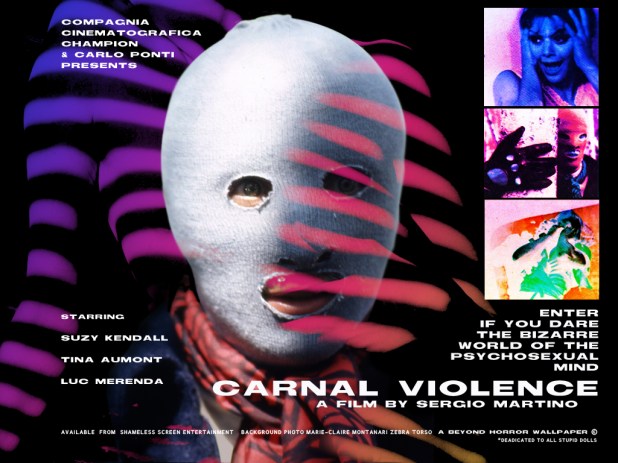
Torso is such a simple title. I’d rather call this film by its Italian name: I Corpi Presentano Tracce di Violenza Carnale, or The Bodies Bear Traces of Carnal Violence. Either way, it was directed by Sergio Martino and features none of the cast that he had come to use in his past films like George Hilton, Ivan Rassimov or Edwige Fenech.

It does, however, star Brtish actress Suzy Kendall, who played the lead role of Julia in Dario Argento’s seminal The Bird with the Crystal Plumage. She’s so associated with giallo that she appeared as the main character’s mother in 2012’s ode to the genre, Berberian Sound Studio.

This is a film that wastes no time being strange. Or salacious. A photographer is shooting a soft focus lovemaking session between three women amongst creepy, eyeless baby dolls. By the time we register what is happening, we’re now in a classroom, where swooping pans and zooms refer us to the main cast of the film as we overhear a lecture and later a discussion about Pietro Perugino’s painting of Saint Sebastian. Did he believe in God? Or was he just trying to sell sentimentality? Could an atheist find himself able to translate religion to those with faith?

We cut to a couple making out in a car as a figure stalks them through the eye of the camera, making us complicit in the act of the killer. Quick cuts reveal the white-masked face of this maniac. The man runs after him while the girl doesn’t even care that they had a voyeur watching. As she waits for him to return to the car, but grows impatient. The headlights of the car cast her shadow large across the columns of a bridge. And their light is quickly extinguished by black-gloved hands. The camerawork here is really striking, keeping us watching for the killer, as we’re no longer behind his eyes. His attack is swift and ruthless, juxtaposed against the images of fingers penetrating the eyes of a doll.

The art professor (John Richardson, Black Sunday, The Church) and Jane (Kendall) meet by chance at a church where she challenges him to change his views on Perugino. As she returns from their somewhat romantic afternoon, Jane spies her friend Carol arguing in the car with a man who she believes is married.

Meanwhile, ladies of the evening walk the street, ending up with Stefano, a student who has been stalking Julie. He has trouble performing and the prostitute he’s with tells him that all the men with hang-ups always come her way. That said — even if he’s queer, he better pay the money. He flips out and attacks her, but she makes her escape.

We’re then taken to a hippy party that looks like it’s taking place inside Edward Lionheart’s Theater of Blood. There’s weed, there are acoustic guitars, there are bongos, there are dudes with neckerchiefs, there are motorcycles. Truly, there’s something for everyone. But after leading on two men, Carol just walks out into the mud. They try and chase her, but she makes her escape into the foggy night. We hear her footsteps through the swamp as she walks, exhausted and covered in mud. What better time for our white-masked killer to return? We see glimpses of him through the fog and then he is gone. Whereas in past films Martino ignored the murder scenes instead of story, here the violence is extended, placing the killer and his actions in full view. After killing the girl, he rubs mud all over her body before stabbing her eyes — again intercut with the baby doll imagery. Her blood leaks into the mud as the score dies down.

This scene really feels like what the first two Friday the 13th movies were trying to achieve, but of course several years before they were made.

A police detective is in front of the art class, showing images not of art, but of the crime scene. A piece of cloth has been found under the fingernails of one of the murdered students, Flo. And that same scarf was found on Carol’s body. It’s their duty to report seeing anyone who wore this scarf to the police, who want to cooperate with the students who normally riot and throw rocks at them.

Two of the men in the class — Peter and George — were the last two people to be seen with Carol, the ones who she turned down at the party. Meanwhile, Stefano continues to stalk Jane. The music in this film is so forward-leaning — tones play when the killer shows or during moments of tension.

A man calls Daniela and tells her that if she ever tells where she saw the red and black scarf, she’s dead. Fearing for her life, she tells her uncle, who lends his country home to her and her friends so that they can get away from the city while the killer is at large.

Oh yeah — I forgot the pervy scarf salesman, who the police are leaning on. Right after talking to the police inspector, he calls someone and asks for money to buy his silence. Whoever it is, they bought the scarf from him and wouldn’t want anyone else to know. They’ll also get out of town and head to the country. Coincidence? I think not!

Stefano is all over Dani, telling her that he needs her. She wants nothing to do with him. When she stares at him, she remembers seeing him wear the red scarf. She escapes — slamming the door in his face. She tells Jane that she remembers seeing him wear the scarf — and never again — the day Flo died. The whole time, the creepy uncle is watching the two girls. Jane offers to speak to Stefano, then meet the girls at the vacation home.

The street vendor is flush with cash, creeping along in the dark. A car starts to follow him. We see the black-gloved hands again as the car hits its victim again and again, bright red gore pouring all over the screen.

Jane goes to speak to Stefano, finding only strange baby dolls and letters to Dani asking her to love him and remember the promise that she made as a little girl. Jane is surprised by Stefano’s grandmother, who tells her that he left town.

The other girls are asleep on the train as someone watches them. A strange man enters their train car and sits down.

The camerawork in this movie feels as predatory as the perverts and killers that exist within it. Speaking of pervs, when the girls arrive in the countryside, the local men pretty much lose their minds, particularly over Ursula (Carla Brait, the man wrestling dancer from The Case of the Bloody Iris). She and Katia make out as a peeping tom watches, only for the killer to show up and off the leering man. There’s an amazing scene of the killer dumping the pervert into a well, shot underwater and staring upward as the body falls toward the lens.

Man, every man in this movie is scum. They’re either frightened boys or perverts wanting one chance to knock up a woman or scarred from past sexual encounters. None of them are positive, as even the uncle who gives Dani the villa seems way too interested in her. Every man is a predator at worst and a leering pervert at best.

Jane hurts her ankle when she gets overly excited about breakfast. A doctor arrives — the mysterious man from the train — and he gives her a pill, which knocks her out.

The girls go sunbathing while Jane recovers. Dani thinks she sees Stefano — complete with the red scarf — watching them. They return home and drink champagne, which Jane uses to wash down her sleeping pills.

A few minutes later, the door rings. It’s Stefano — the girls all scream — but he’s dead — the girls scream again — and the killer is behind him, holding the red scarf — now scream even louder! Instead of showing us the murders, Martino switches form, cutting to a ringing bell and Stefano being buried.

Jane wakes up, asking where her breakfast is. She’s obviously slept late as a result of the pills. She walks around the apartment, looking for Dani, Ursula and Katia, only to find a mess. Tossed chairs, bottles of beer and every single one of her friends murdered. Suzy Kendall is amazing in this scene, caught between fear and nausea. Unlike so many wooden giallo performances, she’s actually believable.

She hides as the killer comes back, forced to stay quiet and watch as he saws her friends into pieces. Even the ordinary world routine of the milkman arriving cannot stop the butchering of her friends, with her trapped just feet away.

This final act is completely unexpected, as up until now, the film had played by the rules of the giallo, the large number of victims versus a large number of red herrings.

In fact, this film is so packed with red herrings, even the cast had no idea who the killer was. Martino wouldn’t tell them who it was, so each of the actresses had her own theory as to who the killer was. And in the original script, the killer survived.

Now, instead of that traditional giallo structure as I mentioned above, it is the last survivor — a near prototype for the final girl — against a killer. Throw in that Julie can’t move well due to her leg and Martino has set up quite the suspenseful coda.

Trapped in the house, Julie tries to signal with a mirror, using Morse code. But it totally misses the heroic doctor’s sight. He places a call, but it doesn’t seem like it’s to Julie. She looks out the window and sees the killer coming back.

It turns out that the killer was the professor, who saw a childhood friend die trying to reach for a doll. He compares the other kills to dolls, with only Julie as a flesh and blood person. Everyone else was a bitch or played games with him or blackmailed him. He hacked Ursula and Katia to pieces like dolls as a result. Dani saw him. Carol may have seen him. And he killed Stefano when he saw him in the village. Death, he says, is the best keeper of secrets and then he sees Julie as a doll and tries to hang her. She’s saved at the last second by the doctor.

They battle into a farmhouse, across the yard and to a similar rock where we saw the younger professor watch his friend die. We hear a screen and have no idea who has been killed — but luckily for Jane, the doctor survives.  He discusses that whether fate or providence had kept him in town, where he could save her. Perhaps it was written in the stars. Julie replies that Franz, the professor, would have been a realist and called it a necessity. Franz is dead and the dreamers live on.

The more times that I’ve watched this film, the more that I appreciate it and how it flips the genre conventions on their head and moves toward more of a slasher, with many of the giallo elements feeling tacked on somewhat to stay within the expected pieces of the form. A real clue that it’s really a slasher? The killings are more important than who the killer is.
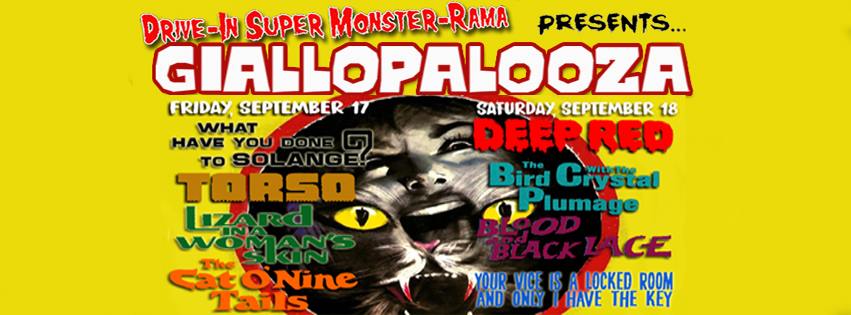
Drive-In Super Monster-Rama is presenting “Giallopalooza”, two big nights of classic, fully restored giallo thrillers from such maestros as Dario Argento, Mario Bava, Lucio Fulci and Sergio Martino!

On Friday, September 17, the line-up will be What Have You Done to Solange?, Torso, A Lizard In a Woman’s Skin and The Cat O’Nine Tails. Saturday, September 18 they will present Deep Red, The Bird with the Crystal Plumage, Blood and Black Lace and Your Vice Is a Locked Room and Only I Have the Key.

Admission is $10 per person each night (children 12 and under FREE with adult guardian). Camping on the premises is available each night for an additional $10 a person, and that includes breakfast.

Advance tickets are available online at the Riverside Drive In’s webpage.
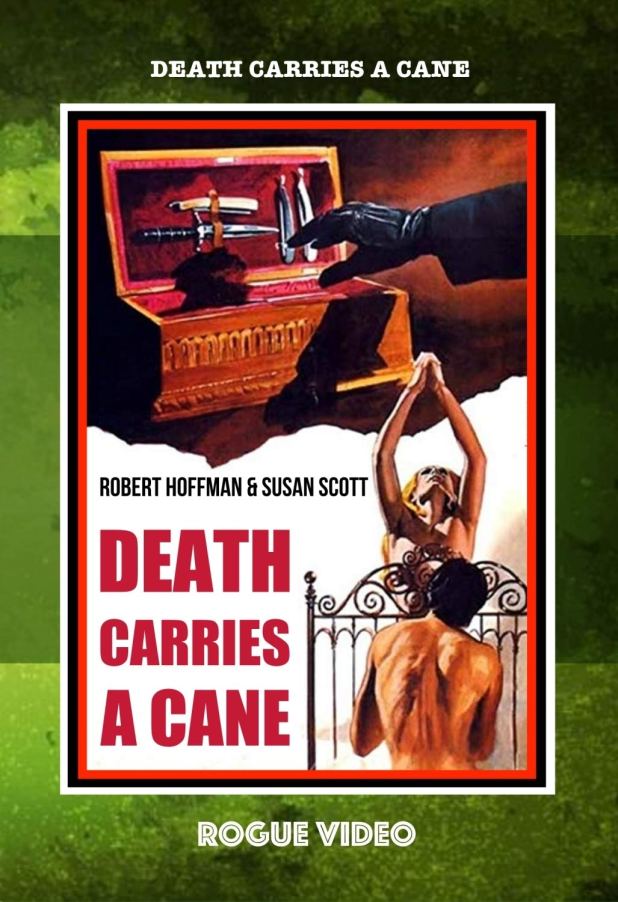
Death Carries a Cane (1973)

If death carries a cane, isn’t it weak? With that thinking, aren’t the alternate titles — Dance Steps on the Edge of a RazorManiac At Large, The Night of the Rolling Heads and Devil Blade — so much cooler?

Well, that’s because whoever the killer is, he or she has a limp. That’s what Kitty (Nieves Navarro, billed here under her boring Americanized nom de plume Susan Scott) sees when she watches a murder through a coin-operated telescope. That’s just the first of many killings and it just might be her boyfriend Alberto, who has the misfortune of having a limp and a cane when that’s what’s being profiled. I’ve said it before and I’ve said it again, defund the giallo police.

Navarro also made two other similarly titled movies, Death Walks at Midnight and Death Walks On High Heels, so if you’re confused, well…this one isn’t as good as those ones.

Director Maurizio Pradeaux also made another Grim Reaper referencing giallo, Death Steps in the Dark, which isn’t all that notable other than the scene where the protagonist has to wear drag to escape the police. Also, it has no Nieves Navarro, so you can skip it.

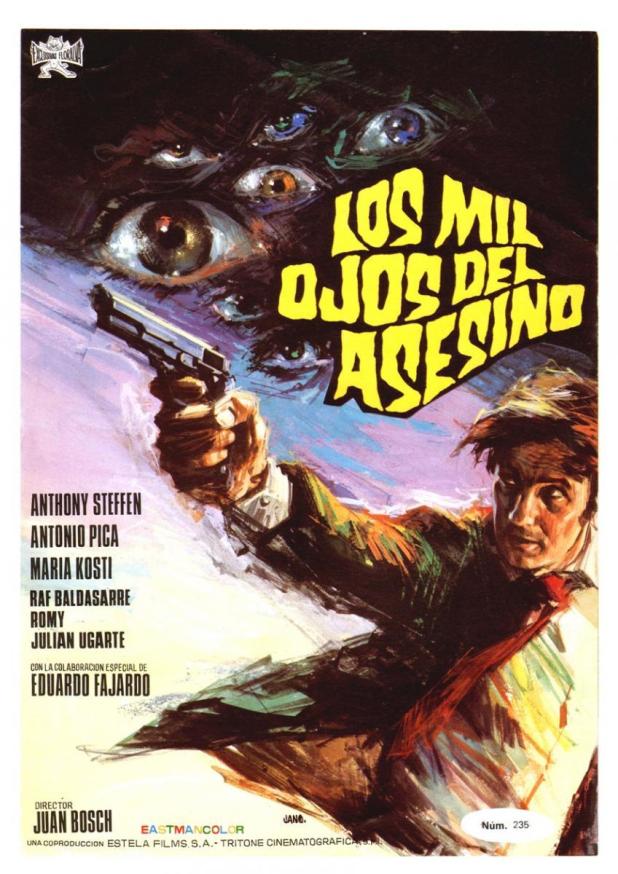
The Killer with a Thousand Eyes (1973)

Hey, this has a giallo title, features a giallo actor in Andrew Steffen* (The Night Evelyn Came Out of the GravePlay Motel), fifteen murders and Juan Bosch, the director of the giallo with the most non-descript giallo title, The Killer Wore Gloves, and somehow, it’s not a full-on giallo.

I mean, it has a black gloved killer and the mystery that you expect of the form, but it’s just as much a poliziotteschi with some hints of Eurospy. As you may know, I do adore cocktails, so let’s drink this one up.

After Interpol agent Alistair McAndrew is killed by a man in a kabuki mask, Michael Laurence (Steffen) is assigned to identify and retrieve his friend’s body. Instead, as a stranger in a strange land, he starts his own investigation, which ends up with all manner of people getting killed by the killer with black gloves and a Japanese mask.

This movie also has a cockfight scene where a woman gets so excited that you’d swear she was having sex. Oh Italy and your obsession with strange desire and animal murder.

*He’s probably better known for his Westerns like the incredible Django the Bastard, but let’s go with this line of thinking for the purposes of this article. Steffen also wrote the script for this movie with Bosch and Alberto De Stefanis, who was one of the production managers on Salò, or the 120 Days of Sodom.