People always want to know how much money I make writing this site if I put this much work into it. Yes, there are times when I put forty or more hours a week in and get nothing in return. Well, everything else in my life is for commerce. Sometimes, you need art. I make something more important than money.
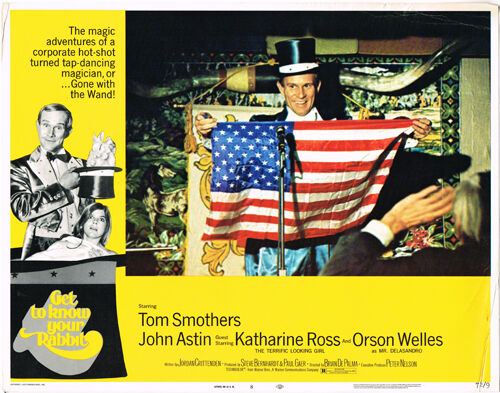
This movie made me consider that. Corporate executive Donald Beeman (Tommy Smothers) is sick of work. So sick of it that he quits his day job and becomes a traveling tap dancing magician as he studies under Mr. Delasandro (real life magician Orson Welles).
Meanwhile, his old boss Mr. Turnbull (John Astin) wants him to come on back to the nine-to-five life and he convinces Donald to help other businessmen with Tap Dancing Magicians, a course — and corporation — that will teach them what he has learned. It’s a success, a wild success, but Donald is back to being a rat in a maze.
Directed by Brian De Palma and written by Jordan Crittenden, this was a Warner Bros. movie made after Easy Rider in the days when studios were looking to the film brats and young people to save their bottom line. The studio — and Smothers — felt uneasy about De Palma’s experience. Smothers so disliked this movie that he disappeared for several days and refused to return for retakes. Making matters worse was that executive producer Peter Nelson recut it and added a new sequence to the film, which the studio had no idea how to promote and one that they dropped as fast as they could.
While the movie ends with Smothers alive and well after his final escape trick, it was originally supposed to end right after the trick, implying that Smothers may have committed suicide. Even wilder, De Palma wanted to end it with him killing his rabbit live on TV to ruin his career and pull off a bigger escape.
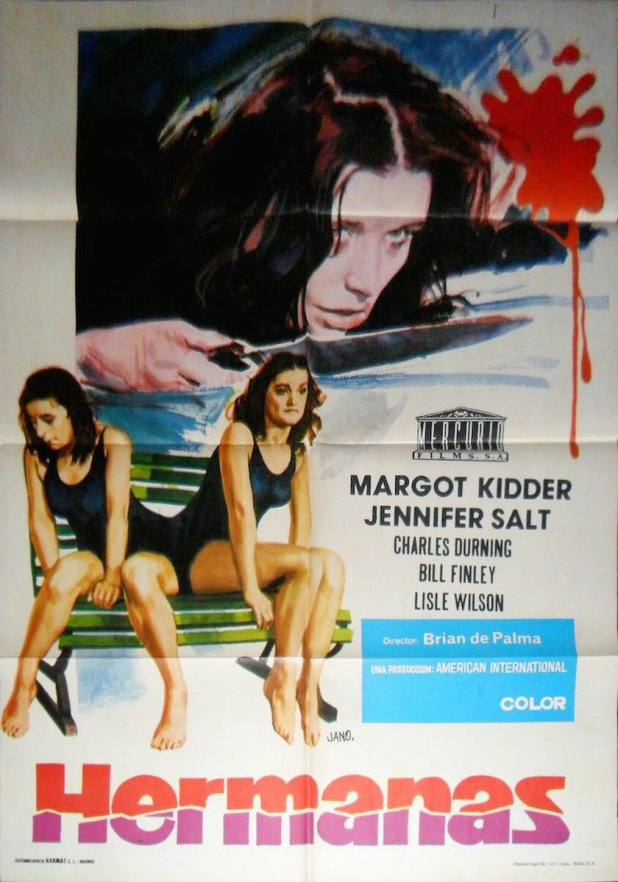
I’ve always struggled with De Palma’s comedies, so when he moved into obsession and strange behavior with Sisters, all was right with the world.
Brian De Palma was inspired to make Sisters after reading an article in Life magazine about how Soviet conjoined twins Masha and Dasha Krivoshlyapova were separated. A photo at the end of the article — along with a mention that the girls were developing psychological problems — struck him, as one twin looked happy and the other appeared to be deranged. And, as always, Hitchcock loomed large, as the script that DePalma wrote with Louisa Rose was directly inspired by his films Rope — the tracking shot that follows the murder of Phillip — and Psycho, as the main character shifts during the movie. He even got Bernard Hermann to come out of retirement and record the music for the movie.
In fact, DePalma had cut his movie to another Hermann score. When he showed it to the composer, he answered back, “Young man, I cannot watch your film while I’m listening to Marnie.”
The film has since influenced countless others. I can see echoes of the documentary within this film on the film within Get Out that details another sinister operation.
An operation is behind much of the horror in this film, as Danielle Breton and Dominique Blanchion (Margot Kidder, as always perfect) were separated and perhaps one of the two did not survive. Then there’s Emil Breton (William Finley, the literal Phantom of the Paradise), who is either Danielle’s ex-husband or the doctor who helped take the twins apart or both. And an investigation into the murder that starts the film and the hypnotic suggestions that perhaps there was no real murder at all.
DePalma has a career that some would say is filmed with misogynistic films, but here, this is the rare slasher with female killers and male victims. Of course, you can also read into this that women’s liberation — somewhat literally — has caused all of these issues.
This is the film where DePalma found his way. Of course, he found it by following in the footsteps of someone else, but if anyone could be the next Hitchcock, he made the best attempt.
The first time I saw this, I was knocked out by the first kill and how it comes out of nowhere and how much De Palma tells us of the plot just through dialogue.
EDITOR’S NOTE: This was originally on the site on .
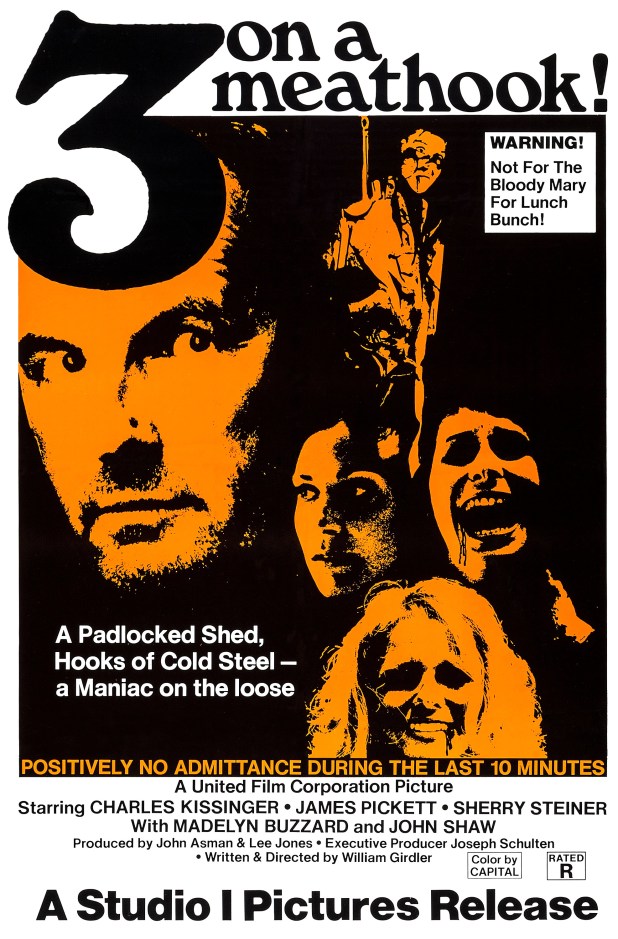
While the slasher genre really starts in 1978 (or 1979, when Halloween really took off), there are movies before that are nascent starting points. This was William Girdler’s second film after Asylum of Satan, made with money from his trust fund. It’s based on Ed Gein, as are Psycho, Deranged, The Texas Chainsaw Massacre and many, many, many more.
Filmed in and around Louisville, Kentucky, the home of the director (whose also wrote and performed much of this film’s score), this is the tale of Billy Townsend (James Carroll Pickett), who seems like such a nice boy. He helps four girls who have gone to the lake for vacation when their car breaks down. But Billy has secrets and a father (Charles Kissinger, who also appears in Girdler’s films Abby, Grizzly, The Manitou, Asylum of Satan and Sheba, Baby) who loves his son so much that he’ll help him get out of any trouble.
This has one of the best titles ever, as well as a great tagline — “WARNING: Not For The Bloody Mary For Lunch Bunch!” — and, as stated before, the notion of being an early slasher. It’s worth checking out to see where the form got its start. When I was a kid, this film’s cover freaked me out, as did the implications of its title. The actual film itself seems laid back and very 70’s, including an anti-Vietnam speech delivered directly to the camera.
You have to love a movie that is willing to totally forget any forward progress by having its antagonist decide to head downtown, watch some bands, see The Graduate and ponder life instead of continually killing people. You never see Michael Myers decide to take a break and grab a beer, you know?
EDITOR’S NOTE: You can read another take on this movie here.
William Girdler was born on October 22, 1947 in Jefferson County, KY and this was his first of nine movies in six years, ending only when he died while scouting locations in the Philippines for his next film.
After he finished with the Air Force, Girlder formed Studio One with best friend and brother-in-law J. Patrick Kelly. Initially focused on TV commercials, Studio One eventually took on movies with this film. It later became Mid-America Pictures when Girdler’s films began making money.
According to the official William Girdler site, his “make ’em fast and cheap” directorial style was the result of a premonition that he’d die by the age of 30. Well, he made it to thirty, at least. Some say that Girdler was so obsessed with his own death that he said that he was in a race against time.
Filmed in Louisville in late 1971 for around $50,000, this is the story of concert pianist Lucina Martin (Carla Borelli) who has been abducted by Dr. Jason Specter (Charles Kissinger) and taken to his Pleasant Hill Hospital for treatment. It’s a sanitarium that she swears that she doesn’t belong in and who would want to be in a place where the doctor kills people to add to his Satanic majesty and immortality? And is Specter also the evil sorceress Martine? Because Kissinger is definitely playing both parts. He was also a horror host in Louisville known as the Fearmonger on WDRB.
It all leads up to a virgin sacrifice with our lovely piano player as the victim and Martine saying things like the fact that she “calls upon the gates of the dark realm to crash asunder” and invokes “blazing angles of the shining trapezoid.” What’s that? Oh, you know, the Order of the Trapezoid which later became the governing body of the Church of Satan.
More of that in a bit.
This being the early 70s, the ending is ambiguous, the rubber bugs and snakes countless and a Satan that looks like someone wearing a costume from a party store. You know, it might sound like I’m laughing at this movie, but I’m not. Asylum of Satan pleases me to an incredible degree, a movie made by someone who knew he was born to make movies and yet trying all he could to learn right there on the screen.
Girlder told the Louisville Times, “Other people learned how to make movies in film schools. I learned by doing it. Nobody saw Billy Friedkin’s or Steven Spielberg’s mistakes, but all my mistakes were right up there on the screen for everybody to see.”
The film was made with the assistance of local investors but the movie didn’t make enough to return their investment. Shortly before his too soon death, Girdler signed over the rights to this movie and Three On a Meathookto those original investors so that they could make back their money.
The Girdler site also has an amazing interview with Don Wrege, who clapped the clapboard for this movie. I loved every word, especially when he explains how the Church of Satan got involved being technical consultants.
“A bunch of high school girls (some daughters of investors) were dressed in virginal white, given candles and positioned in a circle around Borelli who was roped to the alter. A guy in a rubber suit. (Girdler said the suit/mask was from Rosemary’s Baby but wasn’t shown in the film, thus it was affordable and available and, of course, cool.)
There was a lot of motion involved. I think the guy in the rubber suit was on an apple box with wheels. The Asmans were on the largest crane we used the whole time, if I remember correctly. Multiple takes were done, all the time Kissinger (I think) was reciting the invocations that had been written by the satanic guy who was standing in the wings watching all of this take place. The incantation, if that’s the right word, was repeated any number of times with as much sincerity as Charlie Kissinger could muster, as multiple takes were filmed.
During one take, and at some very convenient point in the “prayer,” like “…if you’re present, show yourself…” or something like that, one of the white-draped high school daughters of an investor passed out and hit the floor. Everyone was horrified. The two people from the Black Church without hesitation ran to the girl’s limp body and began saying all sorts of weird shit, speaking in some unidentifiable tongue. The girl’s mother, who was there, TOTALLY freaked out, running to her daughter’s side screaming “You leave her alone…get away!” to the two Satanists.
The daughter came to in a few moments, and was excused for the day. Everything was really tense for a couple of hours after that. I think some folks started to wonder what the hell we were messing with. I made a mental note to try to keep track of that girl who fainted, but I haven’t had the nerve. I really don’t want to know.”
Well, that advisor was Michael Aquino, the actual writer of a lot of the rituals in the Satanic Bible and he told the Girdler site that he didn’t remember anyone passing out. Aquino later broke away from the Church of Satan and formed the Temple of Set.
After receiving his PhD in political science from the University of California, Santa Barbara, Aquino worked as an adjunct professor at Golden Gate University until 1986. The whole time, he was serving as an Active Guard Reserve officer of the United States Army stationed at the Presidio of San Francisco.
As the 80s went on, Aquino became intrigued by the connections between Nazis and the occult. At one point, he performed a solitary rite at Walhalla beneath the Wewelsburg castle which was an infamous ceremonial space used by the Schutzstaffel’s Ahnenerbe group.
He then formed the Order of the Trapezoid, which was a chivalric order influenced by a mix of Satanism, Pagan heathery and even the application of runes within magic. Aquino was often challenged in the Satanic Panic of many crimes, as well as in conspiracy circles for numerous acts of evil as he started his career in PsyOps. He even welcomed LaVey’s daughter Zeena and her husband Nikolas Schreck into the group before the inevitable break.
But I digress, as I always say.
Girdler would do so much more — again, in such a short time — but the basics of his career are here. The 70s were prime time for Satanic movies and he took advantage of it just as he would of all manner of subjects that he thought would make box office.
He was even kind of William Castle in a way here, as the press book mentions ordering “Sign of Satan Soul Protectors” to protect theatergoers from the “Evil Stare of the Devil.” That’s also Girdler’s Porsche in this and his sister Lynne Kelly in the pool with the snakes, because Sherry Steiner refused.
Here’s a drink for this movie.
Snake in the Swimming Pool
2 oz. Southern Comfort
4 oz. cranberry juice
1 oz. lime juice
Build over ice, starting with the SoCo, then followed by the cranberry and lemon.
Directed by John Badham (Bird On a Wire, Short Circuit, WarGames) and written by Robert Malcolm Young (Escape to Witch Mountain) from a Fritz Leiber story, this trip to the Night Gallery has photographer David Faulkner (James Farentino, Dead and Buried) becoming slowly obsessed with his new model. She has no name. Just eyes that want something. That’s where this gets its title, “The Girl With the Hungry Eyes.”
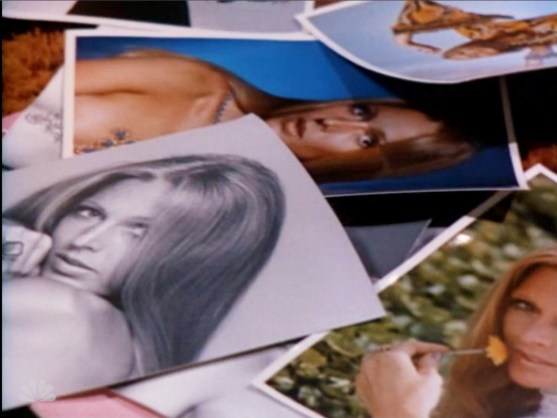
The Girl is played by Joanna Pettet, making this episode her fourth Night Gallery role. She’s also in The Evil which also makes use of her ethereal beauty as she plays a vampire who haunts every man that sees her. Helping her exactly that are the photos taken by Harry Langdon Jr., a legendary Hollywood photographer.
Pettet
told authors Scott Skelton and Jim Benson in Rod Serling’s Night Gallery An After Hours Tour, “Doing “The Girl With the Hungry Eyes” was just a total ego trip! I walked onto the set and there were floor-to-ceiling huge blowups of me! I looked out the window and they had literally made a huge billboard out of me, sipping beer, and erected it on a building across the street. And it was probably the best I ever looked in my life. We all go through our periods — “the look,” you know? It was just perfect. And for the rest of my career I got to use these incredible shots from Harry Langdon. When would I ever have had a chance to get an entire day with somebody like that?”
Plus, you get Night Gallery regular John Astin as a beer company owner desperate to meet The Girl and a script as packed with eroticism as 1972 network television will allow. Badham argued with Jack Laird for more money and more time, even going way over to capture the final scenes inferno which got him fired until, as he said, “the next time they needed somebody.” And they did just a few days later, working on an episode of Ozzie and Harriet.
As for the life-sized photos of Pettet, she wanted one for her own. By the time she asked for one, the crew had taken all of them. Somewhere in garages and dens across Hollywood, appreciative men were now staring at their very own girl with the hungry eyes.
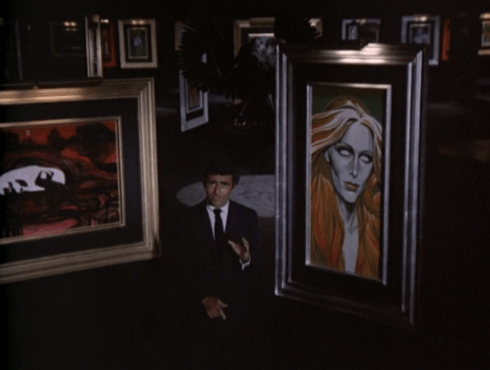
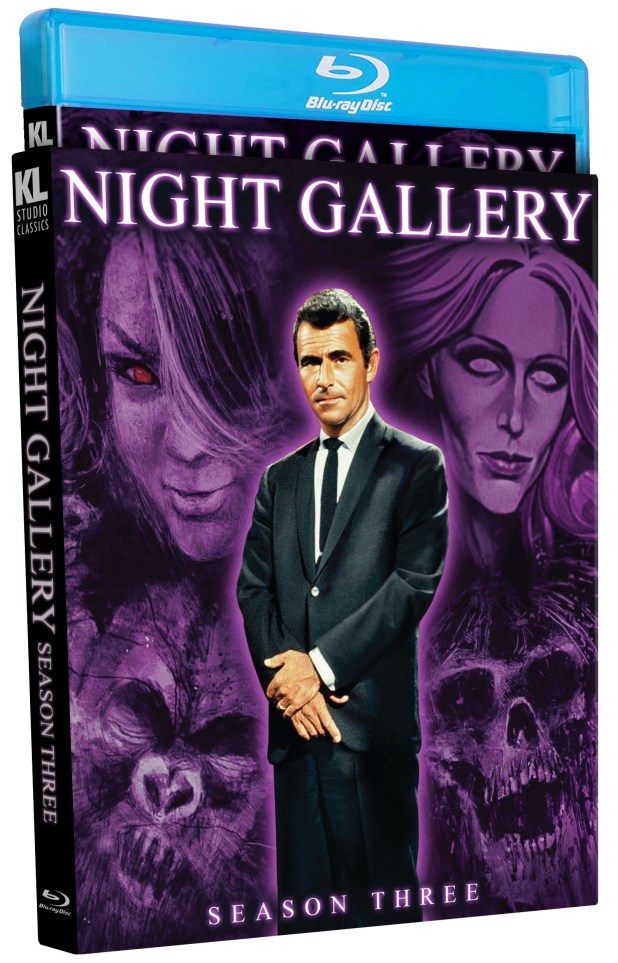
With season 3 of Night Gallery, the show moved to half an hour and often only had one story per episode, which allows some of the better tales to breathe. Or so you’d think, until you realize they had only 24 minutes for each story.
Sadly, this is the last season of the show, but we’ll try not to be too broken up about it. But when you read about how this show was treated going into season 3, that gets a bit difficult.
According to Rod Serling’s Night Gallery: An After-Hours Tour by Scott Skelton and Jim Benson, NBC wanted some changes with the show, as it kept coming in second place to CBS’s Mannix. Beyond the half an hour format, they also made the show more action and suspense instead of outright horror. And they moved it from Wednesday nights to Sundays, a night usually reserved for family viewing.
Serling was not pleased.
“I’m fucking furious. These people are taking what could have been a good series and are so commercializing it,” he told actress Tisha Sterling.
Instead of a battle between Laird and Serling, now he was facing Universal, who wanted to keep NBC happy so the show could be picked up for syndication and make them money. And NBC wanted “an action-packed horrorfest.”
After one of his scripts, “A View of Whatever” was rejected, Serling even wrote a resignation letter in May of 1972 and asked for his name to be taken off the show. However, he had a contract with Universal and he was stuck.
Now that there was one story per week, the creative budgeting that allowed for multiple stories to be shot all in the same larger budget went away. And Jeannot Szwarc said that the scripts weren’t the same quality because once the network stopped caring, everyone else seemed to. “The ratings were good enough, the demographics were sensational, but NBC never understood that show,” he said. “All those guys are heavily into control and there was something a little bit chaotic and anarchistic about Night Gallery that NBC didn’t like.”
CBS responded to the move by sending Mannix to Sundays and ABC had their Sunday Night Movie, which always got big numbers.
The funeral for Night Gallery started before the season did.
Directed by Jeannot Szwarc and written by Halsted Welles from a story by Clark Ashton Smith, “The Return of the Sorcerer” finds Noel Evans (Bill Bixby) answering a want ad for an interpreter. He’s to work for John Carnby (Vincent Price), a sorcerer who is studying the Latin Necronomicon but has found a new Arabic book of spells. The last two men he hired have quit and he threatens Noel’s life to keep him on task.
Meanwhile, Carnby’s assistant Fern (Tisha Sterling, The Coming) has dinner with Noel. joined by her Carnaby’s goat father. There, he learns that the warlock has already killed and dismembered his twin. But more importantly, Fern wants him. She wants him bad.
The translation of the Arabic book frightens Carnaby more than Noel, as it discusses that some magic users can keep their power. Even after death. Even after dismemberment. He cries of his brother, “I hated him because his magic was stronger. But Fern — she caused it! She wanted to be stronger than both of us.”
What follows is a Black Mass — on a Sunday night on NBC no less — where the two brothers are reunited and, one assumes, Fern finally has the power she craves. Now, spider to the fly, she wants to lead Noel to her bed.
What a wild story to start this season off with. The sets were designed by Joseph Alves, who worked with Szwarc on Jaws 2and ended up directing Jaws 3, as well as building the model New York City for Escape from New York and many other production design miracles. Szwarc showed him the art of William Blake and Aleister Crowley, which led Alves to Dennis Moore and Babetta Lanzilli, the witch owner of the Sorcerer’s Shop in Hollywood.
The Black Mass in the show really does have the names off Astototh, Asmodeus, Baal, Belial and more. It was all too much for Serling, who said “I believed those words we were saying were really powerful and meaningful, and one shouldn’t conjure up that kind of energy. It frightened me. I felt I was giving myself over to some dark. horrible force.”
Again, in 1972, this could air on prime time. At the start of the next decade, the Satanic Panic would be in full bloom.
Despite how dour season 3 will get, this is a great start filled with talent. Let’s see how things progress.
We’ve arrived at the end of the second season of Night Gallery. Don’t be sad — there are a few more episodes to go for season 3.
“The Caterpillar” is a classic story for this show, one that gets repeated often and even has entered into being an urban legend. Directed by Jeannot Szwarc and written by Rod Serling from the story by Oscar Cook — who actually served in its setting, Borneo — this is the story of British civil servant — and new man in Borneo — Stephen Macy (Laurence Harvey). He’s moved into the home of Mr. Warwick (Tom Helmore) and his much younger wife Rhona (Joanna Pettet,The Evil) and as you can imagine, quickly makes a move on Mrs. Warwick. He hires Tommy Robinson (Don Knight) to place an earwig — a small bug that burrows into the brain and death is always the end of its work — on the pillow of Warwick.
Except that Macy’s pillow is used. Somehow, the evil man survives and even confesses that he did what he did for love. Sadly, the worse is yet to come, as the earwig that went through his brain — giving “agonizing, driving, itching pain” — was female.
And she laid eggs.
Just a perfect Night Gallery story, directed and told by the two of the best talents on the show. No gore, just a spot of blood and plenty of acting gives this the kind of darkness that some turn away from.
“Little Girl Lost” was directed by Timothy Galfas (Black Fist) and written by Stanford Whitmore (The Dark) from a E.C. Tubb story. Professor Putman (William Windom) was once a brilliant military physicist but the death of his daughter Ginny after a hit and run accident has destroyed him. A psychologist, Dr. Charles Cottrell (Ivor Francis), wants an injured test pilot, Tom Burke (Ed Nelson), to bond with the man, help him think his daughter is still alive and keep him working on the weapon the government needs.
It works at least until they go out in public and someone sits where Putman’s daughter is supposedly sitting. He then realizes what they want. “Bigger and better bombs at a fraction of the cost.”
So he gives it to them. He really does.
This is one of the best Night Gallery episodes as it dispenses with the silliness and gives us dread and darkness. There are no black out gags here, just the end of the world for one man and, well, for everyone, all told in the moral play style that Serling pioneered for television.
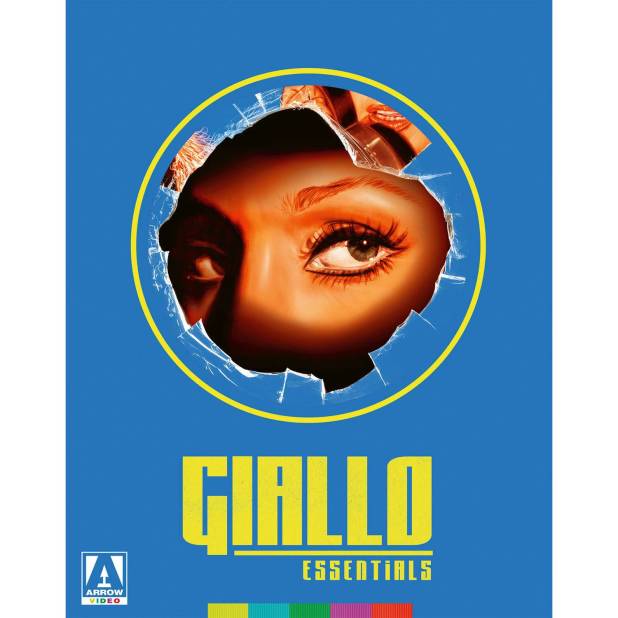
Arrow Video continues its exploration of giallo with its fourth box set after the Black, Red, Yellow and White editions of Giallo Essentials.
In the early 1970s, when the giallo boom was at its peak, producer-turned-director Luciano Ercoli made three standalone — but thematically linked — giallo films all starring his wife Nieves Navarro under the name Susan Scott. This set shares those movies in one convenient and well-priced edition.
The Forbidden Photos of a Lady Above Suspicion (1970): Minou (Dagmar Lassander, The House by the Cemetery) loves her husband, Peter. But Peter is cold and only really seems to care about work. All she does all day is pine for her husband and take care of a turtle. Yep. You just read that correctly.
One night, a mysterious stranger attacks her, cuts open her clothes and then warns her: her husband is a killer.
The mysterious man is proven correct when a man who owed Peter money shows up dead. He demands that she come to his home, where he blackmails her into sleeping with him. Seeing as how he has recorded their tryst, he now has more material on her.
Even her friend Dominique (Nieves Navarro, All the Colors of the Dark, who was married to the director, Luciano Ercoli) can’t be trusted, as Minou finds photos of the blackmailer in provocative poses in her possession. When she finally gets the police to investigate, the man’s home is empty and Dominique tells the police he never even existed. Oh yeah. Dominique was once Peter’s woman before Minou. So there’s that.
Minou has a nervous breakdown and overdoses on tranquilizers before sobering up and learning that it’s all been a plot against her from the beginning. But come on — if you’ve watched any giallo, you knew that going in.
Despite its lurid title, Forbidden Photos of a Woman Above Suspicion isn’t filled with sex or even all that much violence. It’s more about alcoholism and how women were taught that they had to have the skills to land a man, but not what to do with their lives to make them fulfilled beyond just a relationship.
Director Luciano Ercoli has some gorgeous shots in here that really take advantage of the space age 1960’s aesthetic. And a bossa nova score by Ennio Morricone keeps this film bouncing. It wouldn’t be the first giallo I’d recommend, but it’s not the last, either.
Extras include commentary by Kat Ellinger; Private Pictures, a documentary featuring interviews with Navarro, Ercoli and Gastaldi; an appreciation of the music of 70s Italian cult cinema by musician and soundtrack collector Lovely Jon; a Q&A with Lassander; the Italian and English trailers and an image gallery.
Death Walks On High Heels (1970):
A man is stabbed on a train, leading the police to question Nicole (giallo queen Nieves Navarro) about diamonds that are missing. Her life turns upside down, as she begins to receive disguised phone calls asking about the diamonds and a blue-eyed masked man attacks her in her boudoir. She then remembers that her jealous lover Michel owns contact lenses in that color, so she runs away with an older eye surgeon to the coast of England. But Michel isn’t far behind…
The first of three giallo directed by Navarro’s husband, Luciano Ercoli, this is what the genre should be: shocking, lurid, bloody and oh so fashionable. It also makes a deft turn from what we expect from the form into an actual mystery film.
There’s a plot twist here that honestly shocked me, so I won’t spoil it. While the other two films in the Ercoli giallo trilogy are much better, this is still a quality film worthy of your time. Some critics decry them as Ercoli making movies just to feature his wife, but if you had a quality woman like Navarro in your life, I bet you’d do the same.
This comes with audio commentary by film critic Tim Lucas, an introduction to the film by screenwriter Ernesto Gastaldi, an interview with Ercoli and actress Navarro, Gastaldi explaining how to write a successful giallo, an interview with composer Stelvio Cipriani and Italian and English trailers. These extras are a sheer joy for giallo lovers and what an opportunity to hear from Ercoli, Navarro and Gastaldi.
In this one, she plays a fashion model named Valentina who agrees to help her journalist beau study LSD. But while she’s dosed and in the middle of a photo shoot, she watches a man brutally murder a woman with a spiked gauntlet. He thinks she’s just hallucinating and publishes her account, but she believes it’s real. And when the killer starts stalking her, she really starts to worry.
The entire opening of the film is one big acid freakout and everything that follows is the bad trip, the comedown and reality brutally intruding into drugged out bliss. This is a film packed with brutal violence and plenty of gore, but it makes sense. The movie demands it.
The end, when everything is wrapped up by the killer (killers?) is pretty great, as the many red herrings are discussed and the entire plot is finally explained to us. If everything before felt like a nightmare, this is bracingly cold water directly to the face.
Even better, Navarro portrays a heroine who doesn’t faint at the first sign of danger. She deals with the ineffectual police and indifference of her boyfriend with aplomb.
And yes — this film is packed with bonkers crazy fashion — a metal/glass silver wig and a strange sculpted wall feature prominently — so if that’s why you love giallo, you’ll be quite happy here. Me? I loved every minute.
This release comes with audio commentary by film critic Tim Lucas, an introduction by screenwriter Ernesto Gastaldi, an extended TV version, a reflection by Gastaldi reflects on his career in the crime film-writing business and Desperately Seeking Susan, a visual essay by Michael Mackenzie exploring the distinctive giallo collaborations between director Luciano Ercoli and star Nieves Navarro. If you love giallo — or are just getting into it — all of these extras will open deepen your love for the form; Lucas is one of the best commentary track experts there is.
This limited edition Arrow Video box set comes in rigid packaging with the original poster artwork in a windowed Giallo Essentials Collection slipcover. You’ll enjoy 2K restorations for all three films as well as reversible sleeves for each film featuring original and newly commissioned artwork by The Twins of Evil and Gilles Vranckx.
There aren’t many episodes left in season 2 of Night Gallery. With each new installment, I feel a pang of sadness, as only one season remains.
“I’ll Never Leave You — Ever” was directed by Daniel Haller and written by Jack Laird from a story by Rene Morris. It starts in the middle of lovemaking between Moragh (Lois Nettleton) and Ianto (John Saxon) and we quickly learn that she’s married to a dying man, Owen (Royal Dano), and the two wish that he would just take that turn for the worse so they could finally be together.
As she returns home, we can feel both her guilt and her disgust at the man she once loved slowly succumbing to illness. I don’t know if you can blame her for going to an old woman (Peggy Webber) and receives a doll that she can use to destroy her husband once and for all.
As you can imagine, nothing goes according to plan.
I loved that Laird actually concentrated on making an actually eerie story instead of a joke. Wow — it feels like more than one episode now that I’ve said something nice about him.
“There Aren’t Any More MacBanes” was directed by John Newland and written by Alvin Sapinsley from the story “By One, by Two and by Three” by Stephen Hall.
Bard College is celebrating graduation, which includes Elie Green (Darrell Larson), Mickey Standish (Barry Higgins) and — if he can pass his classes and earn his Master’s in Philosophy — Andrew MacBane (Joel Grey). Yet it may never happen, as the man paying his way, his Uncle Arthur (Howard Duff) is frustrated by his progress. He finally delivers a new rule: Andrew must find a job within six months or be completely cut off, not just for his stipend but for his inheritance.
Yet Andrew doesn’t care. He’s more concerned with discovering the ten pages that are missing from the spellbook of his ancestor Jedediah MacBane, who died after using a spell to murder his worst enemy, his best friend and his best friend’s wife — yes, three people, all at the same time — centuries ago. The friends laugh about this and plan to meet in six months.
As you can figure, Andrew doesn’t have a job in six months. Instead, his uncle soon is torn to pieces by something that seems like a wild animal. Mickey dies next as he works in Africa. And now, the creature is coming for Elie and, as you may have surmised, Andrew.
The messenger who delivers the letter for Elie? Mark Hamill.
This one has some real tension but the final reveal is laughable when it should terrify.
This is one of the few episodes I’ve seen where Rod Serling hostd and didn’t write anything. The stories are fine, but this show should be better than just simply good. It aspires to be great at times and when it just coasts, it feels like a waste.
VIDEO ARCHIVES NOTES: This movie was discussed on the April 15, 2023 episode of the Video Archives podcast and can be found on their site here.
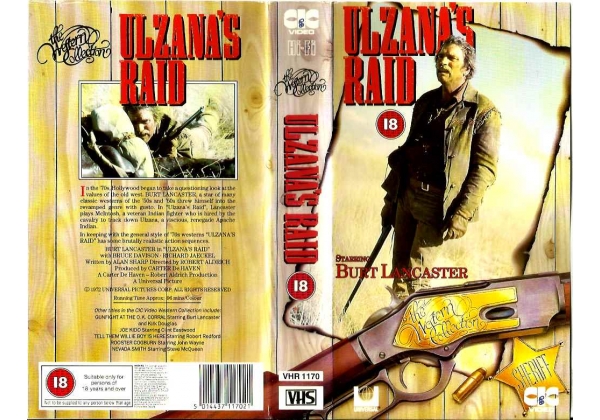
The Video Archives podcast really hit a lot of Roger Aldrich movies this season. The director told Film Comment, “From the time we started to the time we finished the picture, I’d say fifty, sixty percent of it was changed. Alan Sharp, the writer, was very amenable and terribly helpful. And terribly prolific. He can write twenty-five pages a day. He couldn’t agree more with my political viewpoint—so that was no problem. And fortunately, Lancaster and I felt pretty much the same about the picture. It was good that I had support from Sharp and Lancaster, because I don’t have the highest regard for Carter DeHaven, the producer.”
The first time Aldrich and Burt Lancaster worked together since Vera Cruz, this was a Western released after Italy had its way with the genre, which gave birth to the American revisionist Western.
It’s a definite Tarantino favorite, who said in a New Beverly blog article said that it was “hands down Aldrich’s best film of the seventies, as well as being one of the greatest westerns of the seventies. One of the things that makes the movie so remarkable is it isn’t just a western; it combines the two genres that Aldrich was most known for, westerns and war films.”
That’s because it’s just as much a movie about Vietnam as it is the West.
Ulzana (Joaquin Martinez) has taken a Chiricahua war party and escaped captivity. This puts the fear of, well, Native American vengeance into most of the army that faces them, as one even kills himself and the woman he is escorting than face them. The unlucky man to try and stop him is McIntosh (Burt Lancaster). Near the end of his service, he only has a few dozen men to win this skirmish, including Apache scout — and Ulzana’s brother-in-law Ke-Ni-Tay (Jorge Luke) and a way too young soldier named Garnett DeBuin (Bruce Davidson).
Where this becomes Vietnam, obviously, is because the Native Americans have known this land for hundreds of years and the better armed Americans aren’t better trained. They just have nicer guns. DeBuin isn’t ready for the way that war will change him and McIntosh is just ready to die by the end of the film. Even Ke-Ni-Tay lays down his weapons, knowing he’s done, but he’s changed each and every person who has faced him.








 B&S About Movies
You must be logged in to post a comment.