CANNON MONTH 2: Straw Dogs (1971)

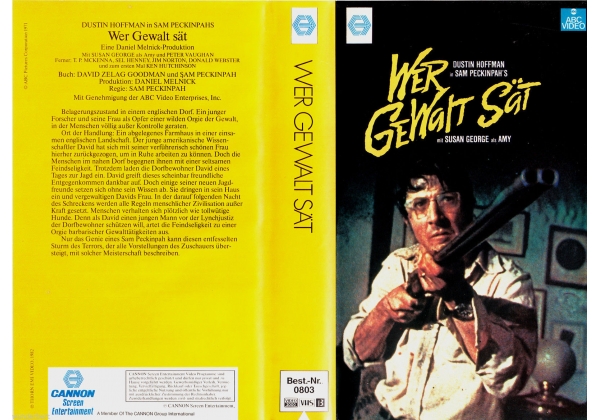
EDITOR’S NOTE: Straw Dogs was not produced by Cannon. It was, however, released on video in Germany by Cannon Screen Entertainment.

I know they made a remake of Straw Dogs in 2011, but there’s no way I can imagine people not being beyond upset with this movie. The violence probably wouldn’t upset all that many people, but the two graphic assaults of Susan George — much less the quick flash that she may not have been all that upset by the first — would be greeted by a procession of anger the likes of which no movie made today would be able to create. I mean, would director Sam Peckinpah have been able to make movies in today’s world? One could argue that he struggled to do it in the 70s.

Based on The Siege of Trencher’s Farm by Gordon M. Williams and written by David Zelag Goodman and Peckinpah, the story begins with David Sumner (Dustin Hoffman) moving his wife Amy (George) back to her hometown of Wakely. Her ex, Charlie Venner (Del Henney), has a gang of horrible townsfolk like Norman Scutt (Ken Hutchison), Chris Cawsey (Jim Norton) and Phil Riddawa (Donald Webster) and each of them resents the meek academic American making love to one of their own.

David and Amy have moved into her father’s house, Trenchers Farm, and hired the four men to fix it up. As the house improves, their marriage falls apart, as she claims he left America because he was a coward afraid of conflict and that he treats her in a condescending manner. He withdraws into his study of stellar structures while she teases the workmen with her body.

Despite the men killing their cat, David still goes hunting with them. They pull the snipe hunting trick and abandon him, heading back to his home so that Venner can attack his wife. That coupling seems a bit too much like lovemaking by the end and as she holds her ex-lover, Scutt comes in with a gun and forces Venner to hold her down. By the time David returns, Amy says nothing.

The next day, David fires the men and Amy has a breakdown in church when she sees them. Things get worse — a local boy named Henry Niles (David Warner) ends up being seduced by a relative of Venner named Janice Hedden (Sally Thomsett). When the men chase them down, he accidentally kills her and goes on the run. After David accidentally hits him with his car, he takes the boy home, which brings the foursome back to begin invading the home.

Then David says, “I will not allow violence against this house.”

What follows is a Hoffman descending into the kind of barbaric behavior one expects in a Stanley Peckinpah movie.

Straw Dogs is older than I am and still packs such infernal power. We see ourselves cheering for David to finally rise up, but is too much well, too much? I guess not from the same man who made The Wild Bunch. I’ve been thinking this film over and over in my head and trying to figure out how I feel about it. It’s not ambivalence. I’m just seeking an answer.

CANNON MONTH 2: The Butterfly Affair (1971)

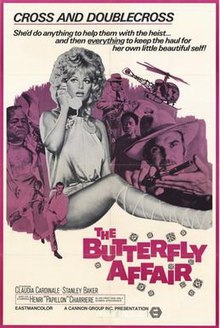
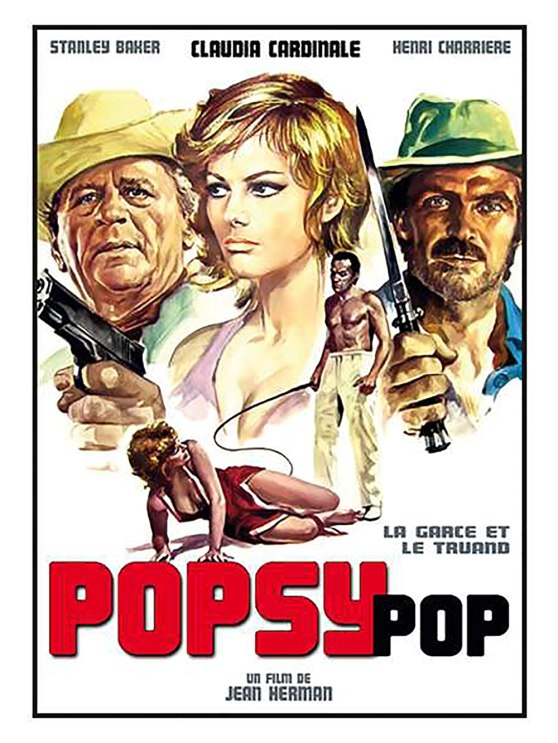
Inspector Silva (Stanley Baker, A Lizard in a Woman’s Skin) is a former private eye and now a surveyor and guard for the interests of a diamond company  Vista Alegra, Venezuela. This is a town where diamonds come right out of the mud. It’s also where French singer Popsy Pop (Claudia Cardinale, Once Upon a Time in the West) has come — on tour? on vacation? why does she travel with a giant Alice In Wonderland book and doll? — along with gangsters led by Marcou (Henri Charrière, the writer of Papillon, the story of his time in a penal colony and his later escape). They want to steal at least $2 million dollars of diamonds.

The heist goes down and only Popsy escapes. The men — except for Marcou — are all killed, with Silva making a deal with the elder criminal: He will help the detective search for Popsy and the diamonds. In exchange, Marcou is to get Popsy, whom he is in love with and he will receive 15 percent of the diamonds.

The two men soon realize that Popsy is able to get into their heads and hearts, which makes her dangerous. Who will get the diamonds? More to the point, who gets the girl?

Directed and written by Jean Vautrin (along with J.B. Beellsolell), this was also released as The 21 Carat Snatch.

CANNON MONTH 2: I, Monster (1971)

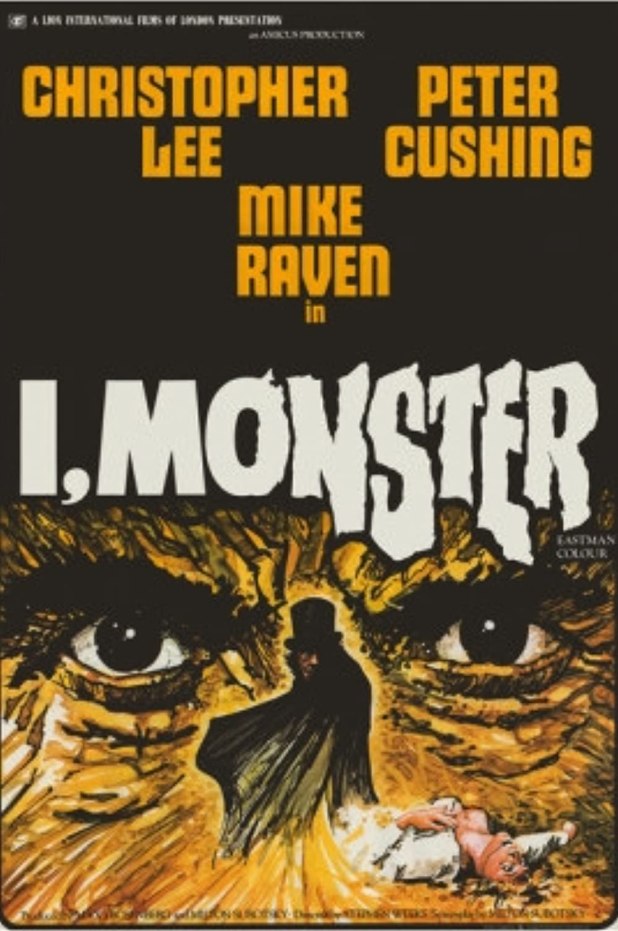
Dr. Charles Marlowe and Mr. Edward Blake, the main characters in this movie, are not fooling anyone. This Amicus film is really an adaption of Strange Case of Dr. Jekyll and Mr. Hyde and has Christopher Lee in the main role and Peter Cushing as his lawyer Utterson, who thinks that Marlowe and Blake are two different people.

This is the first movie that Stephen Weeks directed. He’d go on to make Sword of the Valiant for Cannon in the 80s. The script comes from Amicus head Milton Subotsky.

Originally intended to be released in 3D, the film used the Pulfrich effect — in which the “lateral motion of an object in the field of view is interpreted by the visual cortex as having a depth component, due to a relative difference in signal timings between the two eyes” or in short, the eye and mind are fooled into seeing depth where there is none — it seems like the foreground is always moving to the right and the background sliding to the left.

Peter Cushing has said that this was one of the least enjoyable movies he made, but I’ve heard that about several films.

CANNON MONTH 2: Goodbye Uncle Tom (1971)

EDITOR’S NOTE: This was first on the site on June 2, 2020.

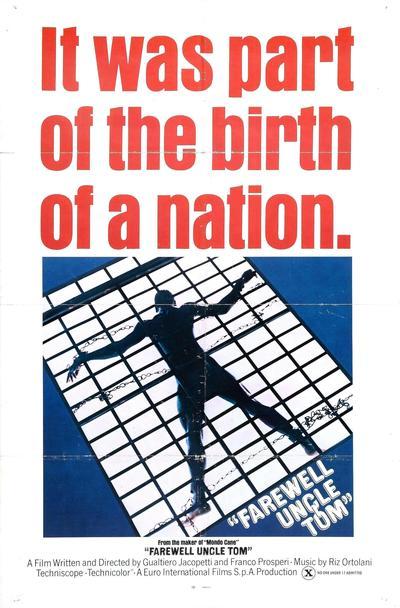
Five years after Africa Blood and Guts, Gualtiero Jacopetti and Franco Prosperi returned with this movie, which is pretty much one of the roughest films I’ve ever made it through.

This was shot primarily in Haiti, where the directors were the guests of Haitian dictator Papa Doc Duvalier, who gave them diplomatic cars, clearance to film anywhere on the island and as many extras as they required to be used as slaves being treated exactly as slaves were. They were also invited to a nightly dinner with Duvalier himself.

If your mind isn’t already blown, stick around.

Goodbye Uncle Tom is based on true events in which the filmmakers explore America in slavery times, using published documents and materials from the public record to make what they consider a documentary, even claiming to go back in time to achieve this level of realism.

This movie was made in opposition to the claims that Africa Blood and Guts was racist. It didn’t work, as Roger Ebert would say, “They have finally done it: Made the most disgusting, contemptuous insult to decency ever to masquerade as a documentary.” He also stated that “This movie itself humiliates its actors in the way the slaves were humiliated 200 years ago.”

The movie was originally released in Italy in a 119-minute version and was immediately withdrawn. I’ve read that the directors were sued for plagiarism by writer Joseph Chamberlain Furnas. It was then re-released with 17 more minutes of footage.

The director’s cut shows a comparison between the horrors of slavery and the rise of the Black Power Movement, ending with an unidentified black man’s fantasy of living out William Styron’s The Confessions of Nat Turner. In that book, Turned is divinely inspired and given a mission from God to lead a slave uprising and destroy the white race.

This ending upset American distributors so much that they forced Jacopetti and Prosperi to cut more than thirteen minutes of racial politics that would upset their audiences. Pauline Kael still said that the movie was “the most specific and rabid incitement to race war,” a view shared with former Ku Klux Klan leader David Duke, who said that Goodbye Uncle Tom was a Jewish conspiracy to incite blacks on white violence.

This movie is not for everyone. But I feel that it needs to be seen. I rarely get political on this site, but in truth, I feel that we as a country have not done enough to understand the roots of the black experience. While an Italian exploitation film isn’t the best way to learn more, it’s a start.

It’s no accident that Cannibal Holocaust would eventually use the music of Riz Ortolani to juxtapose the horrific images on screen with the beauty of his compositions. The composer had been working with the duo since Mondo Cane, where his song “More” nearly won an Oscar.

But make no mistake that this movie, while intending to be educational and anti-racist, still employs the tools of the mondo and exploitation. How else do you describe the conceit that these filmmakers have gone back in time, taking a helicopter with them that they use to fly away from the terrors of the plantation at the end?

In 2010, Dr. David Pilgrim, the curator of the Jim Crow Museum of Racist Memorabilia, said that when he showed this film to a class, it led to some major traumas. “On the day that we watched Goodbye Uncle Tom three students had unexcused absences, several cried while watching, one almost vomited; most sat, sad and disgusted. I taught for another fifteen years but I never showed that movie again.”

He went on to say that the film “is a more truthful portrayal of the brutality and obscenity of slave life than was Roots; however, I have some major problems with the film. I find it ironic that a movie that explored the exploitation and degradation of Black people was filmed in a way that exploited and degraded Black people. In some ways Goodbye Uncle Tom was just a XXX movie set against the backdrop of slavery; the “peculiar institution” served as an excuse to show sexual and violent gore. Jacopetti and Prosperi told a great many painful truths about slavery but they debased hundreds of Blacks to make the film.”

“I said all of that to say this: Jacopetti and Prosperi were not the messengers that I would have selected, and their implied assumptions about Blacks are troubling, but they made a movie that accurately portrayed the horrors of slavery. Of course, it is the case that a realistic depiction of the savagery of slavery would be difficult to watch no matter who made it. This is why when you finish watching Roots you may feel that a family has overcome great oppression and a nation has become more democratic; whereas when you finish watching Goodbye Uncle Tom you just feel sick to your stomach.”

That says a lot about this movie in a better way than I can, but I’m still going to try to sum it up: this is a well-made movie that may have been made with the best of intentions, but was made by two people who only had the experience to make exactly what they made. It is a movie made about slavery that used slave labor. It is a movie that offended both liberals and conservatives, those that believed in tolerance and those that were racist, those that were black and people who were white. This is a message movie that had its message taken away by American producers, leaving two hours of shock with none of the moral it so desperately needed.

If this movie upsets you, perhaps you needed to be upset. You should be less upset about a movie made nearly fifty years ago and more upset about our nation’s history of racism and intolerance. And you should definitely be upset about the lack of civil rights in our country today. I’m writing this after a day of nationwide protest, with police cars ablaze and crowds of protesters and the press teargassed.
CANNON MONTH 2: Face-Off (1971)

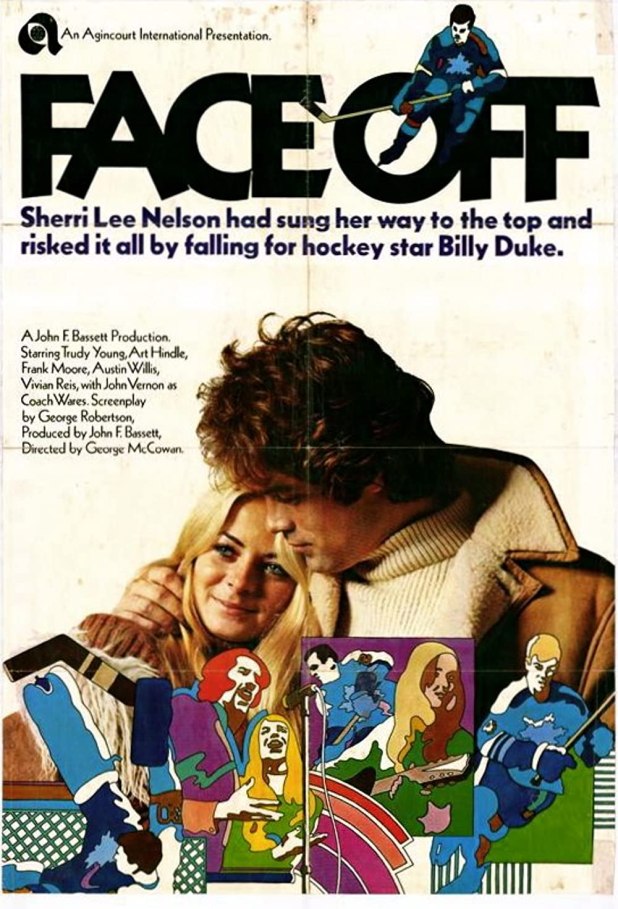
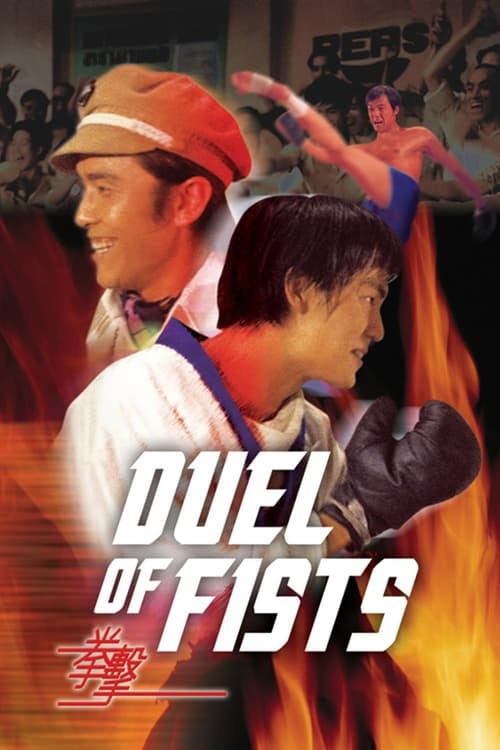
Also titled Winter Comes Early — the name of the band in the movie — this George McCowan (FrogsThe Shape of Things to Come)-written and George Robertson-written film — based on writing by Neil Young’s sportswriter dad Scott — has Art Hindle as Billy Duke, a hockey player who becomes an overnight sensation playing with the Toronto Maple Leafs.

He’s also dating a singer named Sherry Nelson (Trudy Young) who hates all the violence of hockey. That won’t do for his coach Fred Wares (John Vernon), who wants to break up the young couple so Billy can focus on playing hockey. As for Sherry, her former love and bandmate Barney (Frank Moore) is trying to win her back but drugs seem to be really winning her heart.

This is a great opportunity to see 70s NHL hockey with players like Bobby Orr, Stan Mikita, Bobby Hull, Derek Sanderson, George “Chief” Armstrong, Darryl Sittler, Ron Ellis, Rick Ley, Paul Henderson, Bobby Baun and more showing up on the ice.

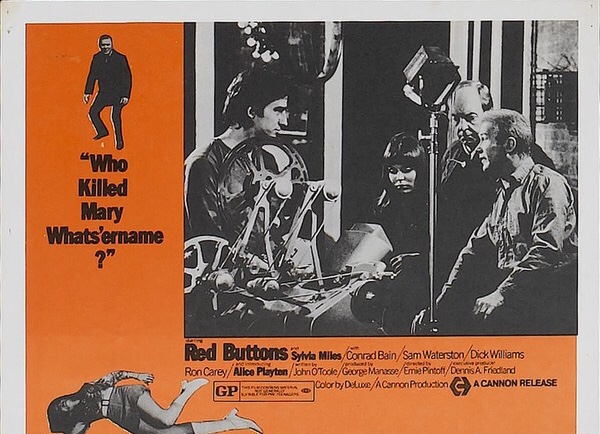
CANNON MONTH 2: Who Killed Mary What’s ‘Er Name? (1971)

Ah man, another impossible to find early Cannon movie.

Also known as Death of a Hooker, this is the tale of diabetic ex-boxer Mickey Isador (Red Buttons, not playing a comedy here) who feels that the NYPD didn’t do enough to investigate the murder of his sex worker neighbor Mary. To solve the case, he teams up with her friend Christine (Sylvia Miles, Madame Zena from The Funhouse), his daughter Della (Alice Playten, under all that makeup, she played Blix from Legend), the drunken Val (Conrad Bain) and would-be director Alex (Sam Waterston).

This movie feels like it lives in the same sleazy neighborhood as any other grindhouse New York movie while never dwelling in that gutter, such as when Mickey turns down a freebie when he saves Christine from being assaulted.

Director Ernest Pintoff also made Lunch Wagon and Jaguar Lives! As for the cast, it’s filled with notable minor pop culture stars, like Earl Hindman (Wilson on Home Improvement), Ron Carey (Carl Levitt on Barney Miller), Gilbert Lewis (The King of Cartoons) and David Doyle (Bosley on Charlie’s Angels).

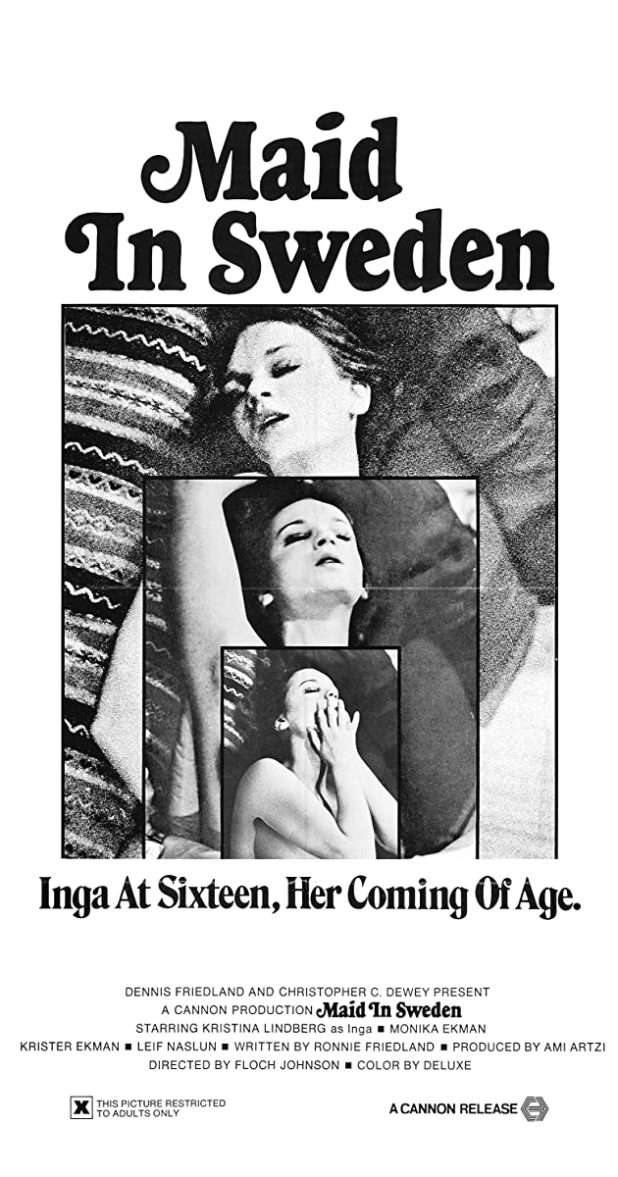
CANNON MONTH 2: Maid in Sweden (1971)

Dan Wolman also made Baby Love and Nana for Cannon. Here, the Israeli filmmaker is in Sweden, making a movie about a young girl named Inga who leaves her small town for the big lights and big city of Stockholm. There, she’s shocked to find her sister Greta (Monica Ekman) is living in sin with her boyfriend Casten (Krister Ekman, Monica’s real-life husband). Before you can say Swedish adult film imported by Cannon, Casten is making love to both sisters, putting a wedge between them. Then, Inga leaves for home.

This movie has just as much sex as travelogue footage, padding it — barely — to eighty minutes.

Yet it has one thing that makes it worth watching.

Inga is played by Thriller star Christina Lindberg.

Yes, the one-eyed demoness of revenge.

I’d like to not have this article descend into me being a Tex Avery wolf over Lindberg, but that’s incredibly difficult. If you ever wondered, was the world created by an accidental combination of chemicals and the Big Bang or was there a Divine Designer behind it all, I point you to Christina Lindberg and ask you to make up your own mind.

CANNON MONTH 2: Crucible of Horror (1971)

EDITOR’S NOTE: On July 19, 1971, Cannon Releasing Corporation brought this British movie to America. It was first on the site on November 1, 2019.

Walter Eastwood (Michael Gough, Alfred from the Batman movies) has been physically and mentally abusing is wife (Yvonne Mitchell from 1984) and daughter, as well as raising a son to be exactly like him. So they do what any of us would. They kill him. The problem is that he won’t stay dead.

Mitchell and Gough were well-known stage performers with Gough appearing in so many British horror films. The couple’s children, Rupert and Jane, were played by Michael Gough’s real-life son Simon and Simon’s fiancee Sharon Gurney. That may seem weird, seeing as how they were married before the movie was released.

Otherwise known as The Velvet House, this take on Les Diaboliques was made for a minimal budget. It shows, but the acting is great.

CANNON MONTH 2: The Blood On Satan’s Claw (1971)

EDITOR’S NOTE: Originally on the site on January 19, 2020, this folk horror film was brought to America by Cannon Releasing Corporation.

In his BBC documentary series A History of Horror, Mark Gatiss referred to this film, along with Witchfinder General and The Wicker Man, as the prime example of a short-lived subgenre he called folk horror.

It’s directed by Piers Haggard, who also was behind The Quatermass ConclusionThe Fiendish Plot of Dr. Fu Manchu and Venom. He’s also the great-great-nephew of H. Rider Haggard, the creator of Allan Quartermain.

Robert Wynne-Simmons was hired to write the story, which was inspired by the modern-day Manson Family and Mary Bell child murders.

In the early 18th century, Ralph Gower (Barry Andrews, Dracula Has Risen from His Grave) uncovers a one-eyed skill covered with fur while plowing his fields. He asks the judge (Patrick Wymark, Dr. Syn, Alias the Scarecrow) to look at it, but it’s gone missing, and his fears are ridiculous.

Peter Edmonton brings his fiancee, Rosalind Barton (Tamara Ustinov, Blood from the Mummy’s Tomb), to meet his aunt, Mistress Banham. Banham disapproves of the coupling and demands that Rosalind sleep in an attic room. After screaming throughout the night, she soon gets ill, and the judge commits her. As she’s led away, Peter discovers she has a claw instead of a hand.

Claws show up all over this — hidden in fields to be found by children and attacking Peter inside the cursed room, causing him to sever his hand. The judge leaves behind the town for London but promises to return. He places Squire Middleton (James Hayter, The 39 Steps) in charge.

One of the children who found the claw, Mark, is lured out by his classmates and killed in a ritual game by the leader of a new cult, Angel Blake (Linda Hayden, MadhouseQueen Kong). She even tries to seduce Fallowfield (Anthony Ainley, the Master from Dr. Who) and tells him that Mark had the devil inside him, which needed to be cut out. Her group also has a Black Mass inside a ruined church where they attack Mark’s sister Cathy (Wendy Padbury, companion Zoe on Dr. Who). They ritualistically assault and murder her before tearing the fur from her skin.

Of course, it’s not long before all hell quite literally breaks loose, with insane children raising Satan himself from the Great Beyond and Ralph growing fur on his leg, marking him for death. This movie is…well, there’s nothing else quite like it. I can see why it had a limited audience for years; it’s so dark and unforgiving.

“It never made much money,” said Haggard. “It wasn’t a hit. From the very beginning, it had a minority appeal. A few people absolutely loved it, but the audiences didn’t turn out for it.”

While Satan’s Skin was the original title, you must give it to American International Pictures’ Samuel Z. Arkoff, who created the film’s title.

CANNON MONTH 2: Jump (1971)

Chester Jump (Tom Ligon) dreams of being a racecar driver but for now, he’s fixing cars for Babe Duggers (Logan Ramsey; Mama Fratelli was his real-life wife). So until he gets there, he’s going on a rambling journey through Florida, picking up service industry women, challenging other men to races, fighting with his family and just trying to get by.

Then he goes from dirt to stock racing, finally succeeding in a demoliton derby before he walks away alone.

Take a look at that poster.

None of that happens in this movie.

What does are long arguments between Chester and his father, playd by an incredible Conrad Bain years before he was Mr. Drummond. He’s drunken, brutal and bleak. Jack Nance, Judd Hirsch and Sally Kirkland are also here in very small parts.

Also known as Fury On Wheels, this film was directed by Joseph Manduke (Omega Syndrome, the movie version of Beatlemania) and written by Richard Wheelwright in his only screen credit. It was shot at the now closed Golden Gate Speedway and many of that scenes locals were used as extras and as stunt drivers.

As for the character of Dutchman, you may recognize the voice. He’s “Voice of God” Norman Rose, who like Bain was also in Who Killed Mary What’s Her Name? He was also the voice of radio drama Dimension X, the voice in the Juan Valdez coffee commerical and the narrator for the American version of Message from Space.

Robert Koster, who was the second unit director, played the Scarecrow in Dark Night of the Scarecrow, while cinematographer Gregory Sandor also worked on SistersThe Born Losers and The House on Bare Mountain. Working as the script and continuity supervisor? William Kerwin’s sister Betty. And the most interesting trivia of all is that the music producer for Jump was Martin Mull, years before he’d start acting.