As Night Gallery moved into its second season, it would start becoming schizophrenic, caught between the darkness and the light of pained comedy or more to the point, creator Rod Serling versus producer Jack Laird. Yet when it works, well, man does it work.
I think about “The Boy That Predicted Earthquakes” so often. Directed by John Badham, years before he’d make Saturday Night Fever, it was written by Rod Serling from a Margaret St. Clair story. Clint Howard is astounding as Herbie Bittman, a young boy who simply talks like a real little kid going on and on about telescopes before dropping apocalyptic knowledge on TV audiences. What kid could hopefully deliver a message of hope when he knows that the world will end horribly the very next day? What a Satanic moment in a series known for so many, a child delivering the burnt out worldview of Serling to the masses. A near-perfect segment worth endlessly rewatching.
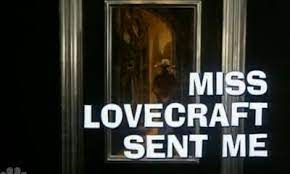
Less can be said about “Miss Lovecraft Sent Me,” the first of too many “black out” gags which has Joseph Campanella as a vampire and Sue Lyon as a babysitter. Director Gene R. Kearney wrote Night of the Lepus and would go on to contribute to the beloved 1979 series Cliffhangers, but the fact that he was involved in Laird putting his insipid fingerprints all over a masterwork is a strike against him. At. least Lyon is gorgeous; she did better work in Lolita and Murder In a Blue World.
“The Hand of Borgus Weems” has that most horrific and hoary of horror tropes: the haunted human hand. Peter Lacland (George Maharis) claims that his hand is possessed and demands that Doctor Archibald Ravadon (Ray Milland) amputate it. It’s simple and effective, with assured direction by John Meredyth Lucas, a producer on Star Trek and the director of several episodes of the Planet of the Apes TV series. Its writer, Alvin Sapinsley, also wrote Moon of the Wolf.
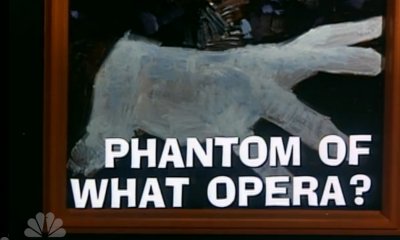
Sadly, “Phantom of What Opera?” is another gag with Leslie Neilsen as the Phantom and Mary Ann Beck as his victim. Directed and written by Kearney, it’s exactly the kind of two-minute silliness that would continue to mar this show all season long.
What do you think of this episode? Which story is your favorite? Let me know in the comments.
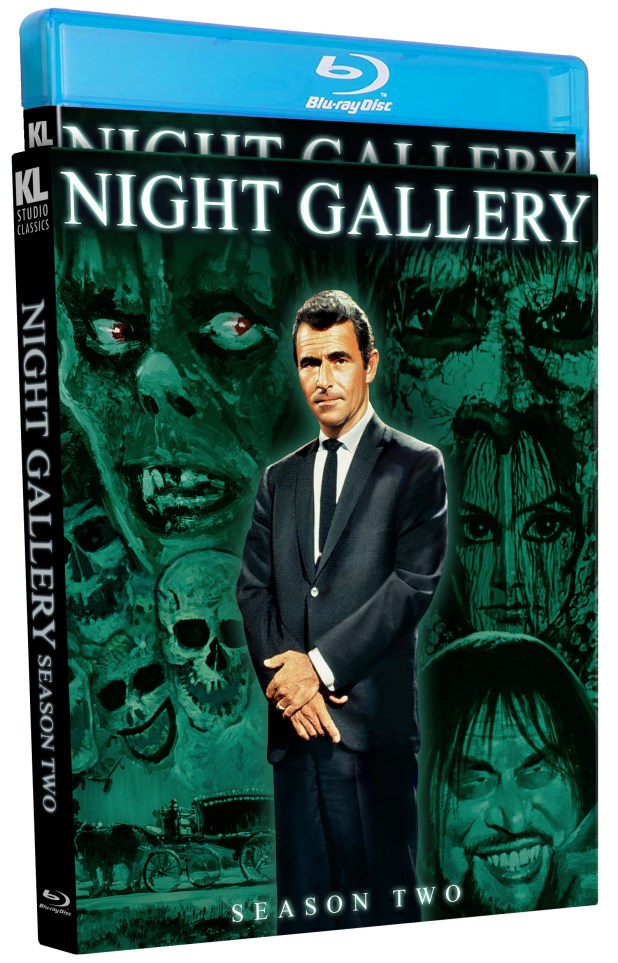
You can buy the second season of Night Gallery on blu ray from Kino Lorber.
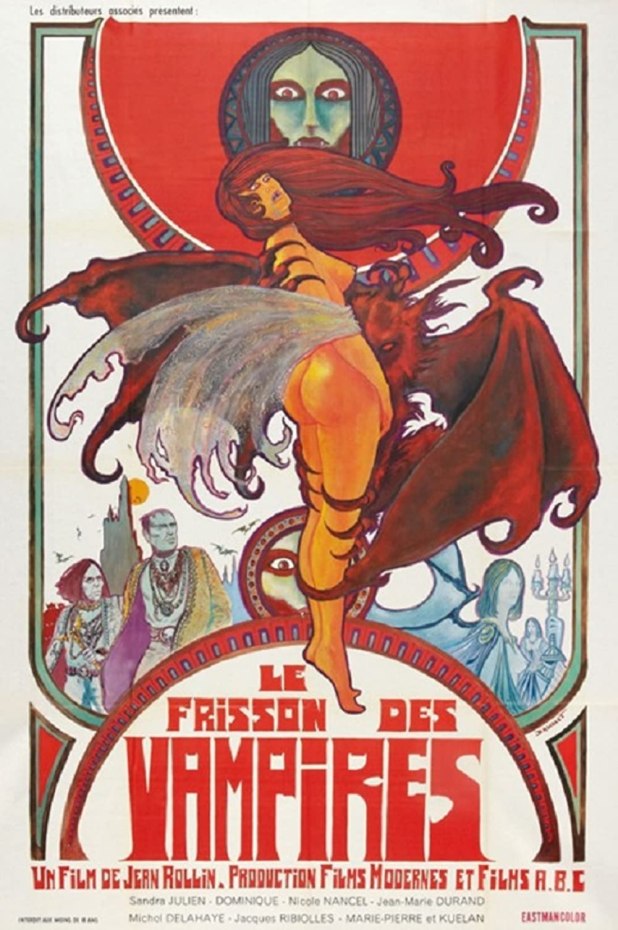
Also known as Sex and Vampires, Strange Things Happen at Night, Terror of the Vampires, Thrill of the Vampire and Vampire Thrills, this is the third time that Jean Rollin would bring a vampire movie to the screen. Look, if you’re obsessed, you’re obsessed.
Isle (Sandra Julien, Je Suis Frigide… Pourquoi?) and Antoine (Jean-Marie Durand) have just arrived in town for their honeymoon, only to learn that the cousins they plan on staying with have died. But hey — they’re house is open, right? And it’s totally not weird that the two servants (Marie-Pierre Castel and Kuelan Herce) just tell them to stay. Nor is it otherworldly that Isolde (Dominique) emerges from a clock and soon, she’s unable to go out into the sun.
Every woman is naked, bras have spikes in them, castles are filled with fog, Rollin shows a love of the lighting and colors of Bava and the band Acanthu is just rocking so hard that no one can yell loud enough over them to tell them, “Hey this is a dreamy sapphic vampire movie, maybe stop rocking so hard” and they’re just headbanging and smoke is everywhere and just go with it, man.
Also: Not the last lesbian vampire movie Rollin had in him.
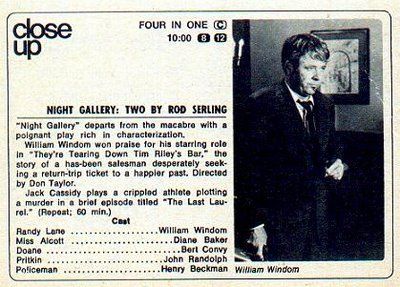
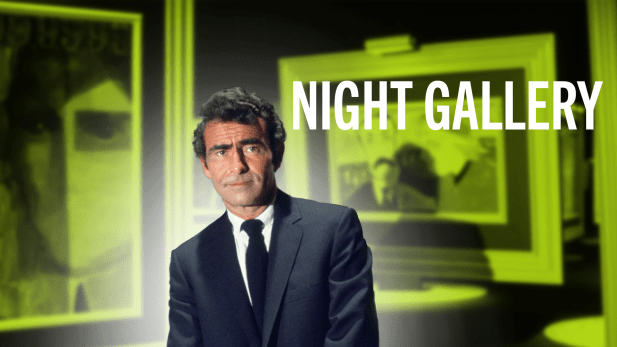
First airing on January 20, 1971, this episode of Night Gallery fully embraces the darkness of the world, as a man grows old and the world changes around him in the first story, one I have gone back to watch again and again.
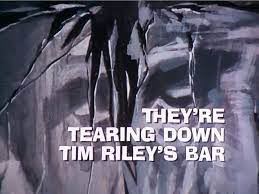
“They’re Tearing Down Tim Riley’s Bar” is directed by Don Taylor (Damien: Omen II, The Final Countdown, Escape from the Planet of the Apes) and written by host Rod Serling is the story of Randy Lane (William Windom), who returned home from the war, had a party at Riley’s, got married and found a great job in plastics. But that was 25 years ago and now, his wife is dead, the job is a dead end and they’re tearing down Tim Riley’s Bar.
His boss (John Randolph) has forgotten him. His assistant (Bert Convey!) is after his job. The only person who seems to care is his secretary (Diane Baker) but he’s blinded by grief and can’t see it. All he can do is drink himself into oblivion and wander the old places of his life and bear witness to the ghosts of the past, much better spirits than he sees every day.
Not really horror, not even scary, this is one of the best segments of the show and was nominated for an Emmy. The older I get, the more it upsets me, but that’s why when Serling is good, there’s no one better, even if the ending is way too simple.
“The Last Laurel” was directed by Daryl Duke, who would go on to make The Silent Partner and The Thorn Birds. Written by Serling from a story by David Grubb, it suffers by comparison to the first half of this episode. Jack Cassidy plays Marius Davis, a man dying and unable to stop his gorgeous wife Susan (Martine Beswick) from sleeping with the man treating him in his last moments, Doctor Armstrong (Martin E. Brooks). Of course, there’s revenge by astral projection.
This ends the first season of Night Gallery yet it feels like things are just getting started.
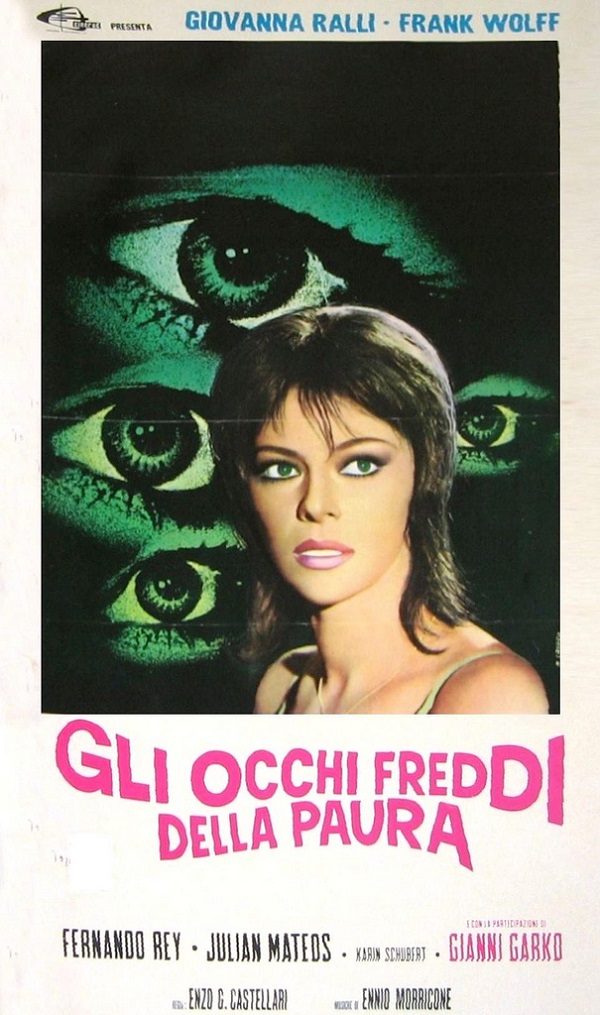
This would be his only giallo, written with Tito Carpi after being inspired by the all-in-one-apartment feel of Wait Until Dark as well as The Boys in the Band and The Desperate Hours, which explains its alternate title Desperate Moments.
When Peter Flower (Gianni Garko, Sartana in my mind forever) picks up the gorgeous Anna (Giovanna Ralli, What Have They Done to Your Daughters?) — or maybe hires her? — and takes her back to his uncle Juez’s (Fernando Rey) house. He doesn’t realize that Arthur Welt (Frank Wolff) and Quill (Julián Mateos) have been stalking the house, as the uncle was the judge who sent them all to jail.
An American star who stayed in Europe to act in tons of movies — thanks to the advice of Roger Corman — Wolff would sadly kill himself weeks after finishing this film. His wife wrote the American dialogue, as this was filmed for foreign audiences, but then she left him. He was clinically depressed; she found another man; he found a younger women who supposedly didn’t return his affection. He literally cut his carotid artery with two razors. He was in tons of great movies — Once Upon a Time In the West, Carnal Circuit, Death Walks On High Heels — and it makes seeing him in this quite sad.
Welt dresses as a cop and continually tells Peter that they are both above Anna and Quill. After all, they both drink J&B, right? That makes them a higher class. By the end of the movie, he’s totally unhinged and that makes sense, as his wife left him during the shooting and he never recovered.
This starts with a scene that seems giallo — a gorgeous woman is menaced with a switchblade — but that’s the first plot twist as this is simply an S&M show. It also has full on jazz freakout music by Ennio Morricone and Castellari pulling off insane things like shooting scenes through glasses of ice. It slows down for some parts, but the sum is greater than the parts, so I ended up really being entertained.
EDITOR’S NOTE: Cinematic Void will be playing this film — my favorite giallo — on Thursday, Jan. 18 at the Central Cinema in Knoxville, TN. For more information, visit Cinematic Void.
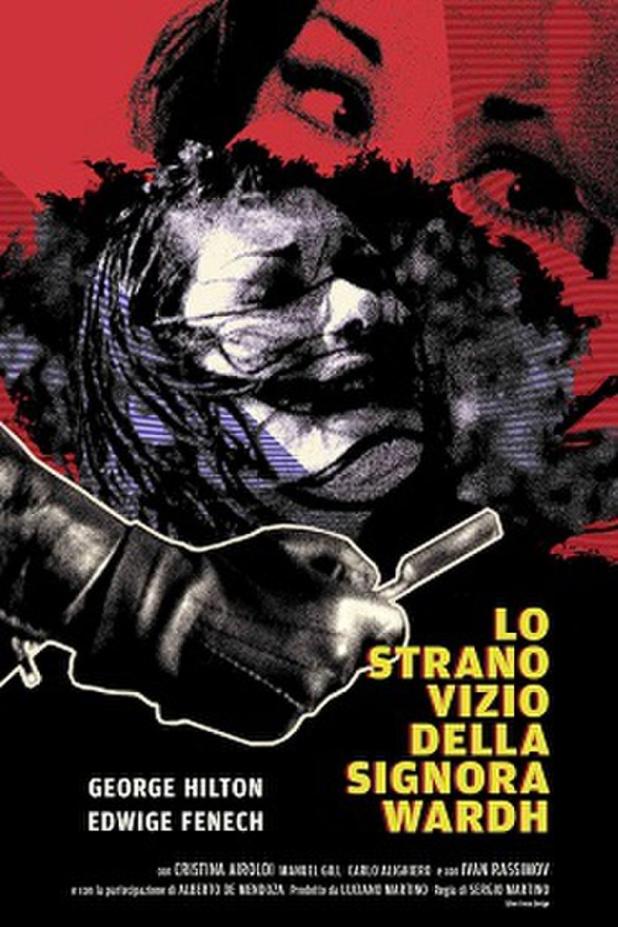
Sergio Martino’s directorial efforts have run the gamut — from straight exploitation (Mondo Sex and Mountain of the Cannibal God, which features Stacy Keach and Ursula Andress, as well as real animal mutilation which we’d never endorse) to horror (Island of the Fishmen, which in addition to starring Barbara Bach and Joseph Cotten, was re-edited by Jim Wynorski and re-entitled Screamers), post-apocalyptic action (2019: After the Fall of New York and Hands of Steel, which is more Terminator rip off than Road Warrior), spaghetti westerns, crime dramas, war films, comedies and even Italian TV, where he’s worked for the last several decades. But this week we’re here to discuss his contributions to the world of giallo.
This is his first effort and the start of the ensemble case in which he’d use in his films. George Hilton would appear in four of his films, Ivan Rassimov in three and one of the queens of the giallo, Edwige Fenech, would star in three (in fact, she was married to Sergio’s brother, the late producer Luciano Martino, at one time).
Wondering why this film isn’t just titled The Strange Vice of Mrs. Ward? Turns out a woman named Mrs. Ward sued before the release, claiming that the film would ruin her good reputation, so they changed the title. Yes, Italy, the country where you can make a movie called Zombi 2and have nothing to do with the original film still has legal settlements such as this. You can also find this movie under the titles Blade of the Ripper, Next! and The Next Victim.
Julie Wardh (Fenech) is the wealthy heir to a retailing company. But she’s also a fragile flower, back in Vienna, a city packed with memories and former lovers. She’s married to Neil (Alberto de Mendoza from Horror Express and A Lizard in a Woman’s Skin), a man so wealthy and powerful that he leaves for business the moment they land.
As Julie rides alone in the rain, her car is stopped by the police who are on the hunt for a killer. The sound of the wiper blades reminds her of the last time she was here, recalling a vicious fight between her and a lover who repeatedly slapped her around before they made love in the rain. There’s a gorgeous shot here at the end, where the lovers are to the left of the camera while rain descends on them, almost illuminating them and a sports card pushes into the right foreground. Compared to other giallo which seem content to merely ape Argento or seem like boring police procedurals, Martino aspires to art within his direction (which honestly is why this site is planning on a week of his films).
A green light and honking horns snap Julie from her reverie and she returns to her apartment, where she takes strange notice of a car. Her apartment has been left exactly as it was the last time she was here — it’s a white pop art explosion of metallic, green and blue lines contrasted with oval windows — and just as she’s getting ready to take a bath, the buzzer rings. A dozen roses with a note attached: The worst part of you is the best thing you have and will always be mine – Jean.
We cut to a party, where Caroll (Conchita Airoldi, who would go on to produce Cemetery Man) is trying to hook Julie up with her cousin George (George Hilton, All the Colors of the Dark, The Case of the Bloody Iris) as a catfight between two girls in paper dresses goes down. Tell you what — if I am to learn anything from giallo, it’s that every party in 1970’s Italy was packed with drugs, crazy music and the chance that anything from a fistfight to an orgy could happen at any minute. People had to be exhausted all the time. Jean (Ivan Rassimov from Planet of the Vampires, Your Vice is a Locked Door and Only I Have the Key, Eaten Alive!), the guy who sent the roses and was the man she remembered in the earlier flashback, is there extending a salute. This enrages Julie, who leaves the party, but he follows her into the street. He reminds her that she belongs to him, but she counters that she married Neil to escape him, which is cemented when Neil shows up and punches the dude. Jean just laughs, looking at both of them, knowing that he owns Julie body and soul.
This leads to a flashback where Jean pours champagne all over her, soaking her dress, then smashes the bottle of champagne, showering her in glass shards. He uses what’s left of the bottle to slice up her dress and skin before he takes her. Their coupling is a mix of pleasure and pain, covered in blood, that she had to escape. But did she want to?
So what then is Mrs. Wardh’s strange vice? Is it for men that are bad for her? Is it for pain and dominance? Or some combination of both? As we learn, she’s caught between three men — her husband, whose cool indifference and emotional (and physical) unavailability is just as cruel as her former lover Jean, who owns her to the point that she is nearly his again before Neil showed up to hit him. And the third side of this love rectangle (is there such a thing?) is George, who is the porridge to her Goldilocks — the just right combination of both. Yet there is a fifth side to this — making it a love pentagon (!?!) — with Julie wanting to be a good woman, true to her vows and not to her need to be beaten, bloodied and forced. She is torn between her desire and her need to fit into the moral code of the world. So much of giallo is based on this — created in a country where the Holy Seat of a religious empire sits smack dab in the middle of Rome. Religion and morality nearly shook hands with the sexual revolution and excesses of the pre-AIDS 1970s.
Ah, but let’s not forget that a proper giallo needs a murder, which this film delivers with a quick slash in the shower. That said — what strikes me about Martino is that unlike Argento, he cares more about the story and the characters than creating murder art set pieces. The conversation between Carol and Julie isn’t just words on a page, they’re vital clues into her mental state. Whereas Carol’s casual amorality is revealed, saying that the killer — who we just saw attack the showering girl — is taking out her competition, Julie worries about her values. She married Neil for security and protection, but not the monetary or physical kind. She wanted protection from herself, as she feels that her loss of control and willingness to submit to the violent impulses of men makes her a sinner.
George shows up to meet Julie and get to know her better. He even tells her that he loves to court women when their husbands are around, cuckolding them. Julie claims that that leaves her cold, while Carol claims that she’d bed him, family or not. They decide to go to lunch together, which seems to be more about George staring at Julie than sustenance. Julie demands that George take her to the bus station, but instead he takes her all over the countryside on his motorcycle (What is it with Fenech’s character and dudes that ride bikes? Is it the freedom that it represents?) while he wears white leather fringe, a look that is very 1971. He calls her the moment that she enters the house and she tells him that she likes him way too much, so she can never see him again. Of course, he’s already there and enters the front door before kissing her. She tries to get away, but he keeps telling her that he is in love with her. She begs him to not complicate her life, that she is not the girl he thinks she is. Their kiss is artfully compressed into a second kiss that occurs much later that same day — an intriguing way to show the passage of time and the growth of their relationship.
As they kiss in the dark, a car nearly hits them, which Julie is sure is Jean. She tells him to take her anywhere, which ends up being his apartment. The car returns and its driver watches from the window as Julie and George make love (or, more to the point, she knees him in the crotch while laying upon him, but whatever works for them, I guess).
Later, Julie gets more flowers from an anonymous admirer. Her husband asks who they are from and she wishes aloud that they came from him. There’s another note attached — “Your vice is a locked door and only I have the key.” She tells him that she realizes that diplomats only love other diplomats. He replies that she feels that he has always failed and wronged her. He asks if she is content. “I’m more than content,” comes her reply.
The black gloved killer is watching her and calls her to blackmail her, saying that he will tell her husband. She goes to talk to Carol and claims that it’s Jean. Carol responds that the killer’s last victim was “that whore at the party” and Jean couldn’t be the killer, as he doesn’t go after women like that. Carol embraces free love and says that if Julie is into George, then why should she have to hide it? Also: Carol just walks around her apartment naked (and also has a crazy cover up that is all black with red feathers) and Julie is just fine with it. Carol offers to go to where the blackmailer/killer wants her to drop off the money.
Julie nervously chainsmokes while watching a motorcycle race, a scene intercut with Carol going to meet the killer. To show the escalation of worry, Martino piles on the jump cuts and quick switches between the two women. Whereas Julie is trapped within her worry and the walls of her apartment, the carefree Carol is all alone within a huge park. Alone until the killer reveals himself, slashing her with a straight razor. Again — the killings are rather matter of fact in contrast to the set-ups in this film.
The police get involved, finally investigating Jean. They go to his apartment, which is covered with photos of naked women and exotic animals. Then, they interrogate him with her in attendance. It’s just an excuse for him to keep trying to seduce her and inform the police that Julie has a blood fetish, so she could be the killer, too. George has also been brought in for questioning, to which Jean says, “Now I know why my flowers have no effect on you.”
Neil arrives to take Julie home, but later George says that he wants to speak to her husband and take her away from the city. She says that she has to see this out, she has to discover who killed her best friend when it should have been her.
As Julie returns home, she finds herself in a dark parking garage. The headlines of a car cut into the inky blackness before she is nearly run over. She runs for the elevator, watching for the killer and the numbers of her floor to get closer. Yet the doors open to reveal the killer! Julie runs from him, even attempting to hit him with her car. She barely makes it inside the apartment, screaming at the door. Her husband lets her in but she’s in hysterics. There’s a lot of this scene that feels like it influenced Halloween 2‘s elevator scene. I’m not alone in feeling like that sequel is a giallo. Check out this awesome article from Bill at Groovy Doom to see what I mean.
Neil has had enough and decides to go to Jean’s house and confront him. He tells Julie that he will go alone, but she is afraid and rushes to be with him. They explore his dark house, finally finding Jean’s body in the tub. Julie is overcome and passes out in her husband’s arms. When they get outside, Jean’s car is gone and flowers have been left in the backseat with another poem. Neil throws the flowers down in disgust.
We cut to a dream sequence of George, a laughing Carol and Jean covered in blood, slapping her around. Her husband wakes her up and shows her the photo of the killer. She asks her husband to protect her, but he leaves. She calls and begs George to come get her. He promises to take her to Spain, a place that will make her forget the rest of the world (people continually promise this to Julie, such as Carol’s offer that a place will make her forget she’s on a diet or that an affair will make her forget her sadness).
Neil comes back home to learn that Julie has left. Meanwhile, the killer tries to attack another woman, who unmasks, disarms and stabs him. He makes one last attempt to kill her, but passes out from blood loss.
Meanwhile (!), George and Julie are spearfishing. The camera work here slows down, turning around our lovers (You can’t tell me that DePalma didn’t watch at least a few giallo, even though he claims to have only seen The Bird with the Crystal Plumage and has been dismissive of Argento’s work. Sure, all of his films and giallo betray the and of Hitchcock, but some of these films seem way too close). They discover that the killer has died, but George disappears and someone starts following Julie. She arrives back at their apartment to hear the sound of dripping water. We follow the sound to the bloody curtains of the tub as water and blood spill out. The camera begins to spin back and forth before she sees Jean’s dead body, screams and passes out. George arrives and tries to wake her up, but she’s catatonic. George finds the cause of Julie’s worry — rust had been dripping onto the floor, looking like blood.
Julie awakens and her mood gives way to madness. She’s sure someone is there and yet there is no one. As she realizes this, she attacks a wall and is chloroformed from behind by…Jean! George is rushing a doctor to see her, explaining her vice for blood that excites and repels her at the same time. But Jean is too busy dragging her to the kitchen, where he duct tapes the window shut. He opens a gas line and locks the door (using an ice cube?), leaving her to die. We hear her heart beating out as it’s cut with shots of the doctor and George rushing to her. She makes an attempt to stand but cannot. And it’s too late — Julie is dead.
Neil comes to see the police and blames George for what the police are classifying as a suicide. Jean waits in a secluded area for George, who greets him with a smile. He asks him for the money — turns out that they were in this together. Even after explaining that they both have an alibi, Jean asks again for the money. George shoots him and leaves a gun in his hand, making it look like a suicide.
Turns out that Neil and George were in on this too — Neil has paid off his debts and with Carol gone, George is the only heir to a fortune — much like Hitchcock’s Strangers on a Train. As they drive away laughing, Neil sees Julie on the side of the road and demands that Neil turn around. To their surprise, it is her — followed by the police. A chase leads them off the side of the road to their death. The doctor has saved her life and it seems like he’s fallen for her.
Wow. The Strange Vice of Mrs. Wardh was but the first of Martino’s giallo films, but it’s great. It kept me guessing until the end with none of the b roll travelogue footage and red herrings that plague so many other films in the genre. What a movie to spend the middle of the night into the morning with!
Here’s a drink recipe.
The Strange Cola of Mrs. Wardh (tweaked from this recipe)
1 1/2 oz. J&B Scotch
5 oz. cola
4 dashes Angostura Orange Bitters
An orange wedge
Put on your black leather gloves and use a switchblade to slice an orange wedge.
Fill a tall glass with ice and pour in the J&B and cola.
Add the bitters, then squeeze in the orange juice and use the rest of the wedge for a garnish.
EDITOR’S NOTE: Cinematic Void will be playing this on Saturday, Jan. 7 at 7:30 PM at the Sie Film Center in Denver, CO (tickets here) with The Corruption of Chris Miller. For more information, visit Cinematic Void.
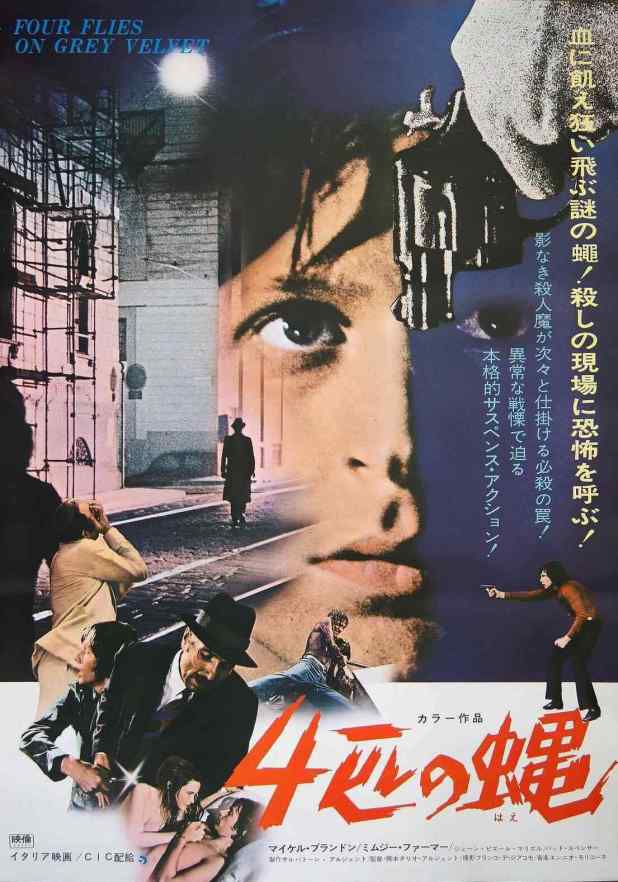
After The Bird with the Crystal Plumageand The Cat o’Nine Tails, Argento had one more movie left in his “Animal Trilogy.” Luigi Cozzi (Starcrash) would both write and assistant direct the film and the results are…interesting. It’s a lot funnier than his other giallo and was considered his swan song to the genre until his movie The Five Days failed at the box office.
Rock drummer Roberto Tobias is being stalked and as he finally catches up to his pursuer, the man pulls a knife. A struggle ensues and Roberto accidentally stabs the man while another masked figure laughs and takes photographs.
The next day, Roberto reads about the man’s death — Carlo Marosi — and gets a letter with a photograph of him murdering the man. He begins having reoccurring dreams that he’s being decapitated. Even worse, he wakes up to a masked man attacking him, who tells him that he won’t kill him because he isn’t finished with him.
Roberto’s wife Nina (Mimsy Farmer, Body Count, Autopsy) returns home and he confesses the murder to her and tells her that he can’t go to the police to stop the harassment. He does turn to his artistic friend “God” Godfrey (Bambino from They Call Me Trinity) and a con artist named the Professor (Oreste Lionello, The Case of the Bloody Iris and the Italian voice for Woody Allen) for help.
Whoever is behind Roberto’s stalking and harassment is a troubled soul who had a horrific childhood and spent some time in an insane asylum. Roberto’s maid Amelia knows who it is, but she pays for it with her life, as the killer uses a straight razor to slice her apart.
Later that night, Dalia (Francine Racette, Donald Sutherland’s wife, so well done Donald) comes to stay with Nina and Roberto, despite him wanting her not to be there. It also turns out that our hero never really killed Carlo, who has been working with his blackmailer, who dispatches him with razor wire.
Roberto then hires Arrosio, a flamboyant investigator who has never solved a case, but hopes that this is the one that he will solve. Amelia’s murder has been discovered and the cops are on the case, so Nina says that she’s leaving town, feeling unsafe in her own house.
It turns out that Dalia has always loved Roberto, so they have sex. As you do. Look, it’s a giallo. Other strange things are afoot, like Roberto’s cat getting kidnapped and beheaded, Nina getting an inheritance, strange photos of Nina and Dalia’s family and more nightmares.
That’s when giallo science intrudes: the killer was in a mental institution called Villa Rapidi, where they were considered dangerous until their father died. This knowledge — and discovering the killer’s identity and finally cracking a case — leads to Arrosio’s death.
Dalia then notices that Roberto and someone in a photo with his wife look quite similar. Just as she puts it all together, she’s stabbed and killed.
Ready for more giallo science? The police perform an optographical test that takes a photo of the retina to show the last image that Dalia saw before she died. Even Argento — a man who made a movie about a girl who can physically speak to insects and becomes friends with an orangutan — thought this idea was stupid until Carlo Rambaldi showed him how the special effect would look.
The last image that Dalia saw? Four flies on grey velvet. No one knows what this means.
Roberto waits for the killer to come for him but then Nina arrives. He tries to get her to leave because the killer is coming when he notices her necklace: a fly. As it swings, he sees it: four flies. In true giallo fashion, the killer is someone who we obviously didn’t ever consider.
A fight breaks out and she repeatedly shoots her husband as she explains how she was placed in the asylum by her abusive stepfather — who raised her as a man — and was only cured when the man died. When she met Roberto, what she felt wasn’t love, but the madness that her stepfather caused within her. She finally would get her revenge by using Roberto as the replacement for the man she couldn’t get back at.
Nina runs away as Godfrey arrives to save Roberto, but she rams the back of a truck. She’s decapitated as the car explodes.
Deep Purple almost did this movie (several members of the Beatles were considered for the role of Roberto), but their schedule didn’t allow it to happen. Ennio Morricone, who worked with Argento on The Bird with the Crystal Plumage worked on the film, but had a huge argument with the director about the score. Goblin would come in and work with Argento for the first time here. Morricone and Argento finally reconciled and worked together on The Stendhal Syndrome.
This film wasn’t commercially released for the home market until 2009, other than an incredibly hard-to-find French VHS version. That’s because the rights to this film in America are owned by Paramount Pictures, which had chosen not to release it. Shameless did put out a UK release that is all region a few years back.
This is one strange giallo. The ending car crash took twelve cars to get right and combined with the music in the scene, it’s really unsettling. This is also one of the first movies to use high speed cameras to shoot bullet time, years before Hong Kong movies and The Matrix. I love the killer’s rant at the end of the film, particularly because big chunks of it are still in Italian! This might be hard for you to find, but it’s worth tracking down.
EDITOR’S NOTE: Cinematic Void will be playing this giallo classic Monday, January 2 at 7:00 PM at the Los Feliz 3 in Los Angeles. For more information, visit Cinematic Void or purchase tickets here. This is an opportunity to see a rare Italian-language 35mm Technicolor print with soft-subtitling from the collection of Harry Guerro.
If you were a well-to-do woman in Italy in the 1970s, chances are — based on the movies that I have seen — that you are about to killed, have killed someone, are having a lesbian affair, are on drugs or all of the above.
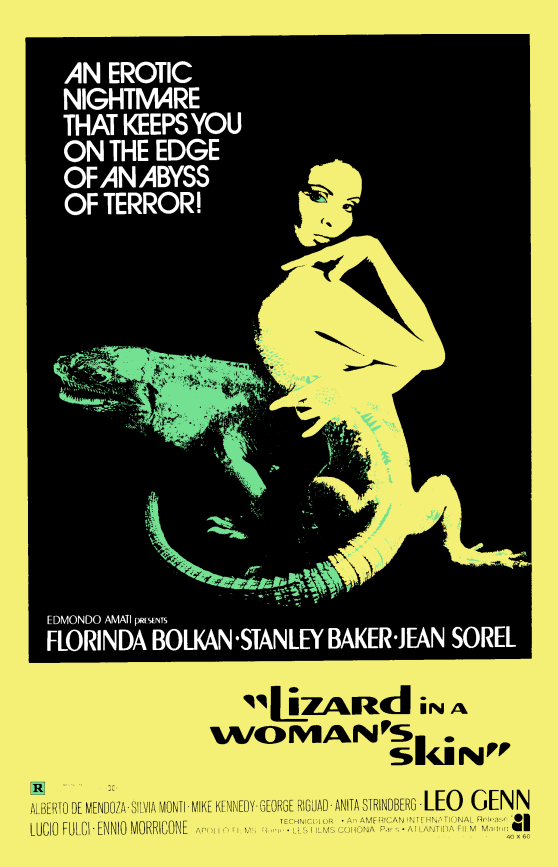
Carol (Florinda Bolkan, Don’t Torture a Duckling) is one of those wealthy women. She lives with her father, rich lawyer and politician Edmund Brighton, husband Frank and step-daughter Joan (Edy Gall, Baba Yaga, The Devil is a Woman). Carol’s been having dreams that cause her to see a doctor. It seems next door neighbor, Julia (Anita Strindberg, Your Vice Is a Locked Room and Only I Have the Key, The Antichrist) is having all-night sex and drug orgies that at once repulse and excite Carol.
All sorts of rich people shenanigans are going on — Frank is having an affair with his secretary. And Carol may or may not be having a lesbian affair with her neighbor. Her dreams have become so intense, she can’t tell fact from fiction. What worries her the most is that her latest dream ends with her stabbing Julia in vivid Fulci splendor while two hippies watch. That dream turns out to perhaps be true, as Julia is dead and Scotland Yard is on the case. The room and condition of the dead body match Carol’s dream.
The hippies that she remembers from her dream don’t remember seeing her kill Julia. But Carol’s prints are on the murder weapon. As she waits for her trial in a sanitorium, one of the hippies breaks in and chases her. What follows is an infamous scene where she happens upon a room full of vivisected, still alive dogs. It’s a dream sequence unconnected to the rest of the film, but it landed Fulci in prison. Carlo Rambaldi, the amazing special effects artist of E.T., Alien and more, saved the director from a two-year jail sentence by bringing the fake dog props to the courtroom.
Ready for some of those giallo red herrings? Turns out that Julia had discovered Frank’s affair with his secretary and had been blackmailing him. Carol gets released, but upon meeting a hippy woman at Alexandra Palace, she’s attacked, first by bats (this is Fulci, after all) and then by a hippy man who graphically stabs her before the police save her.
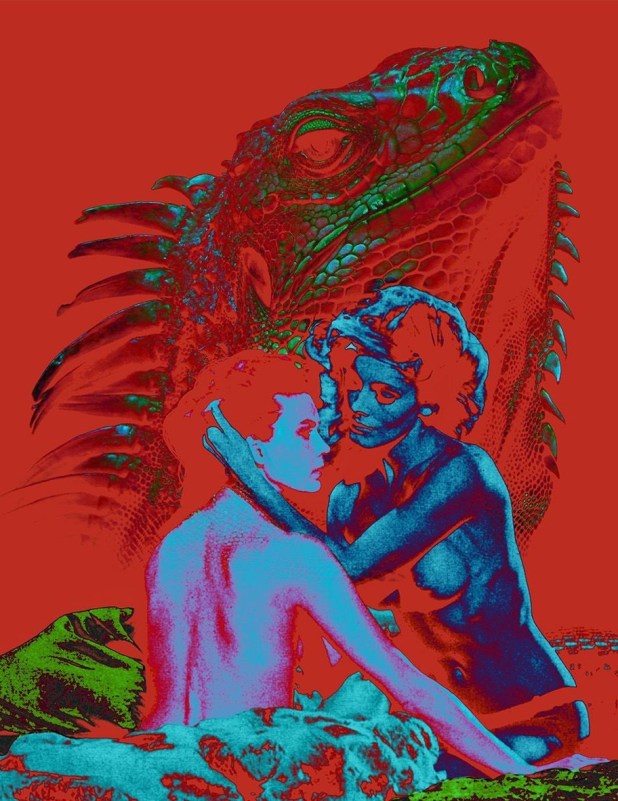
Then, stepdaughter Joan meets with the hippy woman witness but ends up with her throat cut. The hippie witnesses admit to stalking Carol and murdering the stepdaughter, but they know nothing of the night that Julia was killed, only recalling “a woman in a lizard’s skin.” At this point, everyone should scream and jump up and down, as the name of the movie has been said in the body of the film.
Another giallo moment — an action that happens off-screen with a main character. Brighton, Carol’s father, has killed himself, leaving a note that he had killed Julia. At his gravesite, the police ask how Carol knew about Julia calling to blackmail the family when it had never been revealed. Turns out Carol and Julia were in bed together when that call was made, but Julia had also threatened to go public with their lesbian affair.
But what about the hippies? Turns out they were so high on LSD, they remembered nothing. Carol decided that if she combined her crazy dreams with images of the murder, she’d get off because of temporary insanity. So wait — her father didn’t kill the girl? Did she kill her father? Why would she be having such crazy dreams about the neighbor if she’d already indulged in the affair?
If you’re confused by a giallo, sometimes I think it’s doing its job. And after all, this film is all about the visuals, as Fulci does a great job with the hippie sequences and throws some split screens in, pre-DePalma. It may drag in parts, but there are also bravura sequences to make up for that fact.
Originally appearing on January 13, 1971, the fifth episode of Night Gallery has at least two solid tales to deliver.
“Pamela’s Voice” pits Jonathan (John Astin) against his wife Pamela (Phyllis Diller), ending with him killing her because he’s sick of hearing her voice. Yet even death can’t stop her from haranguing him in this story directed by Richard Benedict, who started as an actor and became a director, and written by Rod Serling. While most comedy episodes of this show don’t work for me, there’s a lot of talent here.
“Lone Survivor” is directed by Gene Levitt, the creator of Fantasy Island, and written by Serling. Th crew of the Lusitania find a man in a dress, lost at sea, claiming that he dressed as a woman to escape the sinking of the Titanic years ago. This would be impossible except, well, this show allows the fantastic to become true. That ghost of a man is played by John Colicos in a fine role.
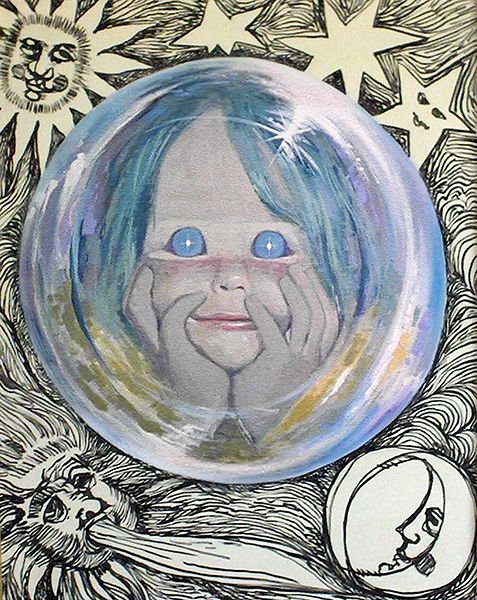
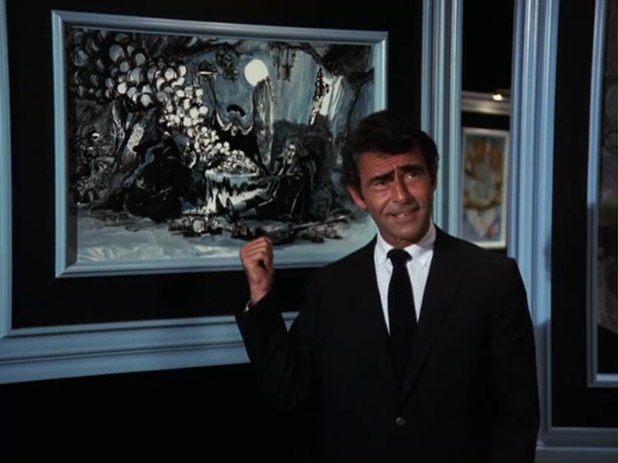
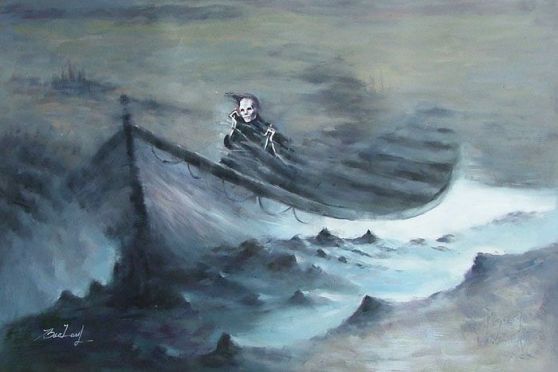
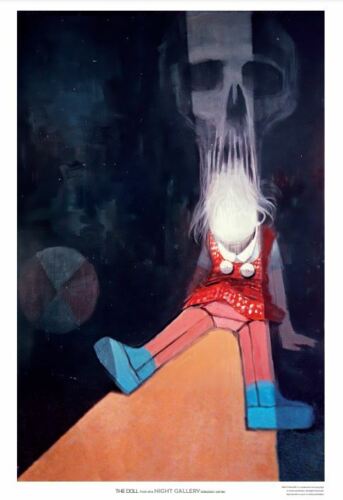
“The Doll” starts with Serling intoning, “This little collector’s item here dates back a few hundred years to the British-Indian Colonial period, proving only that sometimes the least likely objects can be filled with the most likely horror. Our painting is called “The Doll,” and this one you’d best not play with.”
This episode was directed by Rudi Dorn and written by Serling. Based on “The Doll and One Other” by Algernon Blackwood, this is all about a doll given to Col. Hymber Masters’ (John Williams) niece (Jewel Branch) as he returns from India. I have no idea who would be good with such a frightening doll in their home, but yet she loves it, even when it causes chaos. Blame Pandit Chola (Henry Silva), who has sent it to get revenge for the death of his brother.
With this episode, Night Gallery affirms the promise that it had with the pilot. Guillermo del Toro has claimed that so many of his shots come directly from “The Doll” and that it remains an influence on him even today.
Barry Mahon’s real-life story offers movie maniacs the kind of thrills that we breathlessly devour and share with one another. After volunteering for the British air force before America officially entered World War II, Mahon earned the British Distinguished Flying Cross and escaped from a concentration camp twice after being shot down, then became the personal pilot and manager of Errol Flynn before going into making his own movies.
I hesitate to even call this a movie because it was made with all the motion of, well, a slide show. Instead, it’s a series of still images with a narrator speaking every single part. It is the very epitome of low budget, with puppets and people shot in only the murkiest of lighting.
If you ever watched Rudolph the Red Nosed Reindeer and wondered why everyone treated the hero so poorly — and why he would not only forgive them but blame himself for so much of their horrific and abusive behavior — then get ready. Calvin gets brutalized throughout this movie with even the narrator continually reminding us of how ugly he is.
*Some people, if given a time machine, would go back to meet famous people or kill Hitler. I would just go to Dania, Florida and spend the day at Pirates World.
The first children’s film ever made in Canada by a commercial studio independently of either the National Film Board of Canada or the Canadian Broadcasting Corporation, Le Martien de Noël is the first — retoactively — of the Tales for All kid movie series that also includes The Peanut Butter Solution.
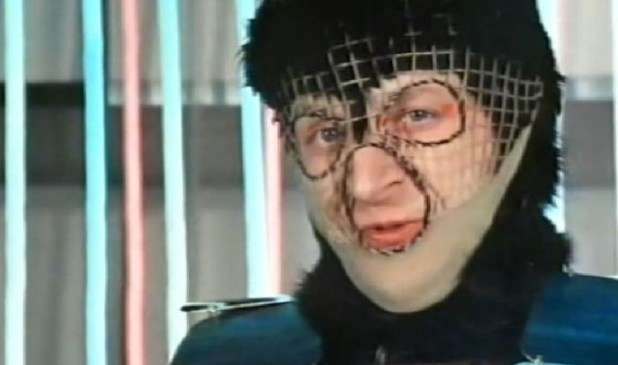
Before Quebec would give birth to child movies like Jacob Two-Two Meets the Hooded Fang, director Bernard Gosselin and writer Roch Carrier made this movie which is…well, it’s pretty wild. Cathy and Frankie meet the Christmas Martian, who has literally fishnet over his face, when his flying saucer crash lands in the snow. What’s that alien’s name? Poo Flower.
The kids help Poo Flower fix his ship and escape a bunch of Earthlings chasing him when they aren’t eating candy or watching an alien turn into a llama. There isn’t much holiday stuff in it until the end, but then again, it has a weird alien flying with a magic wand and bubbles flying out everywhere. It’s not like any Christmas movie that would ever get made in our country, a strange piece of magic that’s lo fi but all heart. I’d never seen this before but wow, it made an impression.



 B&S About Movies
You must be logged in to post a comment.