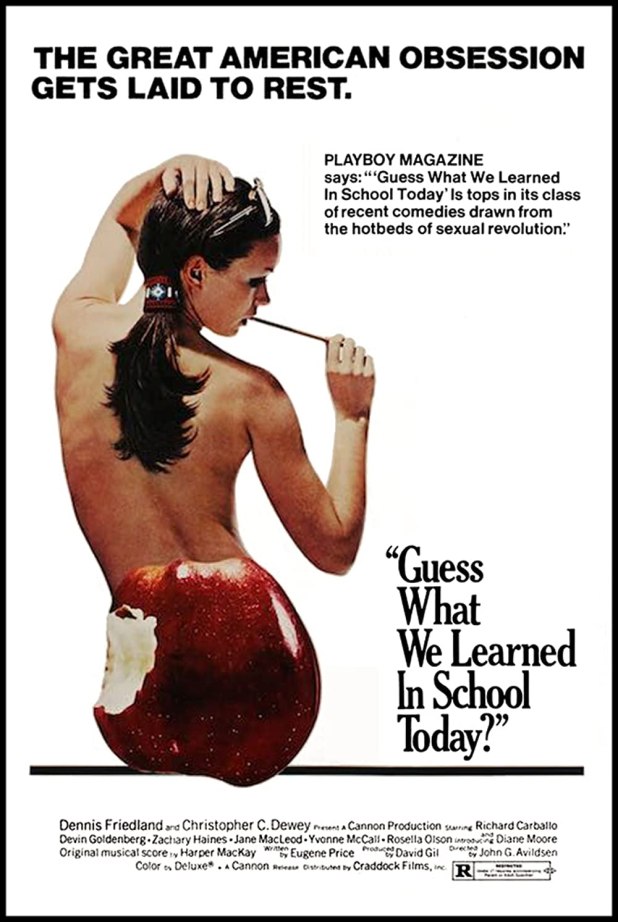
CANNON MONTH 2: Guess What We Learned in School Today? (1970)

Made before Joe but distributed by Cannon thanks to that movie’s success, director John G. Avildsen’s film — he wrote the story as well, which was screenwritten by Eugene Price (Smash-Up on Interstate 5) — has a small town believing that sex education is part of a Communist plot. So, you know, 2022 fifty-two years early.

There are three main characters here:

Roger (Dick Carballo, the second unit director of Avildsen’s Cry Uncle) is a cop who may be gay, definitely entraps women and gives them tickets and then finds love with an African-American transsexual.

Lily Whitehorn (Yvonne McCall) runs a clothing-optional sex institute that drives the town into a  maniacal mob.

Lance Battle (Zachary Hains) is a former Marine against sex education whose wife Rita (Jane McLeod) is obsessed with her son Robbie (Devin Goldenberg, who would go on to write The Happy Hooker Goes Hollywood) to the point that she pays for babysitter Lydia (Diane Moore, Vampire Trailer Park) to read pornography to him and give him hand pleasure, followed by her sending neighbor Eve Manley (Rosella Olsen, I Dismember Mama) to take her son’s virginity while across the street, her husband takes her from behind — all while she moans her son’s name.

Obviously, the satire is quite sledgehammer.

Also known as Guess What!?!Sex-Sex-Sex and I Ain’t No Buffalo, this movie is charitably a mess, but the end of the 60s, the start of Cannon and the fact that this played Cannes all make it worth a historic watch.

CANNON MONTH 2: The Beast in the Cellar (1970)

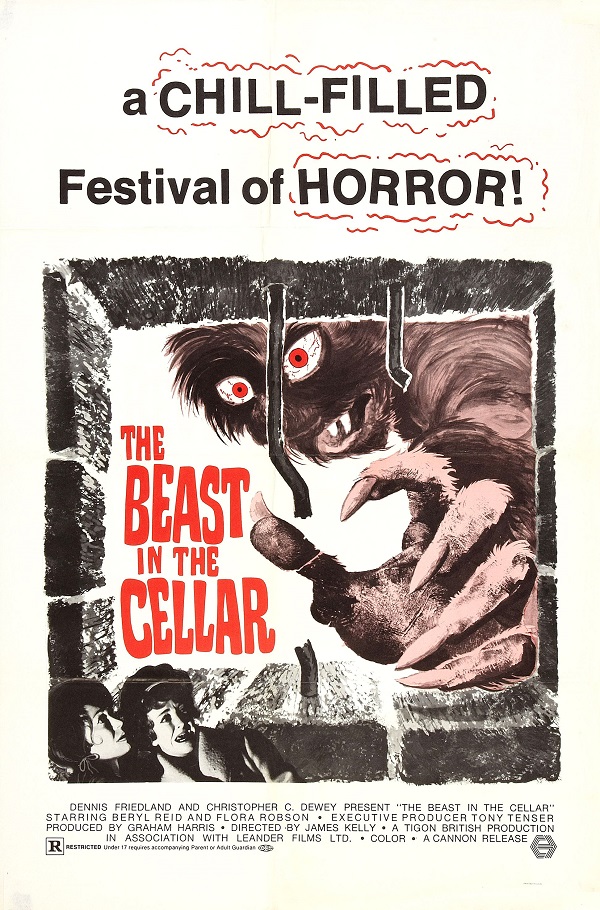
In addition to importing Joe Sarno films, Cannon started distributing the films of England’s Tigon, playing this on a double feature with the incredible The Blood On Satan’s Claw.

Soldiers are being torn to shreds by a wild cat, but Joyce and Ellie Ballantyne (Flora Robson and Beryl Reid) know that it’s their brother Steven (Dafydd Havard), who has escaped the cellar he’s been trapped in for thirty years. Joyce is injured trying to fix the hole that Steven has dug and Ellie must tell the police the truth: After their soldier father came back from war, he beat their brother. They didn’t want Steven to turn out the same way, so to keep him from fighting in the Second World War, they drugged him and kept him high for three decades, creating a killing machine who hates soldiers.

There’s a really great lovemaking to murder scene at the start of the film, showing that director and writer James Kelley (who wrote Doctor Blood’s Coffin and also directed What the Peeper Saw) knows how to create a scene filled with tons of quick cuts and no small amount of blood and terror.

Also known as Young Man, I Think You’re Dying, this gets pretty talky and not much happens for a while, but when the killings happen and the camera gets shaky, it’s pretty wild.

CANNON MONTH 2: Joe (1970)

“I saw a fella sellin’ junk to children

He gets nervous every time I pass

Cause he knows that if I catch him I’m gonna bust his head and kick his fat ass

Hey Joe, don’t it make you want to go to war, once more?

Hey Joe, why the devil did we go to war, before?

What the hell for?”

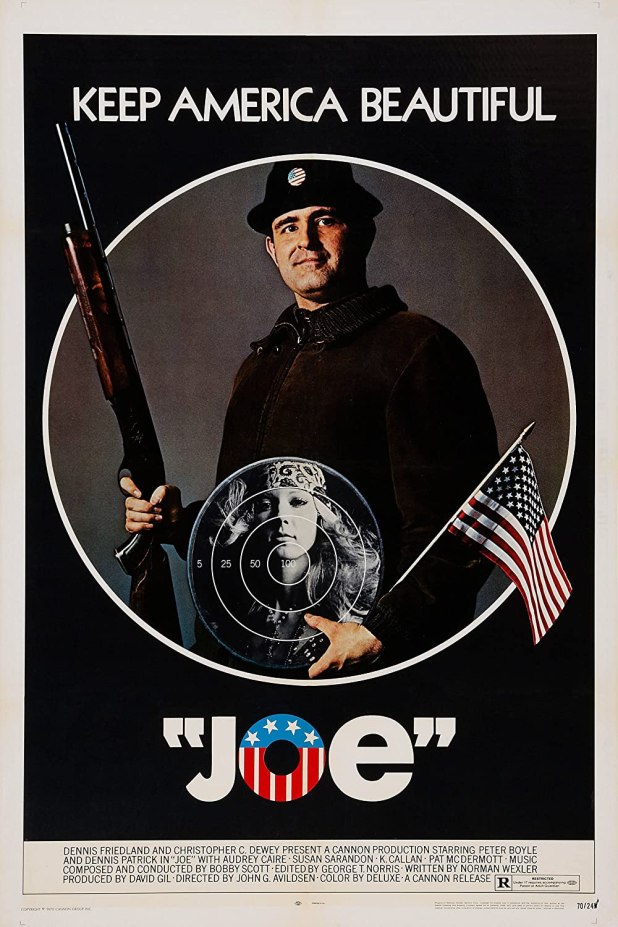
Joe Curran is a simple man, a factory worker who’s sick of the way the world is heading. He’s also MAGA a half-century before we knew what that meant, an older white man seemingly past by the rest of the world. Peter Boyle, the actor who played him, was so upset by the idea that audiences cheered on his violence that he publically said he’d never do another violent film, turning down the role of “Popeye” Doyle in The French Connection (although he is in The Friends of Eddie Coyle and played Joe Gallo in Crazy Joe, which isn’t a sequel to this).

Just imagine if Joe had been played by the original choice, Lawrence Tierney, who was supposedly fired two days before shooting began. Yet again, he was arrested for attacking a bartender who refused to keep serving him.
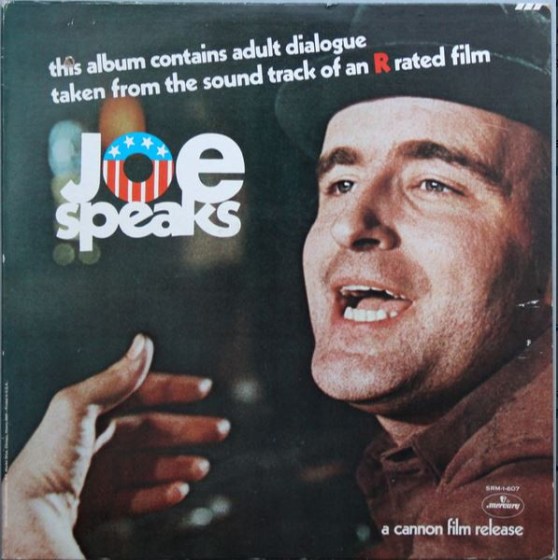
Joe’s rants in the film were so loved that they even released an album, Joe Speaks, which collects the dialogue and the theme song. I can’t even imagine anyone listening to this, but I also totally can.

One night while Joe holds court at a bar, he meets a businessman with the name of Bill Compton (Dennis Patrick). Hours ago, Bill killed the man who hooked his daughter Melissa (Susan Sarandon in her film debut) on heroin. He tells Joe that he’s just done exactly that; Joe’s excited and happy to be his friend.

Joe: I’d love to kill a hippie.

Bill: I just did.

What’s intriguing here is that 99%er Joe and 1%er Bill bond over their mutual hatred of hippies, so if you wondered, “How did the Republican party begin attracting the marginalized that their politics do the most damage to?” the answer is hate, racism and the need to feel as if the America where WASP men ran the world, their wives always had their slippers and newspapers ready and other races, creeds and politics knew their place.

But it wasn’t always that way. This movie was originally called The Gap and it was all about the chasm between Bill and his daughter. Yet Boyle was so good in his small role that the movie ended up being re-edited around him.

Unbeknownst to many, director John G. Avildsen — who was removed from both Serpico (also written by Norman Wexler, the same man who was behind Joe)and Saturday Night Fever — was fired from this film as well. William Sachs, who was an assistant editor at Cannon, renamed the movie, made Joe the lead and still turned down a co-directing credit, as he felt that the position of post-production supervisor was a better way of describing what he did. He’s fixed so many movies in the same way, including LeprechaunExterminator 2,  Servants of Twilight and Cannon’s South of Hell Mountain.

Of Joe, he told Hidden Films, “No one would sit through a screening. It was overdramatic and John Avildsen was demanding to be the editor. They didn’t want him to keep cutting it because it was awful, so they fired him. The first thing I wanted to do was start in reel five and throw away the first four reels, because it was boring. (Susan Sarandon’s character) was with her parents the whole time and Peter Boyle wasn’t even in it yet. It now starts fifty minutes into what was the movie. I didn’t have money for shooting, but I brought Peter Boyle back, and every time he was off camera I gave him lines. I basically made Joe the main character; he was a minor character before. And I changed the ending. It went on for ten minutes, with everyone discussing what happened.”

Sachs would go on to direct plenty of his own wild movies, like There Is No No. 13, The Force Beyond, The Incredible Melting ManVan Nuys Blvd.Galaxina and Cannon’s Hot Chili.

Back to Joe.

After an awkward dinner with the men and their wives, Melissa comes home from the hospital and hears her father say that he killed her boyfriend. She coldly says, “What are you gonna do, kill me too?” and runs away.

Bill and Joe follow her and end up indulging in forbidden fruit, trying the two things hippies were known for: drugs and free love. The gorgeous women they both ball and have disparate experiences, with Bill marveling at the outrageous lovemaking he just shared with a much younger woman — as young as his daughter — while Joe’s unsatisfied girl says, “You just broke the land speed record.”

That moment of post-coital bliss ends when Joe realizes his wallet has been stolen. Attacking the woman he was just inside, he beats out of her where the boyfriends who stole the money are. Heading to a commune upstate, Joe brings some guns — “I got what you might call a well-balanced gun collection, see?” — just to scare the hippies into giving up the money they took. As they hand over the empty wallets, Joe goes wild, opening fire on everyone, even the innocent. He runs out of bullets and as more hippies arrive, he convinces Bill to be part of the murder, which he quickly falls into lockstep, blowing away flower children left and right, including shooting a girl in the back who runs away.

A girl named Melissa.

His daughter.

“What are you gonna do, kill me too?”

Cannon tried to make a sequel to Joe after Golan and Globus took over. After all, they were able to take another right wing fantasy — Death Wish — and turn it into a franchise.

From the Twitter of Larry Karaszewski https://twitter.com/Karaszewski

The proposed second part of the story, Citizen Joe, would have Joe released from a decade in prison to deal with his liberal children. The tagline? “The man has changed but the times have not…He’s back.”

Joe is the kind of movie that reminds me of past culture that people post about on social media, saying “They couldn’t make this today.” To be fair, Joe is forgotten despite how popular it was. But the truth is so many of those elements of culture — like Archie Bunker, which had to have been inspired by Joe — were actually created to hold a mirror up to society and show it how far it had fallen. Instead, society looked at that twisted reflection, embraced it and said, “Finally, someone is telling it like it is.”

Never underestimate the intelligence of the American public.
CANNON MONTH 2: Ha-Timhoni (1970)

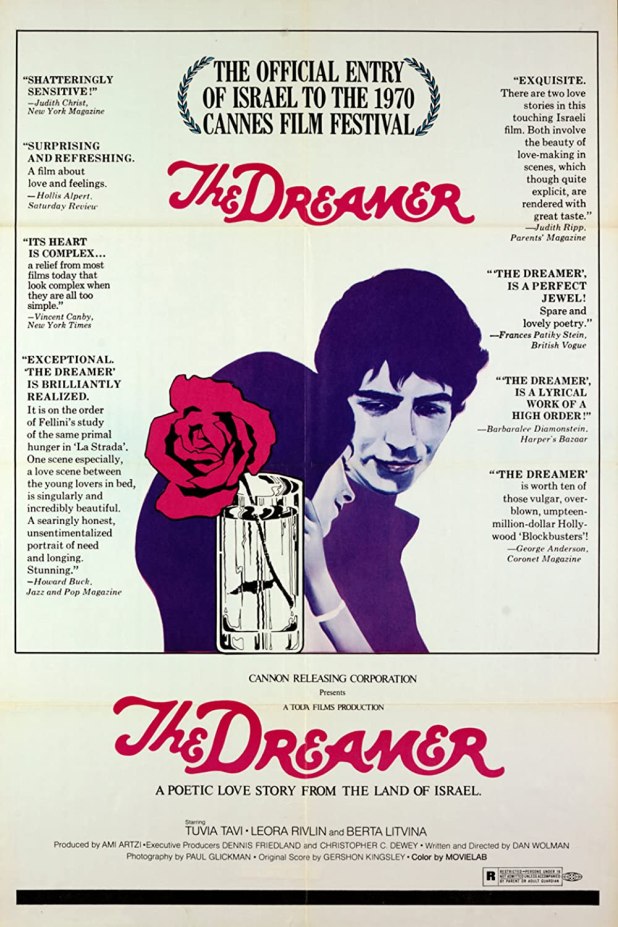
The Dreamer is an early Cannon Films pick up that was directed by Dan Wolman and entered into the 1970 Cannes Film Festival, which features prominently in the advertising. Wolman also directed the Cannon films Nana, the True Key of Pleasure; Baby LoveMaid In Sweden and Up Your Anchor, so he’s a connection between the Dewey-Friedland and Golan-Globus versions of Cannon.

Eli (Tuvia Tavi) is a handyman at an old folks home that is content to be the adopted son of one of the elderly ladies named Rachel (Berta Litvina). Yet when he falls for a young girl (Liora Rivlin), he forgets about painting portraits of Rachel and gets horizontal with his new lady — those love scenes may be why Cannon picked this up.

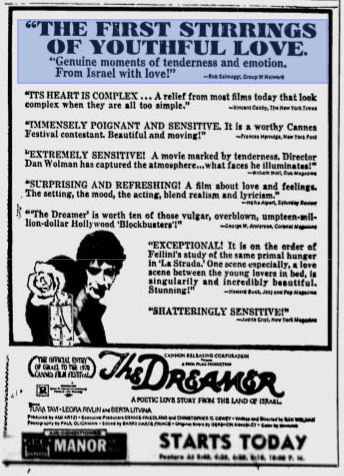
I kind of love that this played the Manor in Pittsburgh’s Squirrel Hill neighborhood:

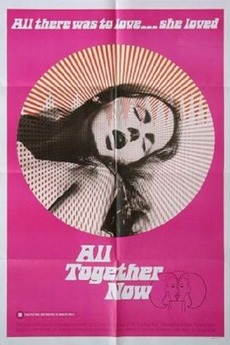
CANNON MONTH 2: All Together Now (1970)

The only film from director William Louis Allan, who co-wrote this with Gayle Greene, this is an early Cannon film from their art/softcore days.

Listed as a House on 69th Street Production, hardly anyone in this movie did a single film other than this one. All I have to go by — I’m struggling to find this — is a synopsis: Marsha’s immature, and animalistic husband neglects and mistreats her, so she throws herself into an affair with a French man, but still doesn’t find the love she seeks. Determined that no woman will have the barren life that se has, she begins to write her own sex novels. To make her novels even better, she meets with a female doctor who is an expert in the field of sexuality. She’s seduced by the doctor and uses that for one of her books, but after suffering through writer’s block, Marsha ends up taking her own life because these old adult films need a square up reel because women certainly can’t have ownership of their own sexuality. Ugh — my least favorite part of these films.

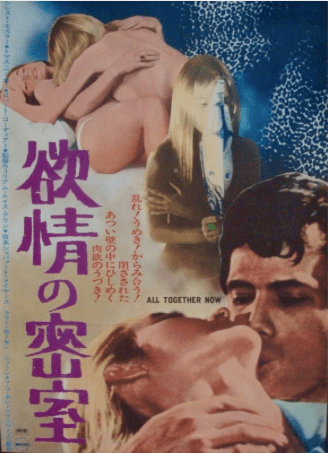
It’s listed in some places as a Swedish/U.S. co-production, which would make sense with the majority of Cannon’s content at this point. I did find a really cool Japanese poster, though.

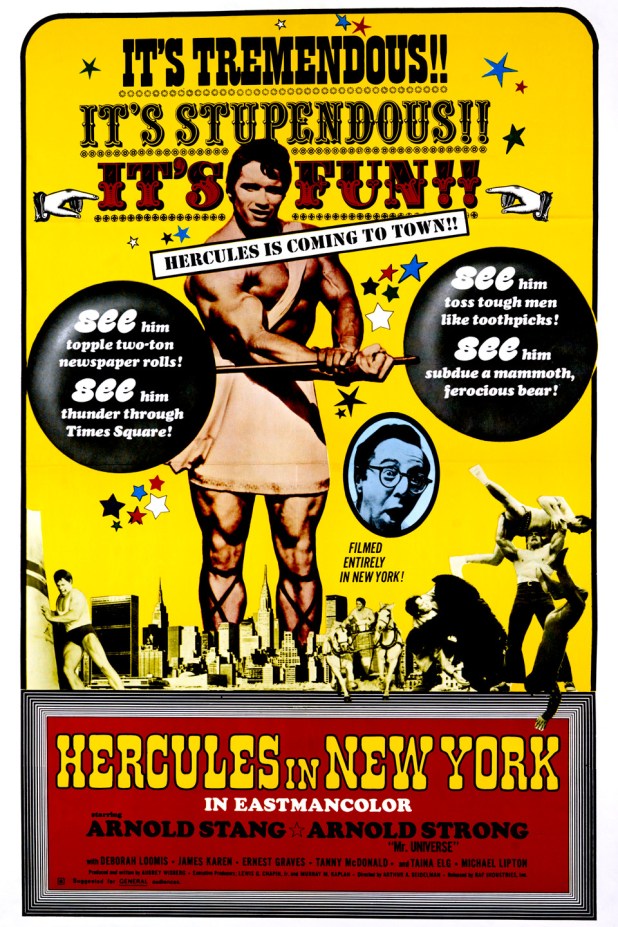
Arnold Week: Hercules In New York (1970)

EDITOR’S NOTE: As the site celebrates Arnold’s 75th birthday, I’ll be featuring multiple articles about his movies every single day. To start, well, we start at the bottom with his first film, not even using the Schwarzenegger name. Originally posted on December 5, 2020, this is Hercules In New York

Whatever happened to the star of this movie, Arnold “Mr. Universe” Strong? Oh yeah. He grew up to be the greatest action star of all time, that’s what. But this movie is the very definition of starting small, as Arnold Schwarzenegger — 22 years old and laying brick with his lifting buddy Franco Columb — was told by his friend Reg Park (who took over for Steve Reeves in Hercules and the Captive Women) that he should shoot for his dream of being a movie star.

This wouldn’t do it.

It’s also the first film for director Arthur Allan Seidelman, who mainly did stage and TV work like the Nancy McKeon TV movie of the week Strange Voices.

If you ever wanted to see Hercules get sick of Mount Olympus and go to Earth, where he becomes a pro wrestler as well as best friends with a pretzel salesman named Pretzie (Arnold Stang, who between this movie, Ghost DadDondi and Skidoo* has pretty much been in the very worst of the worst in film), well, then this movie fills out all of your boxes with a sharp number two pencil.

James Karen (PoltergeistReturn of the Living Dead) and Richard Herd (the Supreme Commander from V) show up, as does four-time Mr. Universe, one-time owner of the biggest escort service in California and later evangelist Dennis Tinerino.

Also, just to be a total anal retentive nerd, I want to mention that while Zeus, Nemesis, Eros, Pluto and Atlas are Greek gods, Hercules, Venus, Juno, Mercury and Neptune are the Roman versions, while Samson — who is kind of, sort of Hercules’ brother in this — comes from The Bible.

So yeah. Hercules comes to New York and gets mixed up with the mob and a pretzel salesman before coming back to Mount Olympus and sending a message on the radio.

*For some reason, I kind of love Skidoo.

You can watch this on Tubi.

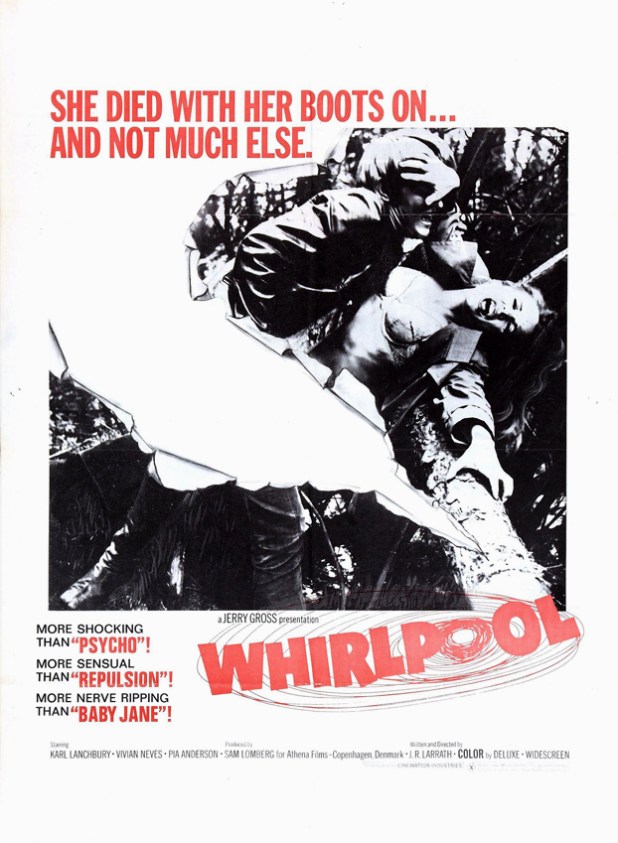
Whirlpool (1970)

She died with her boots on — and not much else.

Yes, José Ramón Larraz didn’t do anything subtle, huh?

Sarah (Pia Andersson) is a woman of a certain age living in the countryside of London with another shutterbug named Theo (Karl Lanchbury) in a relationship that has them refer to one another as aunt and nephew. Sara invites a model named Tulia (Vivian Neves) to stay with them and be photographed; the very first session goes poorly as Tulia sees a hooded figure spying on her. She shares that this same thing happened when her friend Rhonda (Johanna Hegger) stayed at the house and that something was wrong with the lake.

That night, everyone gets drunk, the ladies get naked and Theo and Tulia make love whole Sarah looks at photos of Rhonda when what she really wanted was a threesome. Things get stranger when Mr. Field comes looking for evidence of Rhonda and Theo sets him up to nearly assault Tulia while he films it.

Of course, all is soon forgiven and that menage a trois ends up happening. Moments later, Mr. Field is stabbed to death by Theo, who follows that up by confessing to Tulia that he’s a sadist as she stares at photos of Rhonda being abused by multiple men. She tries to run through the woods but he catches up to her and snuffs her out.

In case you wonder why Roger Ebert said that this movie had “particularly grisly sort of violence, photographed for its own sake and deliberately relishing in its ugliness. It made me awfully uneasy,” it would be because this movie is, well, shocking and brutal at almost every opportunity.

As you can imagine, this movie was cut to pieces when it first played in England. Also released as Perversion FlashFlash Light and She Died with Her Boots On, this feels like the first version of Larraz’s superior Symptoms. That said — it’s still pretty effective.

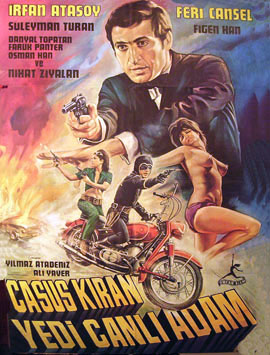
Casus Kıran: 7 Canlı Adam (1970)

Spy Smasher: The Man with Seven Lives is Turkish remix remake ripoff of Fawcett Comic superhero Spy Smasher, who was created by Captain Marvel’s creative team of Bill Parker and C. C. Beck in Whiz Comics #2. Alongside the Big Red Cheese, Spy Smasher’s battles with the Mask, the America-Smasher, the Angel and the Blitzys made Whiz Comics incredibly popular. They even had a cross-over in issues 16-18 where the Mask made Spy Smasher evil and the two heroes fought. After the war ended, he became Crime Smasher for one issue and disappeared until DC Comics purchased the remnants of Fawcett. He was part of the Squadron of Justice along with Bulletman, Bulletgirl, Ibis the Invincible, Mister Scarlet and Pinky the Whiz Kid.

The original character — there’s a female version in the DCU now — also appeared in a William Witney-directed serial, Spy Smasher, which was the inspiration for this film. And, if you can’t tell by the title and year it was released, this also has a fair amount of Eurospy influence — which shows up as this movie liberally borrows from the score for On Her Majesty’s Secret Service.

A sequel to 1968’s Casus Kiran (Spy Smasher), this adventure has foreign delegates coming to Turkey to set up a series of nuclear missile bases. However, someone is killing these important people one after another, so Murat from the Turkish Police seeks out the assistance of Casus Kıran, his just as deadly wife Feri (Feri Cansel) and the Sherlock Holmes cosplayer comic relief Bitik (Ahmet Danyal Topatan) to stop the killing and save Turkey.

The hero is played by Irfan Atasoy, who not only acted in this, but produced and distributed it. After watching so many Turkish remixes of superheroes, I get a bit confused, but the fact that the costume here looks less like Spy Smasher and more like the superhero in Demir Pençe (Korsan Adam) is not helping at all.

It’s amazing to me that while Spy Smasher went from one of the most popular comic book heroes ever to being one of the most obscure in a few decades — Fawcett chose to settle a decades-long lawsuit with DC and went out of business — there were still movies being made on the other side of the world about him.

You can watch this on YouTube.

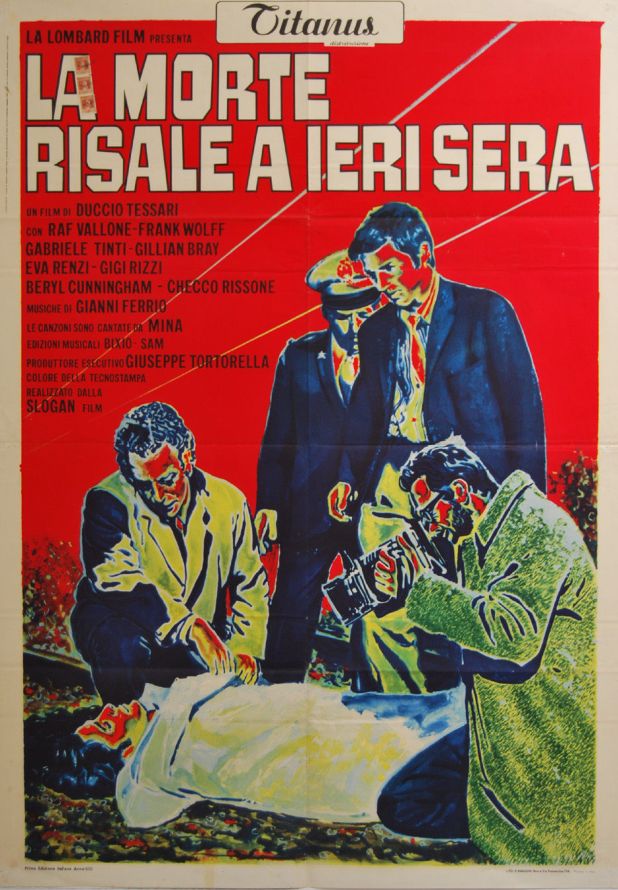
Junesploitation 2022: La morte risale a ieri sera (1970)

June 23: Junesploitation’s topic of the day — as suggested by F This Movie— is gialo! We’re excited to tackle a different genre every day, so check back and see what’s next.

Death Occurred Last Night (also known as Death Took Place Last Night and Horror Came out of the Fog) was based on the Giorgio Scerbanenco novel Milanesi Ammazzano al Sabato (The Milanese Kill on Saturdays) and was directed by Duccio Tessari, who co-wrote A Fistful of Dollars before making his name with A Pistol for Ringo and The Return of Ringo. More to the interest of those who love black gloves and switchblades, he made The Bloodstained Butterfly and Puzzle. He co-wrote the script with Biagio Proietti, who was also the writer of The Killer Reserved Nine Seats and Fulci’s The Black Cat. Tessari even wrote the lyrics to two of the songs in this movie!

Avanzio Berzaghi (Raf Vallone) has come to Milan to find his runaway daughter and works to solve the case himself — much like an Italy proto-Hardcore — at the very same time that detective Duca Lamberti (Frank Wolff) — a character who also appears in the movies Caliber 9 and Cran d’arrêt — and his partner Mascaranti (Gabriele Tinti, husband of Laura Gemser) investigate the seamier side of the city. They finally find her body in a field, burned beyond all recognition. Now, all Berzaghi has left is seeking out revenge that will never be enough.

The film also shows flashbacks of Berzaghi’s relationship with his daughter Donatella (Gillian Bray), a three-year-old child in the body of a fully grown woman with the needs that go with the physical maturity of a twenty-five-year-old. As she lusts after nearly every man she sees, her father had intended to keep her locked up after the death of his wife, but that plan obviously fails.

A cross between giallo and poliziottecschi — each of the two storylines takes each of the genre to heart and then meet at the end — this is a film that doesn’t take its cues from Argento — it was made the same year as The Bird With the Crystal Plumage — and emerges as a unique take on the form with an even more unique soundtrack by Gianni Ferrio which doesn’t sound like any other giallo score — it doesn’t sound like any other music from a film at all — and often puts people off on this movie. Not me.

Speaking of Bird, Lamberti’s wife is played by Eva Renzi, who is so important to Argento’s film. She’s incredible here, not just the most fashionable person in the movie, but her relationship with her policeman husband is one of equal standing.

Want to discover some more giallo? Check out my list of three hundred plus psychosexual murder movies right here.

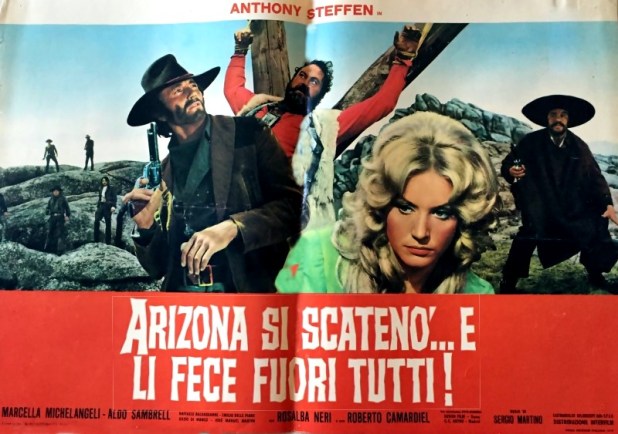
Arizona si scatenò… e li fece fuori tutt (1970)

Arizona si scatenò… e li fece fuori tutt means Arizona Went Wild…and Took Them All Out. It was released in the U.S. as Arizona Colt Returns and it’s a sequel nearly in name only, as Anthony Steffen takes over for Giuliano Gemma, changing the character from a cocky rogue to a near Eastwood Man with No Name. Only sidekick Double Whiskey (Roberto Camardiel) is on hand to remind us of the first movie.

At the start of the story, Arizona and Double Whiskey are living in peace. Then, he learns that there’s a price on his head, so he fakes his death. While in town doing that — as if it were another daily errand — Arizona is asked by a landowner named Moreno (José Manuel Martin) to rescue his daughter Paloma (Rosalba Neri, who was killed in the first movie) from Keene (Aldo Sambrell), an old enemy who of course is the one who set him up. Arizona refuses the job, as he just wants to settle down with his girlfriend Sheena (Marcella Michelangeli). However, Keene makes his mind up for him when he captures Double Whiskey.

It’s time for the hero to live up to his theme song: “I think I’m gonna get my gun. I think I’m gonna shoot someone. Bang bang.” The bad guys even crucify him on an X and dunk him in water, but nothing is going to stop Arizona.

This was the first non-documentary movie directed by Sergio Martino. He’d direct The Strange Vice of Mrs. Wardh the next year and be remembered for an incredible four year run of giallo films. I’d rank him as close to Argento and Fulci as it gets for his films, which span several genre.

You can watch this on YouTube.