CANNON MONTH 2: The Phantom of Terror (1970)

EDITOR’S NOTE: If you look at the poster for the 21st Century release of The Phantom of Terror and wonder where you’ve seen it before, well, it’s been on the site at least three times with the last appearance being September 16, 2021. That’s right — it’s The Bird with the Crystal Plumage. 21st Century re-released it in 1982 and you have to image that people had seen it before twelve years ago and didn’t think it was a new slasher, right?

Other than the films of Mario Bava (Blood and Black LaceThe Girl Who Knew Too Much), there’s no other film that has no influenced the giallo. In fact, the most well-known version of the form starts right here with Dario Argento’s 1970 directorial debut. Until this movie, he’d been a journalist and had helped write Leone’s Once Upon a Time in the West.

Sam Dalmas (Tony Musante) is an American writer suffering from an inability to write. He’s gone to Rome to recover, along with his British model girlfriend (yes, everyone in giallo can score a gorgeous girl like Suzy Kendall). Just as he decides to return home, he witnesses a black-gloved man attacking a girl inside an art gallery. Desperate to save her, he can only watch, helpless and trapped between two mechanical doors as she wordlessly begs for help.

The woman is Monica Ranier and she’s gallery owner’s wife. She survives the attack, but the police think Sam may have had something to do with the crime, so they keep his passport so he can’t leave the country. What they’re not letting on is that a serial killer has been wiping out young women for weeks and that Sam is the only witness. That said — he’s haunted by what he’s survived and his memory isn’t working well, meaning that he’s missing a vital clue that could solve the crime.

As you can see, the foreign stranger who must become a detective, the missing pieces of memory, the black-clad killer — it’s everything that every post-1970 giallo would pay tribute to (perhaps rip off is the better term).

Another Argento trope shows up here for the first time. It’s the idea that art itself can cause violence. In this film, it’s a painting that shows a raincoat-clad man murdering a woman.

Soon, Sam is getting menacing calls from the killer and Julia is attacked by the black-clad maniac. The police isolate a sound in the background of the killer’s conversations, the call of a rare Siberian “bird with the crystal plumage.” There’s only one in Rome, which gets the police closer to the identity of who is wearing those black gloves (in truth, it’s Argento’s hands). It’s worth noting that the species of bird the film refers to as “Hornitus Nevalis” doesn’t really exist. The bird in the film is actually a Grey Crowned Crane.

Alberto, Monica’s art gallery husband, tries to kill her, finally revealing that he has been behind the attacks. Ah — but this is a giallo. Mistaken identity is the main trick of its trade. And even though this film was made nearly fifty years ago, I’d rather you get the opportunity to learn for yourself who the killer really is.

I may have mentioned before that my parents saw this movie before I was born and hated it to a degree that any time a movie didn’t make any sense, they would always bring up “that weird movie with the bird that makes the noises.” Who knew I would grow up to love Argento so much? It’s one of those cruel ironies that would show up in his movies. I really wonder if my obsession with giallo and movies that are difficult to understand is really me just rebelling.

An uncredited adaptation of Fredric Brown’s novel The Screaming Mimi, this film was thought of as career suicide by actress Eva Renzi. And the producer of the film wanted to remove Argento as the director. However, when Argento’s father Salvatore Argento went to speak to the man, he noticed that the executive’s secretary was all shaken up. He asked her what was wrong and she mentioned that she was still terrified from watching the film. Salvatore asked her to tell her boss why she was so upset and that’s what convinced the man to keep Dario on board.

The results of all this toil and worry? A movie that played for three and a half years in one Milan theater and led to copycats (and lizards and spiders and flies and ducklings and butterflies and so on) for decades. Argento would go on to film the rest of his so-called Animal Trilogy with The Cat O’Nine Tails and Four Flies on Grey Velvet, then Deep Red before moving into more supernatural films like Suspiria and Inferno.
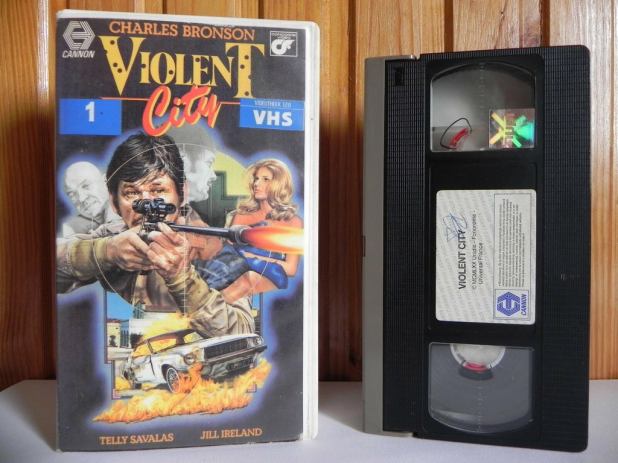
CANNON MONTH 2: Violent City (1970)

EDITOR’S NOTE: This was first on the site on May 30, 2022. It wasn’t produced by Cannon but was released on VHS in the Netherlands by Cannon Screen Entertainment.

Director Sergio Sollima is mainly known for westerns such as Run Man RunFace to Face and The Big Gundown, the Eurospy movies Agent 3S3: Passport to HellAgent 3S3: Massacre In the Sun and Requiem for a Secret Agent and the pirate movies SandokanLa tigre è ancora viva: Sandokan alla riscossa! and The Black Corsair.

With Violent City, co-written with Swept Away director Lina Wertmüller, he was originally upset that it was going to be a traditional gangster story. He did, however, say that “we had the chance to shoot in the U.S., and I would do whatever it took to do that.” So he worked with Wertmüller to create the non-linear way that the story would be told. He also worked with Telly Savalas, who plays the main villain in a movie of bad people, to bring out the humor in his role. As for Bronson, he found him uncommunicative while his wife Jill Ireland was the exact opposite, which is probably why they worked so well together.

He said that in the end, the movie was a lot like his westerns and all about “the encounter and struggle between the individual and the society which is all around him, and the way he reacts to it.”

During a vacation, Jeff Heston (Bronson) and his lover Vanessa (Ireland) are attacked by killers sent by an old business associate who Vanessa has seemingly left Jeff for. He’s jailed and refuses to name her, even if he receives a lower sentence. As soon as he’s released, crime lord Al Weber (Savalas) wants him to work for him, but he claims he’s retired, which is a lie, as he kills the man who set him up in the very next scene.

Of course, Vanessa has been married to Weber all along and even though Jeff wants revenge on her, he can’t kill her. Weber even tells him that his love for her will be his undoing, that she’s the one pulling the strings, but Jeff’s critical flaw is in thinking that she can’t be such a person.

The movie had two major American releases, with the first distributed as Violent City by International Co-Productions and the second wide release distributed by United Artists as The Family, complete with a logo using the same font as The Godfather and a tagline that shouted “The Godfather Gave You an Offer You Couldn’t Refuse. The Family Gives You No Alternative.”

If this was to be strictly an Italian film, Tony Musante and Florinda Bolkan would have been the leads. There was also an attempt to make the movie with Jon Voight and Sharon Tate.

This is a moody and dark film that predates the poliziotteschi films while boasting a strong soundtrack by the master, Ennio Morricone. It also has a stark ending that I’ve been thinking over again and again in the days since I’ve watched the film.

You can get this from Kino Lorber.

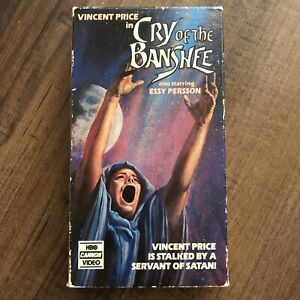
CANNON MONTH 2: Cry of the Banshee (1970)

EDITOR’S NOTE: This originally appeared on July 8, 2021Cry of the Banshee was not produced by Cannon but was released on video by HBO/Cannon Video.

“Who spurs the beast the corpse will ride?

Who cries the cry that kills?

When Satan questioned, who replied?

Whence blows this wind that chills?

Who walks amongst these empty graves

And seeks a place to lie?

‘Tis something God ne’er had planned,

A thing that ne’er had learned to die.”

That poem is Edgar Allan Poe’s “The Bells,” which sets the tone for this unique movie, the last of the American-International Pictures Poe movies. Directed by Gordon Hessler, this film, unlike its predecessors, had nothing to do with the Baltimorean author, offering a fresh take on the horror genre.

According to Peter Fuller on  Spooky Isles, AIP promoted this movie as the hundredth film that its star, Vincent Price, was in. The truth is that it was probably his seventy-sixth. Undaunted, AIP did the same publicity for his next movie, The Abominable Dr. Phibes.

This movie is a visual treat — it was shot in the Grim’s Dyke House, the same location as Curse of the Crimson Altar and The Devil Rides Out. The film opens with an incredibly excellent animation by Terry Gilliam, a visual masterpiece that, unfortunately, was cut from the American print, leaving the audience captivated from the start.

If you enjoyed Vincent Price’s portrayal as a witch hunter in Witchfinder General, you’re in for a treat! In this film, he plays the role of Lord Edward Whitman, a character who has taken it upon himself to rid England of every witch. His relentless pursuit leads to the disruption of Black Masses and the death of many witches, until one of them, Oona, possesses his loyal servant Roderick, complicating his mission.

The movie also inspired a band to name themselves Siouxie and the Banshees. Perhaps you’ve heard of them?

CANNON MONTH 2: Cauldron of Blood (1970)

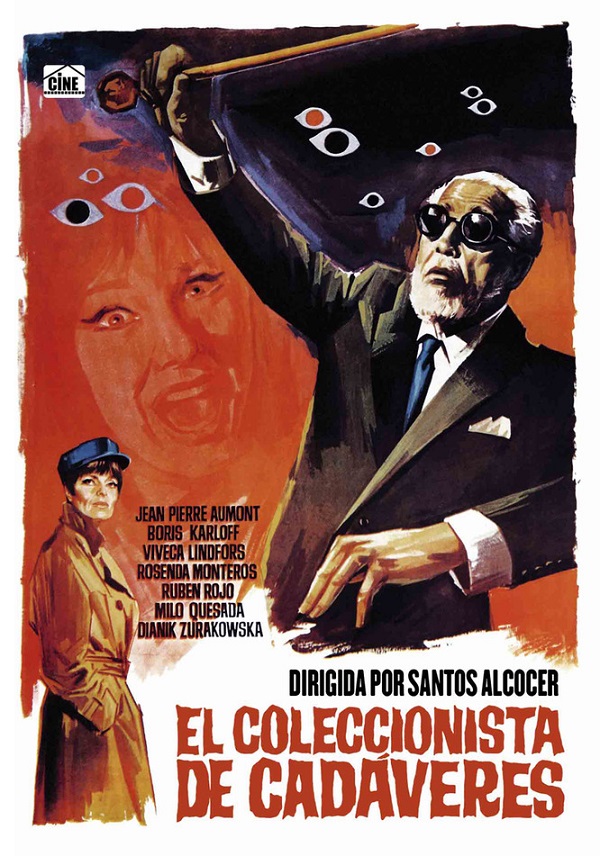
Originally filmed — in Spain — as El Coleccionista de cadáveres (The Corpse Collector), this was directed by Santos Alcocer, who some credit as Edward Mann. They’re definitely two different people — Alcocer also made Only a Coffin and wrote several other movies while Mann  directed Hallucination Generation. He also wrote Island of Terror, The Freakmaker and Seizure, while directing Hot Pants HolidayWho Says I Can’t Ride a Rainbow! and Hooch. He also contributed the song “There’s a Certain Kind of Woman” to this movie, co-founded New York City’s Circle in the Square, was a syndicated cartoonist on Andy Gump, Dixie Dugan and Joe Palooka before doing his own strip Blade Winters and was a creative force who worked to make Woodstock, NY an artier place to live. He also co-wrote this movie along with John Melson and José Luis Bayonas.

Franz Badulescu (Boris Karloff) has been using skeletons in his sculptures for years; it’s only recently that the bones have come from the victims of his homocidal wife Tania (Viveca Lindfors). She’s already hobbled Franz with a car wreck; now it seems that she wants to take him off the table.

Journalist Claude Marchand (Jean-Pierre Aumont) is in town to interview Franz and fall in love with Valerie (Rosenda Monteros) just in time for Tania and her lover Shanghai (Milo Quesada) to select her as their next victim.

Cannon released this on a double bill with Crucible of Horror which seems like a fine pair. Thanks to DVD Drive-In, I learned that Karloff replaced Claude Rains in this film and had been in Spain to shoot an episode of I-Spy — “Mainly on the Plains” — that also has Paul Naschy in it.

Fitting in with the art as murder genre — House of WaxA Bucket of BloodBlood BathColor Me Blood Red — this has a great ending centered around a vat of acid and an awesome psychedelic freakout opening credits sequence. This isn’t a well-considered movie yet I found myself really enjoying it, particularly the dream sequences that Lindfors endures of her being beaten and dressing as a German soldier before waking up to take out her worries on the staff.

If the music seems like you’ve heard it before, that’s because Filmation used it for their Shazam! and Star Trek series.

CANNON MONTH 2: Guess What We Learned in School Today? (1970)

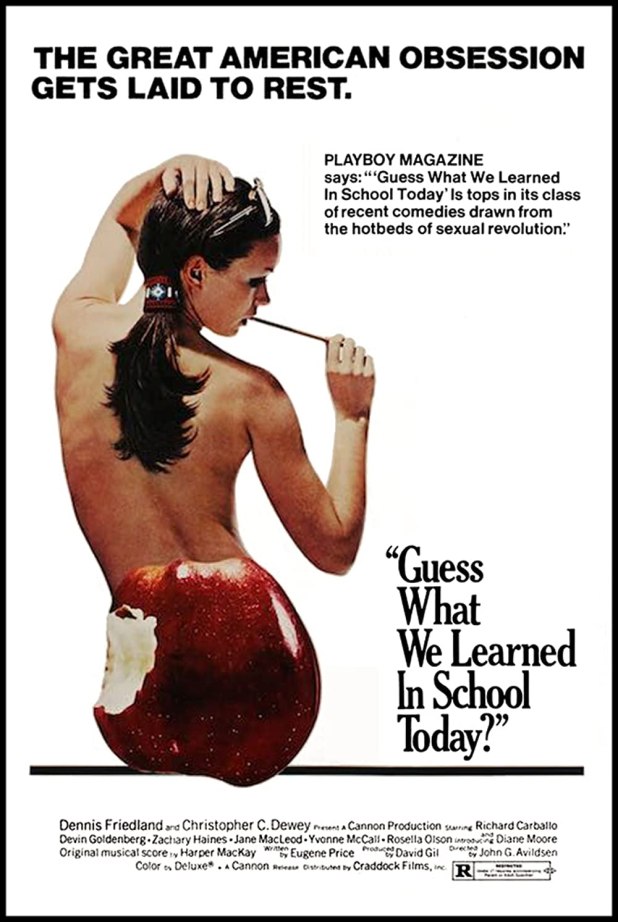
Made before Joe but distributed by Cannon thanks to that movie’s success, director John G. Avildsen’s film — he wrote the story as well, which was screenwritten by Eugene Price (Smash-Up on Interstate 5) — has a small town believing that sex education is part of a Communist plot. So, you know, 2022 fifty-two years early.

There are three main characters here:

Roger (Dick Carballo, the second unit director of Avildsen’s Cry Uncle) is a cop who may be gay, definitely entraps women and gives them tickets and then finds love with an African-American transsexual.

Lily Whitehorn (Yvonne McCall) runs a clothing-optional sex institute that drives the town into a  maniacal mob.

Lance Battle (Zachary Hains) is a former Marine against sex education whose wife Rita (Jane McLeod) is obsessed with her son Robbie (Devin Goldenberg, who would go on to write The Happy Hooker Goes Hollywood) to the point that she pays for babysitter Lydia (Diane Moore, Vampire Trailer Park) to read pornography to him and give him hand pleasure, followed by her sending neighbor Eve Manley (Rosella Olsen, I Dismember Mama) to take her son’s virginity while across the street, her husband takes her from behind — all while she moans her son’s name.

Obviously, the satire is quite sledgehammer.

Also known as Guess What!?!Sex-Sex-Sex and I Ain’t No Buffalo, this movie is charitably a mess, but the end of the 60s, the start of Cannon and the fact that this played Cannes all make it worth a historic watch.

CANNON MONTH 2: The Beast in the Cellar (1970)

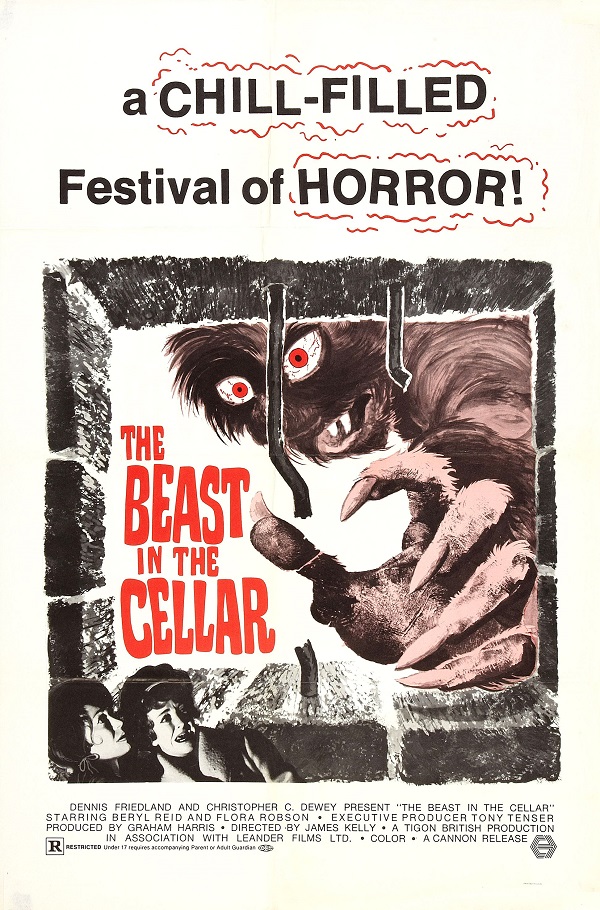
In addition to importing Joe Sarno films, Cannon started distributing the films of England’s Tigon, playing this on a double feature with the incredible The Blood On Satan’s Claw.

Soldiers are being torn to shreds by a wild cat, but Joyce and Ellie Ballantyne (Flora Robson and Beryl Reid) know that it’s their brother Steven (Dafydd Havard), who has escaped the cellar he’s been trapped in for thirty years. Joyce is injured trying to fix the hole that Steven has dug and Ellie must tell the police the truth: After their soldier father came back from war, he beat their brother. They didn’t want Steven to turn out the same way, so to keep him from fighting in the Second World War, they drugged him and kept him high for three decades, creating a killing machine who hates soldiers.

There’s a really great lovemaking to murder scene at the start of the film, showing that director and writer James Kelley (who wrote Doctor Blood’s Coffin and also directed What the Peeper Saw) knows how to create a scene filled with tons of quick cuts and no small amount of blood and terror.

Also known as Young Man, I Think You’re Dying, this gets pretty talky and not much happens for a while, but when the killings happen and the camera gets shaky, it’s pretty wild.

CANNON MONTH 2: Joe (1970)

“I saw a fella sellin’ junk to children

He gets nervous every time I pass

Cause he knows that if I catch him I’m gonna bust his head and kick his fat ass

Hey Joe, don’t it make you want to go to war, once more?

Hey Joe, why the devil did we go to war, before?

What the hell for?”

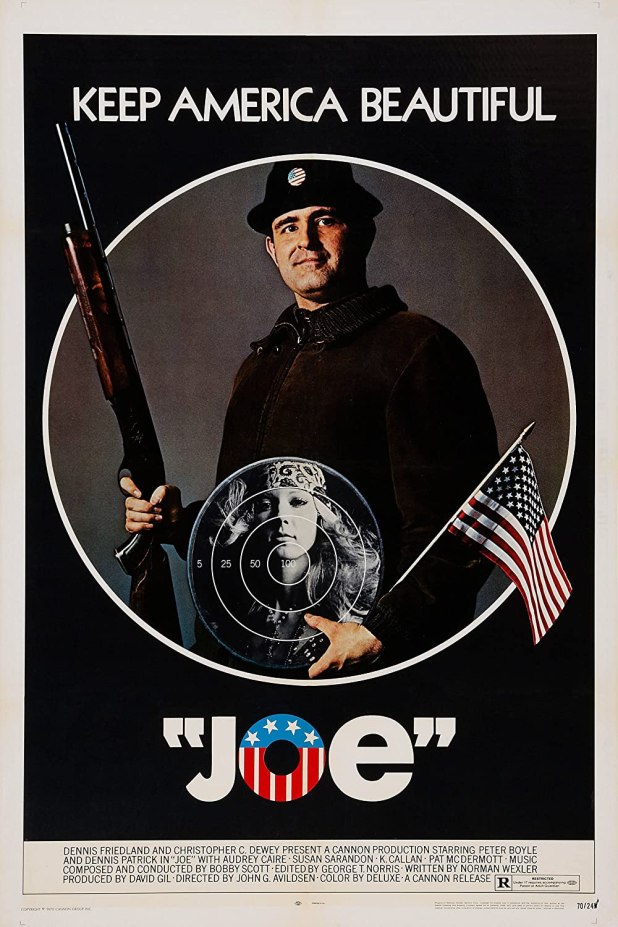
Joe Curran is a simple man, a factory worker who’s sick of the way the world is heading. He’s also MAGA a half-century before we knew what that meant, an older white man seemingly past by the rest of the world. Peter Boyle, the actor who played him, was so upset by the idea that audiences cheered on his violence that he publically said he’d never do another violent film, turning down the role of “Popeye” Doyle in The French Connection (although he is in The Friends of Eddie Coyle and played Joe Gallo in Crazy Joe, which isn’t a sequel to this).

Just imagine if Joe had been played by the original choice, Lawrence Tierney, who was supposedly fired two days before shooting began. Yet again, he was arrested for attacking a bartender who refused to keep serving him.

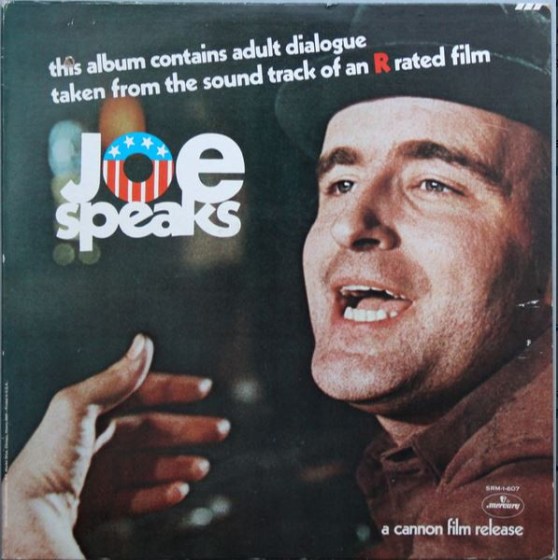
Joe’s rants in the film were so loved that they even released an album, Joe Speaks, which collects the dialogue and the theme song. I can’t even imagine anyone listening to this, but I also totally can.

One night while Joe holds court at a bar, he meets a businessman with the name of Bill Compton (Dennis Patrick). Hours ago, Bill killed the man who hooked his daughter Melissa (Susan Sarandon in her film debut) on heroin. He tells Joe that he’s just done exactly that; Joe’s excited and happy to be his friend.

Joe: I’d love to kill a hippie.

Bill: I just did.

What’s intriguing here is that 99%er Joe and 1%er Bill bond over their mutual hatred of hippies, so if you wondered, “How did the Republican party begin attracting the marginalized that their politics do the most damage to?” the answer is hate, racism and the need to feel as if the America where WASP men ran the world, their wives always had their slippers and newspapers ready and other races, creeds and politics knew their place.

But it wasn’t always that way. This movie was originally called The Gap and it was all about the chasm between Bill and his daughter. Yet Boyle was so good in his small role that the movie ended up being re-edited around him.

Unbeknownst to many, director John G. Avildsen — who was removed from both Serpico (also written by Norman Wexler, the same man who was behind Joe)and Saturday Night Fever — was fired from this film as well. William Sachs, who was an assistant editor at Cannon, renamed the movie, made Joe the lead and still turned down a co-directing credit, as he felt that the position of post-production supervisor was a better way of describing what he did. He’s fixed so many movies in the same way, including LeprechaunExterminator 2,  Servants of Twilight and Cannon’s South of Hell Mountain.

Of Joe, he told Hidden Films, “No one would sit through a screening. It was overdramatic and John Avildsen was demanding to be the editor. They didn’t want him to keep cutting it because it was awful, so they fired him. The first thing I wanted to do was start in reel five and throw away the first four reels, because it was boring. (Susan Sarandon’s character) was with her parents the whole time and Peter Boyle wasn’t even in it yet. It now starts fifty minutes into what was the movie. I didn’t have money for shooting, but I brought Peter Boyle back, and every time he was off camera I gave him lines. I basically made Joe the main character; he was a minor character before. And I changed the ending. It went on for ten minutes, with everyone discussing what happened.”

Sachs would go on to direct plenty of his own wild movies, like There Is No No. 13, The Force Beyond, The Incredible Melting ManVan Nuys Blvd.Galaxina and Cannon’s Hot Chili.

Back to Joe.

After an awkward dinner with the men and their wives, Melissa comes home from the hospital and hears her father say that he killed her boyfriend. She coldly says, “What are you gonna do, kill me too?” and runs away.

Bill and Joe follow her and end up indulging in forbidden fruit, trying the two things hippies were known for: drugs and free love. The gorgeous women they both ball and have disparate experiences, with Bill marveling at the outrageous lovemaking he just shared with a much younger woman — as young as his daughter — while Joe’s unsatisfied girl says, “You just broke the land speed record.”

That moment of post-coital bliss ends when Joe realizes his wallet has been stolen. Attacking the woman he was just inside, he beats out of her where the boyfriends who stole the money are. Heading to a commune upstate, Joe brings some guns — “I got what you might call a well-balanced gun collection, see?” — just to scare the hippies into giving up the money they took. As they hand over the empty wallets, Joe goes wild, opening fire on everyone, even the innocent. He runs out of bullets and as more hippies arrive, he convinces Bill to be part of the murder, which he quickly falls into lockstep, blowing away flower children left and right, including shooting a girl in the back who runs away.

A girl named Melissa.

His daughter.

“What are you gonna do, kill me too?”

Cannon tried to make a sequel to Joe after Golan and Globus took over. After all, they were able to take another right wing fantasy — Death Wish — and turn it into a franchise.

From the Twitter of Larry Karaszewski https://twitter.com/Karaszewski

The proposed second part of the story, Citizen Joe, would have Joe released from a decade in prison to deal with his liberal children. The tagline? “The man has changed but the times have not…He’s back.”

Joe is the kind of movie that reminds me of past culture that people post about on social media, saying “They couldn’t make this today.” To be fair, Joe is forgotten despite how popular it was. But the truth is so many of those elements of culture — like Archie Bunker, which had to have been inspired by Joe — were actually created to hold a mirror up to society and show it how far it had fallen. Instead, society looked at that twisted reflection, embraced it and said, “Finally, someone is telling it like it is.”

Never underestimate the intelligence of the American public.

CANNON MONTH 2: Ha-Timhoni (1970)

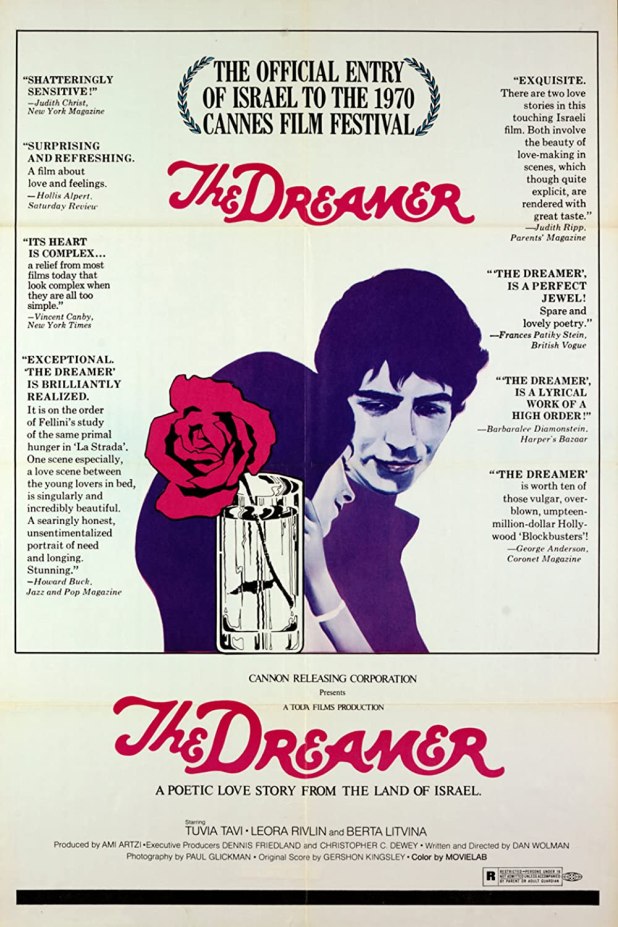
The Dreamer is an early Cannon Films pick up that was directed by Dan Wolman and entered into the 1970 Cannes Film Festival, which features prominently in the advertising. Wolman also directed the Cannon films Nana, the True Key of Pleasure; Baby LoveMaid In Sweden and Up Your Anchor, so he’s a connection between the Dewey-Friedland and Golan-Globus versions of Cannon.

Eli (Tuvia Tavi) is a handyman at an old folks home that is content to be the adopted son of one of the elderly ladies named Rachel (Berta Litvina). Yet when he falls for a young girl (Liora Rivlin), he forgets about painting portraits of Rachel and gets horizontal with his new lady — those love scenes may be why Cannon picked this up.

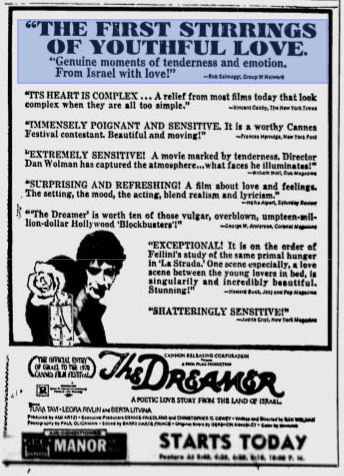
I kind of love that this played the Manor in Pittsburgh’s Squirrel Hill neighborhood:

CANNON MONTH 2: All Together Now (1970)

The only film from director William Louis Allan, who co-wrote this with Gayle Greene, this is an early Cannon film from their art/softcore days.

Listed as a House on 69th Street Production, hardly anyone in this movie did a single film other than this one. All I have to go by — I’m struggling to find this — is a synopsis: Marsha’s immature, and animalistic husband neglects and mistreats her, so she throws herself into an affair with a French man, but still doesn’t find the love she seeks. Determined that no woman will have the barren life that se has, she begins to write her own sex novels. To make her novels even better, she meets with a female doctor who is an expert in the field of sexuality. She’s seduced by the doctor and uses that for one of her books, but after suffering through writer’s block, Marsha ends up taking her own life because these old adult films need a square up reel because women certainly can’t have ownership of their own sexuality. Ugh — my least favorite part of these films.

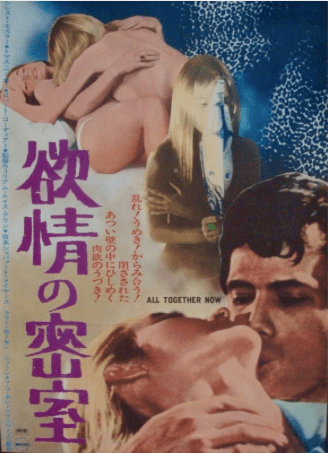
It’s listed in some places as a Swedish/U.S. co-production, which would make sense with the majority of Cannon’s content at this point. I did find a really cool Japanese poster, though.

Arnold Week: Hercules In New York (1970)

EDITOR’S NOTE: As the site celebrates Arnold’s 75th birthday, I’ll be featuring multiple articles about his movies every single day. To start, well, we start at the bottom with his first film, not even using the Schwarzenegger name. Originally posted on December 5, 2020, this is Hercules In New York

Whatever happened to the star of this movie, Arnold “Mr. Universe” Strong? Oh yeah. He grew up to be the greatest action star of all time, that’s what. But this movie is the very definition of starting small, as Arnold Schwarzenegger — 22 years old and laying brick with his lifting buddy Franco Columb — was told by his friend Reg Park (who took over for Steve Reeves in Hercules and the Captive Women) that he should shoot for his dream of being a movie star.

This wouldn’t do it.

It’s also the first film for director Arthur Allan Seidelman, who mainly did stage and TV work like the Nancy McKeon TV movie of the week Strange Voices.

If you ever wanted to see Hercules get sick of Mount Olympus and go to Earth, where he becomes a pro wrestler as well as best friends with a pretzel salesman named Pretzie (Arnold Stang, who between this movie, Ghost DadDondi and Skidoo* has pretty much been in the very worst of the worst in film), well, then this movie fills out all of your boxes with a sharp number two pencil.

James Karen (PoltergeistReturn of the Living Dead) and Richard Herd (the Supreme Commander from V) show up, as does four-time Mr. Universe, one-time owner of the biggest escort service in California and later evangelist Dennis Tinerino.

Also, just to be a total anal retentive nerd, I want to mention that while Zeus, Nemesis, Eros, Pluto and Atlas are Greek gods, Hercules, Venus, Juno, Mercury and Neptune are the Roman versions, while Samson — who is kind of, sort of Hercules’ brother in this — comes from The Bible.

So yeah. Hercules comes to New York and gets mixed up with the mob and a pretzel salesman before coming back to Mount Olympus and sending a message on the radio.

*For some reason, I kind of love Skidoo.

You can watch this on Tubi.