PURE TERROR MONTH: Night of Bloody Horror (1969)

Riddle me this, you trash-cinema loving degenerate:

What do you get when you cross Rick Simon from a Magnum, P.I spinoff with a guy who made a movie about a brain machine with Sheriff Rosco P. Coltrane (The Brain Machine, 1977), then one of the too many bigfoot-horror movies with a TV western actor who appeared on Gunsmoke, The Rifleman, and Bonanza (Creature from Black Lake, 1976), then turned a Monkee into a strangler (The Night of the Strangler; 1972), and chopped up an actress who made her debut in an Alfred Hitchcock film (Women and Bloody Terror; 1970)?

(Bloody) Stumped?

Maybe if that creepy dude showed up, then we’d have a movie.

Okay. Well, did you hear the one about the film that had the unmitigated gall to ask audiences: “How much SHOCK (read: yawning) can YOU stand?”, then baited said audiences with a cut-rate William Castle promotional gimmick by offering $1000 “Death by Fright” insurance policies if any relative was unable to stand the “Violent Vision” film process? (No cardboard glasses required.)

Yep. Joy “J.N” Houck, Jr. is right!

Night of Bloody Horror owes its existence to Hitchcock’s Psycho, with Gerald “Major Dad/Rick Simon” MacRaney as Wesley, the resident Norman Bates of New Orleans who’s recuperated from his screwed-up childhood-to-teen traumas and has returned from the loony bin. (Oh, right, you’re most likely younger than me: MacRaney was George Hearst in HBO’s popular series, Deadwood.)

I don’t get it.

I am completely (well, reasonably) sane and a pretty bright light bulb, overall. I have a job, good hygiene, and a great, normal relationship with my mother. Meanwhile, Norman Jr. comes home and hits a bar, gets pissed, and the delicate flowers are falling from the trees for dates. These are the types Alaric de Marnac from the Paul Naschy-universe (Panic Beats) disciplines by morning star. I see a sickle-neck chop in someone’s future.

“Did you hear that creepy Wesley Stuart is back in town?” Susan says to Kay at the local soda fountain.

“Who’s that?” inquires Kay.

“You remember, Wessy-Pissy Pants, the kid whose wacko mother used to beat him all time, so he murdered his little brother, Jonathan, thirteen years ago because he was ‘mommy’s favorite.’”

Kay’s nether regions begin to moisten. “You don’t mean the loser that the members of The Bored—shempin’ as hoods because the film ran out of money—beat up outside the club the other night?”

“Yep.”

“Do you have his number?”

No need to call him, Kay. Wes hangs with the guys from The Bored, the resident (a real-life New Orleans) psych-rock band that caterwauls over fuzz-bass and overdriven organ about “plastic, fantastic dreams” to an LSD-reverse negative lighting effect. The band’s lead singer, “actor” George Spelvin, also shemps: he’s the red-herring Catholic Priest who has some kink-issues of his own.

Oh, shit. Wes is holding his head again. Cue the cheesy-cheap spiral effect to show he’s readying to “Janet Lee” someone. Yep, he’s having another childhood flashback and the chippy he’s doin’ the hop ‘n’ anchor with transforms into . . . his mother! So the cops haul ‘em in, slap ‘em around, give him a James Dean-Rebel Without a Cause acting-showcase moment, and call him a “fag” a couple dozen times. Hey, it was the un-PC ‘60s, after all. . . .

You’re tearing me apart, Kay!” scenery chews Johnny.

Houck! Why are you doing this to me!

Tommy Wiseau? What the hell are you doing here? Didn’t I already make enough comparative critiques of your oeuvre in my October “Scarecrow Challenge” reviews for Spine and Ice Cream Man?

Don’t worry, baby face. This real Hollywood movie. Is plot twist. So, you and Sam toss football? Lisa and Becca, and that chick you’re with these days, can make sandwiches. We have picnic.”

Yeah, we broke up. And I can’t right now. I need to finish typing this review for B&S Movies’ Halloween tribute to the Mill Creek Pure Terror 50 Box Set.

Hahaha. You’re so silly, R.D. What a story. Oh, hi doggie. . . .

. . . And woosy-Wessie snaps and tosses his plastic water bottle. (Well, glass pop bottle, as there were no plastic bottles—or bottled water—in the ‘60s.)

I did nawt kill her, I did naaawt. Oh, hi, R.D!

Tommy, please.

“Oh, hi doggie.”

. . . Anyway . . . Squeeze #1 gets a knife in the eye; nurse-squeeze #2 gets an axe to the chest, then good ‘ol Doc Moss (Captain Skaggs from the short-lived 1977 series with Ernest “apoc-cabbie” Borgnine and James Evans, Sr. from Good Times that no one seems to remember, but me: Future Cop) has his rubber-hand-filled-with-red paint chopped off—followed with a cranium-chop chaser.

Outside of the opening sex and nudity scene featuring actress Lisa Dameron showing her assets and the dues ex machina-red herring combo twist at the end, you’re better off re-watching the Hitchcock original. But we love American psycho-trash cinema pretending to be Italian that can’t even live up to being a Spanish Giallo knockoff, so we’ll stick by you, Major Mac Simon.

The mystery behind the acting lead singer of The Bored: “George Spelvin” is the American stage-theatrical pseudonym equivalent to the use of “Alan Smithee” in the film world—for those who don’t want to be credited (gee, I wonder why?). According to the exhaustive music database maintained at Discogs.com, The Bored never released so much as a regional-obscure 45-rpm 7” single. None of the band members—again, who doubled as “hoods” that beat the snot out of Wesley—appeared in any other bands? I guess pseudonyms work after all; they’re phantoms. (Luckily, a fan extracted one of the band’s nameless songs from the film for your You Tube listening enjoyment.)

A more infamous rock ‘n’ roll connection of the film: The main reason why this film is remembered above all the other knock-offs in the ‘60s Psycho-inspired, Oedipal-slasher sub-genre: the film was released on August 9, 1969, the same day of the infamous Manson “Helter Skelter” murders.

Night of Bloody Horror was the first film for Gerald McRaney and Joy N. Houck, Jr. (sometimes using the acting nom de plume: J.N Houck, Jr.); they worked together a second time on Women and Bloody Terror—which Houck banged out in a back-to-back fever-dream shoot to serve as his own second feature for the family’s 200-plus chain of drive-ins. Prior to making his writing-directing bow, Houck’s Howco Pictures produced an early Roger Corman directing effort: the rock ‘n’ roll flick, Carnival Rock (1957) . . . and you can never get enough John Agar with The Brain from Planet Arous (1957). Oh, speaking of groan-inducing sci-fi cheese (that we love!) from the ’50 and ‘60s: If the score in Night of Bloody Horror is familiar, that’s because it’s pinched from the sci-fi feature, Phantom Planet (1961).

Meanwhile, as Gerald MacRaney deals with his “mommy issues” and dreams of being a sexy-suave detective in an ‘80s hit TV series, Tom Selleck is brooding over a painting of witches, one that may—or may not—be his wife, in Daughters of Satan (1972). Sound like an investigation for Thomas Magnum.

Yes, it was a hard life in the three-network universe for America’s future TV detectives.

About the Author: You can read the music and film criticisms of R.D Francis on Medium and learn more about his rock ‘n’ roll biographies, along with horror and sci-fi novellas, on Facebook. He also writes for B&S Movies.
PURE TERROR MONTH: The House That Screamed (1969)

ABOUT THE AUTHOR: Paul Andolina is back to watch another movie for us. If you like his stuff, check out his site Wrestling with Film

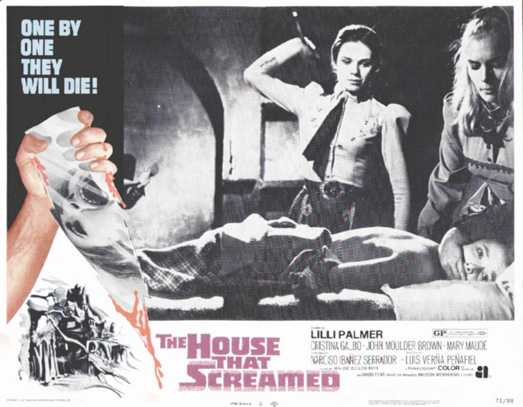
The House that Screamed aka La Residencia, is a Spanish horror film from the director Narciso (Chicho) Ibáñez Serrador. He is mostly known for a game show and the TV series Historias para no dormir (Stories to Keep You Awake). I would love to get my hands on a copy of Historias para no dormir which started in 1966 and ended in 1982. He also wrote quite a few screenplays under the name Luis Peñafiel. Chicho very recently passed away at the age of 83 on June 7, 2019. 

I’m glad I got a chance to watch this film for the first time as part of Pure Terror month. I have recently gotten back into the habit of studying Spanish and although most of my focus is on Latin American Spanish it’s always great to see horror films from Spain itself. This movie is about a boarding house in France run by a lovely old spinster, Madam Forneau, who has made it her mission in life to take care of rehabilitating and educating girls with behavioral problems. She has a bigger problem on her hands though because some of her girls are disappearing under unusual circumstances. 

A new girl, Teresa, is entering the boarding school. She has been sent by her mother who works in a cabaret as a singer to be educated there. This boarding school is essentially a prison, the girls are locked into their shared dormitory every night and most haven’t seen boys in months. Oh, the agony! Madam Forneau’s son Luis is a huge voyeur and sees a few of the girls here and there but that is not the extent of the strangeness going on at the school.

It takes a while for the killing to happen in this movie, which really helps build the atmosphere and tension of the film. This movie reminds me of the Italian Gialli mostly because of its sexual overtones mixed with violence. It’s well shot and I imagine that the Bluray that includes its extended cut looks beautiful. It is an excellent film despite its simplicity of plot. In fact this movie alone will most likely be the reason I seek out Chicho’s other film Who Can Kill a Child? and the Stories to Keep You Awake series.

This movie is worth a watch for pretty much anybody who enjoys horror. I did find it a bit boring because I’m not super invested in the lives of girls living in boarding schools. If you like women in prison movies I also believe you will find something to enjoy with this one.

I enjoyed The House that Screamed and I will look to see if I can watch the extended cut through rental soon. This movie is not one to skip if you pick up the Pure Terror set or if there isn’t much in the way you want to watch on this set you can seek it out on Bluray or DVD. However, I imagine it is impossible to not want to pick up the set as there is so much to enjoy at the cost of almost one DVD!

The Wonderful Land of Oz (1969)

Despite being born in Bakersfield, CA, Barry Mahon volunteered to be in Britain’s Royal Air Force in 1941, achieving a record of five confirmed kills, two probables and three damaged planes, which earned him the British Distinguished Flying Cross in 1985. He was shot down in August of 1942, captured and imprisoned at Stalag Luft III. He managed to escape and was recaptured twice before he was finally liberated by Patton’s 3rd Army in 1945. It’s been claimed that Steve McQueen’s role in The Great Escape is based on Mahon.

Upon returning to America, he became the personal pilot and manager of Errol Flynn. This led to producing films like 1957’s Crossed Swords and 1959’s Cuban Rebel Girls, both of which had Flynn in them. The rest of his films, like Rocket Attack U.S.A.Sex Killer and Fanny Hill Meets Dr. Erotico enter the world of exploitation and sexploitation. Further titles include Bunny Yeager’s Nude Camera, Hollywood Nudes ReportConfessions of a Bad Girl, P. P. S. (Prostitutes’ Protective Society), The Girl With the Magic Box and many, many more. And then there are his children’s films, like Santa’s Christmas Elf (Named Calvin), Jack and the Beanstalk and Thumbelina, which is part of one of the oddest movies I’ve ever seen — imagine exactly how much that statement covers — Santa Claus and the Ice Cream Bunny.

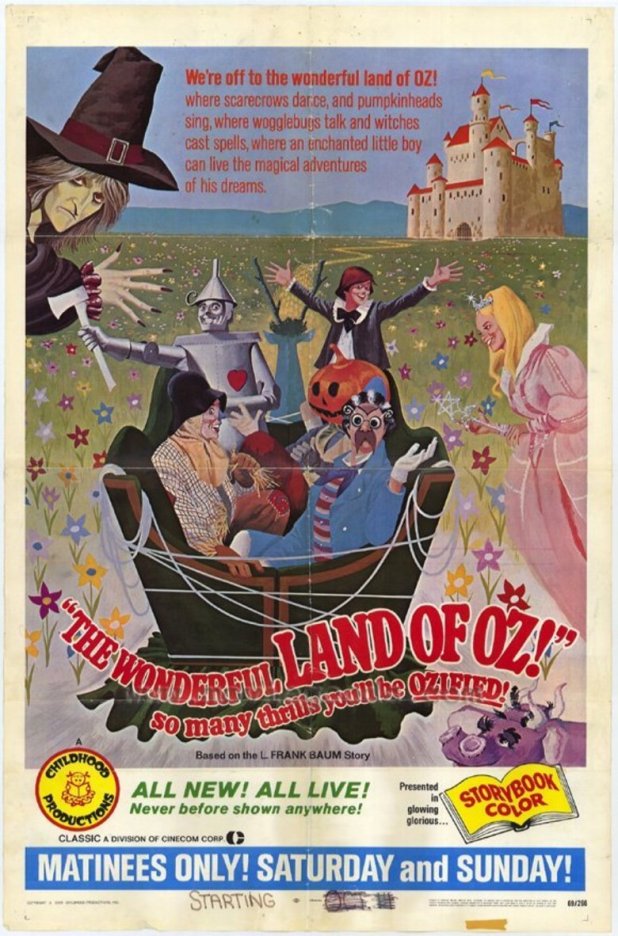
An adaption of The Marvelous Land of Oz by L. Frank Baum, Mahon told The New York Times that he had hired Judy Garland to narrate this movie, which is the ultimate in carnie flim flam.

Mahon’s youngest son Channy, or Chandos Castle Mahon, plays our hero Tip. Yes, Dorothy doesn’t show up, but Glinda, the Tin Woodsman and the Scarecrow all do. However, they’re all embroiled in international intrigue and in-fighting between their kingdoms, I mean cardboard sets that wouldn’t be foreign in a late 60’s nudie-cutie.

Speaking of softcore, all of Jinjur’s Army of Revolt are played by incredibly attractive young women in band uniforms and knee high boots. “Something for daddy,” as they say. Speaking of fathers, there’s also a man with a giant pumpkin for a head that is brought to life and calls Tip dad.

This movie is completely frightening. There’s a papier-mache purple cow, a bug faced man and a scarecrow that looks more like Imhotep than Ray Bolger. You may never get it out of your brain and for that, I am sorry.

You can watch the Rifftrax version on Amazon Prime.

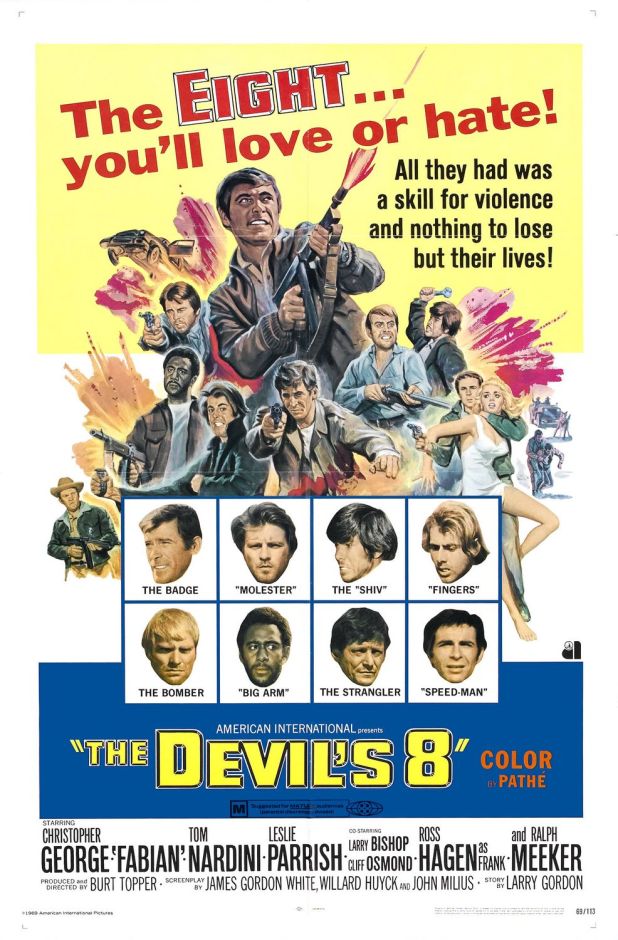
The Devil’s Eight (1969)

Oh American International Pictures. You knew exactly what the kids wanted. In 1969, they wanted their own version of The Dirty Dozen. Who better to give it to them than you?

Based on a story by AIP story editor Larry Gordon and the first draft was by James Gordon White. It was eventually rewritten in ten days by two of his assistants, John Milius and Willard Huyck. The future director of Conan the Barbarian quipped, “It was called The Devil’s 8 because they didn’t have enough money for a full dozen.”

White wasn’t a fan of the final film. “They took the Southern flavor out of it and I’m from the south, so I know from whereof I talk.” Take it from the writer of Bigfoot, The Mini-Skirt Mob and both movies about a head transplant, The Incredible 2-Headed Transplant and The Thing with Two Heads.

Originally known as Inferno Road, this movie has an all-star cast. And by that, I mean an all-star AIP 1969 cast.

Christopher George (Day of the AnimalsCity of the Living DeadPieces and about a hundred other movies that I love) plays federal agent Ray Faulkner, who starts the movie on a road gang before he breaks the rest of the guys out and forces them on to a helicopter at gunpoint. They are:

  • Sonny (Fabian!) is in prison for murder but he’s a great driver. Unfortunately, he has a drinking problem.
  • Frank Davis (Ross Hagen, The Sidehackers) used to drive for the mob, but then they murdered his brother.
  • Billy Joe (Tom Nardini, Cat Ballou) is a mechanic who just wants to drive.
  • Sam (Joseph Turkel, Dr. Eldon Tyrell from Blade Runner and Lloyd from The Shining) loves to get in brawls.
  • Henry (Robert DoQuia, the sergeant from the RoboCop movies) is an African-American prisoner who can really handle the wheel.
  • Chandler (Larry Bishop, son of Joey, who was in Wild In the Streets) would rather read the Bible than get involved in all this.
  • Stewart Martin (Ron Rifkin, L.A. Confidential) is a rookie fed.

After training “The Eight…you’ll either love or hate!” in high-speed driving and throwing bombs, they work their way into Burl’s (Ralph Meeker, who was actually in The Dirty Dozen, as well as Without Warning and The Alpha Incident) illegal moonshine operation. There are all manner of double crosses and not everyone makes it out alive, but Burl’s mistress Cissy (Leslie Parrish) ends up with her real man, Davis.

Let me talk about Leslie Parrish for awhile. She’s led a pretty amazing life, starting under her birth name Marjorie Hellen, which she changed in 1959. While she was a teenager at the Philadelphia Conservatory of Music, she started modeling and became a human test pattern for NBC known as Miss Color TV, as they used her skin tones to test how well they’d transmit over the airwaves.

In 1956, she started her contract with MGM and appeared in redneck classic Lil’ Abner as Daisy Mae. In fact, it was director Melvin Frank who convinced her to change her name. She was also in The Manchurian Candidate and a ton of TV shows at this time, as well as being the Associate Producer on Jonathan Livingston Seagull. Part of that job meant caring for the real seagulls and keeping them in her hotel room, as well as being the mediator between her husband, author Richard Bach, and director Hall Bartlett after they stopped talking. Despite all that, her role is only listed as researcher in the credits.

While acting paid the bills, her real job was activism. She was a member of the Jeannette Rankin Brigade, a coalition of women’s peace groups and had private audiences with politicians and led huge public protests. She has also been incredibly involved in environmental activism and even created KVST-TV, which looked pretty much like C-SPAN does today, but all the way back in 1967. Today, she continues to develop and lead the Spring Hill Wildlife Sanctuary on Orcas Island in Washington. And oh yeah — she was also in The Giant Spider Invasion. Check out her official site!

The Devil’s 8 is decent, but as always, I’m on the side of the bootleggers. Don’t make me divide my loyalty by putting Fabian on the side of Johnny Law! Come on, AIP!

You can watch this on Amazon Prime.

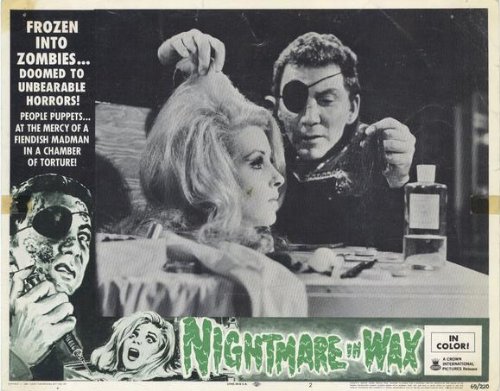
CHILLING CLASSICS MONTH: Nightmare in Wax (1969)

Cameron Mitchell is making his fourth appearance in the Chilling Classics box set with this movie, but I know that he has to be in even more. From voicing Jesus in The Robe to the 1951 version of Death of a Salesman, Mitchell had plenty of big roles in even bigger films. But we’re not here to talk about those. We’d rather talk about his appearances in movies like Night Train to Terror (his segment also appears as another stand-alone movie, The Nightmare Never Ends), The Demon and Blood and Black Lace.

This time out, Cameron is Vince Rinaud, an FX artist who is disfigured by Paragon Pictures studio boss Max Block, who was also a rival for the attention of actress Marie Morgan. Yes, all it takes to ruin a man is to throw wine in his face and then a cigar. Who knew?

Leaving movies behind, Vince gains an eyepatch and a wax museum, while Paragon quickly loses four of their stars. Is it a coincidence that they soon appear as wax statues in Max’s museum?

This movie is pretty much a direct ripoff of House of Wax, except instead of dead bodies being under the wax, Vince uses a serum to turn people into zombies that just stand there under his control. There are also two cops who are the worst detectives this side of a giallo on the case — one of them is Bud Cardos, who appeared in Satan’s Sadists and directed The Dark!

But hey — Cameron Mitchell wearing a cape and an eyepatch. If that makes you happy, we’re happy you’re reading our site.

If you don’t have the Chilling Classics box set — and why don’t you after an entire month of us writing about it? — you can watch this on Amazon Prime free with membership.

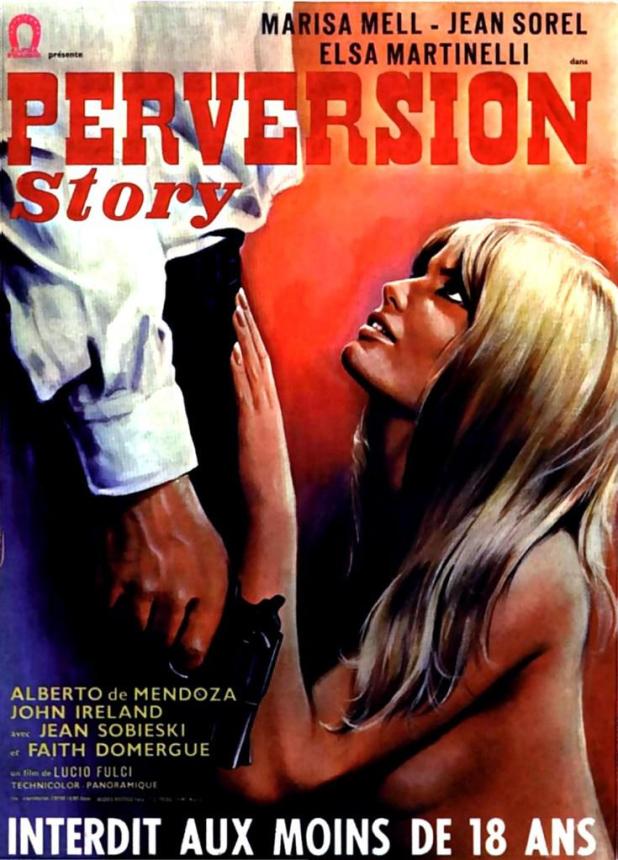
Perversion Story (1969)

Have I ever written here about how much I love Lucio Fulci? Oh that’s right — I’ve written about a few of his movies, like AengimaThe Beyond, The Black CatCat in the BrainConquest, Contraband, Demonia, The Devil’s HoneyDon’t Torture a Duckling, The Four of the ApocalypseHouse by the CemeteryA Lizard in a Woman’s Skin, Manhattan Baby, Murder RockThe New York RipperSodoma’s Ghost, Touch of DeathVoices from BeyondWarriors of the Year 2072 and Zombi 2. Heck, I’ve even written about The Curse and Zombi 3, films that Fulci just did effects on or quit part way through. Yet I was missing this film — also known as One on Top of the Other — until Mondo Macabro re-released it this year.

At this point in his career, Fulci was mainly known for comedies, so the move to the giallo genre was a major shift. Bava had invented the form only six years ago with his one-two punch of The Girl Who Knew Too Much and Blood and Black Lace. And Argento’s The Bird with the Crystal Plumage, which would turn the form into a genre all unto itself, wouldn’t be made until the next year. Gathering inspiration from Vertigo, Fulci felt that the script for Perversion Story ranked among his best.

Unlike many of his later films, this movie enjoys a decent budget, with eight weeks of principal photography and location shooting in San Francisco, Reno and Sacramento, including a gas chamber sequence shot at the San Quentin State Prison.

George Dumurrier (Jean Sorel, Belle du Jour) is the protagonist, a wealthy doctor who runs a clinic with his younger brother Henry (Alberto de Mendoza, The Strange Vice of Mrs. Wardh). He’s leading a double life. He’s caring for his asthma-stricken wife Susan, (played by Marisa Mell, just as gorgeous here as she is in Danger: Diabolik and could be the ultimate Fulci girl, as she nearly lost her right eye in a 1963 auto accident, with the distinctive curl of her upper lip the only remaining evidence of the damage) while he’s also having an affair with Jane (Elsa Martinelli, The 10th Victim).

George and Jane travel to Reno for a romantic getaway whole Susan remains in the care of her sister Marta (Faith Domergue, The House of Seven Corpses) and a nurse. Jane confesses that while she loves our hero, she doesn’t see any future in their relationship. There’s an amazing scene here where we watch the lovers from under the bed — Fulci almost shoots it as if the camera is below them and we’re caught in the space between reality and dream, true life and forbidden passion.

When they arrive at a casino, George has a message waiting from his brother: his wife is dead. Returning home to San Francisco, George meets the disapproving gaze of Marta who believes that he has to be behind her sister’s death, as he stands to receive $1 million dollars in life insurance, money he desperately needs for his business. That said, an insurance agent has been following George and Jane and informs police inspector Wald (John Ireland, I Saw What You DidThe Incubus) of his findings.

In the midst of all this scandal, George and Jane get an anonymous tip that leads them to The Roading Twenties strip club, where they meet Monica, an exotic dancer who looks exactly like Susan with blonde hair — shades of Vertigo fed through Italian sleaze! Monica and George begin an affair that may start with him seeking answers but ends with him being seduced. Fulci masterfully frames these scenes with Monica/Susan in positions of submission while obviously being the one in control of every single action that she allows to happen. For someone who would later contribute to some of cinema’s most stomach-churning excesses, this sequence is an exercise in beauty.

What’s striking about Perversion Story is that on the surface, the film seems like its going to be pure exploitation. But even in moments like when we first see Monica at the strip club, she is the only girl on stage clothed. And she appears on a motorcycle, at the time seen as the very symbol of male independence, mastering and dominating it, in complete control of her sexuality. She owns the entire room and every gaze — male and female — within it.

The police arrest Monica — due process be damned in late 60’s giallo — and she informs them that she’s an in-demand callgirl who was hired to pose as Susan by a woman she only knows as Betty. Fulci again stages an incredible looking scene here as the police begin testing the evidence and autopsy, as the screen fills with no less than five different frames all containing splashes of color and movement, a look and feel that Ang Lee would later attempt in his 2003 version of The Hulk. Again, a rare example of constraint by Fulci here, as we only see a hint of the corpse instead of actually seeing viscera.

Benjamin Wormser (Riccardo Cucciolla, Rabid Dogs) comes to bail out Monica, as he is one of her most besotten clients. However, when he arrives at the station, he learns that her expensive bail has already been arranged by someone the police will not reveal. There’s also a great interrogation scene here where Jane conducts a sexually charged photo shoot with Monica, all to learn why his life has been turned upside down. They need to know — who was his wife’s nurse Elizabeth O’Neal and where is she now? This scene sets up everything we expect from the girl on girl seduction scene, yet it’s all in the service of advancing the plot, something usually unheard of in the genre.

As the police search Monica’s apartment, they discover an envelope filled with money and marked with George’s fingerprints. While the femme fatale goes missed, Goerge is arrested, tried and convicted for his wife’s murder. On the eve of his execution, Henry visits and spills the entire plot to him. Monica really is Susan and they faked her death to get the money and leave him to pay for the crime, with the dead body really being the missing nurse. Of course, we already know this, thanks to a bravura scene where Monica sheds her blonde tresses and contact lenses in an airport bathroom, transforming herself into the woman she has always been, Susan. There’s even a POV shot that puts the viewer directly into the role of the customs officer reviewing her passport.

As Henry leaves his brother to rot, George tries in vain to get anyone to listen and Inspector Wald’s investigation comes up short. The only person left who believes in him is Jane. We follow him from his cell to the gas chamber, but it looks like there will be no last-minute reprieve. Or will there be? As the film intercuts between Henry and Susan’s romantic reunion and George being prepared for the gas chamber, the answer reveals itself. Keep your eyes open for an appearance by Bobby Rhodes from Demons as a prison guard!

Truthfully, George is out of control and powerless for the entire running time as the results of her actions. Even the denouement is out of his control — we hear the end of the story from a reporter and none of the film’s heroic figures have anything to do with the close. It’s the film’s most pathetic character that actually closes off the tale.

Perversion Story doesn’t have all of the trademarks of the giallo — multiple on-camera murders, POV shots of mayhem and black-gloved killers. But don’t let that keep you from watching. I can sum this film up in one word: gorgeous. You can really feel the spirit of the late 60’s and pop art in every single frame, making this look and feel unlike any other film in Fulci’s catalog. Instead of splatter and dread, you get longing gazes at Marisa Mell. Trust me — it’s not a bad trade-off. Throw in a jazz score by Cannibal Holocaust composer Riz Ortolani and you have the complete package.

Now, Mondo Macabro has released what they refer to as the longest, most complete form of the movie ever released (Severin released the French version in 2007). Complete with an uncut 108-minute version with English and Italian audio tracks restored from the original negative (with additional scenes provided by a 35mm print), this edition also features interviews with Jean Sorel and Elsa Martinelli, as well as an incredibly insightful commentary on the movie by Stephen Thrower, author of the book Beyond Terror: The Films of Lucio Fulci. Credit where credit is due — this version of the film looks incredible, fully realizing Fulci’s color choices and sumptuous imagery. You can grab a copy yourself at their site or on Diabolik DVD.

Disclaimer: I was sent this film by Mondo Macabro for review and in no way did that impact my review.

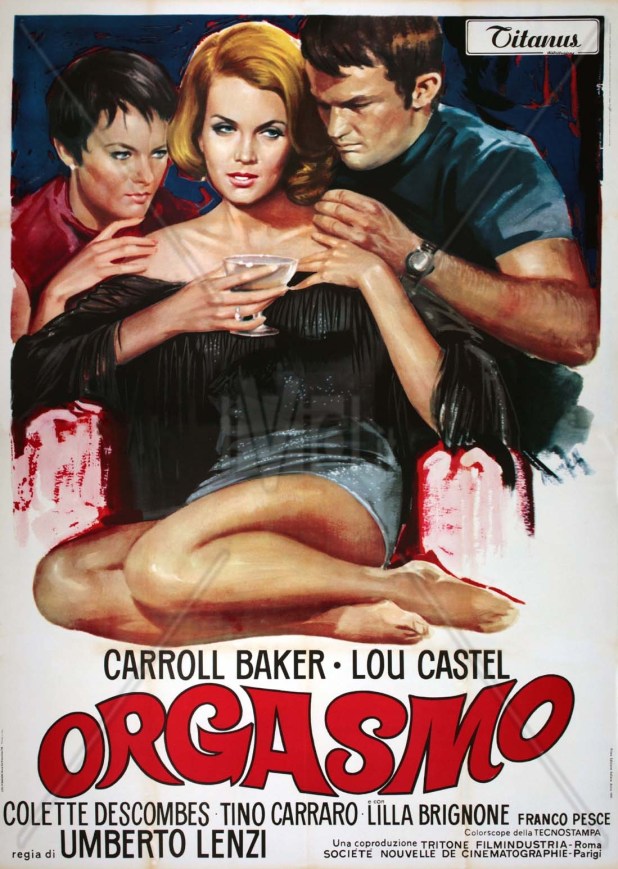
Orgasmo (1969)

Umberto Lenzi, come on down! We’re looking for you to shock us, to titillate us, to maybe even thrill us a bit. Oh, you’re brought Carroll Baker with you! Please! Show us what tale you’ve crafted!

Kathryn West (Baker) is a glamorous American widow who has come to Italy weeks after the death of her older wealthy husband. She movies into a huge villa but her life is lonely and boring until Peter shows up. His free-spirited ways shake her loose and he soon moves in his sister, Eva. But things aren’t what they seem — they aren’t brother and sister and the relationship becomes a threesome. But when Kathryn tries to quit them, they keep her prisoner, constantly high on drugs and alcohol as they keep playing the same song over and over until she goes insane and wants to kill herself.

Caroll Baker started off as a Hollywood sex symbol before retreating to Europe where she’d make Baba YagaSo Sweet… So Perverse and The Sweet Body of Deborah, amongst others. Eventually, she’d move back to America and become a character actress. As for Lenzi, he’d go on to make Eaten AliveCannibal FeroxNightmare City and more.

If you like twists, if you like more twists, if you like your sex scenes filled with acid drenched visuals, then by all means, it’s time for you to savor this one.

You can get this as part of  The Complete Lenzi/Baker Giallo Collection set from Severin, which also has So Sweet…So PeverseA Quiet Place to Kill and Knife of Ice.

BIKER WEEK: Satan’s Sadists (1969)

Al Adamson made his breakthrough with this movie, going on to direct Dracula vs. FrankensteinCinderella 2000Nurse Sherri and one of the most legitimately unhinged movies I’ve ever survived, Carnival Magic. Even stranger, he was murdered and buried beneath his hot tub in 1995, killed by his live-in contractor Fred Fulford in a plot that could have been one of his films.

However, today we’re talking about his contribution to biker films.

The Satans are a motorcycle club who roam the American Southwest, led by Anchor (Russ Tamblyn, TV’s Twin Peaks) and including Firewater (John “Bud” Cardos, Breaking Point), Acid (Greydon Clark, who directed Satan’s Cheerleaders), Romeo (Bobby Clark, TV’s Casey Jones), Muscle, Willie and Gina (Regina Carrol, Adamson’s wife who appears in nearly all of his films). We’re introduced to the gang as they beat up a man, rape his girlfriend and then push them and their car off a cliff.

They have the bad luck to get in the way of hitchhiker Johnny Martin, a Vietnam vet who is just trying to figure it all out. He gets picked up by Chuck Baldwin (Scott Brady, the sheriff from Gremlins) and his wife Nora. The old man’s a cop and wants to help the young Marine as he travels the highways. They all go to a diner, where we meet Lew (Kent Taylor, half of the inspiration for Superman’s alter ego), the owner, and Tracy, a waitress.

The Satans show up and ruin the budding romance between Johnny and Tracy, as they earn the ire of Chuck and his wife, who tosses a drink in one of their faces. Chuck tries to pull his gun, but the old man’s authority means nothing to the hardened toughs who beat the fuck out of him and rape his woman. Then, they kill all three — but not until Anchor screams out a totally inspired rant:

“You’re right, cop. You’re right, I am a rotten bastard. I admit it. But I tell ya something. Even though I got a lot of hate inside, I got some friends who ain’t got hate inside. They’re filled with nothing but love. Their only crime is growing their hair long, smoking a little grass and getting high, looking at the stars at night, writing poetry in the sand. And what do you do? You bust down their doors, man. Dumb-ass cop. You bust down their doors and you bust down their heads. You put ’em behind bars. And you know something funny? They forgive you. I don’t.”

The Satans don’t leave witnesses. Well, except for our hero and the waitress, who just escaped from Muscle and Romeo. Meanwhile, the gang meets three young girls and start partying with them. Gina can’t take seeing Anchor with other women, so she jumps off a cliff.

Willie tries to kill our heroes, but a rattlesnake saves them (!). Meanwhile, Firewater finds his body and comes to tell Anchor, who has gone insane and murdered all three girls. They fight and Firewater leaves the leader for dead. As he finally finds Johnny and Tracy, he is killed by a landslide (again, nature itself is against the bikers).

Finally, Anchor catches up to them and goes nuts, giving another soliloquy about being Satan. He raises Chuck’s gun to kill everyone, but Johnny simply throws a switchblade at him. “In Vietnam, at least I got paid when I killed people,” he says and at that, he and Tracy ride off on the villain’s cycle.

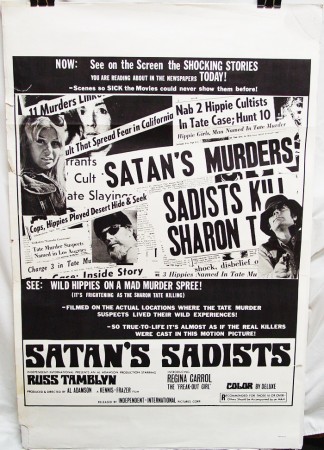
Satan’s Sadists was filmed at the Spahn Movie Ranch in Simi Valley, CA, at the same time the Manson Family lived there. Some movies would hide this fact. This poster will prove that this one wears it on its bloody sleeve.

Truly, this is a movie that does not give a fuck. Just about no one gets out alive or unscarred. Any moments of pleasure are stolen or taken by force. The poster promises human garbage and this film delivers.

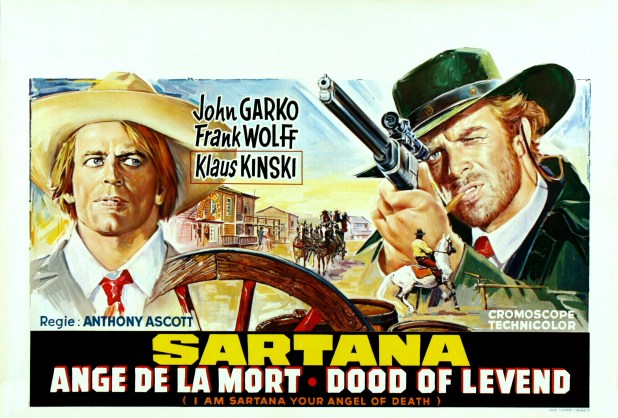
SARTANA WEEK: I Am Sartana Your Angel of Death (1969)

A man who looks just like Sartana robs what has been — up until now — impossible to steal from. Now, bounty hunters are trying to cash in on the bounty on our hero’s head.

Giuliano Carnimeo (The Case of the Bloody IrisExterminators of the Year 3000) takes over the directorial reigns from Gianfranco Parolini with this film.

Sartana becomes less of an angel of death and more of a magician here. Yet he still seems supernatural. Surely he’s been shot so many times that only a dead man can survive having that much hot lead pumped into him!

The movie takes places in Poker Falls, a town devoted to gambling, and the bank robbed at the beginning actually has a gang of killers that seek out potential thieves and kill them before they get the chance to try to take money from them. Throw in Klaus Kinski as a card shark named Hot Dead and you have quite the pickle for Sartana!

This is the only film where Sartana has Buddy Ben as his assistant. Also known as Sartana the Gravedigger, this one didn’t grab me as much as the original. It’s certainly anything but boring, but I really liked the darker tone of the first one. Also, the theme music seems to reference “Santa Claus is Coming to Town” but in a Western banjo way, which seems quite odd to me!