If Jayne Mansfield lived long enough, she most assuredly would have been in Italian western, giallos, slashers and any other films that would have had her. She even made this film, a Eurospy takeoff, not long before her sad demise.
Some young people are on a scavenger hunt which brings them to an island close to Cape Coral, Florida, where the fountain of youth supposedly exists. The rich owner of the island gets his daughter (Mansfield) to kick them all out, but she only wants to see her chubby lover Irving, who somehow is the second person I’ve seen in a film with the trope of being completely uninterested in aardvarking with Jayne. Somehow, Irving has an evil twin named Herman and he has an evil woman in his life named Camille Salamander, played by Phyllis Diller.
Director Joseph Cates also made the sleazy Who Killed Teddy Bear? and somehow went on to produce the Tony Awards. This movie is so threadbare that when they ran out of money, instead of shooting the last scenes, they literally filmed the script.
William Asher’s career was mostly in TV — he was a driving force behind I Love Lucy and Bewitched — and making AIP’s beach movies work. The one aberration is the movie Butcher, Baker Nightmare Maker, which is a mindblowing piece of film that I encourage everyone to see.
AIP was always ahead of the teen curve, as they realized that the beach films had run their course and now, the kids wanted, well, rebellion.
AIP executive Deke Heyward said, “The next big thing for teenage films is protest. Teenagers empathize with protest because they are in revolt against their parents… These films represent a protest against society. These will be moral tales, there will be good guys and bad guys. But we will show the reasons for young people going against the dictates of the establishment.”
Stock car racer “Fireball” Dave Owens (Frankie Avalon) has come from the West Coast to race Spartansburg’s champion Sonny Leander Fox (Fabian). He also gets plenty of glances from Fox’s girl, Jane (Annette Funicello).
The conflict comes when Dave is conned into smuggling moonshine by Julie Parrish and Harvey Lembeck’s characters. Then the IRS gets involved, threatening to jail our hero unless he helps them defeat the moonshiners. And then Fox wants one more race on the deadly Figure 8 track.
The real star of this movie is the Fireball 500, a 1966 Plymouth Barracuda customized by George Barris. There was going to be a sequel, Malibu 500, but that eventually became Thunder Alley.
As if Dave making eyes at Fox’s girl wasn’t bad enough, he’s also hooked up with Martha the Moonshiner (the aforementioned Parrish). So how does our man beat the system and get the girl? There’s only one way to find out.
This beach movie features no beach. Sure, it’s the sixth and last of the AIP beach genre films, but right now it’s the perfect movie for the abject pit of despair that I’ve found myself in tonight.
Mr. Hiram Stokeley (Boris Karloff!) has just died and has to perform just one good deed in the next day so he can go to Heaven. He asks for Cecily (Susan Hart, the wife of AIP co-founder James H. Nicholson) to help him stop his lawyer Reginald Ripper (Basil Rathbone!) from stealing his estate from its rightful owners Chuck (Tommy Kirk) and Lili (Deborah Walley, the Gidget star who was once married to Blood Island star John Ashley).
Ripper has hired his daughter Sinistra (former Miss Scotland and Fabian bau Quinn O’Hara), J. Sinister Hulk (Maytag man Jesse White), Chicken Feather (Benny Rubin) and Princess Yolanda (beach party regular Bobbi Shaw) to kill off our hero and heroine, while Eric Von Zipper (Harvey Lembeck) and his Malibu Rat Pack get involved.
This was originally called Pajama Party in a Haunted House, which is a pretty great title too. It’s the only beach party movie without Frankie Avalon and Annette Funicello, but it does have Nancy Sinatra right at the start of her fame, as well as George Barrows in his ape suit, Italian starlet Piccola Pupa and The Bobby Fuller Four.
Originally announced in the end credits of Dr. Goldfoot and the Bikini Machine (under the title The Girl in the Glass Bikini, it was retooled after AIP producers hated the initial cut. All of the scenes with Karloff and Hart were added in, with Hart superimposed over existing footage and Karloff appearing mostly by himself on a soundstage.
This film arrives at a time before hippies would change the world. It’s kind of ironic that Eric Von Zipper’s motorcycle crash would find its way into another AIP film that would more accurately reflect the latter half of the decade, the Billy Jack-introducing The Born Losers.
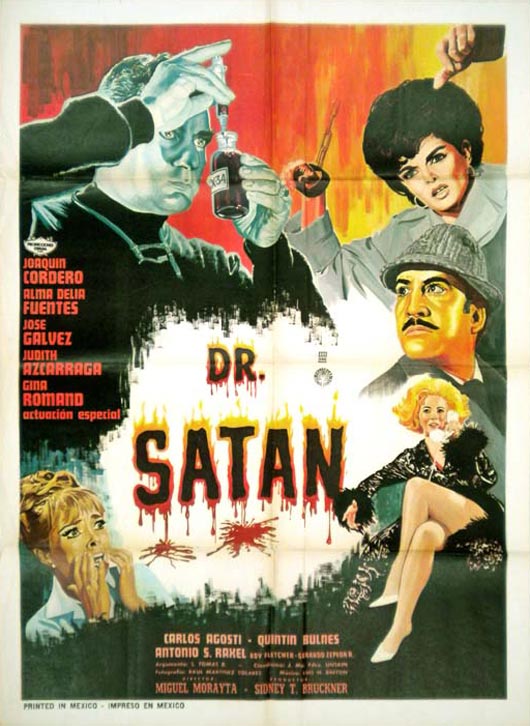
This seems like a crime movie, except that, you know, Dr. Satan has made a deal with Satan to be able to control his three zombie women, which feels like probably the best reason to give over your immortal soul when you think about it.
The devil does show up several times, mostly from far away and he has large black wings and he’s really ferocious and awesome in the way that only a totally Catholic culture could make him look.
Joaquin Cordero, who plays the titular character, studied in a seminary and even considered being a priest at one point. He decided to become a lawyer, but then changed his mind and became an actor. He would go on to become one of Mexico’s biggest stars, including appearances in Secta Satanica: El Enviado delSenor, Vacations of Terror 2, The Book of Stone and the somehow even better sequel to this movie.
Interpol agents against a doctor with zombie slaves that were gifted to him by el primero de los caidos. It’s as if someone took my most perfect dreams, sent them back in time and filmed them in Mexico. The left hand path has taken me many places, but this may be the most enjoyable.
“To the worm in the cheese, the cheese is the universe. To the maggot in the cadaver, the cadaver is infinity. And to you, what is your world? How do you know what is beyond the Beyond? Most of us don’t even know what is behind the Beyond.”
Mondo Bizarro blew my mind and it hadn’t even started yet.
Much like all of the Lee Frost and Bob Cresse mondos, this is a mix of both documentary and faked footage. Sure, that one way glass in a changing room is fake, but hey, Frederick’s of Hollywood is real, even if it shows up in so many mondo films that I lose track of which one is which.
This one also has a man sticking nails in his skin and eating glass, the hippies of Los Angeles, Germans watching a Nazi play (Cresse must have been, umm, Cresse-ing his jeans, seeing as how he played a German officer in Love Camp 7 with such aufregung.
The duo also used a high-powered lens to capture what they describe as a Lebanese white-slavery auction. Never mind that it’s obviously Bronson Canyon, the setting for everything from Night of the Blood Beast to Equinox, Octaman and, most famously, the entrance to the Batcave in the 1960’s TV show.
Make no bones about it. This is junk. But it’s entertaining junk.
You can get this on the same blu ray as Mondo Freudo from Severin.
Gualtiero Jacopetti and Franco Prosperi could have stopped with Mondo Cane, but no, they had more people to educate. And offend. Actually, mostly offend. This three-year in the making ode to the end of the colonial era in Africa is a barrage of brutality, set to the wondrous music of Riz Ortolani.
Some claimed that the scene that shows the execution of a Congolese Simba Rebel had been filmed expressly for the film, which led to Jacopetti’s arrest on charges of murder. The film was seized by police and editing for the movie had to stop. When Prosperi produced documents proving they had arrived at the scene just before the execution, he was freed.
The American version of the film — which is the one I saw — was edited and translated without Jacopetti, who claimed that this new version of his movie Africa Addio is a betrayal. That version is missing 45 minutes of political setup and exclusively features carnage and gore.
This film more than struck a nerve. While Prospero would say, “The public was not ready for this kind of truth,” and Jacopetti claimed that the movie “was not a justification of colonialism, but a condemnation for leaving the continent in a miserable condition,” the team’s follow-up Addio Zio Tom — while intended supposedly to be an answer to the charges of racism in this film — somehow is even more vile.
You can even see the entire film crew nearly killed while making this movie. They put their lives on the line to bring this to you. Whether you want it or are ready for it are decisions left up to you.
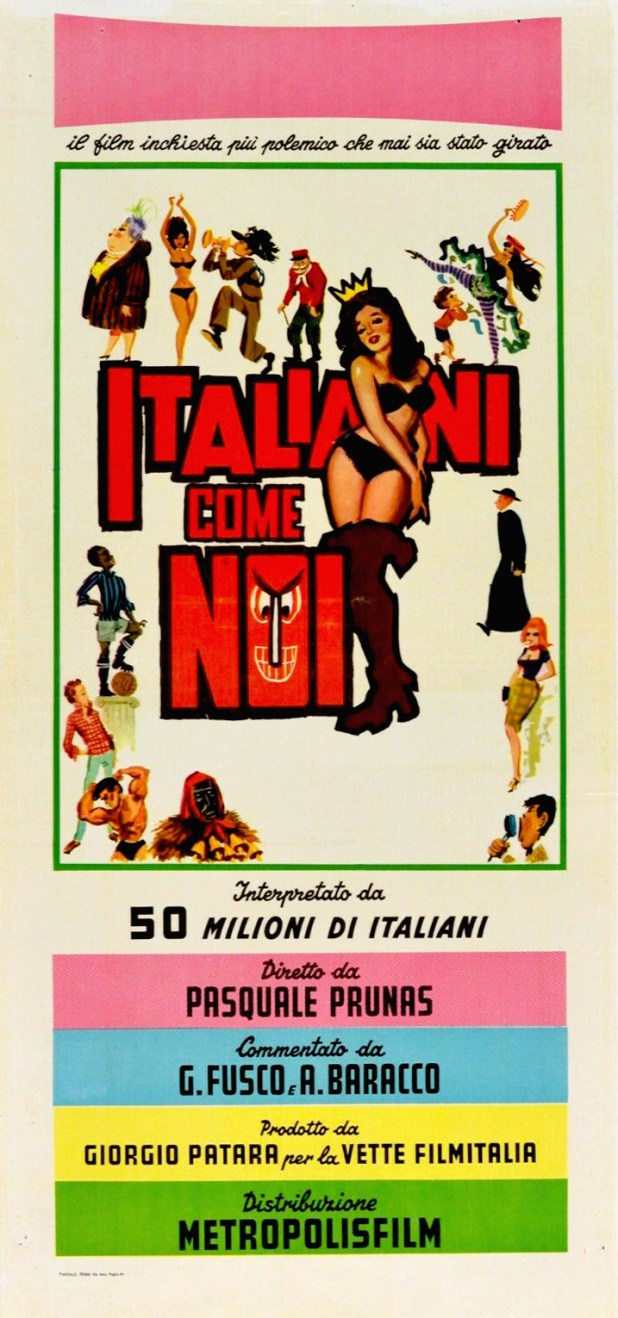
Pasquale Prunas has only one other IMDB entry for a documentary about Mussolini called Blood on the Balcony. However, the writer, Gian Carlo Fusco, would work on several mondos like Realities Around the World and Naked World.
This movie was part of American-International TV’s “Real Life Adventures” syndicated TV package that was offered in 1966. It’s a mondo, but much tamer than any you will encounter. The highlight — other than men toiling in the sulfur mines and the night clubs of the time — is probably a trip to the Venice Film Festival, which looks as if it were shot as a home movie.
Get ready for sixty-six minutes of pure scum from 1966, presented by Lee Frost (who wrote Race with the Devil and directed A Climax of Blue Power, along with The Thing With Two Heads) and Bob Cresse (whose Olympic International Films also brought The Scavengers and Love Camp 7 to the not so silver screen).
AGFA, who got the print of this out to the world all over again, says that it is “packed with staged scenes of Swiss lesbians, L.A. rapists, Parisian tarts and Nazi strippers.”
There’s also a sexy karate school commercial that for some reason has a girl taking a shower, murder and lots of strip club footage because it was 1966 and that’s the kind of thing that wasn’t widely available yet.
There’s also a great jazz/surf rock soundtrack under the hyperbolic narration. This had to blow minds fifty years ago. Today, it’s all pretty tame. But hey — somebody had to break ground, right?
You can get this on a double blu ray — along with Ecco — from Severin.
Mondo Freudo is all about “a world of sex and the strange & unusual laws that govern it,” as told by two absolute maniacs: the producer/director/distributor team of Lee Frost and Bob Cresse, with Cresse himself ranting as we try and make it through another swing through the world of mondo.
Hollywood strippers, Tijuana hookers, London lesbians, Asian sex shows, Times Square Satanists and topless Watusi clubs. Hidden cameras have recorded everything from teenagers making out to a Mexican slave market, a Black Mass near Times Square, while we also see people get painted, beaten and wrestle in mud.
Cresse would go on to make Love Camp 7 and plenty of other upsetting — or awesome — movies before his life fell apart one day while he walked his dog. Coming across two men beating a woman in broad daylight on Hollywood Boulevard, Cresse pulled his gun and ordered the men to stop. Turns out they were cops and shot him in the stomach and then killed his dog. He’d spend seven months in the hospital with no health insurance, losing most of his fortune.
Frost would make The Black Gestapoand put sex inserts into a foreign mondo all about the occult, creating the near-class Witchcraft ’70. He was smart enough to not fight any police.
You can get this movie, along with Mondo Bizarro, from the fine filth merchants at Severin.
This movie is everything I want it to be and more. A pro wrestling hero? A Eurospy James Bond rip-off? Future technology that is now charmingly quaint? A red masked lucha libre-esque hero massacring dudes with a flamethrower while the main villain and his mistress tie said hero’s girl to a torture table on fire? You should watch this movie three times and then stare into the sun and burn your eyes out. That’s how great it is.
Nicola Nostro made a few of the Ten Gladiators movies, but nothing prepared me for the madcap mayhem that he’d unleash on me with this movie. I mean, this is a film where the good guys stab and shoot Superargo just to show us all that he can’t be hurt and that his blood instantly coagulates.
Spanish actor Gérard Tichy (he was in plenty of Spaghetti Westerns and The Corruption of Chris Miller) plays Diabolicus. Loredana Nusciak — Maria, the lover of Django — plays his mistress who, of course, screws him over and gets machinegunned for her troubles by Superargo’s lady.
Superargo is — of course — Ken Wood (Italian real name: Giovanni Cianfriglia). He was Steve Reeves’ body double and shows up in another Italian superhero movie, Sandokan the Great. I love that Superargo becomes a super spy because of depression — he’s too strong and he threw another wrestler named El Tigra from the ring, killing him. Now, he just stays inside until his woman goes to his old army buddy and gets Superargo some government work.
There’s a scene where Argoman does a bicycle thing-a-majig with his feet while they test his blood pressure and scientist dudes lose their minds. Scenes like this are exactly why I adore this movie.
This is a movie that invents gadgets that are totally preposterous: a two-way radio inside a gigantic player piano. A geiger counter that looks like a cocktail olive. And a feminine brooch that has a television inside it that totally clashes with Superargo’s entire wardrobe!
The greatest thing about this movie is that at the end, Superargo awkwardly stares at the screen, kind of smirking, while the credits play. It’s not paused — he’s just standing there — and you’re like, “Yeah. That Superargo is a pretty good dude.”
There aren’t enough stars in the galaxy to rate this one.






 B&S About Movies