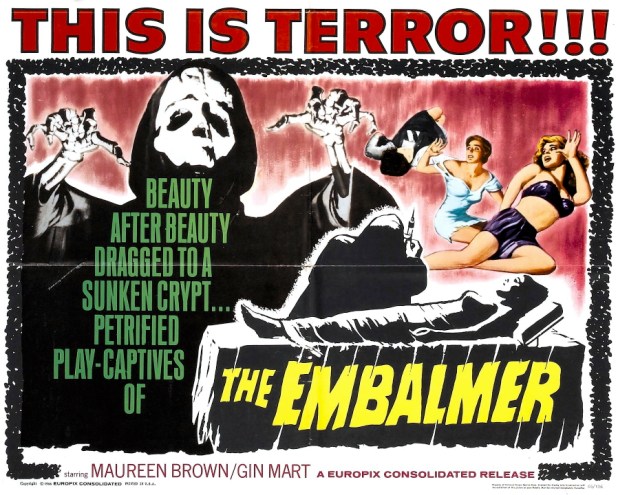
Il mostro di Venezia (The Monster of Venice) is at once a giallo and an Italian Gothic; it’s a movie that, when I started watching, I immediately knew was meant for me.
A skull-masked serial killer is swimming the canals of Venice, where he takes women, drowns them and then embalms their bodies so that they stay alive for him forever. This would be the perfect time for some college girls to come to town, but hey, who am I to say what you do when a mad scientist is on the loose, taking over a monastery deep inside the bowels of Venice? Who are we to look down upon him as he hangs out with a bunch of decaying, dead monks?
Reporter Andrea (Luigi Martocci) falls for one of those girls and, when one of her friends is taken, decides to become the giallo hero, trying to do what the police fail to do.
I don’t get all the hate for this movie, but then again, it hits all my buttons. Krimi killer. Wax museum vibes. Giallo plot. Gothic setting. Jazz. Girls in peril. Defund the giallo police. Defend The Embalmer.
Director Dino Tavella only made one other movie, A Dirty War.
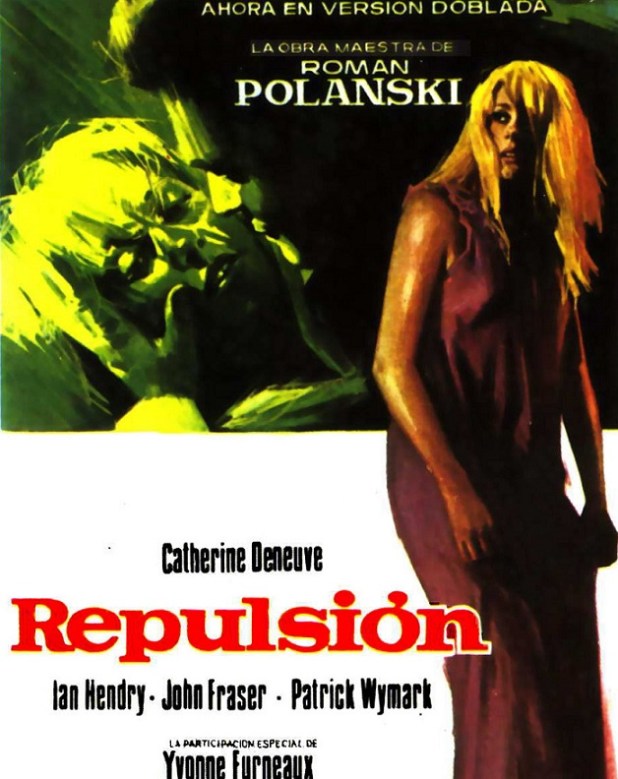
Roman Polanski’s first English-language film, this is part of his “Apartment Trilogy”, followed by Rosemary’s Baby and The Tenant. Strange for the time, it casts a female as a killer — there’s that spoiler — as Carol Ledoux (Catherine Deneuve) starts to melt down as she stays all alone in the small living quarters of her sister Helen (Yvonne Furneaux).
Polanski and co-writer Gerard Brach based this on a friend they knew and someone who they later learned had schizophrenia. Carol’s big issue is dealing with the rudeness of her sister’s married lover, Michael (Ian Hendry), and their lovemaking (this is the first movie with the sound of a female orgasm to play in England). Or maybe it’s every man who crosses her path. Or perhaps it’s every single person and thing she encounters that has sent her over the edge.
Is this even a real story? Seeing as how the camera zooms away from Carol’s eye and back into it at the end, are we instead seeing how she sees the world? How are we to take the photo at the end with the child looking so troubled? Has the father of the two sisters doomed Carol to be repulsed by all men?
Gorgeous black and white, overwhelming darkness and a skinned rabbit — that was supposed to be a real one before the crew talked Polanski out of it. A nightmare, but one worth seeking.
I hate when people make lists of the worst movies ever made, because stuff like this always ends up on it.
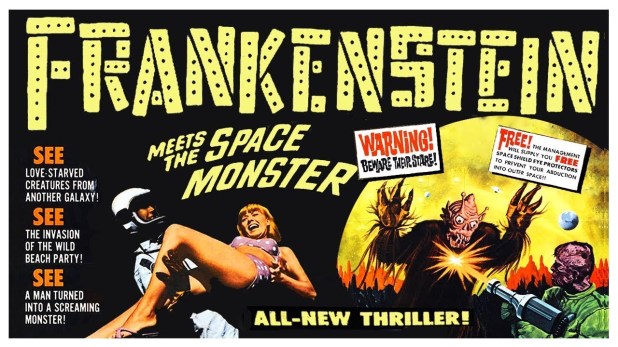
Whether you see it as this title or as Duel of the Space Monsters, Frankenstein Meets the Space Men, Mars Attacks Puerto Rico, Mars Invades Puerto Rico or Operation San Juan, you’re going to see something that is absolutely ridiculous. But why else do you watch movies?
Also: there is no Frankenstein in this movie.
Martian Princess Marcuzan (Marilyn Hanold, the June 1959 Playboy Playmate of the Month who is also in In Like Flintand The Brain That Wouldn’t Die) is in this, the last female survivor of an atomic war who has brought Dr. Nadir (an amazing Lou Cutell, who was Amazing Larry in Pee-Wee’s Big Adventure) with her to screw with Earth.
Oh yeah and abduct women in bikinis. And drive around a lot. And deal with an android astronaut named Colonel Frank Saunders whose face gets all burned up and he ends up fighting a mutant named Mull to the death.
Look, 65% of this movie is stock footage and I wouldn’t have it any other way. So much of this just hits me in the right places. Sure, if it got made today, it would be on digital video, the stock footage would be watermarked and I would hate every single minute of it. But I love what this is.
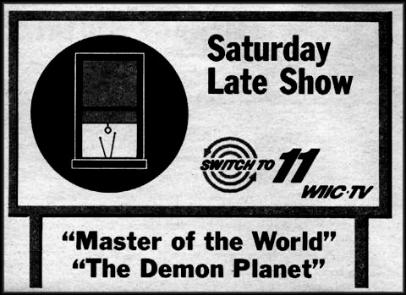
EDITOR’S NOTE: Planet of the Vampires was on Chiller Theater on Saturday, February 24, 1968 at 11:20 p.m.; September 6, 1969 at 1:00 a.m.; Saturday January 30 at 11:30 p.m. and Saturday, December 18, 1971 at 11:30 p.m. It played as Demon Planet.
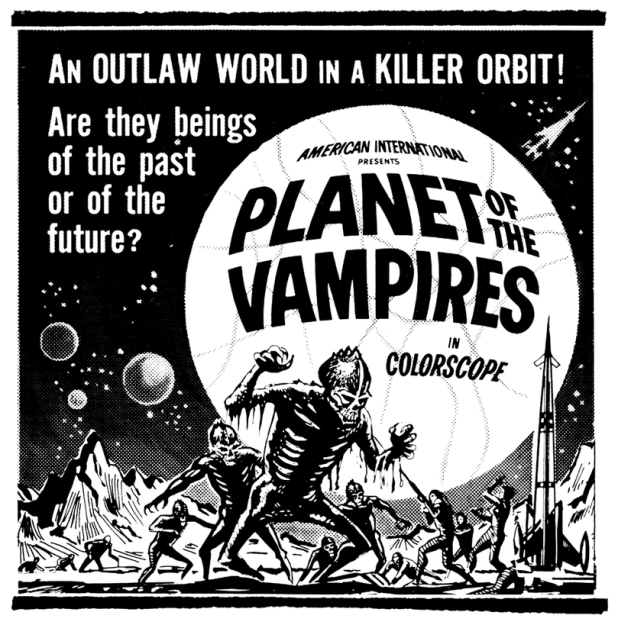
American-International Pictures had made some money in the U.S. with Mario Bava’s Black Sunday and Black Sabbath. It just made sene for Samuel Z. Arkoff and James H. Nicholson to gain more control by producing the films themselves instead of just buying the rights.
Working with Italian International Film and Spain’s Castilla Cooperativa Cinematográfica, AIP provided the services of writer Ib Melchior (The Angry Red Planet) to create the American version of this movie, which was based on Renato Pestriniero’s short story “One Night of 21 Hours.”
This movie was quite literally the Tower of Babel, as each major cast member performed in their respective languages: Barry Sullivan spoke English, Norma Bengell spoke Portuguese, Ángel Aranda Spanish and Evi Marandi Italian. And the low budget would have made a cheap-looking movie with any other director, but Bava was the master of in-camera effects and flooding his sets with color and fog. In a Fangoria article, he would say, “Do you know what that unknown planet was made of? A couple of plastic rocks — yes, two: one and one! — left over from a mythological movie made at Cinecittà! To assist the illusion, I filled the set with smoke.”
When 1979’s Alien came out, those that had been exposed to Bava’s work would let people know that many of the ideas in that film came directly from this modest film with its $200,000 budget — I know Joe Bob, everyone lies about budgets. While Ridley Scott and Dan O’Bannon would claim for years that they had never seen this movie before, the writer would later say, “I stole the giant skeleton from the Planet of the Vampires.”
Want to know how I know those claims are true? From the very start of this film, two large ships — the Galliott and the Argos — in deep space respond to an SOS call and are lured to a planet where alien beings either take their bodies over or murder them. The crew of the Argos instantly begins murdering one another — with only Captain Markary (Sullivan) able to pull his crew out of madness. When they arrive at the other ship, everyone is already dead, including Markary’s brother.
Soon, the bodies of the dead are walking as if alive, the ships are damaged beyond repair, and crew members are getting wiped out (look for a young Ivan Rassimov — later of the giallos The Strange Vice of Mrs. Wardh and All the Colors of the Dark, and the Star Wars clone The Humanoid — as one of them!).
While this film is 55 years old, I have no interest in ruining the ending for you. Instead, I want you to sit and bask in its colorful glow, awash in fog and mystery, with pulpy science fiction heroes running around in fetishy costumes and discovering skeletons that could in no way be human. It is everything that is magic about film.
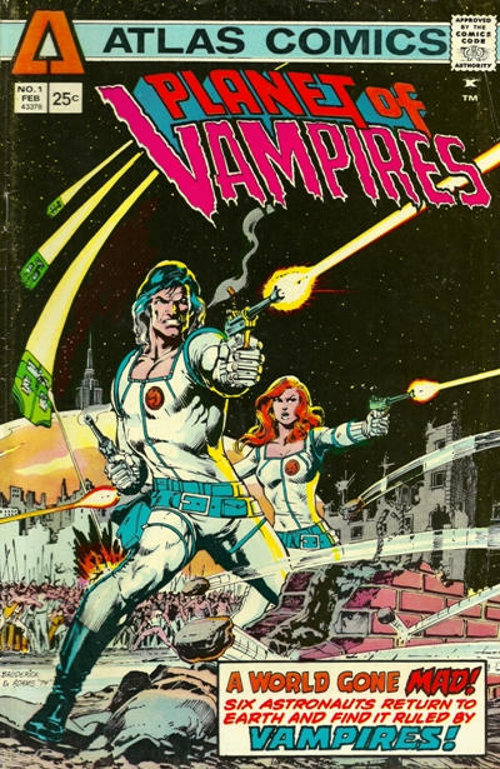
Atlas — the comic company that tried to challenge Marvel and DC in the 1970’s — combined I Am Legend with this film to create the comic Planet of the Vampires. Much like all of their books, it only ran three issues, but the first one boasts a cover with pencils by Pat Broderick with Neal Adams-inks and other issues have great work by Russ Heath. The first issue was also written by future G.I. Joe mastermind Larry Hama. I have no doubt that Atlas did not pay AIP for the rights to this.
Each October, the Unsung Horrors podcast runs a month-long series of themed movies. This year, they will once again be setting up a fundraiser to benefit Best Friends, which works to save the lives of cats and dogs across America, giving pets second chances and providing them with happy homes.
As for Orson Welles, the mastermind behind this, his dedication to storytelling was evident from a young age. His passion for this story dates back to his student days at the Todd Seminary for Boys in Woodstock, Illinois. Despite facing budget constraints, he attempted to stage a three-and-a-half-hour remix of several of Shakespeare’s historical plays, The Winter‘s Tale, in which he played Richard III.This early struggle only fueled his determination to bring his visions to life.
In 1939, he planned Five Kings, a Mercury Theater play that would have 46 scenes and run for more than five hours. Instead of attending rehearsals or finishing the play, which combined Henry IV Parts 1 and 2 and Henry V, Welles and co-star Burgess Meredith got drunk. It played in a few cities but cost the Mercury Theater its contract with the Theater Guild.
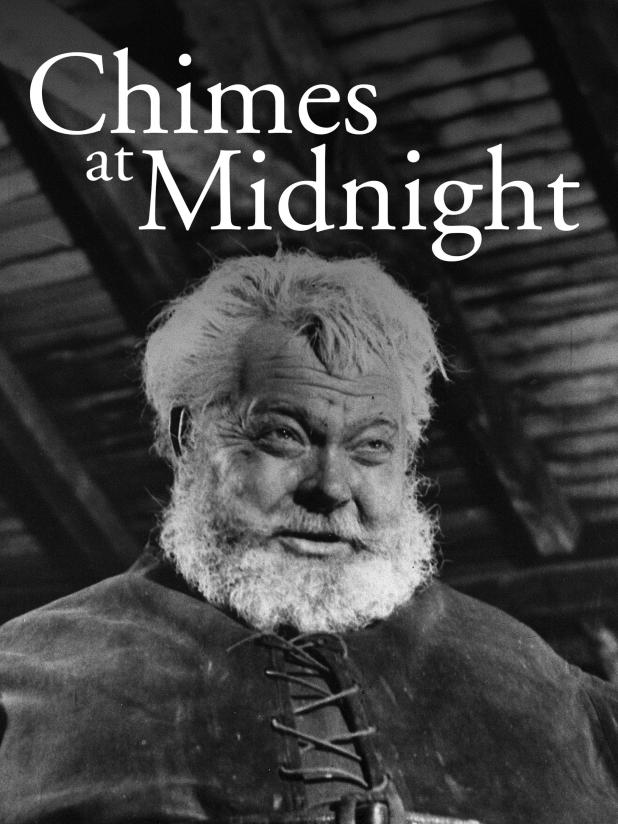
By 1960, the play had evolved into Chimes At Midnight, a film directed by Hilton Edwards but truly a product of Welles’ artistic vision. He saw it as a rehearsal for a movie, a canvas on which he could experiment and bring his ideas to life. His focus was not on traditional aspects of filmmaking like learning lines or attending rehearsals, but on creating a unique cinematic experience.
Four years later, Welles worked with Spanish film producer Emiliano Piedra to produce the film, which he promised would be made at the same time as Treasure Island.
Welles had no intention of making that movie and did nothing about it.
He had $800,000 to make this movie, a cast of stars, and a schedule that didn’t allow all those actors to be in the same scene.
Welles remarked that this was his favorite movie, saying, “If I wanted to get into heaven on the basis of one movie, that’s the one I would offer up. I think it’s because, to me, it’s the least flawed; let me put it that way. It is the most successful for what I tried to do. I succeeded more completely in my view with that than with anything else.”
Sir John Falstaff (Welles) and Justice Shallow (Alan Webb) start the film walking in the snow, reflecting on the past and discussing how King Henry IV murdered Richard II and imprisoned the true ruler, Edmund Mortimer. As for Prince Hal (Keith Baxter), another potential ruler, he spends all of his time drinking and sleeping around, as Falstaff teaches him to live life to the fullest.
As Hal becomes King Henry V, he distances himself from Falstaff, who dies of a broken heart as the boy he led in crimes and schemes goes on to reject those lessons and become a noble king.
Why did I pick this?
Jess Franco worked as an assistant director on the film and was heavily involved in the Battle of Shrewsbury sequence. He fought with Welles, so he isn’t in the credits. He told Horror Garage, “The production of Chimes at Midnight was a total mess, not because the film was too expensive, but because Orson lied about the budget and the film was ten times more expensive. You can imagine…what a disaster.”
Plus, it’s gorgeous.
Is Welles Falstaff? Both men were always looking for money, outright lied to people and yet always were able to drink and eat.
This is one of my favorite experiences, hosting the Drive-In AsylumDouble Feature, a true discovery that I shared with others, a movie about which I had no prior knowledge and was absolutely taken aback by.
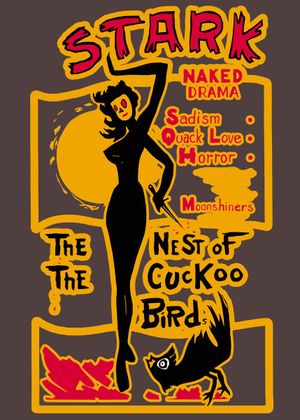
Rescued from The Little Art Cinema in Rockport, Massachusetts and filmed as The Violent Sick, this movie promises you — from the poster — “Sadism,” “Quack Love” and “Horror.” I know what two of those things are, but I never knew what quack love was. I still don’t.
I also have no idea who chose this: “Voted primitive art film of the year.”
Imagine a Southern Gothic but also an early slasher film. Then throw it in the Bayou, where a plastic-masked naked woman stalks the night, undercover cops get figured out, and the soundtrack goes from jazz to screams over cowbell.
Director, writer, producer and star Bert Williams was a character actor. This movie was his bid to do something more than just play roles like the King of Goona in The Wild Women of Wongo or random cops and security guards in movies like Midnight Madness, Murphy’s Law, Helter Skelter, The Usual Suspects, Messenger of Death and Cobra. Man, Charles Bronson must have liked him, because he was in lots of his movies.
Haden Guest, who found the movie, wrote on By NWR, “With its hothouse setting, lurching rhythm and gestures towards horror and sexploitation conventions, The Nest of the Cuckoo Birds is a UFO of a film that resists easy categorization. On one level, Williams’ film offers a fever-dream fantasy of a Deep South driven by the darkest incestuous and murderous desires, a proto-Texas Chainsaw Massacre family bound together by murderous secrets, religious fervor and the taxidermied victims hidden behind the strange inn. At other moments, the film adapts a lyrical pose to become almost an avant-garde trance film best embodied in the figure of the naked, knife-wielding nymph who seems to channel the currents of surrealism and modern dance intertwined in the Cocteau-inspired school of Maya Deren and Curtis Harrington.”
If anything, that’s downplaying just how strange and wonderful this is.
Sure, this is just a Florida regional movie made by a guy who never rose above bit parts and dinner theater, but so what? It stands out from the system; it was created by Williams and his wife, and one of his kids even cut the dailies. This isn’t the kind of film that had studio notes or test audiences. Therefore, it’s brave, frightening, and new territory for your brain, your eyes, and your heart. Sure, it fits into the seedy drive-in world of horror that we all love, but it yearns and demands to be more. That said, I kind of like it out here in the dark.
Bewitched aired throughout the most tumultuous time in modern history — hyperbole, that could also be today, but true, as rehearsals for this show’s first episode were on the day Kennedy was shot and the episode “I Confess” was interuppted by Martin Luther King Jr.’s death — from September 17, 1964, to March 25, 1972. The #2 show in the country for its first season and remaining in the top ten until its fifth season, it presents a sanitized and fictional world that at the time may have seemed contrary and fake to the simmering 60s, but today feels like the balm I need and an escape.
Within the home on 1164 Morning Glory Circle, Samantha (Elizabeth Montgomery) and Darrin Stephens (Dick York, later Dick Sargent) have just had a whirlwind romance and ended up as husband and wife. At some point, she had to tell him that she was a witch, a fact that he disapproved of, and that she should be a normal housewife instead of using her powers. Yet she often must solve their problems — usually caused by her family, such as her mother Endora (Agnes Moorehead) — with a twitch of her nose.
Creator Sol Saks was inspired by I Married a Witch and Bell, Book and Candle, which luckily were owned by Columbia, the same studio that owned Screen Gems, which produced this show. You could use either of those movies as a prologue for this, which starts in media res — I like that I can use such a highbrow term to talk of sitcoms — with our loving couple already settling into the suburbs.
Author Walter Metz claims in his book Bewitched that the first episode, narrated by José Ferrer, is about “the occult destabilization of the conformist life of an upwardly mobile advertising man.” As someone who has spent most of his life in marketing, maybe I should look deeply into the TV I watched as a child. Bewitched was there all the time in my life, wallpaper that I perhaps never considered.
Head writer Danny Arnold, who led the show for its first season, considered the show about a mixed marriage. Gradually, as director and producer William Asher (also Montgomery’s husband at the time) took more control of the show, the magical elements became more prevalent. What I also find intriguing is that with the length of this show’s run, it had to deal with the deaths of its actors and York’s increasing back issues, which finally forced him to leave the show and another Dick, Dick Sargent, stepping in as Darren, a fact that we were to just accept.
That long run, the end of Montgomery and Asher’s marriage and slipping ratings led to the end of the show, despite ABC saying they would do two more seasons. Instead, Asher produced The Paul Lynde Show, using the sets and much of the supporting cast of this show. He also produced Temperatures Rising, which was the last show on his ABC contract, which ended in 1974.
Feminist Betty Friedan’s two-part essay “Television and the Feminine Mystique” for TV Guide asked why so many sitcoms presented insecure women as the heads of households. None of this has changed much, as the majority of sitcoms typically feature attractive women and funny but large husbands, a theme created by The Honeymooners, and the battles between spouses. I always think of I Dream of Jeannie, a show where a powerful magical being is subservient to, well, a jerk. At least on Bewitched, Samantha is a powerful, in-control woman with a mother who critiques the housewife paradigm.
Plus, unlike so many other couples on TV at the time, they slept in the same bed.
Bewitched‘s influence stretched beyond the movie remake. The show has had local versions in Japan, Russia, India, Argentina and the UK, while daughter Tabitha had a spin-off. There was even a Flintstones crossover episode!
Plus, WandaVision takes its central conceit — a witch hiding in the suburbs — from this show. And Dr. Bombay was on Passions!
This is the kind of show that has always been — and will always be — in our lives. Despite my dislike of Darren’s wedding vows of no magic, there’s still, well, some magic in this show. Just look at how late in its run it went on location to Salem for a multi-episode arc, something unthought of in other sitcoms.
You can watch this just for the show itself, to see the differences between the two Darrens and when Dick York had to film episodes in special chairs because of his back pain, when the show did tricks like have Montgomery (using the name Pandora Spocks) playing Samantha’s cousin Serena to do episodes without York or just imagine that the world was changing outside. Yet, magic and laughter were always there on the show, throughout the lives, divorces and deaths of its principals and supporting cast.
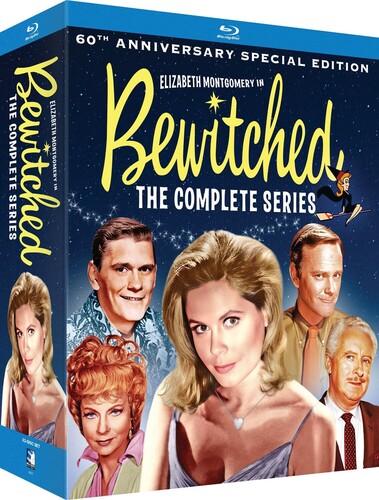
The Mill Creek box set is an excellent, high-quality way to just sit back, twitch your nose and get away from it all. This 22-disc set has everything you’d want on Bewitched, including extras like Bewitched: Behind the Magic, an all-new documentary about the making of Bewitched, featuring special guest appearances by actor David Mandel (Adam Stephens), Steve Olim (who worked in the make-up department at Columbia), Bewitched historian Herbie J Pilato, film and television historian Robert S. Ray, Bewitched guest star Eric Scott (later of The Waltons) and Chris York, son of D. York (the first Darrin). There are also sixteen new episodic audio commentaries, moderated by Herbie J Pilato that include behind-the-scenes conversations with Peter Ackerman (son of Bewitched executive producer Harry Ackerman), David Mandel, Bewitched guest star Janee Michelle (from “Sisters at Heart”), Steve Olim, Robert S. Ray, former child TV actors and Bewitched guest stars Ricky Powell (The Smith Family), Eric Scott (The Waltons), and Johnny Whitaker (Family Affair and Sigmund and the Sea Monsters) and Chris York (son of D. York). There’s also an exclusive 36-page booklet featuring pieces by Bewitched historian Herbie J. Pilato, as well as an episode guide. You can order it from Deep Discount.
Director Howard Hawks said of this movie that it was about “three old-fashioned hot love stories about these racers and their girls. They have their own code. They kid about danger. They aren’t tough guys, but they talk awful rough. The picture will have something of a wartime feeling: on Friday night, a girl doesn’t know if a boy will still be alive on Saturday night.”
He worked to find six new actors—Gail Hire, Mariana Hill, Laura Devon, James Ward, John Crawford and James Caan—and also had appearances by Carol Connors, George Takei, Teri Garr, Charlene Holt and Norman Alden.
He later told the Los Angeles Times, “Newcomers are good when you have competent people to hold them up. That’s why I wouldn’t try Red Line 7000 again. It’s always been a habit of mine to put new people with pros. It holds them together, gives them a key to tempo. There was nobody for them to take a cue from in Red Line.”
Pat Kazarian (Norman Alden) has a racing team made up of Mike Marsh (James Caan) and Jim Loomis (Anthony Rogers). Jim dies in a crash, which brings on two new team members, Ned Arp (John Robert Crawford) and Dan McCall (Skip Ward), who may have a girl — Gabrielle Queneau (Marianna Hill) — but is falling for Loomis’ girlfriend, Holly McGregor (Gail Hire).
Ned loses his hand, and Mike tries to kill Dan by running him off the track, but he ends up with Gabrielle. I mean, he’s the winner. Have you seen 1965 Marianna Hill? Or any Marianna Hill?
The Arrow Video Blu-ray of Redline 7000 has extras including audio commentary by Julie Kirgo and Nick Redman, an interview with assistant director Bruce Kessler, visual essays by Howard S. Berger and Kat Ellinger, an image gallery of posters, lobby cards, and stills, a reversible sleeve featuring original and newly commissioned artwork by Sam Hadley, a double-sided foldout poster featuring original and newly commissioned artwork by Sam Hadley and an illustrated collector’s booklet containing new writing by film critic Martyn Conterio. You can get it from MVD.
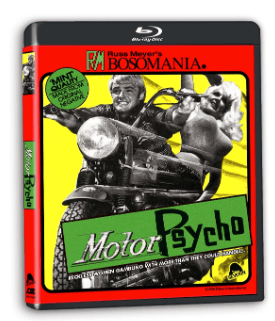
Made just before Faster, Pussycat! Kill! Kill!, Motorpsycho has bikers Brahmin (Steve Oliver), Slick (Thomas Scott) and Rufus (F. Rufus Owens) assaulting women and killing their husbands. Their next victim is Gail Maddox (Holle K. Winters), the wife of veterinarian Cory Maddox (Alex Rocco). As he gets her to the hospital, the gang have already tracked their next victim, Ruby Bonner (Haji, who seriously seems to be some kind of goddess from another planet*), the way too young wife of Harry Bonner (Coleman Francis), who she hates with all her being. They’re both shot and left for dead, but Cory saves her and says he can take her as far as the next town. He wants to kill everyone who dared touch his wife.
There’s an incredible scene where a snake bites Cory and he demands that Ruby suck the poison out. It gets wild, let me tell you. “Suck it!” he keeps yelling. Man, Russ Meyer is anything but subtle.
I imagine that this story is taking place in the same desert as Pussycat! and we’re just lucky that the male bikers never met Varla, Rosie and Billie.
Haji’s real name was Barbarella Catton. Beyond the two Meyer movies mentioned already, she’s also in his movies Good Morning and… Goodbye!, Beyond the Valley of the Dolls and Supervixens. She started exotic dancing at the age of 14 and she wrote most of her dialogue in his movies. I’m overjoyed by the fact that she’s also in Demonoid, one of my favorite movies, as well as Wam Bam Thank You Spaceman, Bigfoot, and Ilsa, Harem Keeper of the Oil Sheiks, using the name Haji Cat. She continued performing in burlesque shows until a year before her death in 2013.
* I have evidence. She told Chris Poggiali, “I’ve always claimed that I’m just a visitor from another place, here to restore energy to my body. My mother was from another galaxy. She brought me here, and we settled in Quebec, but I’ve been here many times before that.”
Extras include commentary by film historian Elizabeth Purchell and filmmaker Zach Clark; interviews with Haji and Alex Rocco and a trailer. Get it from Severin.
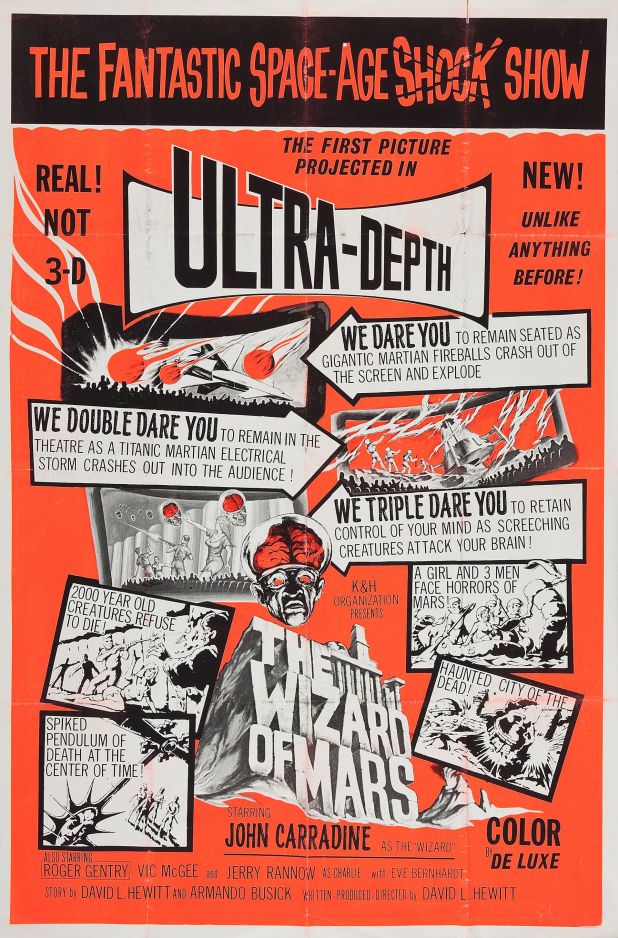
EDITOR’S NOTE: The Wizard of Mars was on Chiller Theater on Saturday, April 10, 1976 at 1:00 a.m.
David L. Hewitt was an illusionist in the Dr. Jeckyll’s Strange Show who wanted to be in the movies. He wrote to Forrest Ackerman and gave him his script Journey into the Unknown, which became The Time Travelers. After that, he directed the 3D short Monsters Crash the Pajama Party, which played with spook shows, as well as Dr. Terror’s Gallery of Horrors, Hell’s Chosen Few, The Mighty Gorga, The Girls from Thunder Strip and The Tormentors. He’s also Gorga in that giant monkey movie.
When this movie was released by Regal Video in the 80s, it was retitled Alien Massacre and it could have either been this movie or Dr. Terror’s Gallery of Horrors in the tape you got. That movie has no aliens. Neither has a massacre. But the box art and tagline, “Blood flows like water,” got plenty of people to watch whatever it was.
Let’s head to the future of 1975, where Steve (Roger Gentry), Doc (Vic McGee), Charlie (Jerry Rannow) and Dorothy (Eve Bernhardt) have barely made it to Mars alive. After crash landing, they battle monsters in the canals of the red planet, avoid a volcano and get caught in a dust storm, all of which makes Charlie lose it and start shooting his rifle at everything.
They find a stone road that leads them to a city that is empty other than a dead Martian and a silver globe which mentally directs them to fixing what has been broken and reveals the face of John Carradine, who tells them how Mars once ruled the universe before coming back to their home to ponder the next stage of evolution. Then, the city goes back into the planet.
Obviously, this is The Wizard of Oz in space, just like Zardozwould kind of be a decade later. That movie wasn’t made for $33,000 with a Don Post mask and it was not also edited for spook show audiences. It also rips off plenty of sound design from Forbidden Planet.
John Carradine gets to read a long speech, intoning ““Space is vast, time is long. It was then that we impaled time on an axis. Eternal stillness, transgression upon time. Time tugs us to our yesterdays almost as strong as all the unborn tomorrows that stretch through all eternity.” That’s really all it took to make me love this movie.




 B&S About Movies
You must be logged in to post a comment.