Bucheon International Fantastic Film Festival: Rock-A-Bye Baby (2022)

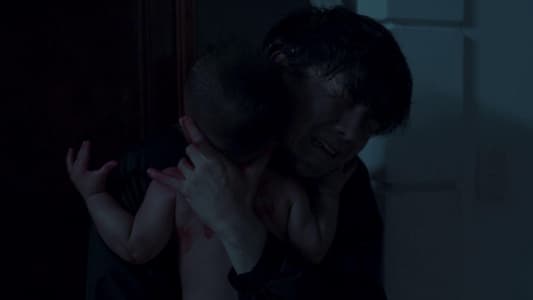
Tran Long, an influencer who uses his web show Memory of Murder to delve into actual crime scenes, weaves a complex web of interconnected narratives for his viewers. The movie unfolds with a man who killed his lover and his parents, another who broke into a jewelry store and then kills the family that owns it, and finally, a man trapped in gambling debts who tries to get an ex to help. When she refuses, he kills her. These stories, seemingly disparate, are intricately linked, leading to a compelling revelation.

Based on actual events, this movie honestly pulls no punches, with the last murder being incredibly grisly. This is an unsanitized view of crimes that men visit upon other men, unlike so much of reality-based true crime.

Vietnamese director Le Binh Giang, best known in America for his movie KFC, continues his exploration of the human psyche in Memory of Murder. This film continues his journey into the heart of darkness he started in KFC. By the end, we discover that Tran Long created his show to deal with his grief over his parents’ murder. All three stories are interconnected and point to who may be behind that crime.

I watched this film as part of The Bucheon International Fantastic Film Festival (BIFAN). You can learn more at their official site.

CBS LATE MOVIE MONTH: Cry of the Banshee (1970)

EDITOR’S NOTE: Cry of the Banshee was on the CBS Late Movie on April 10, 1973, 

“Who spurs the beast the corpse will ride?

Who cries the cry that kills?

When Satan questioned, who replied?

Whence blows this wind that chills?

Who walks amongst these empty graves

And seeks a place to lie?

‘Tis something God ne’er had planned,

A thing that ne’er had learned to die.”

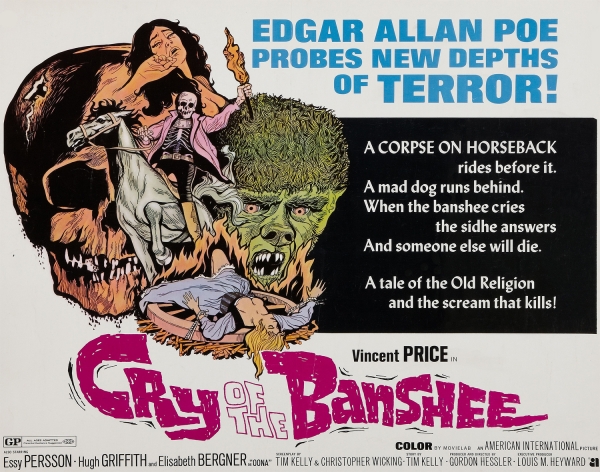
That poem is Edgar Allan Poe’s “The Bells,” which sets the tone for this unique movie, the last of the American-International Pictures Poe movies. Directed by Gordon Hessler, this film, unlike its predecessors, had nothing to do with the Baltimorean author, offering a fresh take on the horror genre.

According to Peter Fuller on  Spooky Isles, AIP promoted this movie as the hundredth film that its star, Vincent Price, was in. The truth is that it was probably his seventy-sixth. Undaunted, AIP did the same publicity for his next movie, The Abominable Dr. Phibes.

This movie is a visual treat — it was shot in the Grim’s Dyke House, the same location as Curse of the Crimson Altar and The Devil Rides Out. The film opens with an incredibly excellent animation by Terry Gilliam, a visual masterpiece that, unfortunately, was cut from the American print, leaving the audience captivated from the start.

If you enjoyed Vincent Price’s portrayal as a witch hunter in Witchfinder General, you’re in for a treat! In this film, he plays the role of Lord Edward Whitman, a character who has taken it upon himself to rid England of every witch. His relentless pursuit leads to the disruption of Black Masses and the death of many witches, until one of them, Oona, possesses his loyal servant Roderick, complicating his mission.

The movie also inspired a band to name themselves Siouxie and the Banshees. Perhaps you’ve heard of them?

CBS LATE MOVIE MONTH: Black Noon (1971)

EDITOR’S NOTE: When I first wrote about this movie, I said “If this played on the CBS Late Movie, it would have probably taken two hours and forty minutes with all the commercials. Actually, it did, on August 29, 1972 and March 6, 1975.”

Bernard L. Kowalski has a decent horror pedigree, directing Night of the Blood BeastAttack of the Giant Leeches; Krakatoa: East of JavaTerror in the Sky and Sssssss. Here, he puts the terror on a slow boil and puts Reverend John Keyes (Roy Thinnes, always battling the occult) and his wife Lorna (Lynn Loring, The Horror at 37,000 Feet) against an unseen force bedeviling a small Western town named San Melas. There’s voodoo, devil worship and a mute young girl and a gunslinger possessed by the Left Hand Path.

Ray Milland shows up, proving that Old Hollywood is never to be trusted. Plus there’s Gloria Grahame (Blood and Lace), Henry Silva (Almost HumanMegaforce, the epic Escape from the Bronx), stuntman Stan Barrett, Joshua Bryant (Salem’s Lot), a young Leif Garrett (Thunder Alley) and Jodie Foster’s brother, Buddy.

70s made for TV horror neglects the Old West, so this is a strange film to start with. Then again, it also plays the Troll 2 trick of a town with a backward name and a connection to witches, but it doesn’t telegraph that. The ending — which moves to 1971 — more than makes up for the slow moving last 68 minutes.

Actually, I love dreamy TV movies that seem to take forever to get anywhere.

CBS LATE MOVIE MONTH: The Biggest Bundle of Them All (1968)

EDITOR’S NOTE: The Biggest Bundle of Them All was on the CBS Late Movie on March 24 and July 26, 1972; September 13, 1973; March 24 and August 30, 1976.

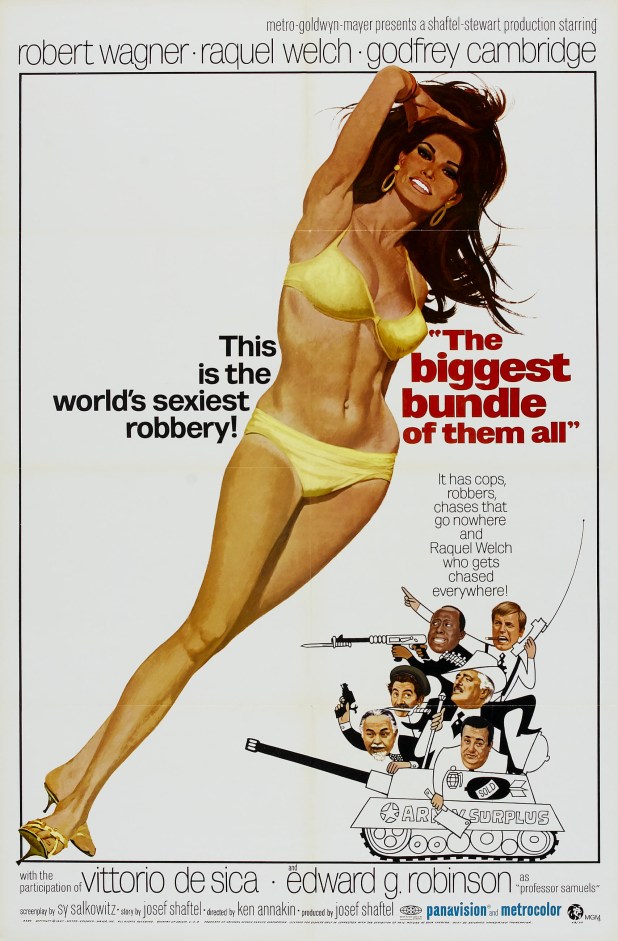
It’s easy for us in 2023 to forget just how big of a deal Raquel Welch was. I was born in 1972, so by the time I hit puberty, she was playing the role of the former sex symbol. But once you see her in this film, it all makes sense.

In this, she’s Juliana, the girlfriend of criminal Harry Price (Robert Wagner). Price’s gang has taken former Chicago gangster Cesare Celli (Vittorio De Sica, yes, the director of Bicycle Thieves) captive. Yet none of the older man’s fellow bosses try to save him. No one is more insulted by Cesare, who decides to teach Price and his gang how to steal $6 million in plutonium.

Ten days before shooting, director Ken Annakin realized he’d read a similar script called The Happening. That movie was being made by Sam Spiegel at Columbia, who got 15% of the profits for this, got to approve the script, changed the title from The Italian Caper and delayed it for six months after his movie.

There’s a great cast in this, with Edward G. Robinson as a professor of crime, plus Godfrey Cambridge, Davy Kaye, Francesco Mulé, Mickey Knox and Victor Spinetti. The soundtrack is also a pretty choice because Johnny Matthis sings “Most of All There’s You,” with music written by Riz Ortolani.

It’s funny reading interviews with Annakin and Robinson, as they both didn’t think much of Welch. They either said she winged all of her lines and didn’t learn them or that she was just using her body instead of being an actress. Robert Wagner wrote that she was late so often that Robinson cut a ten-minute promo, leaving Welch in tears.

She was late again the next day.

CBS LATE MOVIE MONTH: The Illustrated Man (1969)

EDITOR’S NOTE: The Illustrated Man was on the CBS Late Movie on July 14, 1972 and October 11, 1973.

Beyond Bird with the Crystal Plumage, there’s one movie my mother has already brought up that she hated. And that would be this one.

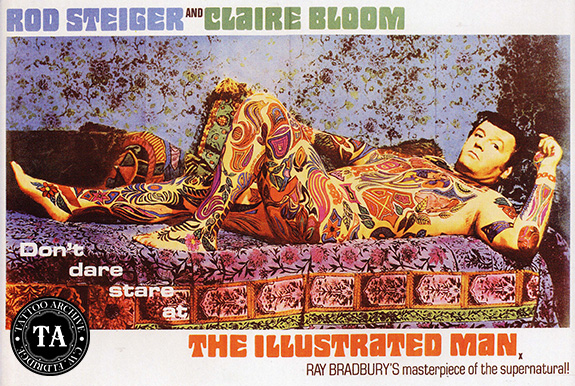
The book that these stories come from has eighteen of them, but Howard B. Kreitsek and Jack Smight picked these three for the film without ever speaking to Ray Bradbury, the author of the book. The tattooed man who appears in the book’s prologue and epilogue would become this film’s main story and be played by Rod Steiger.

The funny thing is that when Steiger takes off his glove to reveal his hand, it’s tattooed and played off as a horrific moment. A half-century after this movie was made, nearly all my friends have this many tattoos.

Carl, the tattooed man, meets Willie and uses his skin illustrations to tell tales throughout time. The ink came from a mysterious woman named Felicia. At the end of the film, Willie sees his death at Carl’s hands in the only bare patch of skin on the Illustrated Man.

The stories that are told include “The Veldt,” which takes place in the future and involves children who study within a virtual version of the African veldt. Soon, the lions will solve this issue of their parents. “The Long Rain” has solar rains* that drive an entire crew to madness in space. And “The Last Night of the World” predates The Mist, with parents who must decide if their children should survive the end of the world.

The final story—and its bleak ending—is exactly why my mom hates this movie. The fact that she may have told me all about it when I was a kid may have given me nightmares.

This movie did poorly critically and financially. Rod Serling, an expert on adapting short stories to film, called it the worst movie ever made.

*Their spaceship is recycled from Planet of the Apes, Beneath the Planet of the Apes and Escape from the Planet of the Apes.

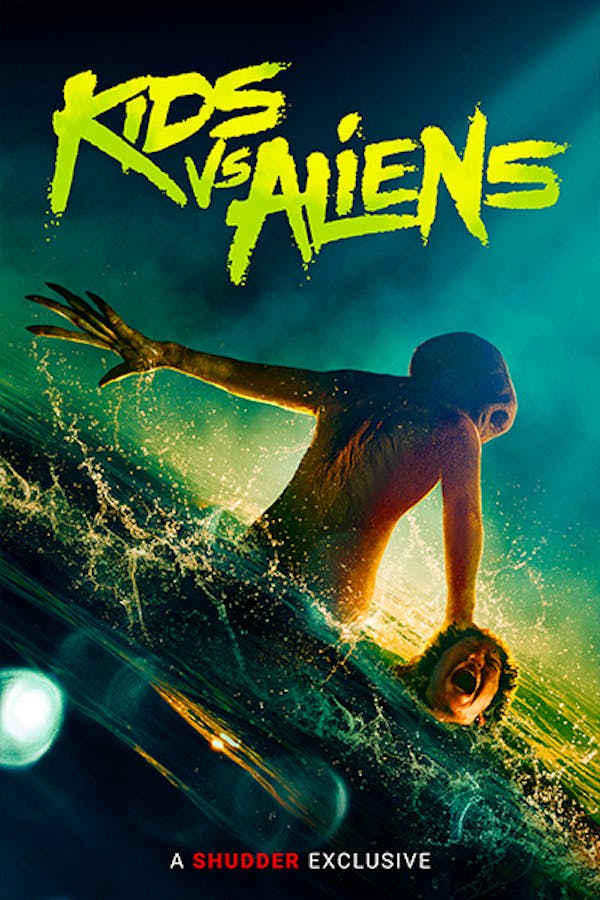
Bucheon International Fantastic Film Festival: Kids vs. Aliens (2022)

A feature-length adaptation of “Slumber Party Alien Abduction” from V/H/S/2, this finds kids Gary (Dominic Mariche), Jack (Asher Grayson) and Miles (Ben Tector) being bullied by teens Billy (Calem MacDonald), Dallas (Isaiah Fortune) and Trish (Emma Vickers) with Gary’s sister Sam (Phoebe Rex) caught in the middle. You see, the kids love to backyard wrestle and make home movies, but Sam is growing up and it’s time for her to decide if she really wants a boyfriend. That said, Billy might not be the best pick.

It’s all a moot point, because on the night of a party gone wrong that the bad kids force Sam to throw, aliens attack and all extraterrestrial hell breaks loose.

Directed by Jason Eisener (Hobo With a Shotgun), who wrote the film with John Davies, this is a movie that’s gorier, weirder and more profane than it’s title would suggest. It also has characters that — other than Sam (Phoebe Rex) — are cookie cutter at best and annoying at worst. It feels like a mean spirited cliche of Spielberg-esque alien movies and while it looks great and has wonderful practical effects, I kept asking if there was more. The end feels so abrupt that you feel cheated; it doesn’t have to have a happy ending, but it just feels like the filmmakers ran out of ideas and time.

I watched this film as part of The Bucheon International Fantastic Film Festival (BIFAN). You can learn more at their official site.

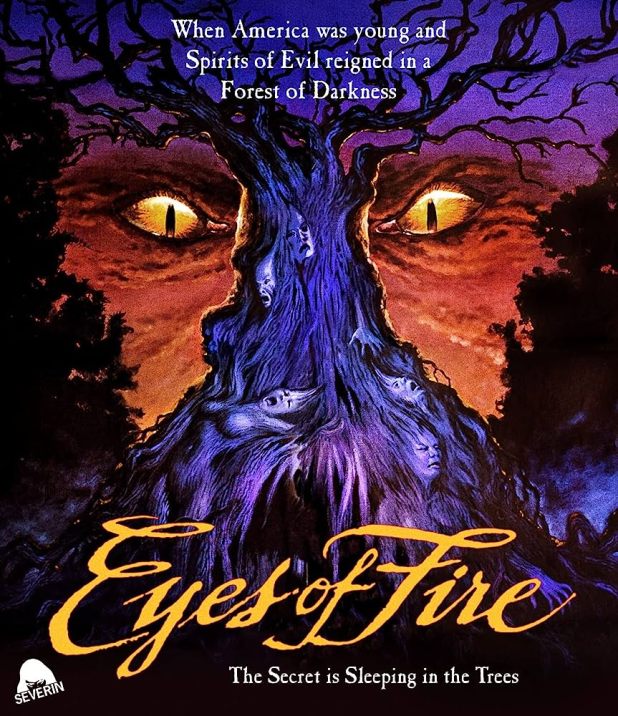
Bucheon International Fantastic Film Festival: Eyes of Fire (1983)

Released by Vestron Video in 1987, this forgotten folk horror—also known as Cry Blue Sky—is very similar to The Witch, minus any arthouse aspirations. Instead of a man whose pride casts his family out of their village, this movie is about a reverend accused of adultery and polygamy.

Reverend Will Smythe (Dennis Lipscomb, Under Siege) and his followers leave their town behind to live in a valley haunted by an ancient evil. A rugged woodsman, Marion Dalton (Guy Boyd, Body Double), is along for the ride because he has his eye on Smythe’s lusty wife, Eloise. Hijinks, as they say, ensue. And by hijinks, I mean whatever is in the woods begins to haunt and kill everyone.

Rob Paulsen, who plays Jewell Buchanan, would become a voice actor. Perhaps you’ve heard him as Raphael and Donatello, two of the Teenage Mutant Ninja Turtles, or Pinky from Pinky and the Brain. He’s also in the movies Stewardess SchoolWarlock and Body Double. He’s also the voice that says, “Cheers was filmed in front of a live audience.” In all, he’s been in 1,000+ commercials and been the voice of 250+ cartoon characters.

Director Avery Crounse started his career as a photographer and only made two other films: The Invisible Kid and Sister Island, which starred Karen Black.

I watched this film as part of The Bucheon International Fantastic Film Festival (BIFAN), as part of the Folk Horror: Lands of Cruelty, Beliefs of Terror program which also includes Valerie and Her Week of WondersKill List, the 2019 French version of la LloronaWoodlands Dark and Days BewitchedBldg. NIn My Mother’s Skin and To Fire You Come at Last. You can learn more at their official site.

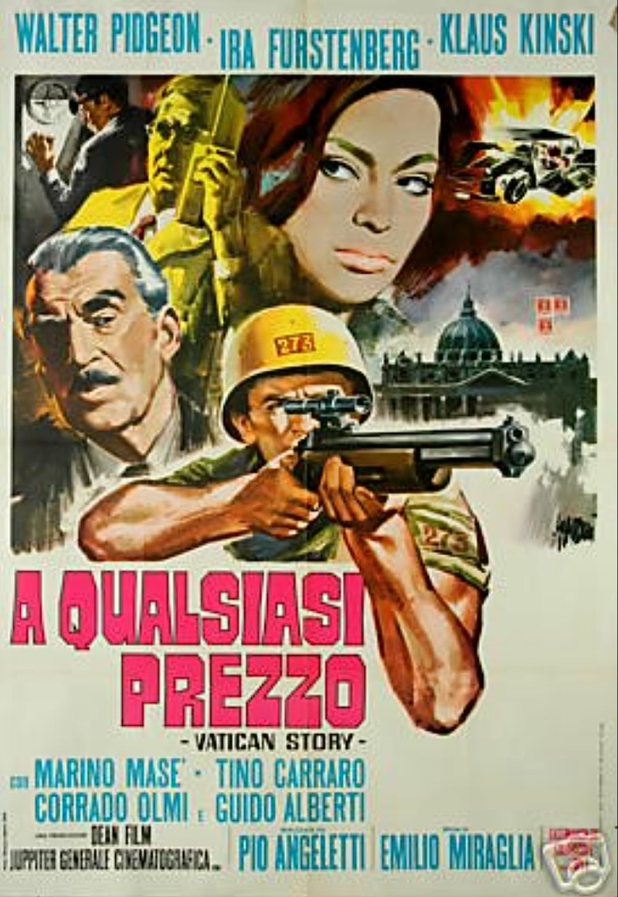
CBS LATE MOVIE MONTH: The Vatican Affair (1968)

EDITOR’S NOTE: The Vatican Affair was on the CBS Late Movie five times, airing on March 14, 1972; March 19, June 10 and December 29, 1975 and June 22, 1988.

Emilio Miraglia is best known to readers as the director of The Night Evelyn Came Out of the Grave and The Red Queen Kills Seven Times.

Professor Herbert Cummings (Walter Pidgeon) seems like no threat to anyone. After all, he’s blind. But in a surprising turn of events, he’s also looking to rob gems from St. Peter’s and has hired Clint Rogers (Klaus Kinski) to help get the job done. Richard (Marino Masé) and Pamela Scott (Ira von Fürstenberg) complete the crew.

The plot is similar to Operazione San Gennaro, directed by Dino Risi, and Operazione San Pietro, the sequel, directed by Lucio Fulci. It’s like another movie with Kinski, Ad ogni costo (Grand Slam). However, the true star of the film is the captivating soundtrack, composed by Luis Bacalov, which adds more excitement than what’s happening on screen. Bacalov, known for his work on DjangoThe Great SilenceThe Designated VictimIl Postino and Hell of the Living Dead, delivers a score that will keep you on the edge of your seat.

Source

Emilio Miraglia – Wikipedia. https://en.wikipedia.org/wiki/Emilio_Miraglia

CBS LATE MOVIE MONTH: Dracula Has Risen From His Grave (1968)

EDITOR’S NOTE: Dracula Has Risen From His Grave was on the CBS Late Movie on May 19 and October 12, 1972 and August 9, 1974.

This was the fourth Hammer Dracula movie and the third to star Christopher Lee (he doesn’t appear in The Brides of Dracula). It was directed by Freddie Francis, who stepped in to replace Terence Fisher, who injured his leg in a car accident. It has an extraordinary and wonderful effect when Dracula appears in the film, as the edges of the frame take on the colors of crimson, amber and yellow.

There’s a fantastic beginning where a young altar boy (Norman Bacon) finds a dead woman hidden inside a church bell, just one more of Dracula’s victims. But a year after — and the events of Dracula: Prince of Darkness — finds the greatest of all the undead quite dead.

Monsignor Ernst Mueller (Rupert Davies) visits the village from the opening and learns that the altar boy can no longer speak and the town’s holy man (Ewan Hooper) has lost his faith. Because Dracula’s castle has a shadow that extends over their church, they refuse to even come near it. The Monsignor decides to exorcise the castle, which leads to the kind of strange occurrences that always bring Dracula back: lightning strikes, the older priest slips, he hits his head on a rock, and the drips of his blood through the cracks in the ground make their way to the deceased vampire.

As Mueller returns home, Dracula quite literally rises from his grave and takes on the frightened priest as his familiar. Now unable to enter his castle, he flips out and demands revenge, heading off to Keinenberg, where he plans on making Mueller’s niece Maria (Veronica Carlson, Frankenstein Must Be DestroyedThe Horror of Frankenstein) into one of his lovers.

Luckily, her boyfriend Paul (Barry Andrews) is ready to protect her, even if he has to defeat the advances of a barmaid Zena (Barbara Ewing, who has since become a well-reviewed author) who has been hypnotized by Dracula. There’s a wild moment when Dracula orders the priest to kill Zena, so he burns her body in a bakery oven while Dracula leaps across the rooftops to find and bite Maria.

This has some fascinating ideas as Paul has to go it alone after the Monsignor dies. As an atheist, he and the lost faith priest are unable to properly stake and destroy Dracula. As always, Dracula is stopped, and faith is restored. This is the most challenging time for achieving that end goal.

As a kid, the Hammer movies were quite literally the end-all, be-all of my existence. I thought about them all day and would discuss them with anyone who wanted to hear about them—often, many who didn’t.

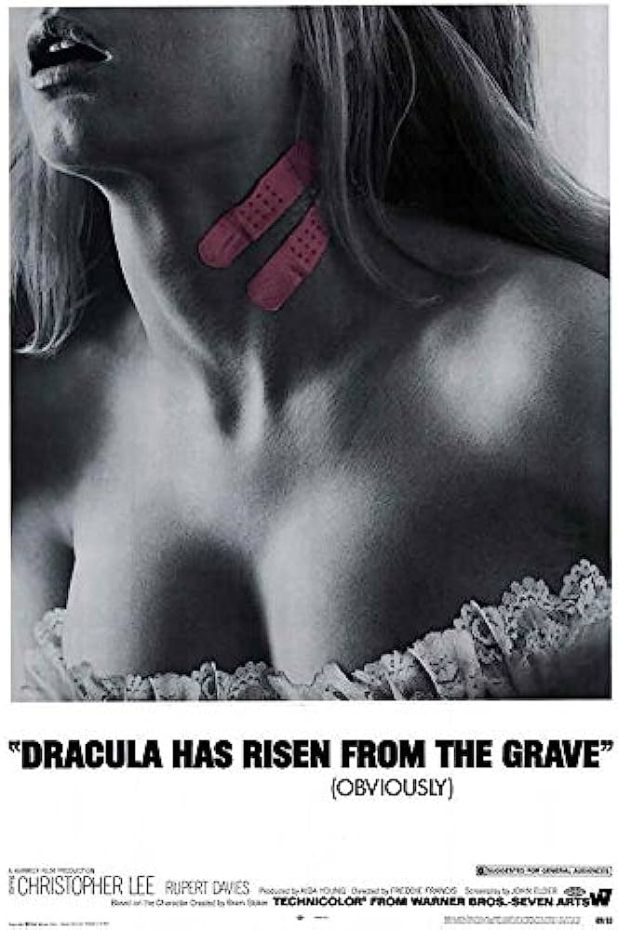
As an old man, I’m struck by how often the film in the movie is sped up, which doesn’t work, while the color effects and rooftop scenes have lost none of their infernal power. Plus, this has one of the best posters I’ve seen, just the throat of a bosom woman with band-aids where Dracula’s teeth have penetrated her.

CBS LATE MOVIE MONTH: Kingdom of the Spiders (1977)

EDITOR’S NOTE: Kingdom of the Spiders was on the CBS Late Movie on April 28, 1982 and January 12, 1983.

Directed by John “Bud” Cardos and written by Richard Robinson and Alan Caillou, whose real name was Alan Samuel Lyle-Smythe MBE, M.C. and who was an author, actor, screenwriter, soldier, policeman and professional hunter.

Despite the initial fright they may cause, it’s worth noting that tarantulas’ venom is about as dangerous as a bee sting. They mostly cause itching from the shedding of their bristles, which are used to make itching powder. This fact, coupled with the humorous association of itching powder with comedy movie scenes of mischief, adds a delightful touch of humor to the film.

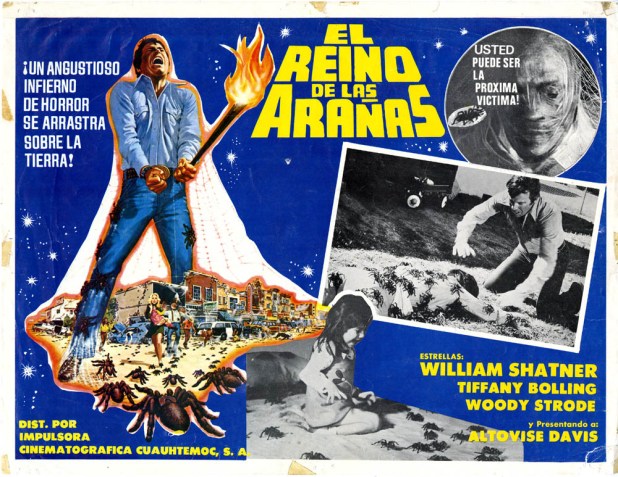
This film features 5,000 tarantulas in its cast, a staggering number that took up 10% of the film’s budget. It’s safe to assume that star William Shatner was compensated more than his eight-legged co-stars. Interestingly, these spiders, being cannibals, had their own set of demands. All 5,000 of them had to be kept in separate containers, adding a unique challenge to the production process.

They’re also very shy, so to make it appear that the spiders were attacking people, fans and air tubes were used.

Let’s take a trip to Camp Verde, Arizona.

That’s where Dr. Robert “Rack” Hansen (Shatner) practices. He’s heading out for a house call to see Walter Colby (Woody Strode), whose prize calf dies for reasons that puzzle Hansen. Diane Ashley (Tiffany Bolling) comes down from the big city of Flagstaff to blow his mind: spider venom killed the cow.

It gets worse. Walter’s wife, Birch (Altovise Davis, Sammy Davis Jr.’s third wife), soon discovers that their dog is dead and that a giant spider nest is in the backyard. Thanks to all the pesticides, the spiders have lost their natural food source, and instead of turning on one another, they’ve decided to eat larger meals.

Their big scientific plan is to burn the spider hill, which doesn’t go well because the arachnids escape into tunnels and show an advanced intelligence that conducts a revenge hit on Walter, his wife and Hansen’s sister-in-law Terry (Marcy Lafferty).

The mayor (Roy Engel) gets Sheriff Gene Smith (David McLean) to spray the town with pesticides, which is how things got this bad in the first place. Ashley says rats would have been a better idea, but obviously, the mayor met Larry Vaughn at a convention of mayors in Las Vegas and saw his seminar on never canceling the county fair, no matter what common sense tells you. More pesticide is planned, but the spiders deal with that by crashing a crop duster.

The survivors plan on escaping in an RV, but by the time they try, the entire town has been webbed up as the outside world forgets them and plays country music on the radio.

In 1998, Shatner told Fangoria that he was working with Cannon Films in the late 1980s to produce a sequel, but he probably meant Menahem’s 21st Century, which did run trade ads for Kingdom of the Spiders 2. Shatner would direct, write and star in the film, in which a man would be tortured with spiders. As you can imagine from Menahem’s playbook, this ad was just a photo of Shatner and the title of the movie.

Producers Igo Kantor and Howard James Reekie, using the name Port Hollywood, planned a sequel in the 2000s that promised Native American myth and spiders driven mad by secret government experiments involving extremely low-frequency tones.

I love this movie because you can tell that the spiders want nothing to do with anybody, much less feel the need to attack them. The entire cast of Bela Lugosi fights an octopus, and the emotion of fear is present, but no one is ever in danger.