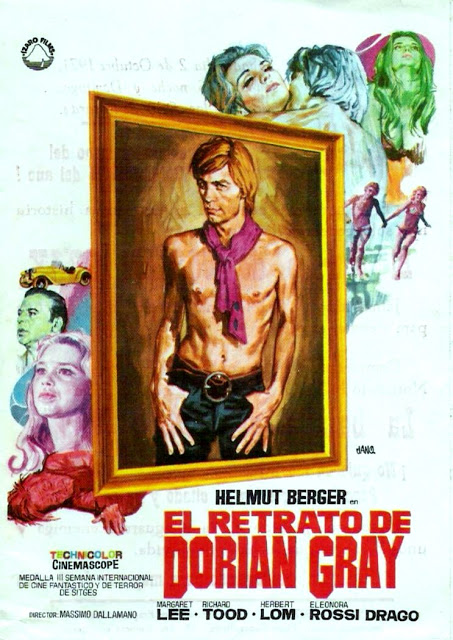
Dorian Gray (Helmut Berger) once had his portrait painted by Basil Hallward (Richard Todd). The modeling session is interrupted by Henry Wotton (Herbert Lom) and his sister Alice (Maria Rohm), which sends Dorian into the evening, settling on a theater where he quickly mates with actress Sybil Vane (Marie Liljedahl) before abandoning her, which causes her to kill herself. Dorian won’t be young and vital forever, so why settle for anything?
He wishes that the painting could age for him and somehow, incredibly, it does. While the rest of his friends settle down, he’s still devoted to a lifestyle of excess in 1960s and 1970s London with all of the wild fashions that you need to make this movie incredible. Throw in a guitar score by Giuseppe De Luca and you have a freakout version of a classic novel made sleazy.
Is it any surprise that Harry Alan Towers produced this?
15. HALLYUWOOD: It’s time to dig up the onggi and watch yourself a South Korean joint, the saltier the better.
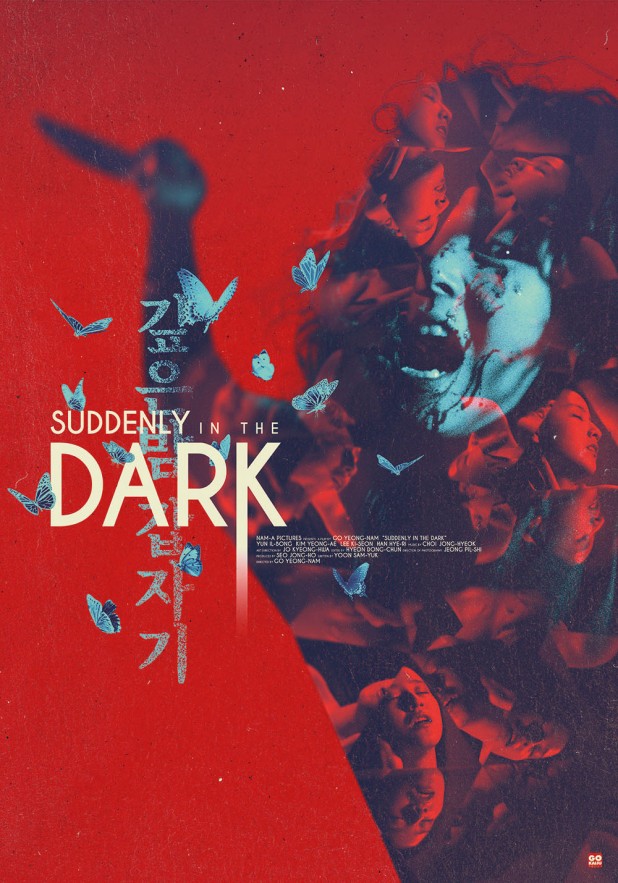
Gipeun bam, gapjagiis a South Korean horror film directed by Ko Young-nam. It all starts with Kang Yu-jin (Yoon Il-bong) hiring a new housekeeper, Mi-ok (Lee Ki-seon). They couldn’t be further apart, as he’s a wealthy biology professor conducting a study of butterflies and she’s a simple village girl who is the daughter of a recently dead shaman priestess.
While Kang Yu-jin and his wife Seon-hee (Kim Young-ae) enjoy having the girl in their home, it doesn’t last. Mi-ok keeps a wooden doll with her that has shown up in Seon-hee’s nightmares. She also thinks that she’s having an affair with her husband, which is an even more powerful reason to hate her. When things finally come to blows, the rich woman accidentally kills the maid, then becomes haunted by her.
This is as close as Korean cinema will get to a giallo, as color theory — Seon-hee appears in conservative purples while Mi-ok is in revealing white clothes — while the neon hues scream Bava and some scenes appear to be shot underwater or within a kaleidoscope. It all starts so simply but by the end, the score is literally bashing you in the face while a storm rages throughout the film.
Each October, the Unsung Horrors podcast does a month of themed movies. This year they will once again be setting up a fundraiser to benefit Best Friends, which is working to save the lives of cats and dogs all across America, giving pets second chances and happy homes.
Today’s theme: In Memoriam
Racquel Welch had the kind of power behind her game that when men of my dad’s age would talk about her, they’d get excited or look to see if their wives were listening. Just that name was enough for them all to communally make happy noises and look skyward, as if to thank whatever is waiting for us up there for making something so wonderful.
She died February 15 of this year and I’ve been watching more of her movies.
I always wrote her off as someone getting by on her looks yet I have enjoyed so many of these films.
Written by Ed McBain (who is really Evan Hunter and changed his name from Salvatore Albert Lombino; he wrote the scripts for The Birds, Walk Proud and Strangers When We Meet and had movies made of his novels, including Blackboard Jungle, Mister Buddwing from his book Buddwing, Last Summer,Every Little Crook and Nanny and Lonely Heart from his book Lady, Lady I Did It.
Fuzz comes from one of his 87th Precinct books. Directed by Richard A. Colla and written by the author, it stars Burt Reynolds as Detective Steve Carella. He’s investigating why teenagers are setting unhoused people on fire and nearly dies from one of them doing exactly that to him. There’s also a killer threatening to murder city leaders which has Detectives Kling (Tom Skeritt) and Brown (Jack Weston) looking for whoever grabs the money the caller asked for. They fail twice at this and a commissioner and the deputy mayor are both rubbed out.
Detective Eileen McHenry (Welch) is new to the precinct and set up by Carella and Meyer when she’s looking for a rapist. She’s not in the mood to find their antics funny and that night, when walking through the park, she’s stalked. The detective turns the tables on the rapist and beats him unmerciful and solves the case.
The caller ends up being someone called The Deaf Man (Yul Brynner), so called because, yes, he ahs a hearing aid. He’s one of those unstoppable villains, even getting set on fire by the kids from the beginning and somehow surviving at the credits.
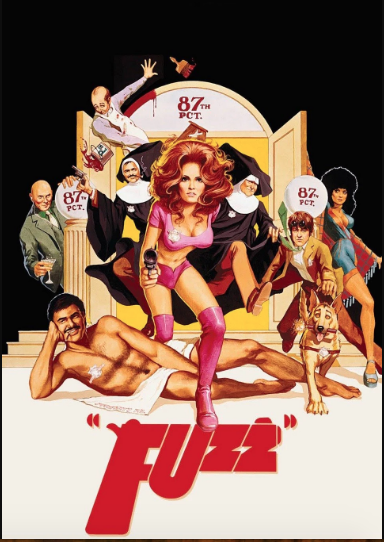
Welch got paid $100,000 for this and was supposed to be in her bra and panties in one scene. It’s not in the movie but it is on the poster, which was painted by Richard Amsel which also has Reynolds in his famous nude pose from Cosmo.
This was a hard movie to find for some time, as a series of copycat crimes — strangely in Boston where the movie is set, even if the 87th Precinct books are in New York City — that had teens setting houseless people on fire. The movie was pulled from airing for most of the 70s.
There are even more movies made of the author’s works than those I listed earlier. The 87th Precinct novels were adapted as the movies Cop Hater, The Mugger, The Pusher, Kurosawa’s High and Love (King’s Ransom is the book it’s based on), Sans mobile apparent, Claude Charbrol’s Blood Relatives and Killer’s Wedge. There was also a TV series in 1961, the TV movie Ed McBain’s 87th Precinct: Lightning and two sequels, Ice and Heatwave. And two of the Columbo TV movies, No Time to Die and Undercover were based on So Long as You Both Shall Live and Jigsaw.
Fuzz is very 1972 in the good and bad ways. But hey, Reynolds says it best.
“It was kind of fuzzy. It was made by one of those hot shot TV directors. I liked working with Jack Weston; it began our relationship. I did like working again with Raquel. And I liked the writer whose book the film was based on, Ed McBain, The 87th Precinct. I’d like to direct one of his books.”
EDITOR’S NOTE: Battle In Outer Spacewas on Chiller Theater on Saturday, December 11, 1965 at 11:20 p.m. It also aired on December 23, 1967 and December 21, 1968.
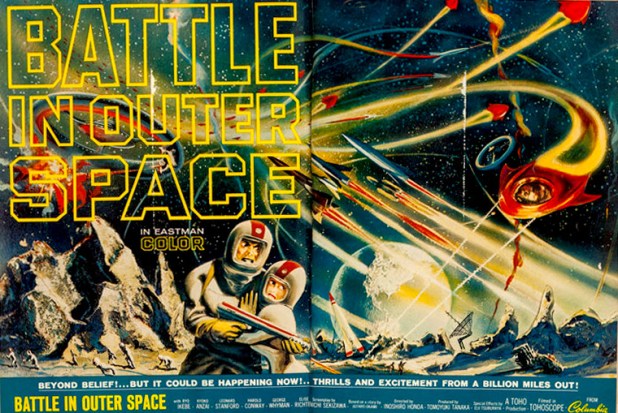
Directed by Ishirō Honda, written by Shinichi Sekizawa and special effects by Eiji Tsuburaya, Battle In Outer Space starts with disaster all over the world. Major Ichiro Katsumiya, Professor Adachi and Dr. Richardson think that it’s aliens and they are soon proved right by Dr. Ahmed, the Iranian scientist in the group, who starts sabotaging everything.
The Earth is going to become part of the planet Natal, unless Earth can get it together and do what we do best: kill things. Some of the biggest cities are turned into models and blown up real good, but don’t worry. We know how to vaporize things. We have the technology.
The exterior of the Science Center is the National Sports Center, which was made as part of the Tokyo Olympiad. I love that Japanese filmmakers decide to just blow up their own country more often than anyone else’s, but when the Cinerama Dome in Tokyo gets zapped, I did get depressed.
When Apollo 11 landed on the moon, Eiji Tsuburaya watched and said, “We were right, our special effects team did a great job. Now, we can hold our heads before the public.”
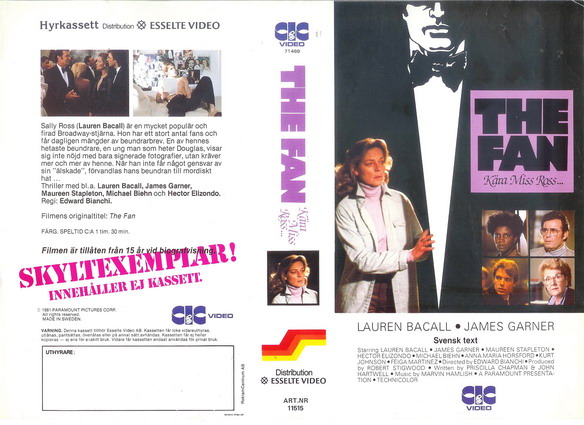
EDITOR’S NOTE: The Fan was on Chiller Theater on Saturday, September 4, 1983 at 2 a.m.
Today, Ed Bianchi is famous for his work on TV series like Deadwood and Boardwalk Empire, but he also has two movies to his credit. This one and the bizarre 1991 movie Off and Running, where Cyndi Lauper plays a mermaid-themed lounge singer whose boyfriend is murdered in front of her before she hooks up with a professional golfer.
It’s produced by Robert Stigwood, who in addition to managing the Bee Gees and Cream, produced the films Jesus Christ Superstar,Grease, Tommy, Saturday Night Fever, Bugsy Malone, Moment by Moment, Grease 2 and Sgt. Pepper’s Lonely Hearts Club Band. As you can tell, the success of these films gradually declined as time moved on.
The Fan received plenty of negative media attention, due to being released a few months after the murder of John Lennon, who lived in The Dakota, the same building where legendary actress and star of this film Lauren Bacall had been living for many years. She wasn’t pleased with the final film, however.
“The Fan is much more graphic and violent than when I read the script. The movie I wanted to make had more to do with what happens to the life of the woman–and less blood and gore.”
You have to admire the audacity of people who will take a legend like Lauren Bacall — someone who had only made one Robert Altman movie since last appearing in the Duke’s last movie, The Shootist — and put her in a slasher.
Douglas Breen (Michael Biehn!) is obsessed — and that’s putting it mildly — with star of stage and film Sally Ross (Bacall). No matter how many autographs he gets or curt replies or even outright silence, it’s never enough. He must have her, he must own her, he must consume her.
Sally doesn’t even know he exists. She’s acting in a Bob Fosse-like musical and reconnecting with her ex-husband Jake Berman (James Garner!). But after the letters become more carnal — yes, this is how we sexted in the 1980s, I was 9 when this was made, so I know — her assistant Belle (Maureen Stapleton!) starts to worry. She should — Douglas is stalking her every single move. And when he figures out that Belle is the reason why his letter didn’t get through, he slices her up with a straight razor.
She survives, but Elsa the maid doesn’t. Soon, Sally is under protection courtesy of Inspector Raphael Andrews (Hector Elizondo) and is asked if she’d like to have conjugal relations with a meat cleaver. Of note, the 2002 Paramount DVD release of this film re-edited this line to be much less profane.
Our heroine leaves town but that’s when Douglas gets smart. He gets cruised in a gay bar and in the midst of some oral delight, murders the man and sets him ablaze, faking that the body was his. Oh, the 1980’s, when DNA didn’t exist and these things happened all the time.
Finally, Sally comes back for opening night, but despite how amazing her performance is and even getting to reconcile with her ex, Douglas is waiting. He kills her costume designer and a guard before coming after her. But finally, he offers her an embrace and she responds by stabbing him in the neck before presumably leaving for the cast party at Sardi’s.
Look for Anna Maria Horsford from the Friday films as a female cop, Reed Jones (the original Skimbleshanks in Cats), a young Dana Delaney working in the record store alongside Douglas, Dwight Schultz as the director, Griffin Dunne as his production assistant and Liz Smith as herself.
The Golden Raspberry Awards nominated the song “Hearts, Not Diamonds” for Worst Song the year this came out. My ire for these awards and the wonderful films that they deride knows no bounds. Who are they to scoff at the abilities of Marvin Hamlisch and Tim Rice? How dare you insult Ms. Bacall! Why, why, why — I should write a letter just like Douglas did! That turned out alright!
There’s a rumor that this film was originally intended to be a straightforward thriller starring Elizabeth Taylor and directed by Jeff Lieberman. Yes, America’s favorite actress in the twilight of her career, being directed by the maker of Blue Sunshine. How did this not happen? How can we get to the parallel Earth where it did?
Much respect to Shout! Factory for finally releasing this insane blast of end of the last century star power-driven slasher on blu ray. It’s going to sit in a place of honor, right next to the other movies that I’m so happy they finally released, like The Lonely Lady.
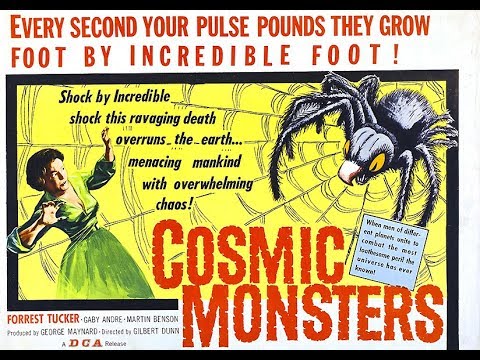
EDITOR’S NOTE: Cosmic Monsters was on Chiller Theater on Sunday, October 5, 1963 at 11:10 p.m. It also was on the show on December 26, 1964.
Also known as The Strange World of Planet X, this film has scientists Dr. Laird (Alec Mango) and Gilbert Graham (Forrest Tucker) goofing around with magnetic fields and working with Brigadier Cartwright (Wyndham Goldie) and Michele Dupont (Gaby Andre) to solve their issues of needing massive amounts of energy to do their work.
While the military is interested in how they can use this research, the magnetic field gets so messed up that it causes brain wave disruptions and makes men into killers and bugs into giant monsters. Humanity must be saved by Mr. Smith (Martin Benson), an alien being with his own flying saucer, as Dr. Laird has lost it, sending giant spiders after Dupont and endlessly making magnetic mayhem.
At least it has a good tagline: “Shock by incredible shock this ravaging death overruns the earth…menacing mankind with overwhelming chaos!” The poster is pretty fun with the giant spider being the main thing and who doesn’t enjoy monstrous bugs? I once dated a scientist who would do experiments like seeing how long bugs could live without their heads and I referred to movies of this genre to warn her of the dangers. She refused to hear me.
Since it’s the Halloween month of October, Deaf Crocodile is thrilled to announce its acquisition of 3 rarely-seen Eastern European genre classics for release in 2024 in newly-restored versions, co-presented with Seagull Films:
The fourth release by legendary Russian fantasy master Aleksandr Ptushko following Ilya Muromets, Sampo and The Tale of Tsar Saltan: his final film Ruslan and Ludmila, a 2-part, 2-1/2 hour epic fantasy in a gorgeous new 4K restoration.
Belarusian director Valeri Rubinchik’s long-unseen folk horror masterpiece The Savage Hunt of King Stakh, in a new restoration of the 2-hour director’s cut.
Georgian filmmaker Georgiy Daneliya’s surreal, comic sci-fi gem Kin-Daz-Dza!, available for the first time ever in North America.
Deaf Crocodile plans to release the 3 films in Spring – Summer 2024:
Ruslan and Ludmila – 1972, Mosfilm, 150 min. The final film from Russian fantasy master Aleksandr Ptushko (ILYA MUROMETS, SAMPO), Ruslan and Ludmila was a glorious and magical summation of his career: a 2-1/2 hour greatest hits package filled with the sweeping lyricism, bejeweled visual F/X and mythic storytelling that put him on par with Walt Disney, Ray Harryhausen and Mario Bava. Based on an epic fairy tale written in 1820 by Alexander Pushkin (Ptushko had previously adapted Pushkin’s The Tale of Tsar Saltan, and half-jokingly said they were related), the film opens with the seemingly-joyous marriage of bogatyr (warrior) Ruslan (Valeri Kozinets) to Ludmila (Natalya Petrova), the daughter of Prince Vladimir. (Like his earlier Ilya Muromets, the action of the film is set during the legendary era of the Kyivan Rus’ culture that pre-dated both modern Ukraine and Russia.) On their wedding night, Ludmila is spirited away by the long-bearded wizard Chernomor (Vladimir Fyodorov), and taken to his sinister palace where she’s held prisoner. On their epic quest to rescue her, Ruslan and his three rivals encounter some of Ptushko’s most unforgettable imagery: a giant’s monstrous, decapitated head slumbering on an open plain, magic rings and stone warriors, sorcery and sacrifice, all in the hope of reuniting lost lovers. Newly restored by Mosfilm for release by Deaf Crocodile and Seagull Films. In Russian with English subtitles.
“One of Ptushko’s richest works, a compendium of all the techniques and special effects he had developed in previous films. His miniature work reached its peak here, especially in the model of Chernomor’s icy kingdom with its gloomy castle perched atop a craggy cliff. Just as memorable are the sequences of Ruslan riding through the haunted woodlands at sunset …” – Alan Upchurch, Video Watchdog.
The Savage Hunt of King Stakha (1980, Belarusfilm, 126 min. Dir. Valeri Rubinchik): “We have more ghosts than live people,” murmurs the pale, haunted mistress of the mansion of Marsh Firs (Elena Dimitrova) to a scholar of ancient folklore (Boris Plotnikov) who has arrived at her castle to research the bloody legend of King Stakh, a murdered 15th century nobleman whose spirit supposedly thunders through the local woodlands. (The Wild Hunt is a fixture of northern European folklore in which a sinister figure leads a chase followed by ghostly companions.) Part folk horror, part supernatural mystery, King Stakh is a melancholy, chilling mixture of Terry Gilliam, Italian Gothic Horror, 1960s Hammer Films and The Wicker Man – and a major rediscovery for genre fans. The longer the young scholar stays in this mysterious house of “shadow, gloom, madness and death,” the more strange and surreal the imagery becomes: a mad widow in a white wig; a man bleeding spontaneously from his skull; a dwarf hiding in a decayed doll’s house; screeching ravens and maniacal puppet shows. Based on the novel by Belarusian writer Uladzimir Karatkievich, the long-unavailable King Stakh has recently been restored from the original film elements in its extended 126 min. Director’s Cut by Deaf Crocodile and Seagull Films for its first-ever U.S. release. (In Russian with English subtitles.)
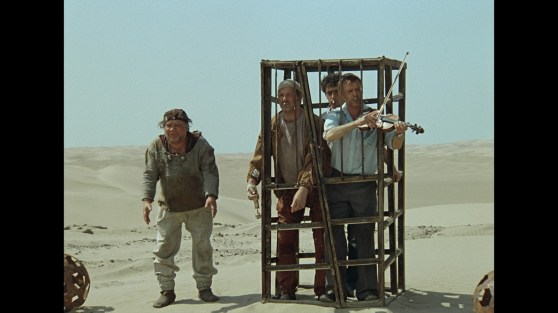
Kin-Dza-Dza! (1986, Mosfilm, 135 min. Dir. Georgiy Daneliya.): Imagine Andrei Tarkovsky circa Solaris directing Douglas Adams’ The Hitchhiker’s Guide to the Galaxy and you’ll come close to the existential weirdness of the wonderfully loopy Soviet-era sci-fi comedy Kin-Dza-Dza! Two average Muscovites – a plainspoken construction foreman (Stanislav Lyubshin) and a Georgian violin student (Levan Gabriadze) – encounter an odd homeless man on the street who asks, “Tell me the number of your planet in the Tentura?” In a flash, they’re teleported across the universe to the planet Pluke in the Kin-Dza-Dza galaxy – a Tatooine-like desert world whose inhabitants are hilariously noncommunicative (their main words are “ku” for good and “kyu” for very bad) and where common wooden matches are tremendously valuable. A deadpan, absurdist mixture of Kurt Vonnegut, Monty Python, Samuel Beckett and Jodorowsky’s never-made Dune where alien cultures are even more haphazard and WTF? than our own, the film is also a savage satire of bureaucratic idiocy and dysfunction no matter what political system you’re living under – or what planet you’re living on. Recently restored by Mosfilm for its first-ever U.S. release by Deaf Crocodile and Seagull Films. In Russian with English subtitles.
“Possibly the most underrated science fiction film of the past 50 years … A collapsed Ferris wheel provides a home for destitute desert dwellers. Graves are marked by balloons containing the deceased’s final breath. The colour of your trousers signifies social status, so they are powerful barter items… There is no convoluted plot, but instead a convoluted universe, and its incredulous victims ready to point out the farcicality therein.” – Joel Blackledge, Little White Lies
Somewhere in Maine, Julie (Angelina Danielle Cama) has grown up with foster parents Todd (Sean Whalen) and Janelle (Maria Olsen), but at this point, she can’t wait until she’s eighteen. Despite how close she is to being free, she keeps running away from home, which alerts a social worker named Rebecca (Kaiti Wallen) to her case.
The supernatural part of this story — the one that ties it into the flashback that opens the film — is that Julie has found a pendant and a secret Viking burial ground that holds Frey (Yan Birch), a monstrous killing machine that has been buried alive for hundreds of years. She feels for the creature and hides it in a shed, bringing it food when she can. But as you can imagine, that won’t be enough and he’s soon feeding on her neighbors.
Beneath Us All mixes up social issues, Rebecca’s workaholic nature and the growing vampiric bond between Frey and Julie, as well as the money issues that are getting to Todd and Janelle. At the same time, Detective Booker (Harley Wallen) is investigating the murders that keep growing and soon destroy two of the foster kids Sarah and Erica (Hanna and Emilia Wallen). Now only Stephen (Malachi Myles) is left and he’s fearing for his life while his foster parents refuse to leave their refuge.
This movie touches on things without hitting you over the head with them, like how Todd and Janelle have had so many problems yet continue to foster kids for fifteen years. Do they love them? Does it make them happy? The film is ambiguous in the right way, the way that life can be at times. The fact that natural nurturer Julie is turned to the side of Frey also feels that way. It’s the first time she’s had power and she’s going to use it.
The entire Wallen family seems to have put their lives into this movie, as Harley directed from a script by Bret Miller. I’ve enjoyed past movies I’ve seen by the director (Ash and Bone,Tale of Tails, A Bennett Song Holiday) but this is the most complete and intelligent work I’ve seen from him yet.
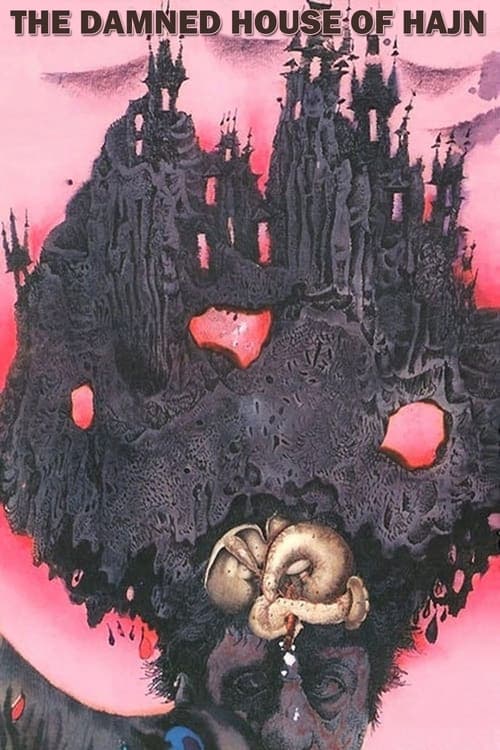
The Damned House of Hajn is about Soňa Hajnová (Petra Vančíková), who now has all of the money and power of the Hajns, a noble Czechoslovakian family with soap business. She is married to Petr Svejcar (Emil Horváth), who wants to grow in social circles no matter how crazy his new bride’s family is. That includes Uncle Cyril (Petr Čepek), who lives in the attic and wants everyone to think he can’t be seen, which is hard when he keeps showing up out of every curtain and door while trying to bed his much younger niece, who is married and oh yeah, his niece.
Based on Jaroslav Havlíček’s novel Neviditelný, this movie takes place inside a giant mansion that feels like it was made for a Mario Bava movie, filled with mazes of hallways, a spiral staircase and so many places to get scared in.
After the uncle finally gets what he wants — sexual assault with Soňa — he and his strange paintings are sent to the sanitarium and she assumes the true place at the head of the family. And that role is someone out of their mind, seeing waking nightmares of sexual encounters with Cyril throughout the never-ending gigantic house she will never leave. Now in love with the ghost of the man who destroyed her life, she even believes that the infant in her womb belongs to him.
There are also very real monsters in this, as the money and power are always for the stealing. Conspiring to murder relatives and the curse being passed to the next generation are just a few of the issues this family will deal with.
This is the type of movie that needs its own genre: Czech gothic noir horror that’s a mediation on the impossibility of human happiness.
14. AKA: The same great show by a name you didn’t know.
I might not be the biggest fan of Scream but I’m going to watch the Bollywood remake.
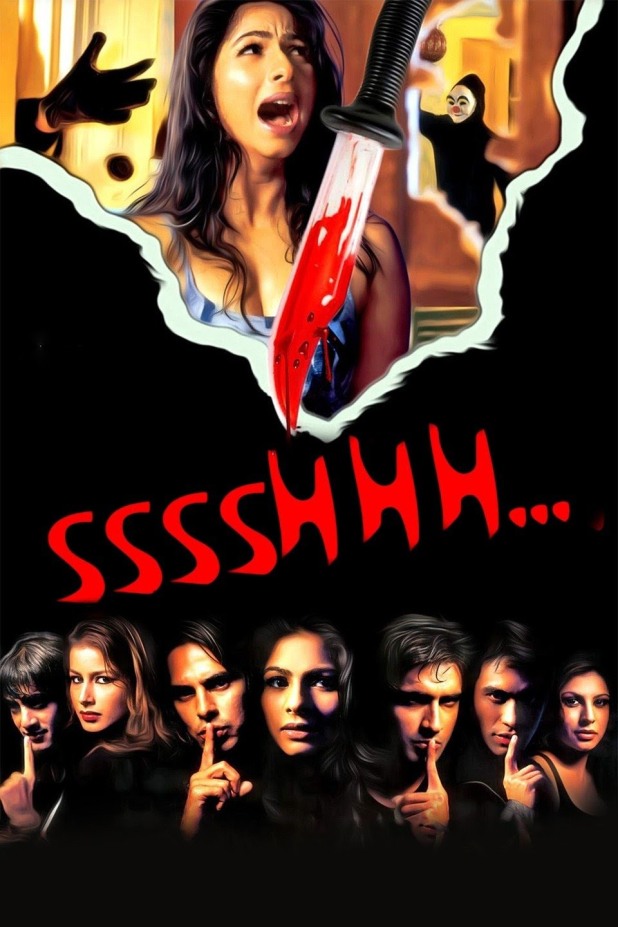
Directed by Pavan S. Kaul and written by Arshad Ali Syed, this starts just like its American inspiration with two teens — Malini Gujral and Sunny — murdered. The difference is that instead of having a mask that looks like Edvard Munch’s work, it looks like a clown.
Malini’s sister Mahek and her friends Rocky, Gehna, Rajat, Rhea, and Nikhil are all going to Simon College and are stalked by the killer just like her sister. In fact, whoever it is, the clown-faced slasher keeps calling Mahek. There’s also new love, perhaps, from Suraj Rai, who has just moved to campus.
As Mahlek is chased repeatedly by the killer, one of the teachers, Mrs. Roy, is killed inside a bathroom — Scream 2, right? — thinking a man has been staring at the girls there. The bloody tracks left behind have the cops thinking that it’s Rocky but while the foot size is close, the actual print is different. It’s closer to Suraj’s shoes, but by now, Mahek is interested in this stranger but then she discovers that the killer also has the same watch as him.
Everyone decides to get away and go on an island vacation, so this movie becomes I Still Know What You Did Last Summer. Nearly everyone gets killed and twist after twist happens, including one taken from Scream and adding on even more family tragedy between the killer and Mahek.
This has tons of kills, some good locations and is filled with songs which pushes it to more than 2 and a half hours. But hey, that’s Bollywood. What’s strange is that it doesn’t refer to any other horror movies and the meta nature of the inspiration is what set it apart. Instead, this is nearly a slasher based on a movie making fun of slashers without any of the comedic elements. The telephone calls aren’t even a part of this movie. Just a mask, a cloak, a similar poster and a heroine who has a single mom. Well, they do get the arguing love interests who may or may not be Ghostface. Or the Joker, as he’s known in this.







 B&S About Movies
You must be logged in to post a comment.