SUPPORTER DAY: The Private Afternoons of Pamela Mann (1974)

EDITOR’S NOTE: Today’s movie is brought to you by AC Nicholas, who has graciously become a Big B&S’er, a monthly supporter of the site and got to pick an entire week of movies. Would you like to have me write about the movies of your choice? It’s simple!

  1. Go to our Ko-Fi site and donate. There’s no set amount and I won’t tell you what to do. In fact, if you just keep reading for free, we can still be friends.
  2. Join as a monthly member for just $1. That makes you a Little B&S’er.
  3. As a Medium B&S’er at just $3 a month, if you pick a movie or a director, I’ll write about them for you. In fact, I’ll do one for each month you subscribe and even dedicate the post to you.
  4. For $5 a month, you basically get some major power. As a Big B&S’er, I’ll write an entire week on any subject you’d like. How awesome would that be? In fact, I’ll do it for every month you’re a member. Do you think any of your other movie sites will do that for you?

Bill Margold said, “The Private Afternoons of Pamela Mann signals an end to the all-balling, no purpose, disposable mastur-movies that go into one orifice and out another.”

There are no movies made like it today.

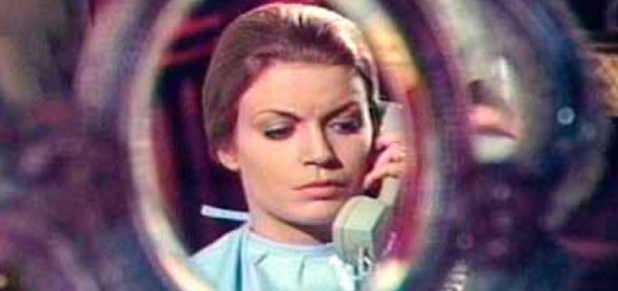
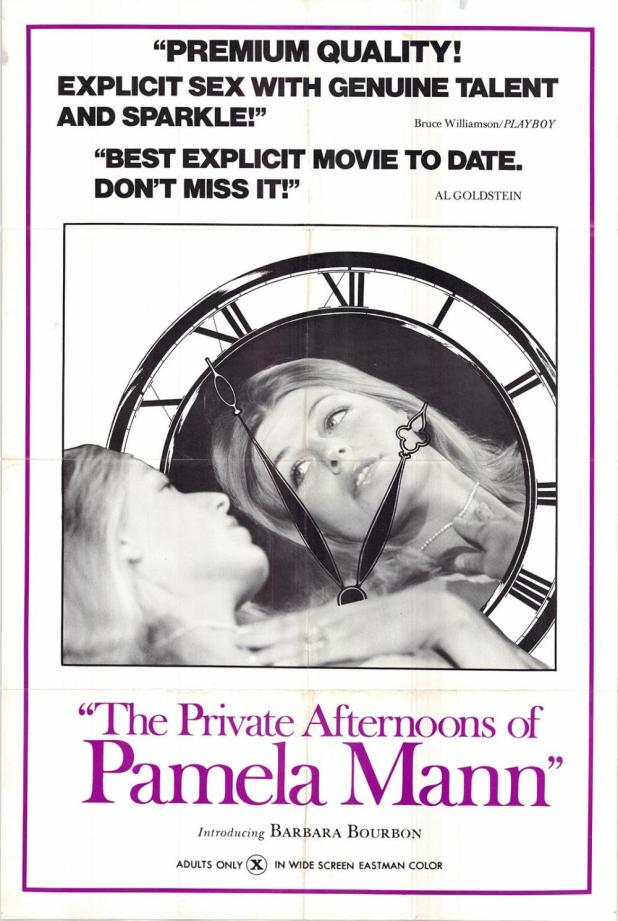
Pamela Mann (Barbara Bourbon) is a married psychotherapist in Manhattan. Throughout the day, we watch as she has several encounters with everyone from one of her female patients to a group of radicals — one of whom takes the time to recite the Supreme Court decision on pornography while Pamela is being taken — and even a man who is just sitting on a park bench. All while Frank (Eric Edwards), a detective, films every single second. By the end of the film, we learn that unlike most of the detective stories that we’re used to, Pamela is watching the movies herself. With her husband. In bed. The sexual revolution — until a few years and AIDS — has been won.

Based on the life of the real Pamela Mann, who was in The Seduction of Inga, Side Street GirlsKeyholes Are for Peeping and Dungeon of Pain, this found Radley Metzger recovering from the bad box office of The Score and embracing hardcore, but not before taking his middle name and favorite town to become Henry Paris. And yes, that politician that she sleeps with is Sonny Landham, who would someday be in Predator.

Throughout the movie, a woman keeps asking questions of the characters after they finish making love. “Do you think the welfare state is still viable considering the inability up to the present of the system to reconcile the isolation of the poor with the assimilation into the system of relatively well-to-do hierarchy of government, administrators, corporate functionaries and executives and the other white color elite who are the necessary benefactors of these poor?” seems like a strange thing to bring up after we’ve seen so much on camera that was once kept from public eyes.

At the end, when they ask her why she’s so inquisitive, she replies, “I’m here to give the film socially redeeming values.”

It also has Georgina Spelvin as a sex worker named Klute and a moment that is just as incendiary and flat-out shocking as it was when this was released, as Darby Lloyd Raines and Jamie Gillis assault Mrs. Mann at gunpoint. I was completely unprepared for this moment and it’s kind of astounding that in the middle of a movie that has cute winks at the camera that all this open sex can be so dangerous.
SUPPORTER DAY: Opening of Misty Beethoven (1976)

EDITOR’S NOTE: Today’s movie is brought to you by AC Nicholas, who has graciously become a Big B&S’er, a monthly supporter of the site and got to pick an entire week of movies. Would you like to have me write about the movies of your choice? It’s simple!

  1. Go to our Ko-Fi site and donate. There’s no set amount and I won’t tell you what to do. In fact, if you just keep reading for free, we can still be friends.
  2. Join as a monthly member for just $1. That makes you a Little B&S’er.
  3. As a Medium B&S’er at just $3 a month, if you pick a movie or a director, I’ll write about them for you. In fact, I’ll do one for each month you subscribe and even dedicate the post to you.
  4. For $5 a month, you basically get some major power. As a Big B&S’er, I’ll write an entire week on any subject you’d like. How awesome would that be? In fact, I’ll do it for every month you’re a member. Do you think any of your other movie sites will do that for you?

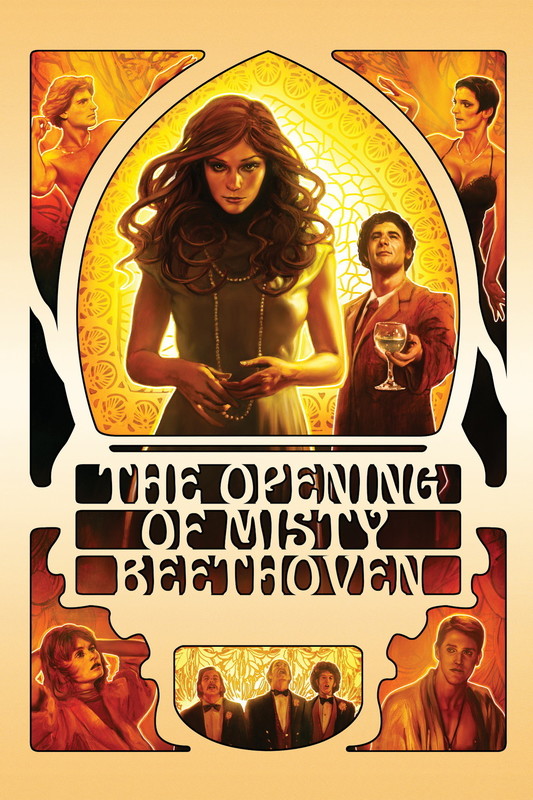
Adult films probably never had as big of a budget or as rich of a look as this movie, which was shot in New York City, Rome and Paris.

Dr. Seymour Love (Jamie Gillis) is our Dr. Henry Higgins because this is Pygmalion or My Fair Lady. He is transforming common streetwalker Dolores “Misty” Beethoven (Constance Money), a woman whom Love believes he can make into an elite and elevated lady who will impress Geraldine Rich (Jacqueline Beudant), the Colonel Pickering of this movie.

The goal will be that by the time of a party thrown by magazine publisher Lawrence Layman (Ras Kean) and his wife Barbara (Gloria Leonard), Misty will be the most wanted woman in the world. That’s not Kean in the threeway scene that follows. Instead, the female on male penetration has the stunt body of Casey Donovan. He’s also the homosexual art dealer who Misty seduces.

This was shot by cinematographer Paul Glickman, who used the name Robert Rochester. He was also the cinematographer for The Stuff and God Told Me To, as well as the director of photography for Al Adamson’s Dracula vs. Frankenstein. He was also nominated for the Best Animated Short Film Oscar for Calypso Singer and El Salon Mexico.

SUPPORTER DAY: The Princess and the Call Girl (1984)

EDITOR’S NOTE: Today’s movie is brought to you by AC Nicholas, who has graciously become a Big B&S’er, a monthly supporter of the site and got to pick an entire week of movies. Would you like to have me write about the movies of your choice? It’s simple!

  1. Go to our Ko-Fi site and donate. There’s no set amount and I won’t tell you what to do. In fact, if you just keep reading for free, we can still be friends.
  2. Join as a monthly member for just $1. That makes you a Little B&S’er.
  3. As a Medium B&S’er at just $3 a month, if you pick a movie or a director, I’ll write about them for you. In fact, I’ll do one for each month you subscribe and even dedicate the post to you.
  4. For $5 a month, you basically get some major power. As a Big B&S’er, I’ll write an entire week on any subject you’d like. How awesome would that be? In fact, I’ll do it for every month you’re a member. Do you think any of your other movie sites will do that for you?

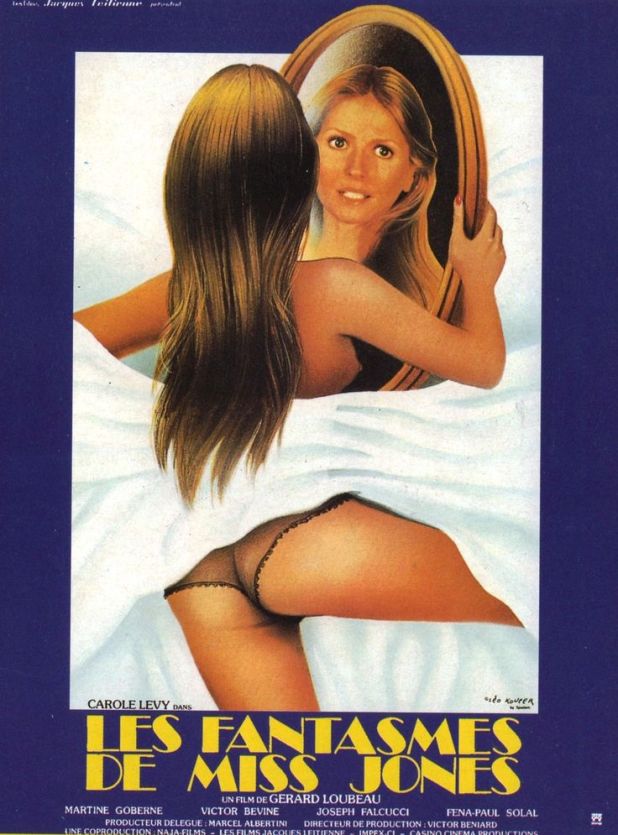
For his last movie, Radley Metzger — Gérard Loubeau is credited — chose to adapt the French story Frontispiece by Pierre Serbie, which is a lot like Mark Twain’s The Prince and the Pauper. Carol Levy (Alone In the Dark) plays the twin roles of Audrey Swallow and Lucy Darling, two women who are as different as they look alike.

One of them is a virginal girl about to married and in need of experience; the other is a high class call girl. As you can imagine, everyone gets what they want, even if getting back to switch places in time proves somewhat of a difficult proposition.

Originally playing on The Playboy Channel, this is a return to the softcore films that Metzger was known for and not his Henry Paris films in the 70s and early 80s. You may also find it as The Fantasies of Ms. Jones.

SUPPORTER DAY: Little Mother (1971)

EDITOR’S NOTE: Today’s movie is brought to you by AC Nicholas, who has graciously become a Big B&S’er, a monthly supporter of the site and got to pick an entire week of movies. Would you like to have me write about the movies of your choice? It’s simple!

  1. Go to our Ko-Fi site and donate. There’s no set amount and I won’t tell you what to do. In fact, if you just keep reading for free, we can still be friends.
  2. Join as a monthly member for just $1. That makes you a Little B&S’er.
  3. As a Medium B&S’er at just $3 a month, if you pick a movie or a director, I’ll write about them for you. In fact, I’ll do one for each month you subscribe and even dedicate the post to you.
  4. For $5 a month, you basically get some major power. As a Big B&S’er, I’ll write an entire week on any subject you’d like. How awesome would that be? In fact, I’ll do it for every month you’re a member. Do you think any of your other movie sites will do that for you?

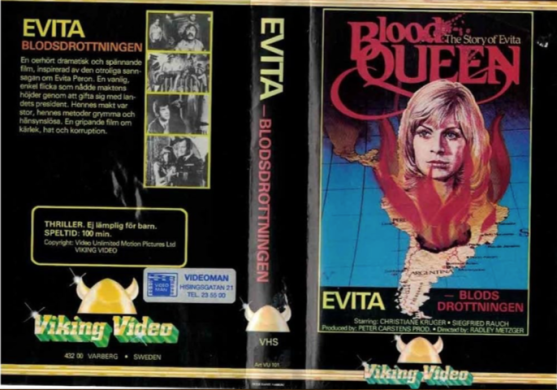
Is Radley Metzger the director you expected to make one of the first movies about the life of Evita Perón?

Yes, seven years before Andrew Lloyd Webber, he made a thinly disguised take on her life. Marina (Christiane Krüger) marries South American dictator Colonel Pinares (Siegfried Rauch) and becomes the Little Mother to a nation.

Also known as Woman of the Year, we move on to find Marina being asked to be put on the ticket as Pinares Vice-President for the next election he plans to prove that his country has open elections. Of course, she can easily sacrifice him to become the leader of the people. Even as she suffers from a fatal illness, she is plotting how to become immortal in the hearts of her followers.

Foreign releases didn’t even hint at the tone of this movie, calling it Blood Queen: The Story of Evita.

This is an attempt for Metzger to work in mainstream film and while not totally successful, there are still some strong images here and the daring chance to work on a film about Peron years before she was known outside of Argentina.


SUPPORTER DAY: RPM (1970)

EDITOR’S NOTE: Today’s movie is brought to you by AC Nicholas, who has graciously become a Big B&S’er, a monthly supporter of the site and got to pick an entire week of movies. Would you like to have me write about the movies of your choice? It’s simple!

  1. Go to our Ko-Fi site and donate. There’s no set amount and I won’t tell you what to do. In fact, if you just keep reading for free, we can still be friends.
  2. Join as a monthly member for just $1. That makes you a Little B&S’er.
  3. As a Medium B&S’er at just $3 a month, if you pick a movie or a director, I’ll write about them for you. In fact, I’ll do one for each month you subscribe and even dedicate the post to you.
  4. For $5 a month, you basically get some major power. As a Big B&S’er, I’ll write an entire week on any subject you’d like. How awesome would that be? In fact, I’ll do it for every month you’re a member. Do you think any of your other movie sites will do that for you?

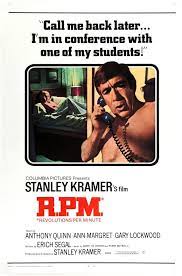
Stanley Kramer called his movies heavy dramas but they’re what are often called message films. A liberal, he brought issues to the public eye through his movies like the dangers of nuclear war (On the Beach), fascism (Judgement at Nuremberg, Ship of Fools), creationism against evolutionism (Inherit the Wind), greed (It’s a Mad, Mad, Mad, Mad World) and racism (The Defiant OnesGuess Who’s Coming to Dinner).

While Pauline Kael saw his movies as “melodramas,” and “irritatingly self-righteous,” she also had to realize that they had “redeeming social importance.”

But in 1970, maybe he was past his expiration date.

Did he feel like Professor F.W.J. “Paco” Perez (Anthony Quinn) does in this movie? For years, Paco has been the radical, the one that stood outside the mainstream. He says at one point that he fought Franco and McCarthy and has learned so much, but the young people don’t want to learn anything. Did Kramer feel that way, an old man in the New Hollywood that was so much more in touch with the youth?

Is Paco just a fifty-year-old fanny chaser, as out of touch with the time as the administration he’s been asked to be a part of?

Radical student activists — Paco is impressed that the blacks and whites have worked together — occupy the administration building with a list of 12 demands. President Tyler (John Zaremba, who spent the 70s and 80s wandering the Earth searching for the best beans for Hills Brothers Cofee) resigns and the Board of Trustees looks at the list that the students have written up of the presidents they would be happy with.

Top on the list? Paco.

It’s after midnight and he’s asleep with his grad student girlfriend Rhoda (Ann-Margret). Yet he’s urged to rush out and fix things. The next day, he starts his new job, showing up on a motorcycle.

Paco reads their demands and many of them, like inner-city scholarships, a college reinvestment program, no military research on campus and adding an African American to the all-white Board of Trustees make sense. But the idea that students can hire and fire faculty doesn’t work for him. He’s already reached the first time where his theory and reality begin to not work together.

With Rossiter (Gary Lockwood) and Steve Dempsey (Paul Dempsey) leading the students, Paco tries to be the person between them and the Board of Trustees. But when Rossiter says that he will destroy all of the campus’ computers, Paco has to make the tough decision to call in the police. They come charging in with tear gas, turning their hero professor into just one of the old people never to be trusted. When the cops round up the students, Rhoda is one of them.

What they don’t know is that Paco has signed off on their bail. Yet he still walks past the crowd and is screamed and booed at. He has learned the hard way that the lessons of books and classrooms often mean little in the real world.

I really liked the songs by Melaine, “We Don’t Know Where We’re Goin’” and “Stop! I Don’t Wanna Hear It Any More,” that were in this. It’s quite preachy, but it also feels like this movie was Kramer attempting to determine where he fit in any longer. Then again, Kramer would say that this was his least favorite film that made the lowest amount of money. The dialogue may get silly sometimes, but that’s because it’s written by Erich Segal, who also did Love Story.

After this movie, however, I understand why my dad and other older male relatives would say Ann-Margaret’s name with the reverence they otherwise reserved for the saints.

You can watch this on Tubi.

SUPPORTER DAY: Therese and Isabelle (1968)

EDITOR’S NOTE: Today’s movie is brought to you by AC Nicholas, who has graciously become a Big B&S’er, a monthly supporter of the site and got to pick an entire week of movies. Would you like to have me write about the movies of your choice? It’s simple!

  1. Go to our Ko-Fi site and donate. There’s no set amount and I won’t tell you what to do. In fact, if you just keep reading for free, we can still be friends.
  2. Join as a monthly member for just $1. That makes you a Little B&S’er.
  3. As a Medium B&S’er at just $3 a month, if you pick a movie or a director, I’ll write about them for you. In fact, I’ll do one for each month you subscribe and even dedicate the post to you.
  4. For $5 a month, you basically get some major power. As a Big B&S’er, I’ll write an entire week on any subject you’d like. How awesome would that be? In fact, I’ll do it for every month you’re a member. Do you think any of your other movie sites will do that for you?

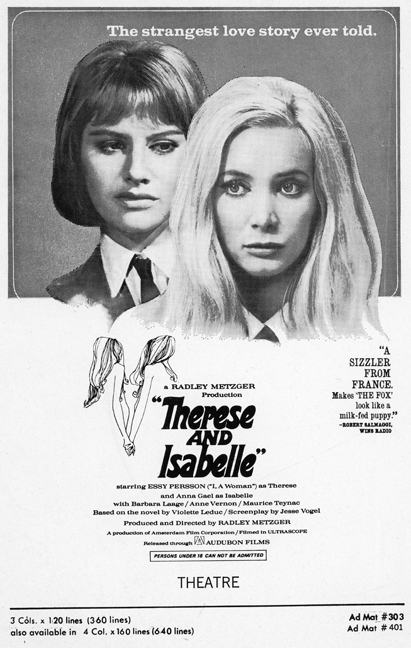
Radley Metzger made this movie in black and white to, as he told The Rialto Report, “to deliberately align it more closely to classic cinematic love stories of yesteryear rather than the often gaudy sexploitation movies that were de rigueur in the late 1960s.”

Thérèse (Essy Persson, who is also in Metzger’s I, A WomanMission Stardust and Cry of the Banshee) and Isabelle (Anna Gaël, also known as Anna Abigail Thynn, Marchioness of Bath; Ceawlin Thynn, 8th Marquess of Bath; Viscountess Weymouth; the Dowager Marchioness; the Honorable Lady Thynn; as you can tell by her title, Gaël’s life was fascinating, beyond acting in movies like Dracula and Son and Zeta One. According to the introduction to her incredible Rialto Report interview, she spent the 70s married to a “…wealthy British aristocrat, a controversial and scandalous union that started when Anna was just 15, and involved salacious stories of hundreds of lovers, erotic paintings of the Kama Sutra that police deemed to be obscene, one of the most famous English stately homes, and allegations of racism that caused the break-up of a noble family.”) are two young women who fall in love after Thérèse is taken to a boarding school by her remarried mother. The entire story is told in flashback; as it was shot without sound in the style of Italian movies, the dubbed nature of the film adds a dreamlike quality.

Roger Ebert called it “the worst movie of the year” and “another of his traveling stupidity exhibitions, which masquerade as “art films” to get into respectable theaters.”

I don’t know if he saw the same movie that I did, to be honest. I was touched by the loss that Thérèse feels as she walks the halls of her abandoned school, remembering when love was young and the feelings of being with the first person that you love. That’s my than smut or a so-called dirty movie in my eyes.

SUPPORTER DAY: Camille 2000 (1969)

EDITOR’S NOTE: Today’s movie is brought to you by AC Nicholas, who has graciously become a Big B&S’er, a monthly supporter of the site and got to pick an entire week of movies. Would you like to have me write about the movies of your choice? It’s simple!

  1. Go to our Ko-Fi site and donate. There’s no set amount and I won’t tell you what to do. In fact, if you just keep reading for free, we can still be friends.
  2. Join as a monthly member for just $1. That makes you a Little B&S’er.
  3. As a Medium B&S’er at just $3 a month, if you pick a movie or a director, I’ll write about them for you. In fact, I’ll do one for each month you subscribe and even dedicate the post to you.
  4. For $5 a month, you basically get some major power. As a Big B&S’er, I’ll write an entire week on any subject you’d like. How awesome would that be? In fact, I’ll do it for every month you’re a member. Do you think any of your other movie sites will do that for you?

Based on Alexander Dumas’ La Dame aux CaméliasCamille 2000 was made in Italy but directed by Radley Metzger and written by Michael de Forrest. This is the story of Marguerite Gautier (Danielle Gaubert, who died too young at 44 but had a life where she was married to the son of Dominican dictator Rafael Trujillo and ski champion Jean-Claude Killy, as well as acting in 17 movies), a woman of whom the rumors say “the hills are covered with the bodies of the men she’s ruined.”

Armand Duval (Nino Castelnuovo) falls for her instantly, despite the harsh words of his father (Massimo Serato) and the offer by his friend Gaston (Roberto Bisacco) to show him other women. He finally gets her alone and charms her; she tells him that if he really loves her that he should run. They instead live on love on a houseboat in Porto d’Ercole. Armand’s father believes that she’s using her son; unknown to everyone, the opposite is true, as she is selling off every gift rich men have ever given her to keep their life. The father asks her to leave his son, as he’s meant for more. She complies and ends up with Count DeVarville (Philippe Forquet) and hooked on drugs to try and forget. Armand throws himself into work, which becomes his addiction.

One of her friends introduces Armand to Prudence (Eleonora Rossi Drago) who throws an S&M orgy that also has Marguerite and DeVarville invited. Of course, things won’t end well. How can they, as when we first meet Marguerite, someone asks her, “Don’t you ever come down?”

She answers, “Not if I can help it.”

A movie filled with longing, eroticism and inflatable furniture, this is 1969 looking to a future that we’d never find.

SUPPORTER DAY: The Cat and the Canary (1978)

EDITOR’S NOTE: Today’s movie is brought to you by AC Nicholas, who has graciously become a Big B&S’er, a monthly supporter of the site and got to pick an entire week of movies. Would you like to have me write about the movies of your choice? It’s simple!

  1. Go to our Ko-Fi site and donate. There’s no set amount and I won’t tell you what to do. In fact, if you just keep reading for free, we can still be friends.
  2. Join as a monthly member for just $1. That makes you a Little B&S’er.
  3. As a Medium B&S’er at just $3 a month, if you pick a movie or a director, I’ll write about them for you. In fact, I’ll do one for each month you subscribe and even dedicate the post to you.
  4. For $5 a month, you basically get some major power. As a Big B&S’er, I’ll write an entire week on any subject you’d like. How awesome would that be? In fact, I’ll do it for every month you’re a member. Do you think any of your other movie sites will do that for you?

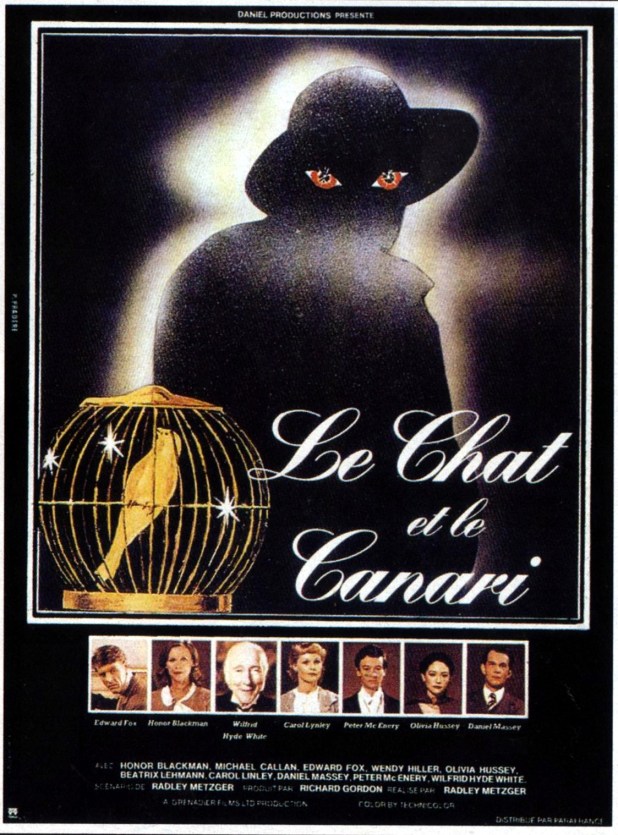
A slasher that plays it classy, this is the sixth film adaptation of John Willard’s 1922 play. It was directed by Radley Metzger, who stepped away from adult briefly — he also made Maraschino Cherry the same year under his Henry Paris name and would return for the uncredited The Tale of Tiffany Lust the following year — to direct a mainstream film.

On the twentieth anniversary of the death of Cyrus West (Wilfrid Hyde-White, My Fair Lady), his cousins are summoned to his mansion to watch his will and testament. They are stuntman Charlie Wilder (Peter McEnery, Footprints On the Moon), hunter Susan Sillsby (Pussy Galore herself, Honor Blackman), her lover Cicily Young (Olivia Hussey, Black Christmas), surgeon Henry Blythe (Daniel Massey, The Vault of Horror), fashion designer Annabelle West (Carol Lynley, The Poseidon Adventure) and songwriter Paul Jones (Michael Callan, Double Exposure). Joining them are the executor of the will, Allison Crosby (Wendy Hiller, Toys In the Attic) and the maid, Mrs. Pleasant (Beatrix Lehmann, Psyche ’59).

To get the entire estate, Annabelle must remain in the abandoned mansion with all of her cousins for one night and remain sane. Dr. Hendricks (Edward Fox, The Day of the Jackal) will judge her, yet the first thing he does is inform everyone that a trenchcoat-clad patient has escaped from the mental hospital, one who believes that he is a cat and loves to murder with claw-like weaponry.

What follows is a haunted house/slasher/giallo cocktail that is quite a potent mix. Shot in the same house as The Omen, it looks and feels great. Metzger’s only non-adult movie, it came about because of his long-time business relationship with producer Richard Gordon, who had once hired him to direct the English language versions of the films he was importing from Europe.

In an interview with Psychotronic Video, Metzger said, “It was a fun picture, but the litigation involved was horrendous. The distributor chose not to honor the contract. We sued, and it is very difficult to be the aggressor in a lawsuit. After all those years of defending myself in censorship cases in which we never lost one, there I was trying to create a case on the other side. It took a very long time. We won the suit because it was an obvious breach. The picture was finally released in 1981, but the timing was off. The haunted house aspect helped when it came to ancillary rights. Outside of theatres, Cat has done tremendous business. It was the leader in all those syndication packages. It has never stopped playing. We actually have been living off that picture for eight or nine years.”

You can watch this on Tubi.

SUPPORTER DAY: Barbara Broadcast (1977)

EDITOR’S NOTE: Today’s movie is brought to you by AC Nicholas, who has graciously become a Big B&S’er, a monthly supporter of the site and got to pick an entire week of movies. Would you like to have me write about the movies of your choice? It’s simple!

  1. Go to our Ko-Fi site and donate. There’s no set amount and I won’t tell you what to do. In fact, if you just keep reading for free, we can still be friends.
  2. Join as a monthly member for just $1. That makes you a Little B&S’er.
  3. As a Medium B&S’er at just $3 a month, if you pick a movie or a director, I’ll write about them for you. In fact, I’ll do one for each month you subscribe and even dedicate the post to you.
  4. For $5 a month, you basically get some major power. As a Big B&S’er, I’ll write an entire week on any subject you’d like. How awesome would that be? In fact, I’ll do it for every month you’re a member. Do you think any of your other movie sites will do that for you?

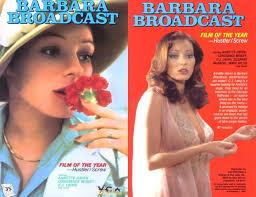
Radley Metzger is probably the best regarded director of the Golden Age of adult. Once he moved from softcore to hardcore, he started to use the name Henry Paris. What he didn’t change was that he was able to shoot his films in some great locations, including the Olympia ballroom and the lobby of the Royal Manhattan Hotel, which was made to look like a restaurant.

Barbara Broadcast (Annette Haven, who was a consultant for Brian De Palma and Melanie Griffith’s coach for Body Double) is a best-selling author and celebrated liberated woman. As she dines in a fancy restaurant, she gives an interview with Roberta (C. J. Laing, bestill my heart), a journalist who wants to know her story.

As they talk about life and, well, sex, fans come up to meet Barbara and outright couplings — Sharon Mitchell is a waitress, after all — happen all around them. There are also asides, such as Barbara meeting an executive (Michael Gaunt) who can’t meet with higher ups without being with her first and Roberta being inspired enough to have an encounter in the kitchen with a dish washer (Wade Nichols). Depending on the edit you get of that scene, you may get more than you expected.

Finally, Barbara and Roberta consummate their interview and meet Curley (Jamie Gillis) who tells them of his slave (Constance Money). This scene was intended for The Opening of Misty Beethoven and Metzger edited it into this movie. Money sued him and was paid for this movie, as she’d only agreed to be in his earlier film and not this one.

Where so many of the Metzger/Paris films are high class — not that this isn’t — this honestly is a move toward an honest to goodness no apologies dirty movie. Most odd is the fact that one of the songs in this film, “The Big One,” is the theme to The People’s Court.

SUPPORTER DAY: Score (1974)

EDITOR’S NOTE: Today’s movie is brought to you by AC Nicholas, who has graciously become a Big B&S’er, a monthly supporter of the site and got to pick an entire week of movies. Would you like to have me write about the movies of your choice? It’s simple!

  1. Go to our Ko-Fi site and donate. There’s no set amount and I won’t tell you what to do. In fact, if you just keep reading for free, we can still be friends.
  2. Join as a monthly member for just $1. That makes you a Little B&S’er.
  3. As a Medium B&S’er at just $3 a month, if you pick a movie or a director, I’ll write about them for you. In fact, I’ll do one for each month you subscribe and even dedicate the post to you.
  4. For $5 a month, you basically get some major power. As a Big B&S’er, I’ll write an entire week on any subject you’d like. How awesome would that be? In fact, I’ll do it for every month you’re a member. Do you think any of your other movie sites will do that for you?

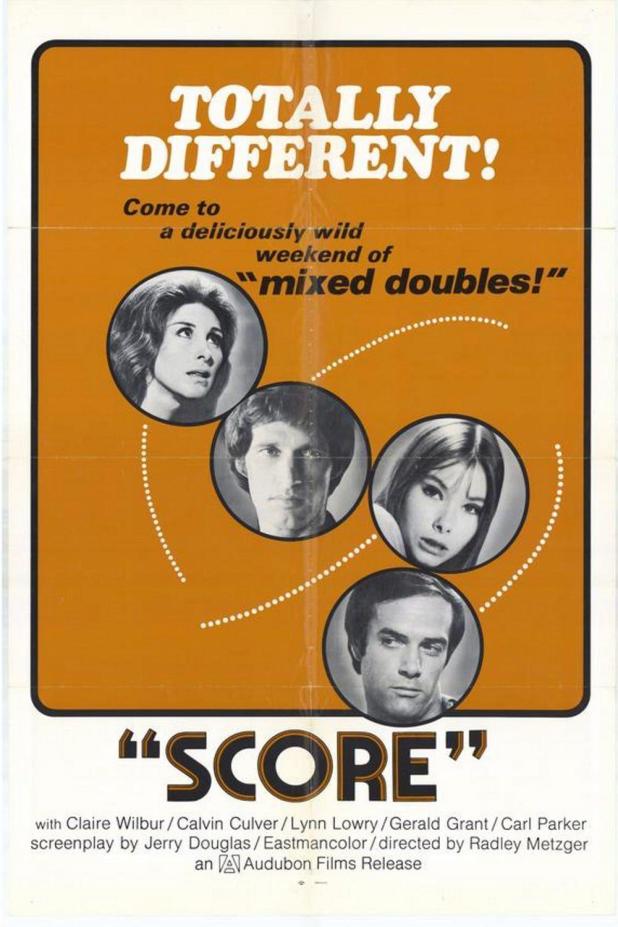
Even today, almost fifty years after Score was made, it pushes taboos. It’s one of the first films to explore bisexual relationships, which is something movies still shy away from. And it was one of the porn chic movies of the 1970s Golden Age, a time when adult movies could both be adult and movies.

It was directed by Radley Metzger, someone who one can honestly say was an auteur of adult filmmaking. He told Cinedelphia, “When I was coming of age, eroticism was always in films, but eroticism was punished. The promiscuous girl never got the leading man, the woman who sold her charms, always had a bad fate. The “good girl” always achieved ends the bad girl never did. As a reaction to that, I tried to do the opposite. You could have a free attitude and behave in a free way and not be punished. A parallel to that is that it could also be light. It didn’t have to be tragedy. You could look at sex in a fun way. That was a personal thing, to work against the clichés in cinema when I was growing up.”

It’s based on an off-Broadway stage play that ran in 1970 and even had Sylvester Stallone in a small part. The movie version was written by Jerry Douglas, who also wrote the original play, who would go on to create the magazine Manshots and eventually direct several of his own adult films.

In the mythical European city of Leisure — the play was set in a New York City apartment building — married couple Jack (Gerald Grant) and Elvira (Claire Wilbur, who originated the role and would go on to win an Oscar for producing Robin Lehman’s The End of the Game) have a bet about who can pick up whom. She thinks she can win over Betsy (Lynn Lowry, who is still in so many horror movies and making them better just by being herself), a young bride who has just married Eddie (Casey Donovan, who was a popular gay adult star and the long-time lover of Tom Tryon).

Betsy might be a Catholic schoolgirl who doesn’t know the world yet but she’s fascinated by Elvira, who even seduces a telephone repairman (Carl Parker) right in front of her. That night, she catches her husband masturbating and confesses that she’s not happy.

A costume party allows them all to change it up, as Eddie is dressed as a cowboy and Betsy a nun. They pair up with their same sex — just to talk, hmm? — and confess that they’re unsatisfied. The pot helps. So does the poppers. Before midnight, the young couple is seduced. The shocking part — for some — may be that in the hardcore cut that the man-on-man sex is given just as much time as the female-on-female. By the end, Betsy and Eddie wonder which one of them is the strange one.

By the way, Lowry’s scenes have a body double in them, as she didn’t participate in the unsimulated coupling.

While yes, this is a dirty movie, one of the things you find in all of Metzger’s films of this era are class. The budget is good, the setting — Croatia — is beautiful and there’s more story than sin.