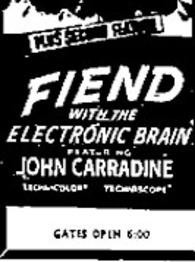
The Fiend with the Electronic Brain is — sort of — Al Adamson’s 1965 movie Psycho-A-Go-Go which is also — sort of — Blood of Ghastly Horror.
Psycho A-Go-Go is all about Joe Corey taking part in a diamond heist with the stolen contraband hidden inside a little girl’s doll when it isn’t about Tacey Robbins singing.
This remix has Joe Corey’s madness explained as he is an injured Vietnam vet who is experimented on by Dr. Vanard (John Carradine). Everything that happened in the first version also happens here but Joe is off the hook, I guess, because of the surgery on his mind.
Venard wanted to heal the soldier’s shrapnel injuries with electric shock therapy, but he turned Joe into a woman-killing monster who is now hunting him down. He straps Dr. Vanard to his own lab equipment and electrocutes him before we somehow find ourselves back in that jewel robbery, the diamonds in the doll and the forest haunting of the woman and her daughter, all before Joe gets shot and falls off a cliff.
Beyond also being Bloof of Ghastly Horror and also The Man with the Synthetic Brain, a Sam Sherman retitling for TV. You could see this movie four times and be taken every time as you’re seeing the same story with little tweaks along the way with footage being Xeroxed over and over and over.
I get upset when Spielberg or Lucas comes back and meddles with their movies but I am in no way upset that Al Adamson just kept trying to make this movie better. Arguably, he didn’t. He tried and you have to give it to him for that.
Bubble Bath: Hungarian director György Kovásznai’s wildly idiosyncratic animated musical is one of the most indescribably strange, personal and totally irresistible cartoon features ever made. A walking ball of anxieties, shop window decorator Zsolt (voiced by Kornél Gelley, with Albert Antalffy singing) bursts into the apartment of his fiancée’s best friend Anikó (voiced by Vera Venzcel, with Kati Bontovits singing), paralyzed with fear at his impending marriage. Zsolt is like a stoned hippie alleycat, or an Eastern European Frank Zappa in a tux; medical student Anikó a more curvaceous and leggy post-modern Betty Boop – and both unsure of their attraction to each other, of the choices they’ve made, of what life has in store for them.
A truly insane mash-up of styles, from 1920s Art Deco to 1960s Psychedelia to late 1970s louche Roxy Music decadence, Bubble Bath is incredibly restless and creative, the bohemian love-child of Bill Plympton’s off-kilter individualism and Ralph Bakshi’s wonderfully warped, rubbery visual style. In other words: it’s not quite like any animated film you’ve ever seen before. Sadly, this was director and animator Kovásznai’s only feature film — he died of leukemia in 1983. Bubble Bath has been beautifully restored by the National Film Institute in Hungary for its first-ever U.S. release by Deaf Crocodile. In Hungarian with English subtitles.
World War III: The official Iranian entry for Best International Feature Film at the 2023 Academy Awards, and the Winner of the Orizzonti Awards for Best Film and Actor at the Venice Film Festival 2022, director Houman Seyedi’s savage, mysterious thriller/drama World War III is one of the darkest, most enigmatic portraits of class inequality, desperation and murder since Lee Chang-dong’s Burning and Bong Joon-ho’s Parasite. Mohsen Tanabandeh delivers an unforgettable performance as Shakib, an anonymous day laborer still grieving the deaths of his wife and son who’s given a job guarding the set of a film about the Holocaust. When the lead actor playing (yes) Hitler is struck ill, Shakib is enlisted to wear the costume and mustache – and for the first time in his life, he has a little money, respect and a place to sleep. Unexpectedly, his sex worker “girlfriend” (Mahsa Hejazi) shows up, threatening to upset his tenacious hold on prosperity. What starts out as a dark satire of the Iranian film industry quickly evolves into a near-Hitchcockian thriller of the underclass struggling violently to be heard, to be seen – with an apocalyptic ending that is truly something to behold. Rated 100% Fresh on Rotten Tomatoes. In Persian with English subtitles.
Plus they have a movie up for preorder!
The Mysterious Castle In the Carpathians: A unique and almost indescribable mix of Gothic fiction, steampunk gadgetry (designed by Czech animation wizard Jan Švankmajer), slapstick comedy and romantic opera, director Oldřich Lipský’s wonderfully bonkers delight has elements of The Fearless Vampire Killers, Terry Gilliam, Mel Brooks and The Benny Hill Show. Based on an 1892 Jules Verne novel The Carpathian Castle (which partially inspired Bram Stoker to write Dracula), the film follows Count Teleke of Tölökö (Michal Dočolomanský) on the trail of the count’s lost lover, opera singer Salsa Verde (Evelyna Steimarová) – only to discover she’s been abducted by fiendish Baron Gorc of Gorceny (Miloš Kopecký), whose castle home is filled with the bizarre inventions of mad scientist Orfanik (Rudolf Hrušínský). Littered with puns, sight gags and non-sequiturs – “Later, in Werewolfston”, an invented dialect, a detached golden ear for eavesdropping, a staff topped by an enormous TV eyeball – Mysterious Castle was the third fantastical film from the team of director Lipský and writer Jiří Brdečka after their much-loved musical western spoof Lemonade Joe (1966) and their detective/horror satire Adela Has Not Had Supper Yet (1977), both major Czech cult hits. (Note that actor Miloš Kopecký and Jiří Brdečka worked on the supernatural anthology Prague Nights, also released by the Národní filmový archív, Deaf Crocodile and Comeback Company.)
Bonus features include:
New restoration of Mysterious Castle by Craig Rogers for Deaf Crocodile.
New video interview with Czech film critic and screenwriter Tereza Brdečková on her father, Jiří Brdečka, writer of Mysterious Castle. (In English).
New essay by film historian and expert on Eastern European cinema Jonathan Owen.
New audio commentary by Tereza Brdečková and Czech film expert Irena Kovarova of Comeback Company.
Two eerie and stunningly beautiful Jiří Brdečka animated short films: Vzducholoď a láska (Love and the Dirigible) (1948, 9 min.) and Třináctá komnata prince Měděnce (Prince Copperslick aka Prince Měděnec’s Thirteenth Chamber) (1980, 9 min.) Both in Czech with English subtitles.
A feature-length documentary on the life and career of filmmaker, animator, screenwriter and illustrator Jiří Brdečka, covering his childhood, his work as a screenwriter with Jiří Trnka, Karel Zeman and Oldřich Lipský, and his own acclaimed work as an animator and director. In Czech with English subtitles.
Blu-ray authoring by David Mackenzie of Fidelity In Motion.
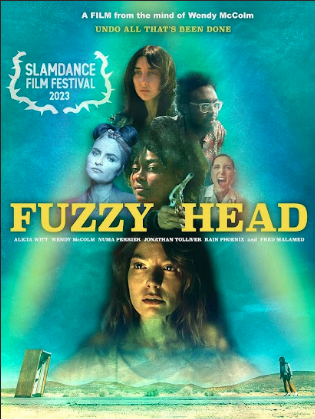
A film with a perfectly fitting title, writer/director/star Wendy McColm’s Fuzzy Head is a surreal genre-film meditation on lifelong trauma that began with childhood abuse.
Insomniac Marla (McColm) may or may not be interacting with others, viewers may or may not be witnessing actual events or imagined ones from her life, and the nonlinear framework of the film makes things even less clear as the young woman tries to piece together whether she murdered her mother, who once made her walk on broken glass as a childhood punishment. But if things were clear to us, we couldn’t sympathize with Marla’s plight as much as we do — and hers is the type of character, thanks to McColm’s work behind the camera and in front of it, that we ultimately want to see come out of everything okay.
McColm is great in the role, with her character going through the wringer, and her supporting cast — particularly Alicia Witt as Marla’s mother — is solid throughout. If you enjoy symbolism and dream interpretation in your cinematic choices, Fuzzy Head should keep you busy. There’s more than a little David Lynch influence at play here, along with influences from other filmmakers, but McColm’s film is its own unique work, boasting plenty of oddness and intriguing visuals.
Fuzzy Head is a heavy, heady, often uncanny character study with thriller elements that should leave viewers with plenty to chew on long after the ending credits roll.
Fuzzy Head, from Gravitas Ventures, is currently available as a streaming release.
December 1: Happy Horror-days! Celebrate trying to survive the festive season with a collection of cult films that are set around the holidays or are up to their knees in snow. Either way, there will be chills galore. From everyone at ARROW, we wish you Happy Horror-days! Titles include: Holiday Fear, The Leech, Chill Factor
Also on December 1: Once Upon a Chinese Hero Kickboxer and Ninja Hunter
December 4: Gala Avary Selects Vol. II: Gala Avary (producer of the Video Archives podcast and host of The Gala Show) invites you into the scene… POV: It’s December 4th. You know what that means. It’s my birthday and you’re invited to my party! We’ve already been out to Finney’s Crafthouse for dinner and enjoyed cauliflower tacos and a Bavarian pretzel. Don’t forget the sweet potato fries! I’ve blown out 28 candles, plus one for good luck, and made my wish. Oh, you want to know what I wished for? It’s bad luck to share so I’m keeping it to myself. Now that dinner’s over, it’s time for gifts — but wait! Just because it’s my birthday doesn’t mean you don’t get something too. Come on, unwrap it. It’s just what you wanted: 20 new ARROW Selects hand-picked by myself. Which one are you going to watch first? Titles include: Bloody Birthday, Lady Morgan’s Vengeance, The Initiation.
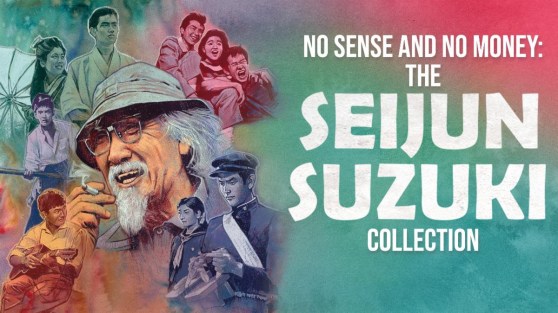
December 15: No Sense and No Money: The Seijun Suzuki Collection: “I make movies that make no sense and no money”, Seijun Suzuki said of his own work, but what fun is ‘sense’ compared to surreal, unforgettable and influential Yakuza movies? Although unappreciated at the time, especially by Nikkatsu, the studio that fired him after calling his masterpiece Branded To Kill “nonsense”, Suzuki left behind a legacy of work unlike any other. His films made indelible impressions on filmmakers such as Jim Jarmusch and Quentin Tarantino and ARROW are proud to present a curated Season in No Sense and No Money: The Seijun Suzuki Collection. Titles include: Eight Hours of Terror, The Boy Who Came Back, The Sleeping Beast Within.
December 18: Travis Stevens Selects: The producer of Cheap Thrills, Jodorowsky’s Dune, We Are Still Here, Buster’s Mal Heart and more, shared: “It was a pleasure diving into the ARROW catalogue to pull together a selection of international films that cover everything from sex & violence, to haunted relationships, to tactile science fiction, to alt vampires, to how the hell did that movie ever get made? Basically, everything that makes cinema great, now streaming only on ARROW.” Titles include: No, The Case Is Happy Resolved, Inferno of Torture, Shock.
December 29: Five Fighters from Shaolin and The Leg Fighters
Head over to ARROW to start watching now. Subscriptions are available for $6.99 monthly or $69.99 yearly.
ARROW is available in the US, Canada, the UK and Ireland on the following Apps/devices: Roku (all Roku sticks, boxes, devices, etc), Apple TV & iOS devices, Samsung TVs, Android TV and mobile devices, Fire TV (all Amazon Fire TV Sticks, boxes, etc), and on all web browsers at https://www.arrow-player.com.
With a slickly designed and user-friendly interface, and an unparalleled roster of quality content from westerns to giallo to Asian cinema, trailers, Midnight Movies, filmmaker picks and much, much more, ARROW is the place to go for the very best in on-demand entertainment.
Al Adamson was the son of silent film stars Denver Dixon and Dolores Booth. After working on some of his father’s later films, he started his own production company with Sam Sherman called Independent-International Pictures.
From tinting a Filipino horror movie neon hues and releasing it as a movie shot in Spectrum X — Horror of the Blood Monsters— to filming two movies at Spahn Ranch and making two softcore stewardess movies in one year (1975’s The Naughty Stewardesses and Blazing Stewardesses, which actually had parts written by the elderly Three Stooges who were unable to appear), Adamson’s movies are all over the map. His films Dracula vs. Frankenstein and Carnival Magic are both shockingly inept and amazingly transcendent, sometimes at the very same time. Yeah, I get the incongruity of this statement.
This movie was to be a straight action picture, back when it had the title Echo of Terror. But soon, it turned into a vehicle for Adamson to promote Tacey Robbins’ singing amidst a plot where a murderous jewel thief stalks a woman and her child after jewels are hidden inside the girl’s Christie Minstrel doll. Yes, a singing black baby doll that sings old slave songs, 1965 grindhouse fare ain’t the place to find woke storylines. I’d imagine that this plot point was cribbed from The Night of the Hunter.
Amazingly, Adamson would resurrect this movie numerous times over the next several years, turning it into a veritable zombie of a film. In 1969, it was completely re-edited, with John Carradine as a mad scientist added after the fact, and re-released as The Fiend with the Electronic Brain.
Two years after that, Adamson added even more footage to the film, including scenes with his wife Regina Carrol, and created an entirely new version called Blood of Ghastly Horror. The fact that three different movies are vying for one coherent narrative probably didn’t matter to Adamson. All of this was released one more time as a fourth version of the film, The Man With the Synthetic Brain. I can only imagine the confusion of some viewers who had to be sure they’d seen this movie before, as the main villain’s motivations go from being simply villainous to being experimented on by an evil doctor to dying early in the third and fourth versions of the film before his father brings a zombie to gain revenge on the family of the evil doctor. Imagine a movie being a sequel to itself but never telling you! Talk about confusing!
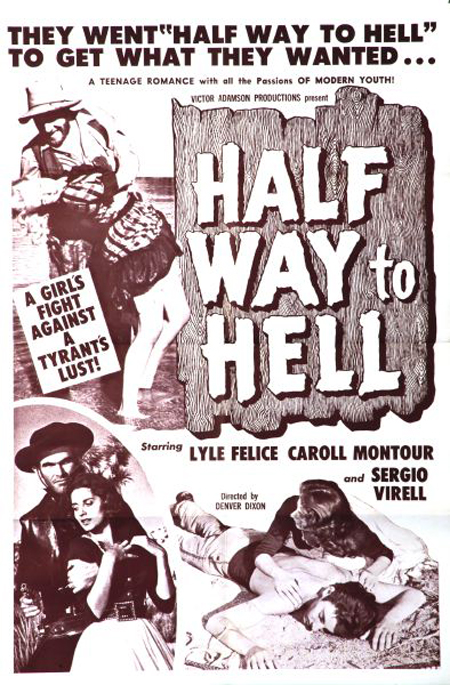
Al Adamson directed his first movie with his father, Victor, and wrote the script with Alan Greedy. His father was also the cowboy actor Denver Dixon.
In the days before the Mexican Revolution, the daughter of a wealthy landowner named Maria San Carlos (Caroll Montour) is set to take part in an arranged marriage with Escobar (Al Adamson using the name Lyle Felice). Not in love, she and Joanne (Shirley Tegge) run away with Escobar’s mercenaries after them. Her servant Manuel (Sergio Virel) and another team of henchmen are also sent.
The high point of this — I don’t have the box set, so I’ve been hunting a copy — is that there’s a duel with bullwhips.
The interesting thing is that this is all told from a female POV — novel for 1960 and a Western — and gets pretty rough with Mariah nearly being raped. It’s 67 minutes long and would start the foundation for the movies that Adamson would make.
EDITOR’S NOTE: Today’s movie is brought to you by AC Nicholas, who has graciously become a Big B&S’er, a monthly supporter of the site and got to pick an entire week of movies. Would you like to have me write about the movies of your choice? It’s simple!
Go to our Ko-Fi site and donate. There’s no set amount and I won’t tell you what to do. In fact, if you just keep reading for free, we can still be friends.
Join as a monthly member for just $1. That makes you a Little B&S’er.
As a Medium B&S’er at just $3 a month, if you pick a movie or a director, I’ll write about them for you. In fact, I’ll do one for each month you subscribe and even dedicate the post to you.
For $5 a month, you basically get some major power. As a Big B&S’er, I’ll write an entire week on any subject you’d like. How awesome would that be? In fact, I’ll do it for every month you’re a member. Do you think any of your other movie sites will do that for you?
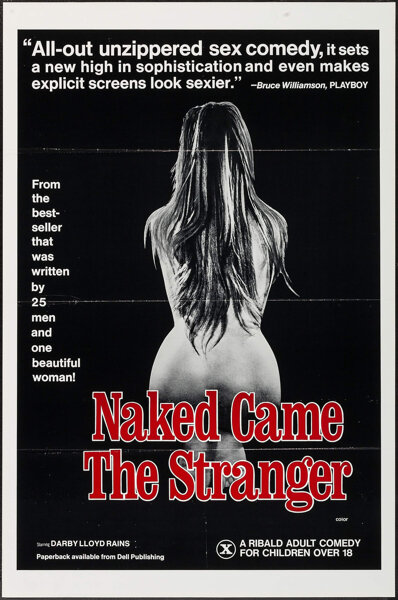
Naked Came the Stranger is based on a hoax.
Mike McGrady was convinced that books had become so dirty — just read Harold Robbins and Jacqueline Susann — that any book could be a best seller if it had sex in it. He recruited nineteen men and five women from Newsday including 1965 Pulitzer Prize winner Gene Goltz, 1970 Pulitzer Prize winner Robert W. Greene and journalist Marilyn Berge. The book, which he edited with Harvey Aronson to ensure that it was not well-written in the least, was written by Penelope Ashe, who would be played by McGrady’s sister-in-law Billie Young.
After selling 20,000 copies, McGrady went on The David Frost Show and told America that it was all a lie. It sold 70,000 more copies after that.
According to The Washington Post, “Mr. McGrady and the other writers had nothing to do with the hardcore film with the same title. They did, however, see the movie at a Times Square theater. During one vivid scene, Aronson told The Charlotte Observer, someone shouted “Author, author! Seventeen of us stood up.”
Working under his Henry Paris name for directing (his middle name and favorite city) and Jake Barnes (the narrator of Hemmingway’s The Sun Also Rises) for writing, Radley Metzger created this adult adaption of the book. Gilly (Darby Lloyd Rains) and Billy (Levi Richards) host a morning show. He’s always been able to sleep around in the marriage — she catches him with their assistant Phyllis (Mary Stuart) — but something has always held her back. This will be the day in which she unleashes herself, even if it keeps ending up in failure.
When she finally gets it together, she has a memorable moment with Marvin (Alan Marlow) in the second floor of a bus in a daring scene shot with no permits, obviously. She also gets Phyllis for herself and even has a classy silent movie black and white love scene with Teddy (Grant Taylor).
If the movie they’re watching in the beginning seems familiar, it’s British freakout Bizarre AKA Secrets of Sex.
EDITOR’S NOTE: Today’s movie is brought to you by AC Nicholas, who has graciously become a Big B&S’er, a monthly supporter of the site and got to pick an entire week of movies. Would you like to have me write about the movies of your choice? It’s simple!
Go to our Ko-Fi site and donate. There’s no set amount and I won’t tell you what to do. In fact, if you just keep reading for free, we can still be friends.
Join as a monthly member for just $1. That makes you a Little B&S’er.
As a Medium B&S’er at just $3 a month, if you pick a movie or a director, I’ll write about them for you. In fact, I’ll do one for each month you subscribe and even dedicate the post to you.
For $5 a month, you basically get some major power. As a Big B&S’er, I’ll write an entire week on any subject you’d like. How awesome would that be? In fact, I’ll do it for every month you’re a member. Do you think any of your other movie sites will do that for you?
Directed by Gérard Kikoïne and Radley Metzger and shot at the same time as Aphrodesia’s Diary, this finds Betty (Veronica Hart) suggesting that her friend Tiffany (Dominique Saint Claire using the name Arlene Manhattan) that she attend a taping of the talk show of Florence Nightingale (Vanessa Del Rio). Within the audience, people are encouraged to live out their fantasies.
Some of those people acting on them are a very young Ron Jeremy, Desiree Cousteau, Samantha Fox and Candida Royalle. When she gets home, Tiffany discovers that her husband (George Payne) has been cheating on her with Misty Regan.
Metzger had hoped that his film The Cat and the Canary would be a mainstream success which is why Kikoïne is the only director in the credits.
This was the first release of Mélusine, Vinegar Syndrome’s adult label.
Shot in 1979 but not released until 1983, this was directed by Gérard Kikoïne but had Radley Metzger as an advisor. It was filmed at the same time as Metzger’s 1979 movie The Tale of Tiffany Lust, which also had French actresses Dominique Saint Claire and Morgane in the cast and uses cinematographer Gérard Loubeau.
Adrianne (Dominique Saint Claire) finds herself working as a non-performer in adult movies and somehow gets a ticket to New York. There she meets a gambler who introduces her to sexual freedom, as if she were Emanuele, but not Black Emanuelle. Of course, with those risks comes danger, as always lurks in these golden age movies which were less about the act and more of the reasons before.
Vanessa Del Rio is in this as a therapist and Désirée Cousteau as Cassandra, an erotic spirit who guides our heroine through her adventures, which at the end take her back home to a committed relationship, which is an odd close for a Radley Metzger movie, but who am I to judge?
Gérard Kikoïne also made Dragonard and Master of Dragonard Hillfor Cannon, as well as Edge of Sanity and Buried Alive, the 1990 one with Donald Pleasence, John Carradine, Robert Vaughn and Ginger Lynn.




 B&S About Movies
You must be logged in to post a comment.