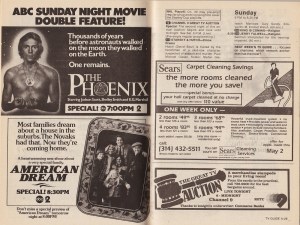
EDITOR’S NOTE: The Phoenix was on the CBS Late Movie on April 3, 1986 and March 2, 1987.
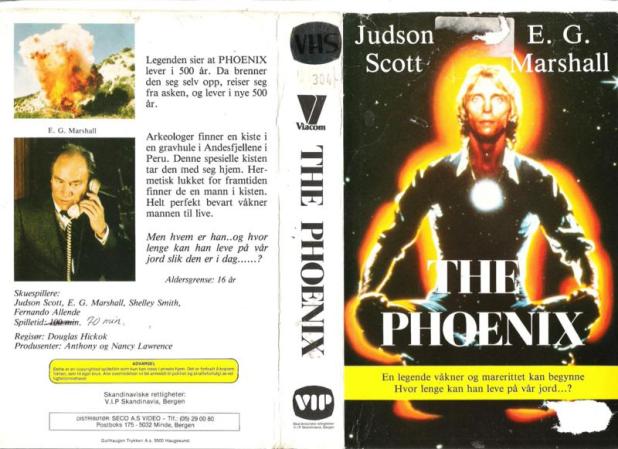
Long ago, in a remote corner of the world, ancient astronauts landed from a distant planet with a gift for mankind…the Phoenix. For a thousand years, he has waited…suspended in time. Now, he’s awakened to complete his mission. He searches for his partner, Mira. For only she knows his ultimate assignment on Earth. Dependent on the sun for his trek for survival, endowed with a superior intelligence, he has fully developed the powers of the human mind. Relentlessly pursued by those who seek to control him, he must stay free. The Phoenix.
In 1981, a young Sam (Becca was just a glimmer at this point) was obsessed was science fiction, ancient aliens and television. This TV movie — and the four episodes that followed — were repeatedly discussed in the Panico household as a show that seemed to have such promise and then suddenly just disappeared.
Judson Scott (Star Trek II: The Wrath of Khan) played Bennu, an ancient astronaut who is awakened from suspended animation within an Incan pyramid. He’s constantly on the run, as the government wants to either control or cut him up (they’re led by Richard Lynch from Bad Dreams).
In the movie, he acquires a love interest who is killed as a result of his escape. The whole movie is pretty dark, actually, setting Bennu up as someone above human emotion and morality who learns how important life on our planet is. His home planet is called Aurica in the movie, but Eidebran for the series.
He has plenty of powers, too. Physical levitation, telepathy, astral projection, precognition, clairvoyance and telekinesis, which are all helped by his Phoenix Amulet and its ability to draw use solar energy.
Beyond Richard Lynch’s Justin Preminger antagonist, Bennu must also contend with another alien named Yago. Just like our hero uses the sun, he uses our moon. It’s hinted that Lucifer and Dracula are both fictionalized versions of this villain, who can deafen with his Bells of Thon and has a musical instrument named the Black Moonball that allows him to teleport or change his appearance. Even more interesting to me, at least, is that his original name in the show was to be Aiwaz, the angel who read The Book of the Law to Crowley!
Bennu isn’t all alone, though. He’s helped by Dr. Ward Frazier (E.G. Marshall, Creepshow) and spends the series searching for his mate, Mira (Sheila Frazier, Super Fly).
The show was created by Anthony Lawrence, who wrote several Elvis movies and created the TV series The Sixth Sense that was often syndicated along with Night Gallery. And get this, a few of the episodes were directed by Douglas Hickox (Theater of Blood)!
There’s never been an actual release of this series, but you can find it on iOffer and other grey market sites.
EDITOR’S NOTE: The Apple was on the CBS Late Movie on January 10 and June 12, 1986. I can’t understand how this was on CBS but there you go.
The first time I saw The Apple, I was in the throes of losing my job and starting a new company and feeling lost. This is the movie that not only made me feel like I could go on, but inspired me to start writing more about films and why they mattered to me.
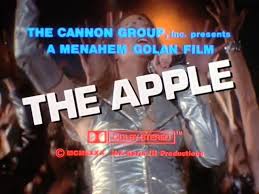
You know how everyone thinks Cannon put out some completely crazy movies? If you haven’t seen The Apple (also known as Star Rock), you haven’t seen their full power. Directed by Menahem Golan, this slice of sheer madness is a movie I use to test the resolve of anyone brave enough to watch movies with me.
The genesis of this film begins in 1975. Israeli rock producer Coby Recht was signed to Barclay Records and began to feel distrustful of show business. He worked it into a story with his wife Iris Yotvat and brought it to the attention of his longtime friend Menahem. After hearing the demos for the songs, the producer/director instructed Recht to go to Los Angeles immediately. They were making the movie.
Yotvat said, “That was marvelous. That was just fantastic to think that it was going to be a movie all of the sudden. It was just amazing.”
It wasn’t going to stay that way.
Recht and Yotvat lived in a villa that Menahem provided, writing six screenplay drafts in three weeks. As those drafts progressed, the story became more comical and less Orwellian. Soon, things were getting corny, out of touch and out of date. If you’ve seen any of the movies that Golan was involved in, you can see how that might be true.
After auditioning thousands of hopefuls, Recht settled on Catherine Marie Stewart for the lead role of Bibi. Who is a singer. Not a dancer, like Stewart. He figured she could learn, but the producers decided to have her voice dubbed.
Tensions only got worse once filming began, as what started as a $4 million dollar movie turned into $10 million and then more. Editor Alain Jakubowicz claimed that Golan shot around a million feet of footage, with six cameras of coverage for every dance number, ending up with a four-hour rough cut.
The movie got way bigger than its scriptwriters intended. Shooting in West Berlin lasted forever, with a five-day shoot for the opening number, the song “Speed” being filmed at the Metropol nightclub (which held the world record for biggest indoor laser show) and some scenes were actually shot inside a gas chamber that had killed people during World War II.
Nigel Lythgoe, who later was a big part of American Idol, choreographed the film, saying that some days were “really, really depressing” and others “very, very stressful.” The cast and crew hated the script, but here they were, making the film.
Menahem and Recht’s battles soon got worse. The writer felt he should be in London mixing the songs (the sessions had more than 200 artists involved), but Menahem demanded that he show up at the shoot. The first day he was there, he witnessed the uncut version “Paradise Day” which featured fifteen dinosaurs and a tiger that broke free and escaped. This scene also contained elephants getting their trunks stuck in the set, actors collapsing while wearing a too hot brontosaurus costume and a set that made it near impossible for people to dance on and cameras to move around. Removing this scene makes the Biblical end of the movie come out of nowhere. That’s right. None of this is in the film.
Catherine Marie Stewart has stated that none of this rattled Menahem. In fact, he was convinced that The Apple was going to be embraced: “Menahem was very passionate about what he was doing. He had very lofty ideas about the project. He thought this was going to break him into the American film industry. It had, you know, all the elements that he thought were necessary at that time. It was the early eighties and there were a lot of musicals. And Menahem thought that was his ticket into the American film industry.”
So what happened?
The plot is basically Adam and Eve meets Faust. Bibi (Stewart) and Alphie (George Gilmour) are contestants in the 1994 Worldvision Song Festival. They’re talented but easily defeated by the machinations of Mr. Boogalow (Vladek Sheybal, Kronsteen in From Russian With Love) and BIM (Boogalow International Music).
The evil leader soon signs the duo but they soon fall victim to the darkness of show business. Bibi is caught up in the drugs and sex and glamour, while Alphie is beaten by cops and nearly dies to save her. He also lives with a woman who is either his mother or lover or landlady and no one ever explains it to us.
Eventually, they escape and live as hippies, having a child. Mr. Boogalow finds them and claims that Bibi owes him $10 million dollars, but soon God, known here as Mr. Topps (Joss Ackland, The House That Dripped Blood, Bill & Ted’s Bogus Journey) takes them away in his Rolls Royce and the Rapture occurs.
There are numerous scenes where people put stickers, called BIM Marks, all over their faces. Everyone has camel toe. And the movie is nearly 100% disco.
The movie premiered at the 1980 Montreal World Film Festival. To say it did not go well is an understatement.
Attendees hated the film so much that they launched giveaway records of the soundtrack at the screen. Menahem was so devastated that he almost jumped off his hotel balcony before being saved by his business partner, Yoram Globus. A similar scene happened at its second premiere at the Paramount Theater in Hollywood.
The director said, “It’s impossible that I’m so wrong about it. I cannot be that wrong about the movie. They just don’t understand what I was trying to do.”
I get it, Menahem. You were just trying to get people to understand the power of love and music and being hippies a full decade after any of that mattered. You didn’t care if anyone else got it. You had a vision. And we’re not talking about any of those critics today. No, we’re talking about you. We’re talking about The Apple.
This is a movie that wears its heart messily all over its spandex crotch. The songs are ridiculous. The dancing is, at times, poor. The story makes no sense at all. You’re lucky to sit and witness it. I can’t even tell you how many times I’ve watched it!
BONUS! You can hear Becca and me talk all about The Apple on our podcast.
Herschell Gordon Lewis week (July 14 – 20) HG seemed to truly love packing theaters. He’s most famous for introducing gore to horror movies, but he’d fill any need that the audience had. He made every genre of exploitation __ – even kids movies! Gore movies would’ve happened eventually, but Herschell seemed to take joy in crafting gross-out shocks for unsuspecting cineasts. INTERESTING FACT! HG Lewis was a huge fan of Kentucky Fried Chicken and had them cater all of his productions. Col. Harland Sanders himself appeared in Lewis’ Blast Off Girls!
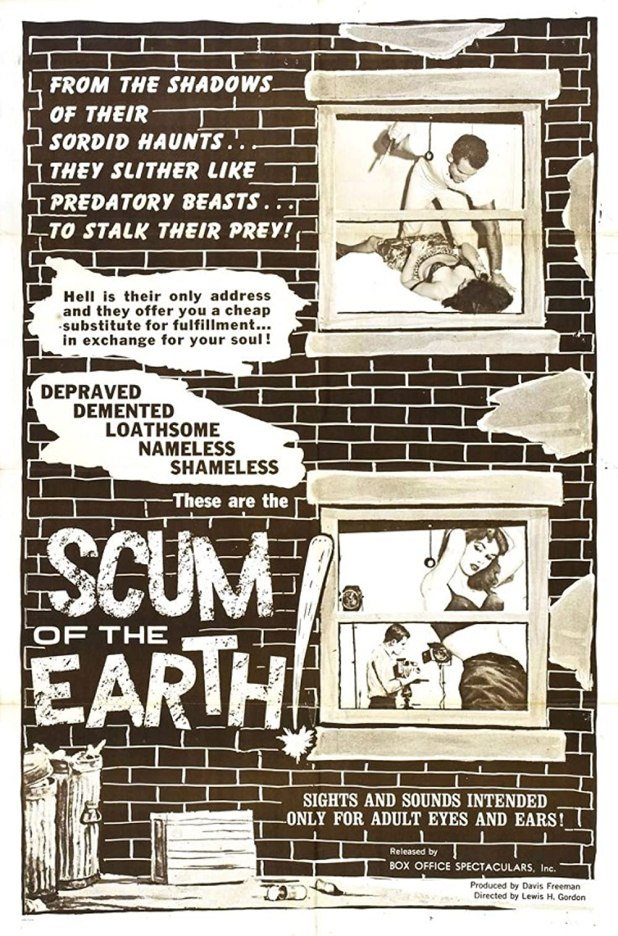
The first roughie and the work of Herschell Gordon Lewis and producer David F. Friedman, Scum of the Earth! tells the story of Kim Sherwood (Vickie Miles, AKA Allison Louise Downe, who was also in several other Lewis movies like She-Devils on Wheels), a college girl She-Devilshe wrong way and ends up trying to pay her tuition with glamour photos. But you know how the road to hell goes. It ends up going deeper and deeper, with Kim getting blackmailed into doing more and more explicit photos and dealing with sexualized violence, which is pretty insane for 1963.
Shot in six days and filmed in the same Miami locations that Blood Feast stained, it was made in black and white so that it would look filthy, like some kind of smoker film that would start turning on some old cigar smoking men before turning on them and shocking them with its willingness to make its sex violent. There’s also the matter of Sandy, another older girl, and her willingness to put the young Kim through all this so that she herself can escape.
Lewis — and Friedman — were the kings of talking you into the theater. They blessed this movie with some of the best taglines ever, like “Hell is their only address and they offer you a cheap substitute for fulfillment … in exchange for your soul!” and “Depraved. Demented. Loathsome. Nameless. Shameless. These are the Scum of the Earth!”
Lewis also knew how to write some dialogue, with stuff like “All you kids make me sick! You act like little Miss Muffet and down inside you’re dirty, do you hear me? Dirty! You’re greedy and self-centered and think you can get away with anything. You’re no better than the girl who sells herself to a man, you’re worse because you’re a hypocrite. And now little Miss Muffet is in trouble and she’s all outraged virtue. Well you listen and you listen well, you’re damaged merchandise and this is a fire sale.”
This was beyond hot stuff in the early 60s. Now you can stream it into your home. Times have changed.
Herschell Gordon Lewis week (July 14 – 20) HG seemed to truly love packing theaters. He’s most famous for introducing gore to horror movies, but he’d fill any need that the audience had. He made every genre of exploitation __ – even kids movies! Gore movies would’ve happened eventually, but Herschell seemed to take joy in crafting gross-out shocks for unsuspecting cineasts. INTERESTING FACT! HG Lewis was a huge fan of Kentucky Fried Chicken and had them cater all of his productions. Col. Harland Sanders himself appeared in Lewis’ Blast Off Girls!
Directed by Bill Rebane and an uncredited Herschell Gordon Lewis, Monster A Go-Go has astronaut Frank Douglas (Henry Hite) — or maybe an alien impersonating him — coming back to Earth and going wild, often being restrained by scientists, not that anyone sees it. Most of the movie seemingly must be inferred from dialogue or read by the narrator. Rebane gave up on this movie in 1961 and Lewis came back to finish it, as he needed something to show along with Moonshine Mountain. Characters disappear, never to return. There is nothing resembling normalcy.
The movie ends with this narration: “As if a switch had been turned, as if an eye had been blinked, as if some phantom force in the universe had made a move eons beyond our comprehension, suddenly, there was no trail! There was no giant, no monster, no thing called “Douglas” to be followed. There was nothing in the tunnel but the puzzled men of courage, who suddenly found themselves alone with shadows and darkness! With the telegram, one cloud lifts, and another descends. Astronaut Frank Douglas, rescued, alive, well, and of normal size, some 8,000 miles away in a lifeboat, with no memory of where he has been, or how he was separated from his capsule! Then who, or what, has landed here? Is it here yet? Or has the cosmic switch been pulled? Case in point: The line between science fiction and science fact is microscopically thin! You have witnessed the line being shaved even thinner! But is the menace with us? Or is the monster gone?”
Most horror movies end with the monster chased down and killed. This one ends with Lewis reading those words, probably because that was cheaper. You have to admire that.
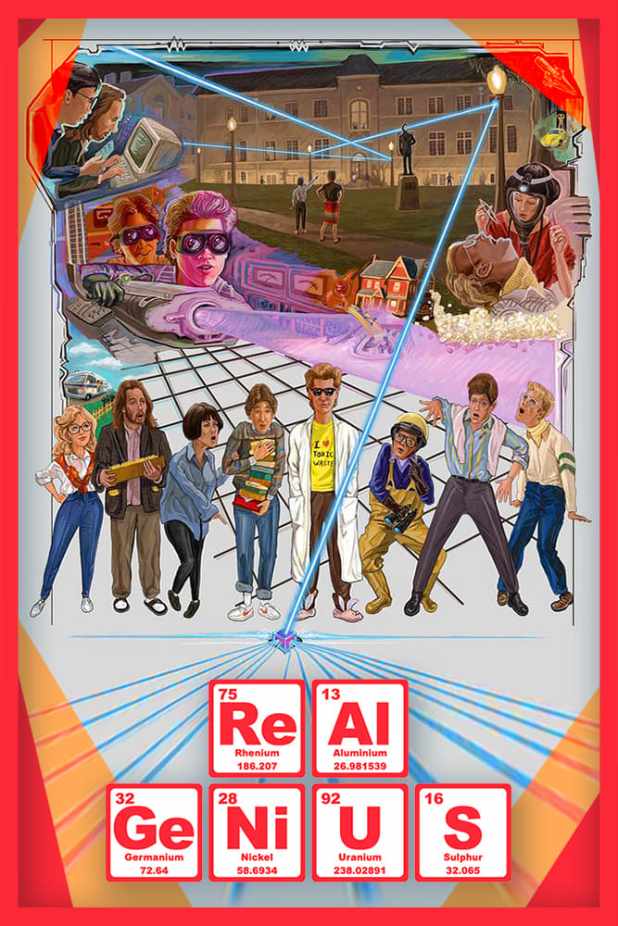
EDITOR’S NOTE: Real Genius was on the CBS Late Movie on March 2, 1990.
I was lucky enough to have some teachers that cared back in high school. One of them was the only teacher who gave me a D in my entire history and believe it or not, I should thank him for it.
By ninth grade, I didn’t care at all about school. I went through the motions, I knew that I wanted to be an artist or something creative, and I couldn’t wait to escape my small town. Every decision felt like something I was committed to and just did to fit in or fulfill some set role: marching band being a major one of these decisions. One of my few joys was the computer club, where Mr. Brown would allow students to learn how to program at night, watch movies that he selected or just hang out. It’s where I first heard a dubbed tape of Metallica’s song “Orion,” which put me on a path to the music I enjoyed. And it’s where I watched two movies that I can remember — My Science Project and this film.
Mitch Taylor is 15 and already in college. He’s been fast-tracked to Pacific Technical University where the best and brightest minds develop weapons — unbeknownst to them — for slimy Professor Jerry Hathaway (all-time all-star asshole William Atherton).
Chris Knight (Val Kilmer, never better) was once like Mitch but has now become burned out on academics and would rather party. Hathaway assigns Mitch to lead his laser research team because he has fresh ideas, but he’s also hoping that he’ll kick Chris in the butt and remind him how he used to be.
The bad kids of the college — such as it is, they’re all nerds in this movie — try to beat on MItch, but Chris rallies to his aid and explains why he is like he is. There was once a student named Lazlo who was devoted to his experiments until he learned they were all being used for weapons research. He went insane and now he lives inside the walls of the college. Chris didn’t want the same thing to happen to him, so he now enjoys life more than college.
Chris and Mitch get on the same page and they form a team to get things done. Lazlo even shows up to help. Mitch even gets a girlfriend, Jordan (Michelle Meyrink, who soon left acting to be a Zen Buddhist), who became pretty much every girl I looked for from that moment on. Then I learned the truth: there aren’t many genius geek girls that look and act like Michelle Meyrink.
Hijinks ensue — as they should — with the team taking down Hathaway, including taking his assistant Kent’s car apart and rebuilding it inside his dorm room, then placing a radio receiver inside his teeth so he thinks he can hear the voice of God, which ends up being Chris. Also: the prank at the end with the laser exploding Jiffy Pop inside Hathaway’s house is truly the prank of all movie pranks.
That’s what I love about this movie — the heroes may be put upon, but never emerge as mean spirited or hurtful in their revenge. They’ve been treated badly but there’s no reason to perpetuate the pain. They just want to have fun.
This movie is packed with talent. There’s Yuji Okumoto, a few years removed from his amazing heel work in The Karate Kid Part 2. Lazlo, the man in the walls who ends up entering tons of contests and becomes rich, is another cameo star turn by the always surprising Jonathan Gries. Warhol girl Patti D’Arbanville shows up (interestingly enough, she was the inspiration for two Cat Stevens songs, “Lady D’Arbanville” and “Wild World”). Severn Darden – Kolp from the last two Planet of the Apes films — plays a professor. Dean Devlin — who would go on to write Universal Soldier, Stargate and Independence Day) — acts in this. And the Valley Girl herself, Deborah Foreman, shows up.
By the way — Lazlo’s multiple Frito-Lay contest entries is more than just a funny scene in this movie. It’s based on reality. In 1974, Caltech students Steve Klein, Dave Novikoff and Barry Megdal did the same thing to win a McDonald’s contest. They sent in around 20% of the total entries and walked away with a station wagon, $3,000 in cash and $1,500 in food gift certificates.
I also love that Lazlo has left this quote inside his tunnels: “Against stupidity the gods themselves contend in vain,” a translation of a quote from the German poet Friedrich Schiller. Seriously, what a strange and well-rounded character, but that’s the genius of this movie (and Jon Gries).
Between Valley Girl, National Lampoon’s Joy of Sex and this movie, Martha Coolidge sure had a great teen movie run in the 80’s. She went on to make the critically acclaimed Rambling Rose and still works today in TV.
Back to that D. Mr. Brown — that same computer club teacher — was the one who gave it to me. I was taking a programming class and didn’t study and thought because he was so friendly to us he’d cut me a break. He didn’t.
At first I felt betrayed and angry. But as I realized that I had coasted and not lived up to my full potential — and spent 6 weeks grounded with no computer and had to apply myself — I realized that he was right.
From then on, I changed out my classes so that I would take classes that would prepare me to be an artist and writer. I dropped out of band and even went to school in the summer so that I could take more electives. That D changed my life. It’s funny because I was one person away from graduating with honors and part of me could be mad about it, because I had worked so hard. But I wasn’t in the National Honor Society or graduating with the smart kids because of that D. And that was fine — I refused to peak in high school. Better things were on the way. I learned that thanks to that class, that teacher and yes, this movie.
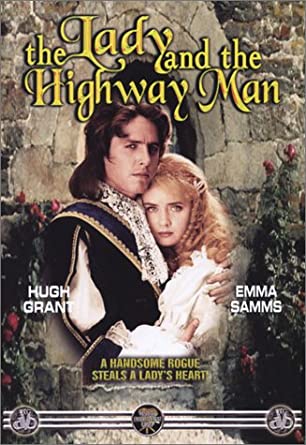
EDITOR’S NOTE: The Lady and the Highwayman was on the CBS Late Movie on April 27, 1990.
Barbara Cartland’s romance novel Cupid Rides Pillion was filmed as this British TV movie, one of the first appearances by Hugh Grant, who appears alongside a pretty solid cast that includes Oliver Reed (once a werewolf, once a diver out of a mansion window in Burnt Offerings), Claire Bloom (Clash of the Titans), Michael York (who I associate with this type of movie most often, as he was in The Three Musketeers), Emma Samms (Dynasty), Sir John Mills (Quatermass in the 1979 TV movie) and Liz Fraser (who was in many of the Carry On movies) among others.
Emma Samms’ character of Lady Castlemaine is based on the life of Barbara Palmer, First Duchess of Cleveland, one of King Charles II’s mistresses and the mother of several of his children, in case you’re into British scandals.
This is the story of Lord Lucius Vyne (Grant), who is loyal to King Charles II and helping help to return to rule after Cromwell. He takes on a secret identity as the Silver Blade, kind of like a musketeer of sorts. He’s too late to save Lady Panthea Vyne’s (Lysette Anthony, Krull) King Charles Spaniel from being stomped to death, so fair warning if you like small dogs.
Even when the king comes back, he has enemies, so the Silver Blade remains in his service, even when it nearly costs him and his lady love’s life.
You can watch this on Tubi and trust me, the print is just as horrible. I think with a British TV movie from the late 80’s, this is as good as we’re going to get.
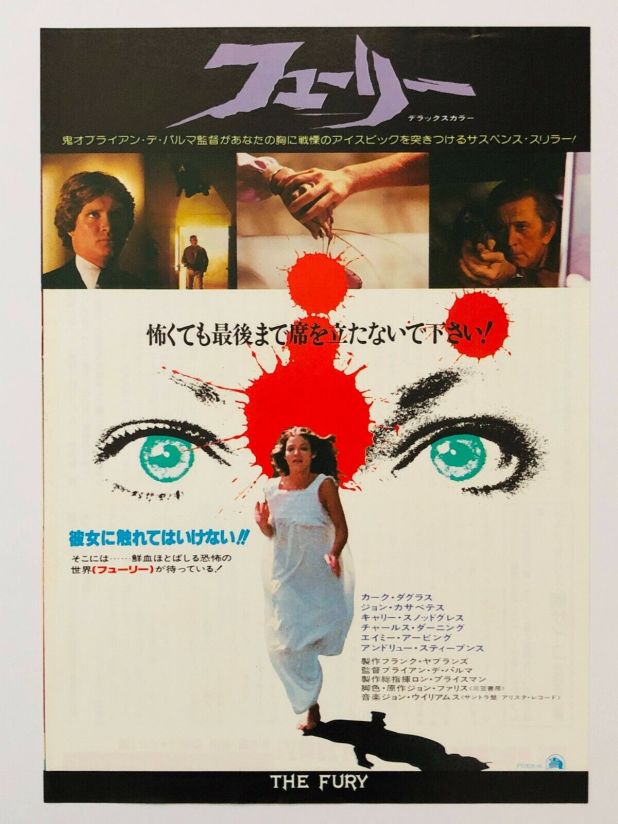
EDITOR’S NOTE: The Fury was on the CBS Late Movie on September 6, 1985.
Roger Ebert said of this movie, “I’m not quite sure it makes a lot of sense, but that’s the sort of criticism you only make after it’s over. During the movie, too much else is happening.”
Ex-CIA agent Peter Sandza (Kirk Douglas) and his psychic son Robin (Andrew Stevens) meet up with Ben Childress (John Cassavetes), one of Peter’s old spy friends. Peter is leaving the life behind, but Ben is prepared. He stages a terrorist attack that nearly kills his supposed friend and takes his son away.
Across the world, student Gillian Bellaver (Amy Irving) learns that she has powers of her own. She can barely control them, so she goes to the Paragon Institute, a front for the same organization that Childress is running, one that kills parents and takes their psychic teens away to make them into weapons for the U.S. government. Thanks to having a girlfriend (Carrie Snodgress) on the inside, Peter starts to track down his son.
Gillian grows in power and soon meets Robin psychically. Childress determines that she knows too much, so he plans to eliminate her, while Peter plans on following her to find his son. Working with Dr. Susan Charles (Fiona Lewis, between this and Strange Behavior not someone I would trust with my teenage child), they have successfully transformed Robin into a killing machine. That said, he can’t be controlled and his abilities have already caused one mass homicide at a theme park.
As Peter and Gillian break into Childress’ mansion, Robin goes full-on mental and thinks that PSU wants to replace him with Gillian. He kills his handlers and even tries to murder his father, who tries to keep him from falling. When he responds by scratching Peter’s face and causing his own death. Seeing his son dead, the old agent decides life isn’t worth living and he kills himself.
As he lies dying, he gives Gillian all of his power, power she soon uses to cause Childress to bleed from the eyes and then to literally blow up. It’s one of the wildest stunts ever and one that took two tries. De Palma told The Talks, “I had 8 or 9 high-speed cameras and he explodes. He explodes. And the first time we did it, it didn’t work. The body parts didn’t go towards the right cameras and this whole set was covered with blood. And it took us almost a week to get back to do take two.”
How was this achieved? In the same interview, the director said, “Nobody had ever done this before. I had these incredible high-speed cameras that the astronauts use and about three of them jammed because they were going so fast. They were all shooting super, super slow-motion – this is in the ’70s – and then it’s all over and you look around and the set is completely in shambles.”
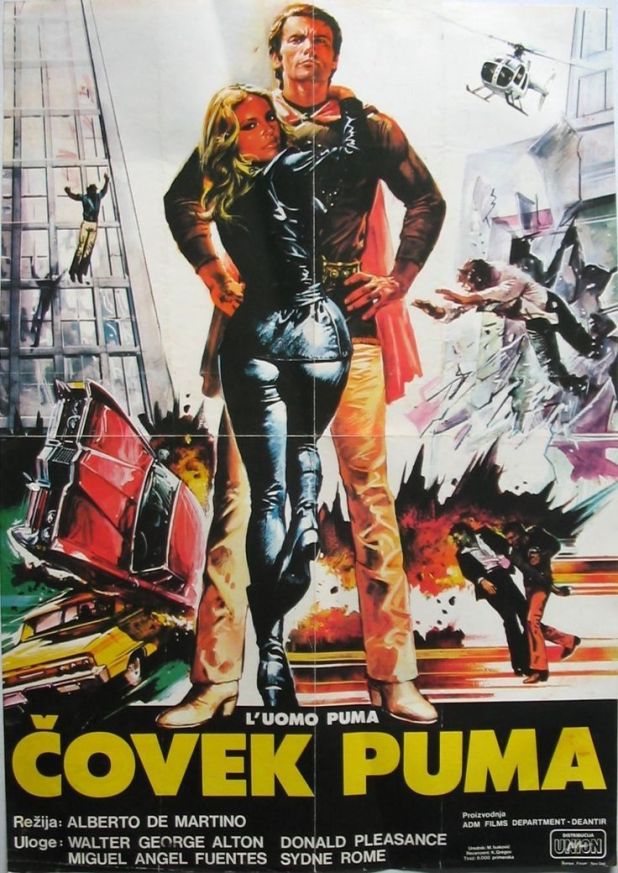
EDITOR’S NOTE: The Pumaman was on the CBS Late Movie on January 3 and July 9, 1985.
After Superman, the Italian film industry did what it always does best: figure out how to make their own versions of a film. However, the danger of making superhero movies is that. the special effects — particularly after Star Wars and Superman, which was sold on the idea of believing that a man can fly — had to be perfect.
Alberto De Martino knew that Italian trend quite well. When sword and sandal movies were big, he directed The Triumph of Hercules. He made Ringo and Django clones in the spaghetti western craze. And when James Bond got hot, he made several Special Agent 077 movies. Giallo? De Martino turned out the New Mexico-shot The Man with the Icy Eyes, the Telly Savalas-starring The Killer Is On the Phoneand the Dirty Harry meets Italian psychosexual horror in Canada romp Strange Shadows In an Empty Room. As The Exorcist and The Omen got hot, the director answered with The Antichrist and Holocaust 2000.
But superheroes? Superheroes nearly broke the man.
In Roberto Curti’s book Diabolika: Supercriminals, Superheroes and the Comic Book Universe in ItalianCinema, De Martino was quite candid about the failure of this movie. The Pumaman “was a production based on the trend of the moment. I had always done it that way and always done well. But regarding this genre of film, there was the audience’s diffidence toward Italian movies featuring special effects. They knew we were not up to the task, and didn’t take us seriously.”
He’d go on to say that it was “the only pic I did wrong in my whole career. When I saw it was a flop, I started asking myself questions. I had made a film I shouldn’t have. However it did well abroad and managed to get the guaranteed minimum back, otherwise I’d have had to sell my house. It did not even gross half a billion lire in Italy.”
Pumaman was played by Walter George Alton, his only film role before he became a medical malpractice attorney in New York City. He’s the ancestor of ancient aliens that gave birth to the Aztecs and entrusted a guardian armed with a golden mask. Ah — superheroes, Erich Von Daniken and Italian cinema? Bellisimo!
The mask is discovered by archaeologist — and the daughter of a Dutch ambassador — named Jane Dobson (Sydne Rome, who grew up near Cedar Point in Sandusky, Ohio before heading out to Italy to make movies like Man Called Amen and Sergio Martino’s Sex With a Smile). She learns that it can control minds, which pleases her boss Dr. Kobras (Donald Pleasence!) who takes over her brains instantly and then decides to start a Herrod-like campaign to kill Pumaman before the reincarnated hero becomes a threat.
Pumaman ends up being American paleontologist Tony Farms, who learns of his powers after the Native American named Vadinho throws him out a window and he survives the experience. How many people did Vandinho toss before he met the real Pumaman?
Of course, Tony and Jane are destined to fall in love and make the Pumababy, as foretold when the aliens visit Stonehenge and take the golden mask back. Of course.
You can watch this on Tubi with riffing from Mystery Science Theater 3000. You’re going to need it, because the man who never said no to a role, Donald Pleasence, stated that this was the worst movie he did in his entire career. Just imagine the depths of that statement.
Herschell Gordon Lewis week (July 14 – 20) HG seemed to truly love packing theaters. He’s most famous for introducing gore to horror movies, but he’d fill any need that the audience had. He made every genre of exploitation __ – even kids movies! Gore movies would’ve happened eventually, but Herschell seemed to take joy in crafting gross-out shocks for unsuspecting cineasts. INTERESTING FACT! HG Lewis was a huge fan of Kentucky Fried Chicken and had them cater all of his productions. Col. Harland Sanders himself appeared in Lewis’ Blast Off Girls!
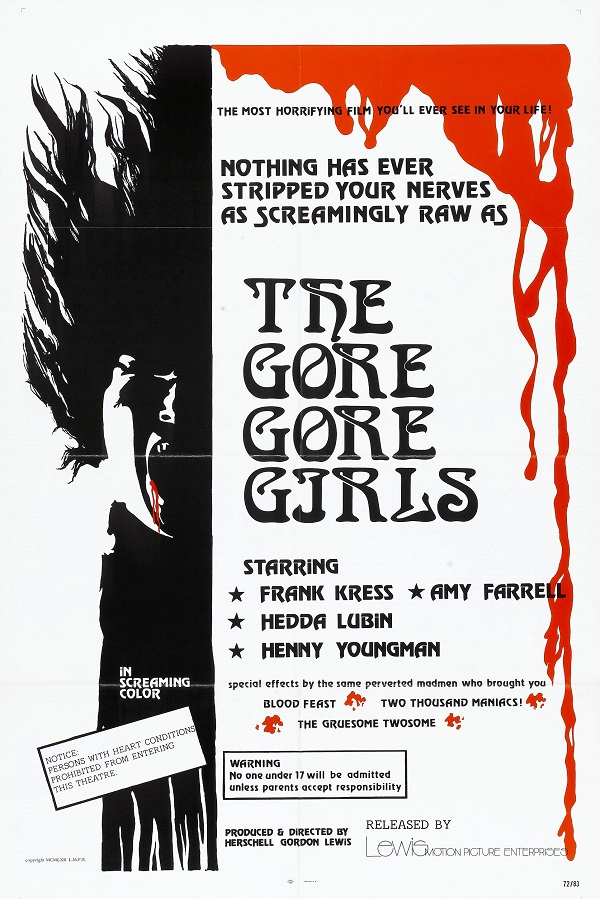
This was a parody of everything that had come before in the gory and sleazy Herschell Gordon Lewis and if anything, goes even further than all that had been done in the past.
Reporter Nancy Weston (Amy Farrell) has offered detective Abraham Gentry (Frank Kress) $50,000 if he can solve the murder of Suzie Cream Puff (Jackie Kroeger), as long as she gets the exclusive. Following him on his investigation, other food-themed dancers like Candy Cane and Pickles get killed with evidence that points to a man named Grout (Ray Sager), a Vietnam vet that misses smashing the heads of dead people during war and finds vegetables a poor substitute. Or maybe its the feminists who are protesting all the male gaze in the go go club. Oh yeah — Henny Youngman also shows up as Mr. Marzdone Mobilie, a man who owns plenty of jack shacks and strip clubs.
Gentry keeps Weston drunk most of the time or gets her onstage to dance in an amateur contest but he’s just really trying to lure the killer into his clutches. He’s a horrible person and in fact, nearly everyone in this movie is completely despicable, some kind of alternate world where everyone is absolute scum. I say this with beaming happiness.
The only movie that Lewis ever sent to the MPAA — it got an X, so no surprises there — this is the kind of movie where a woman’s breasts are cut over with scissors to drink chocolate milk out of them, but it can still have themes of PTSD from Vietnam in 1972, years before any other filmmakers were articulating this issue.
But at heart (and guts and brains), this is a movie where a woman’s butt is beaten with a tenderizing hammer and then seasoned with salt and pepper. Or a bubble gum chewing dancer dying as her bubble is filled with blood? Then somehow there’s a level-headed appearance by the feminist group in the movie that pretty much has them saying everything that Lewis probably knew he was guilty of. Literally exploitation and education at once, but lost on everyone who just loved a director who often had characters just play with entrails for long stretches while he zoomed in. And then he invented direct mail.
Herschell Gordon Lewis week (July 14 – 20) HG seemed to truly love packing theaters. He’s most famous for introducing gore to horror movies, but he’d fill any need that the audience had. He made every genre of exploitation __ – even kids movies! Gore movies would’ve happened eventually, but Herschell seemed to take joy in crafting gross-out shocks for unsuspecting cineasts. INTERESTING FACT! HG Lewis was a huge fan of Kentucky Fried Chicken and had them cater all of his productions. Col. Harland Sanders himself appeared in Lewis’ Blast Off Girls!
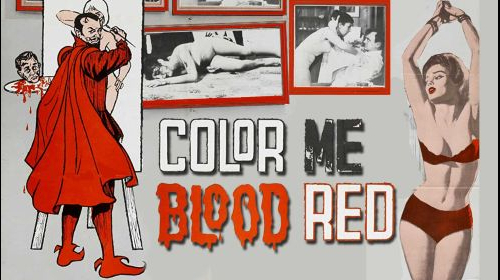
Part of Herschell Gordon Lewis’ so-called Blood Trilogy with Blood Feastand Two Thousand Maniacs!, this one concerns Adam Sorg, an artist who is seeking the perfect color red for his latest masterpiece. While conventional science would tell you that blood would turn brown when it dries, in this movie, it remains the same garish tone that an Italian giallo would feature.
Color Me Blood Red and A Bucket of Blood are essentially the same basic film, except that where Roger Corman keeps much of the violence off-screen, you’re here for a Lewis film to see blood and organs splash all over the screen. You’re not here for subtlety.
Gordon Oas-Heim is positively unhinged here as the lead. It’s kind of amazing that years later, he’d play Manford the butler on The New Monkees. He also shows up in Lewis’ Moonshine Mountain as the sheriff (he used the stage name Adam Sorg here!) and also is in Andy Warhol’s Bad.
This would be the last film from the duo of Lewis and David F. Friedman. There were plans to make a fourth in the series — Suburban Roulette* — but Friedman thought they’d done all they could when it came to gore. He’d move on to make roughies and nudie cuties like A Smell of Honey, a Swallow of Brine; 7 Into Snowy and The Acid Eaters, as well as Love Camp 7 and Ilsa She-Wolf of the SS using the name Herman Traeger.
You can watch this on Tubi or get the Arrow Video blu ray from Diabolik DVD. That has audio commentary by Lewis and Friedman, as well as Something Weird as a second bonus film. If you don’t have the gigantic Lewis box set, this is a great purchase.
*Lewis would end up making a movie with this title in 1968.

 B&S About Movies
You must be logged in to post a comment.