Teen Titans: The Judas Contract (2017)

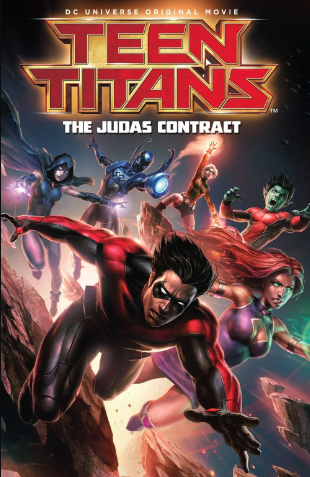
Directed by Sam Liu and written by Ernie Altbacker, this is based on The Judas Contract, a long-running storyline — Tales of the Teen Titans #42-44, and Teen Titans Annual #3  — by writer Marv Wolfman and artist George Pérez. It somehow tries to combine Young Justice with Teen Titans and hopefully the original comics as well.

Robin (Sean Maher), Speedy (Crispin Freeman), Kid Flash (Jason Spisak), Beast Boy (Brandon Soo Hoo) and Bumblebee (Masasa Moyo) were once youngsters, saving Starfire (Kari Wahlgren) from Tamaran soldiers as she escaped to Earth. This is the opening from Teen Titans #1 and soon, we move into the story of Brother Blood (Gregg Henry) and Mother Mayhem (Meg Foster), who have started a cult that takes the powers of heroes, using Deathstroke (Miguel Ferrer) to fight the Titans, who has a double agent named Terra (Christina Ricci) who becomes a member of the team and Beast Boy’s girlfriend, only to betray them.

This also has the newest Blue Beetle (Jake T. Austin), Raven (Taissa Farmiga) and the new Robin, Damian Wayne (Stuart Allea), as well as Kevin Smith showing up to interview Beast Boy. It’s one of the darkest stories of the Titans, one with love and loss, but it seems strange to get through it so quickly, as this story felt like years of my life in my teens.

You can watch this on Tubi.

The Wizard of Space and Time (1979, 1987)

Mike Jittlov was a math major at UCLA, but taking an animation course to satisfy his art requirement led to two movies, The Leap and Good Grief, which made it into the professional finals for Academy Award nomination.  With a 16mm camera and a multiplane animation system he built for $200, he became an animator.

By 1978, Jittlov was part of Disney’s Mickey’s 50, with his short film Mouse Mania. It was the first stop-motion Mickey Mouse cartoon, as Jittlov created more than a thousand Disney toys marching around a psychiatrist’s office. His short The Wizard of Speed and Time was shown on another Disney special, Major Effects.

When I was a kid in the early 80s, Jittlov’s ads in Starlog for The Wizard of Speed and Time were in every issue. This was before the internet, in a time and place where I wouldn’t be able to see them. Today, years later, I’m old and I can see them at any time.

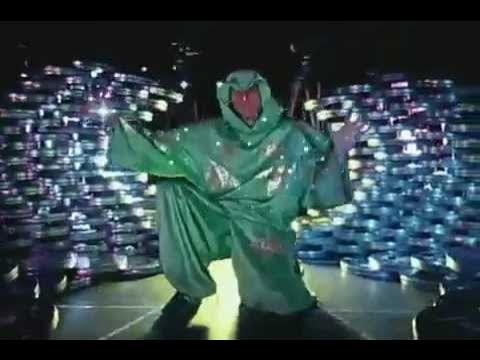
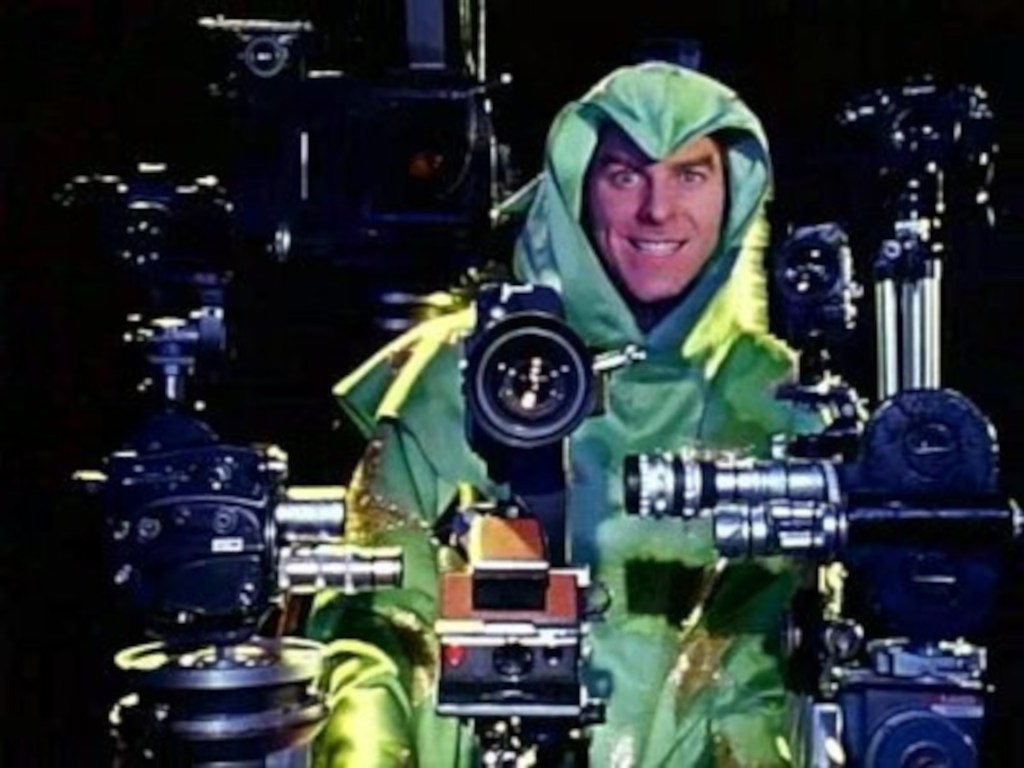
The Wizard of Speed and Time (1979): In just over two minutes, The Wizard of Speed and Time (Mike Jittlov) runs through Hollywood — running at high speed, The Wizard gives a hitchhiking woman (Toni Handcock) a ride, then gives golden stars to others — before crash landing into a studio that comes to life with walking cameras and dancing clapboards. This is pretty amazing because so much of it is stop motion and other sections use zooms and simple camera tricks to give the illusion of movement. Even though this is a short, just watching this you can tell that it took forever to make. This is pre-CGI, all magic and something that I have waited to see for decades.

This was $110 when I was a kid if I wanted to buy it. I kept trying to save up and never made it. Now I wish that I had.

The Wizard of Speed and Time (1988): Combining the original short, along with Time Tripper and Animato, two other early movies he made, Mike Jittlov took the story of The Wizard to new heights with this, a movie he spent fourteen years trying to make and three years filming.

Director Lucky Straeker (Steve Brodie) and  producer Harvey Bookman (Richard Kaye) make a bet if special effects artist Jittlov can actually complete his first effects assignment. Bookman does everything in his power to thwart Jittlov, even firing his friends. The script by Jittlov, Kaye and Deven Chierighino is filled with so many jokes, even including thousands of subliminal messages in the effects and poster.

It’s also overstuffed with cameos from Forrest J. Ackerman, Angelique Pettyjohn, Ward Kimball and Will Ryan, plus cops named Mickey (Philip Michael Thomas) and Minnie (Lynda Aldon), as well as their dog Pluto, who in some shops is just Jittlov covered by a brown jacket and using puppeting himself.

Why doesn’t Jittlov shake hands? He’s telepathic.

I waited too long to see this. Don’t make the same mistake that I did.

You can watch this on YouTube.

Tales from the Crypt S5 E13: Till Death Do We Part (1993)

Directed and written by W. Peter Iliff (Point BreakVarsity Blues), this episode stars John Stamos as Johnny Canaparo, a kept man in the employ of Ruth Rossi (Eileen Brennan), the widow of a powerful mob boss who killed her husband and took over his mob outfit. He never learns, as any woman he sleeps with gets killed, and now he’s couch dancing with Lucy Chadwick (Kate Vernon), a waitress at a club that Ruth owns.

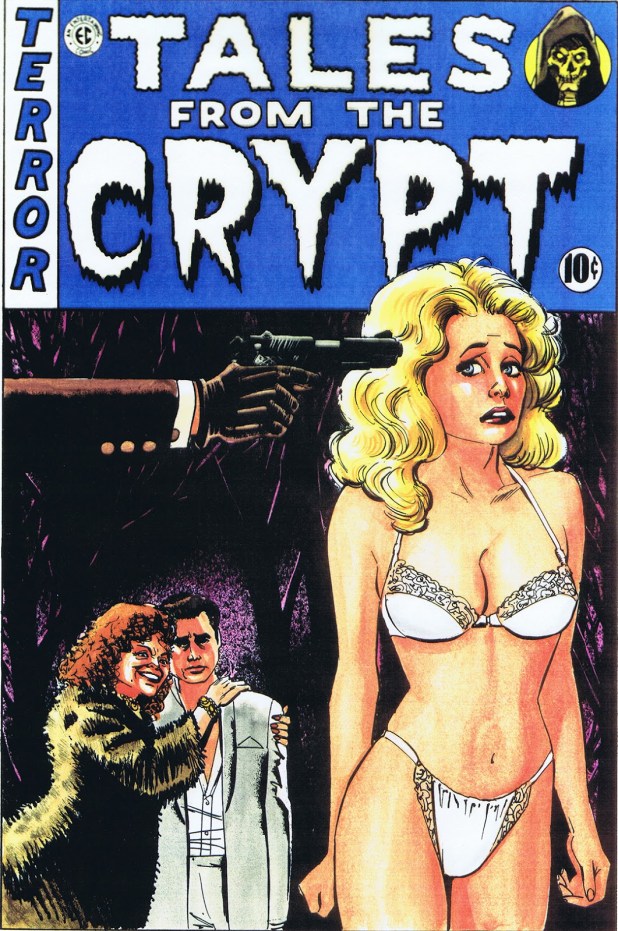
“Welcome back, spurts fans, to game seven of the World Scaries. It’s the Fright Sox versus the Boo Jays. I’m your announcer, Vin Skull-y. Can the Sox keep their winning shriek alive? That’s the big question today. Wait a minute! (glancing at his TV set with the binoculars) Looks like there’s going to be a pitching change. The Jays are bringing in their rot hander, and while they do that, we’ll take another look at the defense. We have Ooze on first, Guts on second, and tonight’s “Terror” tale on third. It concerns a young lady who’s pretty fond of die-amonds herself. And doesn’t mind a little squeeze play to get ’em. I call it: “Till Death Do We Part.””

As a baseball game plays on the radio, Johnny and Lucy get caught cleaning out the safe. This gives our loverboy a choice: either shoot new girl in the head or get killed by his old lady’s men. Maybe a dream sequence will help him figure it out.

This is based on the story of the same name in The Haunt of Fear #12.  Written by Al Feldstein and William Gaines — whose names show up on a tombstone in the Crypt Keeper’s opening — and drawn by Joe Orlando, it’s a totally different story with a criminal not realizing that he’s already a ghost.

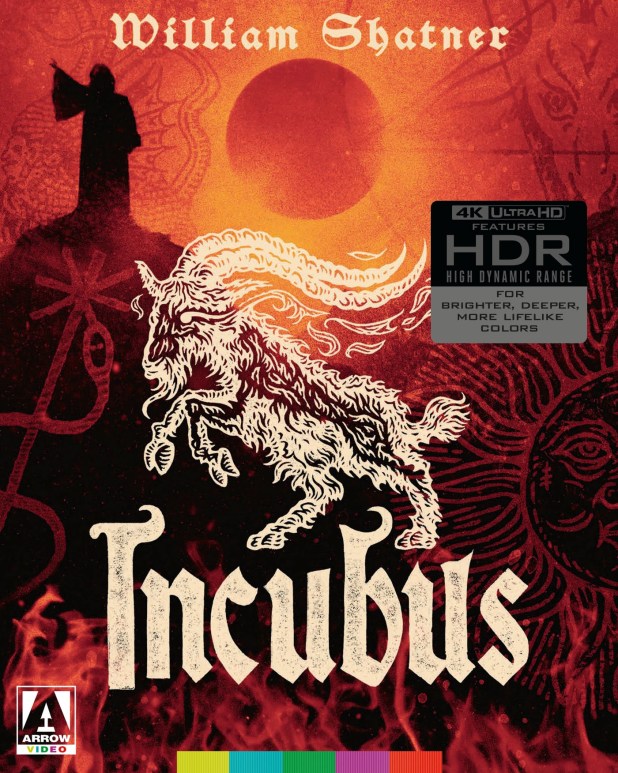
ARROW VIDEO 4K UHD AND BLU RAY RELEASE: Incubus (1966)

Created by ophthalmologist L. L. Zamenhof in 1887, Esperanto is supposed to be a universal second language for international communication. In English, the name means one who hopes and it’s the largest constructed international auxiliary language with a few thousand speakers.

Zamenhof had some big dreams that go past making an easy and flexible language. He thought that this new way of speaking would lead to world peace.

Incubus is the second film to be made in the language, following Angoroj. This was directed and written by The Outer Limits creator Leslie Stevens, who used the cancellation of that show to make an art house movie with that show’s cinematographer Conrad L. Hall and composer Dominic Frontiere.

This is the story of a spring in Nomen Tuum that heals the sick and makes ugly people ravishing and oh yes, there are many succubus and incubus there to lure humans to Hell.

Kia (Allyson Ames) wants a pure man to be her perfect target, but her sister Amael (Eloise Hardt) tries to tell her that if she falls in love, she will lose so much. Then she goes after Marc (Shatner), a soldier here to heal his wounds of battle. He’s with his sister Arndis (Ann Atmar) who is so dumb that she loses her sight by staring at the sun.

This gets wild, as Marc’s purity defiles the demons, who call upon an incubus (Milos Milos, whose life is insane; he was the bodyguard for Alain Delon and a friend of Stevan Marković, who died owning sexually explicit photos of Claude Pompidou, wife of French President Georges Pompidou, causing a big scandal and an unsolved crime; Milos went to America where he married Cynthia Bouron, who had a paternity case against Cary Grant, and was beaten to death and found in the trunk of her car outside a grocery store. As for Milos Milos, he was dating Barbara Ann Thomason, the wife of Mickey Rooney, at the same time he was married to Cynthia Bouron, and they died in a murder suicide that many believed that Rooney engineered) to kill Marc and defile and murder his sister.

This was thought to be a lost film, shown only at the San Francisco Film Festival — where Esperanto speakers laughed at how bad the actors spoke — and in France. Between the language and the scandal over Milo killing his girlfriend and himself, the movie was kind of dead. It was found in 2001 when it was reassembled from existing materials.

The Arrow Video release of this movie has it restored in 4K from the last known surviving 35mm print. Extras include commentary by writer and genre historian David J. Schow, author of The Outer Limits: The Official Companion, a second commentary by William Shatner and a third by producer Anthony Taylor, cinematographer Conrad L. Hall and camera operator William Fraker; an alternate 1.37:1 presentation of the film; Words and Worlds: Incubus and Esperanto in Cinema, a newly filmed interview with genre historian Stephen Bissette; Internacia Lingvo: A History of Esperanto, a newly filmed interview with Esther Schor, author of Bridge of Words: Esperanto and the Dream of a Universal Language; An Interview with the Makers of Incubus, an archive interview by Schow with Taylor, Hall and Fraker; a trailer; a reversible sleeve featuring newly commissioned artwork by Richard Wells and an illustrated collector’s booklet featuring new writing on the film by Frank Collins and Jason Kruppa.

You can get the 4K UHD and blu ray from MVD.

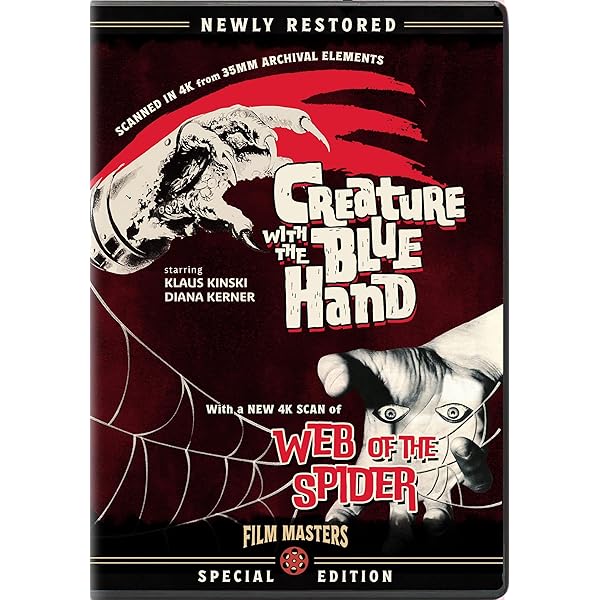
FILM MASTERS BLU RAY RELEASE: Creature With the Blue Hand (1967), Web of the Spider (1971), The Bloody Dead (1987)

Film Masters has put together an exciting blu ray with Creature of the Blue Hand, scanned in 4K from 35 mm archival elements, a new 4K scan of Web of the Spider and The Bloody Dead. Bonus features include commentaries on both movies by Stephen Jones and Kim Newman; reimagined trailers for Creature of the Blue Hand and Web of the Spider; a trailer for Castle of Blood; new documentaries on Edgar Wallace and Klaus Kinski’s acting in the Rialto krimi movies; an archival commentary for The Bloody Dead by Sam Sherman; raw and behind the scenes footage for The Bloody Dead and a booklet with essays by Christopher Stewardson and Nick Clarke.

You can get it from MVD.
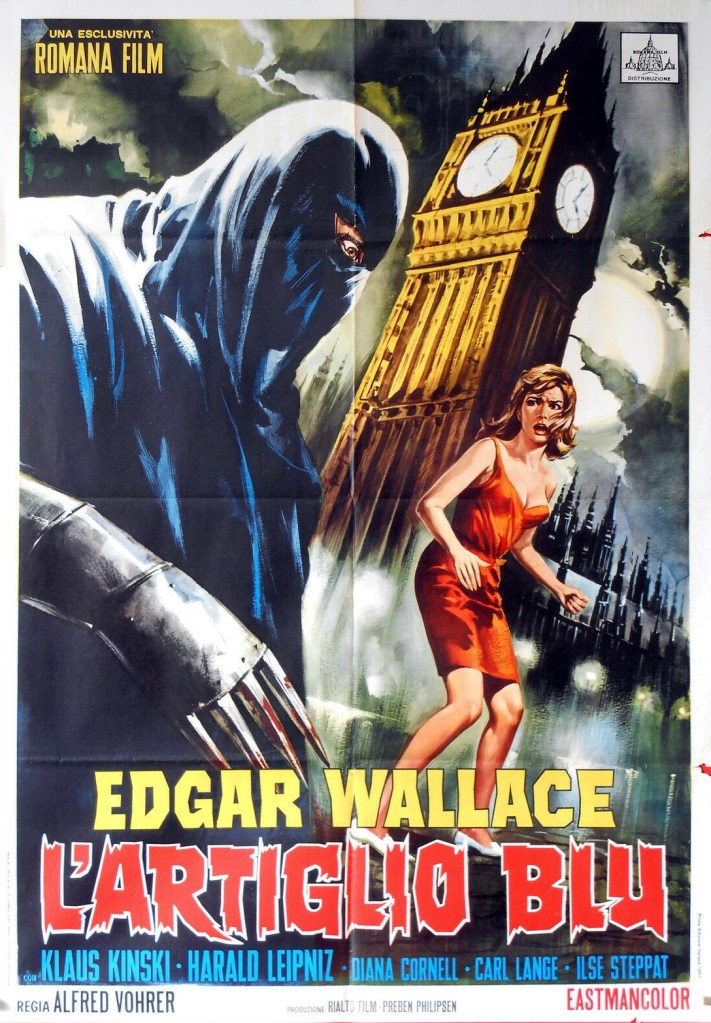
Creature With the Blue Hand (1967): Based on the Edgar Wallace novel The Blue Hand and part of a long-running series of krimi adaptations by Rialto Film, this was bought by New World Pictures and issued as a double feature in the U.S. with Beast of the Yellow Night. Man, how good was life then?

Klaus Kinski plays Dave Emerson, who chokes out a nurse and escapes from a mental hospital before running to the castle of his twin brother Richard — also Kinski — as a black robed killer roams the grounds and kills people with his astounding blue claw with razorblades on the fingers, like something out of a giallo. For example, oh, Death Walks at Midnight. Or A Nightmare On Elm Street, which came 17 years after this.

Director Alfred Vohrer keeps things moving and it all looks gorgeous if indebted to Mario Bava. That said, aren’t all movies made after him? There’s also an incredible insane asylum sequence, featuring rooms filled with mice, rats and one female patient who just strips all day and night. This is the kind of movie world where you just want to live inside it, except that, yeah, there’s a killer on the loose and the cops are as always ineffectual.

Coming out just three years before giallo would surpass the krimi while using many of the same ideas from Edgar Wallace, this film reminds me that I need to get deeper into watching these German detective movies.

Creature With the Blue Hand later re-edited in 1987 with new gore inserts by producer Sam Sherman for his company Independent International — wow, I love that so much — and released to home video as The Bloody Dead. The extra scenes — almost ten minutes of new footage — were directed by Warren F. Disbrow and his father Warren Disbrow Sr.  You can learn more about that movie below.

Web of the Spider (1971): After Castle of Blood‘s disappointing box office, Antonio Margheriti felt he could remake the film in color and have it be more successful.

Edgar Allan Poe (Klaus Kinski) is our narrator and Kinski shows up for the beginning and the ending of the movie. He’s interviewed by Alan Foster (Anthony Franciosa), who challenges him as to the truth of his stories. This leads to a bed with Lord Blackwood (Enrico Osterman) about spending a night in his castle, a place where he soon meets Elisabeth (Michèle Mercier, Black Sabbath) and quickly falls into love — and bed — with her before she announces that she’s no longer alive.

There’s also Julia (Karin Field), William Perkins (Silvano Tranquilli) and Elisabeth’s husband,Dr. Carmus (Peter Carsten). The ghosts need his blood to come back to life, but Elisabeth helps him to escape, only for him to impale himself on the gate, dying just as Poe gets there.

I adore that the tagline of this is “Based on Edgar Allan Poe’s Night of the Living Dead.” He did write a poem “Spirits of the Dead” and the 1932 movie The Living Dead was based on Poe’s “The Black Cat” and “The System of Doctor Tarr and Professor Fether” as well as Robert Louis Stevenson’s The Suicide Club. But no, he has nothing to do with Romero’s movie.

I really like the soundtrack by Riz Ortolani but this can’t compare to the black and white — and yes, Barbara Steele appearance — in the original. That said, Kinski is awesome in every second he’s on screen, looking like a complete madman.
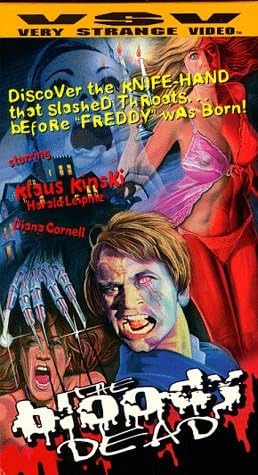
The Bloody Dead (1987): Warren F. Disbrow Jr. met Sam Sherman when he shot the interview footage for Drive-In Madness. That led to him being called to shoot new footage — 15 minutes worth — with Gene Reynolds and Tony Annunziata on remade asylum sets to make it appear that Creature With the Blue Hand wasn’t a movie made twenty years before as this was going to be released on VHS by Very Strange Video.

When this came out on DVD from Image Entertainment, Jim Arena wrote “”Sam needed to punch up the film with some gore to make the picture more appealing to modern-day audiences. That meant new scenes would have to be filmed. With a lucrative video distribution deal already on the table, Sam went to work and brought in associate Warren Disbrow to re-create the German asylum sets at his facilities in New Jersey. Hannibal Lector’s Silence of the Lambs institution cell recreation for 2002’s Red Dragon has been hailed for its precision, but Sherman and Disbrow’s attempt at duplicating Dr.Mangrove’s asylum, where most of the newly shot footage was intended to expand upon, is no less impressive. It is actually difficult to tell the difference between the two sets.”

Disbrow Sr. made a new version of the claw hand that the killer used and Ed French did the special effects. Other than the 15 minutes or so of new footage, this is almost the same exact movie, just with the added gore that late 80s audiences expected.
Deathstroke: Knights & Dragons (2020)

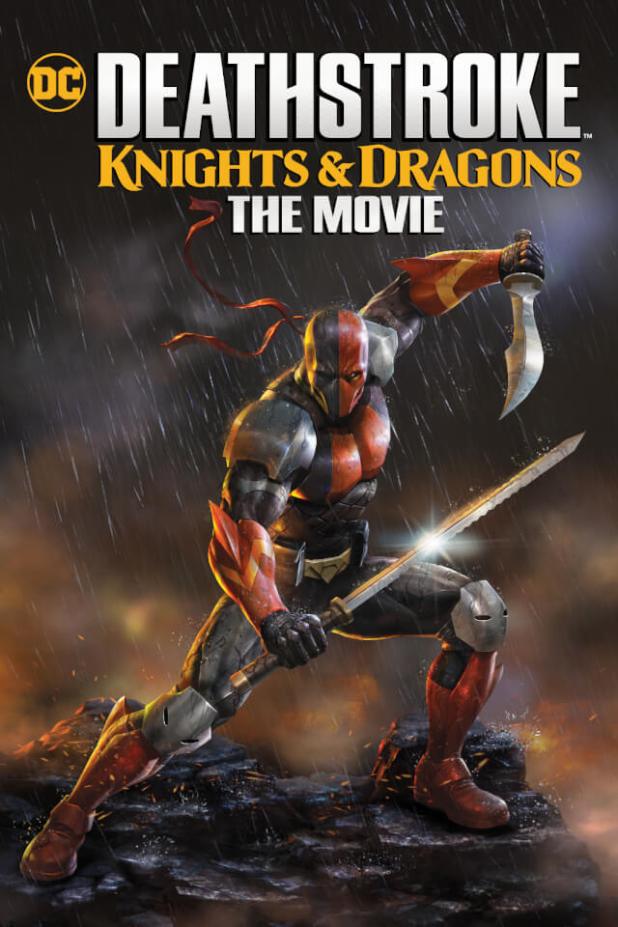
Deathstroke: Knights & Dragons started as an animated web series on CW Seed. Once the first episode aired, the series was repurposed into a direct-to-video animated film. Written by J.M. DeMatteis and directed by Sung Jin Ahn, it attempts to make a hero out of Slade Wilson, the villain known as Deathstroke.

Michael Chiklis is the voice of Wilson, a soldier who volunteers for an experimental drug that gives him super strength, enhanced agility and regeneration. He doesn’t tell his lover Adeline “Addie” Kane (Sasha Alexander) that he has become a costumed killer with the help of William Wintergreen (Colin Salmon). When one of his missions takes him to Cambodia, he falls in love with a woman named Lilith who has his child, Rose (Faye Mata) after he leaves. She soon dies in a hit and run accident and he never knows that he has a daughter, as he comes home to marry Addie and they have a son, Joe (Griffin Puatu).

However, in revenge for destroying most of H.I.V.E. (Hierarchy of International Vengeance and Extermination), their leader Jackal (Chris Jai Alex) kidnaps his son. Fighting through his troops, he takes the arm of Bronze Tiger (Delbert Hunt) — this is obviously tied into the New 52 version of these characters, who were friends that served in the Dead Bastards mercenary group together and Deathstroke having to save Bronze Tiger from Slade’s father Odysseus; Lady Shiva (Panta Mosleh), who is also in this story, is another character in this New 52 version of the characters — and saves Joe, but not without his son’s throat being cut, costing him his voice.

Now, ten years after losing his wife and son, Deathstroke must learn about his family and work with Addie to save them. Despite being shot numerous times and even blown to pieces, he keeps surviving. This is an R-rated cartoon, so know that before the kids watch, but they may find it strange that Wilson is treated as a good guy after all he’s done to the Teen Titans.

You can watch this on Tubi.

Spy Shadow (1967-1968)

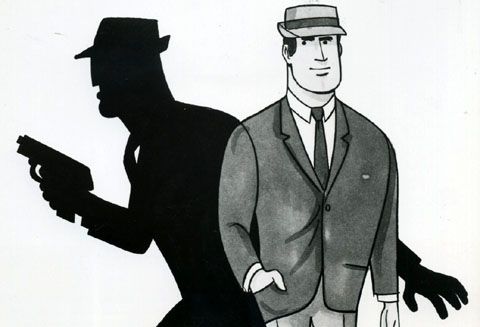
As part of the show Super President, which had two adventures per episode, one part of the show was where we learned of Spy Shadow, an agent of Interspy named Richard Vance (Ted Cassidy) who learned — somewhere in the mysterious Far East, just like Lamont Cranston, here said to be in Tibet with mystics who taught him the power of concentration — how to command his shadow to become another person. He’d need that power as he fought S.P.I.D.E.R. (Society for Plunder, International Disorder, Espionage and Racketeering) in Eurospy-style adventures.

Created by DePatie-Freleng Enterprises, formed by David H. DePatie and Friz Freleng, this is a footnote in TV superheroics, but may have been a bigger character had it not been placed with Super President, a show that people still seem to hate sixty years after it first aired.

I wonder if the makers of this show had been reading Doom Patrol, as Spy Shadow’s powers are a lot like Negative Man from that team. At least Spy Shadow doesn’t have to be wrapped up in bandages like Larry Trainor.

You can watch all of the episodes of this show on YouTube.

Batgirl (1967)

Detective Comics #359, the first issue of January 1967, featured “The Million Dollar Debut of Batgirl!” They were getting Batgirl into fan’s minds before she would debut on the show, even if there had already been another Batgirl, Bette Kane, who first showed up in Batman #139. Post-Crisis, her name would be changed to Flamebird.

The show was suffering from lower ratings, but producer William Dozier felt that if they introduced a younger female, it would do two things: introduce some new blood and refute any worries that Batman and Robin were gay.

ABC executives needed to be convinced that Yvonne Craig was the right person for the role, so this pilot — where she would fight Killer Moth (Tim Herbert), same as the first time she showed up in comics — was ordered. She also meets Batman (Adam West) and Robin (Burt Ward), setting up the next season of the show.

You can also spot future Peach Pit owner Joe E. Tata as one of the henchmen, as well as TV vet Guy Way and stuntman Al Wyatt Sr.

In an interview, Craig said, “…while Batgirl is an active type, she is also very feminine. None of that smacking people low with karate and kung-fu. In my opinion, three karate chops, and you’ve lost your femininity. If a girl goes on a date and a fellow gets fresh, she can’t very well give him a karate chop for a good-night. But if she ducks, she’s simply adept and feminine. Batgirl will be aiding and assisting Batman and Robin, not constantly rescuing then. I like that, too.” That’s because Batgirl wasn’t allowed to throw punches, as TV executives thought that the show Honey West got bad ratings because all of her brawling made her less feminine.

In spite of adding the sexier Batgirl, as well as Eartha Kitt taking over from Julie Newmar as Catwoman and female villains like Marsha, Queen of Diamonds (Carolyn Jones), Olga, Queen of Cossacks (Anne Baxter), Nora Clavicle (Barbara Rush), Minerva (Zsa Zsa Gabor) and Lorelei Circe (Joan Collins), the show fell out of favor, ending in the third season.

You can watch this on Daily Motion.