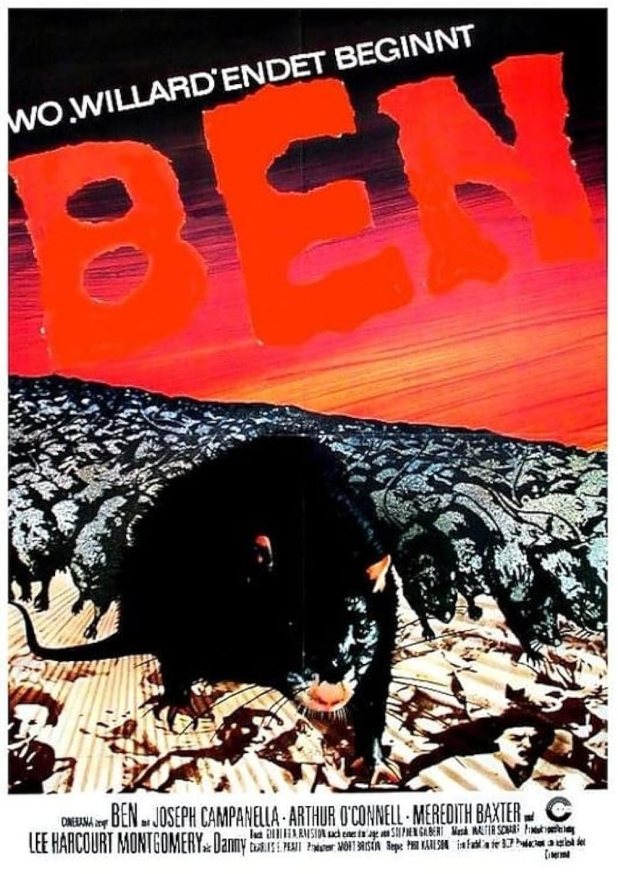
I knew the song “Ben” better than Ben the movie, but now, I know both.
Remember when Willard Stiles was killed by Ben and all the rats when he finally tried to kill them? Well, you get to see it again when this movie starts and we follow Ben until he meets Danny Garrison (Lee Harcourt Montgomery, Burnt Offerings), a lonely boy with a heart condition. They become best friends — until now, Danny only has his mother, Beth (Rosemary Murphy) and sister, Eve (Meredith Baxter) — and Danny does fun stuff like write songs for them, put on marionette shows for their amusement and create a train ride for them.
Rats are rats, however, and they go nuts, attacking food trucks, grocery stores, and people, all while they help Danny get over bullies, loneliness and probably dying soon.
Directed by Phil Karlson (The Wrecking Crew, Walking Tall) and written by Gilbert Ralston (the creator of The Wild, Wild West), this has an ending where you will care about a rat more than you thought was possible. Seriously, I got weepy. Over a rat. A rat that got to ride in a train, dammit, not I’m crying again.
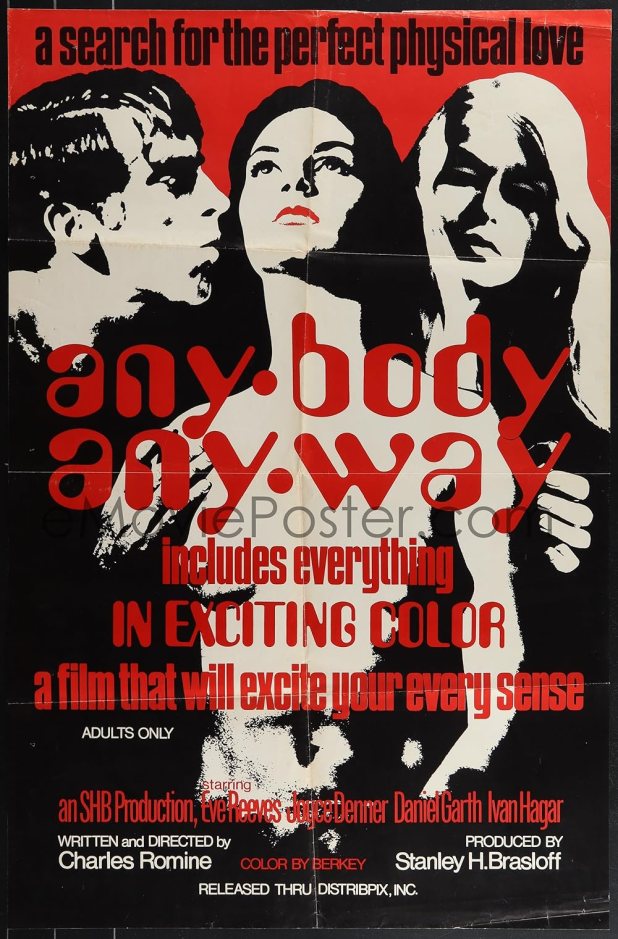
Also known as Any Body…Any Way, this movie was exactly what I wanted it to be: fucking weird.
When Terry Wilson (Joyce Danner) and Ann Henderson (Eve Reeves) go to the middle of nowhere for a barn party, Ann is nearly raped but saved by the middle-aged, British and oh-so-strange Mr. Bradley (Daniel Garth). They ditch the party and Ann’s man, but then run out of gas because otherwise we wouldn’t have a movie.
In the middle of nowhere, they walk up to a house — on the suggestion of a drifter (Ivan Agar, Laughing Crow from Shriek of the Mutilated) who is more than he seems — that just so happens to belong to Mr. Bradley and his sister Ida (Irene Lawrence). They have no phone and their car isn’t working either, so they stay for dinner and a bed for the evening. Ida needs the company. She’s been there for two years, ever since her mortician brother retired.
So why are there bars on the windows? Why did their door lock behind them? Why are the closest filled with women’s clothing of all sizes? Why would Terry pick this exact and terrifying time to finally get sapphic with her office buddy?
The Bradleys wake them up and let them know that they’re in control and must play their demented games with them or end up like all the embalmed bodies in the basement. Mr. Bradley just wants to discover the perfect way to make love, so if he has to tie up women and then kill them, that’s how his laboratory of libido operates.
I mean, this is a movie that starts with fifteen minutes of go go dancing in a barn — I played in a band that practiced in a barn and it’s hard to sing when all you can smell is shit, so I can’t even imagine go go dancing while smelling cow feces — and ends with that same barn and Ann going off with the guy who tried to rape her and Terry finding another young lady to enjoy a game of flats with. Yes, I used a 17th-century term — lesbian sex was thought to look like two playing cards rubbing together — in this article. I bring you quality euphemisms, my friend.
Did you not see Harry Novak’s signature hanging above this? Behind Locked Doors was directed and co-written by Charles Romine, who would go on to make Mysteries of the Gods. In contrast, producer and uncredited co-writer Stanley H. Brassloff made one of the most upsetting softcore movies, Toys Are Not for Children.
This movie looks way better than it should, with great lighting, bright colors, and a room full of gorgeous and dead women — or are they? — posed seductively, along with an off-the-rails room destroying catfight and an ending that blew my mind, as deceased denizens of the strange mansion come back for one last dance with brother and sister into the inferno. This is the kind of movie that makes you stay for all that barn dancing, and you wonder, “When does it get weird? Sam promised me it would get there,” and when it does, you’ll text me and say, “I can’t believe that this is a real movie.” Well, it is, pal. It sure is.
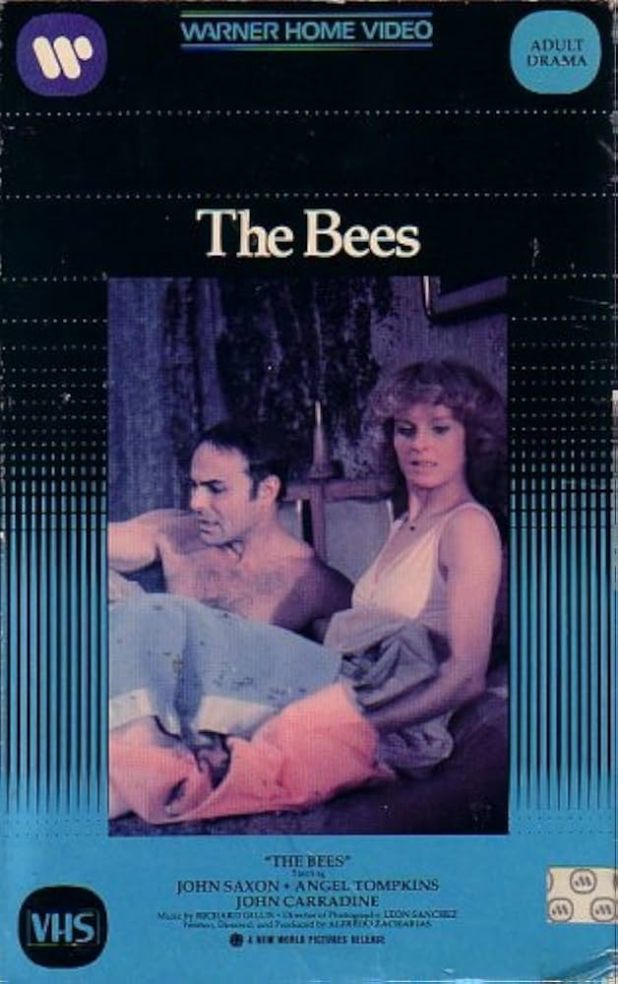
Alfredo Zacarías made Demonoid, and we should thank him for that. He also took advantage of the sheer terror that ensued when the Africanized honey bee was on its way to America. Initially used in Brazil to increase honey production, 26 swarms escaped quarantine in 1957 and spread throughout South America, incredibly defensive and angry bees that supposedly can chase a person for a mile. These bees have killed a thousand people, with many of their victims being stung over and over again. Just imagine six-year-old me watching this on the news every night as we were told repeatedly how close these bees were to us and how doomed we all were.
I also blame the exploitation film industry, which seized upon this and made so many killer bee movies, as they had all the news doing their advertising work for them. There was the 1974 TV movie Killer Bees, The Swarmand this movie, ads filled with just bee after bee, and I’d watch when I was outside, sure today was the day I’d be stung to death.
Jack Hill went uncredited on this as a writer, as he was supposed to direct it, but life didn’t work out that way. It’s the story of South American killer bees who haven’t just been smuggled into the country for experiments, but have also mutated into even smarter than your average bee and use that to kill humans.
It all happens when Dr. Miller (Claudio Brook) is trying to crossbreed the aggressive bees with a much calmer species to make more honey. A local tries to break in and steal the bees, which leads to his angry family and friends burning down Miller’s house, and the bees escaping. Meanwhile, Miller’s wife Sandra (Angel Tompkins) takes the queen to her uncle Dr. Sigmund Hummel (John Carradine, of course) and Dr. John Norman (John Saxon), who have the same goals as her husband, except there’s a honey spy ring trying to make more money off the bees and that means murder.
There’s a scene where Carradine falls to his doom, and I won’t lie—I watched it nine times, and with each rewatch, I loved this movie even more. Also, John Saxon speaks to stock footage of the UN.
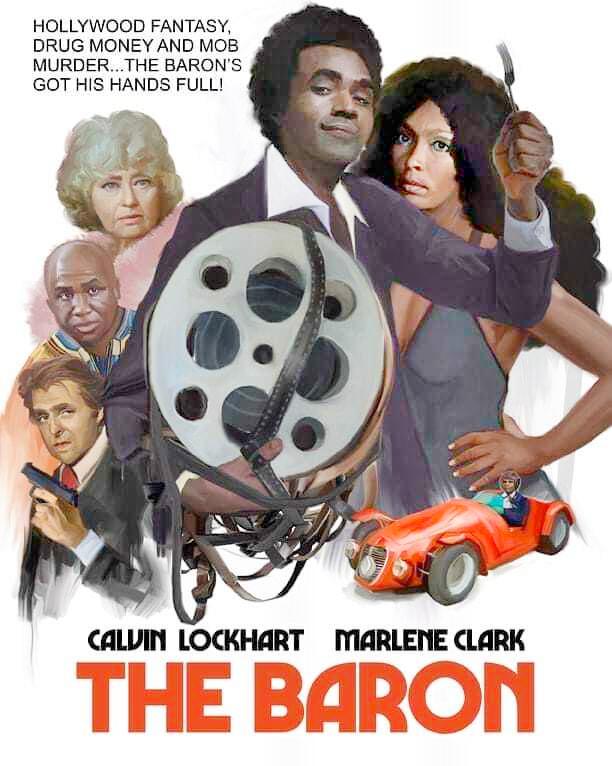
Jason (Calvin Lockhart) is trying to make his auteur — or vanity — project, a movie about Baron Wolfgang von Trips. But the studio wants to buy the project and replace him as director and actor. And then the connection to the studio dies, leaving Jason holding the. bill for the mob who was really paying for this. They send Joey (Richard Lynch) to collect the money as Jason gets hired by The Cokeman (Charles McGregor) to service Old Hollywood actress Joan Blondell, who is playing Mama Lou. As you can expect, his girl Caroline (Marlene Clark) can’t understand. Neither can I. That’s Ganja herself! What are you doing, Jason?
Somehow, in the middle of all this, Gil Scott-Heron did the music.
Also, Calvin Lockhart said, “There’s no stopping what can’t be stopped, no killing what can’t be killed,” in Predator 2.
Director Phillip Fenty also wrote Super Fly, and co-wrote this with his wife Linda and Nelson Lyon (the writer/director of The Telephone Book!?!). It’s something—a movie past the blacksploitation timeline but with elements of it, Lynch chewing the scenery, dropping sexist, racist and just plain evil dialogue on everyone.
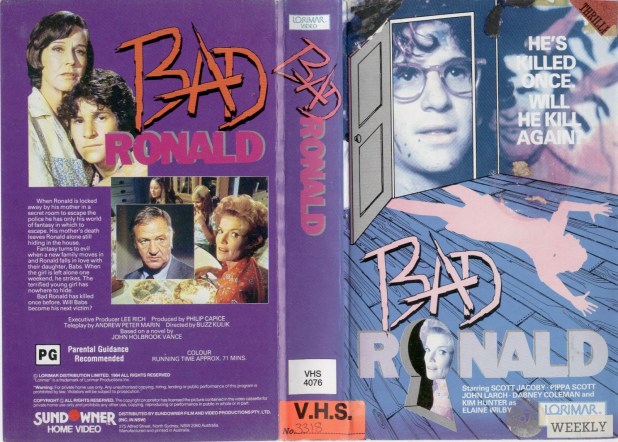
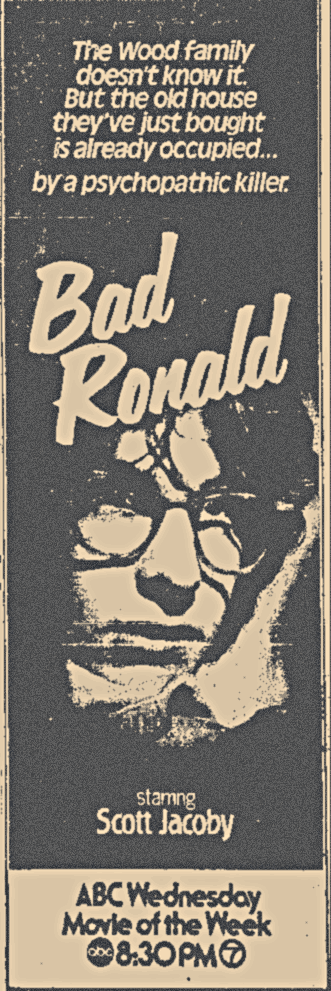
The beauty of made-for-TV movies is that they can be way, way weirder than anything you’ll ever see on the big screen. For a blast of pure insanity — as long as you can get your brain to agree with the major reality-bending events you’ll witness — you can’t go wrong with spending a little over an hour with Bad Ronald.
Originally airing on October 24, 1974, on the ABC Network, this film tells the sad tale of Ronald Wilby (Scott Jacoby, The Little Girl Who Lives Down the Lane), a kid who is a great artist and lives in a fantasy world. So far, he’s me at 15, all socially awkward and afraid of girls. Where he is not like me is that his dad left town and never came back, leaving him with an insanely overprotective mother (Kim Hunter, Zira from Planet of the Apes) who has some mystery disease and wants Ronald to go to med school and heal her. That seems like a lot of pressure. Maybe so much pressure that after getting the Heisman and being shut down by Laurie Matthews, the object of his affection, he shoves Laurie’s younger sister Carol. The little girl just keeps verbally abusing Ronald — trust me, I’ve had things twelve-year-old girls say hurt me to this day and gotten over every punch to my face — until he shoves her again, so hard that her head bounces off a concrete block. Boom. She’s dead.
Yep. In the 70s — and perhaps nowhere more so than in a 70s made-for-TV movie — life is cheap. So Ronald and his mom do what any normal person and normal mother would do — they bury the body, hide the evidence and even hide Ronald inside a concealed room. They hope everything will just blow over — even when the police come by with questions. Nosy neighbors be damned, her boy will be just fine, provided he stops drawing, does his studies, eats right and remembers his exercises.
It should work. Except she dies, leaving Ronald alone in the house with all his cans of food. Before you get to the next commercial, Ronald has totally escaped into a fantasy world of princes, princesses and demons. His house is sold to the Wood family — mom, dad (Dabney Coleman of Cloak and Dagger, 9 to 5, Tootsie and so much more) and three sisters — Babs, Althea and Ellen.
Ronald is running out of food and really needs human interaction. Babs becomes the princess of his dreams while her boyfriend, Duane Matthews, becomes his demon. Well, he’s already killed one of Duane’s sisters, and now he’s descended so far into pure mania that who can say what will happen next?
From Ronald murdering the old lady who keeps peeking into the house to his peepholes all over the place, this is a really disturbing slice of TV cinema. There’s a truly great scare when the girls finally see an eyeball inside of those holes. And it’s a nail-biter wondering if they can escape Ronald, who finally makes his play for his princess when the parents leave town.
This is quite the effective little chiller, directed by Buzz Kulik, who was also in the chair for the incredibly famous Brian’s Song. It was remade in 1992 as Méchant Garçon, starring a young Catherine Hiegel. But man — we’re huge Scott Jacoby fans and will stick with the original!
BONUS: You can listen to the podcast we did on Bad Ronald!
Armando Crispino really only did two horror films, 1972’s The Dead Are Alive and this 1975 giallo, which is a shame, as this is a pretty decent entry in the genre. Known in Italy as Macchie Solari (Sunspots), it does indeed feature sunspot footage from space before we see any major murders. And if you’re looking for a movie packed with autopsy footage, good news. It totally lives up to its title.
Simona Sana (Mimsy Farmer, who is also in Argento’s Four Flies on Grey Velvet and The Perfume of the Lady in Black; I am legally and ethically forced to remind you that she is a perfect angel somehow on Earth, a fragile flower of magic and splendor) is a pathology student who is trying to work on a theory about suicides, one that’s disputed by a young priest, Father Paul, whose sister — Simona’s dad’s latest fling — has recently killed herself. It turns out there’s been a whole series of self-killings which are being blamed on, you guessed it, sunspots.
I mean, what can you say about a movie that starts with several of said suicides, like sliced wrists, a self-induced car explosion and a man machine gunning his kids before turning the gun on himself? Obviously, this is a rather grisly affair, with real corpse photos spread — quite literally — throughout the film.
In between all of the gore, corpse penises, two bodies falling to their deaths and crime museums, there’s also Ray Lovelock (The Living Dead at Manchester Morgue) as Simona’s boyfriend, an out there Morricone score and a heroine who hallucinates that the dead are coming back to life.
The plot gets pretty convoluted, but if you’re on this site, you obviously appreciate films like this and will get past it. This is an Italian 70’s murder movie, though, so if you get easily upset about the way men behave, well, be forewarned.
Once, Ator was just a baby, born with the birthmark that prophesied that he’d grow up to destroy the Spider Cult, whose leader Dakar (a pro wrestler who appeared in Titanes en el Ring against Martín Karadagian) tries to kill before he even gets out of his chainmail diapers.
Luckily, Ator is saved and grows up big, strong and weirdly in love with his sister, Sunya. It turns out that, luckily, he’s adopted, so this is only morally and not biologically upsetting. His father allows them to be married, but the Spider Cult attacks the village and takes her, along with several other women.
Ator trains with Griba, the warrior who saved him as a child (he’s played by Edmund Purdom, the dean from Pieces!). What follows are pure shenanigans — Ator is kidnapped by Amazons, almost sleeps with a witch, undertakes a quest to find a shield and meets up with Roon (Sabrina Siani, Ocron from Fulci’s batshit barbarian opus Conquest), a sexy blonde thief who is in love with him.
Oh yeah! Laura Gemser, Black Emanuelle herself, shows up here too.
Ator succeeds in defeating Dakkar, only to learn that the only reason that Griba mentored him was to use him to destroy his enemy. That said, Ator defeats him too, leaving him to be eaten by the Lovecraftian-named Ancient One, a monstrous spider. But hey, Ator isn’t done yet. He kills that beast, too!
Finally, learning that Roon has died, Ator and Sunya go back to their village, ready to make their incestual union a reality. Or maybe not, as she doesn’t show up in the three sequels, The Blade Master, Iron Warrior and Quest for the Magic Sword.
Ator is played by Miles O’Keefe, who started his Hollywood career in the Bo Derek vehicle Tarzan the Ape Man, a movie that Richard Harris would nearly fist fight people over if they dared mention it. He’s in all but the last of these films, and while D’Amato praised his physique and attitude, he felt that his fighting and acting skills left something to be desired.
Ator the Fighting Eagle pretty much flies by. It does what it’s supposed to do — present magic, boobs, sorcery and swordfights — albeit in a PG-rated film.
The first time I saw The Apple, I was in the throes of losing my job, starting a new company and feeling lost. This movie not only made me feel like I could go on but also inspired me to start writing more about films and why they mattered to me.
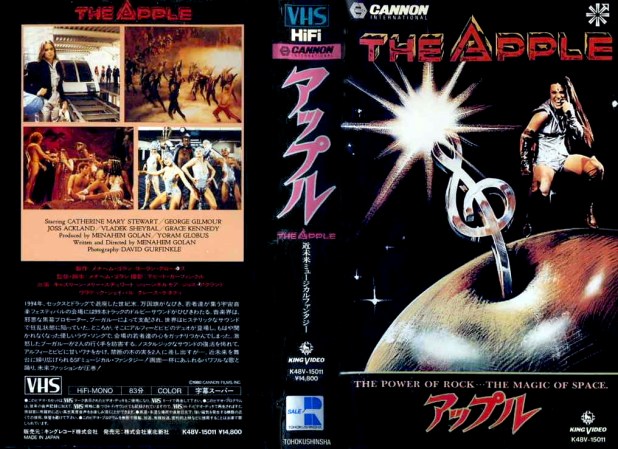
You know how everyone thinks Cannon put out some completely crazy movies? If you haven’t seen The Apple (also known as Star Rock), you haven’t seen their full power. Directed by Menahem Golan, this slice of sheer madness is a movie I use to test the resolve of anyone brave enough to watch movies with me.
The genesis of this film begins in 1975. Israeli rock producer Coby Recht was signed to Barclay Records and began to feel distrustful of show business. He worked this into a story with his wife, Iris Yotvat, and brought it to the attention of his longtime friend Menahem. After hearing the demos for the song, the producer/director instructed Recht to go to Los Angeles immediately. They were making the movie.
Yotvat said, “That was marvelous. That was just fantastic to think that it was going to be a movie all of a sudden. It was just amazing.”
It wasn’t going to stay that way.
Recht and Yotvat lived in a villa that Menahem provided, writing six screenplay drafts in three weeks. As those drafts progressed, the story became more comical and less Orwellian. Soon, things were getting corny, out of touch and out of date. If you’ve seen any of the movies that Golan was involved in, you can see how that might be true.
After auditioning thousands of hopefuls, Recht settled on Catherine Marie Stoutdatedhe lead role of Bibi. Who is a singer. Not a dancer, like Stewart. He figured she could learn, but the producers decided to have her voice dubbed.
Tensions only got worse once filming began, as what started as a $4 million movie turned into $10 million and then more. Editor Alain Jakubowicz claimed that Golan shot around a million feet of footage, with six cameras covering every dance number, up to a four-hour rough cut.
The movie got way bigger than its scriptwriters intended. Shooting in West Berlin lasted forever, with a five-day covering opening number, the song “Speed” being filmed at the Metropol nightclub (which held the world record for the biggest indoor laser show), and some scenes were actually shot inside a gas chamber that had killed people during World War II.
Nigel Lythgoe, who later was a big part of American Idol, choreographed the film, saying that some days were “really, really depressing” and others “very, very stressful.” The cast and crew hated the script, but here they were, making the film.
Menahem and Recht’s battles soon got worse. The writer felt he should be in London mixing the songs (the sessions had more than 200 artists involved), but Menahem demanded that he show up at the shoot. The first day he was there, he witnessed the uncut version “Paradise Day” which featured fifteen dinosaurs and a tiger that broke free and escaped. This scene also contained elephants getting their trunks stuck in the set, actors collapsing while wearing a t,oo hot brontosaurus costume and a set that made it near impossible for people to dance on and cameras to move around. Removing this scene makes the Biblical end of the movie come out of nowhere. That’s right. None of this is in the film.
nearlyerine Marie Stewart has stated that nonfor e of this rattled Menahem. In fact, he was convinced that The Apple was going to be embraced: “Menahem was very passionate about what he was doing. He had very lofty ideas about the project. He thought this was going to break him into the American film industry. It had, you know, all the elements that he thought were necessary at that time. It was the early eighties and there were a lot of musicals. And Menahe,m thought that was his ticket into the American film industry.”
So what happened?
The plot is basically Adam and Eve meets Faust. Bibi (Stewart) and Alphie (Georgmeetmour) are contestants in the 1994 Worldvision Song Festival. They’re talented but easily defeated by the machinations of Mr. Boogalow (Vladek Sheybal, Kronsteen in From Russian With Love) and BIM (Boogalow International Music).
The evil leader soon signs the duo but they soon fall victim to the darkness of show business. Bibi is caught up in the drugs and sex and glamour, while Alphie is beaten by cops and nearly dies to save her. He also lives with a woman who is either his mother, lover, or landlady, and no one ever explains to us.
Eventually, they escape and live as hippies, having a child. Mr. Boogalow finds them and claims that Bibi owes him $10 million, but soon God, known here as Mr. Topps (Joss Ackland, The House That Dripped Blood, Bill & Ted’s Bogus Journey), takes them away in his Rolls-Royce and the Rapture occurs.
There are numerous scenes where people put stickers, called BIM Marks, all over their faces. Everyone has camel toe. And the movie is nearly 100% disco.
The movie premiered at the 1980 Montreal World Film Festival. To say it did not go well is an understatement.
Attendees hated the film so much that they launched giveaway records of the soundtrack at the screen. Menahem was so devastated that he almost jumped off his hotel balcony before being saved by his business partner, Yoram Globus. A similar scene happened at the film’s second premiere at the Paramount Theater in Hollywood.
The director said, “It’s impossible that I’m so wrong about it. I cannot be that wrong about the movie. They just don’t understand what I was trying to do.”
I get it, Menahem. You were just trying to get people to understand the power of love and music and being hippies a full decade after any of that mattered. You didn’t care if anyone else got it. You had a vision. And we’re not talking about any of those critics today. No, we’re talking about you. We’re talking about The Apple.
This is a movie that wears its heart messily all over its spandex crotch. The songs are ridiculous. The dancing is, at times, poor. The story makes no sense at all. You’re lucky to sit and witness it. I can’t even tell you how many times I’ve watched it!
BONUS! You can hear Becca and me talk all about The Apple on our podcast.
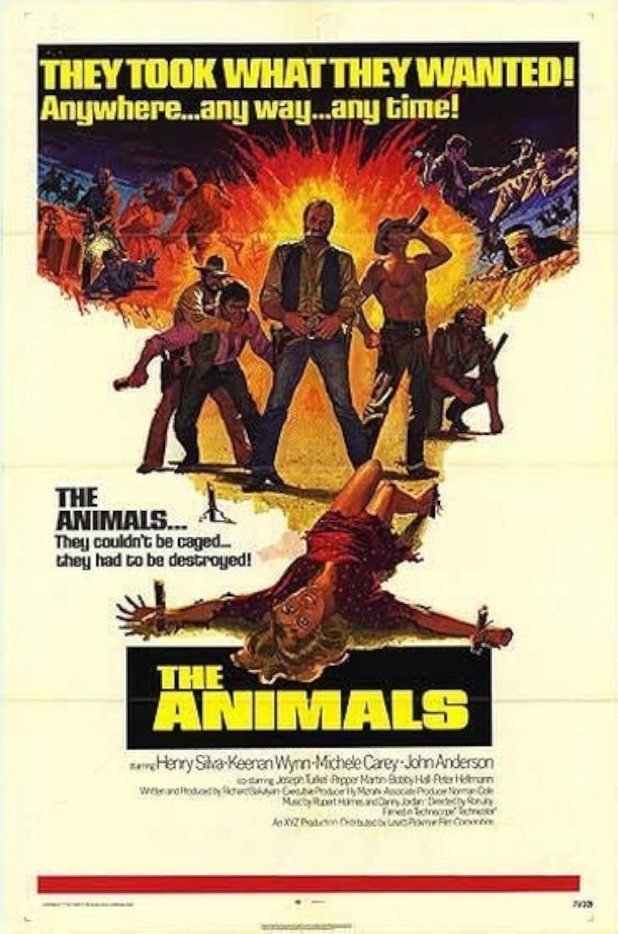
Also known as Five Savage Men, this starts with everyone on a stagecoach being killed, other than schoolteacher Alice McAndrew (Michele Carey, The Choirboys), who is assaulted and left for dead by Pudge Elliot (Keenan Wynn) and his henchmen, who include Peyote (Joe Turkel, not tending bar for Jack Nicholson) and Jamie (Pepper Martin). I mean, they crucify her to the ground in the desert before they do it and I get it, it’s a revengeomatic, but in the ways of Michael Winner — this was directed by Ron Joy and written by Richard Bakalyan — that assault goes on so long that we begin to feel complicit in it.
After they depart, Native American Chatto (Henry Silva, who was Sicilian and Spanish) rescues her — why didn’t he jump in sooner? — and not only brings her back to health, he also teaches her how to kill and becomes her lover, which seems kind of odd, but what do I know?
The law, led by Sheriff Allan Pierce (John Anderson), thinks Chatto is behind all of this. You can see where that is going. What you won’t expect is an acid rock soundtrack by Rupert Holmes, who had two hit songs about cheating, “Escape (The Piña Colada Song)” and “Him.” I never knew that he created the AMC series Remember WENN.
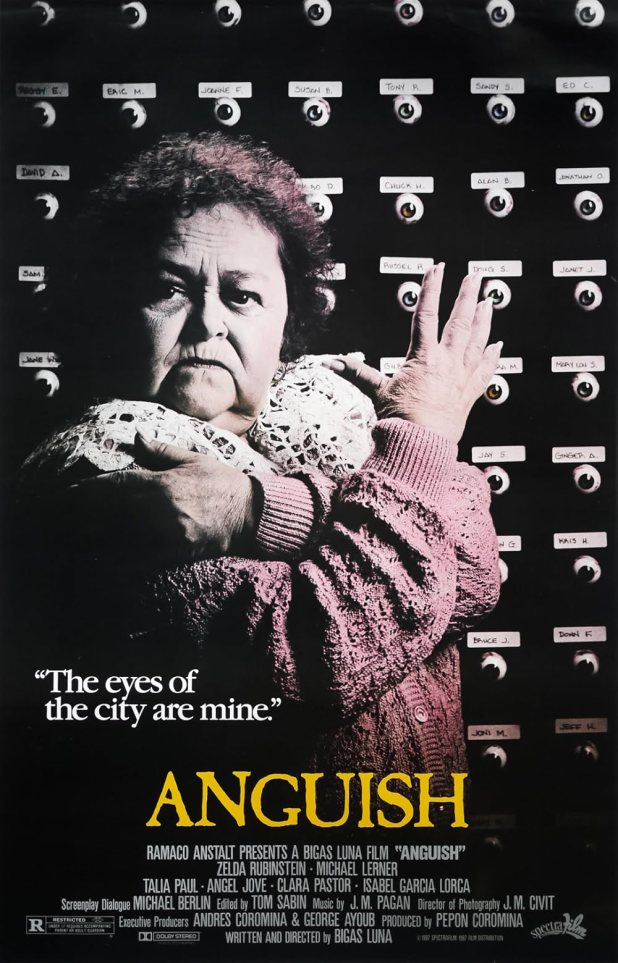
John Pressman (Michael Lerner) is a barely controlled diabetic who works for an eye doctor but is also going blind. And his mother, Alice (Zelda Rubinstein), is controlling him, making him kill people for their eyes. One night, he decides to escape from his mother and hide in a theater that’s showing The Lost World, killing people one by one until the cops arrive with his mother as a hostage negotiation tactic. Except she gets shot and he gets arrested. Cue the credits.
Maybe not.
Because The Mother is the movie playing at The Rex, it’s disturbing everyone who views it. There’s even one man who keeps coming back and has decided to kill people in perfect union with the movie. Even as the police arrive in The Mother, they are showing up in Anguish, but the movie never ends. Even with the death of the killing machine, John Pressman shows up in one of the survivor’s minds and he wants her eyes.
Maybe not.
Because this is another movie in a movie.
Bigas Luna seems like he’s directing a slasher, pulling every rug out from under you, and dropping the floor and the earth under you. Originally, Bette Davis was asked to be The Mother in this and wow, except that Rubinstein is beyond exceptional. Also, it starts with this disclaimer: “During the film you are about to see, you will be subject to subliminal messages and mild hypnosis. This will cause you no physical harm or lasting effect, but if for any reason you lose control or feel that your mind is leaving your body — leave the auditorium immediately.””


 B&S About Movies
You must be logged in to post a comment.