WEIRD WEDNESDAY: Black Devil Doll from Hell (1984)

Chester Novell Turner made this movie and Tales from the QuadeaD Zone.

It is enough.

He had been writing horror stories, doing home remodeling and attending a filmmaking correspondence course. Home video cameras had democratized movie making, and you can make fun of Turner’s films, but what have you done?

Well, people thought Turner died until 2013, when Massacre Video tracked him down and got permission to release his films.

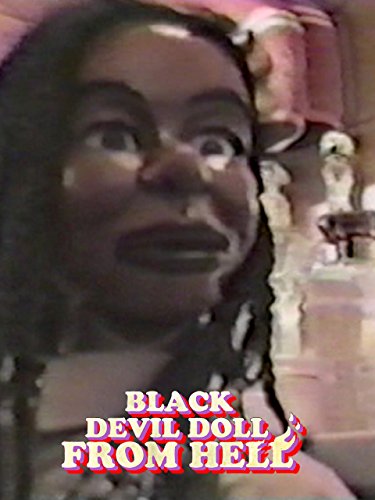
With his girlfriend at the time, Shirley L. Jones, in the lead role, Turner pressed record and made some art, if by art you mean a movie in which a Rick James devil doll has sex with a woman, ruining her for other men, even when his head falls off mid-romping. A doll bought in a hobby shop with a tongue made from latex and a coat hanger, operated by Turner’s nephew.

This isn’t the kind of movie with fleeting sex scenes. These go on so long that they go from gratuitous to just plain demented, and there’s never really been anything else like it. What if Amelia hadn’t run from her Zuni fetish doll and spread for him? This is that. I can’t believe it either, but here it is, ready for you to be upset about. Or enjoy. Maybe somewhere in the middle?

Check out Jennifer Upton’s review.

You can buy this from Massacre Video for $10, but you should spend twice that on this one.

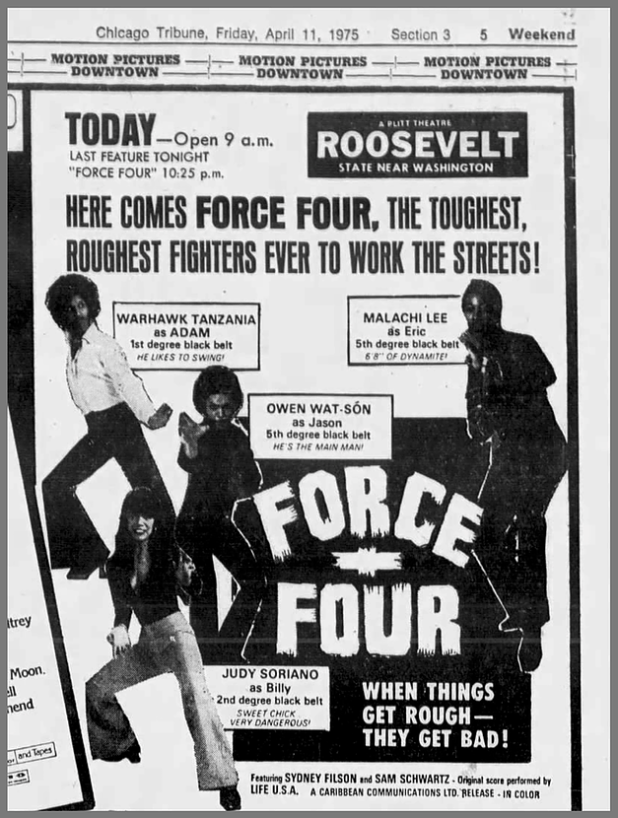
WEIRD WEDNESDAY: Black Force (1975)

Jason (Owen Watson, a two-tour Navy SEAL who was dojo brothers with Ron Van Cleff; his wife Sydney Filson is also in this), Billy (Judie Soriano), Adam (the best-named action hero ever, Warhawk Tanzania, who you may remember from Devil’s Express) and Eric (Professor Malachi Lee, an Isshin Ryu from the dojo of Master Ed McGrath; at 6’7″ he could hit a spinning kick without spinning; sadly he died the year this was made) are Force Four, the other name for this movie, or more to the point four butt kickers who come up against the evil Z (Sam Schwartz), who has stolen a voodoo icon of some sort. Whatever, we’re here for the fights, which have punches and kicks missing by quite a few inches, but again, who cares?

Directed by Michael Fink, who also made another Owen Watson movie, Velvet Smooth, and written by Leonard Michaels, who wrote those two Fink/Wilson movies as well as The Men’s Club, and Janice Weber, this is all about the funk from Life, USA. Which is life, really.

The credits also tell us that all of the kung fu is real: “All martial arts sequences in this film are authentic. No attempt has been made to enhance or alter actual fights by the use of special effects or trick photography. A slow-motion camera was used to capture certain techniques.” This should be no surprise because this looks as clumsy as can be.

The outfits are good, though.

You can watch this on Tubi.

WEIRD WEDNESDAY: Black Cobra (1975)

Do you think that when Jack Palance bounded to the stage, ready to do one-arm pushups and accept his Best Supporting Oscar for City Slickers after being nominated for Sudden Far and Shane, that he had a flashback and said to himself, “I’m in the A list tonight, but man, how can it compare to being in a movie where Laura Gemser dances with snakes?”

Seriously, the man who would become a star again at the age of 73 has a wealth of roles in aberrant movies in his past, but playing Judas Carmichael in a Joe D’Amato movie may be the pinnacle. Or the pit.

Gemser plays Eva, a snake dancer who obsesses Judas, because he has a snake collection at home — as you do — and he wants to show it to her. So she finally gives in and moves in with him while confining her horizontal dancing to the ladies — including Candy (Ziggy Zanger, who Gemser would go on to appear in Black EmanuelleWhite Emanuelle with, along with Nieves Navarro, and just writing that sentence made me a little faint). Judas’ brother Jules (Gabriele Tinti) wants Candy all for himself, so he messes around with the snakes with her — which seems ill-advised — and she gets killed by a mamba. And then he doubles up and kills off Eva’s lover Gerri (Michele Starck, Forever Emmanuelle) and ends up taking Eva from his brother!

Of course, that’s not the end of matters. Eva’s more devious than she looks. And so is Judas. I mean, if your mom names you Judas any time in a year that doesn’t have BC in it, you’re not going to turn out all that great.

Bruno Mattei edited this movie — a fact that makes me love it so much more — and it was also called Emmanuelle And The Deadly Black CobraHot Pants and finally and most awesomely Emmanuelle Goes Japanese, which makes no sense for a movie set in Hong Kong.

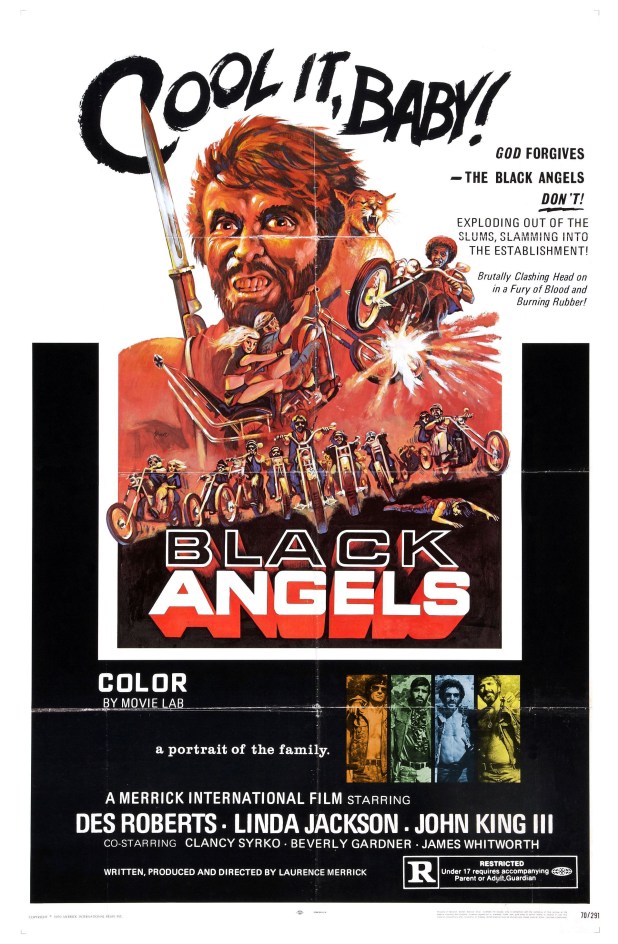
WEIRD WEDNESDAY: Black Angels (1970)

Satan’s Serpents and The Choppers are happy to coexist, but the cops start pushing racial tensions between them in the hopes that the two biker gangs will wipe one another off the face of the planet. Any wars these gangs had before this were about turf, not the color of their skin. But Lt. Harper (Clancy Syrko) hates bikers, and there you go.

What sets this beyond other biker films is that there’s a pet racoon who smokes weed, a mountain lion, snakes used to kill people, bikers pissing all over one another, screaming stuff like “It’s champagne! I just blessed you with my golden shower!” and people have names like Chainer (he has a chain) and Knifer (because he has a knife). They’re named like off-brand GI Joe lines, like America’s Defense and The Corps, used to name the bad guys. There’s also a go-go dancer who doesn’t let a full-on brawl stop the dance.

Mostly, people ride bikes. If you like to see people ride bikes, that’s good news. People ride lots of bikes.

This was directed and written by Laurence Merrick, who also made Guess What Happened to Count Dracula? and Manson. He was killed by a stalker in 1977.

Also known as Black Bikers from Hell.

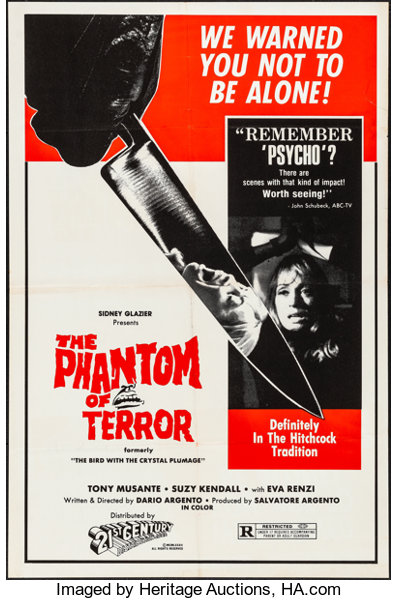
WEIRD WEDNESDAY: The Bird with the Crystal Plumage (1970)

Aside from Mario Bava’s influential films, such as Blood and Black LaceThe Girl Who Knew Too Much, no other movie has left as indelible a mark on the Giallo genre as Dario Argento’s 1970 directorial debut. Before this, Argento was a journalist who contributed to the screenplay of Sergio Leone’s Once Upon a Time in the West.

The title of the film, The Bird with the Crystal Plumage, is a metaphor for the protagonist’s predicament. Just as the bird is trapped by the beauty of the crystal plumage, Sam is trapped by the beauty of the art gallery and the mystery it holds. This metaphorical title sets the tone for the film and its exploration of the relationship between art and violence. In the film, Sam Dalmas (played by Tony Musante) is an American writer struggling with writer’s block. He travels to Rome for a change of scenery, accompanied by his British model girlfriend, played by Suzy Kendall. Just as he decides to return home, he witnesses a black-gloved man attacking a woman inside an art gallery. Desperate to save her, he finds himself helpless, trapped between two mechanical doors as the woman silently pleads for help.

The woman, Monica Ranier, is the gallery owner’s wife. Although she survives the attack, the police suspect Sam may be involved in the crime and confiscate his passport to prevent him from leaving the country. Unbeknownst to them, a serial killer has been targeting young women for weeks, and Sam is the only witness. Haunted by the attack, Sam’s memory is unreliable, leaving him without a crucial clue that could solve the case, adding a layer of suspense to the narrative.

This film introduces several tropes that would become hallmarks of the genre: the foreign stranger turned detective, the gaps in memory, and the black-clad killer—elements that later Giallo films would pay homage to. These elements, along with Argento’s unique visual style and use of suspense, would go on to influence a generation of filmmakers and shape the Giallo genre as we know it today.

Another recurring theme in Argento’s work appears for the first time here: the notion that art can incite violence. In this instance, a painting depicting a raincoat-clad man murdering a woman plays a significant role.

As the story unfolds, Sam receives menacing phone calls from the killer, and the masked assailant attacks Julia. The police manage to isolate a sound in the background of the killer’s conversations—the call of a rare Siberian bird. This bird, a Grey Crowned Crane, plays a significant role in the film’s narrative, serving as a clue that brings the police closer to unraveling the mystery. The film’s use of this rare bird as a plot device is a testament to Argento’s skill as a storyteller and his ability to create tension and suspense.

Alberto, Monica’s husband and the owner of the art gallery, ultimately attempts to kill her, revealing that he orchestrated the attacks. However, in true giallo fashion, mistaken identity is a crucial plot twist. Even though this film was made nearly fifty years ago, I won’t spoil the reveal of the real killer.

I recall my parents seeing this movie before I was born and disliking it so much that they would mention “that weird movie with the bird that makes the noises” whenever they encountered a confusing film. Ironically, I grew to love Argento’s work. My fascination with Giallo and difficult-to-understand films is a form of rebellion against their opinions.

This film, an uncredited adaptation of Fredric Brown’s novel *The Screaming Mimi*, was initially considered a career misstep by actress Eva Renzi. The film’s producer even wanted to replace Argento as director. However, when Argento’s father, Salvatore, spoke with the producer, he noticed that the executive’s secretary appeared shaken. When he asked her what was wrong, she revealed she was still terrified from watching the film. Salvatore convinced her to explain her fear to her boss, ultimately leading to Argento staying as director.

The outcome of this struggle? It is a film that played in one theater in Milan for three and a half years, leading to countless imitators—and inspired many elements in films featuring lizards, spiders, flies, ducklings, butterflies, and more—for decades to come. Argento would later continue his so-called Animal Trilogy with The Cat O’Nine Tails and Four Flies on Grey Velvet, then Deep Red before moving into more supernatural films like Suspiria and Inferno.
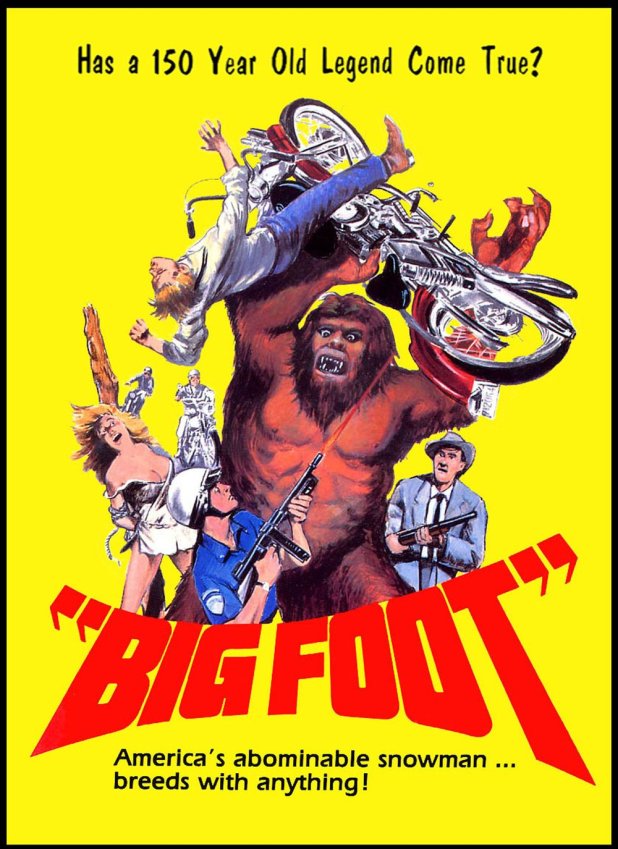
WEIRD WEDNESDAY: Bigfoot (1970)

Anthony Cardoza produced some really interesting films. You may call them turkeys. You may also call them…well, you wouldn’t call them works of art. But hey, his movies live on, like The Beast of Yucca FlatsThe Hellcats and today’s film, Bigfoot.

Jasper B. Hawks (John Carradine!) and Elmer Briggs (John Mitchum, brother of Robert and the writer of the John Wayne voiced “America, Why I Love Her” that TV stations used to sign off when TV stations still existed and actually signed off) are driving around the forest. And Joi Landis (Joi Lansing, a former MGM contract girl who shows up in the long tracking shot that begins Touch of Evilin her final role) is a pilot whose plane breaks down. She parachutes into the woods and encounters Bigfoot.

Then there’s Rick (Chris Mitchum, son of Robert and also an actor in films like Jodorowsky’s Tusk and Jess Franco’s Faceless) and his girlfriend Chris, who find a Bigfoot cemetery and get attacked, too.

Of course, the authorities are of no help. Only Jasper will help Rick, and that’s because he wants a Bigfoot for his freak show.

Peggy gets kidnapped by Bigfoot, and we discover that Joi has been taken, too. Upon reaching the lair of the Bigfoots (Bigfeet?), we discover that the creatures we’ve seen are his wives, and the real creature is 200 feet tall. Yes,. You just read that right. And he’s about to fight a bear that’s just as huge.

A gang of bikers gasses Bigfoot, but he escapes the freakshow and then gets blown up by bikers. John Carradine quotes from King Kong (he does throughout the film) and the movie ends.

Along the way, we find Doodles Weaver, whose scene in the completely bonkers The Zodiac Killer may be the most ridiculous scene in what is quite honestly one of the strangest films I’ve ever seen.

And hey, is that Bing Crosby’s son Lindsey? Yes, it is! And the first singing cowboy, Ken Maynard! This movie has actors with much more interesting stories than the film they’re stuck in.

But you know what is interesting? The strange doom funk that plays every time the bikers show up. And keep your eyes open for a quick appearance by Haji, who famously appeared in Russ Meyer’s Faster, Pussycat! Kill! Kill! 

Director Robert F. Slatzer only did two other movies, but one of them was The Hellcats, where Russ Hagen battles a female gang. Leather on the outside…all woman on the inside!

But hey — Bigfoot. Come for the bikers. Stay for the bigfoots. Enjoy the bikinis. But dig this crazy sound, man!

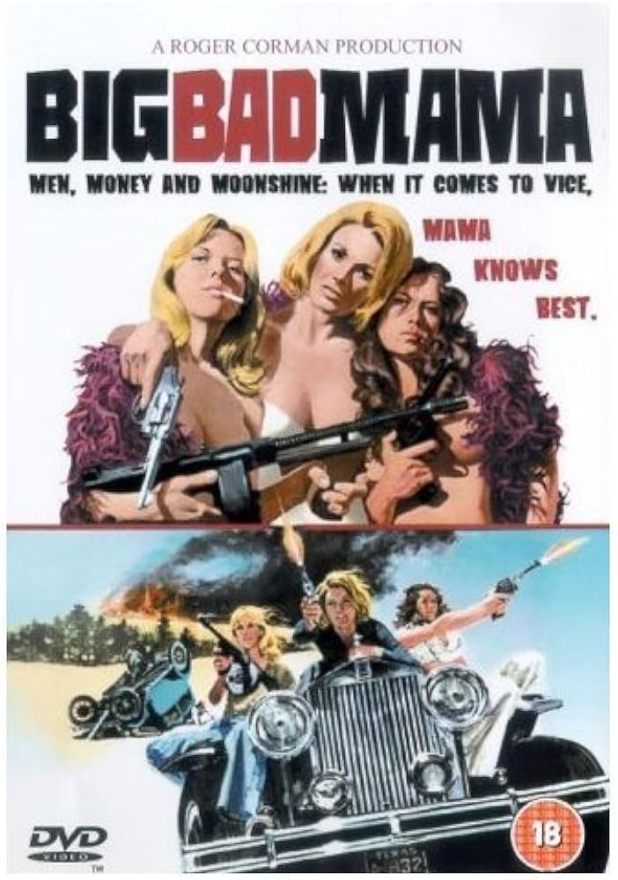
WEIRD WEDNESDAY: Big Bad Mama (1974)

Steve Carver originally intended to get involved in the worlds of cartooning, commercial art and animation before becoming a cameraman for ABC’s Wide World of Sports, shooting St. Louis Cardinals baseball games before he made thirty documentaries while teaching college at the same time.

One of those documentaries got him into the American Film Institute, where he studied under George Stevens, Alfred Hitchcock, Charlton Heston and Gregory Peck. He also had the opportunity to be the assistant director on Dalton Trumbo’s Johnny Got His Gun.

Carver’s final AFI project was a short based on Poe’s The Tell-Tale Heart, which brought him to the attention of Roger Corman. He edited 150 trailers for the producer and directed The Arena — which has Joe D’Amato as director of cinematography — before this film. He’d go on to make two Chuck Norris films, Lone Wolf McQuade and An Eye for an Eye, before leaving film for the world of photography, pining for the more fun days of working with Corman.

Texas, 1932. Wilma McClatchie (Angie Dickinson) has taken over her dead man’s bootlegging still but gets caught by the law. Forced to hand over all her money and even her wedding ring to the sheriff, she decides that she and her daughters Polly (Robbie Lee, Lace from Switchblade Sisters and eventually the voice of Twink on Rainbow Brite; she’s also the goddaughter of Roy Rogers and Dale Evans) and Billy Jean (Susan Sennett, The Candy Snatchers and wife of Graham Nash) are going to live a life of crime.

While Wilma is at a bank trying to pass a fake check, the girls end up helping Fred Diller (Tom Skerritt) as he knocks over the joint. He and Wilma soon become lovers, but that doesn’t last long before she’s bedding gambler William J. Baxter (William Shatner), and he starts sleeping with both of her daughters, sometimes at the same time, because Roger Corman produced this.

After kidnapping and ransoming the daughter of a millionaire, federal agents and the police finally track down the gang. Baxter gets cuffed, and the girls escape while Diller defends them with a hail of Thompson submachine gun fire. But as they drive away, Wilma dies, her bloody arm dragging against the left side of the car as it speeds away.

Well, or so you’d think, as there was a sequel.

I learned so much about so-called bad movies from the Medved brothers. In their 1986 tome Son of the Golden Turkey Awards, they nominated Dickinson’s role in this film as “The Most Embarrassing Nude Scene in Hollywood History.” Now that I’m older and wiser, I can say that these guys must have been embarrassed themselves as they actually enjoyed this trash. I hate the idea of guilty pleasures; just like what you like.

Oddly enough, Jerry Garcia performed most of the guitar and banjo music in the movie. And if you’re looking for fun actors, Sally Kirkland, Dick Miller and Royal Dano all show up. It’s not the best movie you’ve ever seen, but it’s filled with sin, skin and bullets. What else were you hoping for?

You can watch this on Tubi.

WEIRD WEDNESDAY: Beyond Evil (1980)

Architect Larry Andrews and his new wife, Barbara (horror movie super couple John Saxon and Linda Day George; if these two ever had a child, it would either be a demon or a gleaming golden angel), have moved to a small island off the coast of the Philippines. Del (former minor league baseball player Michael Dante; he’s also in The Farmer and was introduced to acting by John Wayne), Larry’s business partner, had promised them a brand new condo. Instead, they’re moving into Casa Fortuna, the haunted former home of Esteban and Alma Martín (Janice Lynde), who died after a fight started by Alma’s obsession with the occult.

Within what seems like minutes, next door neighbors and psychic surgery experts Dr. Solomon (David Opatoshu) and his wife Leia (Anna Marisse) warn Larry that Alma wants his young bride’s body for her own. At the same time, Barbara is luring Del into the home with promises of sex and then shoving him off the balcony.

You know what this movie needs? An exorcism. Well, it gets it.

Herb Freed is kind of a forgotten king. I mean, the dude made HauntsGraduation Day and Tomboy, which are three other movies I watch all the time. He wrote the script with producer David Baughn and Paul Ross.

You can watch this on Tubi or order it from Vinegar Syndrome.

WEIRD WEDNESDAY: Beyond Atlantis (1973)

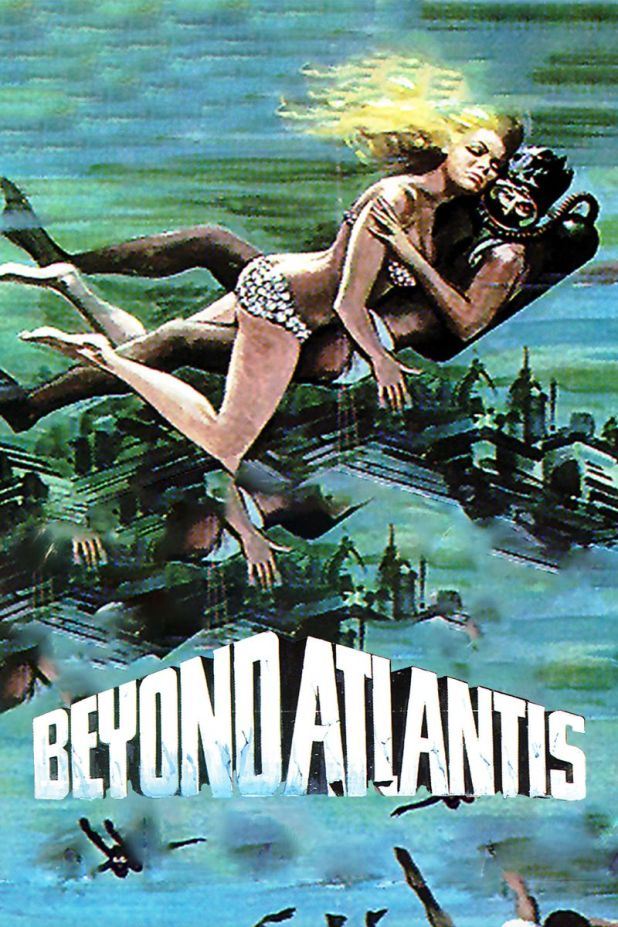
I was so loud while watching this movie that my wife had to come to check on me. The sheer delight had overtaken me when East Eddie (Sid Haig) appeared in a film where gigantic-eyed Atlantean people attempted to keep their undersea world alive thanks to a new queen named Syrene (Leigh Christian), who must constantly sire new children, as decreed by her adopted father Nereus (George Nader).

Eddie is part of a group trying to farm pearls for money, which includes what could be the exploitation movies made in the Philippines version of The Avengers: Manuel the Barracuda (Vic Díaz), Logan (John Ashley) and Vic Mathias (Patrick Wayne).

Producer Ashley had the idea that this would be a science fiction version of The Treasure of the Sierra Madre, which is a big idea, while Wayne would only be in the film if it was a family-friendly movie, but it’s also about rebuilding the DNA of a dying world of interbred bug-eyed merpeople, which is a fun juxtaposition.

The underwater scenes are gorgeous, and this has way better production values than many movies made in the Philippines. Yet if it had more exploitation—a fact that Ashley believed—I think it would be a more exciting movie.

This was released by Dimension Pictures in 1973 and rereleased by 21st Century.

You can watch this on Tubi.

WEIRD WEDNESDAY: Beware! The Blob (1972)

Beware! The Blob or Son of the Blob is a big idea to get your head around. While the original was presented as horror, this film pretty much leans into how ridiculous it all is. Written by Anthony Harris and Jack Woods from a story by Richard Clair and Jack H. Harris, a lot of this was improvised on set, and the script—even though it took all those people—was mostly ignored.

Harris was also the producer, and Anthony was his college graduate son. They were next door neighbors with Larry Hagman — who had previously directed episodes of I Dream of Jeannie and The Good Life — who had never seen The Blob. Harris screened his print for the actor/director, who loved it and said that he could get a lot of his Hollywood friends to show up and get blobbed, as long as he could direct.

Fifteen years after the original Blob destroyed parts of Pennsylvania, Chester (Godfrey Cambridge) has brought a piece of that creature from its frozen grave in the North Pole, where he does the sensible thing and puts it in the fridge. It grows in size as it eats a fly, a kitten, and then his wife, Marianne (Marlene Clark). Finally, while Chester watches The Blob on TV, it eats him too, just in time for Lisa (Gwynne Gilford) to watch him get claimed by the creature.

As she tries to get her boyfriend Bobby (Robert Walker Jr.). to believe what she’s seen, the red jelly eats its way through Los Angeles, claiming the lives of two hippies (Randy Stonehill and Cindy Williams) in a storm drain — were they looking for Simon? — as well as officer Sid Haig, chickens, horses, a bar, a gas station, Scoutmaster Dick Van Patten, a barber (Shelley Berman) and even some home-displaced folks (Hagman, Burgess Meredith and Del Close, who is wearing an eyepatch as his cornea was scratched by a cat previous to filming; he’d return with a similar look as Reverend Meeker in perhaps the best horror remake of all time, 1988’s The Blob).

It takes an ice rink — which was torn down shortly after filming — to stop the monster — maybe — this time. As for the bowling alley in this movie, it’s Jack Rabbit Slims from Pulp Fiction.

In the first movie, the Blob was made of silicone and dyed red. It had to be stirred throughout the movie to keep its color. This Blob was made from a red-dyed powder blended with water, as well as a big red plastic balloon, red plastic sheeting and a red drum of hard red silicone spun in front of the camera. Tim Baar and Conrad Rothmann created these effects, and beyond working on the second unit camera, Dean Cundey helped, years before he’d become such a force in filmmaking.

In 1982, when Hagman was on Dallas and the shooting of his character J.R. Ewing was the biggest moment in pop culture, this was re-released with the headline “The film that J.R. shot!”

You can watch this on Tubi.