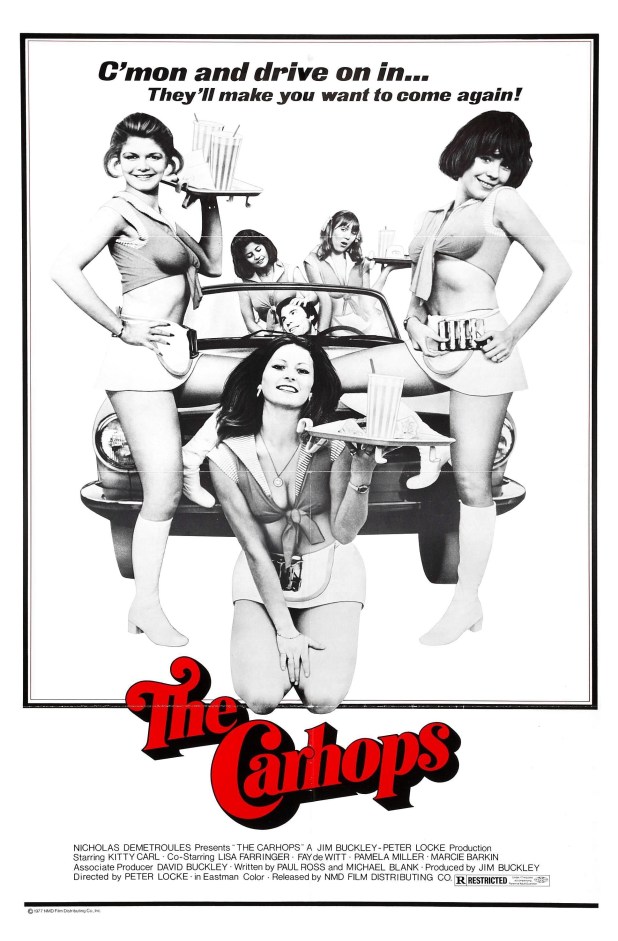
Also known as Kitty Can’t Do It, this was directed by Peter Locke, who also produced The Hills Have Eyes and directed It Happened in Hollywood. It was written by Paul Ross (who also wrote Journey Into the Beyond and Beyond Evil) and Michael Blank, and edited by Rick Jackson and Wes Craven, with second-unit direction by John “Bud” Cardos. It tries to be a nurse’s cycle movie, but reminds you how good the people who made the great ones are, like Stephanie Rothman.
Kitty, as you can expect from the alternate title, is the heroine, and she’s played by Kitty Carl. Speaking of better female-cast movies, she was also in The Centerfold Girls. All of Kitty’s friends are getting laid while she’s still a virgin, perhaps because of her overbearing mother (Fay DeWitt). Those friends try to get their men to sleep with Kitty, but it never works out.
One of those men, MacGregor (Jack DeLeon), is seething into lusty rapist territory by the end, which gives us our chase scene. Otherwise, this is worth watching for the female cast, which includes I’m With the Band author Pamela Des Barres as Vickii, Lisa Ferringer from Coffy as Cindy, Marcie Barkin from Fade to Black, Janus Blythe from Eaten Alive and The Hills Have Eyesas a waitress and Uschi Digard as “Lady in Hotel Room.” She’s barely in it, but she’s what you will remember.
Do you know how much I love you, dear reader? I actually bought this to watch, and luckilyWide World Movie also threw in a triple pack of Invasion of the Bee Girls, 2069 A Sexy Odyssey, and Dr. Dildo’s Secret, all of which I would recommend over this. It’s not even Starhops, which is saying something.
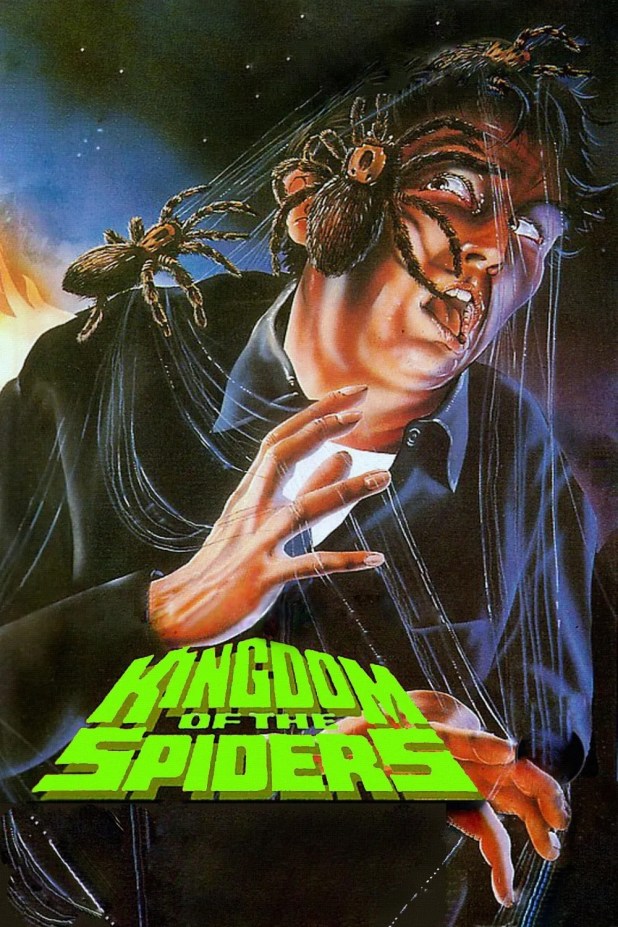
If you’re looking for the ultimate example of Shatner vs. Nature, look no further. This isn’t just a movie; it’s a masterclass in how to take a humble Arizona town and turn it into a literal web of madness, all while the Shat wears the hell out of a Canadian tuxedo.
Directed by John “Bud” Cardos and written by Richard Robinson and Alan Caillou, whose real name was Alan Samuel Lyle-Smythe MBE, M.C. and who was an author, actor, screenwriter, soldier, policeman and professional hunter.
Despite the initial fright they may cause, it’s worth noting that tarantulas’ venom is about as dangerous as a bee sting. They mostly cause itching from the shedding of their bristles, which are used to make itching powder. This fact, coupled with the humorous association of itching powder with comedy-movie mischief, adds a delightful touch of humor to the film.
This film features 5,000 tarantulas in its cast, a staggering number that took up 10% of the film’s budget. It’s safe to assume that star William Shatner was compensated more than his eight-legged co-stars. Interestingly, these spiders, being cannibals, had their own set of demands. All 5,000 of them had to be kept in separate containers, which posed a unique challenge for the production process.
They’re also very shy, so to make it appear that the spiders were attacking people, fans and air tubes were used.
Let’s take a trip to Camp Verde, Arizona.
That’s where Dr. Robert “Rack” Hansen (Shatner) practices. He’s heading out for a house call to see Walter Colby (Woody Strode), whose prize calf dies for reasons that puzzle Hansen. Diane Ashley (Tiffany Bolling) comes down from the big city of Flagstaff to blow his mind: spider venom killed the cow.
It gets worse. Walter’s wife, Birch (Altovise Davis, Sammy Davis Jr.’s third wife), soon discovers that their dog is dead and that a giant spider nest is in the backyard. Thanks to pesticides, spiders have lost their natural food source, and instead of turning on one another, they’ve decided to eat larger meals.
Their big scientific plan is to burn the spider hill, which doesn’t go well because the arachnids escape into tunnels and display advanced intelligence, carrying out a revenge attack on Walter, his wife, and Hansen’s sister-in-law, Terry (Marcy Lafferty).
The mayor (Roy Engel) gets Sheriff Gene Smith (David McLean) to spray the town with pesticides, which is how things got this bad in the first place. Ashley says rats would have been a better idea, but obviously, the mayor met Larry Vaughn at a mayor’s convention in Las Vegas and saw his seminar on never canceling the county fair, no matter what common sense tells you. More pesticides are planned, but the spiders deal with that by crashing a crop duster.
One of the most effective parts of the film is the ending, a bleak, The Birds-esque finale that subverts the typical happy ending of the era. The use of country music on the radio as a backdrop to the town’s total isolation is a stroke of low-budget genius. It suggests that while we’re all going about our business, listening to the latest hits, an entire civilization could be getting cocooned just down the road. It’s also basically a painting.
In 1998, Shatner told Fangoria that he was working with Cannon Films in the late 1980s to produce a sequel, but he probably meant Menahem’s 21st Century, which did run trade ads for Kingdom of the Spiders 2. Shatner would direct, write and star in the film, in which a man would be tortured with spiders. As you can imagine from Menahem’s playbook, this ad was just a photo of Shatner and the movie’s title.
Producers Igo Kantor and Howard James Reekie, using the name Port Hollywood, planned a sequel in the 2000s that promised Native American myth and spiders driven mad by secret government experiments involving extremely low-frequency tones.
I love this movie because you can tell that the spiders want nothing to do with anybody, much less feel the need to attack them. The entire cast fights an octopus Bela Lugosi-style, if you will, and the emotion of fear is present, but no one is ever in danger. Sure, this was made by dumping buckets of spiders on people, but that warms my heart.
If you’ve ever found yourself watching a teen sex comedy from the ’80s and thinking, “This is great, but it really needs more gastrointestinal distress and a much lower production budget,” then boy, do I have a gift for you. King Frat isn’t just a movie; it’s a biological hazard caught on 35mm. It’s the kind of regional filmmaking that feels like it was developed in a bathtub filled with stale beer and regret.
Before he became the founding editor of The Huffington Post, Roy Sekoff starred in this movie, filmed in Miami and Coral Gables, as a takeoff on Animal House. The Bluto Blutarsky of this film is J.J. “Gross-Out” Gumbroski, played by John DiSanti, who, believe it or not, would go on to be in other movies (*batteries not included is one of them).
Set at Yellowstream University, this movie follows the Pi Kappa Delta fraternity, who are only concerned with drinking. A good chunk of the film involves them mooning people, which leads to the death of the dean of the school. Then, a farting contest is announced, and everyone battles to have the best farts in a scene that goes on longer than you’d expect, then goes about another seven minutes past that.
And then there’s the music. Most films have a soundtrack. This is a hostage situation. The same bouncy, synthesized earworm plays throughout the entire runtime, looping with a psychotic persistence that would make a CIA interrogator blush. By the thirty-minute mark, you’ll be humming it. By the end of the film, you’ll hear it when people talk to you, and then you’ll start wondering if the soundtrack has come to life to further torment you.
Amazingly, King Frat comes from Ken Wiederhorn, the same man who directed Shock Waves, Return of the Living Dead Part II and Meatballs II. How do you go from the eerie, waterlogged Nazi zombies to a movie where the primary plot point is a synchronized flatulence symphony? Wiederhorn is a man of many seasons, and apparently, one of those seasons was spent in the absolute gutter. This feels like the moment he decided to see exactly how much the human spirit could endure. It’s filmed in Miami and Coral Gables, but it feels like it was shot in the locker room of a condemned bowling alley.
King Frat is literally the bottom of the absolute barrel of filmmaking, and I love it. If Animal House was too classy for you, if you wondered if they could make a movie where a frat could murder a dean by farting in his face and stealing the body and then have a scene where numerous men and women fart and nearly shit themselves, good news. This is the movie for you.
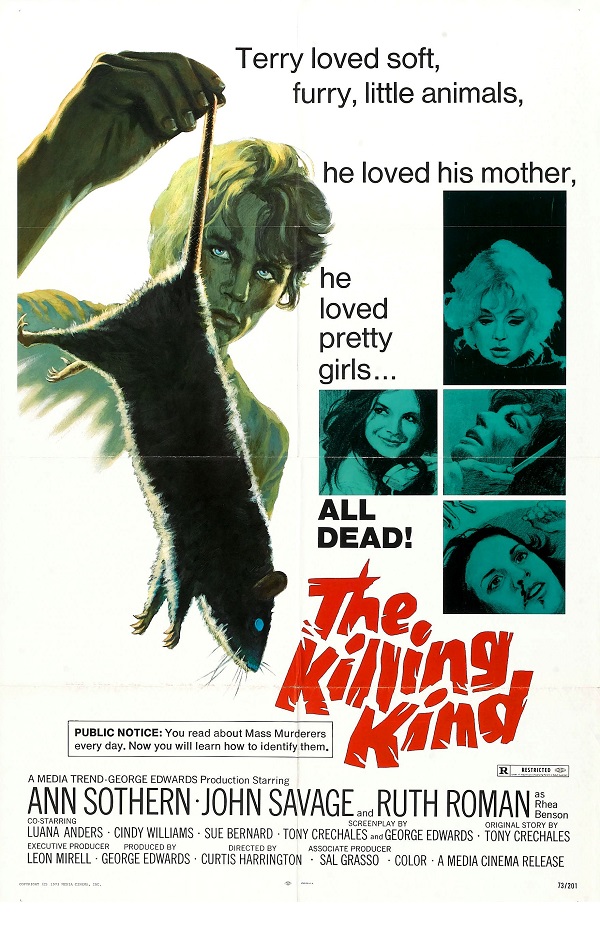
The 1970s were a gold mine for hagsploitation and Southern Gothic grittiness, but The Killing Kind occupies a strange, lonely corner of that subgenre. It’s not just a thriller; it’s a suffocating character study directed by Curtis Harrington, a master of the macabre and the misunderstood (see: Night Tideand What’s the Matter with Helen?).
Harrington was a pioneer of New American Cinema who transitioned into the studio system without losing his avant-garde sensibilities. In this film, he creates a palette that feels as damp and stagnant as a basement. He doesn’t rely on jump scares; he relies on the inherent wrongness of the domestic space. The boarding house is less a sanctuary and more a terrarium where resentment festered until it became lethal.
Terry (John Savage, The Deer Hunter) was forced to participate in a gang assault and served two years in prison, losing his sanity. His mother, Thelma (Ann Sothern, so many roles, but also the titular voice of My Mother the Car), runs a boarding house for old women who all gossip about the strange nature of their relationship; if you didn’t know the truth, you would think they were a married couple, not a son and his mother.
Thelma wishes that the victim of the assault, Tina (Sue Bernard, Faster, Pussycat! Kill! Kill!), were dead. So Terry runs her off the road. He hears how his attorney Rhea Benson (Ruth Roman, whose slate of movies in the early 70s was absolutely wild between this, The Baby and Impulse) didn’t protect him enough, so he kills her too. He even kills new tenant Lori (Cindy Williams, who was commuting between the set of this film and The Conversation), and they move the body out in full view of their suspicious neighbor, Lori (Luana Anders, Night Tide).
Speaking of that librarian next door, the same character appears in 1980s The Attic, which was also written by Tony Crechales and George Edwards.
The true monster of the film isn’t necessarily Terry’s fractured psyche, but the umbilical cord that was never cut. The film dances on the edge of the Oedipal complex, making the audience deeply uncomfortable with every shared meal and whispered confidence between mother and son. It suggests that while society broke Terry, his mother is the one who shaped the shards into a weapon.
Also, to those who worry about cat murder, yes — a cat does die in this. It was a real cat in that scene, but it was sedated by a vet. The one in the dumpster is an actual euthanized cat, but it was not killed for this production.
Sadly, this movie had poor distribution and was lost for a few years. How exciting is it that we live in a world where films get found and we can find them ourselves so easily?
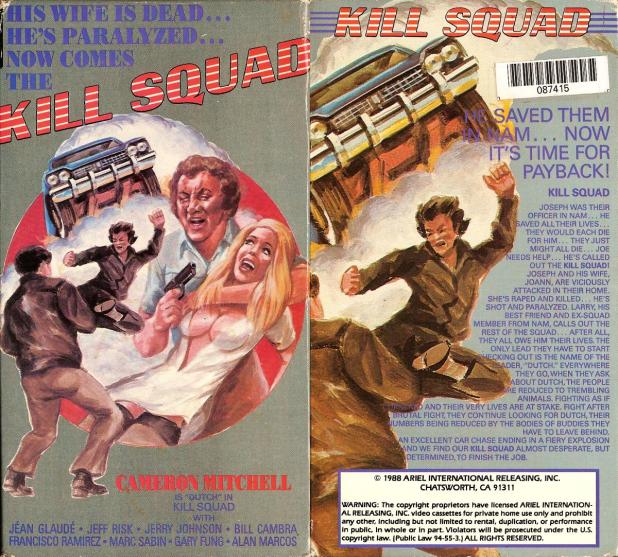
After a home invasion leaves Joseph Lawrence (Jeff Risk) paralyzed from the waist down and his wife sexually assaulted and dead, he reaches out to Larry (Jean Glaudé) to bring together their old army team, the Kill Squad: Tommy (Gary Fung), Arthur (Marc Sabin), K.C. (Jerry Johnson), Pete (Francisco Ramírez) and Alan (Bill Cambra). Once, they were prisoners of war, and Joseph earned their undying devotion by distracting the Vietcong by, well, standing on a landmine.
The man behind the attack is Dutch (Cameron Mitchell), but as the team tracks him down, a sniper keeps killing them as if this were a slasher movie and not a revengeomatic. Finally, Larry tracks down Dutch, who dies by accident, which is the very definition of anticlimactic.
It would be, except that — no spoilers needed for something you’ll figure out from the beginning of the film — Joseph explains that he resents the squad for the loss of his leg in Vietnam and faked his paralysis. In fact, he’s the one who paid for men to rape and kill his wife, all so he could get he rmoney and then kill the squad who left him behind.
Then Larry kicks Jeff right into an axe.
You really need to see the intros for each squad member. Tommy is working as a gardener and when that guy refuses to pay him and calls him a slur, he destroys the man in front of a pool party. K.C. is now a pimp with two girls, Salt and Pepper and no, not the rap trio. Pete is a mechanic. Alan is a bad businessman who is just about to lose everything as he does research on bugs, but mainly has sex with all the women in the office. Then, they do fancy weapon katas to show Joseph that they still got it.
Director and writer Patrick G. Donahue also made They Call Me Macho Woman!, Parole Violators, Ground Rules (a modern movie that nevertheless has a post-apocalyptic motorcycle game; this stars Frank Stallone and Richard Lynch and why haven’t I watched this?) and as G. Padon made the adult film Passion Prcession and the poster for that film is in this movie.
The best part? Or worse? The three Vietncong characters are in the credits as Vietnam Dude,” “Another Vietname Dude” and “Yet Another Vietnam Dude.”
Also known as Patrick G. Donahue’s Kill Squad, because of course it should be.
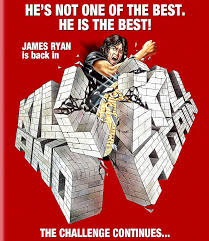
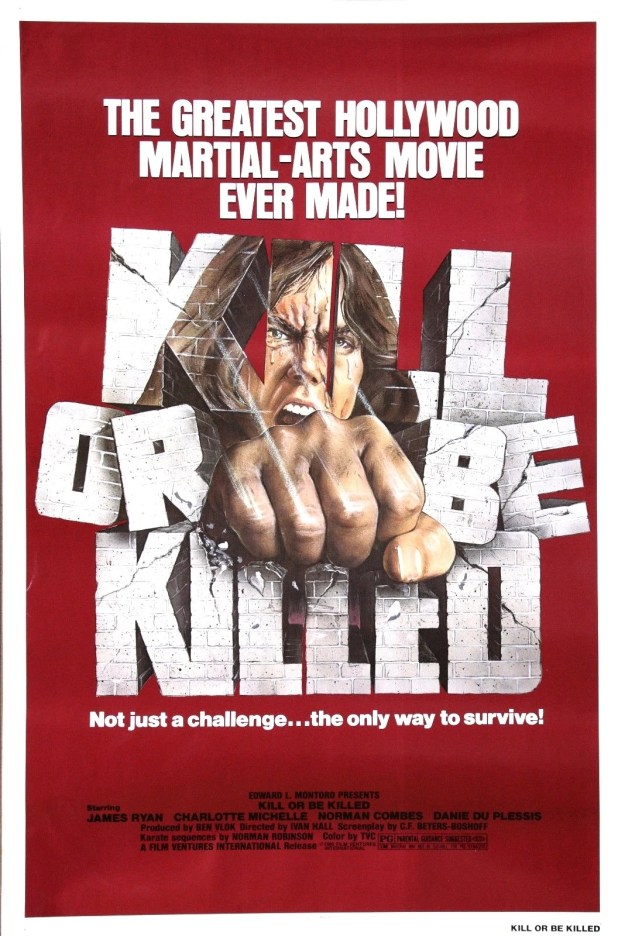
Kill and Kill Again is a sequel to the film Kill or Be Killed and tells another adventure of Steve Chase (James Ryan), a secret agent martial artist who has been hired by Kandy Kane (Anneline Kriel, whose life should be a movie, between having singer Richard Loring writing the song “Sweet Anneline” about her, followed by nude photos she took for his friend Roy Hilligenn being leaked — in 1977 — as well as being present when boyfriend Henke Pistorius — father of Oscar Pistorius, the legless South African athlete who would shoot and kill his girlfriend — shot himself while cleaning his pistol, as well as a singer and Playboy South Africa cover girl, as well as Miss South Africa 1974 and was later crowned Miss World 1974) to find her father Dr. Horatio Kane (John Ramsbottom), a scientist who has learned how to control minds while trying to turn potatoes into an energy source.
Yes, if you thought Kill and Kill Again would be normal, oh no. Oh no.
The government gives Steve $5 million dollars to pick his own team of super agents, which includes former martial arts champion Gypsy Billy (Norman Robinson), the mystic mystery man who only answers to The Fly (Stan Schmidt, a South African master of Shotokan karate), the goofball Hot Dog (Bill Flynn) who when we first meet him is challenging men to stand in a room while he shoots bullets at them and the former pro wrestler and now construction worker gorilla (Ken Gampu, King Solomon’s Mines).
They’re sent to stop Wellington Forsyth III, a billionaire who has now become Marduk (Michael Mayer), who has taken over the town of Ironville and is looking to create an army of warriors to take over the world. He has wanted Steve to come to challenge his champion, The Optimus (Eddie Dori), an unstoppable fighter.
Yes, in the world of South African martial arts, white men are the greatest fighters in the world.
In the commentary track for this movie, James Ryan said that the third film would have been called Most Dangerous Man and had him appear opposite Sharon Stone. However, FVI went out of business and he headed back to South Africa.
Martial arts movies make little to no sense most of the time. Then, there’s this movie.
Steve Chase is a martial artist who goes to the desert for what he thinks is an Olympic style meet. Nope. An ex-Nazi general was defeated at the 1936 Olympics by a Japanese martial artist named Miyagi, so he’s out for revenge. Luckily, Steve and his girl Olga escape.
To fix up his team, von Rudloff’s miniature henchman Chico goes around the world to recruit a new team. And Steve ends up meeting Miyagi and joining his team, which leads to the madcap fight between he and his girl when she is kidnapped and forced to join his team.
Finally, Steve must fight and defeat Luke, the ultimate fighter, leading the Nazi to killing himself rather than face defeat.
I’ve given you a straight reading of the film. To see it is to know how different it is, as it’s either filmed by someone who wants to be an artist or someone who has been in the sun too long. This is often the same thing.
This movie was a success for four years in its native South Africa, where many Japanese martial arts forms were done to perfection. It seems bizarre that a South African martial arts movie became a cult hit, but there’s a historical quirk here. During the 70s, international film boycotts due to Apartheid meant South Africa had to get creative. They produced a string of genre films (often dubbed for international release) that attempted to mimic Hollywood and Hong Kong trends with a fraction of the budget and ten times the weirdness.
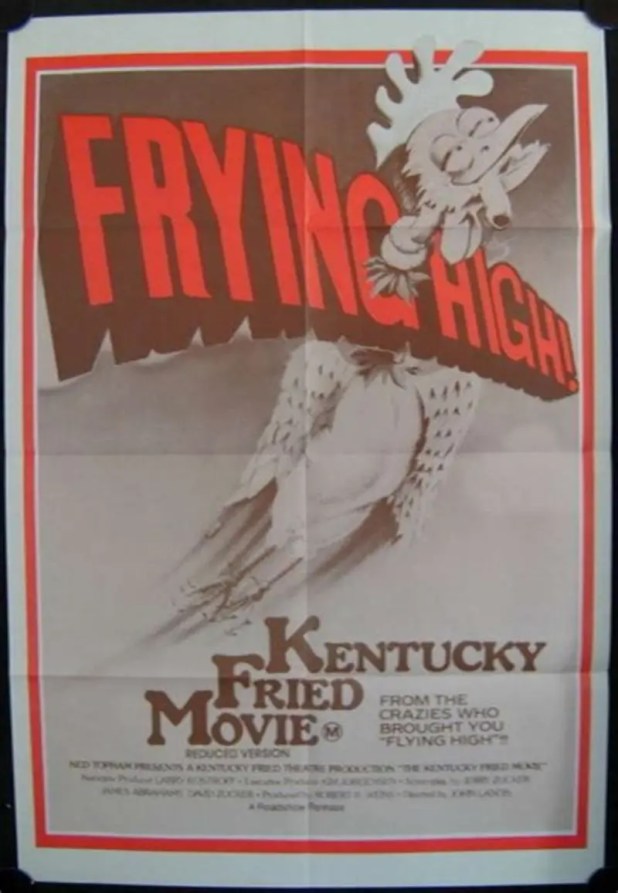
Directed by John Landis and written by the ZAZ team of David Zucker, Jim Abrahams, and Jerry Zucker (who would go on to Airplane! and The Naked Gun), this movie is a complete mess, and I wouldn’t have it any other way. I’ve probably watched this film more than any other, thanks to a taped-off HBO copy I had throughout my teenage years.
Containing a number of exploitation films produced by Samuel L. Bronkowitz (a combination of everyone from Samuel Bronston and Joseph L. Mankiewicz to legendary American International Pictures producer Samuel Z. Arkoff), this movie just never stops or lets up. If a scene isn’t funny for a little bit, stick around. Something really comedic — or strange — is right around the corner.
How can you not adore a film that begins with a news anchorman warning you, “The popcorn you’ve just been eating has been pissed in?”
Starting with a commercial for Argon Oil, the first real segment of the film is an extended watch of A.M. Today, as a gorilla (special effects master Rick Baker) goes wild on set. That’s followed by a trailer for Catholic High School Girls in Trouble, which is pretty much every softcore sexploitation movie the late 1960’s and early 1970s foisted on drive-in and grindhouse screens. The sound effects alone make this segment worthwhile.
A segment titled ” See You Next Wednesday” features a theater that offers Feel-A-Round technology. It’s really just an excuse for Landis to get this catchphrase into one of his films, which he repeats throughout his career. It’s the last line that Frank Poole’s father says to him in a letter from home in 2001: A Space Odyssey. And Landis has used it in movies from Schlock and The Blues Brothers to the video for Thriller, Twilight Zone: The Movie, Trading Places and Spies Like Us (among many of his other films). It also shows up in Amazon Women on the Moon, which is pretty much a spiritual sequel to this. It’s called The Cheeseburger Movie, while the original is called The Hamburger Movie in France, plus they both end with the song “Carioca.”
There are so many moments here that it’s hard for me to list them all. I’ll try. Big Jim Slade, making the album The Wonderful World of Sex much better for the ladies. Building “a fighting force of extraordinary magnitude” in the film’s longest movie-within-a-movie, the Bruce Lee ripoff A Fistful of Yen. That’sArmageddon, an Irwin Allen-style movie that stars George Lazenby and Donald Sutherland as “the clumsy waiter,” a part that never fails to make me laugh. A Leave It to Beaver in court sketch that predates the way modern comedy would reinvent old shows, even bringing original Wally, Tony Dow, along for the ride. The blacksploitation (and jewsploitation) film Cleopatra Schwartz. Danger Seekers, which could never — and probably should never — be made today. And literally so much more.
The humor was going to extend to the film’s title, which was going to be either Free Popcorn or Closed for Remodeling, either of which would have led to total chaos.
“In this documentary film narrated by George Kennedy, we investigate the planet Jupiter and the secret power it holds over our planet Earth. Directors Peter Matulavich and Lee Auerbach have combined years of research and interviews with the nation’s leading scientists and historians. The result is a documentary with such impact that it must be watched and then watched again to fully grasp the tremendous amount of information and prophetic study packed into all 80 minutes! Discover the Jupiter Menace!”
The world is doomed, and nothing can be done about it.
Directed by Lee Auerbach and Peter Matulavich (who wrote several episodes of In Search Of) and written by Matulavich and Alan Coats, this tells us that by the year 2000 — 26 years ago — the poles of our planet would move and send us into space, as a grand alignment would cause volcanoes to explode, earthquakes to shatter cities and, well, you wouldn’t want to live on this planet, let me tell you that much.
That’s because Jupiter and Saturn — “Jupiter and Saturn, Oberon, Miranda and Titania, Neptune, Titan, stars can frighten” — were about to move as well, and the Bible says that will happen, and so do astrologers and the Anasazi. Chester Brooks, a computer programmer and church deacon, explains in this movie how he programmed his computer with every reference to natural catastrophes in the Bible, then uses a simple map to calculate that the Dome of the Rock will be destroyed in the near future.
So do John Gribbin and Stephen Plagemann, who said that this alignment of the planets would cause major disasters, including a large earthquake on the San Andreas Fault, in their 1974 book The Jupiter Effect. A rare planetary alignment when Mercury, Venus, Earth, Mars, Jupiter, Saturn, Uranus, Neptune and Pluto would be on the same side of the Sun would produce enough tidal forces on our system’s big star.
The documentary highlights the San Andreas Fault as a scar and features Peter Franken (a former Pentagon researcher) describing a nightmare scenario where Los Angeles is taken out, resulting in over 100,000 immediate deaths and grotesque injuries. Then, technicians use a computer to simulate a 12-point earthquake on the Richter scale, a force 10,000 times more powerful than the 1906 San Francisco quake.
When the alignment happened on March 10, 1982, no major disasters occurred. Gribbin later disavowed the theory, admitting in The Little Book of Science that he “don’t like it, and I’m sorry I ever had anything to do with it” In 1982, he and Plagemann published The Jupiter Effect Reconsidered, shifting the focus to a supposed 1980 event linked to Mount St. Helens, though this also lacked evidence, as you would expect.
Plagemann, Jeffrey Goodman and John White, who wrote Pole Shift. appear in this, along with psychics Clarissa Bernhardt (who claims to have predicted over 30 earthquakes and visualizes the San Francisco Bay becoming an inland sea and the East Coast being ravaged by volcanic activity) and Alex Tanous, and CSA leader James Ellison (an American white supremacist and this group means The Covenant, the Sword and the Arm of the Lord, a radical paramilitary and survivalist group active in the 70s and 80s). There is also a group of people who plan on living in the sky, the STEL Community, before they come back to the surface to rule. Located 60 miles south of Chicago, this group planned to build 3,000 airships by 1999 to hover above the Earth during the cataclysm, before building a new community they named Philadelphia.
What’s insane is that both of these groups are presented as sane and not at all fringe.
Why should you watch this? Because George Kennedy needed a paycheck, and I can respect that. It also has a soundtrack by Larry Fast, who is also Synergy. On his site, Fast says, “Larry Fast is best known for his series of pioneering electronic music albums recorded under the project name SYNERGY. He is also recognized for his decade-long work with Peter Gabriel, playing synthesizer on recordings and tours, and serving as part of the production team on many of Peter’s albums. During his career, Larry has worked as an electronic music composer/arranger and producer, contributing to numerous platinum-selling recordings with world-renowned artists. Performers as diverse as Nektar, Bonnie Tyler, Foreigner, Hall & Oates, Annie Haslam (Renaissance), The Strawbs, Meat Loaf, Barbra Streisand and many others have called on Larry’s electronic production talents.” He also played synth on “Tonight Is What It Means to Be Young” and “Nowhere Fast” for the Streets of Fire soundtrack, as well as on Hall and Oates’ “Private Eyes” and Bonnie Tyler’s “Total Eclipse of the Heart.”
Much like an off-brand Sunn movie, this has two narrators, the other being C. Lindsay Workman, who was the voice of God in Garfield: His Nine Lives. And hey — the cinematographer was Robert Harmon, who went on to direct The Hitcherand shot stills on Nocturna, Tourist Trap, Fairy Tales, Fade to Blackand Hell Night.
Between Pin, Cathy’s Curseand this film, what is it about Canadian families in horror films? Beneath a surface of politeness, is everyone this psychotic north of the border?
Julie (Isabelle Mejias, Scanners II: The New Order) just wants to play with her pet snake, hunt with her dad, and, well, lie in bed with him. But when her mom takes away her snake, she just watches a delivery boy (Paul Hubbard, who played Flash Gordon in the deleted scenes in A Christmas Story) violate her and does nothing to save her life, even though she’s holding a gun. It’s a horrifying scene, as the man is shocked that he’s knocked the woman’s head so hard into the ground. He’s more upset than Julie when he sees the blood seeping out of the back of her brain. Julie just watches, fascinated yet removed.
Julie thinks she has her father (Anthony Franciosa, Tenebre) all to herself, but he soon finds a new wife: the alluring Susan (Sybil Danning)! She brings sex appeal and a stepson. And because she may have been dating daddy before mommy died, maybe Julie’s dad is taking advantage of the death she caused.
One thing he’s definitely taking advantage of is the opportunity to make sweet, sweet love to Susan. He doesn’t know that his daughter is watching the entire time and enjoying things way too much, imagining herself in bed with her father! Ugh!
And it gets worse and worse, as Julie does things like lock her stepbrother in a refrigerator, nearly killing him, and then brings the rapist who killed her mother back to the house to take out her new mom in a blackmail plot. Yep, she even tells him, “You can rape her all you want!” It all adds up to an ending that totally shocked me, and I don’t want to cheat you out of it.
Unlike The Bad Seed, Julie isn’t just born bad; she is a product of a father who is so pathologically oblivious that he borders on being an accomplice.
Yep. This is one rough little film, which makes sense when you realize it’s by the writer and director of Chained Heat, Paul Nicolas (that movie also has Danning in it, plus Linda Blair, Henry Silva, Tamara Dobson, John Vernon and Stella Stevens for a movie that transcends the WIP genre).
It’s not for everyone. But Mejias is great in it. And it’s the kind of movie that you are amazed exists, and even more astounded as it plays in your DVD player (or streams on YouTube).
In a bizarre twist of “it’s a small world,” Cindy Girling (who plays the mother who gets her head smashed) was actually married in real life to Paul Hubbard (the delivery boy who kills her). Talk about taking your work home with you!



 B&S About Movies