Mill Creek Sci-Fi Invasion: Battle Beyond the Sun (1962)

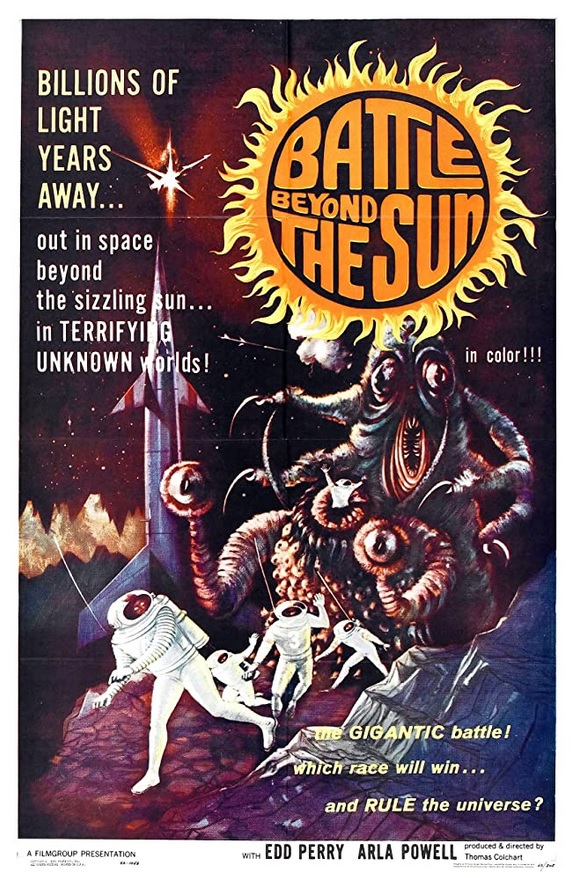
I’m taking a hardline on this review: this movie sucks the stars out of the deepest black hole in the deepest regions of the universe and deserves to be forever public domain-buried on DVD box sets. I know, shocking. I am not usually that rough on a film — new or classic — and I’ll always find the positive in a film.

Sorry, but I get cranky when the celluloid snake oil salesmen and analog hucksters take scissors (yes, and I mean Roger Corman and then film-school student Francis Ford Coppola) to my beloved Russian sci-fi forefathers to Stanley Kubrick’s 2001: A Space Odyssey.

Hiding behind this Roger Corman hack job is a beautiful film known as 1959’s Nebo Zovyot, aka The Sky Calls, by Valery Fokin and Mikhail Karzhukov. Also translated as The Heavens Beacon, the story concerns the galactic competition between the United States and Russia to execute the first mission to Mars. When an American spaceship requests repairs from a Russian crew, they come to discover their Russian saviors are on their way to Mars; the Americans set sail to beat the Russians, veer off-course, become lost in space, and the Russians scrub their mission to save the American crew.

So great are the Yuri Shvets production designs on Nebo Zovyot, Stanley Kubrick hired Shvets to work on 2001: A Space Odyssey during its pre-production stages. Sadly, Shevts’s greatness is lost, courtesy of Corman’s Americanization (read: bastardization) as Battle Beyond the Sun — which also features unrelated special effects inserts from Mikhail Karzhukov’s next film, Mechte Navstrechu, aka A Dream Come True (1963).

You’ve also seen special effects shots from Nebo Zovyot repurposed in the John Saxon*-starring space vampire romp Queen of Blood (1966), which is actually the Americanized version of Mechte Navstrechu.

And since we’re on the subject — and although Queen of Blood is not on this particular Mill Creek box set: In the plot of Mechte Navstrechu, the inhabitants of a distant planet receive a radio transmission of an Earth-based love song; they send a ship to investigate. When the alien mission crash lands on Phobos, a Mars moon, the Earth receives a distress call to rescue the survivors; technical problems and the harsh landscape threaten the mission. See? There’s no space vampires.

And the pillaging of frames from Nebo Zovyot gets worse.

Instead of leaving Pavel Klushantsev’s 1962 masterpiece Planeta Bur, aka Planet of Storms, intact, Corman snake oil-it into 1965’s Voyage to the Prehistoric Planet. Then he revamped it a second time, with with inserts from Nebo Zovyot — and added a few bear skinned-clad bikini cavewomen (courtesy of Peter Bogdanovich, aka Derek Thomas) — as Voyage to the Planet of Prehistoric Women (also known on American UHF television as Gill Women of Venus).

You can watch Nebo Zovyot with English subtitles on You Tube and an even better, pristine non-subtitled copy on You Tube — so you can sample the film’s superior quality, in lieu of the washed-out, dubbed-from-VHS prints of Battle Beyond the Sun that appear on public domain DVDs. Sorry, I can’t in good conscious provide a link to a rip of Battle Beyond the Sun. You’ll have do it yourself.

We get into Nebo Zovot, Planeta Bur and other Russian sci-fi films dating from 1924 to the early ’80s with our “Exploring: The Russian Antecedents of 2001: A Space Odyssey” featurette during our month-long Star Wars tribute last December. However, until we get a Russian Sci-Fi box set of all those great films uncut, you can have your own copy of Battle Beyond the Sun on the uber-cool Mill Creek Sci-Fi Box Set.

Stratten! Ventura! Hamill! Whoa, baby!

* Don’t forget to check out our “Exploring: John Saxon” tribute.

About the Author: You can learn more about the writings of R.D Francis on Facebook. He also writes for B&S About Movies.

Mill Creek Sci-Fi Invasion: Brother from Another Planet (1984)

ABOUT THE AUTHOR: Jennifer Upton is an American (non-werewolf) memoir writer for Story Terrace in London. You can read more of her film, books and music reviews at https://www.jennuptonwriter.com and on her blog https://womanycom.wordpress.com.

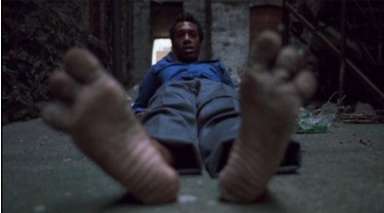
The best Science Fiction holds a mirror up to the society from which it sprang. Brother From Another Planet (1984) does this in several innovative ways. Written and directed by John Sayles, it tells the story of a three-toed empathic runaway alien slave (T2’s Joe Morton) stranded on earth. Despite the fact he cannot speak and is never named, he is one of the most sympathetic aliens ever committed to film. He hears and feels the past through surfaces. Upon landing on Ellis Island, he becomes overwhelmed by the voices of the past – a full 36 years before Klaus in The Umbrella Academy.

As much as Morton is the star of the film, Harlem – where “the brother” finds sanctuary – is his co-star. All the locations are real and at times it looks as if the people in the background were passers-by rather than paid extras. On life as person of color in the city, one character offers the opinion, “I’d rather be a cockroach on a baseboard up here, than the Emperor of Mississippi.” The brother likely feels the same way, albeit about his home planet.

At times, the narrative feels more like a series of short films, than a feature film, with each scene introducing a new character as the brother navigates his way through new earthly experiences. When he’s not working at fixing old arcade games with his special powers, he hangs out in a local bar.  The regulars speculate as to his predicament, although they never guess he’s not “one of them.” 

The brother’s silence leaves ample room for one-sided conversations. Funniest of all is when a couple of tourists from the mid-west spend hours drinking with him believing themselves to be interacting with a genuine big city “local.” All the people the alien encounters offer him a chance to learn about humanity. Conversely, they all see a bit of themselves in him, completely oblivious to his true identity. It’s a powerful testament to the phenomena of psychological projection while also tackling the nature of xenophobia. Essentially, what the film is saying is that it’s what we believe about others that leads to understanding and fellowship, regardless of whether those beliefs are rooted in truth. 

The residents of Harlem all treat brother kindly, giving him shelter and a job. He even falls in love, although it’s never clear if he’ll see her again. Like many of the vignettes in the plot, this one is left open-ended.

The only unsympathetic characters in the entire film are the two white “men in black” pursuing “brother” from their home planet (played by Sayles himself and a young David Strathairn.) The film concludes with others of the brother’s kind who have also assimilated into earth society coming to his assistance. Seeing they’re outnumbered, the pursuers humorously flee proving there’s power in numbers if only we’d realize it.

Overall, it’s a great movie and very different for 1984. Back then, everyone was in love with cute little aliens with glowing fingers. Brother From Another Planet isn’t sci-fi for kids and thankfully, has none of the ‘80s trappings. There are precious few special effects (although the brother’s removable eyeball that records the past was very realistic), it has only one cute kid who is not the least bit precocious, and the visitor from space never goes home. What does it have that those other films don’t? A great deal more intelligence. It’s filled with enough American history analogies and yes – heart – to keep even the staunchest sci-fi fan happy. Given the current state of racial and immigration affairs in the United States and across the globe, the film’s message of acceptance has definitely withstood the test of time. In short, I liked it. A lot. Fans of great writing, documentary-style filmmaking and terrific acting will, too.

Mill Creek Sci-Fi Invasion: The Amazing Transparent Man (1960)

Editor’s Note: The review previous ran on November 4, 2019, as part of our Mill Creek Pure Terror month-long tribute.

ABOUT THE AUTHOR: Craig Edwards is an award-winning blogger as well as a self-proclaimed Media Guy and a consumer of pop culture for a lot of years. He also writes a great blog called Let’s Get Out of Here

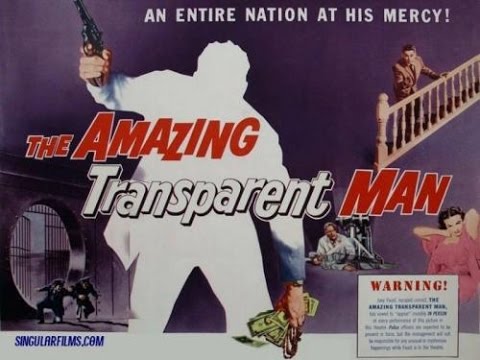
Famed low budget director Edgar G. Ulmer helms this science fiction flick which has apparently fallen into the public domain, which resulted in it being available on countless bargain VHS tapes and now in untold numbers of cheapie DVD sets, much like the very one we’re shining the spotlight on.

Former Army guy Krenner (James Griffith), plans to conquer the world with his soon-to-be army of invisible thugs and he is willing to do anything to make that happen. Krenner forces Dr. Ulof (Ivan Trisault) to work to perfect the invisibility machine Ulof invented. He keeps Ulof’s daughter, Maria (Carmel Daniel) as a hostage with the help of his henchman, Julian (Red Morgan). Ulof needs radioactive elements to improve the invisibility machine which are understandably rare and kept under guard in government facilities. Krenner busts Joey Faust (Douglas Kennedy) out of prison to steal the materials he needs. Faust pulls the robberies using the invisibility power – but chaffs working for the dictatorial Krenner. Soon everyone in the house, including Krenner’s girlfriend Laura (Marguerite Chapman) is working some kind of double cross or secret agenda; and it’s readily apparent that no one is particularly likable – so who’s going to be the treacherous victor?

While it’s obviously a very low budget talkfest, there’s just SOMETHING about Edgar G. Ulmer’s movies that interest me. Consequently, I like this little dud which is usually touted as one of the worst of all time. Ulmer only made two more movies before retiring; but his touch is still evident all over this. Sure, it’s low-budget; it’s static; it’s talky – but I’ve seen it now like three times, and I still enjoy it.

I can’t defend the movie – but to me this works – it’s not an epic of production values and amazing effects – though there are a few sprinkled in – but it works as the little sci-fi talkfest it is. If it sounds at all interesting it is worth a look and it’s certainly not hard to find.

Mill Creek Sci-Fi Invasion: Hundra (1983)

ABOUT THE AUTHOR: Eric Wrazen is a Technical Director and Sound Designer for live theatre, specializing in the genre of horror, and is the Technical Director the Festival de la Bête Noire – a horror theatre festival held every February in Montreal, Canada. You can see Eric as an occasional host and performer on Bête Noire’s Screaming Sunday Variety Hour on Facebook live. An avid movie and music fanatic since an early age, this is Eric’s first foray into movie reviewing.

Preamble:

 Senti-Metal Movie Reviews believes that some things just belong together, like seafood and fine wine, pizza and beer, and of course… questionable B-movies and face-melting heavy metal! 

 A movie might have zero budget, bad acting, and terrible plotting, but just add a pounding metal soundtrack, and it magically becomes an instant party movie masterpiece! 

 Exhibit B:

 Hundra (1983) 

Senti-Metal Soundtrack: Plasmatics – Metal Priestess (1981)

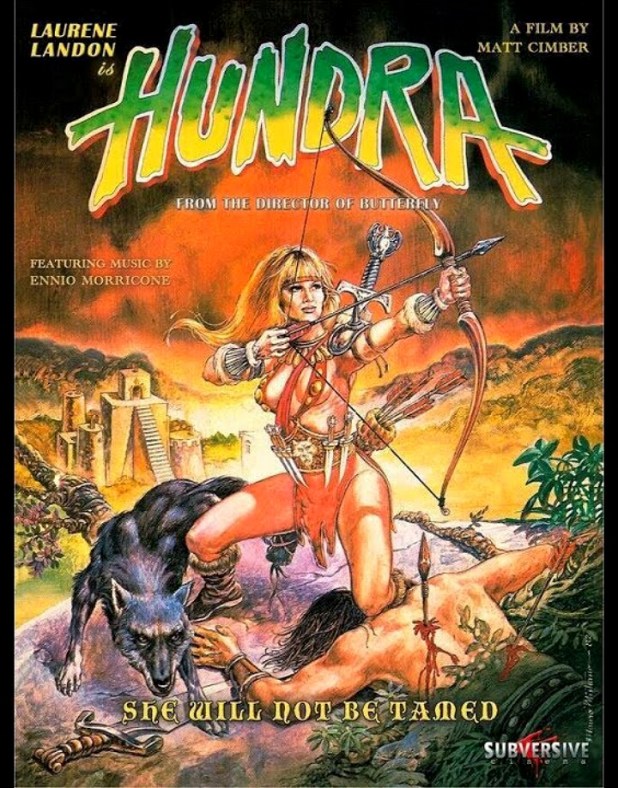
From the description: Born in a tribe of fierce warrior women, Hundra has been raised to despise the influence of men. Hundra finds her family slain and takes a vow of revenge until one day she meets her match.

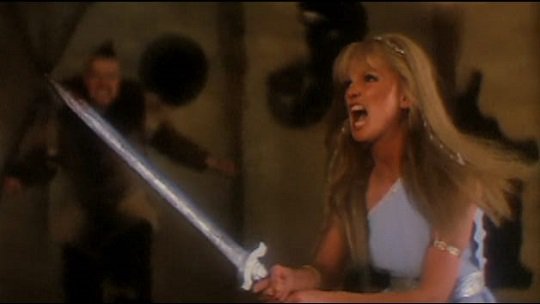
Hundra was an Italian-Spanish-American production co-written and directed by Matt Cimber, who went on to co-create and direct the Gorgeous Ladies of Wrestling (GLOW) television series. Mr. Cimber definitely seems to have an interest in ass-kicking amazons, because a large portion of Hundra’s running time is dedicated to Hundra (played by the statuesque Laurene Landon) partaking in various forms of ass-kicking combat.

Hundra is the classic tale of an amazon warrior out to get revenge for the slaughter of her “women only” tribe, and also get pregnant in order to repopulate said tribe. And if you think

these sound like conflicting goals…. You would be right.

Therein lies the conundrum of Hunrda… finding that subtle balance between copulating with men to save your race whilst also ruthlessly killing as many men as you can lay your hands, legs, sword, spear, daggers, and arrows on.

Note: I cannot think of a better Metal pairing for Hundra than the classic album Metal Priestess by Wendy O Williams and the Plasmatics. Let’s face it, Wendy O could have literally played Hundra in this movie, and she could have even brought her own wardrobe! 

Try queueing up track 2 of Metal Priestess (Doom Song) right around when Hundra finds her destroyed village. 

The driving force of the movie is the action scenes of Hundra battling various hordes of bumbling men… and a good few of these scenes are played for laughs as much as action. It is worth noting that Laurene Landon apparently did all her own stunts in Hundra, which is pretty damn impressive.

Anytime Hundra gets physical (and this happens a lot) is a good time to jump to the next track in the Metal Priestess album, which kicks as much ass as Hundra herself.

Overall, Hundra is a fun sword and sandal epic with a sorta feminist twist, and I have to stress the “sorta”. While it’s fairly clear from the outset that Hundra will prevail in her quest, there are still quite a few scenes in this movie that were a little too “rapey” for my tastes. I have a feeling that Mr. Cimber may have been using John Norman’s “Gor” books as source material for Hundra because I found a little too much of male dominance / female submission in the overall tone of the film. 

So, aside from those uncomfortable moments, Hundra moves at a pretty good pace and if you, like Mr. Cimber, have an eye for “wrasslin’ she babes”, then Hundra is definitely the movie for you!

Note: Both the movie and the Senti-Metal Soundtrack can be found on YouTube:

Hundra (1983)

Plasmatics – Metal Priestess (1981)

Mill Creek Sci-Fi Invasion: Rocket Attack U.S.A. (1958)

“Barry Mahon is magic. And madness, too.”
— Sam Panico, Chief Cook, Bottle Washer, and Master of Vodka Ceremonies

There’s nothing like Russia launching Sputnik, the Earth’s first orbiting artifical satellite, to instill some good ol’ fashioned paranoid propaganda and convoluted espionage conspiracies placed in a melodramatic sci-fi setting to fuel the destructive spread of McCarthyism across America. Sadly, the proceedings are so Ed Woodian in their documentary-styled cheapness and hackneyed dialog that everyone laughed — and probably became “Red Sympathizers” as result.

A male-female team of U.S. secret agents infiltrate the U.S.S.R. as result of British Intelligence (Oy! Is this another “Steele dossier” to bite our arses, mates?) uncovering a Russian plot to bomb America — via intel gathered by Sputnik. The agents fail in their mission to sabotage the attack. They’re killed.

Due to our defective-cum-inaffective counter defense system (Where’s General Jack Berringer?! Flush the bombers!), Manhattan is hit and three million are killed. And since the Russians are cold-hearted war mongers who starve their citizens to fund the military, the peace-loving welfare state of America can’t launch an effective counterstrike.

We all die. Thanks for nothing, Joshua.

Seriously. That’s the movie. And it comes courtesy of . . . Exploit Productions! Seriously. That’s the name of the production company that stitched together this “exploitative” stock footage and voice over extravaganza.

God Bless you, Barry Mahon, we bow to ye. For you gave us The Wonderful Land of Oz and Santa and the Ice Cream Bunny, along with a baker’s dozen of shorts with the word “Nude” in the title, and a rockin’ tale about a ghostly pirate haunting acid-rockers Iron Butterfly at Pirate’s World in Dania Beach, Florida, known as Musical Mutiny.

And we’re thankful this public domain clunker of clunkers is only 64 minutes long. But it was 64 minutes too long for actor John McKay, who made this his fourth and final film. His co-star, Monica Davis, pressed on for a few more years, closing out her career with the bootleggers vs. sheriff vs. local gangsters Drive-In romp The Road Hustlers (1968) — which needs to be put on the B&S About Movies shortlist for a review.

And while you’re at it, General Beringer . . . oh, never mind.

For the discriminating, Barry Mahon completest only, this one is on You Tube and preserved it all of its muddy, digital glory courtesy of Mill Creek’s Sci-Fi Invasion box set.

About the Author: You can learn more about the writings of R.D Francis on Facebook. He also writes for B&S About Movies.

Mill Creek Sci-Fi Invasion: Trapped by Televison (1936)

“Gee, ain’t science great?!”
— Bill collector Rocky O’Neil

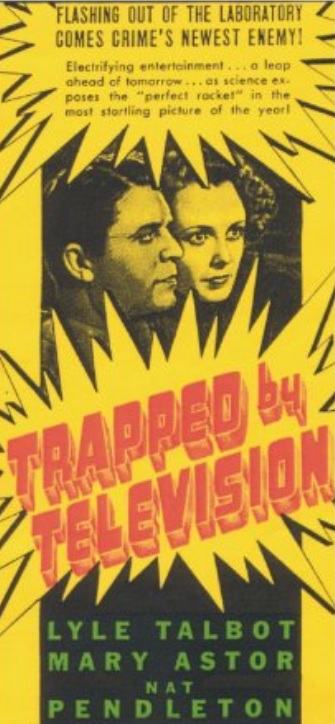
Forrest Gump had a box of chocolates. For the movie hound staff of B&S About Movies, we have Mill Creek boxes of DVDs where you never know what you’re going to get. Well, you do know what your going to get: pure programming insanity. Who in their right mind would collate the adventures of Paco Querak in Hands of Steel (which is also available on ‘the Creek’s Pure Terror box set) into the same box set as this Columbia Pictures “who done it” starring former silent screen star Mary Astor, who worked her way up to a forever-remembered role as Brigid O’Shaughnessy alongside Bogey in The Maltese Falcon (1941) (de rigueur viewing for any movie hound reading this). Oh, and she won an Academy Award for Best Supporting Actress that same year for her portrayal of concert pianist Sandra Kovak in (a film that no one remembers) The Great Lie (1941).

Again. Ex-B movie actress-cum-Oscar winner Mary Astor and Joe D’Amoto’s go-to actor George Eastman . . . on the same box set. Pure insanity. Why? Because, outside of the plot backdrop of the “new” technology of television, this isn’t even a sci-fi movie: it’s a Columbia B-movie comedy starring Lyle Talbot, who excelled at . . . B-movie comedies and romantic thrillers (and later co-starred on ’50s TV’s Ozzie & Harriet).

Hey, wait a minute . . . you sure this isn’t a repack of Murdered by Television starring Bela Lugosi? Nope. That was released a year earlier, in 1936. Remember all of those post-WarGames movies in the ’80s obsessed with the “new” technology of home computers? Then all of those “net” movies in the early ’90s? Well, it that was like that in during the Industrial Revolution of the 1930s — with Hollywood obsessed with television as plot fodder.

Anyway, the always dependable Talbot is Fred Dennis, a broke inventor dogged by Rocky O’Neil (Nat Pendleton), a kind-hearted, mobster-backed bill collector. Hey, gang! Fred’s finally done it: his TV camera and TV monitor (a television set) works! His trusted romantic sidekick is Astor’s Barbara “Bobby” Blake (well, the “hot babe with a guy’s name” screenwriting trope had to start somewhere), blessed with a knack for advertising and promotion; she’s going sell Fred’s invention and they’ll be rich. Corporate intrigue — as we oft say around here — ensues, as gangsters, competing scientists, and electronics companies vie for the invention, with Talbot, Astor, and Pendleton — along with everyone’s favorite Lucille Ball clone, Joyce Compton (in that always annoying pillbox hat) — keeping one step ahead of the lighthearted mayhem.

The twist to this oldie: it’s actually pretty good. And you can watch it on You Tube.

The script by Lee Loeb and Harold Buchman (whose resumes stretch from the early ’30s into the mid-70s across TV and film) is well-written from a technological standpoint (there’s no slapstick-crazy Doc Browns pushing junk science flux capacitors) and the acting isn’t that bad. If you’re a Nat Pendleton and Joyce Compton completest — and need a fix of Bela — you can catch them together in the MacGuffin-strewn noir Scared to Death (1947), which, as it turns out, Mill Creek featured on their Pure Terror box set (recapped here). (Oh, and if you’re interested: we covered all of the films in their Chilling Classics set; recapped here.)

What would we do without Mill Creek box sets supplying us with movies? I don’t even want to think of a Mill Creekless world. Do you? But still . . . this movie encased in a box with artwork featuring a futuristic city under destruction by space ships . . . and Dorothy Statten’s name . . . is pure insanity. And we love it.

Now, let me get to work on my new Lifetime-oriented screenplay: Trapped by Phone App.

About the Author: You can learn more about the writings of R.D Francis on Facebook. He also writes for B&S About Movies.

Mill Creek Sci-Fi Invasion: The Creeping Terror (1964)

ABOUT THE AUTHOR: Jennifer Upton is an American (non-werewolf) memoir writer for Story Terrace in London. You can read more of her film, books and music reviews at https://www.jennuptonwriter.com and on her blog https://womanycom.wordpress.com.

For years I searched for the worst movie ever made. I’ve dove deep. So deep, that time and experience have made me realize there is no single title that unequivocally holds that title. Crap is in the eye of the beholder. Nevertheless, The Creeping Terror (1964) is definitely in the running. It is bad in just about every way imaginable.

Is it the good kind of bad? The kind where you can slam back a few shots and laugh harder than at any Rob Schneider movie ever made? Yes. Yes, it is. For even more laughs, watch the Mystery Science Theater 3000 version. The segment where Mike plays the incredibly monotonous jazz music from the film’s dance hall scene on his sweet new sound system is one of the best things to come out of that show’s sixth season. I digress. 

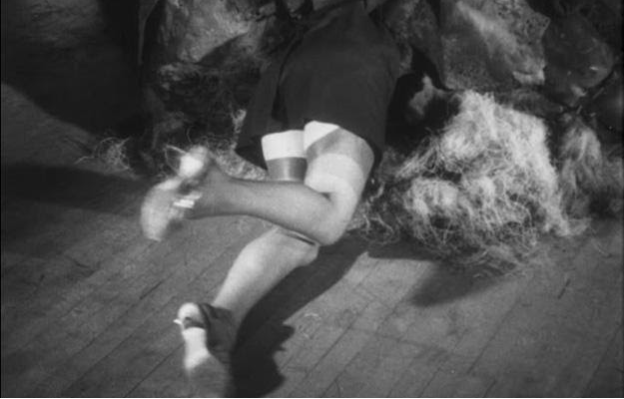
The Creeping Terror’s story concerns a newlywed law man named Martin played by the writer and director Vic Savage. On the way back from their honeymoon, Martin and his new bride Brett (Shannon O’Neil) stumble upon his Uncle – the town sheriff – investigating a crashed alien spacecraft that looks remarkably like a camper under a tarp. It isn’t long before the monsters inside (one actually) ravage the community and start eating people left and right. It especially likes the ladies, whose bodies are pulled in head first, leaving nothing but a pair of sexy legs sticking out.

They call a scientist named Dr. Bradford (William Thourlby) and the group attempts to capture the monster to no avail. We later find out that the animals were engineered as mobile laboratories to consume and analyze human beings and send the data back to their masters. The military comes in and blows it up with a grenade. Just after transmitting the data into space, the monsters’ craft explodes. Will the aliens launch a full-scale invasion? Who knows? Who cares? 

Savage’s story is far more interesting than the movie he made as chronicled in the docudrama The Creep Behind the Camera (2014.) A womanizing, physically abusive con-man with mob ties, it’s never really clear whether Savage thought he was making a good movie or if the whole thing was just a hustle to fleece investors. Given that Mr. Savage disappeared after making the movie, the latter seems to be the most likely scenario. 

Technically, the film is inept. The camera work is shoddy and screen direction is minimal. What we’re left with a disjointed series of shots of people looking the wrong way at something that isn’t there sewn together by a poorly dubbed narration that tries to cover up the fact that the soundtrack was either lost or never recorded in the first place. It makes Plan Nine from Outer Space look like a masterpiece by comparison. 

The design of the creature is odd, to say the least. It’s basically a giant carpet with a head stuck on. It has flexible tubing resembling dreadlocks with eyeballs on the ends for hair (which jiggle when the monster creeps) and another pair of weirdly cute button eyes on its “face.” The remaining props and sets are no better. The inside of the spacecraft is clearly a power station. The army transport vehicle is a farmer’s truck with wood paneling on the rear and the newlywed’s shabbily furnished apartment is…Vic Savage’s shabbily furnished apartment.

It may sound like I’m recommending people not watch this film. Quite the contrary. The riveting fishing scene with Bobby and Grandpa is so hilariously bad, it must be seen to be believed. In it, a young boy wanders away from his extremely round-bodied be-spectacled Grandpa fishing by a river. After a little while, Grandpa – who is wearing pants pulled up to his nipples – wanders around aimlessly yelling “Bobby! Bobby!” hoarsely for a good long while before being eaten. All while Bobby obliviously chases lizards and plays with a stick nearby. Randomly, and when I least expected it, I once received a link to this scene as a text from a friend in Los Angeles at 3am with only the word “Bobby!” as descriptor. A scene that master riffer Crow T. Robot referred to as “a portrayal of deep, clinical depression.” No matter how many times I see this scene (even without the riffs,) it never fails to crack me up. 

If you’re the kind of person who loves bad movies, then go for it. If not, it’s probably best to avoid this one. To jump straight to the Bobby scene, watch below. You’ll be glad you did. 

Sci-Fi Invasion month: It’s Alive! (1969)

ABOUT THE AUTHOR: JH Rood is from El Paso, Texas. He’s part of Ghoul Inc. Productions, a DIY group who are inspired by Roger Corman, Larry Buchanan, Frank Henenlotter, Herschell Gordon Lewis, Edward D. Wood, Jr., S.F. Brownrigg, Barry Mahon and others. I’m so glad that he took this movie, as I knew he’d not only  tell us about how it got made, but share why it means so much to him.

There’s a legend in these here hills: “When it rains and the sun shines at the same time, The Devil is kissing his wife”. And thus begins the odyssey of It’s Alive! Now, there are two films with that title, and it so happens that they were both directed by guys named Larry. This is not the mutant baby flick from 1974 brought to us by Larry Cohen. This It’s Alive! (yes, the exclamation point belongs there) predates the more well known of the two by 6 years, and was directed by Larry Buchanan. It tells the story of a freshly married couple from New York on a road trip to California, who take a wrong turn down south and run out of gas. They bump into a paleontologist named Wayne Thomas (Tommy Kirk, who appeared in a whole slew of Disney movies back in the day) who tells them there’s a house a few miles down the road with a gas pump, and they could probably find some assistance there. The couple follow his directions and find themselves at the home of an odd fellow named Greely, played by late, great Texas actor Billy Thurman, who was a Buchanan Alum and had appeared in a number of his pictures throughout the 1960’s. Greely lives with his housekeeper, Bella (Annabelle MacAdams, aka Annabelle Weenick, another Buchanan regular) in a large, creepy house in the middle of freakin’ nowhere, and runs a small roadside zoo with coyotes, lizards, snakes and various other indigenous critters. Greely is strange yet friendly at first, and explains to the stranded couple, Norman and Leilla Sterns (played by Corveth Ousterhouse and Shirley Bonne) that his zoo and gas pump were once his livelihood, before they built the new interstate and cut him off from civilization. He mentions his disdain for “The Highway People” and shows some signs of psychosis, but invites the couple inside his home to rest up a bit before the gasoline transport truck shows up to fill his tank and they can go on their merry way. Norman is a curt, rude, stereotypical New Yorker and is about as likable as a painful pimple, while Leilla is genuinely kind and rather naïve. Once inside the ginormous house, they’re introduced to Bella, who comes off as shell shocked, skiddish and mildly terrified, like a frightened dog. It’s apparent that Greely is perhaps not the easiest man to work for. For reasons unknown, Greely excuses himself to go outside and leaves the couple with Bella. While outside, Mr. Thomas shows up to check on the Sterns’. He’s greeted by a smiling Greely, and explains that he’s the one who suggested the couple ask him for help. He pops the hood on the couple’s car and asks Greely to retrieve a screwdriver from his Jeep. Greely happily obliges, but returns with a large, blunt wrench instead, and bashes Thomas over the head. He then drags the unconscious man away.

Back in the house, Bella nervously serves tea, and the stranded couple becomes more agitated with their current situation. A jovial, smiling Greely pops in, and sensing the tension, invites them to pass the time looking at the animals in his zoo. The couple agrees, mostly because they haven’t much else to do, and a caged bobcat probably seems like better company than Bella at this point. They meander their way to the crude wood and chicken wire enclosures and peer in on the poor captive animals. Greely points to the entrance of a cave, and tells Norman and Leilla that within that cave is his “prized possession”. The couple exchange glances, as if telepathically telling each other “eh, what the hell” and follow Greely into the cave. The three meander their way down dark, dank catacombs for what probably felt like an eternity, until they reach a large, dark room. Greely excuses himself to go turn the lights on, but instead pulls a lever that brings down large iron bars, trapping Norman and Leilla inside the cave. Big surprise: Greely is nuts!

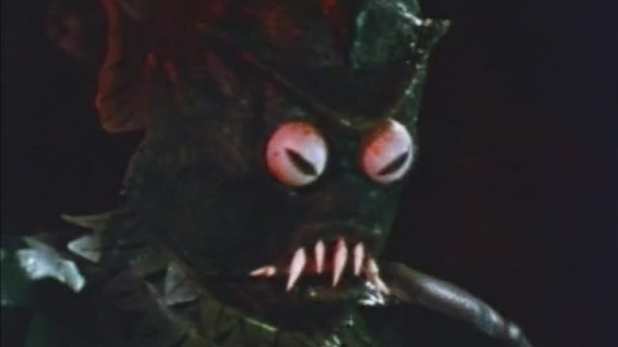
After cackling maniacally and walking away, Greely disappears back to the house to have supper with Bella, leaving Norman and Leilla befuddled and terrified. Luckily, our buddy Wayne is in the cave, too, and after waking up from that nasty bump on the head, the three begin to assess their situation. Bella returns with some food a short time later, and after being pleaded with by the three captives, she tells them that she wants to help them, but she simply can’t. If she upsets Greely, he will feed her to “it”, the “Thing” that Greeley keeps in that cave that has disposed of all the other unfortunate souls who found themselves at his place. Evidently, Greeley isn’t the only monster around here. A short while later, Norman makes his way through the winding passageways of the cavern and awakens the monster! From out of the bubbling water of a hot spring comes a lizard-like creature with a massive overbite and ping-pong balls for eyes, looking like a bargain basement Sleestak. This particular monster getup was actually recycled from a previous Buchanan film, Creature of Destruction. Without going into too much detail and letting any spoilers slip through, we learn a bit more about our boy Greely and his pet
monster and how Bella came to be in Greely’s “employ”, and the whole thing plays out about as predictably as one would expect, though like most Buchanan films, it’s thoroughly entertaining through and through.

When looking at Larry Buchanan’s body of work, the films that tend to stand out, and the films he’s mostly known for, are the ultra-cheesy, made-for-television flicks from Azalea Pictures and American International, of which It’s Alive!  was the last. These films were greenlighted by Sam Arkoff, who was recycling scripts from earlier, successful films that were released theatrically. More often than not, Arkoff would get Buchanan on the phone and say something like “I need this picture made, and I need it done yesterday!”. Larry Buchanan was no stranger to working under pressure and thinking outside the box. Often times, given the extreme time and budget limitations, he would devise ways to get a scene across that was crude but effective, such as smearing petroleum jelly mixed with blue food coloring on a camera lens to create a day-for-night effect. Larry was a real trooper, and put up with things many of his contemporaries wouldn’t. His resiliency could be traced back to his beginnings, which were less than ideal for anyone. Born on the last day of January in 1923 in Lost Prairie, Texas, Larry was orphaned at an early age, and was brought up in a crowded orphan’s home just outside the Dallas metro area. He showed a serious interest in motion pictures at an early age, and was unofficially “adopted” by some of the folks at the Variety Club, a show business club in Dallas. They would give young Larry free passes to the various picture shows around town, and they let him dig through the discarded reels of film that wound up on their cutting room floor. Larry would carefully edit the mish-mash of reels together, and show them to the other kids at the orphanage, using a donated projector. Most of these were industrial films with no sound, so Larry would invent stories to go along with what was happening on the screen and do a live narrative for the other children. After high school, Larry hitchhiked to Los Angeles and managed to get a job at Fox studios briefly, before relocating to New York to join the Army Signal Corps and make military training films. At this time, Larry also began to produce short, one-reel films such as The Cowboy and The Wetback, which caught the attention of the Jamieson Film Company in Dallas, who reached out to Larry and beckoned him back to the Lone Star State. Having just become a father and not wanting to bring up a family in New York, he jumped at the opportunity to return home and make movies, a real win/win for him.

Before cementing his cinematic legacy as a schlockmeister responsible for such film as Curse of the Swamp CreatureMars Need Women and Zontar: The Thing from Venus. Larry had more dramatic aspirations, and it shows in some of his earlier work. Films like High Yellow and Free, White and 21 teetered on blaxploitation, but with more heart, feeling and social conscience. His 1964 film The Trial of Lee Harvey Oswald presented audiences with a controversial yet welcomed “what if” storyline about the man who assassinated President Kennedy getting the trial denied to him by Jack Ruby. All in all, Larry helmed over 40 films during his career, and is today considered the father of the Texas feature film industry. Far from being a household name, his influence has had a ripple effect throughout the world of cinema. That young orphan boy from rural Texas who dreamed of growing up and making motion pictures did just that, and he did it with a fervent zeal. So, when you settle into watch It’s Alive!, or any other Buchanan film, I challenge you to not envision that precocious lad gleefully piecing together random bits of discarded film from the bottom of a trash bin as he concocted wild, imaginative stories to go along with them for nothing more than the entertainment of his peers. Larry is one of those filmmakers I look up to and admire the most, because he could make something from nothing. His films are a middle finger in the face of cinematic pretention and snobbery, simply by existing.

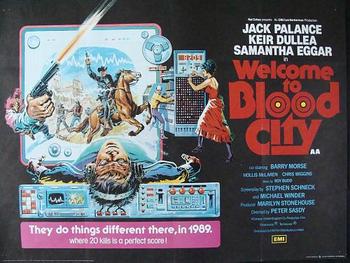
Mill Creek Sci-Fi Invasion: Welcome to Blood City (1977)

Editor’s Note: This review previously ran on April 19, 2018.

Sometimes, I just sit and search through YouTube looking for a movie to watch while I work. Often, that search finds horrible films that I wouldn’t be able to enjoy if I were truly paying attention to them. And sometimes, like with this movie, I end up taking a break from writing and find something I really enjoy.

Directed by Peter Sasdy (The Lonely LadyTaste the Blood of DraculaHands of the Ripper), this film was a UK/Canadian tax shelter affair. But don’t hold that against it! Five strangers all wake up at the same time and have no memories of who they are, other than that they are all killers. They must travel to a Wild West town called Blood City.

Once there, they will spend a year in servitude before they can become free. Then, they’ll be able to own a business and work toward becoming immortal — free from constant worry of challenges to the death. They get there by winning twenty challenges. And there’s only one law in Blood City — Frendlander, played by Jack Palance. It’s no accident that the bad guy from Shane is playing this part. Palance might only be known to younger folks from his Oscar turn in City Slickers, but in the 1970’s he was taking whatever parts he could get. And then he’d sink his teeth into them! He’s fabulous in this movie!

Keir Dullea (Black Christmas2001The Haunting of Julia) stars as Lewis, who finds himself coming up against Frendlander over and over again. The real secret of the film? None of them are in this town at all — it’s a virtual reality simulation to determine the best warriors in a future war. So basically, it’s a combination of WestWorld and The Matrix.

Samanta Eggar (The Brood) shows up as a scientist who falls in love with Lewis and inserts herself into the virtual reality experiment. Barry Morse is also in here, who you may remember as Lt. Philip Gerard from TV’s The Fugitive. And Chris Wiggins is in this as well. He was Jack Marshak on Friday the 13th: The Series.

If you’re looking for this movie, you can find a horrible transfer of it on the Mill Creek Sci-Fi Invasion 50 Pack. That said, the set is pretty worthwhile, as you also get stuff like The Crater Lake MonsterDeath Machines, Sergio Martino’s Hands of SteelHorror High, the Florinda Bolkan film Le OrmeThe Raiders of AtlantisR.O.T.O.R., Robo Vampire, one of the worst/best films ever Rocket Attack U.S.A. and more.

This is totally part of the doomed 1970’s genre and the end — where Lewis chooses the fantasy of Blood City instead of the lies of modern life — still rings true today. I completely expected a ripoff of WestWorld and FutureWorld, yet was rewarded with something really good. It’s slow moving, but if you understand that and can see a movie for what it could be versus what it is, I think you’ll enjoy it.

Mill Creek Sci-Fi Invasion: Escape from Galaxy 3 (1981)

ABOUT THE AUTHOR: Robert Freese contributes to many different magazines, zines and websites such as Videoscope, Rue Morgue, Drive-in Asylum, Grindhouse Purgatory, Horror and Sons and Lunchmeat VHS. (His most recent piece, about the 80’s video distributor Super Video, can be found here). He also co-hosts the Two Librarians Walk into a Shelf podcast so he has an excuse to expose library patrons to ninja and slasher films. 

Depending on what copy of the movie you are watching, the title is either the really cool sounding Escape from Galaxy 3, or it is a fake looking title card blocking out that title with Starcrash II superimposed over it, in classic Commodore 64 font.

Our movie starts with a space attack. Almost immediately we don’t so much as feel like we’ve seen this all before, but we know for a fact that we have seen this all before because we are watching special effects outtakes from Luigi Cozzi’s 1979 sci-fi-adventure flick Starcrash. You may be tempted to take the disc out to check it to make sure you put in the correct movie, but rest assured, you did.

Cosmic radar has picked up an unidentified space craft in the galaxy. It is Oraclon, the King of the Night and possibly a member of some intergalactic glam-rock Village People cover band. He has big eyes and a glittery beard.

Oraclon wants to claim King Ceylon’s planet for his own. Ceylon’s hot to trot daughter, Princess Belle Star, wears half a dress and a glitter pastie in the shape of a star over her single uncovered breast. She is ordered to get into an escape ship with Captain Lithan and collect the King’s allies before Oraclon can make his next move. (This is “Plan Epsilon,” for whatever reason. Seems like a good old fashion retreat to me.)

When Ceylon refuses to surrender to Oraclon, the Studio 54 disco-reject puts a hurting on Ceylon’s space station and blows up the king’s home planet of Exalon.

Belle Star and Lithan manage to get away from the battle that is just as exciting as it was the first time we watched it in Starcrash. Oraclon, enraged, screams, “You galactic idiots! Imbeciles! We are not returning to the base until I have their heads at my feet!”

After rocketing through space, Belle Star and Lithan discover a strange planet, third from a sun, populated by savages. They crash land and damage their ship. These savage men and women, although cleanly shaven, live in huts and perceive the visitors to be enemies. The atmosphere of the earth enables the Captain and the Princess to display superhuman powers. Naturally, they are quickly sentenced to death.

In a moment before being condemned, Lithan saves a young boy from falling to his death, and then the primitive Earth people love him and the princess and welcome them to live in their village. While living among the cleanly shaven primitives, Belle Star and Lithan spy a young couple partaking in some nookie in the woods. This is odd to them, as physical contact between people is not allowed where they’re from. They are curious. It looks like fun. They decide to try kissing.

Never before has the screen exploded in such raw, non-passionate making of the love. I mean, these two kids kiss like they are sharing the same stick of gum. It is painful to watch, like watching your mom and dad kiss. Later, after a nude swim under a waterfall, one of the savages loves up Belle Star and she is enthusiastic for Lithan to try it. He can’t seem to get into the spirit of her experimentations. Just then, a trio of young people, two girls and a guy, come walking by and Belle Star suggests they basically engage in some group lovin’. Everyone is for it but before they can bang a gong and get it on, Oraclon learns where they are and announces he is coming for them. They try to decide what to do and finally feel it is best to leave once the final repairs on their ship are completed.

That night, at the Festival of Love, young men battle in odd, elementary school “Field Day” type competitions to win the opportunity to bed down and make the intercourse with any female they desire. The winner takes Belle Star. She looks longingly at Lithan. Lithan feels jealous and takes a young lady to his bed for a passionless coupling.

Both Belle Star and Lithan imagine the other’s head on the bodies of the people they are shagging. (I think it is safe to say that the similar scene of Tom Hanks imagining different peoples’ heads on Monique Gabrielle’s body in Bachelor Party (1984) drew quite a bit of inspiration from this scene.)

When Oraclon finally attacks Earth, they flee. While on the spaceship and drifting through space, they become bored, so they make sweet, sweet intergalactic nookie. Disgusted, Oraclon watches from a sensor screen and exclaims, “What are they doing?! I don’t understand!!!”

Like a jealous 13-year-old who hangs out with two friends, another guy, and a girl, and love suddenly connects the other guy and the girl, Oraclon vows to destroy Lithan and take Belle Star as his slave. He’ll show them! He has captured all the remaining kings of the different galaxy worlds to bare witness to his cosmic hissy fit. Belle Star tells her soon to be master, “After thousands of years, our sexual powers have come back to life and we haven’t suffered any harm. On the contrary. We’ve acquired a powerful new dimension.”

Aghast, Oraclon and his giant eyes and weird glittery glam beard look at the princess like she has lost her damn mind and wails again, “I don’t understand!”

At last, Belle Star surrenders to Oraclon. He declares that she will be his slave. Captain Lithan is condemned to slave labor, per Oraclon, “For the rest of his cosmic life!”

Belle Star and Lithan kiss, profess their love for one another, and then accept their fate as they stare longingly into each other’s glazed eyes.

In this one moment, Oraclon appears to honestly feel bad for being such an evil jerk. It’s as if he wants to say something, release these two crazy kids so they can experience a life of love and happiness, but his pride and his glitter glam beard keep him from saying anything. Surprisingly, this is a character of great depth, far from perfect, in constant conflict with his true self. (Just possibly, there is a piece of Oraclon in all of us.)

Belle Star goes to Oraclon, accepting her fate, and kisses him. At that precise moment, Lithan shoots eye beams into Belle Star, which pulse through her body and electrocute Oraclon, rendering him into little more than a smoldering pile of charcoal briquettes. They free the kings, set Oraclon’s ship to self-destruct and escape back to Earth, where they can be free and happy and enjoy the making of the savage love of the primitives. It ends with a nude midnight beach frolic, as the strange cosmic lovers embrace, and the passion squirts out of them as they seemingly share one last stick of gum.

Somehow, I missed this movie back when I was teenager. I mention this only because, as a grown up, I realize what a piece of garbage this movie is, but, as a forever 14-year-old, I really enjoyed the straight Star Wars rip-off plot mixed with a teen sex comedy. I mean, this is like Star Wars meshed with Porky’s.

I can’t say that I can recall too many Star Wars rip-offs that ever had such an emphasis on bedroom space antics. Still, it is not nearly as sleazy as it could have been in the hands of, say, Joe D’Amato. (Oh, my!) It has a juvenile charm. It is not as horrible as many movies I can call to mind.

The reason most people seek this one out is that inappropriate and unfotunated AKA, Starcrash II. Luigi Cozzi’s Starcrash was a hit for New World Pictures and for years various sequels were promised. Several attempts at following it up were made, by many different people. This film claims to be a sequel, but in no way should it ever be considered a sequel, even if Cozzi is sometimes mentioned as a co-director. It seems confusing, but when I had an opportunity to ask Cozzi about it, he cleared it up for me.

According to Cozzi, the Italian executive producer of Starcrash, Luigi Nannerini, was given the rights for Italian distribution. Nannerini thought he could utilize unedited model shots of the spaceships and space footage for an entirely new, low budget science fiction film. Early on, Cozzi said he was interested in making that movie for Nannerini, but the producer refused to give him any money for more optical effects. The only effects would be the unused, unedited footage from Starcrash.

Realizing a movie could not be made like this, Cozzi walked away from the project. Nannerini then hired Adalberto “Bitto” Albertini to put the film together. Released in Italy, the film was a flop. Nannerini went back and inserted hardcore sex scenes into it, only for the film to flop in the hardcore Italian market. (I don’t have any other information on this alternate version, so I don’t know what graphic scenes, if any, were added.) In the end, Nannerini admitted to Cozzi that he had been correct. The film really needed new special effects to make it successful for the science fiction crowd.

When I asked Cozzi if fans of Starcrash should consider Escape from Galaxy 3 a real sequel or continuation to his beloved sci-fi adventure, he did not mince words in his response, saying, “Absolutely not. Escape from Galaxy 3 has nothing to do with me [or] with Starcrash. It’s just a kind of [an] extremely bastard son, a rip-off, a giant theft. A shame. I’d never been able to do such a piece of shit.”

I can certainly understand where Cozzi is coming from with wanting to distance this film with his. But from a certain point of view, Escape from Galaxy 3 has a brain damaged charm that is hard to resist. I mean, if someone said, “Hey, do you want to watch a Star Wars rip-off with a lot of nudity?” What is the possibility that you would pass on watching such a film? Well, Escape from Galaxy 3 is that film.

Now, some bare flesh doesn’t a great flick make. And please don’t think I’m trying to convince you that Escape from Galaxy 3 is some kind of lost “drive-in” classic, because it most certainly is not. It’s a throwaway junk flick made to be watched and forgotten as you go to the next movie on the double bill. For those among us who like their entertainment skewered with weirdness, I don’t believe too many would argue that this film is worth a watch. It is so bizarre, like it was directed with the kiddie market that flocked to Star Wars and Starcrash in mind, but then someone said, “Do you know how many tickets we’ll sell if we show the princess naked?” This is one of those wonderfully weird discoveries within a 50-pack of misfit movies that rises above most in the set to deliver unexpected and surprising entertainment value, especially when you were figuring it was going to be just another Italian Star Wars rip-off. When one considers some of those run of the mill Italian “Sons of Star Wars,” Escape from Galaxy 3 is far from the worst of its ilk.

Don’t forget: We take another look at this film on December 19, 2019, as part of our “Star Wars Month” blow out of films that inspired and were inspired by the vision of George Lucas.