CBS LATE MOVIE MONTH: Murder On the Moon (1989)

EDITOR’S NOTE: Murder On the Moon was on the CBS Late Movie on June 29, 1990.

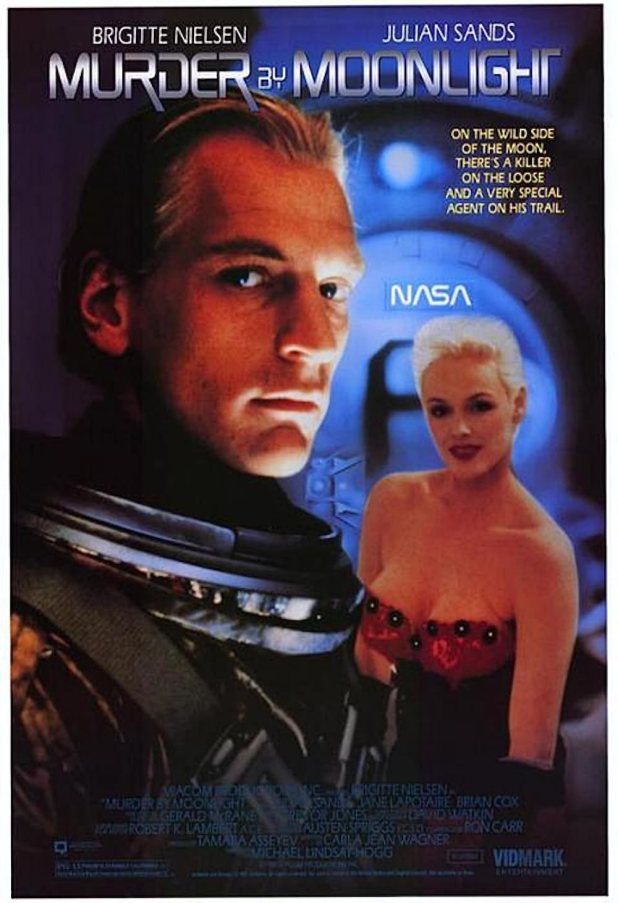
Directed by Michael Lindsay-Hogg and written by Carla Jean Wagner, this is also known as Murder By Moonlight.

After nearly launching a nuclear war, America and Russia decided to work together to colonize the moon. But when several NASA astronauts are found dead, Dennis Huff (Gerald McRaney!) sends Lieutenant Maggie Bartok (Brigitte Nielsen) while Russian drafts Major Sorokin Kirilenko (Julian Sands) to figure out who the killer is.

Can these mismatched space detectives solve the case, compare haircuts and fall in love?

Michael Lindsay-Hogg had a wild career and life. His wife hinted when he was old enough to understand that his father may have been Orson Welles. A DNA test was inconclusive, but Gloria Vanderbilt confirmed the fact for him. He was a director on the British music show Ready Steady Go!, which led to him making clips that later would be known as music videos for the Beatles (“Paperback Writer,” “Hey Jude,” “Revolution,” and “Rain”) and the Rolling Stones (“2000 Light Years from Home,” “Jumpin’ Jack Flash” and “Child of the Moon). He also directed The Rolling Stones’ Rock and Roll Circus and The Beatles’ Get Back, where the Apple rooftop performance comes from and the footage Peter Jackson used for his documentary.

In the 70s, he had great success with Brideshead Revisited and Nasty Habits. In the 80s, he made Simon and Garfunkel’s The Concert in Central Park, Neil Young’s Neil Young in Berlin and Graceland: The African Concert with Paul Simon. And as the 90s came, he made TV movies like Ivana Trump’s For Love Alone.

This has an interesting cast, including Brian Cox, David Yip (Wu Han from Indiana Jones and the Temple of Doom) and Ricco Ross (Private Frost from Aliens). There’s also a completely out-of-left-field trans element that is just as wild in 2023 as it had to be back in 1989.

Sources

Michael Lindsay-Hogg – Wikipedia. https://en.wikipedia.org/wiki/Michael_Lindsay-Hogg

CBS LATE MOVIE MONTH: The Power (1968)

EDITOR’S NOTE: The Power was on the CBS Late Movie on April 7, August 1, 1972 and February 4, 1976.

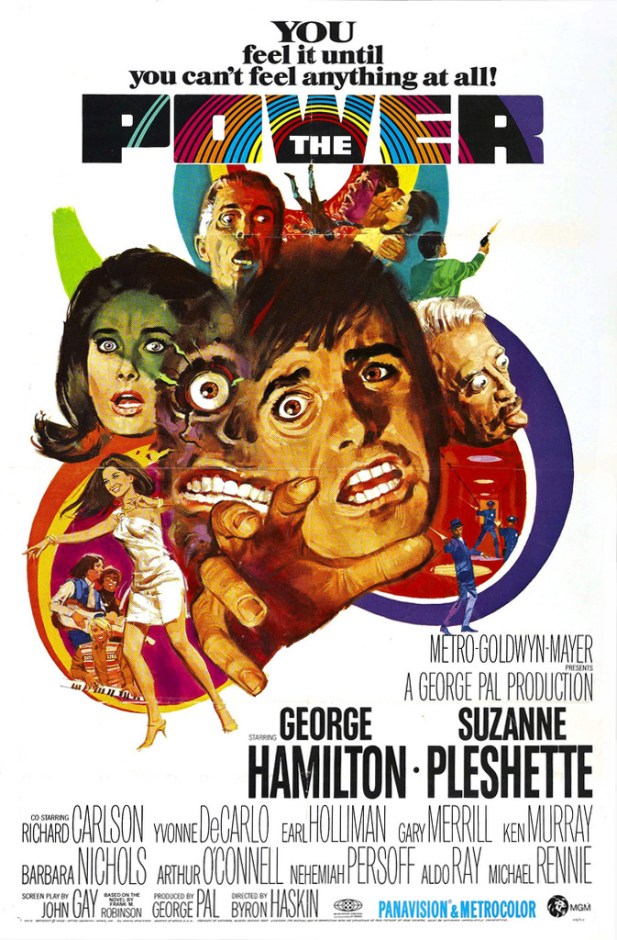
The last film by director Byron Haskin*, who also made War of the Worlds with this film’s producer George Pal, The Power was written by John Gay and based on the book of the same name by Frank M. Robinson. Robinson was also the speechwriter for Harvey Milk and his designated successor, but he didn’t take office after the politician was killed. Another of his books — The Glass Inferno, co-written with Thomas N. Scortia — was combined with Richard Martin Stern’s The Tower and filmed as The Towering Inferno.

The Committee on Human Endurance has been researching the ability to survive pain and physical stress for the space program. Dr. Henry Hallson (Arthur O’Connell) has been screening committee members—biologist Dr. Jim Tanner (George Hamilton), geneticist Dr. Margery Lansing (Suzanne Pleshette), physicist Dr. Carl Melnicker (Nehemiah Persoff), biologist Dr. Talbot Scott (Earl Holliman), Dr. Norman Van Zandt (Richard Carlson) and government liaison Arthur Nordlund (Michael Rennie)—to see who has the best survival ability.

He brings out a psi wheel and claims that someone on the committee has superhuman telekinesis, but the exercise doesn’t prove who it is. He’s soon killed by whoever has the power, and his widow Sally Hallson (Yvonne De Carlo) tells Tanner that a note was left with the name Adam Hart. That was the name of her husband’s childhood friend, whom no one else would know but him.

Tanner becomes the prime suspect when it looks like he lied about his background. He starts to hallucinate and then nearly dies as a result of a psychic attack. Whoever Adam Hart is, he wants him dead. He goes to the man’s hometown and learns that Hart has controlled people there for decades.

This had already been adapted in 1956 as an episode of an hour-long installment of Studio One.

*According to Haskin, the studio was so anxious to be finished with Pal that they ruined this film, casting it with the wrong actors, keeping the budget low and skipping out on many special effects.

You can watch this on Tubi.

CBS LATE MOVIE MONTH: Red Flag: The Ultimate Game (1981)

EDITOR’S NOTE: Red Flag: The Ultimate Game was on the CBS Late Movie on November 2, 1984.

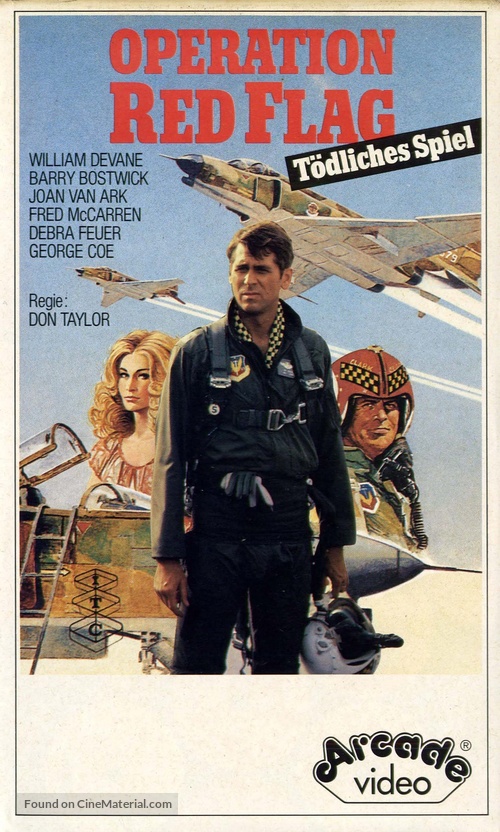
Major Phil Clark (William Devane) and Major Jay Rivers (Barry Bostwick) share a unique bond. Having flown together in Vietnam, they were later assigned to the elite Red Flag Air Force Fighter Weapons School at Nellis AFB, Nevada. Clark, with his loud and self-confident demeanor, is a stark contrast to the quiet Rivers. Their friendship, however, is strong. But when Rivers begins to outshine his mentor, Clark, the dynamics of their relationship are put to the test. Can they maintain their friendship?

Chuck Yeager was the advisor on this, and you get some great F-4 Phantoms in flight. However, a substantial part of the film delves into the on-the-ground relationship drama between Rivers and his wife Marie, played by Joan Van Ark. This aspect of the film adds emotional depth and character development, making it more than just a military action movie.

The IMDB trivia page for this and the goofs are filled with deep military knowledge, so if you want to know what medals Devane has or why some parts are wrong, well, some servicemen are happy to help.

Red Flag: The Ultimate Game was directed by Don Taylor, a seasoned filmmaker known for his work on Stalag 17Ride the Wild SurfEscape from the Planet of the ApesThe Final CountdownThe Island of Dr. Moreau and Damian: Omen II. The script was written by T.S. Cook, who also penned the screenplay for the acclaimed film The China Syndrome. With such a talented creative team, you can expect a compelling and well-crafted film.

You can watch this on YouTube.

CBS LATE MOVIE MONTH: Baron Blood (1972)

EDITOR’S NOTE: Baron Blood was on the CBS Late Movie on June 23, 1976.

There’s an urban legend called The Well to Hell, which claims that you can hear Hell through a hole in the earth, and there have even been audio recordings posted as proof. Those recordings have been revealed to be the soundtrack to this film. That should tell you what you’re getting into.

Peter Kleist arrives from America to take a break and study his family’s history. His uncle Karl allows him to stay at his large mansion and refuses to discuss their ancestor, Baron Otto Bon Kleist, better known as Baron Blood for the torture and murder he inflicted on the village. His foremost crime was burning a witch named Elizabeth Holly at the stake as she cursed him to rise from the dead again and again, knowing no rest, so that she could take her revenge on him over and over again. The Baron’s castle is being remodeled for tourists, so Peter asks his uncle to take him there.

At the castle, Peter meets Eva (Elke Sommer, Lisa and the Devil), who works with Dortmund, a businessman who is fixing the castle. She is there to ensure that Blood’s castle retains its original beauty. Eva comes to Karl’s house for a meal, where we learn that Baron Blood has been seen in the woods near the castle. And Peter has found an ancient spell that will awaken the spirit of the Baron. Karl warns him of dabbling in the occult, and seeing as we’re only a few minutes into the movie, we know he won’t listen.

Of course Peter and Eva go to the bell tower and read the spell at midnight. The bell tolls two, not twelve, symbolic of the time of day that Blood’s victims rose and killed him. Eva begs Peter to reverse the spell, but a gust of wind blows the spell into a fireplace as the Baron emerges from his grave.

The Baron is born with the same wounds he died from, wounds even a doctor cannot heal. He then goes on a killing spree, starting with the doctor and a gravedigger, then hanging Dortmund and smooshing the castle’s caretaker inside a spiked coffin.

The next day, Alfred Becker (Joseph Cotton, The Abominable Dr. Phibes), a disabled millionaire in a wheelchair, purchases the castle. He seems decent, so Eva stays on long enough to have the Baron attack her again. She quits her job and moves to the city, only for the black-clad Baron to follow her, chasing her through the foggy streets in a pure Bava scene. She escapes to Karl’s home and luckily, he finally believes that the Baron is still alive.

A local medium helps them to bring back Elizabeth Holly, who gives them a magic amulet and the knowledge that because Peter and Eva brought the Baron back, only they can destroy him. The moment they leave, the Baron kills the psychic.

The Baron also chases Karl’s young daughter. She then realizes that the Baron and Becker are the same man, as their eyes burn like fire. When they confront the man who uses a wheelchair with this revelation, he denies it and shows them his castle, which now has dummies impaled on stakes as decorations. As they debate what to do next, he rises from his wheelchair and knocks all of them out, taking them to his torture chamber.

Eva learns that when her Blood and the amulet unite, the Baron’s victims all return from the dead. They rise and tear him apart limb by limb as Peter, Eva and Karl escape. As the film ends, we hear Elizabeth Holly’s laughter.

Critically, this is not considered one of Bava’s best. However, I found plenty to like, including the Baron’s quite frightening design. And how can any movie that features Elke Sommer running through the fog be bad?

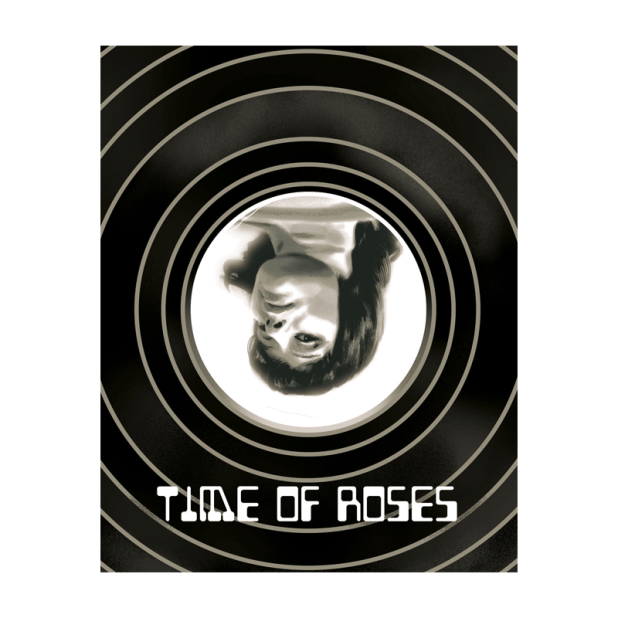
DEAF CROCODILE BLU RAY RELEASE: Time of Roses (1969)

The 2012 we dreamed of in 1969 was very different. In this film, the official review of the Institute of History, after the restless 1960s and 1970s, shows that society has become liberal. Class boundaries no longer exist, and progress is the goal of all.

Documentarian Raimo Lappalainen (Arto Tuominen) is looking back at Finland in the late 60s and making a movie about sex symbol Saara Turunen (Ritva Vepsä), a nude model who dies at some point in the 70s. But as he gets deeper into her life, he discovers that the same issues her world struggled with haven’t truly gone away. Things get stranger when Kisse (Vepsä) plays the role of Saara in recreating her death. Ironically, this film’s director, Risto Jarva, would die young in a car crash in 1977.

This movie promised a future of people dancing by themselves in crowded clubs while wearing headphones, politically compromised media, Edie Sedgwick-looking doomed heroines, pushbutton instant food, unrest in a nuclear plant and inflatable see-through furniture. I should start a Letterboxd list of movies with transparent furnishings, starting with this movie, Too Beautiful to Die and Camille 2000.

Also, I learned from Kathy Fennessy’s Seattle Film Blog that co-writer Peter von Bagh—who worked on the script along with Jarva and Jaakko Pakkasvirta—wrote his master’s thesis on Vertigo. This makes the dead woman being reborn—or at least a look-alike appearing—make even more sense.

By the end, Lappalainen seems like no hero, as the leader of the protests mentions the title of the movie before being killed live on TV, an event that shatters Kisse and barely a notice from him. He seeks to control her in his work, using her as an object instead of a person; this follows through to his real life.

I am obsessed with the ancient future. It seemed like the world would be cleaner and better than the world we live in today. Is it a better place? This movie makes me doubt that. It would, however, be much more stylish.

You can get Time of Roses on Blu-ray directly from Deaf Crocodile. It comes with plenty of extras, including an hour-long documentary Risto Jarva, Tyotoverini (Risto Jarva, My Colleague), in which director Antti Peippo explores the life of the director; two of Jarva’s shorts, Pakasteet (Frozen Foods) and Tietokoneet Palvelevat (Computers Serve); a deleted scene and the original song “Pääskytorni” (“The Swallow Tower”); the trailer; new commentary by film critic, professor and programmer Olaf Möller; a new essay by filmmaker and critic Ville Suhonen of the Risto Jarva Association and newly translated extracts from Risto Jarva’s writings.

As with everything from Deaf Crocodile, this is an incredible release of a film that we may never see in America otherwise.

Sources

Time of Roses – WikiMili, The Best Wikipedia Reader. https://wikimili.com/en/Time_of_Roses

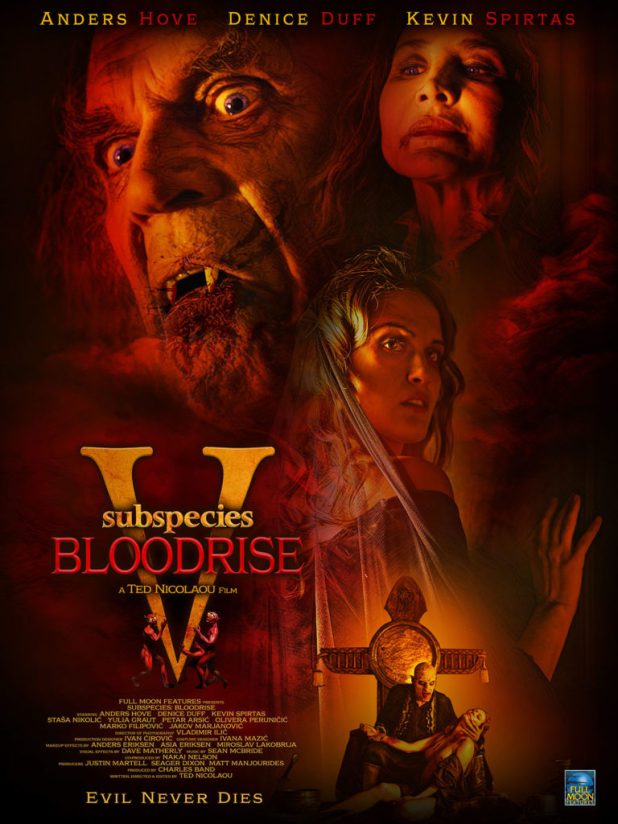
FULL MOON BLU RAY RELEASE: Subspecies V: Bloodrise (2023)

Radu (Anders Hove) and director and writer Ted Nicolaou are back in the fifth movie in the Subspecies series along with SubspeciesBloodstone: Subspecies IIBloodlust: Subspecies III and Subspecies 4: Bloodstorm. Have you ever wondered how Radu went from a warrior in the Crusades, battling for the Church, to a blood-obsessed monster? Wonder no more!

Radu was stolen by crusaders on the night of his birth from a demon mother and vampire father, trained by a brotherhood of monks to kill for the Church until he finds his way to the castle of the vampire Vladislas (Kevin Sprita, who was Mel in the second and third films; he’s taking over for Angus Scrimm; if you didn’t know, Vladislas is also the father of Radu), wielding the Sword of Laertes and in search of the Bloodstone.

If you’re a fan of this series — and I am! — this will give you the fan service you crave. Like having Denice Duff, the heroine Michelle from the second movie, is the female vampire Helena who turns Radu and who will create his enemy Stefan. Or Ash (Marko Filipovic) from the side sequel Vampire Journals is showing up!

This is only 80 minutes, and it’s been two decades since we’ve had a new Subspecies. It feels like nearly too many ideas and too much for one film, which leads me to hope that this isn’t the end of the story.

Subspecies V: Bloodrise gives me hope for Full Moon, as it looks gorgeous thanks to its Serbian setting and the cinematography of Vladimir Ilic, who also shot the Robert Davi movie My Son Hunter.  Dare I dream that someday there will be a new Trancers or a big-budget Puppet Master?

You can buy this from MVD or watch it on Tubi.

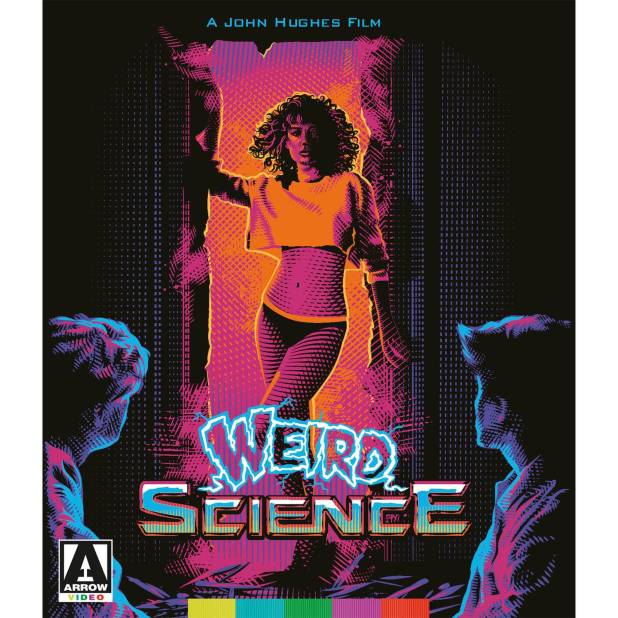
ARROW VIDEO UHD RELEASE: Weird Science (1985)

As John Hughes ruled the 1980’s with six films about teens, this was the first time that he moved from some level of realism to complete fantasy. Named after the 1950’s EC Comics title — producer Joel Silver even paid for the rights to the name — Weird Science seems on the surface that it will be teenage softcore fantasy fulfillment. That’s the bright spot of the film. Lisa may have been created on the computer to be the perfect woman, but the ideal woman would have a mind of her own.

Gary Wallace (Hughes’ avatar in three films, Anthony Michael Hall) and Wyatt Donnelly (who grew up to be a nerd in the best of ways as a professor and published Dungeons and Dragons author) are the geekiest of the geeks at Shermer High — the fictional school that all Hughes’ films emanate from. Their latest humiliation was being pantsed in front of their dream girls Deb (Suzanne Snyder, Killer Klowns from Outer Space) and Hilly (Judie Aronson, Friday the 13th: The Final Chapter) by their boyfriends Ian (an incredibly young Robert Downey Jr.) and Max (Robert Rusler, Sometimes They Come Back).

Inspired by Universal’s Frankenstein, the boys use magic, electricity and a computer to create the perfect woman. A power surge ensures and creates Lisa (Kelly LeBrock, the “it girl” of my teen years), who has limitless powers and the desire to take our boys and turn them into men. The thing is, she isn’t some bimbotastic plastic love doll created simply for their pleasure. That would render this whole movie incredibly stupid. No, she’s here to make their lives better.

There are so many obstacles in her way: Chet (an incredible Bill Paxton), who makes his brother’s life a living hell; the boy’s parents; and yep, Max and Ian. It all comes to a head at a party where a nuclear missile and mutant bikers — yes, that’s Michael Berryman and Vernon Wells — are part of the chaos. It all ends well — Chet gets turned into some form of feces monster while Gary and Wyatt get the girls. And Lisa? She ends up becoming a gym teacher.

My only issue with the film is the scene where the boys go to downtown Chicago and hang with a crowd of older black men, talking about the “eighth-grade bitch that broke his heart.” I realize that this movie was made in 1985, but even then, it completely took me out of the movie. I still have no idea why it remains. This Medium article only confirms that my feelings were valid.

Weird Science was memorable enough to lead to a 1994 to 1998 TV series version. A remake was announced, but that thankfully never made it to the screen.

Arrow Video is now bringing Weird Science to UHD. It features a 4K scan of the original negative, a high-definition 1080p presentation of the film’s theatrical version, and an exclusive extended version with two lost scenes remastered. You also get the edited-for-TV version of the movie and a comparison video showing the dubs and edits for this version.

There are interviews with unique makeup creator Craig Reardon, composer Ira Newborn, supporting actor John Kapelos and casting director Jackie Burch. There’s also It’s Alive: Resurrecting Weird Science, which was also on the 2008 DVD release of the film that has interviews with the cast and crew. If that’s not enough, there are trailers, TV and radio spots, an illustrated collectors’ booklet with Alexandra Heller-Nicholas and Amanda Reyes writing about their love of the movie, a fold-out poster featuring original and newly commissioned artwork by Tracie Ching and a reversible sleeve with the same artwork. It’s a fantastic package, even better than the Blu-ray version they released a year ago.

You can get the UHD and blu ray from MVD.

TUBI ORIGINAL: Scariest Places In the World (2023)

Imagine you’ve watched Scariest Places in America and are curious if the rest of the world is even more terrifying. Well, you’re in for a thrilling adventure. This Tubi special is your ticket to explore the most spine-chilling places on the planet.

Here are the places covered in this movie:

10. Bran Castle, Transylvania, Romania: Commonly known outside Transylvania as Dracula’s Castle, Bram Stoker probably didn’t know anything about this castle. It doesn’t have anything to do with Vlad the Impaler either, who, contrary to popular belief, never even went here. Starting this list with this is, well…not a grand opening. Don’t listen to the paranormal experts in this like Alex Matsuo. There are some great clips of vampire movies, at least.

9. Alcatraz, San Francisco, CA: Maybe Alcatraz held America’s most dangerous criminals for over twenty years, but is it haunted? Or is it just charged with the negative energy of its prison population? The U.S. is the world leader in mass incarceration by nearly five times more the closest competitor. While the number peaked in 2008, in 2016, the World Prison Population List stated that America has 21.0% of the world’s prisoner population despite representing only around 4.4% of the world’s population. That’s more than a ghost scary.

They show some American locations that were left off the list, such as the Queen Mary, Tonopah Cemetery, the Clown Motel and the Lemp Mansion. For more of those places, watch Scariest Places in America.

8. Edinburgh Castle, Edinburgh, Scotland: The most besieged castle in Britain, with 23 attacks throughout Scotland’s history, houses the country’s crown jewels, protects the Royal Family and serves as a prison and barracks. There are tunnels underneath where a bagpiper disappeared; some claim you can still hear him at night. It’s also a place where plenty of torture and bubonic plague have been lived through.

7. Pyramids of Giza, Egypt: A man in early 20th-century clothing has been seen by visitors, and he’s rumored to be the ghost of Howard Carter, the explorer who found the tomb of Pharaoh Tutankhamun. Others have seen an orb apparition of an Egyptian Pharaoh floating away from the pyramids toward the Valley of the Kings. The special has Dr. Sarah Burdorff, Tawny Lewis — who refers to Indiana Jones as “the Raider of the Ark” — and Conner Gossel discuss plenty more. Maybe we should all remember the words of King Diamon, who once sang, “Don’t touch, never ever steal / Unless you’re in for the kill / Or you’ll be hit by the curse of the Pharaohs / Yes you’ll be hit, and the curse is on you.”

6. Capuchin Catacombs, Palermo, Sicily: This is where monks’ and friars’ bodies were dehydrated on ceramic pipe racks and washed with vinegar. Some of the dead were embalmed, and others were enclosed in sealed glass cabinets, making them seem alive. There are  8,000 corpses and 1,252 mummies in the catacombs, including painter Giuseppe Velasco and “Sleeping Beauty” Rosalia Lombardo, a young girl who still appears to be alive. Families could have access to these dead bodies and hold hands with them when they prayed on holy days.

5. Hashima Island, Nagasaki, Japan: The base of the bad guy in Skyfall, this island is also known as Gunkanjima or Battleship Island. In 1959, it reached a peak population of 5,259 before the coal mines under it were used up. Everyone left, and the buildings were left behind, as the abandoned island eventually became a tourist attraction. It also appeared in the live-action version of Attack on Titan.

4. The Tower of London, London, England: There are 13 ghosts in the Tower of London, which feels like a very PR-friendly number. They are Anne Boleyn, Henry VI, Lady Jane Grey, Lord Guildford Dudley, Margaret Pole, The White Lady, Princes Edward V and Richard the Duke of York, Sir Walter Raleigh, The Grey Lady, Arbella Stuart, Guy Fawkes, a grizzled bear — yes, really — and something called The Smothering Force, which is an excellent name for a band.

3. Pripyat, Ukraine: Pripyat was officially proclaimed a city in 1979 and had grown to a population of 49,360 before the Chernobyl disaster. It was evacuated and moved to Slavutych. It’s somewhat famous because they left behind a theme park, which appears in A Good Day to Die HardChernobyl Diaries and Transformers: Dark Side of the Moon. It’s also a level in Call of Duty 4: Modern Warfare and the setting for the S.T.A.L.K.E.R. games.

2. La Isla de Las Munceas, Xochilico, Mexico: Jeremy Lamb, a supernatural influencer, is on hand to explain the Island of the Dolls. Don Julian Santana left his family behind and became a hermit on an island that was part of Teshuilo Lake, paying tribute to a young girl who drowned in the lake, even if many say he just imagined the girl. He collected and hung up hundreds of dolls all over the island. In 2001, he drowned in the same place where the girl supposedly died.

1. The Trans-Allegheny Lunatic Asylum, Weston, WV: I call BS on this list because this was the second on the Scariest Places In America, and it’s number one here. USA? USA! One could argue our entire country is the most frightening place in the world, a place where half the population believes in the right to life and the need to own guns at the same time, that denies that the world is being destroyed by pollution and yet thinks that people are drinking the blood of children. I think that’s a little more frightening than a haunted mental institution — not that I ever want to go there — but this film filled with stock video and herky-jerky possessed footage will certainly make a case for this place over, you know, Texas or Florida.

Anyways, if you want to travel the world and continually poop your pants, consider this your travel agent.

You can watch this on Tubi.

Sources

Is it possible to visit Hashima Island? – Fdotstokes.com. https://www.fdotstokes.com/2022/10/12/is-it-possible-to-visit-hashima-island/

Pripyat – Other & Architecture Background Wallpapers on Desktop Nexus (Image 2325640). https://architecture.desktopnexus.com/wallpaper/2325640/

Mexico’s Island of the Dolls | RetreaTours. https://www.retreatours.com/dolls/

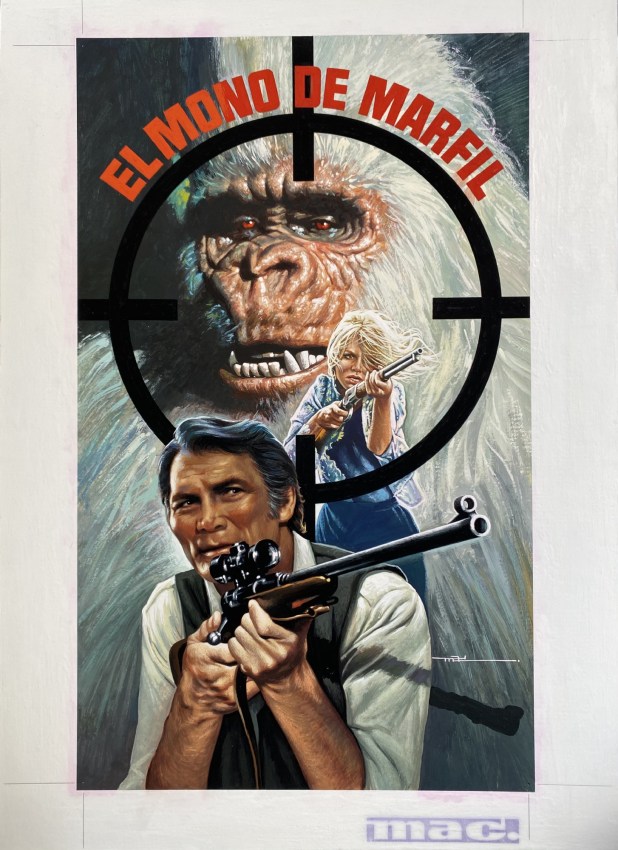
CBS LATE MOVIE MONTH: The Ivory Ape (1980)

EDITOR’S NOTE: The Ivory Ape was on the CBS Late Movie on May 25, 1984 and May 10 and July 24, 1985.

Rankin/Bass had some experience working with Japanese filmmakers after making King Kong Escapes, the Desi Arnaz Jr. feature Marco, Rudolph and Frosty’s Christmas in JulyWilly McBean and His Magic MachineThe Bushido Blade (which has Mako, Sonny Chiba, James Earl Jones, Richard Boone and Laura Gemser all in the same movie), The Bermuda Depths and The Last Dinosaur there.

The last two movies we mentioned and this one were made with Tsuburaya Productions, the company that brought us Ultraman.

While this debuted on ABC on April 18, 1980, an extended version would later play theaters in Japan.

A rare albino gorilla has escaped somewhere in Bermuda, and the hunter who caught it once before (Jack Palance!) is set to destroy it. Can Steven Keats (Bronson’s son-in-law in Death Wish) and Céline Lomez (originally going to play Linda Thorson’s part in Curtains) stop him in time?

Kotani’s work, including The Bushido Blade, is a fascinating blend of Western and Eastern elements. The film, which stars Richard Boone leading sailors versus samurais under the command of Toshirô Mifune, is a unique exploration of cultural dynamics. If that’s not enough to pique your interest, the fact that Laura Gemser is in it might. Kotani’s diverse filmography also includes Pinku redi no katsudoshashin, a feature-length movie about Mie and Keiko Masuda, two idol singers whose Japanese success was imported to the shores of the U.S. Their song “Kiss in the Dark” reached #37 in America, making them the first Japanese act to chart here since Kyu Sakamoto’s “Sukiyaki” in 1961. Sadly, their Sid and Marty Krofft developed series – The Pink Lady and Jeff – only lasted six weeks on NBC during Fred Silverman’s disastrous year of 1980, which also unleashed the Supertrain on an uncaring television audience. Kotani’s other works include The Last Dinosaur and The Bermuda Depths.

There’s something about the 70s TV movies from Rankin/Bass that’s truly unique. Each one carries a certain level of darkness and palpable sadness, making them the perfect choice for a snowy day in 1981 when all you wanted to do was stay under the covers. They still possess that same strange magic today, evoking a sense of nostalgia and appreciation for the historical significance of these films.

You can watch this on YouTube.

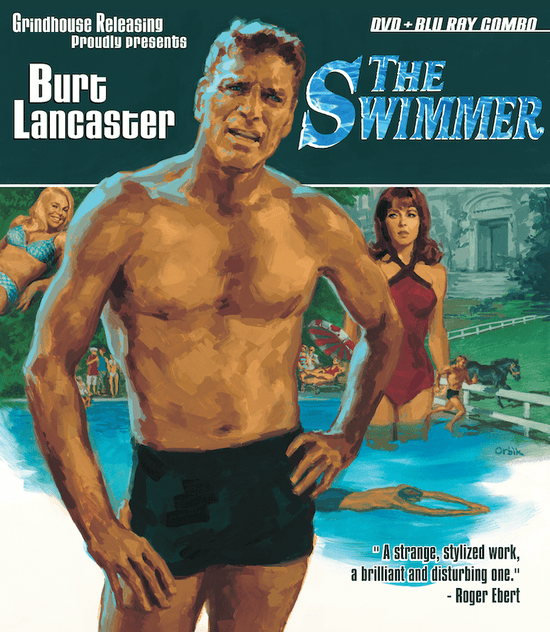
CBS LATE MOVIE MONTH: The Swimmer (1968)

EDITOR’S NOTE: The Swimmer was on the CBS Late Movie on February 22 and December 4, 1973, and July 3 and December 5, 1974.

“It was one of those midsummer Sundays when everyone sits around saying, “I drank too much last night.” You might have heard it whispered by the parishioners leaving the church, heard it from the lips of the priest himself, struggling with his cassock in the velarium, heard it on the golf links and the tennis courts, heard it in the wildlife preserve, where the leader of the Audubon group was suffering from a terrible hangover.”

With those words, John Cheever started his short story “The Swimmer,” which ran in the July 8, 1964 issue of The New Yorker.

It’s the story of Ned Merrill (Burt Lancaster, who feared the water before making this movie), a middle-aged man with a toned body, no shoes and a swimsuit who emerges from the woods that border the affluent homes of a Connecticut suburb. The first party that Ned wanders into welcomes him warmly, with cool drinks in their hands, old friends who welcome him even though it seems like he’s been missing for some time. He doesn’t know, doesn’t care, and is just interested in the idea of swimming his way home through the pools that form the river of his neighborhood.

He meets Julie Ann Hooper (Janet Landgard) in one of those pools, the girl who used to babysit his daughters but now works as a secretary in the big city. She used to nurse a crush on Ned — surely, so many women and girls did; he takes it in stride — and she’s having a rough time dealing with the sexual attentions of the lotharios in the high rises. Ned wants to protect her, drive her to the train, and pick her up when needed, but that’s too much for her. They part ways.

Pool by pool, people open up to Ned. There’s young Kevin Gilmartin Jr. (Michael Kearney), who he teaches to swim in an abandoned pool. Or maybe they don’t quite understand him, like the nudist couple or the woman who insults him for being an uninvited guest.

Somewhere along the way, the swim gets dark. Ned’s obsessed with the idea; the people he thinks he’s connecting with are just ciphers. And so is he. His neighbors are only concerned with bragging about how great their lives are and insinuating that maybe Ned’s life isn’t quite as wonderful as his charming demeanor would make it out to be.

Even Joan Rivers is there, as a woman intrigued by him before a concerned friend leads her away. Ned splashes into the pool only to emerge and see a hot dog cart that was once his. Indeed, it was his, and he wondered why they were keeping it from him. Why are they throwing him out?

Then he remembers Shirley Abbott (Janice Rule, an actress for a time before becoming a psychotherapist and someone who knew a bit about being with intense men, having relationships with Farley Granger, N. In her lifetime, Richard Nash, Robert Thom and Ben Gazzara; her role was initially played by Barbara Loden, the “female counterpart to John Cassavetes.” I’ll get back to that…), someone who he once had an affair with and who he can’t reconcile her hatred of him with his memories.

When once Ned ran, now he’s limping shoeless across a highway, making his way to a public pool where he doesn’t even have the money to get in, a place where he endures the insults of people who gossip about his wife’s expensive taste and his daughters’ troubles with the police. And then there are all Ned’s unpaid bills…

Finally, he gets home, but it’s not the grand castle it was inside his mind. The tennis court where his daughters are playing, well, that’s not even standing any longer. Trees are down, the lawn is overgrown, and the windows are shattered. And Ned slumps in the doorway because he no longer has a key.

The Swimmer is a truly unique and deranged movie, and I say that with a sense of intrigue and curiosity. It was the brainchild of Sam Spiegel, a three-time Academy Award Best Picture winner, and director Frank Perry, who had a personal connection to the story’s setting and shooting location, Westport, Connecticut.

After the film’s shooting wrapped up in September 1966, Perry had plans for additional transition scenes. However, he was unexpectedly replaced by Lancaster’s friend Sydney Pollack and cinematographer Michael Nebbia, who was brought in by Spiegel to finish the movie. This West Coast shoot saw several cast replacements, adding a layer of complexity to the film’s production history.

Speaking of that…

Loden was married to Elia Kazan — man, what is it with 60s playwrights and directors getting impossible gorgeous blonde bombshells to marry them and then making them feel inferior? — the director of Spiegel’s On the WaterfrontThe Swimmer was her first significant film, but she had a prominent career as a star.

During post-production, there was a dispute about the scene where Loden confronts Lancaster between Spiegel and Perry, whose wife Eleanor wrote the script. According to Eleanor, Spiegel hated the rough cut, which, to be fair, wasn’t anywhere near finished. He started showing it around to other directors in Hollywood, including Kazan, who began interfering with the final cut, which belonged to Perry. Kazan wanted the scene toned down, as he didn’t like how Lancaster’s character assaulted his wife’s character — Kazan wrote in his autobiography that his wife depended on her sexual appeal in a condescending way — which led to Loden being replaced. Neither Kazan nor Spiegel would take the blame but accused each other. All that is left of the scene between the two is in Chris Innis’s 2014 documentary The Story of The Swimmer.

After all those reshoots, they still needed one more day to finish, so Lancaster paid for it himself: “The whole film was a disaster; Columbia was down on it. I personally paid $10,000 out of my pocket for the last day of shooting. I was furious with Sam Spiegel because he was over at Cannes playing gin with Anatole Litvak whilst he was doing The Night of the Generals. Sam had promised me, personally promised me, to be there every single weekend to go over the film because we had certain basic problems – the casting and so forth. He never showed up one time. I could have killed him, I was so angry with him. And finally, Columbia pulled the plug on us. But we needed another day of shooting – so I paid for it.”

I thought the wildest thing was that Marvin Hamlisch got hired to score the movie after playing one of Spiegel’s parties.

I love this movie. It feels like the modern mid-60s that I’ve only read about, and it takes you through the rise and fall of that decade and how things changed so much in just a few years. Or a few hours through ten pools. Most of all, I love the tagline, which is so of its era: “When you talk about The Swimmer, will you talk about yourself?”

Lancaster wore 17 identical pairs of suits for this movie, warred with the director over how actors should play their parts, gained twenty pounds of muscle and still said it was his favorite role, despite all the hardship.

It’s also a movie where you slowly fall out of love with its lead or grow in empathy for him. Seriously, they’re right, those tagline writers. Is this the Riddle of the Sphinx, starting on four feet in the morning, two in the afternoon and three at night? Is the measure of a man his accomplishments that he brags about or the fact that in the face of morality, he never wavers? Can you swim the whole way home?

When I write about The Swimmer, will I talk about myself?

For the best possible version of this movie, there’s only the Grindhouse Releasing set. You can get it here, and as with everything they’ve put out, it has the love and care that so few would put into something that anyone else would release as a throwaway. Where others see dross, they know it is gold.

Sources

Middle Age Crazy | Cinema Sojourns. https://cinemasojourns.com/2014/05/24/middle-age-crazy/