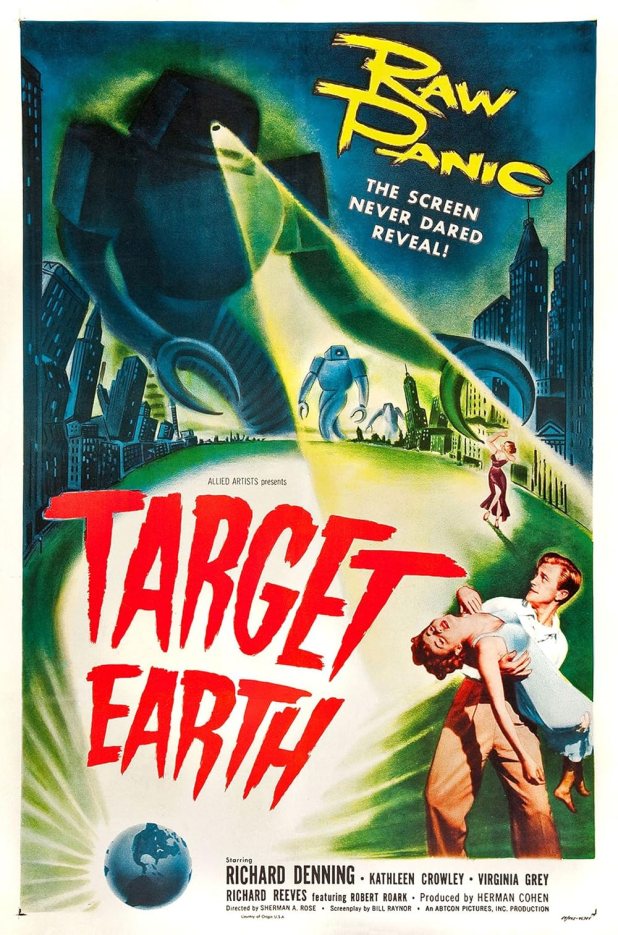
CHILLER THEATER MONTH: Target Earth (1954)

EDITOR’S NOTE: Target Earth was on Chiller Theater on Saturday, February 29 and Saturday, August 8, 1964 at 4:00 p.m. and Saturday, September 14, 1968 at 11:20 p.m.

An army of alien soldiers has landed on Earth, and a small group of humans, including Nora King (Kathleen Crowley), who just attempted suicide, is all that’s left in a city. She trips over a dead body and meets Frank Brooks (Richard Denning), a man who has just survived a robbery. They join up with two partiers, Jim Wilson (Richard Reeves) and Vicki Harris (Virginia Grey), as well as Charles Otis (Mort Marshall), who tells them that all power has been stopped, and even cars won’t stop. Charles freaks out after learning of the aliens and runs into the street, getting blasted by some kind of death ray.

Just when it seems like all hope is lost, a twist in the plot unfolds. The human race, it turns out, is its own worst enemy. A killer named Davis, played by Robert Roark, whose dentist father was a producer on this, ends up murdering Vicky before Jim takes him down. As the aliens launch their final attack, a Shaun of the Dead-style moment occurs. The army arrives at the last minute with a sonic weapon. American firepower to the rescue.

A one-week wonder shot with no permits on the streets of Los Angeles in the early morning, this was based on “Deadly City” by Paul W. Fairman. We hear about a robot army but only see one, which was played by bartender Steve Calvert, the gorilla from Bela Lugosi Meets a Brooklyn Gorilla and Bride of the Gorilla

Director Sherman A. Rose was mainly an editor. The film was written by William Raynor (whose career stretches back to the 1950s, from Snow Dog to Dukes of Hazzard), and by American-International Pictures’ James H. Nicholson and Wyott Ordung, who also wrote Robot Monster

You can watch this on Tubi.

THE IMPORTANT CINEMA CLUB’S SUPER SCARY MOVIE CHALLENGE DAY 30: In Fear (2014)

30. A Horror Film Where the Killer Murders with his Bare Hands

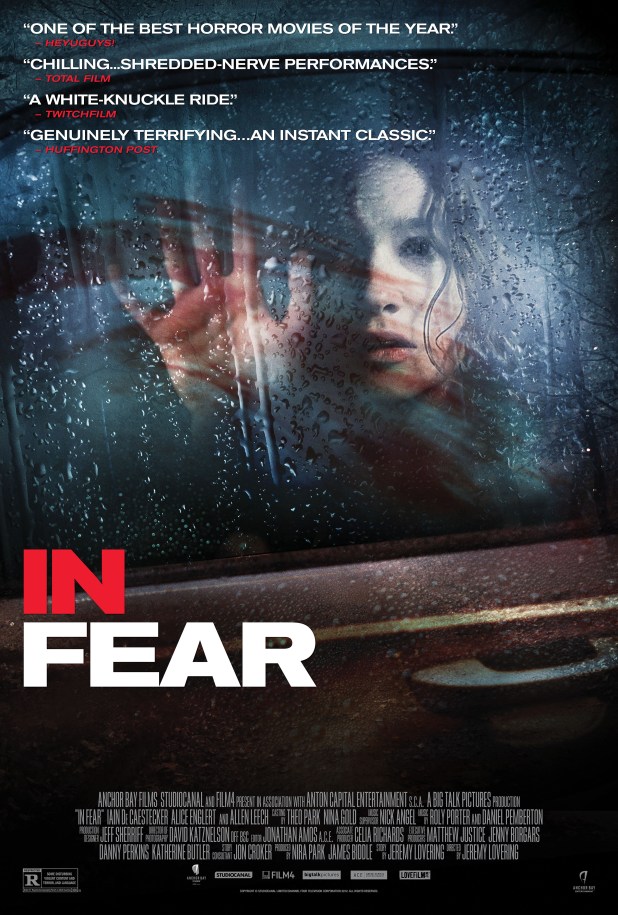
Tom (Iain De Caestecker) and Lucy (Alice Englert) haven’t been dating long, but on their way to a concert, they get caught in a loop, continually ending back at the same place, while Lucy is sure that she sees a man in a white mask. They pick up a man named Max (Allen Leech), who claims to be hunted by the same masked person, but turns out to be that maniac and can manipulate reality. They barely escape him, as he breaks Tom’s wrist.

Lucy and Tom try to hide in the woods after their car runs out of gas. However, Tom is taken by Max, and Lucy barely makes it back. When she flees, she stops to check the trunk. Tom is inside, dead, bound with a hose in his mouth so that he’s been breathing the car’s fumes. The next morning, Lucy sees Max on the road and drives directly toward him.

The leads were not told what would happen to their characters during filming, as it was shot in sequence. Their reactions are real.

This was directed and written by Jeremy Lovering (with Jon Croker co-writing), who was second unit director on Hot Fuzz and Last Night In Soho. This is a fine film, one mostly inside a car, with actors improving so much of their parts. It’s one that needs to be seen by a wider audience.

You can watch this on Tubi.

UNSUNG HORRORS HORROR GIVES BACK 2025: The Beast In Space (1980)

Each October, the Unsung Horrors podcast does a month of themed movies. This year, they will once again be setting up a fundraiser to benefit Best Friends, which works to save the lives of cats and dogs across America, giving pets second chances and providing them with happy homes.

Today’s theme: 1980s

Italy, you’re my favorite.

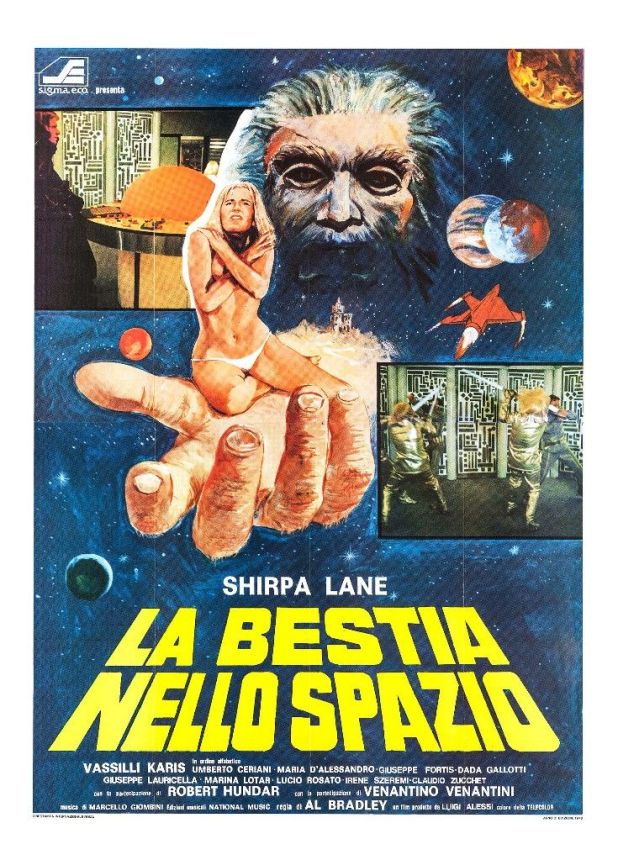
La Bestia nello Spazio earns its The Beast In Space title because it features Sirpa Lane, a star of The Beast (and Immoral Tales, the movie that it was initially part of), in a story reminiscent of Beauty and the Beast. Roger Vadim saw Lane as the next Bardot, a vision that led her to  Papaya: Love Goddess of the Cannibals. Tragically, she passed away from AIDS in 1999.

Captain Larry (Vassili Karis) may live in the future, but there are still bars and still women to pick up in bars, like Sondra (Lane). He steals her from another man, just as a vial he also took ends up containing Antalium, a very important McGuffin that can be used to make bombs. Larry gets a crew and heads off to Lorigon, which is where this element is from, to get as much of it as he can.

The man that Larry fought at the bar, Juan Cardoso (Venantino Venantini), is on his way to this planet and sends a giant robot — the one that has been in Sondra’s dreams — after them. And the planet is run by a computer, Zocor, which makes everyone have sex because this is an Italian movie.

There are light sabers, space horses having space horse sex, dudes in gold body paint, a space satyr penis and all of the costumes and effects from Alfonso Brescia’s other space films, Cosmos: War of the Planets, Battle of the Stars, War of the Planets and Star Odyssey. But this is more The Black Hole than Star Wars. I’m not just saying that because it has an XXX cut.

Brescia also went by the name Al Bradley, the name he used to make the wild Ator remix film Iron Warrior, the Richard Roundtree-starring Miami Cops, the David Hess-starring giallo Omicidio a luci blu, Killer Caliber .32If One Is Born a SwineNaked Girl Murdered In the ParkSuper Stooges vs. the Wonder Woman, and so many more. I’m just shocked that he somehow went from Lucas rip-offs to suddenly making a porny science fiction movie. But you know Italy. Whatever sells.

I watched this with inserts, but you can watch an edited version on YouTube.

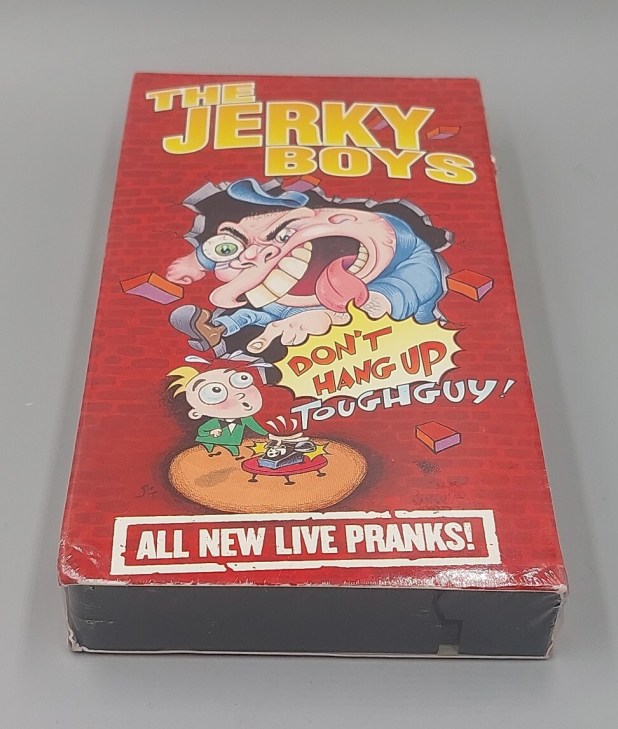
2025 Scarecrow Psychotronic Challenge Day 30: The Jerky Boys: Don’t Hang Up, Toughguy! (1995)

30. DEVIL’S NIGHT: Mischief, mayhem or pranks – oh my!

I refuse to play into the notion that just because something is juvenile, it’s stupid.

In this, The Jerky Boys make prank calls with hidden cameras at MTV’s intern offices, on a double-decker tour bus in Manhattan, on supermarket intercoms and from payphones. These are things that probably couldn’t happen in our world of caller ID and mobile phones, but whatever. It’s a moment in time.

Johnny Brennan and Kamal Ahmed first started making their pranks in the 1980s, often calling unsuspecting people or answering the phone in character for classified advertisements placed in local New York City newspapers. Their first actual album came out in 1993, but bootlegs had been circulating for years. I remember a cassette that I got had this and the Tube Bar all on one 90-minute blast of outlaw insanity. They were Frank Rizzo, Sol Rosenberg, Kamal, Jack Tors, Kissel, and so many more characters. The first time I heard the call “Uncle Freddie,” I may have laughed the hardest I’ve ever laughed, as it’s one of the most uncomfortable comedy acts of all time, as Kissel and his entire family keep asking about Uncle Freddie, who has maybe died, with his son Anthony getting on the phone when his father can’t speak. Brennan’s voice as Anthony is nearly unhinged, as it feels like he’s floating in space, as a woman screams in the background, and Kissel screams that someone has killed their uncle and wants to kill him as well. It’s really an excellent few minutes of madness.

Even people we’d think of as being ultra serious, like Radiohead and Slowdive, named songs for Jerky Boys references (Pablo Honey and Souvlaki, which is a Jerky Boys line the band loved: “My wife loves that Greek shit. She’ll suck your cock like souvlaki.”). Their humor permeates so many parts of the comedy (just like the Tube Bar tapes) and yet, when you ask people about it, they’ll tell you how stupid and immature it is. But does it make you laugh?

Their film, The Jerky Boys, was savaged by critics, and the duo would split up a few years later. But the material is here, especially in this video, which felt like an undiscovered country for me. So many Jerky Boys references litter my daily utterances that some people just think they’re weird things that I say, like “Real proud of ya,” “for some people,” and “I hear you Greeks like trains.”

Yes, it’s stupid. But it all makes me laugh. The world is rough, so I don’t need to be all high-falutin’ about humor these days. A video where the Jerky Boys talk in a grocery store? Put it in my eyeball like heroin. I no longer need to shoot it between my toes.

Also: This is the second Jerky Boys-related Scarecrow Psychotronic Challenge entry I’ve made. I really yearn to be taken seriously as a film critic and look forward to becoming Rotten Tomatoes-certified.

You can watch this on YouTube.

CHILLER THEATER MONTH: Invisible Ghost (1941)

EDITOR’S NOTE: Invisible Ghost was on Chiller Theater on Saturday, November 16, 1968 at 1:00 a.m. and Saturday, June 17, 1972 at 1:00 a.m.

Joseph H. Lewis directed low-budget movies, but he made great ones. Gun CrazySo Dark the Night, this movie…he went above and beyond the money that the movie cost.

Dr. Charles Kessler (Bela Lugosi) is in the middle of a divorce and lives in a lonely home with his daughter, Virginia (Polly Ann Young), and servants. He’s also a killer, which he doesn’t even know, because when he sees his ex-wife (Betty Compson), who has brain damage from a car accident, he goes into a trance. Ralph Dickson (John McGuire), Virginia’s boyfriend, is convicted of the crimes her father committed and is executed. 

Kessler is a kindly man, you know, except when he sees that woman who ruined him. I get it, if I saw my ex-wife, I might lose my mind too. Anyways, Ralph has a twin brother, Paul, who shows up, and then Kessler’s wife just walks right ina nd he goes into his murderous hypnosis routine in front of everyone. It’s not his fault.

This is the first of nine movies Lugosi would make for Monogram. There are no ghosts, visible or invisible.

You can watch this on Tubi.

UNSUNG HORRORS HORROR GIVES BACK 2025: The Seventh Sign (1988)

Each October, the Unsung Horrors podcast does a month of themed movies. This year, they will once again be setting up a fundraiser to benefit Best Friends, which works to save the lives of cats and dogs across America, giving pets second chances and providing them with happy homes.

Today’s theme: 1980s

ABOUT THE AUTHOR: Adam Hursey is a pharmacist specializing in health informatics by day, but his true passion is cinema. His current favorite films are Back to the Future, Stop Making Sense, and In the Mood for Love. He has written articles for Film East and The Physical Media Advocate, primarily examining older films through the lens of contemporary perspectives. He is usually found on Letterboxd, where he mainly writes about horror and exploitation films. You can follow him on Letterboxd or Instagram at ashursey.

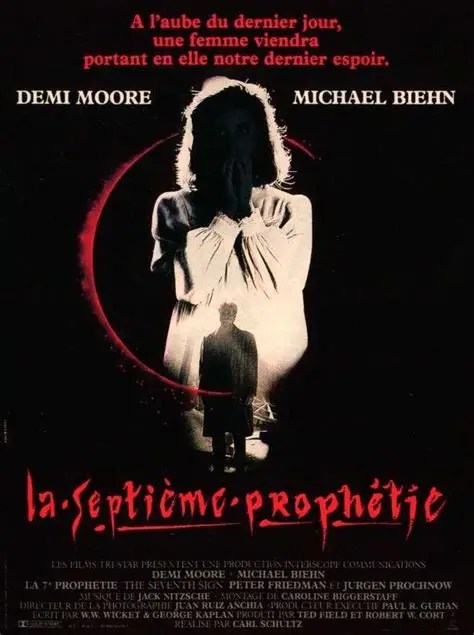
The characters of The Bible have been a fount of inspiration for horror movies since the days of silent film. Many of these films focus on the exploits of demons and the Devil, supernatural beings out to possess, corrupt, and destroy. The Seventh Sign takes a different approach, turning to the back of the Book to see how God’s judgment might be poured out onto the Earth.

If the title had not already been taken by Ingmar Bergman, perhaps The Seventh Seal might have been a more appropriate title. A mysterious man named David (Jurgen Prochnow) is globetrotting, breaking the seal on various parchments. With each break, another disaster occurs, from the fish in the ocean in Haiti dying to the discovery of a frozen desert in the Middle East. Eventually, David finds his way to Abby (Demi Moore), a pregnant woman who is due to give birth on Leap Day. Abby’s lawyer husband Russell (Michael Biehn) is busy trying to get a young man with Down’s Syndrome clemency from the gas chamber for killing his parents (who were also brother and sister), a strange B story that eventually does become more important in the final act.

David rents a room above the garage and tells the couple a story over dinner involving sparrows and their song. According to David, all souls are stored in a place called the Guf. As a soul comes to inhabit the body of a newborn baby, the sparrow sings its song. While the story sounds charming on the surface, Abby soon finds herself face-to-face with the realization that David is actually the second coming of Jesus Christ. And the Guf is all out of souls, starting with her baby. God is ready to judge the world, and only Abby can stop it.

The Seventh Sign takes an interesting approach to its storytelling by melding Jewish folklore with the New Testament. The Guf is not mentioned in the Bible, but it is mentioned in the Jewish text, the Talmud, which is sort of an interpretation by rabbis of the Torah, the oral history of the Jewish people that also incorporates the first five books of the Bible (confused yet?). If nothing else, it was a bold move by the makers of The Seventh Sign to take Jewish folklore and apply it to the apocalypse. In comparison to horror films that tap into Christianity for inspiration, there have not been too many films inspired by Jewish folklore.

Perhaps the most famous being from Jewish folklore featured in films is the Golem, a protector made from clay who comes to life to save and serve the Jewish people. Another figure in Jewish folklore is the dybbuk, a spirit who clings to its host, possessing that person, causing mental anguish. One recent film that explores a dybbuk is Demon (2015), a Polish film featured in the All the Haunts Be Ours: Volume 2 set from Severin Films. Also featuring a dybbuk was The Unborn, a film from 2009 starring Gary Oldman as a rabbi who is consulted to get rid of the spirit. Oh how I love all of the different forms of folk horror! I learn so much about different cultures from these stories, even if I do not care for the film itself sometimes.

But fortunately, I really enjoyed The Seventh Sign, more than others it seems (currently only a 2.7 star rating on Letterboxd). It is a film that I never got around to watching for whatever reason (perhaps due to the lack of champions for the film). But I found it to be very thought-provoking. Demi Moore in the lead role helps for sure. And although the film seems too scared to go for an unhinged ending it could have, there is some comfort in thinking that the prayers and actions of one woman could change God’s mind, a consistent thread throughout the Bible.

I watched this one as God intended—on a VHS cassette tape I bought from Goodwill years ago but before now never cracked the seal so to speak.

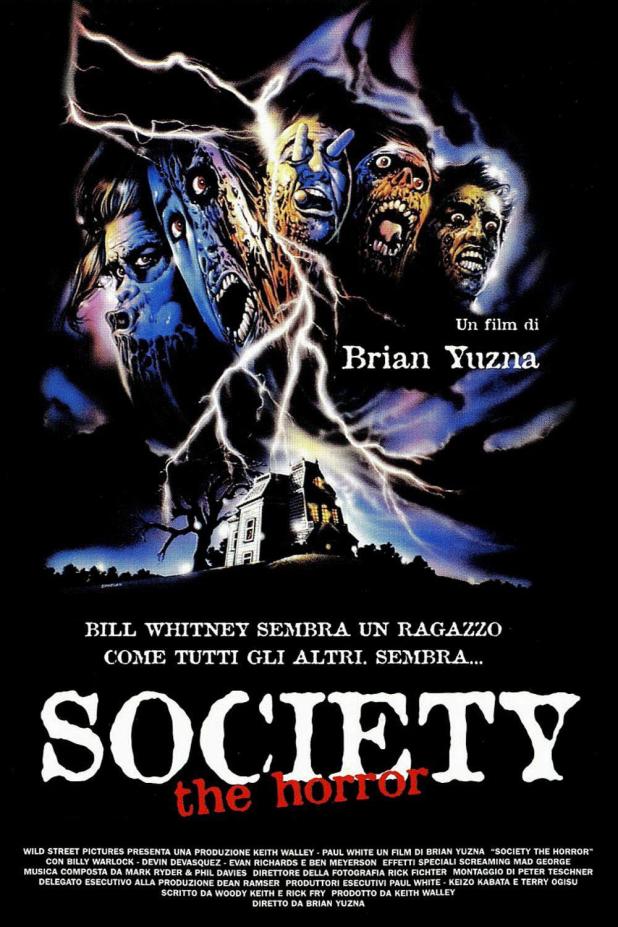
UNSUNG HORRORS HORROR GIVES BACK 2025: Society (1992)

Each October, the Unsung Horrors podcast does a month of themed movies. This year, they will once again be setting up a fundraiser to benefit Best Friends, which works to save the lives of cats and dogs across America, giving pets second chances and providing them with happy homes.

Today’s theme: 80s!

About the Author: Parker Simpson is a writer and podcaster focusing on cult films and their social impacts. They currently cohost Where Is My Mind, a podcast focusing on underappreciated films from a variety of genres and countries. They have also held panels, chartered local organizations, and written articles to their blog. When not writing or studying, they like to spend time with their pets and go outside. Check out the podcast Linktree and blog.

Note: I wrote this in early September. This has been edited accordingly to make it seem like I watched it recently.

It’s not every day you see a mass walk out of a film over one scene. Or seeing those who stay have their jaws permanently agape. Or those same people become increasingly sweaty and anxiety ridden as time passes. It’s rather funny, really. I would highly recommend the experience.

This is an accurate summary of my local drive-in’s screening of Society, which they decided to double-bill with Killer Klowns from Outer Space. I don’t know how they keep getting copies of cult horror films to show in small town America, but I respect it and will keep forking over my money to them (you should, too). Seriously, last weekend they screened Lamberto Bava’s Demons with Return of the Living Dead, and next week is a two-night event including Girls Nite Out, Madman, Re-Animator, Spider Baby, and Children Shouldn’t Play With Dead Things. What is in the water here?

Society is a film known more for its ending (I will try to not spoil too much) than what precedes it. Its timely imagery of the rich literally eating the poor has aged just as well as the special effects Brian Yuzna got the plot from. Despite the continual citing of his and collaborator Stuart Gordon’s influence in recent efforts (see: The Substance), his directorial career is rather bumpy, ranging from extremely amusing (Faust: Love of the Damned) to awful (Beyond Re-Animator). This is his high point: if you ask me, he hit it out of the park with Society and should have done more with social commentaries instead of basing his career on getting ideas from Screaming Mad George. Then again, I shouldn’t curse the man who holds the rights to my favorite franchise.

What makes this stand out from the rest of Yuzna’s filmography is not the melding of naked bodies and human beings turned inside out – it’s the elaborate pacing and making the most of its surroundings. By the time the late 80s rolled around, the popular landscape was more interested in making money than engaging the general public. Culture had shifted away from the organic roots of the 60s and 70s, being redirected to malls and television. It may have been a sign of economic prosperity, but it signaled a cultural downfall we are still feeling the effects of. Setting Society in the wealthy area of Beverly Hills only amplifies this bubble we often see in films of the time – gone are the seedy streets of the inner city, in come the gentrified suburbs. 

However, in the spirit of Blue Velvet, there must be something lying underneath the glimmery surface. Enter the Whitney family, composed of parents Nan and Jim, daughter Jenny, and son Bill. Bill is the black sheep – there is clearly a rift between him and the rest of the family. He knows something is wrong, but he can’t put his finger on it. It’s only when his friend (and sister’s ex) bug the family’s car that he finds out about Jenny’s “coming out” party – something his parents also did, and which features a murderous orgy. Not the sort of thing you want to hear anyone participating in, let alone your immediate family. Only from there does the rift continue to grow, culminating in the now infamous shunting sequence. What could be taken as cheesy teenage angst turns into a genuine feeling of paranoia; while Bill is never really part of his family (he suspects he was adopted), he’s never really able to escape them. He finds their influence extends to the furthest corners of Beverly Hills, as seemingly everyone within a 50-mile radius plots against him. It all culminates in a feast of bodies merging into one another as liquor (and honey?) pours over a sickly orange lighting, a visual you will never really forget. Films primarily based on special effects don’t always work, and while they don’t get to shine until the final 20 minutes, Society may be the one exception.

I could write on and on about this, truly. But it is something you must witness with your own two eyes, an experience you will never forget no matter how or where you watch it. I cannot give this a higher possible recommendation. Just make yourself a nice cup of tea and see it.

(this is my last piece for the month. Thank you to Sam for letting me write for the site and to anyone who has been reading both my pieces and any of the other contributors’ pieces!)
CHILLER THEATER MONTH: It Came from Outer Space (1953)

EDITOR’S NOTE: It Came from Outer Space was on Chiller Theater on Saturday, November 10, 1973 at 1:00 a.m.; Saturday December 14, 1974 at 11:30 p.m.; Saturday, July 3, 1976 at 11:30 p.m.; Saturday, August 20, 1977 at 11:30 p.m. and was the last movie ever shown on Chiller Theater on December 31, 1983.

Based on Ray Bradbury’s original film treatment “The Meteor,” this was directed by science fiction expert Jack Arnold and written by Harry Essex. The two also worked together on The Creature from the Black Lagoon.

Astronomer John Putnam (Richard Carlson, who directed Riders to the Stars) and schoolteacher Ellen Fields (Barbara Rush) watch a meteorite crash land in Sand Rock, Arizona. No one believes John when he claims that a UFO was in the crater. Even Ellen isn’t sure, but when locals start to disappear, Sheriff Warren (Charles Drake) wants action. John wants a peaceful solution.

The aliens appear to John, who demands to see their proper form, like a doubting Thomas wanting to put his finger in the nail marks on Jesus’ hands. The aliens decide that they will destroy themselves instead of dealing with humans — I get it, my dudes — but Putnam gets them back home safely. 

I love this speech from the sheriff: “Did you know, Putnam, more murders are committed at ninety-two degrees Fahrenheit than any other temperature? I read an article once. At lower temperatures, people are more easygoing. Over ninety-two, it’s too hot to move. But just ninety-two, people get irritable.” 

The sheriff’s office is near Courthouse Square from Back to the Future, and the alley where they chase the reborn people is where Atticus faced off with the lynch mob in To Kill a Mockingbird. This film is all about recycling, as the meteorite footage is also in Cat-Women of the Moon and The Astounding She-Monster

Of all the 3D films, this is probably the classiest.

You can watch this on Tubi.

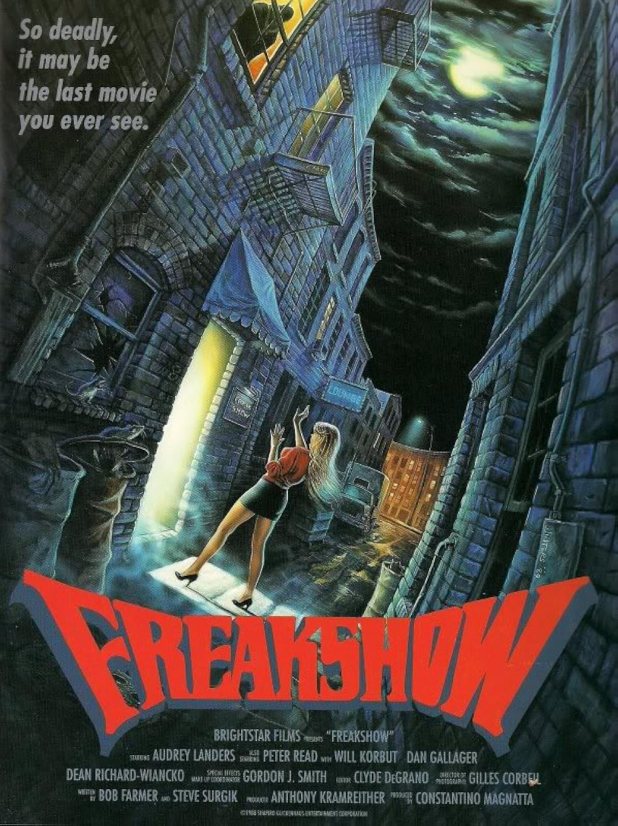
THE IMPORTANT CINEMA CLUB’S SUPER SCARY MOVIE CHALLENGE DAY 29: Freakshow (1989)

29. A Horror Film Without a North American, UK or Australian DVD or Blu-ray release, but that’s on the Internet Archive

Directed by Constantino Magnatta (The Dark Side) and written by Steve Surgik and Bob Farmer, who also wrote the song in the film, “There’s A Ghoul In School.”

A Canuxsploitation portmanteau, Freakshow starts with a massacre in a movie theater by a maniac with a gun — what is this, America and not Canada? — and Audrey Landers, playing a reporter named Shan Nichols, checks in before hiding out at a Freakshow Museum. There she’s told four stories: a poodle getting revenge for her owner, a pizza delivery turned music video that becomes a vampire orgy, a woman being alive for her own autopsy, and finally, zombies wanting the dirt from their graveyard returned from a golf course. Once Shan is added to the museum’s collection, we see that it’s all been a movie, and it starts over again.

This was mostly a cable release, and I’m unsure if it ever played theaters or made it on video in the U.S. It did play in Toronto, however. I’d like to tell you that it’s a great find, but really, it’s a precursor to the boring direct-to-streaming anthologies that litter our world today.

At least it has lots of late 80s Canadian metal like The Nylons, Clean Slate and The Wankers.

You can download this from the Internet Archive.

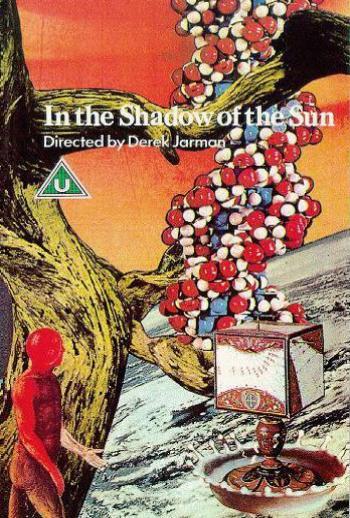
2025 Scarecrow Psychotronic Challenge Day 29: In the Shadow of the Sun (1981)

29. “OCCULT”URAL CENTER: This one’s gotta have a supernatural hotspot in it.

This was made by Derek Jarman, who was the production designer for The Devils and also made Jubilee. He also directed the Pet Shop Boys’ 1989 tour.

Jarman was also involved in music, directing videos and films for The Smiths, Marc Almond, Suede, Wang Chung and Psychic TV. This is a mix of Super 8 films shot by the director between 1972 and 1975, scored by Throbbing Gristle. There are scenes from his films Journey to Avebury. Tarot and Fire Island.

The title refers to the Philosophers’ Stone, which alchemists sought, believing it could transform base metals into gold.

I’ve heard people say this movie is boring. Maybe it’s the space I find myself in, but I found it relaxing and a perfect trance. I guess if it’s not for everyone, then it’s occult.