E tanta paura (1976)

A man is strangled by a transvestite prostitute in his home.

A woman is killed on a bus by a man holding a wrench.

The only thing that ties these crimes together is an illustration from a children’s book by the name of Der Struwwelpete.

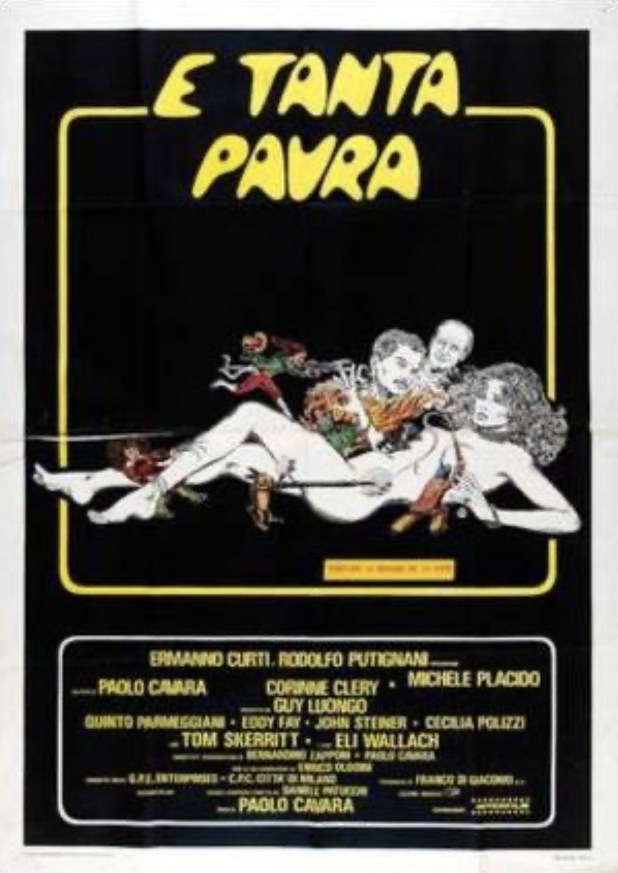
Inspector Gaspare Lomenzo (Michele Placido) is on the case, reporting to higher ups played by Tom Skerritt and Eli Wallach. By sheer luck, he meets Jeanna (Corinne Cléry), who witnessed the death of a sex worker that may be part of this case. She was also at a party being held by a group called Wildlife’s Friends — led by Hoffmann (John Steiner) — that hired a prostitute for one of their events and had to kill her after she learned that it was all a front for diamond smuggling. Now, one by one, members of this group — also a front for swinging, not just gems — are being killed off.

This also has a filthy cartoon by Gibba in the middle of all this, as well as the idea that perhaps Loemnzo shouldn’t trust anyone, as Jeanna is a total noir character and the remaining members of the club contact Wallace for protection. And hey — didn’t Heinrich Hoffmann write and draw Der Struwwelpete?

Director Paolo Cavara may be best-known for working with Gualtiero Jacopetti and Franco E. Prosperi to create Mondo Cane, but he’s not as celebrated as he should be for making two great giallo — this movie and one of the meanest in the entire genre, Black Belly of the Tarantula. He also wrote the script with Bernardino Zapponi (who wrote seven movies for Fellini and co-wrote Deep Red) and Enrico Oldoini.

Peccati di gioventù (1975)

So Young, So Lovely, So Vicious… was directed by Silvio Amadio, who also made the giallo movies Assassination In Rome, Amuck!Smile Before Death and Twisted Girls, as well as Il Medium. He also wrote the story with Roberto Natale.

Also known as Sins of Youth, this tells the story of Angela (Gloria Guida, Bollenti spiriti), a young, beautiful and vicious girl who lives to sunbathe, party and spend her father’s money. But then she learns that her daddy (Silvano Tranquilli) has found a new wife, Irene (Dagmar Lassander). They’re even talking marriage, which worries Angela, because Irene seems to have morals. That means that her endless party seems to be coming to an end. But Angela is willing to go as low as it takes to stay her father’s favorite girl.

This is also — also also? — known in Germany as Sun, Sand and Hot Thighs and that makes it seem like a beach sex film. And yes, Guida is naked for most of the movie. But she’s also scheming the whole time, getting Irene to fall in lust with her while someone documents their entire love scene and sends it off to her father. Yet it seems like Irene and Angela are as much alike as they are different; as Jane says in Whatever Happened to Baby Jane?, “Then, you mean, all this time we could’ve been friends?” — but when you feel a love for a father that is beyond what any other woman could know, well, you’ll do anything to stay solitary in his heart.

You can watch this on YouTube.

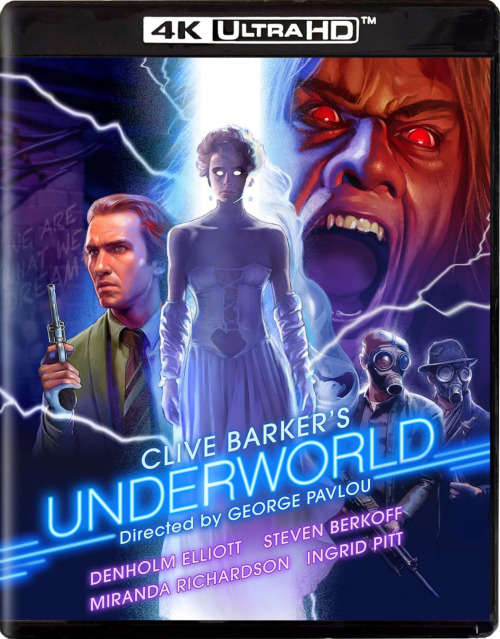
KINO CULT 4K UHD RELEASE: Underworld (1985)

The synthpop band Freur did the music for this, but they ended up getting better known when they took the name of this movie as their own: Underworld.

They’re not the only famous people who are part of this movie — also called Transmutations — that nobody really talks about. Clive Barker — yes, that Clive Barker — wrote the story and co-wrote the script with James Caplin. As for the lead, it’s Denholm Elliott — yes, Marcus Brody — as Dr. Savary, a doctor who has created a mind-controlling drug that he uses to keep an army of deformed sewer dwellers under his command. And the main reason, beyond Barker, that I chose this as my underground sewer movie? It has both Miranda Richardson and Ingrid Pitt in it!

But when Savary abducts high class hooker Nicole (Nicole Cowper, who went below the crust again for 1988’s Journey to the Center of the Earth) from her brothel, businessman Hugo Motherskille (Steven Berkoff, Octopussy) gets her former lover Roy Bain (Larry Lamb) on the case. Meanwhile, all these proto-Nightbreed creatures are doing monster cocaine to stay alive.

So how did this weirdo movie ever happen? George Pavlou wanted to direct a movie (he’d also direct another early Barker script, Rawhead Rex). Barker wanted to write one, so he put together a mash-up of mobsters, monsters, film noir and horror. The money people wanted something else, so they got it rewritten and Barker washed his hands of the whole thing. And then Vestron Video released it as Transmutations.

It looks great though! 1985 great, all blue color and billowy dresses and face paint and movie punk and you know, who cares if it’s kind of silly? Monsters in sewers kidnapping prostitutes who can enter your dreams with the power they get from magical powder? Sounds kind of wonderful, when you think of it.

This Kino Cult release has two disks. The UHD has a brand new HDR/Dolby Vision Master from a 4K scan of the 35mm original camera negative. There’s also a new audio commentary by director George Pavlou, moderated by Stephen Thrower. The blu ray disk has a brand new HD master from a 4K scan of the 35mm original camera negative, the same commentary, the 103-minute Transmutations version, behind the scenes footage and an image gallery. You can get this from Kino Lorber.

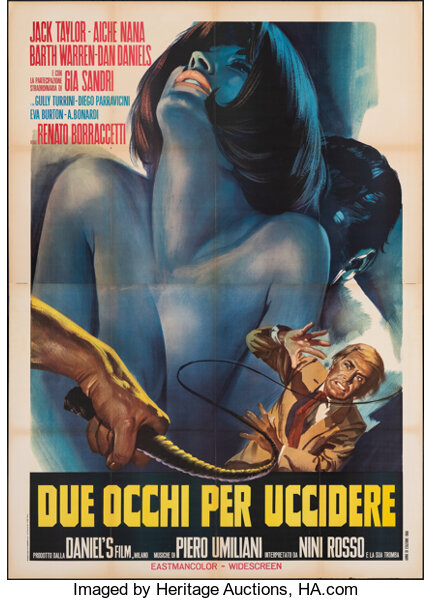
Due occhi per uccidere (1968)

Directed by Renato Borraccetti, who wrote the script with Fernando Luciani, Two Eyes to Kill disappeared after playing theaters and never was released on video. It was sold on eBay in 2014 and was restored as part of a crowd funding mission. The reason why the version online is so short is that one of the reels is missing.

Jean (Fabio Testi) is sentenced to death but keeps his trumpet, playing jazz on the night before he’s taken to the guillotine. He claims he’s innocent until his head comes off his shoulders. The real story, however, is about nightclub owner Max (Jack Taylor), who is being sold out by one of his girls, Rosy (Gia Sandri) and her friend Pierre (Barth Warren). She’s recording everything that happens in the club using her gigantic glasses, which is pretty crazy. They’re playing a game to destroy him, even cluing his girlfriend Nadia (Aichè Nanà) into the fact that he’s assaulting young women.

Why? Well, they were friends with Jean, so we didn’t meet him for no reason. They’re trying to drive Max insane by tormenting him with the sad trumpet song Jean played before he died.

This movie has Eurospy gadgets that may be made from thick paper, lunatic women dancing on stage — Aichè Nanà has a shirtless man appear and start whipping her! — and a jazzy soundtrack by Piero Umiliano and trumpet player Nini Rosso. I wonder if we will ever see a completed cut of this or this is the best we get. Regardless, it’s pretty interesting to check out. I mean, the entire movie seems to be set in a few rooms and curtains take the place of walls.

You can watch this on YouTube.

Source: Eurofever, Cinema Italiano Database

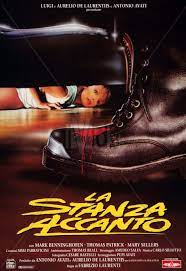
La stanza accanto (1994)

Martin Yakobowsky (Mark Benninghoffen) is a Chicago lawyer assigned to resolve a case close to where he grew up in Iowa, a place that he though he had left behind after his testimony in a triple murder case led to a man going to the electric chair.

As for the case, it’s between Polish farm workers — the same people Martin grew up with — and a state congressman. But while he’s back home, Martin becomes obsessed with the case he testified in, the murder of a call girl and her friends. He can’t remember what he saw years ago and he’s started to hear strange noises out of the storage room next to his hotel room. Was the girl he died his girlfriend? Did she die in that noisy room?

The 1940s atmosphere and being set in the U.S. — and filmed in Iowa and Illinois — don’t let on that this is an Italian giallo. Not only was it directed by Fabrizio Laurenti (who made Witchery and The Crawlers using the name Martin Newlin; Joe D’Amato may also have directed some of those movies), but it has a story by Fabio Clemente and Luigi Sardiello that was scripted by Pupi Avati.

Yes, that’s right. Pupi Avati.

This feels a lot like The House with the Laughing Windows at least as much as it explores the memories that we have in our youth and how they aren’t always true as we get older. This also has one of the most sensual razor kills ever, if that can be possible.

I have no idea why more people aren’t talking about this, a film written by an Italian legend and filmed in America. I also can’t believe it took me so long to discover it.

You can watch this on YouTube.

La ragazza di Cortina (1994)

Mara (Vanessa Gravina) had a memorable childhood vacation in Cortina, but the bad part is that when they returned home, her parents died in a car accident. Now, she’s married to a painter named Carlo (Stefano Abbati) who controls her life and when she refuses to make love to him, he drugs her and does it regardless. She fakes her death and moves into that vacation home from the past, meeting a couple named Sergio (Paolo Calissano) and Lluba (Isabel Russinova) who want her to live with them, as well as protect her when Carlo comes looking for her. Or perhaps not.

The Maurizio Vanni who directed this — thanks, Italo Cinema — is cinematographer Giancarlo Ferrando. He made this movie with Luciano and Sergio Martino assisting with the story, which was turned into a screenplay by Maurizio Rasio (who wrote Craving Desire for Sergio) and Piero Regnoli (who also scripted a Sergio Martino film, Foxy Lady). I would assume they watched Sleeping with the Enemy and then made this.

Seeing as how Giancarlo Ferrando also shot Monster SharkTroll 2 and Detective School Dropouts, this may not be his worst — or most interesting, because I still love those films — movie. And because he also shot All the Colors of the Dark, Your Vice Is a Locked Room and Only I Have the Key and Torso, it’s definitely not his best.

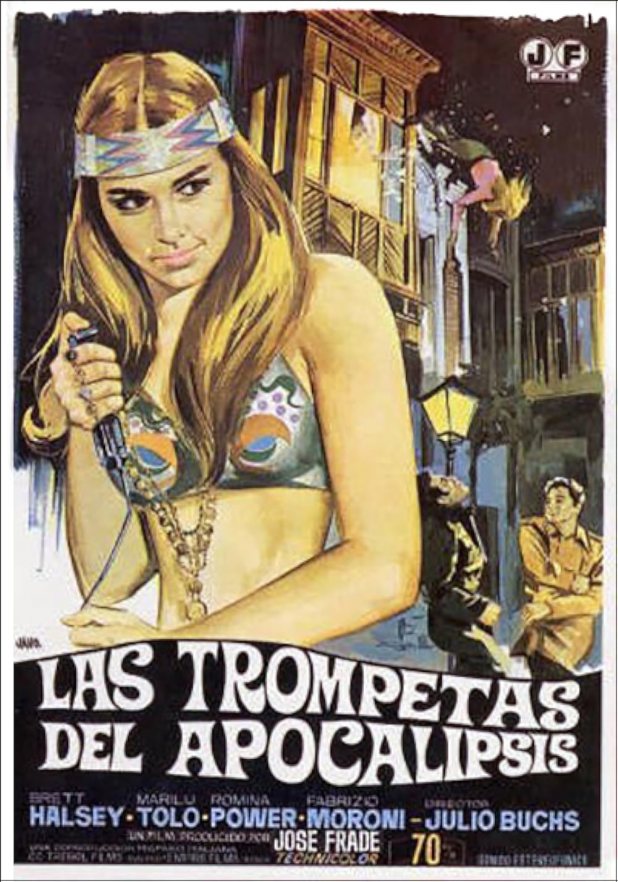
Las trompetas del apocalipsis (1969)

Trumpets of the Apocalypse is also known as Murder By Music and Perversion Story, even if it has nothing to do with Fulci’s movie of the same name.

Richard Milford (Brett Halsey) is a sailor on leave in London who learns that his sister Cathrin has tried to fly while on acid. He doesn’t believe that and investigates her death with her roommate Helen Becker (Marilù Tolo). It seems like the killer is The Romanian (Manuel De Blas) and the murder is all about some bad weed and a song that references the title. There’s a swinging club called the Mouse Hole, where we discover a face painted Romina Power.

Catharin’s music professor killed himself the same way a day before, so obviously our heroes are on to something. There’s also a hurdy-gurdy player whose instrument is his weapon. Alert Donovan…

Director Julio Buchs also made Alta tensión. He wrote this with Domenico Comanducci, Federico De Urrutia, José Luis Martínez Mollá and Mino Roli. I’m a fool for swinging sixties murder movies, much less Spanish-Italian co-productions, so I had a lot of fun watching this.

You can watch this movie on YouTube.


Carnal Circuit (1969)

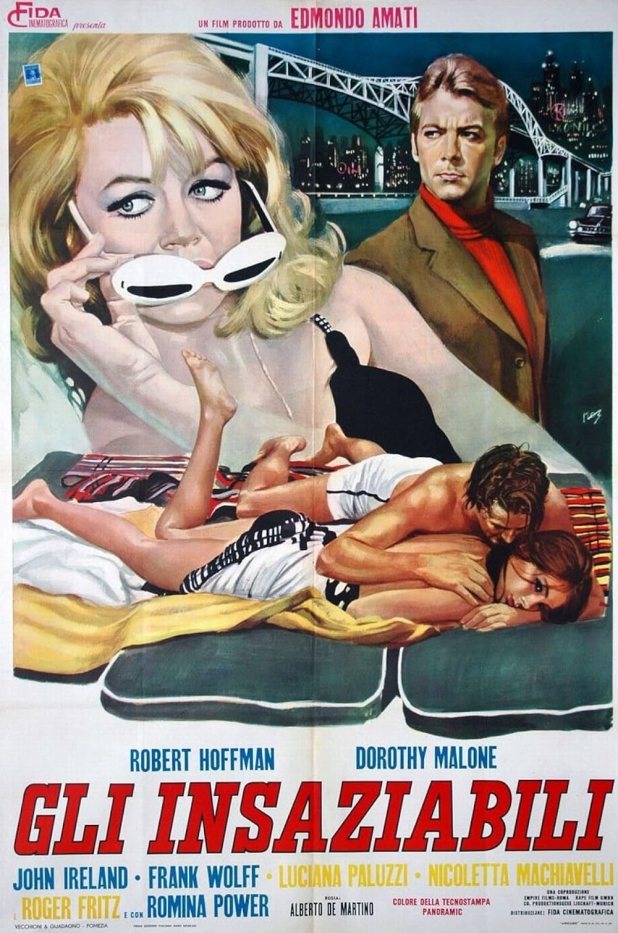
Also known as Femmine insaziabili (Insatiable Females), Mord im schwarzen Cadillac (Murder In a Black Cadillac), The Insatiables and Beverly Hills, this giallo was directed and written by Alberto De Martino (Miami GolemHolocaust 2000OK ConneryStrange Shadows in an Empty RoomThe Antichrist).

Paolo Sartoni (Robert Hoffmann, Spasmo) is an Italian journalist making his way in Los Angeles who takes a beating meant for his childhood friend Giulio Lamberti (Roger Fritz), who is now known as Lambert Smile, the advertising face of International Chemical, but he’s upset the company. Paolo decides to write the story of this assault, only to learn that Giulio is dead. The more he learns about his old friend, the more he discovers that America corrupted him and even caused him to leave his wife Luisa (Nicoletta Machiavelli).

Everyone that Paolo meets from the company are all horrible, including the President of the comapny, Donovan (Frank Wolff), secretary Mary Sullivan (Luciana Paluzzi, A Black Veil For Lisa), Giulio’s boss and new lover Vanessa Brighton (Dorothy Malone, who years later would be in the erotic thriller — what they called giallo in the 1990s — Basic Instinct) and her daughter Gloria (Romina Power, who accidentally had her swimsuit bottom removed by a cameraman and that scene is in the movie; her mother went to producer Goffredo Lombardo shouting and complaining about De Martino; I find this story hilarious because in the same year, she was in Jess Franco’s Marquis de Sade’s Justine), who makes a pass at Paolo. That’s when he learns that Giulio is still alive and will kill anyone — including Paolo’s editor Richard Salinger (John Ireland) — to keep his death a secret.

Bruno Nicolai did the soundtrack, which adds a lot for me. This is a fun film, made in America and filled with the sights, sounds and lovemaking of the late sixities.


Prostituzione (1974)

Rino Di Silvestro said, “Sex is a natural thing, but it’s also something that gives you an uncontrollable desire, like murder for the serial killer who begs to be caught. We have an irresistible desire to make sex.”

He lived up to this because his movies were pretty much as scummy as it gets. I say this with no small amount of admiration. I mean, the guy made Women In Cell Block 7Werewolf WomanDeported Women of the SS Special Section, Baby LoveBello di mammaHanna D. – La ragazza del Vondel Park and The Erotic Dreams of Cleopatra.

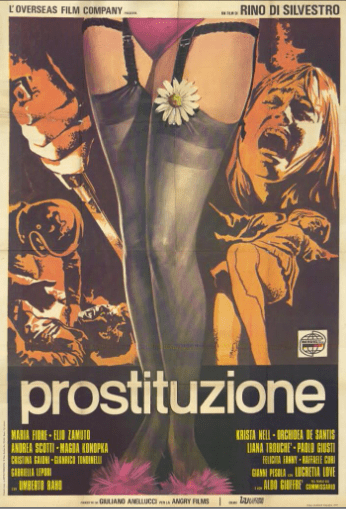
He directed and wrote this, which was also released as The Red Light GirlsLove AngelsSex Slayer  and Street Angels. It begins with Giselle (Gabriella Lepori, Five Women for the Killer) conducting her business — the world’s oldest — as another man watches. She soon stabbed and we see her dead body on the slab of a morgue. Her fiancee Michele (Elio Zamuto) had no idea she was a roadside prostitute.

Inspector Macaluso (Aldo Giuffre) leads the cops in the investigation, but mostly the movie introduces us to slices of life in the dark streets of Italy, like when Benedetta (Orchidea de Santis, The Killer Wore Gloves) is raped by a biker gang, which causes another gang to hunt them and murder their lead with, well, a beer bottle inserted in exactly where you think its going to be shoved in.  There’s also a Satanic john, which I found funny, but it’s like almost as if the movie forgot that it was a giallo.

Did you know that Italian sex workers all hung out at a campfire and had parties when they weren’t working? Well, Di Silvestro did and according to Hysteria Lives, he got fan mail from the ladies he was depicting because of how realistic this movie was.

Also appearing: Krista Nell (So Sweet, So Dead — another giallo that has a secondary version called Penetration that has inserts…just like this film), Magda Konopfka (Satanik), Felicita Fanny (also in the director’s Werewolf Woman and Deported Women of the SS Special Section) and Lucrezia Love (Enter the Devil).

I have no idea why this starts almost like a documentary — a girl interviews on the street says she only fears “syphilis and solitude” — then becomes a dark giallo then is nearly a comedy mixed with soap opera before remembering that there’s a prostitute killer. It’s a mess and exactly what I expected, which is not a criticism. Di Silvestro seems to be trying to shock, upset and entertain you, often all in the same scene.

You can watch this on YouTube.

A… For Assassin (1966)

Balsorano Castle has been the location of many of my favorite movies: Lady FrankensteinBloody Pit of HorrorThe Lickerish Quartet, The Blade MasterBlack Magic RitesThe Devil’s Wedding Night, Crypt of the VampireThe Bloodsucker Leads the DanceSister Emanuelle and more.

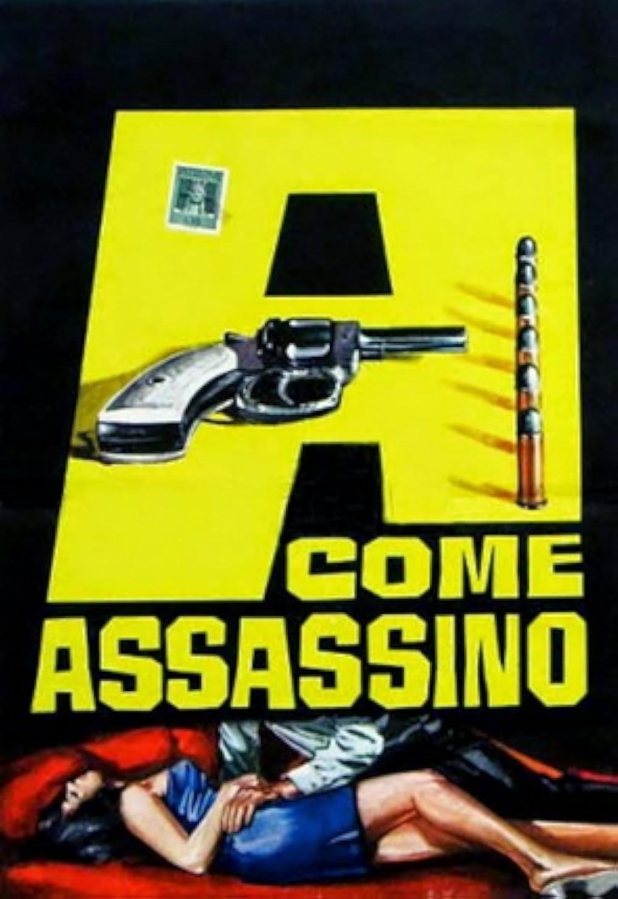
In this early giallo, it’s the home of British millionaire John Prescott, who dies at the beginning and brings together his seven potential heirs, all of whom could have killed him. They are Martha (Giovanna Galletti, the Baroness from Kill, Baby, Kill), his secretary Giacomo (Sergio Ciani, who was also Alan Steel; he started as Steve Reeves’ body double and appeared in Hercules Against the Moon Men and Samson and the Slave Queen), his mentally handicapped son Julien (Charlie Karum), nephew George (Ivano Staccioli, also known as John Heston; he’s in 3 colpi di Winchester per Ringo) and his wife Adriana (Aichè Nanà, whose dancing during a November 1958 private party at the Rugantino restaurant and nightclub on the Viale di Trastevere in Rome led to a national scandal and inspired a scene in La dolce vita), and niece Angela (Mary Arden, who not only was in Blood and Black Lace but also wrote the American dialogue) and her boyfriend Armand (Ivano Davoli).

Prescott leaves behind a recorded will in which he tells each of the gathered guests just how much he hates them. In order to get his money, they have to live together for a month. Then, only three of them can claim it, so that means that at least four people need to be killed for his plan to work.

There’s a dagger with an A in the handle that figures into many of the murders — as the U.S. title was M… for Murderer, the site Euro Fever believes that the scenes with the knife were shot twice and there was an M on the murder weapon — and despite being produced by Walter Brandi (The Vampire and the BallerinaThe Playgirls and the Vampire) and having white nightgowns and candleabras, this leans more giallo than gothic, even if it all takes place in a castle. Italian gothiciallo?

Based on an Ernesto Gastaldi play, this is a movie that even has a flashback halfway through it to show you everything you’ve already seen. Despite that, I have to admit to loving this. It was directed by Angelo Dorigo and written by Sergio Bazzini and Roberto Natale.

You can watch this on YouTube.