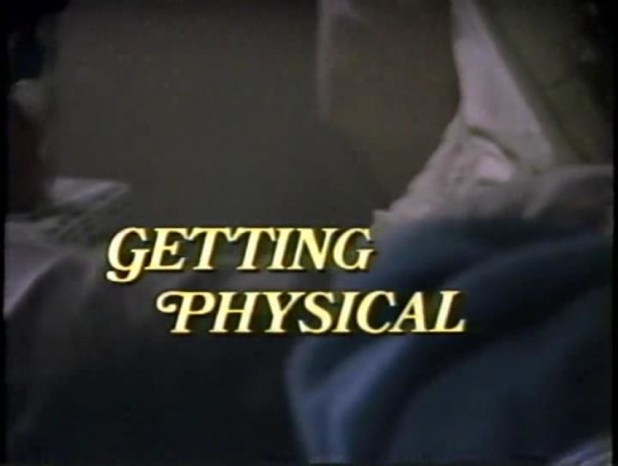
EDITOR’S NOTE: Getting Physical was on the CBS Late Movie on October 22, 1986.
Kendall Gibley (Alexandra Paul) is trying to be an actress, but has a day job she dates, worries that she’s chubby and has self-esteem problems. And then one day, she finds herself at a gym and bonds with Nadine and Craig Cawley (Sandahl Bergman and John Aprea), the owners. While she’s starting a relationship with a cop named Mickey (David Naughton), Kendall gets super into being fit and even starts training for a contest. Her new size upsets Mickey, who ends up punching another cop, and they break up, just in time for Nadine to worry that her husband is paying too much attention to Kendall.
Also: Kendall’s dad Hugh (Robert Webber) thinks she’s fat and her mother Myra (Janet Carroll) thinks she needs to have casual sex. And her boss Byron Waldo (Earl Boen) gets mad when she eats celery at work.
By the end, everything works out well and despite being new to working out, Kendall is a finalist in a contest hosting by Arnold’s best friend Franco Columbu. You’ll also get to see Candy Csencsits (who sadly died at 33 from breast cancer), Vicki Kibler-Silengo, Lisa Lyon (who is also in The Hustler of Muscle Beach), Rachel McLish (Aces: Iron Eagle III), Yana Nirvana (who was Drusilla in the 1977 adult version of Cinderella) and Spice Williams-Crosby (Vixis the Klingon from Star Trek V), Connie Downing (Moving Violations) and Denise Gordy (Reform School Girls). Anne Ramsey (Mama Fratelli!) also shows up.
Directed by Steven Hilliard Stern (Rolling Vengeance, The Park Is Mine, Murder In Space, Mazes and Monsters) and written by Marcy Gross, Laurian Leggett and Ann Weston, this movie is filled with slow jams and 80s soft love ballads, including several songs by Billy Davis Jr. and Marilyn McCoo, as well as songs by Thelma Houston. There’s a new song in almost scene at one point with lots of sweet sounding choruses.
EDITOR’S NOTE: The Alphabet Murders was on the CBS Late Movie on April 5 and August 10, 1972.
Directed by Frank Tashlin (The Girl Can’t Help It, Will Success Spoil Rock Hunter?) and written by David Pursall and Jack Seddon, this film didn’t win the favor of Agatha Christie — who objected to bedroom scenes — and ended up switch Zero Mostel for Tony Randall as Hercule Poirot. Pursall and Seddon, were upset that Tashlin and Robert Morley, who played Hastings, rewrote the script and Randall ad-libbed so much.
It also has two actors who played Poirot. Maurice Denham, who is Inspector Japp, would appear as the famous detective in a 1985 BBC Radio 4 adaptation of The Mystery of the Blue Train. Austin Trevor, who is Judson, played Poirot in three movies: Alibi, Black Coffee and Lord Edgware Dies.
Hastings believes that Poirot is in danger and he’s right. A mysterious woman Amanda Beatrice Cross (Anita Ekberg) makes an attempt and draws him into a murder plot that follows the alphabet — this was based on the book The ABC Murders, but since there was a theater chain in England with that name, it was changed to not offend them — with a clown named Albert Aachen and a bowler named Betty Barnard are the first victims. Poirot thinks that Sir Carmichael Clarke could be the next victim, which makes sense.
This movie establishes the Agatha Christie cinematic universe, as Miss Jane Marple (Margaret Rutherford) and Mr. Stringer (Stringer Davis) show up from their own film series. While that’s awesome, it’s strange to see Poirot be a moron like Inspector Clouseau.
Christie and her fans didn’t like this film, which didn’t play England until a year after its release, showing up as a double feature with Tashlin’s The Glass Bottom Boat.
Doris Wishman week (July 21 – 27) Doris made the loopiest of movies. A self-proclaimed prude who made nudist camp movies, her filmography is filled with contradictions. When she tried to be mean spirited with something like Bad Girls Go To Hell there was always an undercurrent of silliness and fun, but when she tried to be silly and fun in things like Keyholes Are For Peeping there was an underlying seediness and grime that couldn’t be wiped off. It’s hard not to love her!
Doris Wishman produced and directed at least thirty films over four decades, mostly in the usually male-dominated genres of sexploitation and pornography. Her film career began as a hobby after the death of her husband in 1958 and her feature debut was 1960’s Hideout in the Sun.
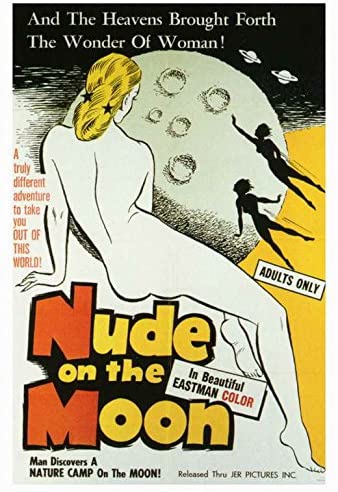
She’d already had experience in the film industry, as she worked for her cousin Max Rosenberg as a film booker for his art and exploitation films. The 1957 New York appeals court that allowed nudism to be shown in movie theaters inspired her to make that first film, which she followed in 1961 with Nude on the Moon, a film that was banned in New York because nudist colonies were legally permissible but nudism on the moon was not. She also worked with the legendary burlesque dancer Blaze Starr but as the nudie cutie genre started losing money, she moved into sexploitation.
That’s when some of her most famous — well, amongst lovers of ridiculous cinema like me — films got made, like Bad Girls Go to Hell and the Chesty Morgan vehicles Deadly Weapons and Double Agent 73, films in which Morgan kills people with her monstrous 73-inch breasts.
Wishman also produced 1972’s Keyholes Are for Peeping, which starred comedian Sammy Petrillo, a Brooklyn nightclub performer who eventually made Pittsburgh his hometown in the 1990’s. He’s probably better known for his teaming up with singer Duke Mitchell (yes, the guy who made Massacre Mafia Style and Gone with the Pope) as the poor man’s Martin and Lewis. They teamed up for Bela Lugosi Meets a Brooklyn Gorilla, which also somehow rips off Abbott and Costello monster films at the same time.
As the industry moved from softcore to hardcore, Wishman directed two Annie Sprinkle features, Satan Was a Lady and Come With Me, My Love. She wasn’t really excited about the shift and denied working on these films. As the 70’s were coming to a close, she released a film she’d been working on since 1971, Let Me Die a Woman, a groundbreaking semidocumentary on transgender issues filtered through the lens of exploitation.
That brings us to today’s movie, A Night to Dismember, which she started filming in 1978 to cash in on the slasher craze begun by Halloween. Wishman was ready to direct and produce the film from a screenplay by Judith J. Kushner. Most of the shoot took place in 1979 in New York at Wishman’s home.
From there, things get weird. Wishman claimed that multiple reels were destroyed in the photo processing lab, resulting in her having to reshoot several scenes and use stock footage to make a releasable final film. After four years (!) of post-production, the film would remain unreleased until MPI Media Group put it out in 1989.
There’s also an entirely different version of this film that was released in August 2018 on YouTube by the film’s cinematographer, C. Davis Smith. This version features actress Diana Cummings in the lead role and an entirely different plot, as adult film actress Samantha Fox replaced Cummings after the destruction of Wishman’s film.
According to Smith, Fox paid Wishman $2,000 to get the starring role of Vicki Kent. He said he doesn’t know for sure, but he believes that Wishman faked the story that the original print was destroyed in a fire and reshot the film with Fox. You can read more about that story here.
Whew! That’s a lot of history to cover, but this is a film that has plenty of it. Let’s get into what it’s really all about!
The Kent family suffers from an ancestral curse that has caused nearly all of them to be murdered, often by one another. Bonnie was first, hacked to pieces by her sister Susan, who was upset that her father favored her sister. After the murder, she slipped on the blood and was killed by the very same axe.
Broderick Kent’s wife Lola is next, murdered in the bathtub. While Kent tries to proclain his innocence, he eventually hangs himself.
That’s when we get to Vicki Kent (Samantha Fox), who has just ben released from an insane asylum after killing two boys. Her brother and sister, Billy and Mary, want her to be committed again.
Despite wanting to rekindle her relationship with her ex-boyfriend, she struggles to make it in the real world, constantly hallucinating. Then again, with Frankie getting decapitated and his head burned in a fireplace, that relationship seems doomed.
Vicki tries to visit some relatives who turn her away before they’re all killed by hatchet and by car. Even a trip to the lake is fraught with horror, as a zombie chases her around, only to be revealed to be her brother Billy who has been trying to frighten her back into the sanitarium.
This is the kind of movie that rewards your lack of attention with shifts in characters, hairstyles and clothing all within the same scene. It doesn’t help that there is next to no voiced dialogue and only a narrorator’s voice to carry us through every scene and change in tone. We go from Vicki performing a sexy dance and trying to seduce a detective to Vicki’s sister Mary actually being the one behind all the killings.
The detective makes his way to the house where he finds a confused Vicki holding a hatchet. Despite hitting him several times with it, he manages to strangle her to death. That’s when we get the voice over from the detective, telling us that Mary was the real guilty party, but she’s escaped after killing a cab driver. And that’s the movie, I guess.
To put it bluntly, A Night to Dismember is a mess. It’s got songs that stop and start, horrible acting, bad gore and footage that appears to be the quality of a 1970’s super 8 home movie. It’s the kind of movie that if I watched it with a roomful of normal folks, they’d scoff and laugh. And that’s why I woke up at 4 AM so that I could enjoy it all by myself, away from the insults of people not ready to cheerful enjoy a movie that combines the insane and the inane. There’s also plenty of 1970’s fashion and an unhinged voiceover to love, which continues over the credits, making me adore this piece of film even more.
Back to Wishman. Before her death in 2002, she was finally honored for her groundbreaking work, with John Waters featured a clips from her films in Serial Mom, appearances on Late Night with Conan O’Brien, appearances at the New York and Chicago Underground Film Festivals and a showing of her films at Los Angeles’s Nuart Theatre entitled “Doris Wishman: Queen of Sexploitation.”
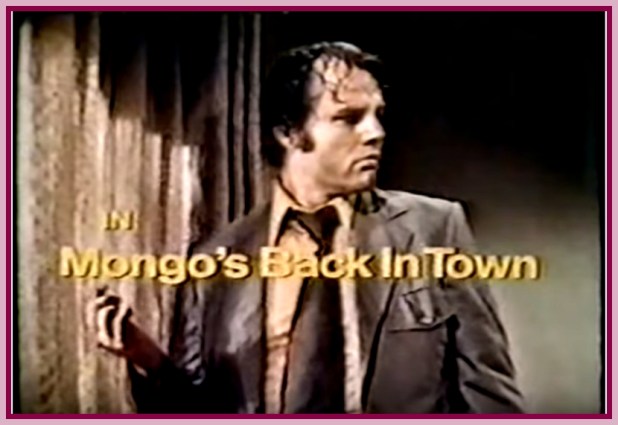
EDITOR’S NOTE: Mongo’s Back In Town was on the CBS Late Movie on January 31 and October 10, 1973 and April 20, 1978.
Lieutenant Pete Tolstad, the character played by Telly Savalas in this made for TV movie, feels like the early version of Kojak before that show would air in 1973. Tolstad grew up in the same neighborhood that is now his beat. He’s never had a real Christmas. He just does his job.
Directed by Marvin J. Chomsky (Tank, Evel Knievel, Roots) and written by Herman Miller and based on the book by E. Richard Johnson. Johnson was a convicted armed robber and murderer who wrote all eleven of his books from his cell at Stillwater State Prison in Minnesota. He started writing to pass the time in prison and his novel Silver Street won the Mystery Writers of America’s Edgar Allan Poe Award for 1968 and the follow-up, which this movie is based on, was considered an even better book. Despite his success, he got into drugs while in prison. He escaped and went back into crime before being recaptured and stayed in jail until 1991.
Everyone is interested in the reasons why Mongo Nash (Joe Don Baker) is back in town and why he’s spending time with a young girl named Vikki (Sally Field) who has just come to town from West Virginia. Is he in town to do a hit for his brother Mike (Charles Cioffi)? Or does he just want left alone?
This has a great cast. Martin Sheen plays Tolstad’s partner Mike and Anne Francis is a gangster’s moll who Savalas has a flirty scene with. Baker is great and somehow makes a killer into someone that you feel some level of empathy for and the way he treats Vikki. Ah yes. He is a killer. On the way to the brutal ending, we have people get acid thrown in their faces and everyone is fair game for murder including kids.
Originally airing on CBS on December 10, 1971, this is also known as Steel Wreath, which is a strange title and probably one that makes more sense once Johnson and his books were forgotten. Perhaps they didn’t want people to think this was a Blazing Saddles sequel, which there was one that is forgotten and was a TV series.
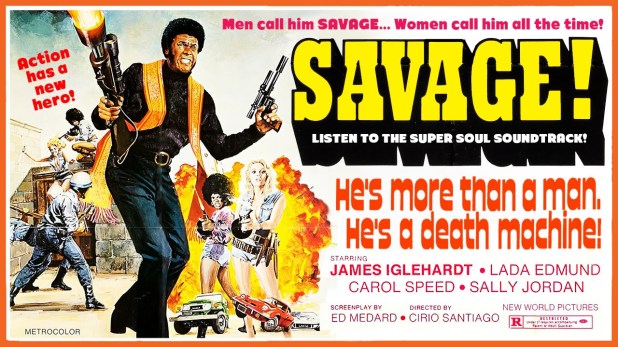
EDITOR’S NOTE: Savage! was on the CBS Late Movie on October 1, 1974 and October 10, 1976.
Between 1973 and 2008, Cirio H. Santiago partnered with Roger Corman on more than forty Philippines-filmed exploitation movies. The cost was low, the stuntmen willing to die, the locations gorgeous. And here’s Savage!, directed by Santiago and written by one time only screenwriter Ed Medard.
Savage (James Iglehart, Beyond the Valley of the Dolls) goes from a criminal evading the law to a leader overthrowing a dictatorship in just over eighty minutes. Working with Vicki (Lada St. Edmund, who went from go-go dancer on Hullabaloo to being the highest paid stunt woman in Hollywood) and Amanda (Carol Speed, always Abby), he goes from fighting the rebels to becoming one of them. I mean, Vicki is a knife thrower and Amanda is an acrobat and they know how to transform those circus skills into deadly arts.
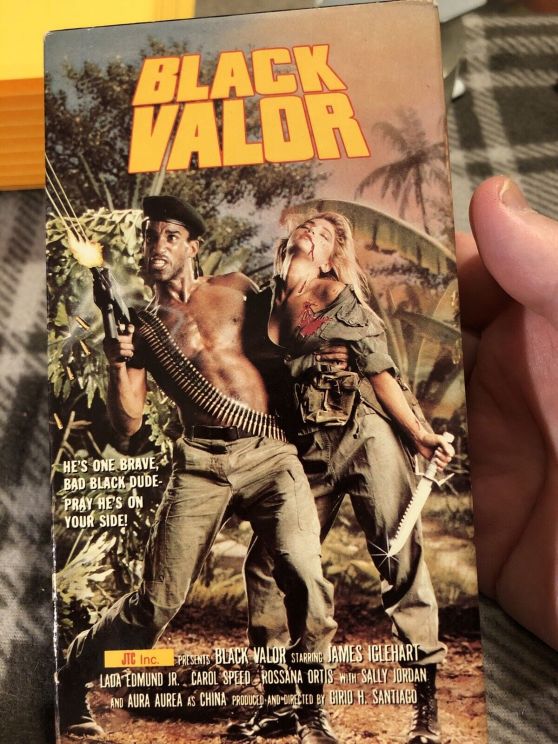
As you can imagine, Vic Diaz is in this and maybe bamboo buildings blow up real good. It’s also called Black Valor, which really isn’t a better title than Savage! but is possibly a better blacksploitation movie name.
Iglehart is also in a much better film in this same genre, Fighting Mad. Aura Aurea, who plays China, was known as the Brigitte Bardot of the Philippines, which is a great name to be awarded, right?
EDITOR’S NOTE: The Couple Takes a Wife was on the CBS Late Movie on September 16, 1974; May 5, 1975 and June 24, 1977.
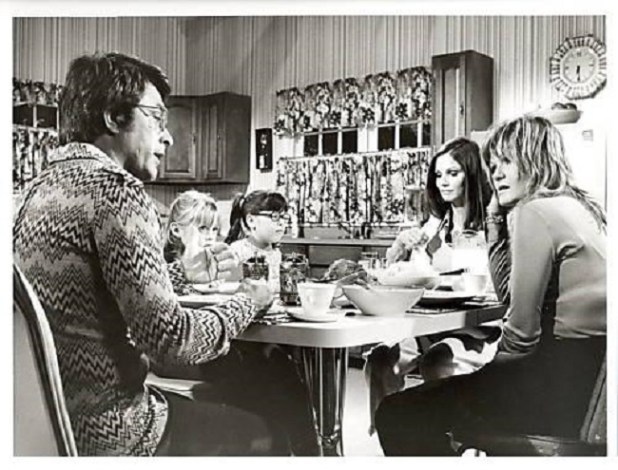
Jeff and Barbara Hamilton (Bill Bixby and Paula Prentiss) lose their maid and decide that if they’re both so busy, they should just get another wife because it’s 1972. And yet in the midst of porno chic, their new wife Susan Silver (Valerie Perrine) is only shown to be fleetingly romantic with Jeff and not interested at all in the benefits of a true triad relationship. But hey — it was on TV in 1972, so why am I wondering these things? Too many Joe D’Amato movies, that’s why.
Throw in appearances by Myrna Loy, Robery Goulet, Nanette Fabray, Larry Storch and Penny Marshall and yes, you have a TV movie.
Seriously, why didn’t Barbara and Susan just run off and leave Jeff — who is a real cad for the entire movie — all on his own?
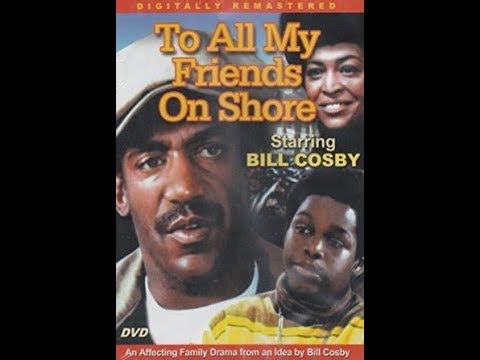
EDITOR’S NOTE: To All My Friends On Shore was on the CBS Late Movie on June 13, 1974.
Blue (Bill Cosby) works as a skycap for an airport and also scrounges for junk he can sell. His wife Serena (Gloria Foster) is a maid and going to school to be a nurse. They’re both working so they can leave the projects and have a better life for their son Vandy (Dennis Hines), who resents the fact that he can’t have fun like his other friends and spend money. Well, when he gets sickle cell anemia, everyone realizes that time may mean as much as dollars.
Directed by Gilbert Cates — the producer of the Academy Awards fourteen times between 1990 and 2008 and was credited with recruiting Billy Crystal, Whoopi Goldberg, David Letterman, Steve Martin, Chris Rock and Jon Stewart to serve as hosts — this was written by Cosby and Allan Sloane.
Cosby and Foster would reunite years later for Leonard Part 6. But that’s another story.
Doris Wishman week (July 21 – 27) Doris made the loopiest of movies. A self-proclaimed prude who made nudist camp movies, her filmography is filled with contradictions. When she tried to be mean spirited with something like Bad Girls Go To Hell there was always an undercurrent of silliness and fun, but when she tried to be silly and fun in things like Keyholes Are For Peeping there was an underlying seediness and grime that couldn’t be wiped off. It’s hard not to love her!
Before we start, I have to explain.
As I look for movies that feature matriarchal societies, it seems like so many of them end up being straight-up male gaze fuelled fantasies. Or so you’d think, because while this movie was made by Anthony Brooks and O.O. Miller, only one of those names belongs to a man.
Brooks may have been Raymond Phelan (the writer, director, editor and one of the main actors of Too Young, Too Immoral), but Miller is really Doris Wishman, who Joe Bob Briggs referred to as “The greatest female exploitation film director in history.” From a series of nudist colony movies to movies with incredible names like Bad Girls Go to Hell, Satan Was a Lady and Let Me Die a Woman, as well as A Night to Dismember and two Eurospy films (Deadly Weapons and Double Agent 73) starring all 73-inches of the woman with the largest bust on record, Chesty Morgan.
The truth is, this movie does introduce us to a female-run society on the moon, which for some reason is the occult-created Coral Castle near Miami, but they’re all topless. Yet like many of the nudist films of the early 60’s, this comes off as quite innocent. And unlike so many of them, this movie isn’t boring.
Dr. Jeff Huntley (Lester Brown in his one and only role) has inherited millions in his uncle’s will and is finally going to the moon with his mentor, Professor Nichols (William Mayer, who shows up as in several of these movies, like Blaze Starr Goes Nudist, which was not much of a life change).
Nichols sees Huntley like a son and worries about how dangerous the moon will be. He’s old, so he’s ready to die. But he wants Huntley to live and find a wife. After all, their secretary Cathy (Marietta) is in love with him and he doesn’t see it or doesn’t care. All he wants to do is go to the moon.
They get there, wearing brightly colored spacesuits with plenty of spaces for the lack of environment on the lunar surface to kill them. But instead, you know, they end up at Coral Castle and meet an entire planet of clothing-free ladies who are led by a Moon Queen (also Marietta) who uses her psychic powers — or maybe Dr. Jeff has never seen breasts before in person — to make our young moon-obsessed friend get obsessed over her mountain peaks.
Perhaps this explains why Jack Parsons blew himself up after falling so hard for Marjorie Cameron. I mean, you become besotten with one literal Whore of Babylon and you lose your security clearance but still get a peak on the dark side of the Moon named after you.
But I digress.
For two guys who planned a trip to the moon for years, they didn’t bring enough oxygen and also leave their camera behind, so no one will believe them that the lunar surface looks more like the aforementioned Blaze Starr’s 2 O’Clock Club.
It all works out, because that’s when the hood doctor discovers that his secretary — who he’s been ignoring forever, who sits and types the same letter all night long hoping that he will notice her — looks just like the Moon Queen. They embrace, the camera dollys back to give them some privacy and then the Professor walks in on them and just looks on approvingly. He just stands there and watches and smiles to the camera.
Keep an eye out for Shelby Livingston, who just three short years later would be chopped to pieces –just a few towns away in Kissimmee, Florida — in Two Thousand Maniacs! Lacey Kelly, who was in Bunny Yeager’s Nude Camera and Common Law Wife, is also on the Moon.
There’s also a moment where the two space-loving men discuss Dr. Jeff going to a movie, as they drive past the Variety Theater, which is showing Wishman’s Hideout in the Sun. Did Dr. Jeff recognize Pat Reilly when he also saw her up there in space?
This movie also has its own theme song, which is pretty cool when you think about it. “I’m Mooning Over You (My Little Moon Doll),” which was warbled by Ralph Young over orchestration that had been arranged by — but not credited to — Doc Severinsen.
While not the most feminist leaning film ever, we can still point to the fact that the Moon Queen does rule her planet and you know, if you can breathe the lack of air on the lunar surface — to be fair, at the end the scientists have no idea where they’ve really come back from — you can forget puritanical mumbo jumbo and just walk around unencumbered.
After all, it worked for Blaze Starr, who was smart enough to get 4% of the profits for the 1984 movies about her life, Blaze.
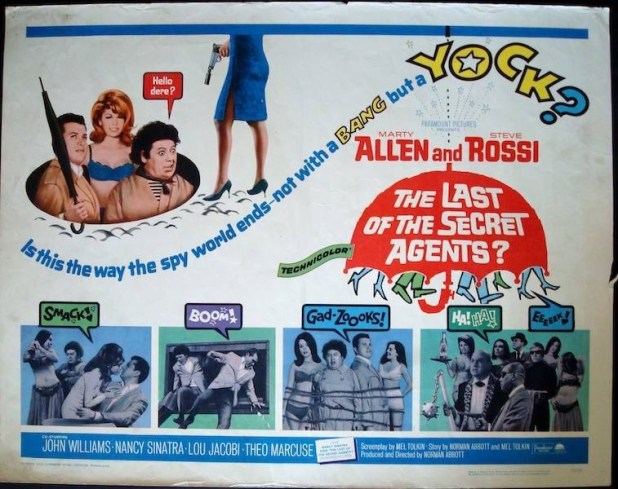
EDITOR’S NOTE: The Last of the Secret Agents? was on the CBS Late Movie on July 8, 1975.
Marty Allen and Steve Rossi — who used the catchphrase “Hello Dere!” — were a comedy from 1957 until 1968 that appeared on over 700 television shows including 44 appearances on The Ed Sullivan Show.
This film is their spy spoof, featuring Nancy Sinatra acting and singing “The Last of the Secret Agents,” which is also in the Billy Murray movie The Man Who Knew Too Little.
Paramount Pictures knew all about comedy teams. In the 1940s, they made big money off of Bob Hope and Bing Crosby and Dean Martin and Jerry Lewis in the 1950s. There was the hope that Allen and Rossi could do the same here, but it didn’t happen. That said, they did make Allen and Rossi Meet Dracula and Frankenstein.
In this movie, they play tourists who are recruited by the Good Guys Institute to battle Zoltan Schubach and THEM, who are stealing art treasures.
It was directed by Norman Abbott, who worked a lot with Jack Benny and was a director for the Get Smart! TV show, amongst many other programs.
Lou Jacobi shows up (he’s Murray, the man who gets lost inside his TV in Amazon Women on the Moon), as does Thordis Brandt (The Witchmaker), Harvey Korman and the one-time wife of Russ Meyer, Edy Williams.
EDITOR’S NOTE: Blood and Roses was on the CBS Late Movie on July 15, 1975.
Carmilla has been made so many times — Vampyr, Dracula’s Daughter, Crypt of the Vampire, The Vampire Lovers, The Blood Spattered Bride — but the Roger Vadim-directed movie moves the setting to Italy in the 20th century.
Carmilla (Annette Stroyberg, Vadim’s wife at the time) is torn apart by the engagement of her friend Georgia (Elsa Martinelli, The Tenth Victim) to her cousin Leopoldo (Mel Ferrer, Nightmare City, The Visitor, both versions of Eaten Alive (with and without the exclamation mark), The Antichristand dude, Mel Ferrer has been in so many movies I love, even The Norseman) and she has no idea who she loves more. Yet she’s also found a dress that belonged to a vampiric forebearer and gone into her grave and nothing good is going to come of that.
And yes, Leopoldo is Count Karnstein, which would make him from the same family as the vampire in Twins of Evil and the rest of Hammer’s Karnstein Trilogy (we already mentioned the other two films, the third is Lust for a Vampire). The role was originally intended for Christopher Lee, which makes sense.
This is the artier side of vampire films when so much of this week has been wallowing in the mire and muck. See, sometimes we can be classy when we share a lesbian vampire movie.




 B&S About Movies
You must be logged in to post a comment.