TUBI ORIGINAL: Dark Secret (2025)

Director and co-writer Johnnard Harper has made more than twenty movies in a short time. Working with writer Anthony Leone, he’s made a perfect Tubi Original: cheap, outrageous and quick. 

We meet April (Kennedy Williams) and Derek (Joseph Mason), a couple deep in the struggle. They’re trying to make it, but the rent is due, and the bank account is screaming. Their solution? Get a roommate.

What follows is a parade of human wreckage that feels like a fever dream. Every interviewee is either legally insane, looking for a three-way, or both. It’s a montage of desperation that captures the true horror of the modern gig economy. There’s one moment when they meet a potential roommate, Jason, who is a stripper and an OnlyFans creator named Donald Trunk. This scene is incredible because it’s a one-take wonder, as at least two of the actors are visible breaking throughout. No notes.

Eventually, they settle on Megan (Mikiya Scottia). She’s polite, she’s clean, she’s perfect. Of course, because we’ve seen the first five minutes of the movie, we know Megan has already stacked a few bodies. We’re in on the joke; the roommates are the punchline.

This being a Tubi Original, there’s a late-in-the-film twist you’d never see coming, and because I said that, you can see it coming. But you still won’t see it coming. I apologize if this makes no sense, unless you are a watcher of numerous Tubi Originals and then, well, you get it.

You can watch this on Tubi.

Paying for It (2024)

ABOUT THE AUTHOR: Joseph Perry writes for the film websites Gruesome Magazine, The Scariest Things, Horror FuelThe Good, the Bad and the Verdict and Diabolique Magazine; for the film magazines Phantom of the Movies’ VideoScope and Drive-In Asylum; and for the pop culture websites When It Was Cool and Uphill Both Ways. He is also one of the hosts of When It Was Cool’s exclusive Uphill Both Ways podcast and can occasionally be heard as a cohost on Gruesome Magazine’s Decades of Horror: The Classic Era podcast.

Official synopsis: Set in the late 90’s, Paying for It follows the trials and travails of Chester (Dan Beirne), a cartoonist and Sonny (Emily Lê), a TV host, who are in a long-term, committed, romantic relationship. When Sonny introduces the idea of opening up their relationship, Chester begins sleeping with sex workers, forcing him to face his issues with intimacy and romance in the process. Based on the best-selling graphic novel by acclaimed alternative-cartoonist Chester Brown.

Celebrating the vibrant underground comic and zine era through the experiences of cartoonist Brown, Paying for It connects the past with the present by bringing together emerging comic actors, performance artists, authors, activists, and multimedia creators in front of and behind the camera, and it has resonated for festival audiences and critics alike.

Canadian dramedy Paying for It may be one of the most honest narrative films released this year. Director Sook-Yin Lee brings to the screen a semiautobiographical account of her longtime relationship with alt-cartoonist Chester Brown, first as a couple and then as friends. The pair is portrayed here by Emily Lê as Lee’s cinematic counterpart Sonny and Dan Beirne as Brown.

Lee, who cowrote the screenplay with Brown and Joanne Sarazen, balances the characters wonderfully, making neither one more “right or wrong” than the other, and portraying them as real people making unusual decisions in their lives. Beirne and Lê are both fantastic in their roles, and they lead a sizable supporting cast that includes a wonderful performance by Andrea Werhun as Yulissa, who together with Brown strikes up a highly intriguing intimate relationship.

The tone of the film never falls into straight comedy, with the humor being more of the smile-inducing type rather than going for belly laughs. Nor does the drama become too heavy or didactic. Paying for It simply offers up two people’s unique views on nontraditional relationships and the ways that their behavior affects those around them, giving viewers plenty to chew on long after watching. 

Paying for It opens in theaters on January 30, 2026. 

Poolboy: Drowning Out the Fury (2011)

I don’t know how director Garrett Brawith (who also made FDR: American Badass!) and writer Ross Patterson (Helen Keller vs. Nightwolves) got Kevin Sorbo to say some of the dialogue in this, but this movie is less a film than an exercise in saying really off-color things and then claiming that it’s a joke.

Poolboy is supposedly — in the world of the film — the vanity project of Saint James St. James, who made this when he was ten. Well, this is the sequel. The first one was so racist that no one is allowed to see it.

Sorbo is Jan Van Hammer, who plays Sal Brando, the poolboy of the title. He was hoping to come home from Vietnam to start a pool cleaning business with Fontaine (Deon Richmond), but all he has left is that man’s arm. And he gets back to his house just in time to catch his wife in bed with Eduardo (Bryan Callen). He steals the man’s van and pool businesses, which gets his wife and kid killed by Caesar (Danny Trejo), who is part of a huge national Mexico vs. America conspiracy.

At some point, when Jan Van Hammer is nearly killed, his role is taken over by Jason Mewes.

This is a confusing film. It’s going to offend everyone because of what it says, and yet it wants you to love it by saying, “I’m just kidding!” As always, there’s the danger of laughing at rather than with the film’s themes. But it’s still kind of fascinating, even if it’s way too long and runs out of steam after thirty minutes, as it’s a sketch stretched thin.

You can watch this on Fawesome.

The Booth at the End (2010-2012)

ABOUT THE AUTHOR: Exploitation-film historian A.C. Nicholas, who has a sketchy background and hails from parts unknown in Western Pennsylvania, was once a drive-in theater projectionist and disk jockey. In addition to being a writer, editor, podcaster, voice-over artist, and sometime actor and stand-up comedian, he’s a regular guest co-host on the streaming Drive-In Asylum Double Feature and panelist on the Deep Images podcast and has made multiple appearances on Making Tarantino: The Podcast. He also contributes to the Drive-In Asylum fanzine, the B & S About Movies Podcast, and the Horror and Sons website. He currently programs a monthly film series, A.C. Nicholas’s Hidden Gems, at The Babylon Kino in Columbia, South Carolina.

“Show. Don’t tell.” This adage is as old as film itself. Looking at the first quarter of the twenty-first century, perhaps screenwriters have taken that statement too much to heart. Apart from the few films written by folks who can write memorable dialogue, like Quentin Tarantino and David Mamet, the typical film or TV show today is an empty spectacle, or as my father used to say, “parada,” Polish for “show” or “exhibition.” Fathers of my generation would tell kids, “You’d better stop your crying, or I’ll knock you into next Wednesday,” but my dad always used parada when sternly presaging an ass-whipping: “Don’t make a big parada out of it.” And that describes your typical $200 million Hollywood blockbuster—empty, soulless, and cynical, just a series of huge action set pieces strung together by the most perfunctory narrative, a big parada. (Quick, how many films in the past 25 years deal with a fight over “magic junk” or advanced technology, something that if it falls into the hands of the wrong people will cause mass destruction? There’s a Letterboxd list for you, Sam.) Let’s just say the era of dialogue-driven films–“all tell, no show”–such as My Dinner with Andre, Swimming to Cambodia, and Before Sunrise, is but a distant memory 

Which brings us to a weird little item called The Room at the End, which had its genesis as a web series of 62 two-minute episodes. They were later strung together and shown on Canadian and British television before floating around streaming services in this country. How I discovered it years ago, I cannot remember. But it’s something I’ll never forget. It’s one of the best things I’ve ever seen, from anywhere, from any era, in any medium. And, apart from a handful of reviews and posts online, it remains largely unknown. But not for long, I hope.

In the end booth of an old-school diner, sits a rumpled guy with a pen and a book. He’s never referred to by name. He’s just “The Man,” and he’s played by long-time character actor Xander Berkeley. As each vignette begins, he’s sitting there, perhaps reading the newspaper or having coffee, when he’s approached by someone who has heard that he can help them with a problem. A man has a terminally ill child. A young woman wants to be prettier. A nun has lost her faith. Each of them tells their story to The Man, who says that what they want can happen, but first, they must complete a task and return to report the details of carrying out that task. He then opens his book, jots a note or two, and tells them what they must do to receive their desire. For the man, his kid will get better if… he kills someone else’s child. For the young woman, she’ll be prettier if… she steals $101,043 from some banks. (The randomness of that number is like the randomness of the universe.) And the nun will hear God again if… she gets pregnant. The Man also tells each of them that they can walk away from his offer. In follow-up vignettes, we hear the decision each made and what happened.

The compiled vignettes form two seasons with a total of 10 approximately 23-minute episodes. (You can, as I did, binge the entire series in an afternoon. And once you get started, I’m betting you will.) Each episode follows the same format: Here is the diner, here is The Man in the booth at the end, and here are the clients entering one after another to either make a deal or give The Man updates. The only other character is a waitress named Doris, who takes on a greater significance in the second season when The Man sets up shop in the booth at the end of a different diner.

Who is The Man? Does he have supernatural powers? What is the significance of the book? How will the clients respond to their assigned tasks? Some of those tasks even intertwine. For example, the guy who must kill a child is unknowingly pitted against a guy whose task is to protect a child. In the end, how do these stories resolve? I think the true nature of the show is subtly found in its title: The Booth at the End. Yes, it’s the “end” booth in the diner, but “end” could also refer to the existential end of a person’s hope.

This is all the brainchild of writer/creator Christopher Kubasik, who got his start working on video games and writing tie-in novels. It’s easy to see that, in writing cut scenes for video games, he had the perfect training to write short-form internet content. Based on The Booth at the End, I wish he’d do more stuff. I was surprised to discover that there was a 2017 Italian movie adaptation of the show called The Place, which was nominated for a whole bunch of Donatello awards, the Italian Oscars. I must seek it out. 

Now before you cry “rip-off of Needful Things by Steve King from the University of Maine,” let me remind you that this plot about getting what you wished for–and then regretting it–has been around for ages and not just in the various adaptions of the short story The Monkey’s Paw. Folklore about wish fulfilment and its consequences goes back to the tales of the Arabian Nights. The Booth at the End is built upon a sturdy and reliable trope. And what makes it so special is how it subverts our expectations of that “genie and three wishes” plot. It does so entirely with dialogue. That’s right. Nothing is shown. Everything is discussed. In each vignette, a client sits in that booth and has a conversation with The Man. And these conversations are riveting, philosophical, and often horrifying. For, you see, life is like that, and Kubasik has stripped everything away, the action, the violence, the special effects, “the showing,” if you will, to concentrate on the thoughtful “telling”–and not a big parada.

On paper, this minimalistic approach would appear either boring or, at best, “twee,” as a cinephile friend likes to say. But watch a two-minute chunk, and you’ll see that it’s breathtakingly brilliant. The stories grab your attention with their complex dilemmas. Forgive me for using that overworked expression that you could do a semester college class in philosophy–or screenwriting–about the show, but it’s spot-on here. (The movie Groundhog Day similarly fits the description.) You, as the viewer, are drawn into this small, bell-jar universe of right and wrong, morality and immorality, and good and evil. It’s impossible not to ponder how you would react if faced with the same decisions The Man’s clients must make. The stories are like modern parables. 

And Kubasik tells these stories like the caveman who told his friends around the campfire how Ook fell into the pile of mammoth dung on their hunting trip, unadorned with CGI or VFX. It’s the oldest, yet most powerful, narrative device: simple storytelling. Too many filmmakers today forget the power of the spoken word. 

But an equally important reason this show succeeds, in addition to the weighty ideas and impressive writing, is the brilliant central performance by Xander Bekeley as The Man. All the actors here are good to great, but this is Berkeley’s day in the sun. While you might not recall his name, you’ll recognize him as a character actor who’s been kicking around for decades, quietly doing solid work in TV shows such as 24, Nikita, and The Walking Dead and the movies Candyman, Air Force One, and Heat, among many others. Lucy Mangan of The Guardian said Berkeley’s performance should be “used as an acting masterclass.” That’s 100% accurate. When the nun, played by Berkeley’s real-life wife, Sarah Clarke, asks him how she can be sure he’s not the devil, Berkeley’s delivery of “you can’t” is chilling. He’s so compelling that he could read a diner menu and be mesmerizing. But he’s equally compelling in his reactions to the details that his clients give him. He may be in a minimalistic show, but his acting is anything but minimal. He’s fantastic, demonstrating that sometimes the greatest acting is not always done by the big star in the big parada.

Over the years, I’ve recommended The Booth at the End to friends with discerning taste—this is not something you recommend to someone like that person who many years ago posted on a CompuServe board I moderated that Grease was the greatest movie ever made–yet no one has ever listened to me and watched it. I guess that description of “all tell, no show” was a buzzkill. Anyway, you’re an exceptional discerning person: Go watch The Booth at the End, which is streaming on Tubi. And then give me the details. I’ll be waiting for you at the booth at the end… of the drive-in snack bar.

MVD REWIND COLLECTION 4K UHD RELEASE: Knock Off (1998)

For all the amazing Hong Kong movies Tsui Hark made, he only has two Western films to his credit. Both star Jean-Claude Van Damme, but only one co-stars Rob Schneider. This would be that movie. It also features fight choreography and second unit direction from Sammo Hung, but many of his longer battles were cut from the film that was finally released. This movie almost had Jet Li in it, but he decided to make Lethal Weapon 4 instead.

Marcus Ray (Van Damme) and Tommy Hendricks (Rob Schneider) own V Six Jeans and are about to be busted for selling knock offs of their own product by Karen Leigh (Lela Rochon, Waiting to Exhale) who is not only their boss, but also a CIA agent out to ferret out the spy within the company. There’s yet another CIA agent named Harry Johannson (Paul Sorvino!) who is really a double agent for terrorists and the Russian mob. And to top all that off, Tommy is CIA too.

It turns out that the knock off jeans and some baby dolls are laden with nanobombs. Go with me here: they were made by former KGB agents who now work with terrorists who are using the Russian mob to get them on the black market all so that they can extort $100 billion dollars from the world’s governments. Who you gonna call? The copy guy and Van Damme, that’s who.

Knock Off is totally ridiculous, but you kind of know what to expect going into it. Van Damme as a fashion magnate? Sure, why not? At least he doesn’t get crucified on a ship or have an old guy stretch him out in this one.

The MVD 4K UHD release of this film has extras like an archival audio commentary by action cinema experts Mike Leeder and Arne Venema; a collectible 4K LaserVision mini-poster and reversible cover art. There are also interviews with Steven E. de Souza and Moshe Diamant; a trailer and a making of. You can get it from MVD.

ARROW 4K UHD RELEASE: The Visitor (1979)

In 2013, when the Alamo Drafthouse presented the uncut version of this film for the first time in the United States, they called it an “unforgettable assault on reality.” Those words best describe what is otherwise an indescribable film.

But I’m going to try.

Maybe a recipe will help.

Take Chariots of the Gods, and some of Rosemary’s Mary, then a little bit of The Omen, throw it in a blender and then pour the whole thing down the sink.

No? Maybe a synopsis.

We start in Heaven, or somewhere very much like it, where Franco Nero (the original Django) is one of those space gods that Erich von Däniken wrote about. He tells the bald children who surround him that there was once a war between two aliens, one good and one bad. The bad one — who is either called Sateen or Zathaar — was defeated, but not before he slept with a whole bunch of Earthwomen. Cue the Book of Enoch in the Lost Books of the Bible. Or cue the Scientology myth of Lord Xenu. Or Xemu, because he has two different spellings, too.

Only one child is left — a young girl — and a vast conspiracy wants her mother to have another child — a brother this time — so they can mate. The Christ figure sends John Huston — yes, the director of The Maltese Falcon and The African Queen — and the bald children to a rooftop somewhere in Atlanta to stop this plot. To do that, the children become adult evil men and dance around a lot while Huston walks up and down the stairs to triumphant music. If you think I’m making that last sentence up, you’ve never been blessed with this movie.

Meanwhile, Lance Henriksen (Near DarkAliens) is Ted Turner, pretty much. His name is Raymond Armstead, and he owns the Atlanta Rebels basketball team that plays at the Omni, and he is dating Barbara (Joanne Nail, Switchblade Sisters), who, of course, has the seed of the gods inside her. Her daughter Katy is 8 years old and already using her powers to help the Rebels win their games. But that isn’t all the help Raymond is getting. The rich, powerful and ultra-secretive Zathaar cult controls the world and is helping his team become winners. All he has to do is marry Barbara, knock her up and let their kids fuck. Hopefully, they have a boy, or Raymond is gonna have to get in the saddle all over again.

Raymond can’t even do that right, and the leader of the bad guys, Mel Ferrer (The Antichrist and Eaten Alive!) is upset and ready to quit on Raymond. Barbara doesn’t want more kids, and indeed not another child. But who can blame her? Her daughter is one creepy little girl. Her daughter knows all about the conspiracy and begs her mom to get married so she can have a brother (and this is where, in person, I’d throw in “…to have sex with” but I’d use the f word). How creepy is Katy? Well, she kills a bunch of boys with her mental powers because they make fun of her while she ice skates. And then she accidentally shoots her mother at a birthday party. Yep, it’s as if The Bad Seed met Carrie!

Then, as all 70’s occult movies must, the stars of Hollywood’s golden age make appearances!

Glenn Ford, the actor, plays a cop that Katy curses out and uses hawks to wreck his car!

Shelley Winters plays Barbara’s nurse, who once had one of the space babies and killed it, but can’t bring herself to kill Katy! According to interviews, Winters really smacked around Paige Conner, the actress who played Katy!

Sam Peckinpah, the director (!), plays an abortionist who removes one of the space babies from Barbara after the conspiracy pays a bunch of things to artificially inseminate her. Turns out Peckinpah had trouble remembering his lines, which is why we never learn that he’s Barbara’s ex-husband! Then is he Katy’s dad? Who knows! His voice is even Peckinpah’s! They had to ADR all of his dialogue.

In response to the abortion, Katy shoves her mom through a fish tank. She also decides to throw her down the stairs, Whatever Happened to Baby Jane?-style. And by throwing her down the steps, I mean do it over and over and over again.

Meanwhile, John Huston is still going up and down the stairs. Finally, they HAVE HAD ENOUGH (I like to emphasize that so you get the gist) and sent their John Woo-ian flock of doves to fight the hawks. Meanwhile, Mel Ferrer and all his men show up dead with black marks on their bodies.

And Katy? Well, as Huston tells us, kids can never be evil. She gets her head shaved and goes into space to meet the Interstellar Jesus Christ. The title comes up as insane music blares.

Writer/director/insane man Michael J. Paradise (Giulio Paradisi) was in Fellini’s 8 1/2 and La Dolce Vita. What inspired him to this level of cinematic goofiness? He was helped along by Ovidio G. Assonitis, whose resume includes writing Beyond the DoorMadhouse and Forever Emmanuelle before becoming the major stockholder and CEO of Cannon Pictures in 1990. That may explain some. But not all.

I know I often write things like “I don’t have the words to describe this” when I do these reviews — mainly after I write a few hundred words all about said subject. But this is one time that that statement is not pure hyperbole. Just watch the trailer and be prepared to lose your grasp on normalcy!

The Visitor defies the logic of good and bad film. It can only be graded on whether it’s an absolute film, ala Fulci or Jodorowsky. It is something to be experienced.

The Arrow Video 4K UHD release of this film features a brand-new 4K restoration of the 109-min European version from the original 35mm camera negative, by Arrow Films. Extras include brand new audio commentary by film critics BJ anf Harmony Colangelo; visual essays by film critics Meagan Navarro and Willow Catelyn Maclay; archival interviews with Lance Henriksen, Lou Comici and cinematographer Ennio Guarnieri; a theatrical trailerl an image gallery; a reversible sleeve featuring original and newly commissioned artwork by Erik Buckham and a collectors’ booklet featuring new writing by Marc Edward Heuck, Richard Kadrey, Craig Martin and Mike White. You can get it from MVD.

ARROW VIDEO 4K UHD AND BLU-RAY RELEASE: Excalibur (1981)

Shot entirely on location in Ireland, mainly employing Irish actors and crew, Excalibur was an essential film for the Irish filmmaking industry and helped start the careers of Liam Neeson, Patrick Stewart, Gabriel Byrne and Ciarán Hinds.

It was also known as the Boorman Family Project, as several members of director Jonathan Boorman’s family appear: his daughter Katrine Boorman as Igrayne (Arthur’s mother), his daughter Telsche as the Lady of the Lake, and his son Charley as Mordred as a boy. It was shot a mile from his home, so he was able to stay home for the entire shoot.

Boorman has wanted to make the movie since 1969, yet United Artists saw the three-hour script as too costly and instead offered him The Lord of the Rings, which he did not make but did develop. He ended up using some of the work that went into that adaptation here and was potentially inspired by Monty Python and the Holy Grail.

He’d worked with Rospo Pallenberg on that canceled film (as well as Exorcist II: The Heretic and The Emerald Forest; Pallenberg would also direct Cutting Class), so he worked with him here to bring Malory’s Morte d’Arthur to theaters. Boorman said that his film was about “the coming of Christian man and the disappearance of the old religions, which are represented by Merlin. The forces of superstition and magic are swallowed up into the unconscious.”

I love Roger Ebert’s review of this movie, in which he said that the film was both a wondrous vision and a mess, “a record of the comings and goings of arbitrary, inconsistent, shadowy figures who are not heroes but simply giants run amok. Still, it’s wonderful to look at.”

It’s beyond gorgeous, actually, a movie that combines shocking gore with artistic flourishes, like the three ladies in white who attend Arthur to Avalon at the close. Boorman was also smart enough to cast Nicol Williamson as Merlin and Helen Mirren as Morgana Le Fay, two actors who had had a conflict when they acted together in Macbeth. He felt that tension would be seen on screen, and it certainly is. That said, Mirren claimed that the two became friends while making Excalibur.

It rained every single day of the shoot, which added to the film’s foggy look. It had many issues, as the first fight scene had to be filmed three times. It was filmed at night, and the exposure meter was broken, leaving two scenes underexposed.

Boorman’s career is pretty great. Sure, there are the big movies like Deliverance, but I love that he shoots for the fences and makes off-the-wall stuff like Zardoz and Exorcist II: The Heretic. Here’s to less playing it safe for directors, even if the misses turn out to be spectacular losses. I don’t think that can happen in entertainment anymore.

My initial exposure to this film came from Mad Magazine. Often as a kid, we wouldn’t see an R-rated movie until it was on HBO, so many of the films I’ve had to find as an adult were first seen through the eyes of Mad’s Usual Gang of Idiots. This time, Don Martin did the movie adaption. I’m happy to share a few panels with you thanks to Jesse Hamm on Twitter.

The Arrow Video 4K UHD and Blu-Ray release of Excalibur — buy it at the MVD links — has so much. It all begins with a brand-new 4K restoration from the original 35mm negative by Arrow Films, presented in its original aspect ratio of 1.66:1 for the first time on home video. You get both the theatrical and TV cuts, as well as extras like two new audio commentaries: one by Brian Hoyle, author of The Cinema of John Boorman, and the other by filmmaker David Kittredge, director of Boorman and the Devil. There’s also an archival audio commentary by director John Boorman. Plus, there’s The Making of Excalibur: Myth into Movie, a never before released 48-minute documentary directed by Neil Jordan during the production of Excalibur; new interviews with Boorman, Charley Boorman, creative associate Neil Jordan, production designer Anthony Pratt and 2nd unit director Peter MacDonald; Anam Cara, a new featurette on the working friendship of John Boorman and co-writer Rospo Pallenberg featuring a newly filmed interview with Pallenberg; Divided Nature, a brand new featurette by film historians Howard S. Berger and Kevin Marr; trailers; an imkage gallery and Excalibur: Behind the Movie, a 50-minute retrospective documentary in which cast and crew look back on the making of the film. It’s all inside a reversible sleeve featuring two original artwork options, along with a collector’s perfect-bound booklet containing writing by Charlie Brigden, K.A. Laity, Kimberly Lindbergs, Josh Nelson, Philip Kemp, John Reppion, Icy Sedgwick and Jez Winship, a double-sided fold-out poster featuring two original artwork options and six postcard-sized reproduction art cards.

Final Flesh (2009)

Vernon Chatman (creator of Wonder Showzen) decided to reach out to four different low-production-value adult film-on-demand groups and have them film his script. There’s nothing sexually arousing here, which makes you wonder what the porn actors involved in this had to believe that they were doing.

Women give birth to meat, men want to go back to the womb, the end of the world arrives, God carries humanity as if it were a fetus, the Pollard family keeps changing with each different group of actors, and this has way more sitting on the toilet than any other movie I’ve seen.

Did you know that to see God’s face, you have to strip?

Can you imagine going to work and your job is having sex all day on film, and then you’re instead making a movie about nuclear war, cheese gratering penises and spraying acid into the face of the Supreme Being. I wonder whether people who have jobs we think they’d love get burned out. Do they come into the office — or the hotel or Van Nuys rented house — and think, “I’m so tired of oral sex.”

This is an interesting experiment, but also a torture test.

The Silk Worm (1974)

Smeralda Amadier (Nadja Tiller) is a singer who has gone from fame to owing money to loan sharks. They give her three days to pay, or else… well, you know, else. She decides to sell all of her jewelry, but after a night of passion, she wakes up to her safe empty. The cops show up, claiming that the man she was horizontally dancing with is the suspect. And now, in her home, you find his sweater. His bloody, bullet-hole-littered sweater.

Plus, with George Hilton on hand as her ex-lover, we definitely have a giallo. Except this is closer to the Lenzi/Baker Gialli of nearly a decade before, and not the films of Argento.

You do get Evi Rigano (The Tenth Victim) as the personal assistant Marcelle, the evil yet smoke-show sister Yvonne (Evi Marandi, Planet of the Vampires), and Guy Madison in his only giallo! Yes, the star of Long Days of HateLSD Flesh of the Devil and Five for Revenge. Director Mario Sequi also made The Cobra and The Tramplers. Also: A great twist ending and an even better chase scene.

You can watch this on YouTube

Obsessive Love (1984)

Directed by Steven Hilliard Stern (Rolling VengeanceThe Park Is Mine) and written by Iris Friedman, Petru Popescu and its star, Yvette Mimieux, this is about Linda Foster. She isn’t just a viewer of TV; she’s a resident of her favorite soap opera Savage Hills in her own mind. While the rest of the world sees flickering pixels, Linda sees a soulmate in Glen Stevens (Simon MacCorkindale). Her apartment isn’t a home; it’s a temple dedicated to a man who doesn’t exist.

So she does what any of us would: she gets a movie makeover, goes to Hollywood and does more than meet Glen. She carefully constructs a persona that mirrors his TV love interests to secure a one-night stand.

Of course, she doesn’t see him as a himan being. He’s Michael to her.

She can do just about anything. She systematically dismantles his marriage, positioning herself as the only person who truly understands him. Meta alert: She then works their true story into the actual show that she loves and makes everyone fall in love with her.

Who cares if she’s crazy?

Well, Glen, maybe.

The tension peaks when the real world and the soap world collide. When Glen realizes he isn’t being loved, but consumed, he uses the only weapon an actor has: the script. By demanding his character be killed off, he attempts to kill Linda’s reality.

Well, Glen does. He discovers the truth, then gets his character killed off. This upsets Linda so much that she goes back to the insane asylum. She falls in love with another character and that’s that.

You’ll want more violence and sex, as well as Linda to actually, you know, be mental. But she isn’t. She’s just in love. And this is a TV movie.

But it’s still fun and you can laugh at how much the shopping montage in Pretty Woman steals from this movie.

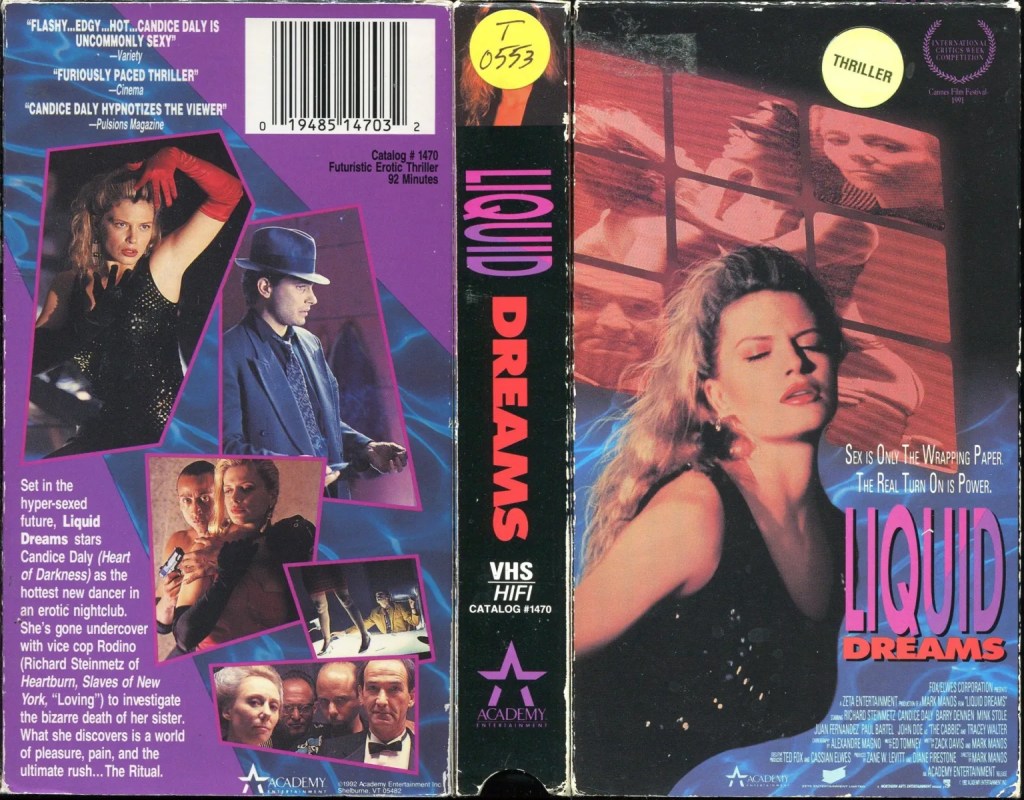
You can watch this on Tubi.