Tales from the Crypt S2 E11: Judy, You’re Not Yourself Today (1990)

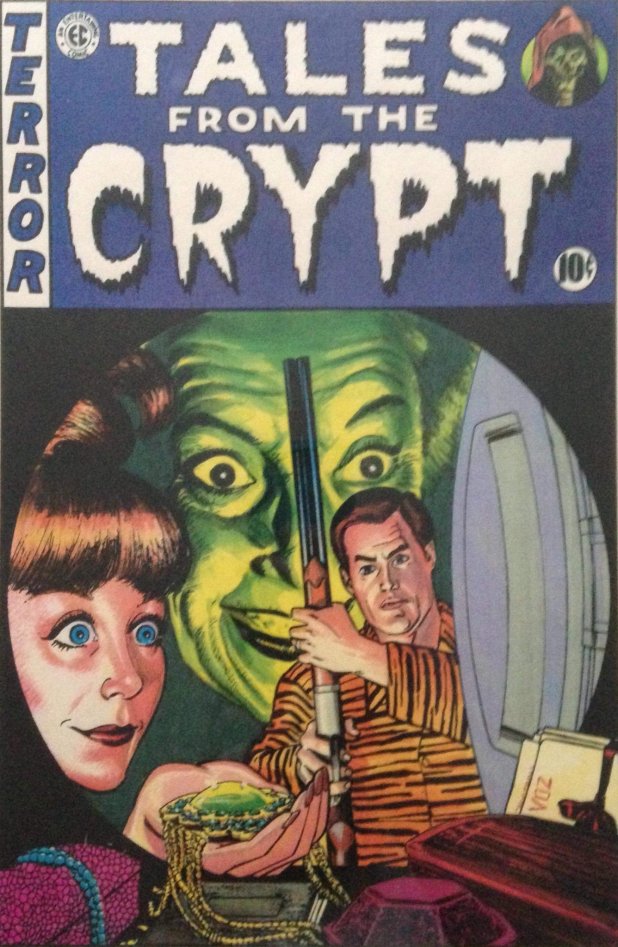
“Oh, hello there, fright fans. I’ve just been sitting here waiting for my blood pack to harden. My cosmetologist said I was starting to look a little lifeless. Much better, eh? Which reminds me, tonight’s poison parable is about a couple who take their appearance very seriously. Needless to say, they’re going to end up trying to save face. I call this one “Judy, You’re Not Yourself Today.””

Directed by Randa Haines (Children of a Lesser God) and written by Steven Dodd and Scott Nimerfro (who wrote eleven episodes of this show), “Judy, You’re Not Yourself Today” is about possibly MAGA couple Donald (Brian Kerwin) — who walks around their house armed and dangerous — and his wife Judy (Carol Kane), who speaks with a fake English accent. One day, a door-to-door saleswoman/witch (Frances Bay) comes to sell her a magic necklace that allows her to steal her body.

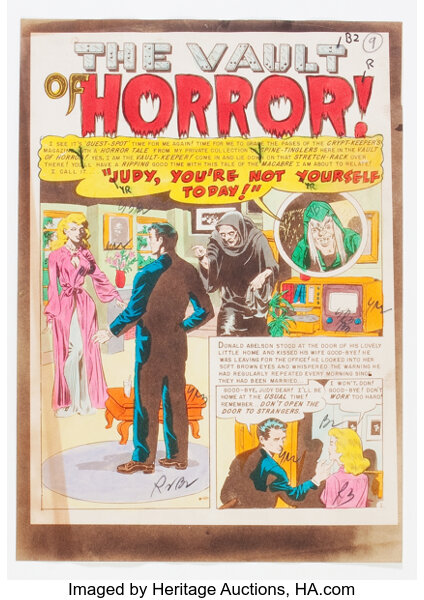
The story comes from Tales From the Crypt #25 and was written by Al Feldstein and William Gaines and drawn by probably the best of all EC artists, Wally Wood. Like many EC stories, it’s inspired by — sometimes Gaines and company would outright rip off stories — H.P. Lovecraft’s The Thing On The Doorstep.
It has some prestige talent in front of and behind the camera, but is just fine. It’s a quick story and at least Kane and Bay are fun in it.
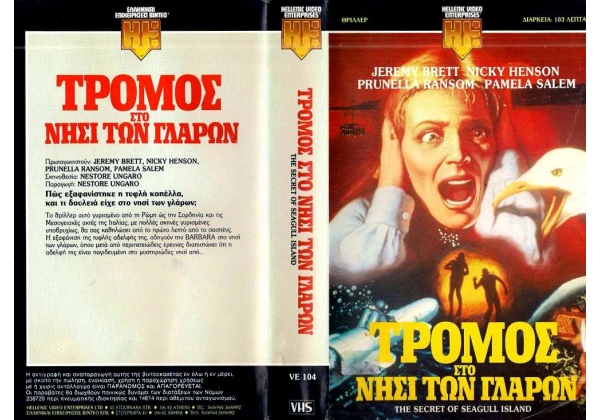
The Secret of Seagull Island (1982)

The TV mini-series Seagull Island is 3 hours and 36 minutes long. The movie that they hacked it into is an hour and forty two minutes. As you can imagine, a lot gets lost, but this is not a unique thing. Yor Hunter from the Future and The Scorpion With Two Tails were also originally made as TV miniseries that were edited.

Barbara Carey (Prunella Ransome, Who Can Kill a Child?) has come to Rome to visit her blind concert pianist sister Marianne Saunders (Sherry Buchanan, Eyes Behind the Stars). It turns out that she’s the third blind girl to go missing recently, so like many a gialli heroine, Barbara investigates the case along with British Consulate Martin Foster (Nicky Henson). Her detective work takes her to the private island of millionaire David Malcom (Jeremy Brett), a place filled with secrets and, yes, the bodies of women without their eyes.

This is the kind of movie where the sounds of seagulls causes a woman to get so upset that she jumps right out a window and where ineffective cops literally have waiters in the squad room ready to bring them hard boiled eggs.

This aired on the CBS Late Movie on May 27, 1983. It’s not the only giallo that CBS played, as The Bird With the Crystal Plumage also aired on that venerable late night movie destination.

As for this movie, it makes me wonder. A spoiler, but why don’t rich people with deformed children look into a support group or working with a professional instead of doing it on their own and getting beautiful women killed? Then again, so many gialli would never be made if these fictional families got it together.

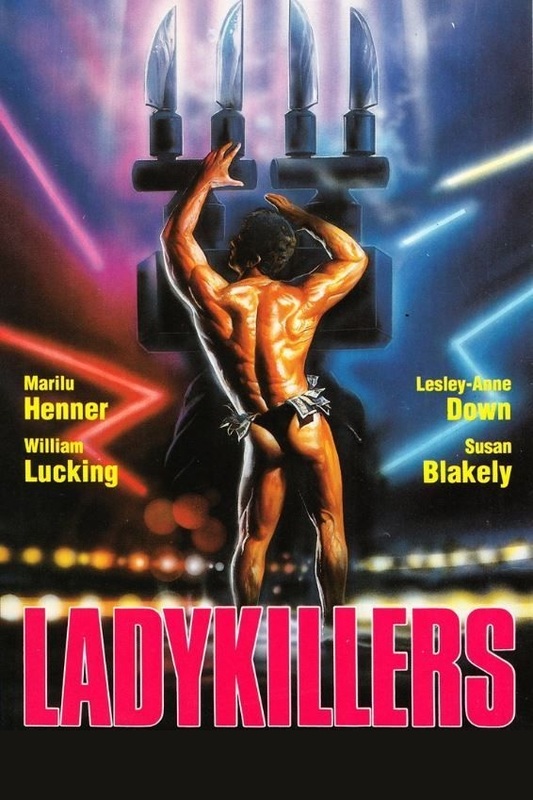
Ladykillers (1988)

Originally airing on ABC on November 9, 1988, Ladykillers inverts the expectation of giallo — you’d expect that this would take place in an exotic dancing club with women on stage, not men — and has not only men be the object of the camera’s gaze but a female detective in the lead.

Ladykillers is the kind of bar where women get dressed up to watch men get undressed to the hottest music of 1988, which means cover versions of “Glamour Boys” by Living Colour, “Pump Up the Volume” by MARRS, “Beds Are Burning” by Midnight Oil, “I Didn’t Mean to Turn You On” by Robert Palmer — well, originally Cherrelle  and Jimmy Jam and Terry Lewis wrote it — as well as “

Keep in mind that this is an American made-for-TV movie and not an Italian giallo!

Despite the murders in her club, owner Morgana (Leslie Anne Down) won’t close the place with all the business. I mean, what women are coming out to…oh yeah, true crime. It all makes sense. The police are on the case with partners — and former lovers — Samantha Flannery (Marilu Henner) and Cavanaugh (Thomas Calabro) not just looking for the suspects but Cavanaugh going undercover with a g string. Plus you get Susan Blakely as an advertising executive and Keith David as a cop. What else do you need?

Director Robert Michael Lewis also made A Stranger WaitsComputercideS.H.E: Security Hazards Expert and Pray for the Wildcats. It was written by Gregory S. Dinallo, who wrote another TV movie that’s almost a giallo, Calendar Girl Murders.

The Los Angeles Times said that it was “inept” and “an excuse for a male flesh parade.” The New York Times claimed that it was “leering” and “prurient.” I enjoyed it. You knew that, right?

You can watch this on YouTube.

La porta sul buio: La bambola (1973)

The third episode of Doorway to Darkness was directed by Mario Foglietti (who wrote the original story for Four Flies On Grey Velvet) and Luigi Cozzi and was written by Foglietti and Marcella Elsberger.

Argento informs us, in his introduction, that someone has escaped from a sanitarium, saying “…a sick mind wandering a small town, apparently normal, in matter of fact incandescent… Its aim: to kill.” That sick mind may be Robert Hoffman, who has checked into a hotel with an attache case before wandering the streets. One redhead is already killed when he meets Daniela Moreschi (Mara Venier) and follows her back home.

This feels like ten minutes of story shoved into an hour and sadly doesn’t work. But hey — Erika Blanc is in it and if the worst thing you do is watch a giallo with her in it, your day isn’t all that bad. Foglietti gets the look of Argento but doesn’t have the same ability to make art out of a flawed script.

You can watch this on YouTube.

La porta sul buio: Testimone oculare (1973)

Directed by Roberto Pariante (who was the assistant director for Argento on The Bird With the Crystal PlumageThe Cat o’Nine Tails and Four Flies On Grey Velvet) and Dario Argento, who wrote the script with Luigi Cozzi, Testimone oculare is my favor episode of Doorway to Darkness. It’s so simple and yet succeeds as an example of giallo.

Roberta Leoni (Marilù Tolo, Las trompetas del apocalipsis) is driving on a dark and rainy night when she sees a woman dive in front of her. She doesn’t hit her, but does find her dead body. She’s been shot in the back. That’s when she sees the glint of a gun and runs through the storm to a diner where she breaks down. The police, led by Inspector Rocchi (Glauco Onorato), take her back to the crime scene but there’s no body and no blood.

Everyone treats Roberta like a hysterical woman, including her husband Guido (Riccardo Salvino), even after someone breaks into their house while they’re out for their anniversary and the next day when someone tries to shove his wife into traffic. Then the phone calls start and never seem to stop.

One night, while all alone, the killer calls and says that they will finally kill Roberta. Guido comes home just in time and says that instead of leaving — the killer cut the phone line — they are going to wait for them and he will shoot whoever is after her. As you can imagine, this isn’t the way things end up happening.

Sometimes, a simply told mystery is exactly what you need. That’s what this episode gave me. Supposedly Argento disliked the work that Pariante did and went back and filmed a lot of this himself — the tracking of the killer by footsteps is definitely him — and then not putting his name on it.

You can watch this on YouTube.

La porta sul buio: Il tram (1973)

For the second episode of Doorway to Darkness, Dario Argento himself would direct and write. Il Tram (The Train) under the name Sirio Bernadotte (thanks to the incredible Italo Cinema).

A young woman is murdered on a train in the seconds that the lights go out and before they return. The murder baffles everyone except for Commisario Giordani (Enzo Cerusico) who seeks to solve it. He thinks that it has to be ticket taker Roberto Magli (Pierluigi Aprà), except that he’s never satisfied. It seems too simple. That’s when he brings his girlfriend Giulia (Paola Tedesco) to ride the train and try to lure out the true murderer.

A very Hitchcock-influenced story, this moment was originally going to be part of The Bird With the Crystal Plumage but it took away from the story. Argento would return to the dark mystery of a train and how frightening it can be in probably the best sequence of his post-Opera films in Sleepless. This may not have the insane energy and madness of his usual style, but the story is well-told and I loved how the hero must overcome his own shortcomings — he’s too cocky, which may be because of his youth — if he wants to save his lover and solve the mystery.

There’s also a striking scene where the killer chases Giulia through the train and into a station and down an immense hallway, all POV, all with her staring back at us. It’s incredible.

You can watch this on YouTube.

La porta sul buio: Il vicino di casa (1973)

In 1973, Dario Argento was invited to RAI television and delivered Door Into Darkness, a show that he would host and even guide some of the episodes. Argento says, at the start of one of the episodes (translated into English) “As for Door Into Darkness, which is the title of the series, you will wonder what it means. Well, it means many things: opening a door to the unknown, to what we don’t know and which therefore disturbs us, scares us. But for me it also means other things. It can happen, and it has happened once, even just once in a person’s life, to close a door behind them and find themselves in a dark room… looking for the light switch and not finding it… trying to open the door and not being able to Do. And having to stay there, in the dark… alone… forever. Well, some of the protagonists of our stories have closed this fatal door behind them.”

The first episode, Il vicino de casa (The Neighbor) was the second directing job for Luigi Cozzi, who had debuted with Il tunnel sotto il mondo (The Tunnel Under the World). It’s the tale of a young couple by the names of Luca (Aldo Reggiani) and Stefania (Laura Belli). They arrive at their new home late at night with their infant child and barely meet anyone, other than knowing they have a neighbor (Mimmo Palmara) but otherwise, they live in a very isolated neighborhood.

On one of the first evenings they are there, as they watch Abbott and Costello Meet Frankenstein, they start to see a stain in the corner of the ceiling that starts to leak from upstairs. What is it? And should they tell the neighbor they have never met? When they go up there, no one is home. However, they soon find the dead body of their neighbor’s wife just in time for him to come back and tie them up.

This story was also written by Cozzi and it has plenty of tension, such as the couple hiding in the dark and then realizing that the husband has dropped his lighter in the killer’s room. It also has a dark non-ending that doesn’t give you much hope, as well as an Argento cameo as a hitchhiker.

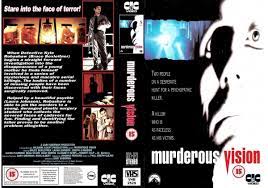
Murderous Vision (1991)

I was watching Visioni Senz Volto on YouTube and I thought, “Is that Bruce Boxleitner?”

And that’s how I learned that this was an American TV movie and not an Italian giallo.

The man who was Scarecrow and Tron is Detective Kyle Robeshaw, a cop stuck on the missing persons cases, when he discovers that a serial killer who was dating a cop before he killed her. The female police officer was once a friend of his, so he takes her case personally and investigates it on his own. For such a tough cop, he  has no problem partnering with Elizabeth (Laura Johnson), a woman with psychic visions whose best friend is missing.

Directed by Gary Sherman (Dead and BuriedVice SquadPoltergeist III) and written by Paul Joseph Gulino, this reminds me that there was once a time when TV movies had killers who spoke to the voice of a doctor they once killed who sends him out to murder people and slice their faces off, then put them in jars with their names on them.

It’s not exactly a perfect movie, but hey, it was a serial killer movie in the 90s before we were sick of the idea. Robert Culp is in it, which sometimes is all I need to watch a movie.

You can watch this on YouTube.

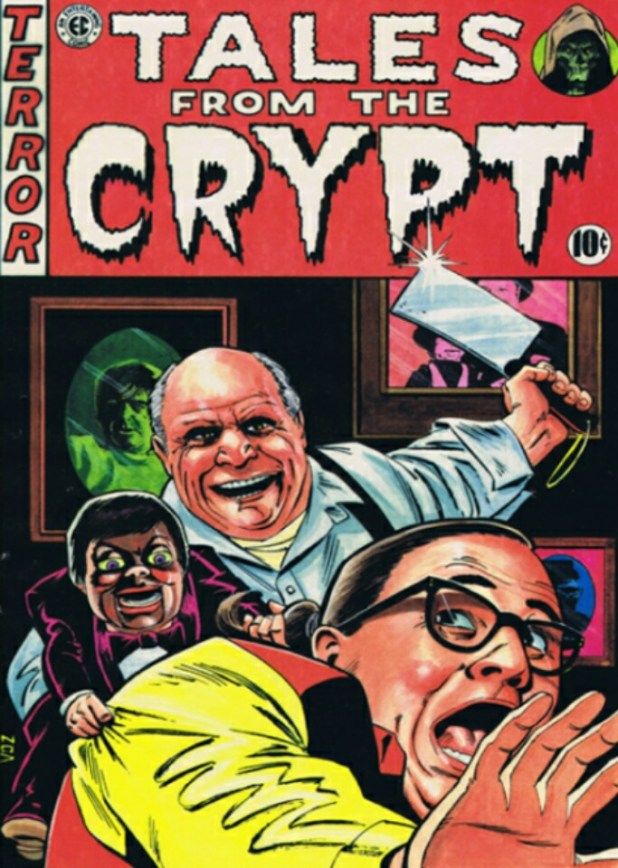
Tales from the Crypt S2 E10: The Ventriloquist’s Dummy (1990)

“Good evening, fear fans. You’re just in time. Contents: one ventriloquist’s dummy Hacme Novelty Company, Battle Shriek, Michigan. Oh, goody! Watch this, kiddies. You won’t see my lips move. You know why? I don’t have any! Well hello, Dickie. Would you like me to tell a tale from the crypt? No thanks, death-breath. Then how about sitting a little closer to the fire?!”

Directed by Richard Donner and written by Frank Darabont and Steven Dodd — wow, this episode is bringing the wattage, right? — “The Ventriloquist’s Dummy” stars Bobcat Goldthwait as Billy Goldman, a horrible amateur ventriloquist who saw the final performance of his idol, Mr. Ingles (Don Rickles) and Marty, which ended in a fire, Ingles losing his hand, his girlfriend being killed and the end of his career.

Billy invites Mr. Ingles to see him perform and he bombs. The elder artist lashes out at him, telling him that he’s horrible with no technique or ability to work an audience. Moments later, a woman who was seen with Ingles is found dead and Billy was covering the body with his coat. When Billy finds the man he has looked up to so much, Ingles is shooting morphine into his stump. Calling him a junkie and murderer, Ingles says that Morty is the one who hates women. The truth is that Morty is no doll. He’s a conjoined twin at the wrist and the morphine is all that keeps him from killing. Now that he’s taken so long to give him his medicine, Morty attacks him and then Billy, who makes a deal with him to be a star.

However, Morty is always a step ahead of the person calling him a dummy.

This episode comes from the story of the same name from Tales from the Crypt #28. It was writtem by Al Feldstein and William Gaines and drawn by Graham Ingels, who the Mr. Ingles character is named for.

This is a really great episode that is, as I said above, filled with talented people.

Private Crimes (1993)

Businessman Marco Pierboni (Joe Kloenne) is killed in his garden, but his body is found near his factory. Meanwhile, a young woman named Sandra Durani (Vittoria Belvedere) disappears, just as a series of anonymous letters start to hint that there is some kind of a conspiracy. Journalist Nicole Venturi (Edwige Fenech), Sandra’s mother, starts to investigate the case with  Andrea Baresi (Manuel Bandera) and police inspector Stefano Avanza (Ray Lovelock) and soon finds the body of her daughter near the bank of a river and soon finds a third body, Sandra’s friend Paolo Roversi (Lorenzo Flaherty).

Welcome to Private Crimes, a four part/six hour television miniseries co-produced by Fenech, directed by Sergio Martino nearly a quarter decade after they worked together on some of the classics of giallo (The Strange Vice of Mrs. Wardh, Your Vice Is a Locked Room and Only I Have the KeyAll the Colors of the Dark) and written by Laura Toscano and Franco Marotta.

I think it’s really interesting that the synth score by Natale Massara sounds so much like Twin Peaks and this all feels like an Italian version of that. I don’t say that as if it’s being ripped off, just that it has the flavor of it.

The main draw for this — being Sergio Martino — is Fenech. Not only does she look as fashionable as you’d hope, she also really gets the chance to show some dramatic acting range, as she’s going through increasingly more threatening letters and trying to solve the case while dealing the loss of her daughter. Because the miniseries has more time than your average movie, it gives her time to explore the character. She also has a fabulous white cat that she seems to take everywhere with her.

I kind of like the idea of Martino watching David Lynch and giggling at how much he’s enjoying it.

You can get this from Severin.