Spy Shadow (1967-1968)

As part of the show Super President, which had two adventures per episode, one part of the show was where we learned of Spy Shadow, an agent of Interspy named Richard Vance (Ted Cassidy) who learned — somewhere in the mysterious Far East, just like Lamont Cranston, here said to be in Tibet with mystics who taught him the power of concentration — how to command his shadow to become another person. He’d need that power as he fought S.P.I.D.E.R. (Society for Plunder, International Disorder, Espionage and Racketeering) in Eurospy-style adventures.

Created by DePatie-Freleng Enterprises, formed by David H. DePatie and Friz Freleng, this is a footnote in TV superheroics, but may have been a bigger character had it not been placed with Super President, a show that people still seem to hate sixty years after it first aired.

I wonder if the makers of this show had been reading Doom Patrol, as Spy Shadow’s powers are a lot like Negative Man from that team. At least Spy Shadow doesn’t have to be wrapped up in bandages like Larry Trainor.

You can watch all of the episodes of this show on YouTube.

Batgirl (1967)

Detective Comics #359, the first issue of January 1967, featured “The Million Dollar Debut of Batgirl!” They were getting Batgirl into fan’s minds before she would debut on the show, even if there had already been another Batgirl, Bette Kane, who first showed up in Batman #139. Post-Crisis, her name would be changed to Flamebird.

The show was suffering from lower ratings, but producer William Dozier felt that if they introduced a younger female, it would do two things: introduce some new blood and refute any worries that Batman and Robin were gay.

ABC executives needed to be convinced that Yvonne Craig was the right person for the role, so this pilot — where she would fight Killer Moth (Tim Herbert), same as the first time she showed up in comics — was ordered. She also meets Batman (Adam West) and Robin (Burt Ward), setting up the next season of the show.

You can also spot future Peach Pit owner Joe E. Tata as one of the henchmen, as well as TV vet Guy Way and stuntman Al Wyatt Sr.

In an interview, Craig said, “…while Batgirl is an active type, she is also very feminine. None of that smacking people low with karate and kung-fu. In my opinion, three karate chops, and you’ve lost your femininity. If a girl goes on a date and a fellow gets fresh, she can’t very well give him a karate chop for a good-night. But if she ducks, she’s simply adept and feminine. Batgirl will be aiding and assisting Batman and Robin, not constantly rescuing then. I like that, too.” That’s because Batgirl wasn’t allowed to throw punches, as TV executives thought that the show Honey West got bad ratings because all of her brawling made her less feminine.

In spite of adding the sexier Batgirl, as well as Eartha Kitt taking over from Julie Newmar as Catwoman and female villains like Marsha, Queen of Diamonds (Carolyn Jones), Olga, Queen of Cossacks (Anne Baxter), Nora Clavicle (Barbara Rush), Minerva (Zsa Zsa Gabor) and Lorelei Circe (Joan Collins), the show fell out of favor, ending in the third season.

You can watch this on Daily Motion.

The Adventures of Super Pup (1958)

Last week, there was plenty of online outrage — when isn’t there? — about Krypto in the new Superman trailer.

There’s another super powered dog who no one gets mad about because, well, no one knows about it.

Television producer Whitney Ellsworth planned to continue The Adventures of Superman in 1959 with at least two more years’ worth of episodes that would begin airing in the 1960 season. The death of the actor playing Daily Planet editor Perry white, John Hamilton, stalled that, but Pierre Watkin, who played the role in two Superman movie serials, was hired to play Perry’s brother. However, a bigger problem was the death of George Reeves, but Jack Larson, who played Jimmy Olsen, was approached with the idea for a Superman’s Pal, Jimmy Olsen series in which he would play the lead and when Superman showed up, it would be stock footage of Reeves and stunt doubles shot from behind. Larson turned that down, but that wasn’t the end of Super-ideas.

In addition to The Adventures of Superboy pilot starring Johnny Rockwell, Ellsworth also had the idea for a show where Superman took place in another universe with dogs instead of humans. Shot on the same sets as The Adventures of Superman, this would have live-action dwarf actors with large masks playing all the roles.

Yes, it’s as crazy as it sounds.

The Daily Planet became the Daily Bugle, years before Peter Parker would freelance for that publication. Clark Kent is now Bark Bent, Lois Lane is Pamela Poodle and Perry White is Terry Bite.

Bark Bent and Superpup are played by Billy Curtis, whose career encompassed roles from Mayor McCheese to the lead in The Terror of Tiny Town, a Munchkin in The Wizard of Oz, multiple roles on the Superman and Batman TV shows, the AIP little people crime film Little CigarsEating Raoul and so many more movies and TV shows.

Terry Bite was played by Angelo Rossitto, whose career is just as impressive. He debuted in 1927’s The Beloved Rogue and would appear in FreaksThe Wizard of OzMesa of Lost WomenBrain of BloodDracula vs. Frankenstein and as the Master half of Master Blaster in Mad Max Beyond Thunderdome.

Pamela Poodle has been tied to a rocket about to be launched by Professor Sheepdip (Harry Monty, who was also in The Wizard of Oz as a Munchkin and a winged monkey, as well as playing a mutant in This Island Earth and a child ape in Planet of the Apes) and Superpup has to save her.

The dog masks were constructed of fiberglass and weighed two to three pounds. The plan, if the show was bought, was to make puppets of the characters that could articulate dialogue in close-ups. What we get here is just strange, as blank faced dogs just go through the motions as the actors say the lines off-screen. Beyond the wolves and dogs, there’s also Montmorency Mouse, seemingly the only other species in a canine world. He’s the Jimmy Olsen in this story and is played by a puppet.

Director Cal Howard mainly worked in animation as a writer. Most of the crew on this were from the Superman show as well, trying to get new jobs. Obviously, this wasn’t bought, but it remains an incredible artifact.

You can download this from the Internet Archive.

Super President (1967-1968)

When this show aired, it upset so many people. The National Association of Broadcasters said: “An all-time low in bad taste, with the President of the United States in a Superman role. NBC was responsible for this direct ideological approach to totalitarianism. We fear that there may be other broadcasters who are irresponsible enough to keep it in circulation.”

The idea of a super-powered American President seems dumb, but four years after the death of Kennedy and as America seemed to be on the verge of falling apart, maybe it seemed like a great plot for a cartoon. At least the DePatie–Freleng studio, who also made The Pink Panther cartoons, were commissioned to make Warner Brothers specials and also animated the lightsabers for Star Wars, thought so.

The President of the United States, former astronaut James Norcross, is voiced by Paul Frees, whose voice has been in almost everything you’ve ever watched. Other voice talent included Ted Cassidy, June Foray and Don Messick, whose voices would be in the few things that Frees didn’t work on.

Super President got his powers from a cosmic storm, just like the Fantastic Four, giving him increased strength and the ability to change his molecular composition like Metamorpho, plus he has a cave and special vehicle called the Omnicar like Batman and his Batcave and Batmobile.

Perhaps this cartoon, while forgotten today, inspired Calvin Ellis, the Kryptonian President of the United States on Earth-23 who is also the Superman of that reality (and just happens to look like Barack Obama).

You can watch all of the episodes of this show on YouTube.

Wonder Woman: Who’s Afraid of Diana Prince? (1967)

Eight years before Wonder Woman became a series with Linda Carter — after Cathy Lee Crosby appearing in the TV movie — William Dozier, who also worked on the 1967 Batman series — tried to get Wonder Woman on the air. We’re all the better that it never happened.

In this four-minute screen test, Ellie Wood Walker (Targets, Easy Rider) is Diana Prince and TV veteran Maudie Prickett is her mother, Hippolyta. They live in the big city, together, with mother needling daughter about growing too old without getting married with lines like, “How do you expect to get a husband flying around all the time?”

The narrator, who was Dozier, says that Wonder Woman has the strength of Hercules, the wisdom of Athena and the speed of Hermes — who is she, a female Captain Marvel? — but she only thinks she has the beauty of Aphrodite. This leads to her staring in the mirror, as we see her as she sees herself, as  “Oh, You Beautiful Doll” plays. In the mirror is Linda Harrison (Nova from Planet of the Apes) dressed in the famous Wonder Woman costume, as we get a full minute of her nearly touching herself.

It’s as if the women’s liberation revolution was never happening.

This was written by Stan Hart, Stanley Ralph Ross and Larry Siegel. Hart and Siegal were writers for Mad Magazine and would go on to be writers for The Carol Burnett Show. Ross worked as a voice actor and wrote several episodes of Batman, as well as developing the 70s Wonder Woman show, developing the Monster Squad and That’s My Mama series and becoming an ordained minister and marrying TV Robin Burt Ward to his third wife. He was also Ballpoint Baxter on the Batman show, a name he’d used on other projects, as well as the writer and producer of 200 songs, owned nine comedy clubs, two baseball teams and came up with the phrase “The thrill of victory and the agony of defeat” while working for ABC Sports.

At one point, Dozier had three TV series on the air: Batman, The Tammy Grimes Show and The Green Hornet with plans to make a Dick Tracy series. The Chester Gould newspaper strip had been the original character that ABC wanted to make a show about before settling for Batman. The pilot for that show, “The Plot to Kill NATO,” had Dick Tracy (Ray MacDonnell) battle Mr. Memory (Victor Buono). Yet by 1967-1968, Batman was down from two days a week to one, Tammy Grimes had been cancelled and The Green Hornet wasn’t as big as the campy DC series. Dick Tracy would never be picked up, despite a fully produced pilot.

You can watch this on YouTube.

Flash Gordon: The Greatest Adventure of All (1981)

Directed by Gwen Wentzler, written by Samuel A. Peeples and animated by Filmation, this was inspired by the success of Star Wars and intended to be a TV movie. When NBC saw the finished film, they turned it into the 1979 Saturday-morning animated TV-series Flash Gordon. The TV movie version is, obviously, a lot more adult and even has a moment where Ming shows that he has been giving weapons to Hitler.

Robert Ridgely plays Flash, Diane Pershing is Dale and David Opatoshu is Zarkov. This is closer to the newspaper strip, as Flash works alongside lionman King Thun (Ted Cassidy) while Ming’s (Bob Holt) daughter Princess Aura (Melendy Britt) attempts to possess Flash. They’re soon joined by Prince Barin and King Vultan of the Hawkmen to attempt to stop Ming from marrying Dale and destroying Earth.

The animation looks so much better than Filmation’s Saturday morning work, as it is rotoscoped. This is a process of animating over live action to ensure that movements appear like real people.

Mattel would make Flash, Ming, Thun, a Lizard Woman, Zarkov, a Beast Man, King Vultan, Captain Arak and a rocket ship for Flash and Ming’s shuttle. Flash’s ship was inflatable and looked like a zeppelin; it’s one of my favorite toys I ever got to play with.

This finally aired three years after the cartoon and NBC definitely aired it on the NBC Late Movie, playing on September 5 and 26, 1982. I was ten and totally watched it the whole way through both times it aired on a black and white TV on my parent’s inside porch.

You can watch this on YouTube.

Popeye Meets the Man Who Hated Laughter (1972)

The ABC Saturday Superstar Movie was a series of made-for-television films, often cartoons, that were broadcast on Saturday mornings from September 9, 1972 to November 17, 1973. Considered the ABC Movie of the Week for kids, this series was produced by several production companies like Hanna-Barbera, Filmation and Rankin/Bass and featured hour-long movies with Yogi Bear, The Brady Bunch and Lost in Space, among other popular shows. Some of these episodes were also pilots.

Over two seasons, episode aired like The Brady Kids on Mysterious Island (The Brady Kids pilot), Yogi’s Ark Lark (the pilot for Yogi’s Gang), Mad, Mad, Mad Monsters (a spiritual sequel Mad Monster Party), an animated Nanny and the ProfessorWillie Mays and the Say-Hey KidOliver and the Artful Dodger, The Adventures of Robin HoodnikLassie and the Spirit of Thunder Mountain (the pilot for Lassie’s Rescue Rangers), Gidget Makes the Wrong ConnectionThe Banana Splits in Hocus Pocus Park, an unsold Bewitched cartoon pilot called Tabitha and Adam and the Clown FamilyThe Red BaronDaffy Duck and Porky Pig Meet the Groovie GooliesLuvast U.S.A. (a child version of Love, American Style), an animated That Girl movie by the title of That Girl in Wonderland, an unsold Lost In Space pilot, The Mini-Munsters and Nanny and the Professor and the Phantom of the Circus.

This cartoon is the first time that Steve Canyon, The Phantom, Tim Tyler and Flash Gordon would be animated. Professor Morbid Grimsby (Bob McFadden, who did nearly every voice other than the Popeye and female voices) is getting rid of the comics pages in the newspaper, working with Popeye’s enemy Brutus. The President of the U.S. gets everyone — Barney Google, Snuffy Smith, Blondie Dagwood, Beetle Bailey and characters from that strip, people from Bringing Up Father, Flash Gordon, Henry, Hi and Lois, The Katzenjammer Kids, Little Iodine, The Little King, Mandrake the Magician, Lothar, The Phantom, Popeye, Prince Valiant, Quincy, Steve Canyon, Tiger and Tim Tyler — must all work to get the professor to laugh for the first time.

Directed by Lou Silverton and written by Hal Seeger and Jack Zander, this was animated by Filmation, who would go on to make the early 80s Flash Gordon adaption. It’s quick and most of the characters barely get a part, but for someone who grew up with the Sunday comics, it’s awesome to see them all appear in one movie.

You can watch this on YouTube.

25 DAYS OF CHRISTMAS CHALLENGE: Santa Baby (2006)

I just want holiday movies to be an escape because I’ll be frank, I’m head in the sand about the next few years and I’m trying to use the power of film to hide in my own world until I feel like this one is safe again. Then again, it never was safe and you should avoid any echo chamber, but yeah. I don’t need to put on a Christmas movie and remember how Jenny McCarthy normalized stopping vaccines and look where we are, as polio shots are being on the list of things stopped and people are going to remember what the measles were like again.

But anyways.

She’s Mary Class in this, daughter of Santa, who is played by George Wendt. Why did Santa and Mrs. Claus (Lynne Griffin!) wait so long to have kids? And why did she go into marketing? Why would this bring the real world in to have Santa have a heart attack and why is this a Hallmark movie where Mary has a lost love named Luke (Ivan Sergei) at home in the North Pole?

Somehow, this has Michael Moriarty in it and I wonder, did I cast this movie?

The sequel has Dean McDermott as Luke and Paul Sorvino as Santa. Lynn Griffith was back and that’s really all I care about.

Director Ron Underwood made Tremors. Yes, he also made City Slickers and Hearts and Souls, but The Adventures of Pluto Nash is the reason why he made ABC Family Christmas movies, including Holiday In Handcuffs, Deck the Halls and this movie and its sequel.

You can watch this on Tubi.

Mandrake (1979)

Lee Falk created both Mandrake the Magician and The Phantom. Comic historian Don Markstein said, “Some people say Mandrake the Magician, who started in 1934, was comics’ first superhero.” Falk may have based the hero on Leon Mandrake, a real-life magician who also wore a top hat, had a thin mustache and also rocked a scarlet-lined cape. Leon Mandrake had changed his stage name to Mandrake to match the popular strip and then legally changed his real last name to Mandrake. Leon Mandrake also had a stage assistant named Narda who dressed like Mandrake’s assistant Velvet.

Mandrake had his own radio show from 1940 to 1942 and first appeared on film in 12 part serial. The King Features characters — specifically Mandrake and The Phantom — were popular in India, which led to a bootleg film in 1967, Mandrake Killing’in Peşinde.

Fellini and Michael Almereyda were both rumored to be interested in making Mandrake films and in the past few years, Jonathan Rhys Meyers, Hayden Christensen and Sacha Baron Cohen were all supposed to play the magician.

In 1954, NBC had a pilot for a series that would have had Coe Norton as Mandrake and Woody Strode as Lothar. Beyond making appearances on Defenders of the Earth — he even had an action figure — and Phantom 2040, Mandrake also showed up in Popeye Meets the Man Who Hated Laughter, an animated TV movie that has Barney Google, Snuffy Smith, Blondie, Dagwood, Beetle Bailey, Flash Gordon, Hi and Lois, Little Iodine, The Phantom, Prince Valiant, Quincy, Steve Canyon, Tiger, Henry, Jiggs and Maggie and Tim Tyler, many animated for the first time ever.

That brings us to the Mandrake TV movie.

Mandrake (Anthony Herrera) and his assistants Stacy (Simone Griffeth, Annie from Death Race 2000) and Lothar (Ji-Tu Cumbuka) get into a mystery when a scientist dies during Mandrake’s Vegas act, revealing the name of Arkadian (Robert Reed). He plans on unleashing sleeper agents — or maybe someone else does, hmm? — to take over the country, but Mandrake can cast illusions using his necklace, which was taught to him by Theron (James Hong), and he’s going to put an end to this for the government agency he sometimes works for.

One of Arkadian’s scientists is played by this movie’s magic consultant, Harry Blackstone Jr., who looks more like Mandrake than Anthony Herrera. And that plane crash that kills Mandrake’s dad? It’s from the 1973 remake of Lost Horizon.

Director Harry Falk was not related to Lee. His career was mainly in TV and he was the first husband of Patty Duke. Writer Rick Husky created T.J. HookerCade’s Country and S.W.A.T.

In one of my favorite Italian Western series, Gianni Garko based his portrayal of Sartana in If You Meet Sartana Pray for Your Death on Mandrake. And wow — there was even a musical play, Mandrake the Magician and the Enchantress.

You can watch this on YouTube.

Tales from the Crypt S5 E12: Half-way Horrible (1993)

Years ago, Roger Lassen (Clancy Brown) made a dirty deal somewhere in the rainforest. Now, he’s being called on to look at the body of a dead business partner, Dan King (Costas Mandylor). All that greed, all those underhanded schemes, they’re all about to come back to haunt him.

“”Ooh, I just love how your hair has groan out! A little scream rinse and conditioner, and it’ll look fa-boo! If you don’t look dead, we don’t look dead. Oh, hello, kiddies! You’re right on time for your appointment. You know, it was always one of my ghouls in death to open my own scare salon. Now, let’s see…a few shrieks in your hair would look good. A boo-faunt would look even better! Or maybe you’d like to try tonight’s die-fashion statement. It’s a nasty nugget that asks the question, zom-bie or not zom-bie. I call it “Halfway Horrible.””

Directed and written by Gregory Widen, who also directed The Prophecy and wrote Highlander and Backdraft, this has Martin Kove as a detective and Cheech Marin as a witch doctor. But yeah, Clancy Brown was also in Highlander and just like he did in that movie, he chops off the head of someone — a zombie — with a sword.

It turns out that Roger’s company has created a preservative called Exthion-B that is based on Brazilian black magic and ritual sacrifice. Anything to get ahead in the world, huh? Well, as stated above, it comes back on the CEO, making half of him a rotted zombie.

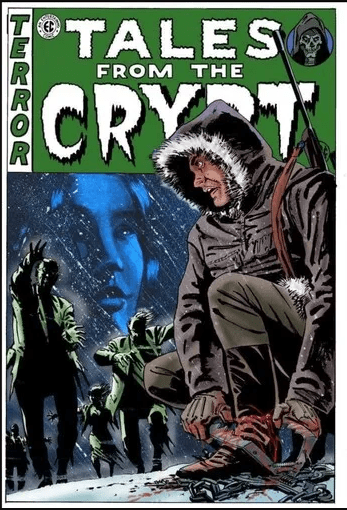
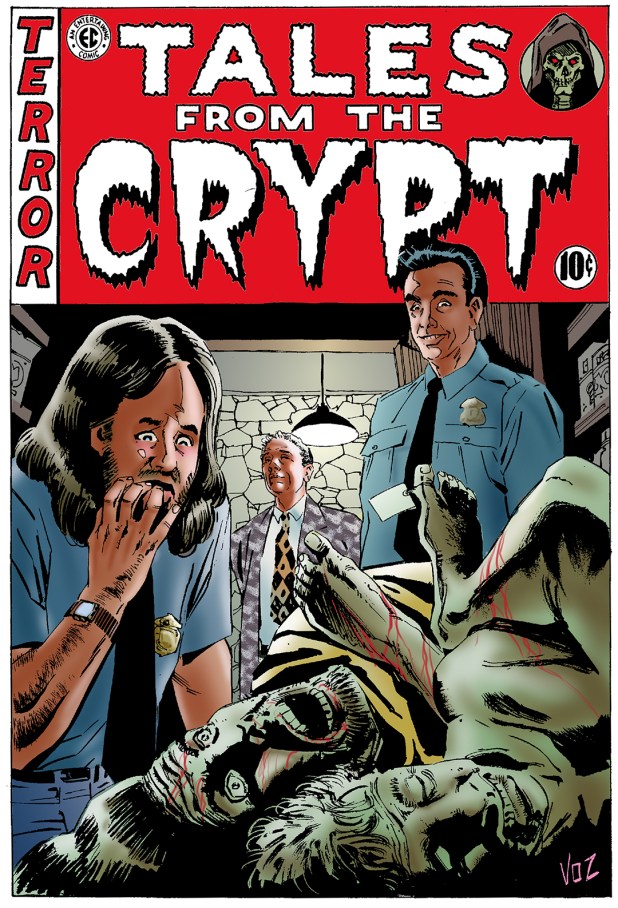
This episode is based on “Half-Way Horrible!,” which was in Vault of Horror #21. It was written by Al Feldstein and William Gaines and drawn by Sid Check.