Interview with Amanda Reyes of Made for TV Mayhem part 1

We’re really excited for the chance to share this interview with Amanda Reyes, who was a major inspiration in our decision to do multiple made for TV movie weeks! She was good enough to do an extended interview and shared her feelings on several of the films we’ve already covered!

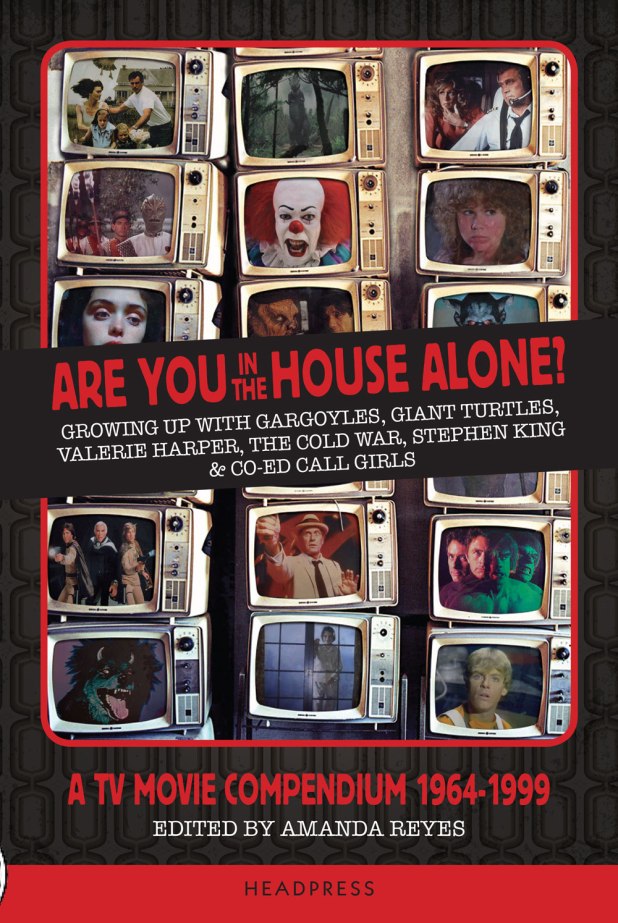
Amanda is an archivist, author and film and television historian. She edited and co-wrote Are You in the House Alone? A TV Movie Compendium: 1964-1999 (Headpress, 2017) which celebrates the made for television film, and was featured on Barnes and Noble’s Best of Horror list for 2017, and was nominated for Book of the Year at the Rondo Hatton Classic Horror Awards. The book is an expansion of her TV movie-centric blog, Made for TV Mayhem and its companion podcast. Most recently, her essay on anthology shows featuring scary holiday episodes was published in Yuletide Terror: Christmas Horror on Film and Television (Spectacular Optical, 2017).

Reyes has been a guest speaker at international film festivals, TV movie screenings, and academic conferences in such places as England, Australia, and stateside in Austin, TX, where she currently resides. She also contributed the commentary tracks for the Blu Ray release of the 1977 telefilm The Spell (Shout Factory, 2017) and the upcoming release of Last House on the Left (Arrow, 2018). And, she is the curator and co-presenter of the Alamo Drafthouse’s Made for Television Mystery Movie series, which runs quarterly as part of Terror Tuesday. She also loves slashers and soap operas, and is completely obsessed (and slightly disappointed) by how much she relates to Alison on Melrose Place.

B&S About Movies: How did you get into TV movies?

Amanda Reyes: When I was pretty young our local channel used to run a lot of telefilms as part of their weekend afternoon programming. It was such a gateway into horror because I was only four or five when I saw movies like Gargoyles, Horror at 37,000 Feet, etc. Those were game changers for me! I also saw some great dramatic telefilms like Circle of Children, and dark comedies like The Girl Most Likely To… So even though I didn’t recognize them as TV movies at the time, I was heavily exposed to several amazing small screen films at a young age.

B&S: And how did this lead to Made for TV Mayhem?

AR: As I got older, and these films began to air less and less, I got really nostalgic for them. I started buying bootlegs off of eBay, back when they allowed that. Then I wrote an article about TV movies for a fanzine called Debaser. As a lover of odd films, I found myself wanting to write more about these films, many of which seemed truly lost. That got me into blogging. I started Made for TV Mayhem about a decade ago on Livejournal! I’m still a bit of an idiot with technology, but the blog, which is now on Blogger, is popular and people don’t seem to mind the typos or sometimes hinky coding! Anyway, while I was working on the book, I wanted to expand my audience and branched out into podcasting, which is just an extension of my blog but with an even more casual vibe. I really enjoy doing both, and wish I had more time to blog!

B&S: Have you talked to any of the talents that worked on these films?

AR: I have. I guess the most important person I’ve met and spent real time with was the late director Gordon Hessler. I got to spend a day with him in his amazing home in the hills of Los Angeles. We drank cosmopolitans and talked film with the friend who brought me over to Gordon’s house! That was so exciting. Hessler is a bit of an underrated figure in the telefilm world. He’s got an amazing filmography, and his thrillers are always heavy with atmosphere. Anyway, he was a really wonderful and talented man.

Other people I’ve met are Richard Matheson, William F. Nolan, and Parker Stevenson, who was kind of blown away by how much I loved This House Possessed. He loved to tell funny stories about his work in the TV movie and was just as charming as you’d expect. I’ve also talked with John Carpenter about making Someone’s Watching Me! I’ve met several others as well, but those are the biggest names that come to mind.

I interviewed Lance Guest for my blog. It was mostly about his work in the Afterschool Special, but we did discuss some of his TV movie work. Most people that I’ve met who have some work experience with the telefilm hold it in very high regard. It’s a tough gig – short shooting schedules, little money, and lots of restrictions. They have to create these little worlds without a ton of resources, and are generally really wonderful at doing it. They really respect the work and the medium, and so I like to give that respect back.

B&S: Why do you think so few of these films have been released to DVD or are streaming?

AR: I don’t know for sure, but think it’s partially because there are rights issues. Some of these movies were co-produced between networks and studios and I think the licensing might be a little complex. Also, the people who have the rights don’t often think there’s a market for TV movies. There’s some truth to that. A lot of TV movies don’t really profit in their home video releases. That’s why the Warner Archives model is so important for the TV movie. The print on demand service is a great way to sell DVDs. They don’t have to worry about paying for thousands of copies of something that won’t sell. I was hoping more companies would take that route, but since Warner Bros. owns those films, and most companies only license titles to distribute for a finite period of time, I can see where it’s not as feasible.

Come back tomorrow to hear what Amanda had to say about the made for TV movies that we’ve recently featured! Make sure to visit her on Twitter and Facebook, too!
SON OF MADE FOR TV MOVIES WEEK: Curse of the Black Widow (1977)

To end our second week of made for TV movies, Bill Van Ryn from Drive-In Asylum and Groovy Doom is back!

Dan Curtis was responsible for delivering a number of memorable genre productions. Cult TV series “Dark Shadows” is definitely his most successful and enduring endeavor, but he got a couple of other major lobbies into his lengthy career as well. Including being a producer of the original TV film The Night Stalker, he directed the sequel himself, The Night Strangler. Although he wasn’t involved the weekly series that followed, titled “Kolchak: The Night Stalker”, it’s interesting that the rest of the output Curtis was involved in took a similar direction. While “Kolchak” came up with a series of diverse supernatural monsters and threats for its hero to encounter every week, Curtis also gave us a bizarre menagerie of villains and creatures that his characters faced. Perhaps feeling he had exhausted the typical canon of vampires (“Dark Shadows”, House of Dark Shadows, and the TV production of “Dracula” starring Jack Palance) and werewolves (Scream of the Wolf), Curtis relied more and more on invented myths and legends, such as the killer hunting fetish doll that terrorizes Karen Black in TV anthology film Trilogy of Terror.

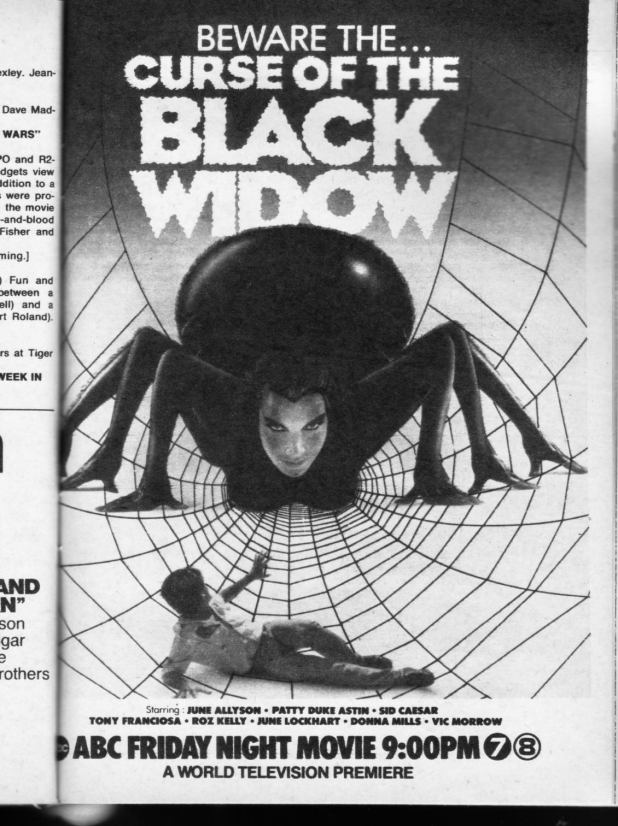
Curtis didn’t get around to today’s subject at hand, Curse of the Black Widow, until 1977, and even for Dan Curtis, it’s way out there. Just like his other films and programs, Curtis approaches the far-fetched material with great seriousness and realism that could be construed as camp, although this writer would never say that’s a bad thing. The creature that the creators have summoned in this film is a woman who can shape shift into the form of a giant spider. The structure of the movie presents this as a mystery, going through the motions and hoping you don’t notice that Patty Duke is playing a dual role. Duke plays Laura Lockwood, one of two twin sisters who were born when their father crashed his private plane in the desert. They and their mother survived for two days in the wilderness until they were rescued by a Native American. One of the babies had been bitten repeatedly by spiders, which apparently caused her to turn into a giant spider whenever there’s a full moon.

The script has a little fun making it seem as if the spider baby is going to turn out to be Laura’s sister, Leigh (Donna Mills), who also happens to be a romantic interest to the male lead, a private investigator played by Anthony Franciosa. Franciosa gets help with his investigation from a young hopeful he calls “Flaps”, played by Roz Kelly, who apparently could not play any role without her exaggerated New York accent. Franciosa tracks down the guy who discovered the plane crash when Leigh and Laura were babies, now living as a caretaker in one of the family’s abandoned vineyard properties, and there’s some suggestion of Native American mysticism that explains the spider transformation. I did a little research myself, and although there is indeed a spider woman myth, she’s a godlike creature and not a murderous monster that transforms during the full moon.

I don’t feel bad spoiling the fact that Laura is our trans-species mutation, because the film doesn’t do that great of a job disguising it. The script can’t really decide if Laura does or does not know she’s a spider lady; she has mental flashes that reveal snippets of the deaths of her unfortunate victims, but she also seems genuinely bewildered by them, and also of the existence of “Valerie”, an alter-ego she creates by putting on makeup and a wig and speaking with an accent. “Valerie” serves the purpose of frequenting bars and picking up men to serve are victims. The script suggests that she does this as a form of vengeance against men in general, having been victimized by a male rapist in her past. One of the best scenes occurs at the climax, where Donna Mills comes face to face with “Valerie” and somehow does not immediately recognize her as her sister wearing a wig. It seems one of Laura’s transformations had been witnessed by their mother, played by June Lockhart from “Lost In Space”. Lockhart went insane, and for some reason Laura decided to fake the woman’s death and keep her confined to an attic apartment in the family mansion. Leigh is stunned to discover their mother still alive, although once “Valerie” turns into a giant spider again, their mother isn’t alive for much longer.

The weird climax of the film is when we get most of the spider action on camera, and it’s none too convincing. Most shots reveal it to be a motionless prop dangling from wires, although some clever editing almost makes it passable. There’s a lot of creepy atmosphere in this sequence though, which includes Franciosa discovering the spider’s lair with tons of cobwebs and the skeletons of its victims hanging in cocoons.

Curse of the Black Widow plays like an episode of “Kolchak: The Night Stalker” with a different actor as Kolchak. The last film I commented on here was another TV movie, Don’t Be Afraid of the Dark, which was filmed partially at the Piru Mansion in California. Curse of the Black Widow also uses the same house one of the main locations, proving that once a mansion has been cursed with such things as demonic imps, cannibalism (Folks At Red Wolf Inn/Terror House), sexual slavery (Pets), or Robert Wagner (“Hart to Hart”), nothing will ever change that.

Want to hear what Bill, Sam and Becca had to say about Folks at Red Wolf Inn? Listen here: part one and part two

SON OF MADE FOR TV MOVIES WEEK: Death Car on the Freeway (1979)

When it comes to the biggest TV movies of all time, you have to include Steven Spielberg’s Duel on the list. A battle between Dennis Weaver and an 18 wheeler for a taunt 74 minutes that stayed in viewer’s minds for way longer.

That leads us to this film, which originally aired on CBS on September 25, 1979.

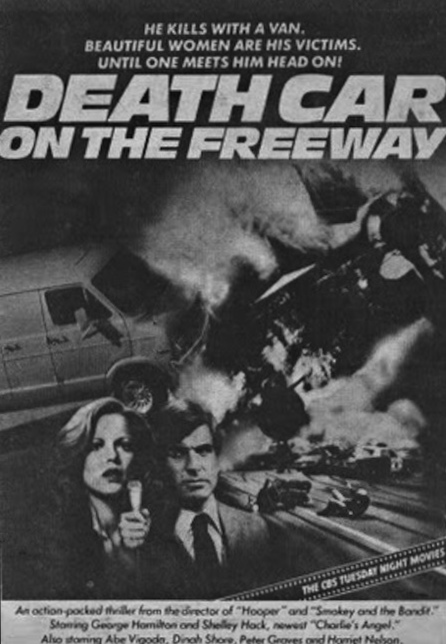
Janette Clausen (Shelley Hack, TV’s Charlies Angels, plus Troll and The Stepfather) is a crusading reporter who has moved up from writing feature stories to being on the air herself. She sinks her teeth into a story about a van driver who she feels has been targeting and killing only female motorists, taking on not only the male establishment but even Detroit auto manufacturers and advertising itself!

If you’re a 1970’s TV star buff like myself, you’ll have a field day with this film. You’ve got Peter Graves (Mission: Impossible) as Lieutenant Haller, the main cop on the case. There’s George Hamilton as Jan’s ex-husband who keeps trying to control her. And hey look — that’s Dinah Shore as a tennis pro who may have faced off with the villain of this piece, the Freeway Fiddler, before!

As Billy Mays used to say before he died from doing too much blow, “But wait, there’s more!”

The Riddler, Frank Gorshin, is here! Is that Ozzy’s wife, Harriet Nelson? Why yes, it is! Do I spy Barbara Rush from It Came from Outer Space and Peyton Place? I do! Abe Vigoda! You’re here too! I feel like I’m on Romper Room using my Magic Mirror to see all my friends!

Tara Buckman! You got your throat slashed in Silent Night, Deadly Night and here you are in this TV movie! Even better, you drove the Lamborghini with Adrienne Barbeau in Cannonball Run and even appeared in Never Too Young to Die!

Morgan Brittany! Sure, you were in Dallas, but you also started your career in Gypsy but found the time to be in movies I care way more about, like being the Virgin Mary in Sunn Pictures’ In Search of Historic Jesus and the TV movie The Initiation of Sarah!

Nancy Stephens! We love you! She’s probably best known as Nurse Marion Chambers from the Halloween series of films. But did you know she’s married to Halloween 2 director Rick Rosenthal? Now you do!

Is that Hal Needham as the driving instructor? It is! Hal formed Stunts Unlimited, which did all the stuntwork for Burt Reynolds’ biggest films, but he also directed Megaforce! And guess what? He also directed this movie and did a ton of the stunts, too.

Death Car on the Freeway sets up a slasher who kills targeted women with his evil black van, particularly strong women who excel beyond men. And while he does it, he plays fiddle music! We never see him or learn more about him than that, but if this reminds you a bit of Death Proof, Quentin Tarantino’s part of Grindhouse, you’re not alone.

The best part — for me — was when Jan goes to meet a gang of street racers and Sid Haig shows up! I ran around the house screaming, “SID HAIG!” so many times that Becca had to tell me to settle down and covered me with a blanket until I calmed myself.

When Jan ends a report by saying, “This is Janette Claussen for KXLA from the scene of the Freeway Fiddler’s latest attack, and not at all anxious to leave the scene, horrible as it is. Because when I do, I’m going to be like thousands of other women, in a car on Los Angeles’ 491 miles of freeway… all alone.” you’ll be riveted, wondering when the killer will strike next. Seriously, maybe it’s because I’ve spent the majority of a Sunday just allowing YouTube to randomly reward me with TV movies while I rest up and enjoy some magical napping, but I love this movie.

Of course, it’s not available on DVD. But you know, if you can get to this site, you can probably figure out YouTube? Am I right? I am!

SON OF MADE FOR TV MOVIES WEEK: Something Evil (1972)

Steven Spielberg directed this Robert Clouse (the director of Enter the Dragon) written TV movie that originally aired on January 21, 1972. In fact, Spielberg even appears briefly in the film speaking to Carl Gottlieb (who would go on to co-write Jaws) at a party.

Marjorie (Sandy Dennis, God Told Me To) and Paul Worden (Darren McGavin, Carl Kolchak forever) have just moved to a Pennsylvania farmhouse with their children, Stevie (Johnny Whitaker, Jody from Family Affair) and Laurie. There are symbols all over the house, which no one seems to have any issues with.

Is there weirdness at the farm? You know there is. Their neighbor, Gehrmann, (Jeff Corey, Battle Beyond the Stars) kills chickens right in front of the kids. Marjorie keeps hearing the sound of crying children. Then there’s Harry (Ralph Bellamy, Coming to AmericaPretty Woman), a local who believes in demons and says that the house is protected from them because of all the symbols.

Marjorie is convinced that the devil wants her and even slaps her son, which leads to her leaving the family, as she can’t even trust herself. But what if the devil was after her kids and not her? Hmm?

Spielberg would escape TV movies after this. It’s a low budget affair, but his style as a director transforms the material. It’s unsettling, filled with doom and gloom and dread. The 70’s really seem like a dismal time to be alive if we only go by TV movies, huh?

SON OF MADE FOR TV MOVIES WEEK: Scream, Pretty Peggy (1973)

The ABC Movie of the Week for November 24, 1973, Scream, Pretty Peggy was directed by Gordon Hessler, who was behind films as diverse as The Oblong Box, Kiss Meets the Phantom of the Park and Sho Kosugi’s introduction to the U.S., Pray For Death. It was written by Jimmy Sangster (who directed Hammer’s Lust for a Vampire and wrote The Curse of Frankenstein, Whoever Slew Auntie Roo? and many more), so this film has a much better pedigree than you’d expect.

The central character of the film is Peggy, a college student who aspires to become an artist. She applies for a job at the home of noted sculptor Jeffrey Elliott (played by Ted Bessell, TV’s That Girl) and his mother, the iconic Bette Davis. Peggy’s annoyingly chipper character adds a unique dimension to the story.

Let me give you some advice, in case you are a young girl looking for a housekeeping job and find yourself in a 1970s TV movie. If the house you’re working in has an Old Hollywood actress in it, run (refer back to my past rules of always avoiding Old Hollywood actors and actresses). And if you find out that there’s a room that you aren’t allowed to go into, don’t try to go into that room. Just get away as fast as you can.

However, Peggy’s curiosity gets the better of her. She stumbles upon Jeffrey’s collection of eerie demon sculptures, each more terrifying than the last. She also encounters George Thornton, whose daughter used to work in the house. This leads to a confrontation with the formidable Mrs. Bette Davis, a situation one should never find themselves in.

It turns out that Jessica, Jeffrey’s sister, is living in the room above the garage that Peggy isn’t allowed into. Again, get out. Now.

No, Peggy decides she wants to make a new friend. And what if that friend is really Jeffrey, who killed his sister and has split his personality with her inside his head?  Oh, Peggy. You brought this on yourself.

Scream, Pretty Peggy is a fine slice of 70s TV movie thrills. Any time you have Ms. Davis deigning to be in a TV movie, you will get something good. But seriously, I wish these girls would wise up. There are better things to do in this world than live in a house of maniacs!

SON OF MADE FOR TV MOVIES WEEK: Crawlspace (1972)

Based on the novel by Herbert Lieberman, Crawlspace is what happens when Albert (Arthur Kennedy, The Sentinel, The Living Dead at Manchester Morgue) and Alice (Teresa Wright, Best Supporting Actress for the film Mrs. Miniver, as well as The Little Foxes and The Pride of the Yankees) Graves take in Richard Atlee as their adopted son.

Well, let’s hold on a second. The Graves have moved to a small town to help Albert recuperate from his heart attack. And when their furnace goes, the repair company sends Richard to fix it. They invite him over for dinner and the furnace goes bad a few days later. When the new repairman shows up, he tells them that Richard disappeared.

Strange sounds come from the crawlspace. Turns out Richard has been living there. And even when the Graves adopt him and try to care for him, he refuses to sleep anywhere but the crawlspace.

Even after Sherriff Birge warns the couple about the boy, they keep him in their home. But then, Richard starts acting out. His violent outbursts toward the Graves and the entire town (particularly a general store) increase in intensity and menace.

Directed by John Newland and Buzz Kulik (who also did Bad Ronald), this February 11, 1972 TV movie is slow, haunted and pretty effective. You can see why the couple wanted Richard in their lives, as he becomes the only topic of their conversations. And as he begins to fix things around the house, he becomes oddly necessary.

“What the hell are we doing with a boy in the hole in our cellar?” You’ll wonder this same question! This is a real actor movie, with Arthur Kennedy really shining here, his anger toward what he perceives as Richard’s rudeness balanced by Teresa Wright’s need for someone to care for. The scene where she asks if she should add Richard’s name to Christmas cards is heartbreaking.

The police finally give up on trying to convince Albert and Alice to give up Richard and refuse their calls when a gang of boys he’s feuding with attack their house. Despite pleas for Richard to leave, despite offering him money, despite all attempt at sanity, Richard will not leave.

An attack from the gang of boys leads to Richard killing one of the men and Albert covers for Richard one last time. Alice loses her civility and screams that she wants Richard to leave. He attacks her, leading to Richard shooting him and dying for a stress-related heart attack. Only Alice is left behind in the crawlspace.

Crawlspace is filled with sadness. A couple that could never find a child. A man who can never find his place in the world. And even in the brief moments of happiness they find together, there is always the chance that it could fall apart at any moment. You can see the ending before the characters do, but that doesn’t lessen its impact.

SON OF MADE FOR TV MOVIES WEEK: All the Kind Strangers (1974)

Let’s not judge Burt Kennedy for directing the Hulk Hogan vehicle Suburban Commando. Let’s remember him for something much better — All the Kind Strangers.

Written by Clyde Ware — a writer/director/producer who worked on shows like Airwolf and Gunsmoke, as well as TV movies like The Hatfields and the McCoys and The Story of Pretty Boy Floyd — this film reeks of backwoods menace. No wonder — Ware was born in West Virginia and his second novel, The Eden Tree, was a semi-biographical read which scandalized his hometown.

Jimmy Wheeler (Stacy Keach, ButterflyMountain of the Cannibal God) is a photojournalist traveling through via car to Los Angeles. He runs through a small Southern town where he sees Gilbert, an adorable child, walking on the side of the road. Seeing that the kid is hefting some heavy groceries, Jimmy offers him a ride. As the road goes further and further into the woods, the rain increases. Soon, he realizes he’s trapped in a house of seven children.

The oldest, Peter (John Savage, HairThe Deer Hunter) has hidden the fate of his mother and father from the town, using various resources to keep their power on and training vicious dogs to protect the children. Their father was a bootlegger and mother a schoolteacher (what a match!); when she died, he drank until he fell from the roof.

The rest of the children — John (Robby Benson, who sings two songs on the soundtrack), Martha, Rita, James and Baby (named because their mother died before they could name him) — need guidance, so Peter sends the younger ones out to lure people to their home. Then, they evaluate whether or not they’ll be good parents. If they’re fit, they stay. If not, they’re free to go. Or that’s what the kids think. Evidence points to another more grisly fate.

There’s a new mother already in the house. Carol Ann (Samantha Eggar, The BroodDemonoid Messanger of DeathCurtains) has been taking care of the children for some time. She has seen plenty of other father figures and while she asks for help, she also knows that everything seems pointless.

Jimmy has to convince the kids that he’d make a good dad while trying to find a way to escape. But between the multitude of kids and dogs, as well as his car being sunk in the swamp, he starts losing hope as well.

I have two issues with this film. Things get wrapped up with way too neat of a bow. Jimmy gives a speech to the kids which saves his life and Peter asks him to walk him into town so that they can get some help. Jimmy doesn’t even talk about the police and when you know that these kids have murdered numerous “kind strangers” you have to wonder if he traded his freedom in for some complicity in the crimes. Second, for being a photojournalist, the only camera that Jimmy has is a Polaroid, which would not be good enough to be printable in the 70’s. I know that it makes good theater to have him show Gilbert the photo as it develops, but it’s a stretch.

All the Kind Strangers is a small screen Deliverance, yet it has some fine acting from Keach and Eggar. It’s restrained, but there is more not seen than seen that makes this movie slightly scary.

Feed Shark

SON OF MADE FOR TV MOVIES WEEK: She Waits (1972)

Laura Wilson (Patty Duke, Valley of the DollsThe Swarm) and Mark (David McCallum, Illya Kuryakin on The Man from U.N.C.L.E. and better known to today’s TV audience as Dr. Donald Mallard on N.C.I.S.) haven’t been married long. On their first trip to meet his mother (Dorothy McGuire, The Greatest Story Ever Told), she learns that maybe this marriage wasn’t the best of ideas. Mom has been ready to go nutzoid ever since Mark’s first wife, Elaine, died, and she’s convinced that her ghost is inside her home.

Everywhere Laura goes, she starts hearing Elaine’s favorite song and even her voice. Is she trying to possess her? Or is she just being ridiculous, as the family doctor suggests? The movie never fully embraces the supernatural. It’s more about Mark shutting himself off and not dealing with the past.

The family maid thinks that Mark’s mother is getting worse and worse, with Laura in danger of the very same insanity. And what’s the deal with Mark’s friend David (James T. Callahan, the dad from Charles in Charge)? And can you talk a ghost out of possessing someone just by talking to them?

Director Delbert Mann (Marty) weaves a competent story, penned by Art Wallace, the main writer for TV’s Dark Shadows. It’s a tale that fits snugly into the 1970s, a time when possession, Satan, and the ghosts of murdered wives lurked around every corner. The film’s slow pace is a deliberate nod to the conventions of TV movie horror, inviting you to revel in the nostalgia of a bygone era.

SON OF MADE FOR TV MOVIES WEEK: Don’t Be Afraid of the Dark (1973)

For the first installment of our return to the wonder of TV movies, Bill Van Ryn from Drive-In Asylum and Groovy Doom returns to tell us about one of his favorite movies.

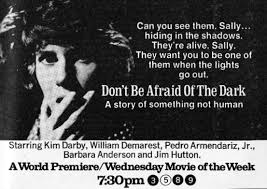
Considering the reputation of 1973’s Don’t Be Afraid of the Dark as a TV movie that forever scarred some impressionably young viewers, it’s surprising that the movie got dismissive reviews when it was current. The LA Times reviewer said the film was unintentionally funny and pointless, and a paper from Massachusetts claimed actress Kim Darby was “miscast” in the lead role of a housewife who finds herself confronted with tiny, demonic homunculi inside the spooky house she and her husband have just inherited.

Darby plays Sally Farnham, whose task of redecorating the old mansion turns dire when she unwisely removes a bolted barrier covering the ash pit of a bricked-up fireplace. Ignoring the warnings of the elderly handyman of the house (played by William Demarest), Sally soon discovers she has unleashed three tiny, misshapen monsters who lurk in the shadows of the old house. The goblins are driven off by light, so many of the film’s horror episodes involve the creatures tampering with the lights and hunting Sally when it’s dark, with the intention to either kill her or make her one of them–or maybe those two things are the same.  

The strange, whispering imps were enough to give many viewers nightmares, especially those of the young and impressionable type. The film avoids any back story on the creatures, other than to suggest that at least one of them is a family member of Sally’s who was transformed, which could mean that each of the monsters was once a human being. It’s this sense of uncertainty that, hopefully, inspires the viewer to imagine their own explanation of the weird things we see happening. The director, John Newland, creates the illusion of miniature demons by filming diminutive actors in monster costumes on oversized sets. Some of the shots are convincing, others are not, but the film relies just as much on atmospheric touches to communicate a sense of dread. The creepy house used in the film is none other than the Piru Mansion in Piru, California, and it’s appeared in numerous films and TV shows, including Curse of the Black Widow, The Folks At Red Wolf Inn, Pets and Tarantulas: The Deadly Cargo.

It was still common in the 1970s for a scary movie to be slowly paced and easy on the horror, and yet it could still be effective if the filmmakers were focused on suspense and atmosphere. Since it was a made-for-tv movie, Don’t Be Afraid of the Dark is forced to be restrained in the way it depicts onscreen death and peril. There’s only a single death in the movie, when one of the characters falls down the stairs. It’s worth noting that it isn’t death that the heroine of the film has to fear, since the implication is that the homunculi are former residents of the house who are damned to forever inhabit the strange void that seems to be accessed by the ash pit behind that fireplace. What they really want is to make her one of them, alive forever, and presumably trapped in the house.

The plot is made much more suspenseful because of the inability of the characters to communicate effectively. What Ever Happened to Baby Jane? would have been over right away if Blanche had simply gone to her window and started screaming “HELP, MY SISTER IS TRYING TO KILL ME!”, and there are several moments where Don’t Be Afraid Of The Dark would have over if Demarest’s character would have stopped speaking in riddles. Additionally, Sally’s husband (played by Jim Hutton) shows an unbelievable disregard for everything his wife says, despite the fact that she seems to be a sentient adult to whom he is married. Even at the film’s conclusion, when Hutton finally becomes a believer and rushes off to question Demarest one final time about what threat could be lurking in their house, he still chooses to leave Sally alone *in the house*, instead of taking her away and ending the entire ordeal.

Let’s not quibble over logic, though—it’s a horror movie we’re talking about. Don’t Be Afraid of the Dark has a grim conclusion, something that was becoming more common as the 1970s progressed, and the downbeat ending delivers the goods without offering any kind of explanation about everything that came before it. Of course, this fear of the unknown seems lost on modern audiences, and the 2010 remake of Don’t Be Afraid Of The Dark offered us detailed information about the creatures–something that was utterly pointless, because it brought nothing new to the story arc itself, and the details just became diversions to pad out the run time.  The remake also overexposed the creatures and rendered them powerless in doing so, and if the miniatures in the 1973 original are unconvincing, at least this seems to have inspired the director to show them as little as possible, giving them a greater sense of mystery.

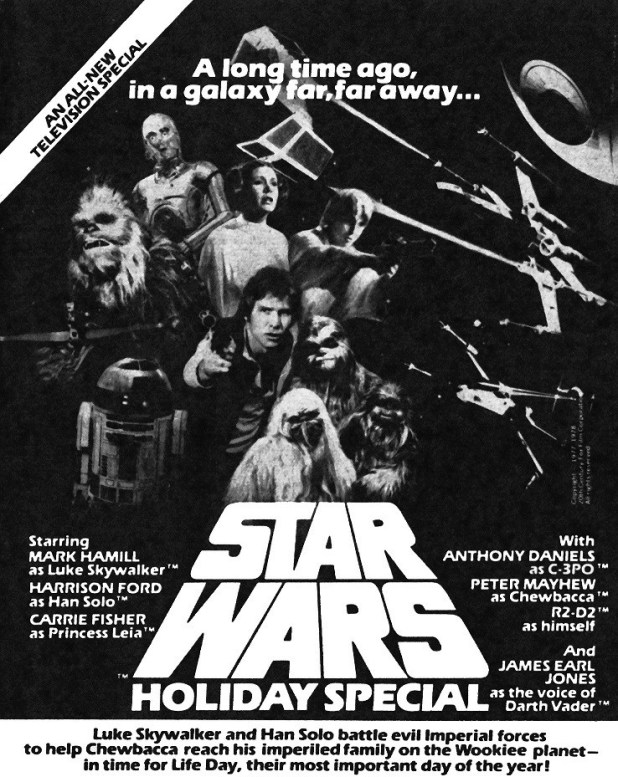
CHRISTMAS CINEMA: Star Wars Holiday Special (1978)

In 1978, we had no idea when we’d see a new Star Wars. We didn’t have them every single year, like we’re all celebrating right now. No, we had our comics and toys, but no other new media. So it was with great excitement that my three-year-old brother and my six-year-old self gathered in front of the TV on November 17, 1978 to get a whole new adventure.

It’s Life Day — the Christmas of the Star Wars universe. Chewbacca just wants to get home, but the Empire is on his tail.

Meanwhile, on his home planet of Kashyyk, Chewie’s family hopes for him to be there. His wife, Mallatobuck, scans for starships and calls Luke Skywalker and R2D2. Yes, everyone from Star Wars is in this, even noted crank Harrison Ford.

She also gets in touch with Saun Dann (Art Carney from The Honeymooners? Yes. Don’t freak out just yet.) and tells him to look for Chewbacca and Han. Meanwhile, Chef Gormaanda (Harvey Korman from The Carol Burnett Show) teaches her how to cook via a hologram.

Saun brings Life Day gifts for everyone, including virtual reality porn featuring Diahann Carroll as an alien for Attichitcuk, Chewbecca’s dad. This sequence will bend your mind and make you humble. Keep the Force strong and your fast forward button handy, as the song in this scene, “This Minute Now” invites the wookiee to have a fantasy and experience the alien woman.

Let me reiterate what just happened: kids tuned in for Star Wars and got to see Chewbacca’s dad polish Vader’s helmet. He was shooting womprats in Beggar’s Canyon. Releasing the Special Edition. Dare I say, jumping to de-light speed. Communicating with Red Leader One. You know what I’m saying. And I think you do.

Han and Chewie land on the planet, but the Imperial army is looking for them. They get distracted by food and Jefferson Starship singing a song called “Light the Sky on Fire” — again, yes, I am not shitting you — while Chewbacca’s son Lumpawarrump goes to watch a cartoon.

Ths cartoon — produced by Canada’s Nelvana — is the best part of the show. This is the first appearance of Boba Fett, who acts as if he is a hero. It’s short and sweet, with stylized artwork and plenty of action. It’s the best part of the show, which isn’t much of a feat. It’s said that the animation was based on the artwork of Jean “Mœbius” Geraud at the request of George Lucas. Mœbius was part of the crew that Alejandro Jodorowsky had assembled to create his version of Dune, along with Dan O’Bannon, who helped create the effects for Star Wars. Interestingly, many believe that Lucas stole Jabba the Hutt’s design from Jodorowksy’s idea of what Baron Harkonnen should look like.

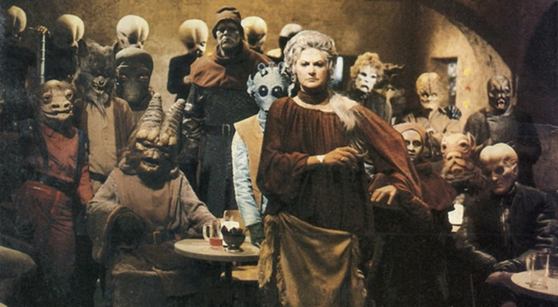
Harvey Korman shows up again, then the Empire shuts down the planet Tatooine. We return to one of the best parts of Star Wars, the Mos Eisley Cantina, where we meet the owner, Ackmena (Bea Arthur from The Golden Girls. Yep. Bea Arthur.) and Harvey Korman shows up again! And Richard Pryor is there, too!

Then, in defiance of the Empire’s curfew, Ackmena sings “Good Night, but not Goodbye” with Figrin D’an and the Modal Nodes, the cantina band. If you can make it through this part of the special, you must have a high midichlorian count. Of note, Greedo is in the bar showing no ill effects of being shot at first, as well as one of the rats from The Food of the Gods.

Chewbacca’s son runs from the Imperial troopers but is saved by his father and Han. Then, everyone goes to the festival at the Tree of Life. Everyone appears and a song about Life Day, which somehow has the same theme as the Star Wars theme, is sung by Princess Leia (Fisher demanded that she be allowed to sing in this special). We sit through b-roll of the original film and then see the wookiees eat dinner.

This has never been broadcast again or sold, as George Lucas sees it as a major source of embarrassment. Then again, he created the prequels, too.

If you’re wondering why the wookiees speak only in their native language and it’s never translated, thank Lucas. He fought for this against the wishes of writer Bruce Vilanch. Yes, that Bruce Vilanch. This means that for minutes at a time, all you hear are yells and grunts instead of English.

But this wasn’t the last Star Wars Christmas project. In 1980, Meco Monardo, who recorded the amazing combination of disco and science fiction entitled Star Wars and Other Galactic Funk, created Christmas in the Stars, an album that found C-3PO and R2-D2 travel to a droid factory that makes toys for S. Claus. It’s also the first audio appearance of Jon Bon Jovi, singing on the song “R2-D2, We Wish You a Merry Christmas.”

If you truly love Star Wars and the holidays, you have so many other ways to spend your time. Don’t give in to the forbidden fruit that is the Star Wars Holiday Special. My brother and I had no idea of the horrifying monstrosity we’d face back in 1978. Imagine the feeling Grand Moff Tarkin had watching the Death Star explode, except our pain went on for two hours. Two hours is a long time when you’re three and six.

It hasn’t gotten any better with age. In fact, it’s all curdled with time, like a glass of Thala-Siren milk that’s been left out overnight.