CHILLING CLASSICS MONTH: The Hearse (1980)

I feel bad that I’ve forced Jennifer Upton to watch some really bad movies this month, but I do appreciate everything she wrote for Chilling Classics Month. An American living in London, she is a freelance writer for International publishers Story Terrace and others. In addition, she has a blog where she frequently writes about horror and sci-fi called Womanycom.

At the beginning of The Hearse, Jane Hardy (Trish Van Devere) has just gone through a tough divorce and decides to move from metropolitan San Francisco to a small town in the countryside. On her way, she is nearly driven off the road by a mysterious hearse with a front grill that resembles a grimace. The chauffeur is clearly evil too. His pencil-thin mustache says it all.

After moving into her deceased Aunt’s home, she soon finds herself plagued by ghosts and suspicious townsfolk. She finds her Aunt’s diary, which chronicles her love affair with a charismatic Satanist and her indoctrination into the faith. Suddenly, the townspeople’s contentiousness makes sense. They fear that she will continue her Aunt’s legacy and bring the devil into their midst.

Soon, Jane meets a man named Tom (David Gautreaux) who later turns out to be the ghost of the original man who seduced her Aunt. It’s presented as a plot twist, but anyone who has seen more than 3 horror films could have guessed it from the outset.

Overall, the film is well executed. All of the performances are good. Particularly noteworthy are the scenes involving the various hostile men in the village who see her as little more than a potential new conquest and there are a few good creepy scenes where Jane questions her own sanity. The problem lies not in with the production or the actors. It’s in the script.

The film works fine as a haunted house movie, with the obligatory slamming doors, flickering lights and dodgy windows. But, to call it The Hearse made no sense. The scenes with the car are never explained and have little to do with the rest of the story. It is never made entirely clear who the chauffeur is or why he is following her on dark country roads. It’s almost as if the film were written as a straightforward ghost story but then someone decided they needed an evil-looking car to make it more exciting and pad out the running time.  

The conclusion finds Jane escaping the house and Tom, who is now pursuing in said hearse. What happened to the chauffeur? Was it Tom all along? There are no answers. The car careens over a cliff in a fiery explosion and the credits roll leaving the audience wondering what the hell just happened.

In terms of visual quality, The Hearse is one of the better selections on the Mill Creek set. A pity it isn’t a better movie.  It has a lot going for it. Just not enough for a solid recommendation.

NOTE:  Thanks, Jennifer! If you want to see what I thought about this movie, here it is!

CHILLING CLASSICS MONTH: The Legend of Bigfoot (1976)

Thanks to Jennifer Upton for contributing this review. An American living in London, she is a freelance writer for International publishers Story Terrace and others. In addition, she has a blog where she frequently writes about horror and sci-fi called Womanycom.

The 1970s were the pinnacle decade for Bigfoot films.

The film that kicked off the craze was Charles B. Pierce’s classic Legend of Boggy Creek, which was a huge hit on the Drive-In circuit in 1972. Derivative in style to this far superior predecessor, The Legend of Bigfoot is a 1976 docudrama that follows researcher/tracker/nature photographer Ivan Marx on an expedition to find the elusive creature. Through narration of footage shot by Marx himself, he guides the
audience through a series of events that may or may not prove the existence of the elusive North American ape. Where Boggy Creek succeeds in re-creating some supposedly true stories to great (and creepy) impact, Legend wastes a lot of time on lengthy digressions that focus on the other animals that live in the creature’s habitat.

In his search, Marx travels from his home in Northern California to Alaska, Oregon, Arizona and even the Arctic Circle. Along the way, we see Musk Oxen, Moose, deer and many other animals. We see them chilling out, defending their territories, eating and basically doing what animals do. Unfortunately, we are also subjected to several scenes of what today, would be considered animal cruelty. These include footage of a cougar being forcibly removed from its den and a mortally wounded ground squirrel dragging itself to its nest to die. Animal lovers beware.

The nature footage and gorgeous landscapes probably looked great in their time, but Mill Creek’s extremely poor transfer is almost unwatchable on a modern high-resolution Television. Even a basic color correction on a home editing system would go a long way towards improving the source material. At times, it’s hard to even make out what’s happening in the darker shots.

True to the Bigfoot subgenre, Legend includes a lot of close-ups of footprints and incorporates many theories of the creature’s potential lifestyle and habits. What the film is probably most famous for is the conclusion, which features what Marx claimed was actual footage of a real Sasquatch. Spoiler Alert: It’s a guy in a gorilla suit. It was just one of many hoaxes perpetrated by Mr. Marx over the years, leaving his reputation maligned within the Cryptozoology community. Nevertheless, he released two sequels. In the Shadow of Bigfoot (1977) and Alive and Well (1982) and maintained his footage was real up until his death in 1999. All but the biggest Bigfoot aficionados would do well to avoid The Legend of Bigfoot.

It’s duller than many other films of its type and at a running time of 1 hour and 16 minutes, it feels a lot longer. In the beginning Marx opines, “You’ll never know what it is to wait…until you become a tracker.” Yes, Mr. Marx, we do know what it is to wait…for something to happen in this movie.

CHILLING CLASSICS MONTH: Body in the Web (1960)

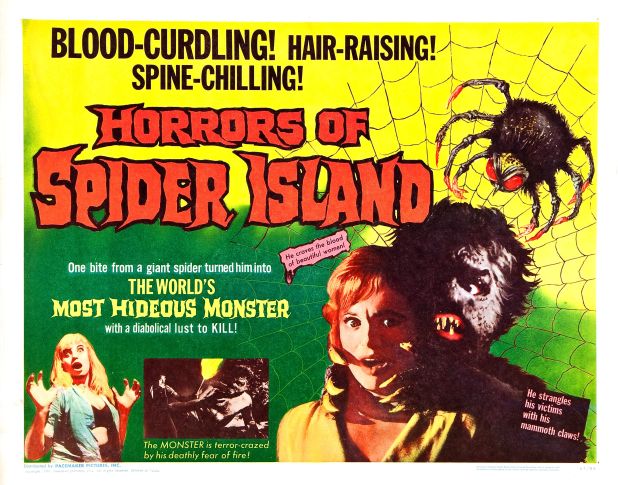
Also known as Ein Toter Hing im Netz or A Corpse Hung in the Web, this West German horror film is all about Gary, a nightclub manager who invites several pretty ladies to strip dance in Singapore. They crash land on the way, make it to an island and find a giant spider web. Soon, Gary is bitten by the spider and becomes a mutant.

https://www.youtube.com/watch?v=X_2JyQS3aBE

First released here as an adults’ only nudie cutie called It’s Hot in Paradise, it was re-released without nudity as Horrors of Spider Island. Your enjoyment of this film depends on how much you like watching women wrestle one another and pull hair.

Maybe just look at the awesome German poster and choose not to watch it. The things I do for you people, staying awake and avoiding the small death of sleep in order to watch dubbed non-sexy sex movies.

If you have to see this, it’s on Amazon Prime.

CHILLING CLASSICS MONTH: Nightmare in Wax (1969)

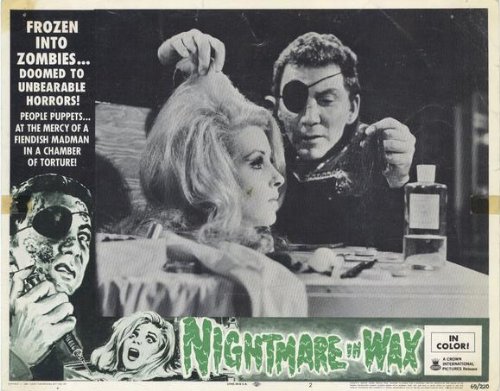
Cameron Mitchell is making his fourth appearance in the Chilling Classics box set with this movie, but I know that he has to be in even more. From voicing Jesus in The Robe to the 1951 version of Death of a Salesman, Mitchell had plenty of big roles in even bigger films. But we’re not here to talk about those. We’d rather talk about his appearances in movies like Night Train to Terror (his segment also appears as another stand-alone movie, The Nightmare Never Ends), The Demon and Blood and Black Lace.

This time out, Cameron is Vince Rinaud, an FX artist who is disfigured by Paragon Pictures studio boss Max Block, who was also a rival for the attention of actress Marie Morgan. Yes, all it takes to ruin a man is to throw wine in his face and then a cigar. Who knew?

Leaving movies behind, Vince gains an eyepatch and a wax museum, while Paragon quickly loses four of their stars. Is it a coincidence that they soon appear as wax statues in Max’s museum?

This movie is pretty much a direct ripoff of House of Wax, except instead of dead bodies being under the wax, Vince uses a serum to turn people into zombies that just stand there under his control. There are also two cops who are the worst detectives this side of a giallo on the case — one of them is Bud Cardos, who appeared in Satan’s Sadists and directed The Dark!

But hey — Cameron Mitchell wearing a cape and an eyepatch. If that makes you happy, we’re happy you’re reading our site.

If you don’t have the Chilling Classics box set — and why don’t you after an entire month of us writing about it? — you can watch this on Amazon Prime free with membership.

CHILLING CLASSICS MONTH: A Bucket of Blood (1959)

Today’s article for Chilling Classics month comes to us from El Paso, Texas. He’s part of Ghoul Inc. Productions, a DIY group who are inspired by Roger Corman, Larry Buchanan, Frank Henenlotter, Herschell Gordon Lewis, Edward D. Wood, jr., S.F. Brownrigg, Barry Mahon and others. He’s an awesome guy and I know no one better to tackle this Corman film!

When I asked Sam at B & S About Movies for a word count on this article before I began writing it, His response of “As many as you want!” was both encouraging and daunting. This is an article on a Roger Corman film starring Dick Miller, Roger being the one guy that has had a bigger impact on my filmmaking and overall attitude towards films in general than anyone else, and Dick being perhaps the most prolific character actor of all time. This has the potential to become very long winded. However, Sam asked me for an article, not a book, so self-discipline, do your thing!

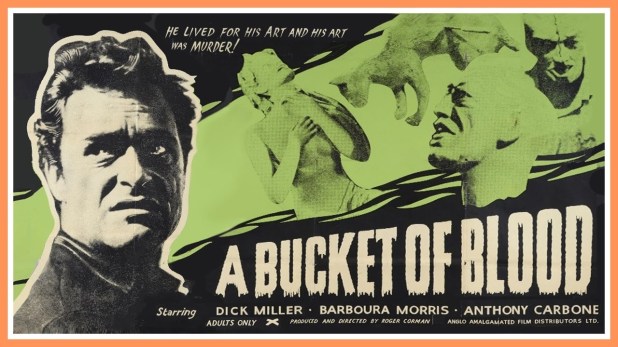
A Bucket of Blood was released on October 21st, 1959, and tells the story of Walter Paisley (Miller), a shy little guy who busses tables at The Yellow Door, a hip coffee joint that caters to beatniks. Walter spends his days cleaning up after the pretentious clientele who treat him poorly, yet he dreams of one day being an artist and rubbing elbows with them. Walter’s boss, Leonard (Anthony Carbone, Creature from the Haunted Sea, The Pit and the Pendulum and a few other Corman flicks) is a particularly unlikable prick, and treats our boy Walter like dirt. One night after a typical shift, Walter returns home to his dingy little one-room apartment to find that his landlady’s cat, Frankie, has gotten into the walls. With no real malicious intent, Walter decides the best way to get Frankie out is to cut through the drywall with a large kitchen knife. As you can imagine, this does not go well, particularly for Frankie. Shocked and terrified that he accidentally skewered Mrs. Swickett’s beloved pet, he gets the idea to cover Frankie’s carcass with sculpting clay, and turn him into a work of art. The next day at the Yellow door, Walter’s “Dead Cat” sculpture, complete with protruding knife, is a big hit with the beat crowd, particularly with one Maxwell Brock (Julian Burton, also in Corman’s Masque of the Red Death), who seems to be the epicenter of the local scene. Suddenly, even that beret wearing tool Leonard is treating Walter with some respect, as is Walter’s crush, Carla (played by Barbara Morris, another Corman alum with Wasp WomanThe Trip and Machine Gun Kelly to her credit). It would seem that Walter’s horse has finally come in, as he goes from forgettable busboy to art sensation overnight. Unfortunately, all that glitters is not gold, and Walter begins to attract the attention of Yellow Door regular and undercover cop Lou Raby, who tails Walter home one evening after an overly enthusiastic female admirer slips Walter a vial of heroin. Detective Raby knocks at Walter’s door and promptly lets himself in once the door is opened. He begins to grill Walter about the heroin, but it’s clear to us in the audience that Walter had no idea what he was given. Walter is a sweet, mousey, gullible little man that we can’t help but like, so Lou’s persistent badgering comes off as just another example of poor Walter being bullied. It is for that reason that when Walter panics and bashes Lou’s skull in with a frying pan that we can’t help being just a bit relieved, and Walter comes off as vindicated. But alas, Detective Raby was no house cat, and Walter has just committed murder. Fortunately, he still has plenty of sculpting clay, and Voila! “Murdered Man” is created, and becomes Walter’s latest masterpiece!

With “Murdered Man”, Walter has become a bonafide artist, has folks desperately trying to outbid one another for his work, and shows up at The Yellow Door wearing a beret, carrying a cane he calls his “Zen Stick” and orders Papaya Cheesecake and Yugoslavian white wine. Fame went to his head very quickly. And although he has become a bit of a pretentious jerk, He’s still just likable enough to keep us rooting for him. We can see that he is in way over his head, but all we can do is pretty much sit back and watch this whole thing run its course. When Carla suggests that Walter sculpt her, he promptly but politely refuses, as that would surely mean the end of Carla. However when the overly obnoxious blonde diva Alice (Judy Bamber of 1963’s Monstrosity) hints that she’d let Walter sculpt her, he responds with “I just might”, with a murderous glint in his eye! 

Shot in just five days with a budget of $50,000 and using a recycled set from the film Diary of a High School BrideA Bucket of Blood was written by Charles B. Griffith, who also collaborated with Corman on Little Shop of HorrorsBeast from Haunted CaveSki Troop Attack and Death Race 2000 as well as directing a half-dozen films himself (including Up from the DepthsForbidden Island and Eat My Dust! starring Ron Howard). Griffith was also instrumental in helping Roger capture the comedic tone of the film, as he did with Little Shop of Horrors. Corman found the idea of doing comedy a bit unnerving, stating in an interview once “If you make a comedy and no one laughs, you’re dead!”. Griffith, however was born into a vaudeville family, and his parents even offered advice on how to make the comedic aspects of the film work. In addition to being a skilled filmmaker, able to make things happen with minuscule budgets and insanely tight schedules, Corman was (and is, for that matter, still kicking in his 90’s these days) a great businessman and very sharp at making pictures that will pique the interest of the movie-going public. The beat scene was a subculture of the 1950’s that brought us the work of one Jack Kerouac, but compared to other subcultures that have been overly exploited in films over the years (Bikers, Hippies, Gangsters etc.) Beatniks never really got a whole lot of screen time, the only other film from the era that comes to mind would be Julian Roffman’s The Bloody Brood, featuring a young Peter Falk, also released in 1959. Corman and Griffith reportedly spent several evenings frequenting beatnik coffee bars and hangouts in doing research to make the characters as “authentic” as possible. 

Is A Bucket of Blood one of Corman’s best films? I suppose it depends on who you ask. What the film is to me, however, is 64 minutes of kooky fun. Like many of Corman’s early work, or just about any other wacky 1950’s horror/sci-fi/monster fare, it’s not exactly “terrifying” or even mildly disturbing, but a fun little flick for those who truly appreciate these films for what they are, and how they came to be. 

CHILLING CLASSICS MONTH: The Revenge of Dr. X (1967)

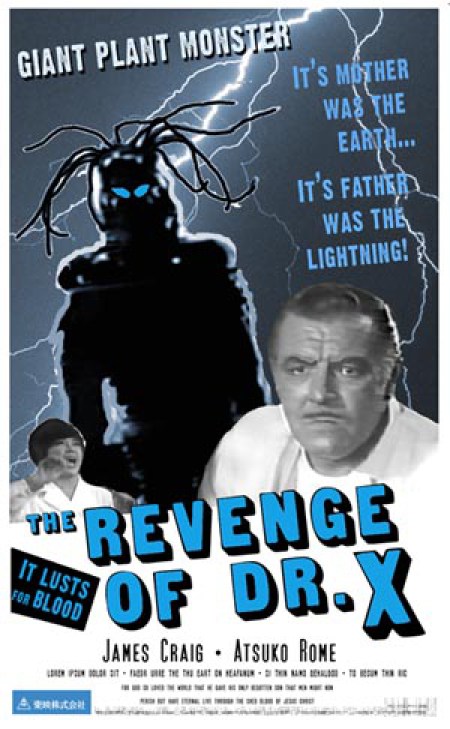
It’s been said that this movie is based on a 1950s screenplay by Edward D. Wood Jr., but he isn’t credited. He probably should be — this has his weird hands all over it. Even stranger, the first American video release had credits for a completely different movie, the 1969 Filipino film The Mad Doctor of Blood Island.

Also known as Venus Flytrap and Body of the Prey, this movie sat unreleased for 3-4 years, depending on who you ask, before it was unleashed on the moviegoing public. Just look at this amazing VHS box art, which has nothing to do with the actual film.

It’s all about Dr. Bragan, a NASA mathematician. After realizing that if his numbers are off by even the slightest decimal point, he could be sending men to their deaths, he has a nervous breakdown. His assistant suggests he goes to Japan to recuperate.

He’s played by James Craig, who was also in Bigfoot and The Tormentors, but his real life is way more interesting than any of the films that he was in. Once heralded as the successor to Clark Gable — indeed he took over many of his roles once Gable was drafted — his life took a turn thanks to drinking and bad relationships. His first marriage to Mary June Ray ended after 15 years due to claims of spousal abuse. His second marriage to Jill Jarman would not last the year, ending with him being threatened with arrest for not attending their divorce hearing. It was alleged that he broke into her home, beat her and cut up all of her clothes. That said, four years later, she’d kill her eleven-year-old son and commit suicide. A third marriage also ended in divorce. After the mid 1970’s, Craig retired to become a real estate agent.

But back to The Revenge of Dr. X. In Japan, Dr. Bragan stays at a hotel with his beautiful assistant, Dr. Hanamura (Kami), whose phonetic dead readings tell us she’s in love with this guy who is way too old for her and acts way too creepy, giving her unnecessary compliments about her looks before he even really knows her. He also begins experiments on a Venus Flytrap plant he brought from America, customs be damned. After he crosses it with a carnivorous undersea plant that he has nude pearl divers get for him — exploitation movie logic — and blasts it with lightning, is it any wonder that it’s soon eating puppies and people?

Come for the stock footage and library music. Stay for the strange plant person. If you think you know what a bad movie is and you haven’t seen this one, well, you don’t know what a bad movie is.

You can catch this on Amazon Prime.

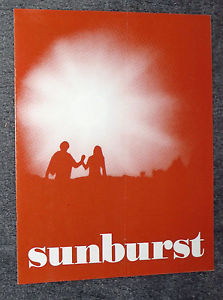
CHILLING CLASSICS MONTH: Sunburst (1975)

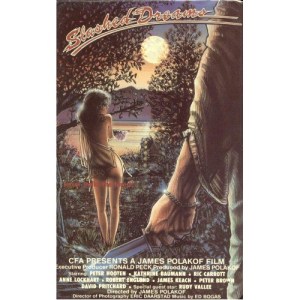
Sometimes the Chilling Classics rewards you with magic. Other times, it assaults you with a film like Sunburst, also known as Slashed Dreams.

Robert (Peter Hooten, the original Dr. Strange) and Jenny (Katharine Baumann, The Thing with Two Heads and now a handbag creator) are going up to the woods to find their friend, Michael (Robert Englund), who has left the world of capitalism behind for a simpler one in the woods.

Once they’re up there, they run into one of a store owner played by Rudy Vallee. In his era, Vallee was one of the biggest teen hearthrobs ever. Here, he’s singing and trying to sell our protagonists a knife. You can also see Vallee in The Phynx and Michael Winner’s strange family film, Won Ton Ton, the Dog Who Saved Hollywood. Seriously, if you’re a fan of old Hollywood, that movie has so many cameos that your head will spin.

Anyways, while skinny dipping, two hooligans (James Keach and David Pritchard, the writers of the film) attack Robert and rape Jenny. Michael saves them, then Robert has a mudwrestling fight with the two men, who run away. Jenny reads a poem from Khalil Gibran and…that’s the end of the movie.

To no surprise, this slice of 1970’s post-hippie weirdness comes from James Polakof, who was also behind the lost woman in the 1970’s trying to make sense of it all by having sex with the devil movie Satan’s Mistress.

To make matter worse — or better — the film features seven songs by Roberta Van Dere, including one titled “Animals Are Clumsy Too” and “Theme from Sunburst.” Actually, best of all, the version of this film on the Chilling Classics set has a video effect over the Sunburst title, replacing it with a keyed out box and the words Slashed Dreams.

Why a movie about Deliverance-esque hillbillies raping and attacking a couple ala Straw Dogs needs a legendary jazz crooner and numerous Carol King sounding songs is beyond me. I met James Keach once, as his son’s band (he was once married to Jane Seymour) was playing a benefit for the charity my agency did work for. If only I had seen Sunburst, because I would have driven him insane asking a million questions about this movie. Or maybe he would have loved the fact that someone had actually seen it.

You can get this in the set or pick up all on its lonesome from Cheesy Flix.

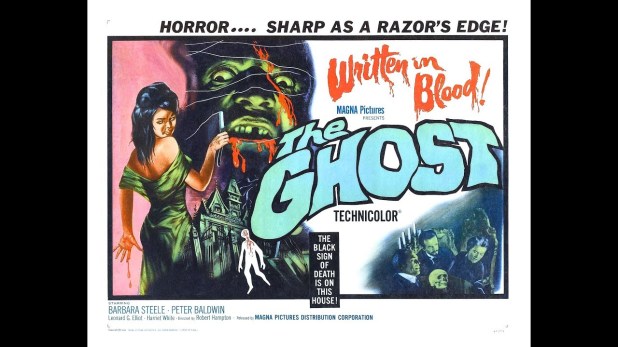
CHILLING CLASSICS MONTH: The Ghost (1963)

An Italian horror remake of 1955’s Les Diaboliques, I’ll give you one reason to watch this movie: Barbara Steele. Otherwise, it’s a brooding take on murder and gaslighting. And while this is directed by Riccardo Freda, stars Steele and has a character named Dr. Hichcock, it is not the same movie as The Horrible Dr. Hichcock. While this movie was shot right around the same time, it is also not a sequel per se. There are some people who care about these kind of things. Like me.

https://www.youtube.com/watch?v=MehANEpjkRI

The ailing Dr. Hichcock and his housekeeper Catherine are engaged in a seance whole his wife Margaret (Steele) is having a love affair with Dr. Livingstone (Peter Baldwin, who in addition to acting in this movie and I Married a Monster from Outer Space, went on to become a director, being behind the camera for TV movies such as the aborted Revenge Against the Nerds TV show pilot, The Harlem Globetrotters on Gilligan’s Island and The Brady Girls Get Married and The Brady Brides series follow-up).

Soon, the doctor is dead and Catherine, Margaret and Livingstone get none of the money. And the key to his safe? Well, he’s literally taken it to the grave. Every time they think they get close or find the money, they’re thwarted. And soon, Catherine the maid is possessed and throws shade on the lovers, convincing Margaret that she should kill the not so good doctor.

The close is where this movie turns the screw. Hichcock has been alive and well the entire time and he murders Catherine, his co-conspirator, and incriminates Margaret. She had been planning suicide and poured a glass of poison, which Hichcock thinks is poison. He begs for the antidote, but she walks away to be arrested for Catherine’s murder. As the movie closes, Hichcock seals himself away inside his castle to die.

Should you watch it? Do you like gothic romantic horror ala Bava but want to see one with none of Bava’s directorial flair? How much do you love Barbara Steele? That should inform your opinion. The good news is that if you have an Amazon Prime membership, you won’t have to pay anything to watch it.

CHILLING CLASSICS MONTH: The Devil’s Hand (1961)

Also known as Witchcraft, The Naked Goddess, Devil’s Doll and Live to Love, this black and white film is all about some people in Los Angeles who want to be ahead of the Black House’s curve in San Francisco and start worshipping Satan…err, Gamba, the Great Devil God.

Probably the most interesting thing that I can tell you about this movie is that Chess Records released Baker Harris and the Knightmares’ “Theme from ‘The Devil’s Hand.” No word on how many people bought it.

Rick Turner (Robert Alda, Father Michael from the bastardized version of Bava’s Lisa and the Devil that was retitled The House of Exorcism, which strangely enough also has a similar plot to this movie, so Satan has to be behind this coincidence) keeps seeing a succubus, a nearly nude vision of a woman dancing in the clouds. Soon, he has come to a doll shop that has one in the exact image of his dreams, which is a likeness of Bianca Milan (Linda Christian, the first Bond girl).

Understandably, his girlfriend Donna (Ariadna Welter, El Vampiro) is freaked out when she finds a doll that looks just like herself. Rick is too after the shop owner Frank Lamont (Neil Hamilton, Commissioner Gordon from TV’s Batman) knows him by name. He also refuses to sell Donna her doll, instead stabbing it and causing her no end of pain.

Of course, while his lady is in the hospital, Rick becomes Bianca’s lover. She’s been sending thoughts into his mind and wants him to join her cult and takes him to a meeting, where Gamba decides if a woman lives or dies when his wheel of knives descends on a woman. She lives, but a cult member takes photos of the event.

Donna is cured by midnight and released from the hospital. There are bigger problems, as the cultist who took the photo is a reporter who Frank curses and kills like Dr. Lavey cutting out photos of Jayne Mansfield.

Soon, the cult is having another meeting to test Rick, asking him to choose if Donna lives or dies. Who knew being in a devil cult had so many meetings? It seems like an awful lot of commitment to make. He chooses her and all of the cult dies in a fire.

The film ends quite ambiguously for when it was made, as the couple thinks everything is copacetic and we soon see in the skies, waiting for him. This is one weird movie, one that feels like a waking dream.

You can watch this for free on the Internet Archive or on Amazon Prime with your membership.

CHILLING CLASSICS MONTH: Dr. Tarr’s Torture Dungeon (1973)

If all Juan López Moctezuma directed was Alucarda, he’d still be celebrated. Throw in the fact that he was behind the camera for El Topo and also created this little piece of strangeness and you can see that he’s someone to be celebrated.

A journalist has traveled to Dr. Maillard’s (Claudio Brook, AlucardaThe Devil’s Rain!) remote mental institution to write a story about the progressive treatment the doctor offers: patients are free to roam and fully live out their fantasies. However, when he gets there, the reporter learns from the doctor’s daughter Eugenie that he hasn’t met the real doctor, just one of the inmates that is quite literally running the asylum and randomly quoting Aleister Crowley. Even better — Susana Kamini, Justine from Alucarda, shows up as a cult priestess!

Imagine if Hammer or Amicus made a movie in Mexico, with all of the dialogue in English, and fed massive amounts of drugs to everyone involved. That’s pretty much how I imagine that this film was made. It’s also an Edgar Allan Poe story (The System of Dr. Tarr and Prof. Fether), but really, it’s also a costume drama with more powdered wigs than a British courthouse. And man, has there ever been so sensationalistic a title?

Will you like it? Not if you’re expecting a horror movie. Again, the Chilling Classics set confounds expectations, seeming like it will only feature the worst schlock and somehow embracing Mexican art cinema. I can only imagine that there’s a basement in the Mill Creek offices where the maniac that chose the films for this set signed off on it with a feather pen and a giant flourish, exclaiming, “I hope this makes someone’s brain melt!”

Beyond watching this on the Chilling Classics box set, you can also find it on Amazon Prime. If you want a much better looking copy of this film, Mondo Macabro released it as The Mansion of Madness, complete with a brand new digital transfer and Guillermo dl Toro discussing the director.