17. THE WATCHENING: Today’s film title should end with an -ing: The Conjuring
18. VIDEO STORE DAY: This is the big one. Watch something physically rented or bought from an actual video store. If you live in a place that is unfortunate enough not to have one of these archival treasures, then watch a movie with a video store scene in it at least. #vivaphysicalmedia: Trick or Treat With Reed Richmond
19. THE ABANDONED PLACE: This spooky classic trope that must inhabit tonight’s viewing: Cub
20. DANCE DANCE DEVOLUTION: Today’s viewing soiree must be some kind of mutant, freak, or genetic mishappening: The Toxic Avenger
21. TWINNERS CIRCLE: Scientists rejoice! Human cloning has been achieved: The Boys from Brazil
22. WRECK TANGLE: Rubberneck a car crash scene: The Road Warrior
23. SURVIVORS?: If anything walks away from a plane crash, the chances of it being healthy are pretty slim: The Langoliers
24. IN YOUR DREAMS: Heavy on the dream sequence, Jack: Aliens
25. ELECTRIC SLIP’n’SLIDE: Wriggle your way through a sloppy/goopy good time flick: The Toxic Avenger Part II
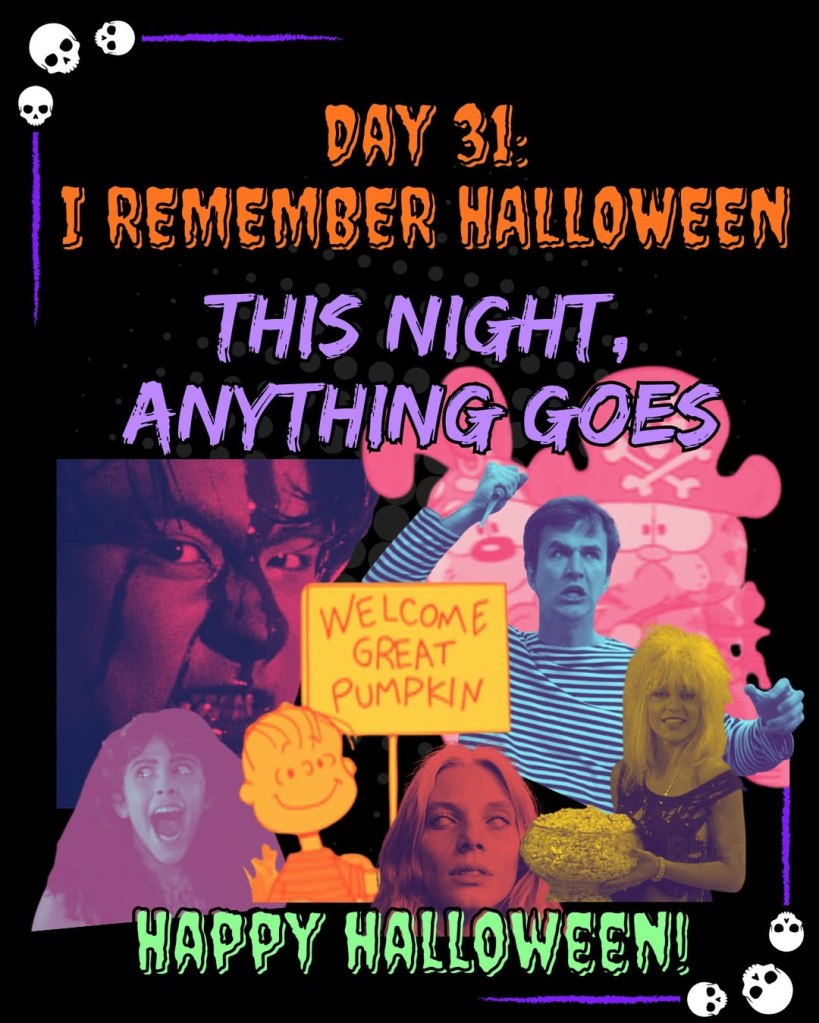
31. I REMEMBER HALLOWEEN: This night, anything goes.
I hate that in the new Halloween films, we’re told the sequels no longer exist, yet they’re still endlessly referenced. Sure, I could be happy with just watching the first two films, but every year, with every new Halloween, the movies that came before seem to get better.
Until we get a good one, there are fan films.
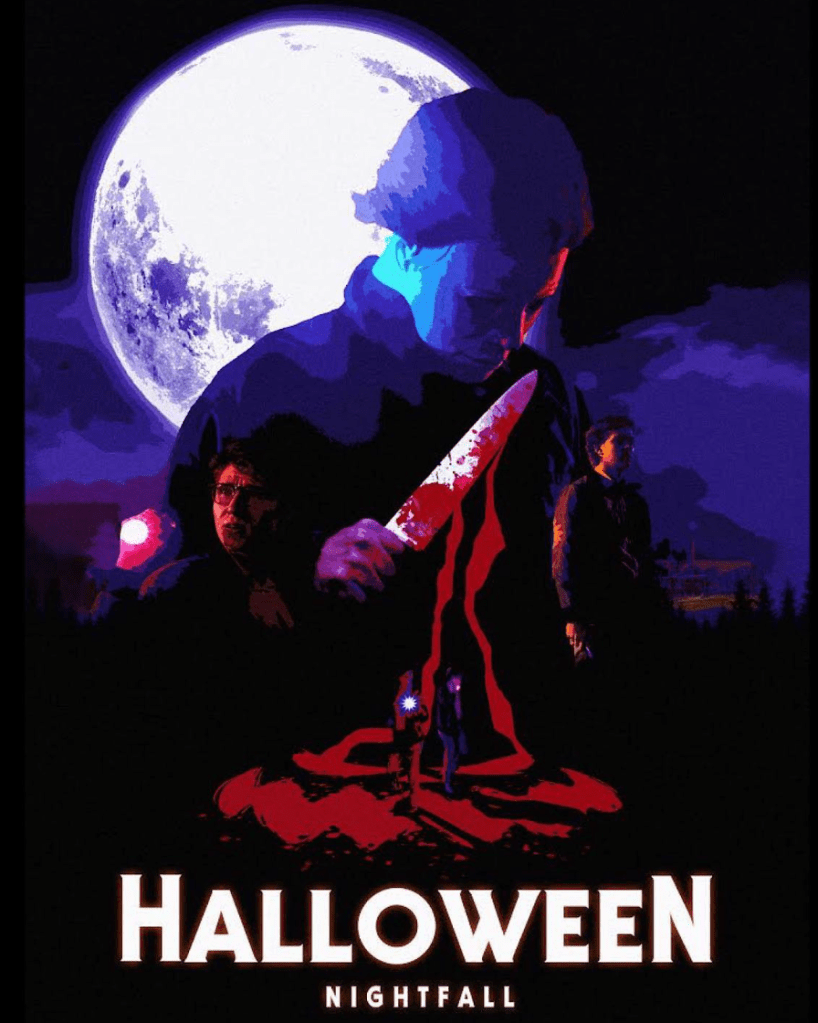
Halloween Nightfall is the kind of movie that you need to shut your mind off for. It tells how Michael got from Smith’s Grove to Haddonfield, but it’s not set in 1978. So you get a Screammask, a Jason costume, an inflatable Stay Puft Marshmallow Man and “Thriller” playing in the same world where Annie, Laurie and Lynda walk home from school with the same dialogue and the same “Don’t Fear the Reaper.” And you get a way better-looking film than most streaming films, created by director Jackson Bennink.
Maybe the Michael in this looks small, perhaps his mask is very Spirit Store, but the director actually took his time doing color balancing and setting up more than just medium shots the entire time, which is above and beyond what I expect for even professional streaming horror these days.
You can watch this on YouTube.
Michael Myers: Absolue Evil (2016): I hate it in true crime when they tell us that before a murder in a small town, that everyone once kept their doors unlocked and after, they knew what evil was. As this short starts, a movie that imagines the Halloween films as if they were real, we hear from Lindsay Wallace, who survived the original attack. She informs us that the entire town knew that he was just a few miles away in Smith’s Grove, at all times, so they had already lived in fear.
With experts like Edgar Warsam, the author of The Devil’s Eyes: The Story of Michael Myers, and filmmaker John Borowski, as well as a news interview with Michael’s mother Edith, director and writer Rick Gawel’s film expands on which of the movies told the right story — yes, the adaptions exist in this world — and an entire sequence that explains the Thorn cult and how it ties into the story of The Shape.
I wish this had a bigger budget; if it had a more TV-like look, it would have been perfect. That said, many of the actors are really great. The sequence that breaks down Halloween II as if it were an actual crime show is absolutely perfect. And going deep into the history of Dr. Loomis is incredible.
This could be a bit shorter and sharper, but for what it is and the budget that it had, it’s pretty good. I’d love to see this with a crew that has worked on true crime and a bit better graphic design. It’d make a great extra feature on a box set.
You can watch this on YouTube.
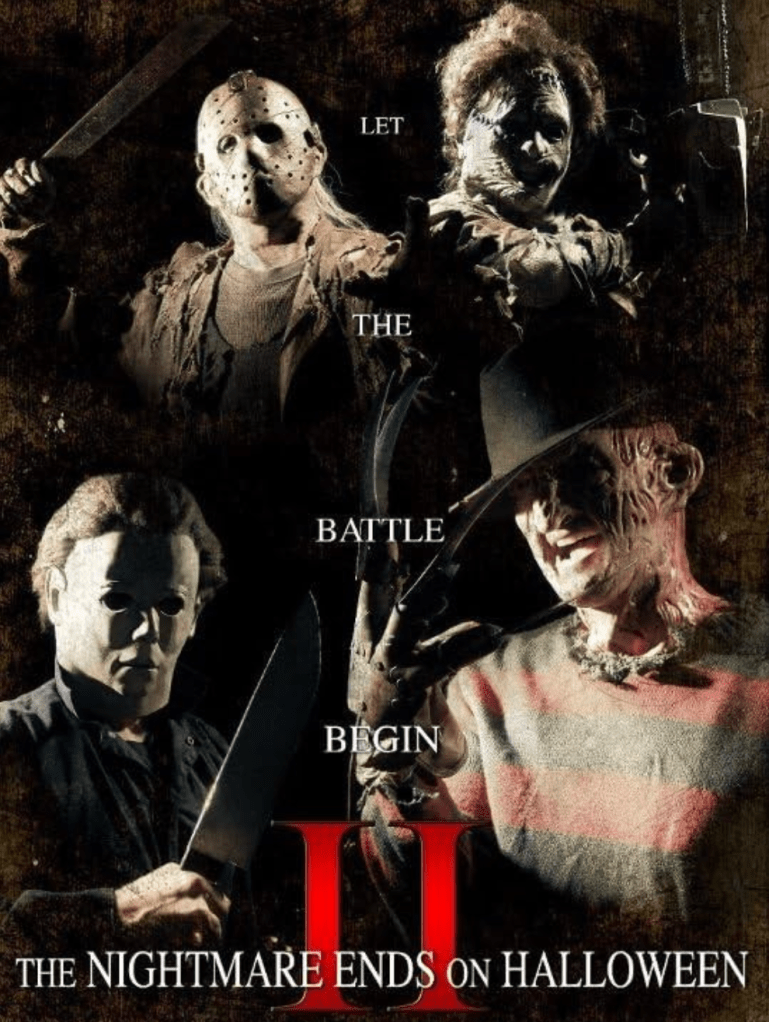
The Nightmare Ends On Halloween II (2011): Directed and written by Chris R. Notarile, this takes the mid-2000s idea of mixing franchises beyond what studios were ready for, creating a trial for Freddy Krueger in which he’s judged by Pinhead and forced to face off with Leatherface, Jason Voorhees, and Michael Myers.
Roberto Lombardi, who plays Krueger, has done so in several other fan films, while Hector De La Rosa, who is Jason, has also been in several Snake Pliskin fan films.
Notarile, who also did the effects for this, has also directed movies about the Black Terror, Red Widow, US Agent, Phantom Lady, Spawn, James Bond, Candyman, The Shadow, Darkman and more. You can see his movies on his YouTube page.
I love that Leatherface and The Shape are the same actor, Anthony Palmisano. Even more, I absolutely love that Freddy defeats Leatherface with a nut shot. “Fucking rednecks,” he says.
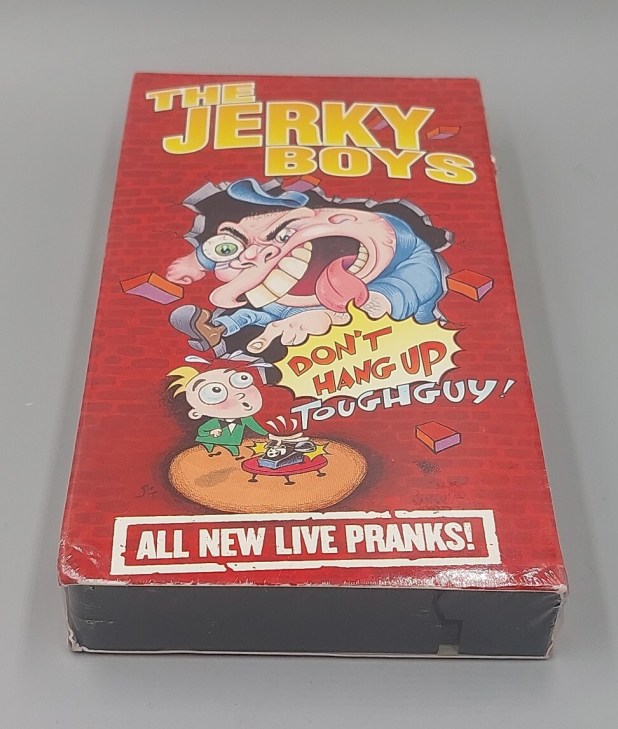
30. DEVIL’S NIGHT: Mischief, mayhem or pranks – oh my!
I refuse to play into the notion that just because something is juvenile, it’s stupid.
In this, The Jerky Boys make prank calls with hidden cameras at MTV’s intern offices, on a double-decker tour bus in Manhattan, on supermarket intercoms and from payphones. These are things that probably couldn’t happen in our world of caller ID and mobile phones, but whatever. It’s a moment in time.
Johnny Brennan and Kamal Ahmed first started making their pranks in the 1980s, often calling unsuspecting people or answering the phone in character for classified advertisements placed in local New York City newspapers. Their first actual album came out in 1993, but bootlegs had been circulating for years. I remember a cassette that I got had this and the Tube Bar all on one 90-minute blast of outlaw insanity. They were Frank Rizzo, Sol Rosenberg, Kamal, Jack Tors, Kissel, and so many more characters. The first time I heard the call “Uncle Freddie,” I may have laughed the hardest I’ve ever laughed, as it’s one of the most uncomfortable comedy acts of all time, as Kissel and his entire family keep asking about Uncle Freddie, who has maybe died, with his son Anthony getting on the phone when his father can’t speak. Brennan’s voice as Anthony is nearly unhinged, as it feels like he’s floating in space, as a woman screams in the background, and Kissel screams that someone has killed their uncle and wants to kill him as well. It’s really an excellent few minutes of madness.
Even people we’d think of as being ultra serious, like Radiohead and Slowdive, named songs for Jerky Boys references (Pablo Honey and Souvlaki, which is a Jerky Boys line the band loved: “My wife loves that Greek shit. She’ll suck your cock like souvlaki.”). Their humor permeates so many parts of the comedy (just like the Tube Bar tapes) and yet, when you ask people about it, they’ll tell you how stupid and immature it is. But does it make you laugh?
Their film, The Jerky Boys, was savaged by critics, and the duo would split up a few years later. But the material is here, especially in this video, which felt like an undiscovered country for me. So many Jerky Boys references litter my daily utterances that some people just think they’re weird things that I say, like “Real proud of ya,” “for some people,” and “I hear you Greeks like trains.”
Yes, it’s stupid. But it all makes me laugh. The world is rough, so I don’t need to be all high-falutin’ about humor these days. A video where the Jerky Boys talk in a grocery store? Put it in my eyeball like heroin. I no longer need to shoot it between my toes.
Also: This is the second Jerky Boys-related Scarecrow Psychotronic Challenge entry I’ve made. I really yearn to be taken seriously as a film critic and look forward to becoming Rotten Tomatoes-certified.
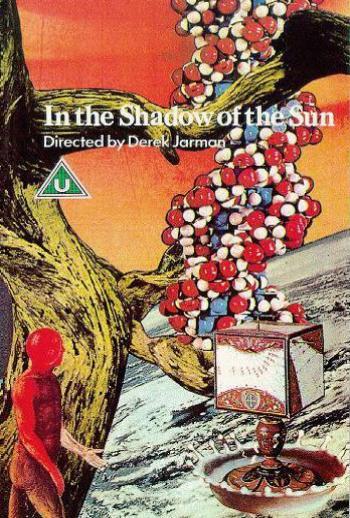
29. “OCCULT”URAL CENTER: This one’s gotta have a supernatural hotspot in it.
This was made by Derek Jarman, who was the production designer for The Devils and also made Jubilee. He also directed the Pet Shop Boys’ 1989 tour.
Jarman was also involved in music, directing videos and films for The Smiths, Marc Almond, Suede, Wang Chung and Psychic TV. This is a mix of Super 8 films shot by the director between 1972 and 1975, scored by Throbbing Gristle. There are scenes from his films Journey to Avebury. Tarot and Fire Island.
The title refers to the Philosophers’ Stone, which alchemists sought, believing it could transform base metals into gold.
I’ve heard people say this movie is boring. Maybe it’s the space I find myself in, but I found it relaxing and a perfect trance. I guess if it’s not for everyone, then it’s occult.
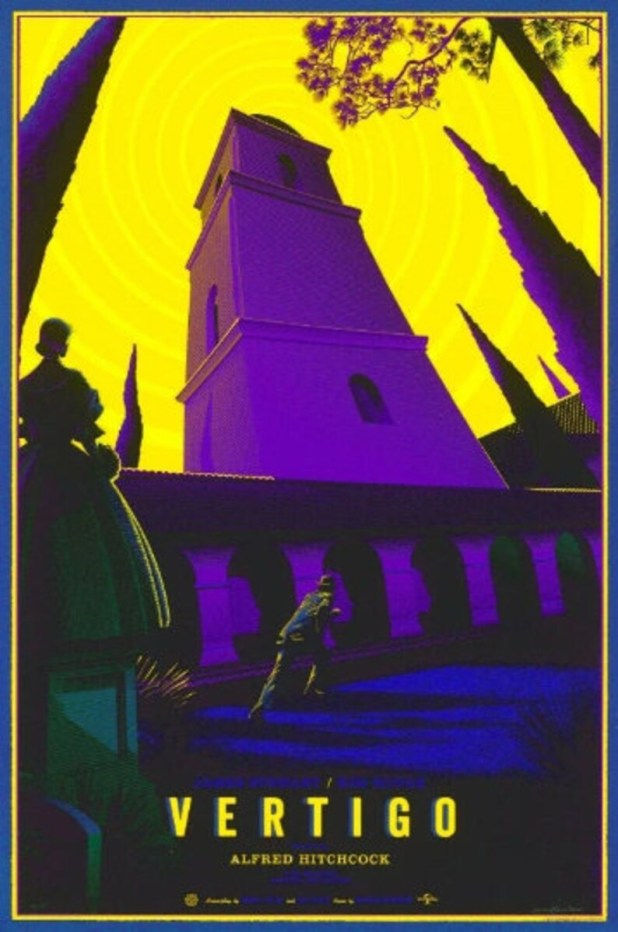
28. THIS IS JEOPARDY: Ken says you must solve the clues to survive the predicament.
I’m working through my central Alfred Hitchcock blind spot this year. Yes, I jumped right past him to Giallo, De Palma and Krimi. As I look back, I see the beginnings of my obsessions.
It was written by three people: playwright Maxwell Anderson (who worked on The Wrong Man), Alec Coppel and Samuel A. Taylor. Their work was inspired by D’entre les morts by Pierre Boileau and Thomas Narcejac; Hitchcock had tried to purchase their previous work, Celle qui n’était plus (She Who Was No More), which was made as Les Diaboliques.
San Francisco detective John “Scottie” Ferguson (Jimmy Stewart) has had to retire early. A rooftop chase led to the death of one of his fellow officers, and he’s been struck by a fear of heights, which comes out as vertigo. His former fiancée, Marjorie “Midge” Wood (Barbara Bel Geddes), thinks that he needs a shock to his system. As he looks for a way to fill his empty days, his friend Gavin Elster (Tom Helmore) asks him to follow his wife, Madeleine (Kim Novak).
He traces her to the Mission San Francisco de Asís and the grave of Carlotta Valdes — not a real person — then to the Legion of Honor art museum, where she gazes at a painting of her. The woman was Madeleine’s great-grandmother, and Gavin feels that she’s possessed his wife. Carlotta was the mistress of a rich man, but after she gave birth to his child, he kept the child and left her. Then, she killed herself. Whenever possessed, Madeleine has no memory of what she’s done or where she’s visited.
She tries to drown herself and is saved by Scottie, to whom they soon profess their love. She runs up the steps of Mission San Juan Bautista, Carlotta’s childhood home, and demands that he not follow her. He tries, but his vertigo keeps him grounded as she falls to her death. It’s ruled a suicide, but Scottie is institutionalized.
Once he comes back to reality, he sees another woman who reminds him of his lost love. She is Judy Barton and is the woman he knew, but was involved with Gavin in an elaborate murder; as Scottie was afraid to go up the stairs to save Madelaine, Gavin threw her already dead body to the ground below. As Judy has been cast aside by her lover, just as Carlotta was, she falls for Scottie, who asks her to start looking like Madelaine.
To finally get past his fear, he feels that he must go through the event all over again. At the top of the bell tower, he makes her admit her crime. She begs him for forgiveness; she embraces him, just as a nun appears and frightens Judy, who falls to her death. At least Scottie is no longer afraid of heights.
So much of Giallo can be traced to this film. Fulci’s Perversion Story takes the setting and idea of a woman coming back from the dead through someone who appears just like her. One of the shots in this has been used in suspense movies ever since. Uncredited second-unit cameraman Irmin Roberts invented the famous zoom-out and track-in that shows how vertigo feels. That moment — just a few seconds — cost $19,000 to film. Hitchcock based it on how it looked when he passed out at a party.
How Hitchcock explained this to Truffaut — “To put it plainly, the man wants to go to bed with a woman who is dead.” — could be any Giallo. The way light and color twist and turn at key moments is also echoed in Argento’s work.
What is interesting is that, as crucial as Madelaine/Judy is to the story and the motivations of its hero, she doesn’t speak until the movie is a third of the way in. She’s been nearly a cipher for so long, someone that Scottie can fall in love with in a day, projecting perfection onto someone he barely has met.
Judy: If I let you change me, will that do it? If I do what you tell me, will you love me?
Scottie: Yes. Yes.
Judy: All right. All right then, I’ll do it. I don’t care about myself anymore.
Does Scottie even love Judy? Or is he recreating the woman that he thought she was before, without knowing it? In the words of Roger Ebert, Scottie “…falls obsessively in love with the image of a woman–and not any woman, but the quintessential Hitchcock woman. When he cannot have her, he finds another woman and tries to mold her, dress her, train her, change her makeup and her hair, until she looks like the woman he desires. He cares nothing about the clay he is shaping; he will gladly sacrifice her on the altar of his dreams.”
When she remakes herself, emerging from a bathroom with green neon fog, she’s done it for him. As Ebert notes, “The other man has, after all, only done to this woman what Scottie also wanted to do. And while the process was happening, the real woman, Judy, transferred her allegiance from Gavin to Scottie, and by the end was not playing her role for money, but as a sacrifice for love.”
Hitchcock wanted to edit out Judy’s flashback sequence, which reveals that she and Madeleine are the same person. He was worried that if he gave away the twist, audiences would check out. He did a test in New York City. The version with the flashback was the clear winner. That said, the film didn’t do well at its initial release, which the director blamed on Stewart’s age.
Unlike every other movie the director made, the killer is not punished. The American Production Code Administration demanded an ending where a radio show reveals that Elster has been caught. That never made it into the film.
27. TRANCING AND HYPNOTISM: Gold watches ain’t just for retirement.
I’ve been obsessed with this movie for years.
My Drive-In Asylum co-host Bill Van Ryn shared an ad for a movie that I’d never heard of on his Groovy DoomFacebook page, and it immediately piqued my curiosity. What could Death Is Not the Endbe?
Kinorium says, “The mystery of life eternal is discussed by a number of purported experts in various fields of metaphysical research, as well as individuals who assert that they’ve lived before.”
The AFI Catalog goes a bit deeper, telling us “Reporter Wanda Sue Parrott and an African American laborer named Jarrett X are put into deep hypnotic trances as part of a psychic experiment in past-lives therapy.”
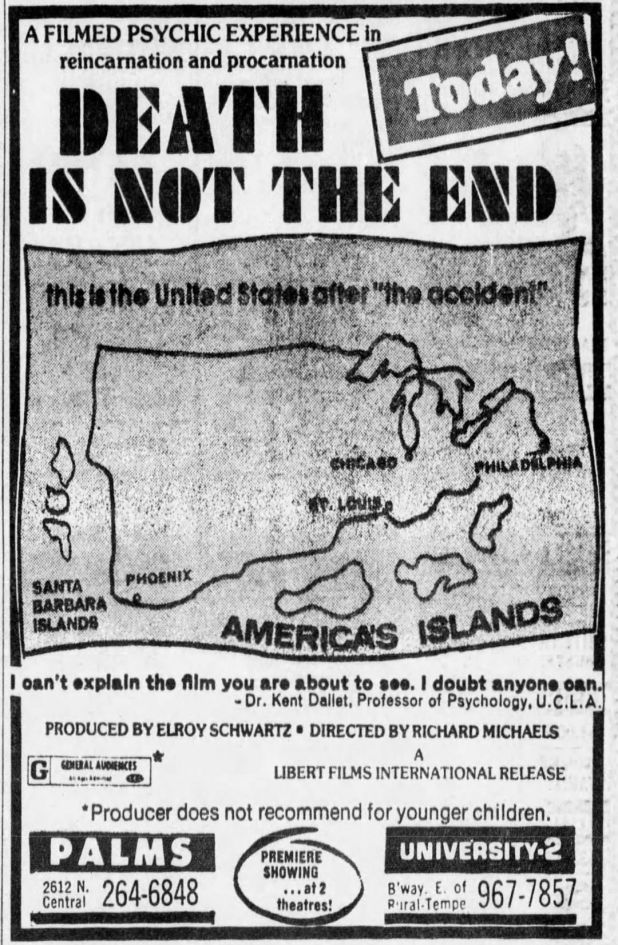
It played at least a few times, if ads are to be believed. The Phoenix, AZ, premiere was on December 8, 1975 — the ad featured in this article — and it also played a year later in Los Angeles on April 11, 1976.
The July 25, 1974 Hollywood Reporter claimed that the film, then known as 75 IT, would premiere at the Atlanta International Film Festival in Georgia on August 16, 1976. Dona Productions took over distribution in 1976, and the film’s title was changed to ‘Death Is Not the End’, a title that hints at the film’s themes of reincarnation and life after death.
Anyways, these are a lot of facts, but there was no chance I was ever going to see this movie.
Or was I?
Imagine my surprise to open my email and see this:
Hi Sam,
We were given a big binder of family stories for Christmas, and in it was a DVD of 75 IT. We already had one, but it got me and my husband googling the movie and we found your blog.
I watched it years ago but am not sure I ever got to the end as it was pretty bad. I did enjoy the brief shots of my husband as a child at the very beginning.
I’m not sure who has the rights to it now. Wanda used to stay in touch with Ron Libert but I think they fell out over the publishing of her novel.
Are you still looking to watch it?
It took about six months to arrive. And you know how I work. When I get something I’ve been waiting to see, I tend to sit on it. Like gift cards, I like the idea of having something to look forward to. In this case, the anticipation of finally watching this rare and obscure film was too exciting to rush.
But today would be the day that I would watch this.
75 IT or Death Is Not the End was the work of Elroy Schwartz. The brother of Sherwood Schwartz, he and Austin Kalish wrote the original pilot for Gilligan’s Island, which went unaired until TBS showed it in 1992. He would continue to be a writer on the show along with his brother, Al.
In 2000, the Los Angeles Times reported that Schwartz and Kalish were suing Sherwood, saying, “They charge that the older sibling has been cheating them out of Gilligan’s Island credits and royalties for decades. The dispute apparently began in 1963, when Elroy and Kalish say they wrote most of the pilot show. Sherwood was the producer and, as a favor, they honored his request and listed his name as a co-writer on the script, the suit says. Ever since, they charge, Sherwood has tricked them out of their share of royalties and has controlled the rights to the show, which has made him as rich as, say, Thurston Howell III.”
They’re not exaggerating. In Kalish’s obituary in The Hollywood Reporter, it’s reported that “Years after the show ended, Kalish said documents were uncovered that indicated he should have been entitled to one-quarter ownership of the series, worth about $10 million, but he received nothing.”
In addition to being a writer, Schwartz was a licensed hypnotherapist specializing in past-life regressions. He described this movie as such: “There wasn’t any established script. The movie is a ‘happening’ — a spontaneous filming of a hypnotic regression into reincarnation, and ‘procarnation’ — a look into the subject’s next life.”
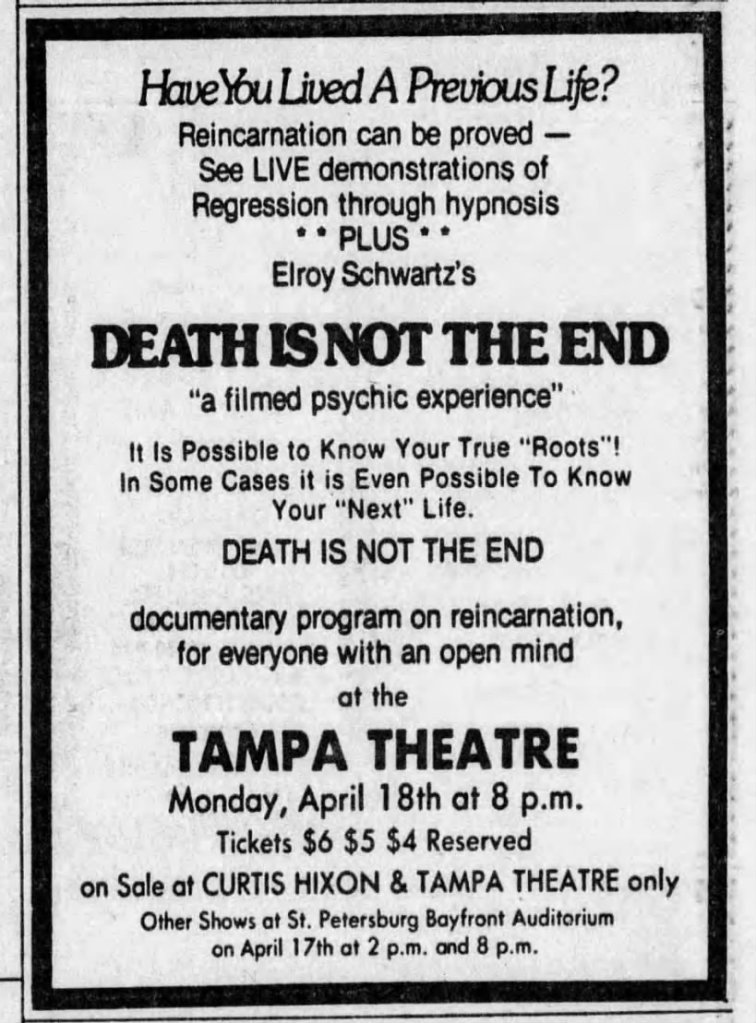
According to the article (The Tampa Times from April 4, 1977) posted above, “Elroy Schwartz, stocky, cordial, gregarious, doesn’t look like a Svengali, but, he says, he’s “a hell of a hypnotist.” Schwartz is in town from Los Angeles, where he’s a full-time writer and producer (he’s written for such TV shows as I Love Lucy, Gilligan’s Island and Movie of the Week and a sometime hypnotist who’s delved into uncharted areas of the mind. From these explorations have come both a book, The Silent Sin, and a movie, Death Is Not The End, scheduled for showing Monday night at the Tampa Theatre. His book, written six years ago, deals with a hypnosis subject whom he “regressed,” or took backward in time, over a period of several months, eliciting from her unconscious several past lives she felt she had lived in various reincarnations. In one reincarnation, the subject went through a reenactment of labor pains. For Schwartz, “It triggered something in my mind.” He thought, “If we can go backward in time, why can’t we go forward?” He tucked the thought away for a while, but some time later met Wanda Sue Parrot, a newswoman with the Los Angeles Herald Examiner, and “got good vibes from her.” They started work on regressing, and when he felt she was really in touch with her subconscious, Schwartz asked her to go forward in time to her next life.
He was in for a shock. Wanda was “reborn” as a mutant inhabitant of a world recovering from the near-annihilation of an accidental atomic detonation from China. What had been the United States was now “America’s Islands,” fragmented, with whole sections gone from the map. She lived in “Utah County” in the year 75 I.T., which, the hypnotist found, meant International Time, a time system set up by the “World Tribunal,” which governed what was left of Earth.
From the concept of this horror story emerged the movie, which was filmed live as Schwartz repeatedly put his subject into a trance state under the supervision of a medical doctor.
“It’s not edited except for time,” Schwartz said. “Producers have told me it’s not technically a movie, but it has a tremendous impact. Wherever it’s shown, people thank me. They want to see it again.” For himself, Schwartz “knows what we have is real. Maybe this is a warning; maybe we can stop history if we stop and think what we’re doing.” For now, he’s trying to find practical and creative ways to utilize his gift.”
So let’s get to the movie.
It’s wild: this is relatively low quality, but when you have what may be one of the few copies of a movie in the entire world, you don’t complain.
This film is relatively simple. Schwartz sits in a chair, a shirt unbuttoned to reveal a bare chest, speaking with Wanda Sue Parrot, who wrote for the Los Angeles Herald-Examiner and Chicago Tribune. As Schwartz hypnotizes her, she quickly remembers several of her past lives, including being a woman named Akina in an early civilization. Often, she is unable to communicate with Schwartz because there is no translation for her words or for how she sees things.
She starts as a single-cell organism, then gets brothers and sisters as a cavewoman, as Schwartz tries to get her to speak the language she used. The language can’t be identified as a modern language; it’s very rudimentary. It sounds Native American, which makes sense, as Parrot has Chickasaw and Cherokee ancestry in her family tree. She also wrote under the Native American byline Prairie Flower.
Schwartz then hands her the paper and a marker so she can write. Even though she’s a writer by trade, she struggles with the marker, biting down on a pencil as she creates a triangle. Synth music bubbles as she continues her drawing. In her language, she tells him what the drawing is. Then she says it’s a drawing of creation and how it came to our world. She says there are two sides of God, symbolized by two fish. She refuses to take the pencil out of her mouth so that Schwartz can understand her. He then puts her to sleep so he can get the pencil back, and asks her to wake up; he will be her god Ika. He will talk to her and she will understand him.
“You have been a good person, Akina. You may speak to your god.” Schwartz says. She laughs and says that Ika is invisible. He replies by walking out and coming back, saying that he’s Iko. She holds his hands and smiles, studying his watch, which she smells and tries to bite. She’s also interested in his many rings. “Ahh e tu ah,” she replied. Then says, “Snake.”
He puts her back to sleep.
Akina dies when she goes to see the blue people — is this Yor Hunter from the Future? — and she is crushed. She dies far below her people. Schwartz then counts to three and tells her to feel the pain of Akina as she dies on a bed of stones. Wanda begins to move around in pain, just as she’s told to go to sleep.
What about the blue people? Akina describes the geography of the world she lived in. The blue people raised cattle, sheep, and a bird. Their skin is as dark as ashes, but not black like ashes. A deep color blue like the sky. They were being extincted, and their women were unable to reproduce, having only one child each. Any children they had moved into new territories across the ocean, but their color changed to dark, but not blue, except in cases of…she doesn’t know the word. They had blue black skin, brown black skin. Then she discusses other people, like the Unix, who were the work animals.
Schwartz then tries to learn how the electron that she once was became the identity of a new person and how the soul moves through different bodies through time. We hear her be born and make very realistic noises as if she were a crying infant. He then takes her to the 1600s, where she is a French man. Wanda only speaks English and Spanish, not French, so when she starts to say things in French, it’s surprising.
The film cuts to a couch, where Schwartz meets Jarrett X, a black man wearing a dress shirt covered in dots and white flowers. He quickly is able to get Jarrett to go into a hypnotic state and remember being named Jacob Elliot Nash. After the Civil War, he worked on a farm for Master Hearst, a white man he disliked, who often beat him with whatever he could find. Schwartz tries to take on the voice of Jarrett’s master, yelling at him before learning that the young slave stayed behind on the plantation, bound by the fact that his mother would not leave.
This gets pretty harrowing, as Jarrett is asked to sing at one point and says that he refuses to sing as he no longer believes in God, as what God would allow so much suffering? Schwartz counts to three, snaps his fingers and reminds Jacob of when he was a child and did sing. He then relates a few bars of “Sometimes I Feel Like a Motherless Child.”
Then, the worst memory comes when Jarrett remembers the owner’s son stabbing him with a pitchfork, ending his life. This gets even harder to watch, as we learn that in the past, Jarrett was accused of fooling around with a white woman, which earned him his death. As Schwartz snaps his finger and wakes him up, he quickly seems like a totally different person.
Schwartz relates to Dr. Kent Dallt, Professor of Psychology at UCLA, how he wrote his book on hypnotherapy and reincarnation. As they sit in a field, they discuss how no one seems to believe in previous or future lives. Schwartz relates that even if he had proof that someone was actually alive —a newspaper article or a tombstone —no one would believe it. Skeptics never open their minds to these things.
Dallt brings up From India to the Planet Mars by Theodore Flournoy and Sonu Shamdasani. The book explores Catherine Müller, also known as the medium Hélène Smith, “who claimed to be the reincarnation of Marie Antoinette, of a Hindu princess from fifteenth-century India, and of a regular visitor to Mars, whose landscapes she painted and whose language she appeared to speak fluently.”
Death Is Not the End moves on to the procarnation exercises, which move Wanda to her next life as a blind mutant newly born in Cold Springs, Utah. Seventy-five years after a nuclear accident, which gives this film the name 75 IT, the United States has been divided into the American and Barbara Islands, which are ruled by the World Tribunal of Africa. As America has been decimated by this nuclear event, its people aren’t allowed to celebrate any religion, experiment with any science or even marry one another.
This is all supposed to be happening in the year 2100 or so, Schwartz thinks. All Wanda can say is that it’s the year 75 IT when Wanda’s mutant future form is twenty. She claims that her father was from Philadelphia. Elroy pushes her for more information on the accident, to which she can only reply, “Horrible. Horrible.” He keeps asking, and she tells them that people burned, their skin came off their bodies, their eyeballs fell out, and they still didn’t die.
No one knows why or how the accident happened, which doesn’t help us much. It wasn’t a war, she knows that much, and that it happened in China. Schwartz goes through several cities and asks if they are still around. Miami and Florida have sunken beneath the waves, but Omaha and St. Louis are safe. Most of the towns he throws out, she can’t remember, although she has heard of Birmingham. England is underwater with piranhas, she says, at one point.
The world is governed by the World Tribunal, which has representatives of every nation on Earth. Elroy then asks if she will always be in Cold Springs, but she will go to the University of Heidelberg when she’s 25. Oh yeah — Phoenix is a port now, too.
Throughout the interview, Wanda seems almost upset and struggles to explain herself. Schwartz even chuckles a few times. This makes me drift and see the room he has set up, which is very 1970s, with green shag carpeting, tons of plants, and comfy couches with afghans. It isn’t a place you’d discuss the end of the world.
She claims Kennedy would win the 1980 election, and Elroy quickly moves on. She then took up a lover, Joseph Martin, her lover from Belgium. He taught her how to see, which landed him in jail for treason. While she was blind, she was taught to see with the center of her brain or her third eye. Joseph showed her how to use transmission to see and how to use telepathy to see through his eyes.
There’s a wild moment here where the mutant wakes up in Wanda’s body and can see. She looks like she’s freaking out and then seems elated that she can see. It’s hard to tell if she’s sending messages back in time or speaking through this body. This moves her to tears.
The mutant dies in the year 106 IT. She goes home to Cold Springs to have her baby, the child of a criminal. She goes up the mountain and doesn’t come back. The baby is born. Schwartz wakes her up with a smile.
The end credits claim that the year IT is 2012. It also says that “Two months after the final edit of this film, Dr. Dallet, finding the film personally distubring, shared the Procarnation description of “the accident” with colleagues at the University’s Astronomy and Science departments. Their “concensus of opinion” theory was that “the accident” was probably a Pole Shift — cause by a weight imbalance at the poles due to a melting of the polar ice caps.”
There’s a producer’s note — which makes me wonder if this was planned to be released in 2005, before the 2012 event and in a time when polar shift theory was at its height — that says “In the thirty years since this documentary was filmed, much of the polar ice has melted — and continues to melt at an increasing rate. Thirty years ago, Earth scientists considered the melting of the polar ice as improbable and without precedent.
Death Is Not the End doesn’t feel fake. It feels like people are being captured in moments of hypnosis. Whether they’re guided to feel this way or they’re really sharing moments of their past and future is up to you, the viewer. It feels way too raw to be either improv or scripted.
I can’t even tell you how overjoyed I am to get this movie, and I am beyond thankful that it was sent to me. I wish it had a bigger potential audience than just movie nerds like me, as I can’t even see this being something a boutique label would release. But in a world where we can find everything within seconds online, the fact that some films remain hard to find — and therefore occult — is something that keeps me alive.
As bas as the world seems like it can be, we also live somewhere that the real creator of Gilligan’s Island can make an unseen movie about past and future lives, as well as an end of the world that never came.
Notes on the people who made this:
Richard Michaels directed the film and began his career as a summer assistant to legendary New York sportscaster Marty Glickman before becoming a script supervisor. He also directed episodes of Mr. Deeds Goes to Town and The Odd Couple, and produced Bewitched, a show he would direct for 55 episodes.
That show would change his life, as he and star Elizabeth Montgomery fell in love during the show’s eighth year, breaking up her marriage to William Asher and his to Kristina Hansen. They were together for two and a half years.
The rest of his career was spent in TV, mostly directing TV movies such as The Plutonium Incident and Scared Straight! Another Story, Heart of a Champion: The Ray Mancini Story, Leona Helmsley: The Queen of Mean and many more.
The music comes from Mort Garson, who wrote the song “Our Day Will Come,” which is on the soundtrack of Grease 2, More American Graffiti, Under the Boardwalk, Shag, Buster, She’s Out of Control, Love Field, The Story of Marie and Julien, You Should Have Left and Role Play. He was part of The Zodiac’s Cosmic Sounds, a 1967 concept album released by Elektra Records that had early use of the Moog synthesizer by Paul Beaver (“a Scientologist, a right-wing Republican, unmarried and a bisexual proponent of sexual liberation” who helped build Keith Emerson’s custom polyphonic Moog modular synthesizer, did the sound effects for The Magnetic Monster and composed the score for The Final Programme) with music written by Garson, words by Jacques Wilson and narration by folk musician and Fireside Theater producer Cyrus Faryar, all with instruments played by members of the Wrecking Crew studio collective, such as Emil Richards, Carol Kaye, Hal Blaine, Bud Shank and Mike Melvoin.
Garson was an early adopter of Moog, which makes me like him even if he wrote the theme song for Dondi. He also wrote the song “Beware! The Blob!” for the Larry Hagman-directed sequel and scored René Cardona Jr.’s Treasure of the Amazon, Paul Leder’s Vultures and Juan López Moctezuma’s To Kill a Stranger.
Plus, his song as The Zodiac, “Taurus – The Voluptuary,” also shows up in several gay adult films of the early 70s, including the Satanic-themed Born to Raise Hell, which also uses his songs “Black Mass,” “The Ride of Aida (Voodoo),” “Incubus” and “Solomon’s Rising.”
Garson was also Lucifer, the electronic artist who released Black Mass — also called Black Mass Lucifer — that AllMusic reviewer Paul Simpson says is “a soundtrack-like set of haunting Moog-based pieces which interpret various supernatural and demonic themes.”
Cinematographer Alan Stensvold also shot Bigfoot and Wildboy for The Astral Factor, Dimension 5, Cyborg 2087, Thunder Road, and the TV show Dusty’s Trail, where he had to have met Elroy Schwartz, who created the show with his brother Sherwood.
This movie was edited by Joan and Larry Heath. While Joan has no other credits, Larry has an extensive portfolio of work on TV, including 106 episodes of Rhoda, 46 of Simon & Simon, the film Billy Jack and episodes of Gilligan’s Island and Dusty’s Trail, where he also met Schwartz.
Notes on the production and distribution companies:
Schwartz’s Writer’s First only lists this movie and episodes of the show Dusty’s Trail as released productions.
Dona Productions seems made just to distribute this film,
Libert Films International was seemingly was a tax shelter used to distribute films like Rum Runners, Angela, Encounter with the Unknown, The Great Masquerade, My Brother Has Bad Dreams, Mario Bava’s Roy Colt & Winchester Jack, The Devil With Seven Faces, Never Too Young to Rock, Willy & Scratch, Charlie Rich: The Silver Fox in Concert, Beyond Belief and Stevie, Samson and Delilah. Ron Libert was the CEO of this company and Apollo Productions and was part of American Pictures Corporation, along with Robert J. Emery, who directed the Claudia Jennings-starring Willy & Scratch.
Cougar Pictures, which picked this up in 1977. also distributed The Flesh of the Orchid, Starbird and Sweet William, Scream, Evelyn, Scream! and another Libert pick-up, Beyond Belief.
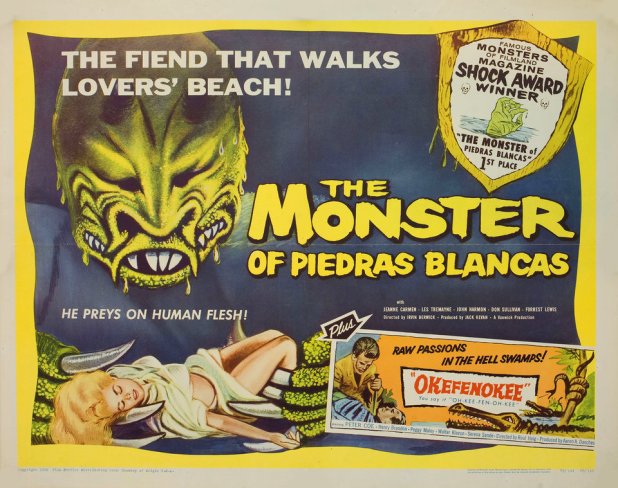
26. THAR SHE GLOWS: There be a light house in this plot.
Irvin Berwick and Jack Kevan were nobodies at Universal.. Kevan hated working for makeup department boss Bud Westmore, who took all the publicity ahead of the people who actually did the work. They formed Vanwick Productions and became independent producers and seeing as how Kevan had overseen the manufacture of the costumes for Creature from the Black Lagoon, why not make their own version? Using the feet of the mutant from This Island Earth and the hands of The Mole People, the diplovertebron was born.
Universal helped out, believe it or not. As they felt bad about so many of their technical people being laid off, they let them work on this film and gave the production discounts on equipment.
Sturges (John Harmon), the lighthouse keeper, is convinced that his daughter Lucille (Jeanne Carmen, who started dancing at the age of 13 before becoming a trick shot golfer before leaving her husband and hooking up with alleged mobster Johnny Rosselli, who introduced her to Sinatra, who in turn took her to Hollywood. She’s in The Three Outlaws, which has Neville Brand as Butch Cassidy and Alan Hale Jr. as the Sundance Kid. She was also in Untamed Youth and was the reason why Eddie Cochoran covered “Jeannie, Jeannie, Jeannie.” While working as a pin-up, she met R0selli again, who told her to leave Hollywood because of her friendship with the Kennedys and Marilyn Monroe, so she dyed her hair, got married, and had kids in Scottsdale. She is a bad girl, so he keeps losing his mind at everything she does.
He’s a weird dude who leaves food for the monster and keeps telling people that there’s such a thing, which drives the cops nuts. Well, there is a monster —a long-extinct prehistoric man-creature that rips off people’s heads.
How many people does it kill? Enough that diner owner Kochek (Frank Arvidson) has to open up his freezer to Constable George Matson (Forrest Lewis) and let him hang the headless bodies there. As for the town doctor, well, that’s voiceover actor Les Tremayne.
Berwick went on to make Strange Compulsion, The Street Is My Beat, The 7th Commandment, Hitch Hike to Hell, the Christian movie Suddenly the Light and Malibu High. As Darcia, he made the softcore film Ready for Anything! and was also the associate producer of Larry Buchanan’s The Loch Ness Horror. This is the only movie Kevan ever produced, but he would write The Street Is My Beat and The 7th Commandment. Screenwriter H. Haile Chace went on to direct and write the sexploitation movie Paradisio and the scare film V.D.
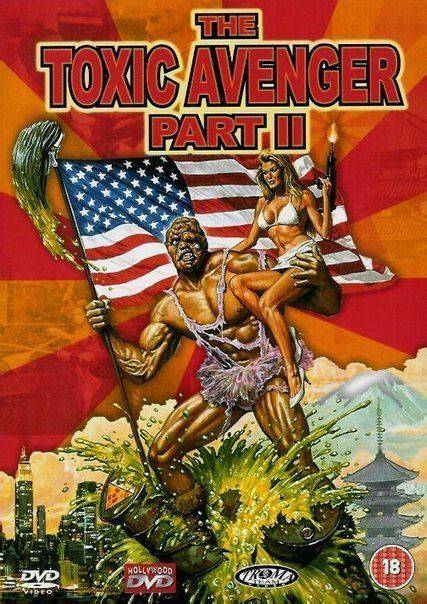
25. ELECTRIC SLIP’n’SLIDE: Wriggle your way through a sloppy/goopy good time flick.
Directed by Lloyd Kaufman and Michael Herz, written by Kaufman and Gay Partington Terry, this finds Toxie (John Altamura voiced by Ron Fazio) getting a job at the Tromaville Center for the Blind with his girlfriend Claire (Phoebe Legere). But an evil company named Apocalypse Inc. blows up the center to destroy Tromaville and take it over. The Toxic Avenger defends the town, but then is tricked into going to Japan to find his father.
However, when he meets his father, Big Mac Junko (Jack Cooper), he learns that he’s a criminal and ends up having to kill him, all while Tromaville is being destroyed by a Dark Rider, who has a bomb on his back. However, sumo wrestling training makes our hero stronger; he defends his city and meets his real father, who was the victim of identity theft.
The original edit of this was four hours long! Come on! How is that possible? The other footage not in this is in The Toxic Avenger Part III: The Last Temptation of Toxie. This is nowhere as good as the original, but it does have 66 deaths and a man’s face turned into taiyaki.
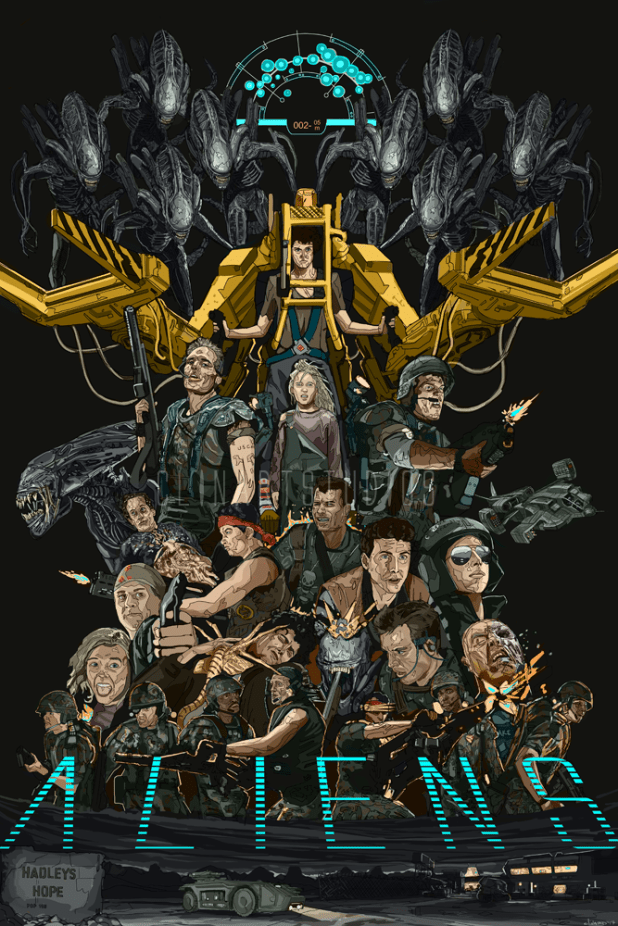
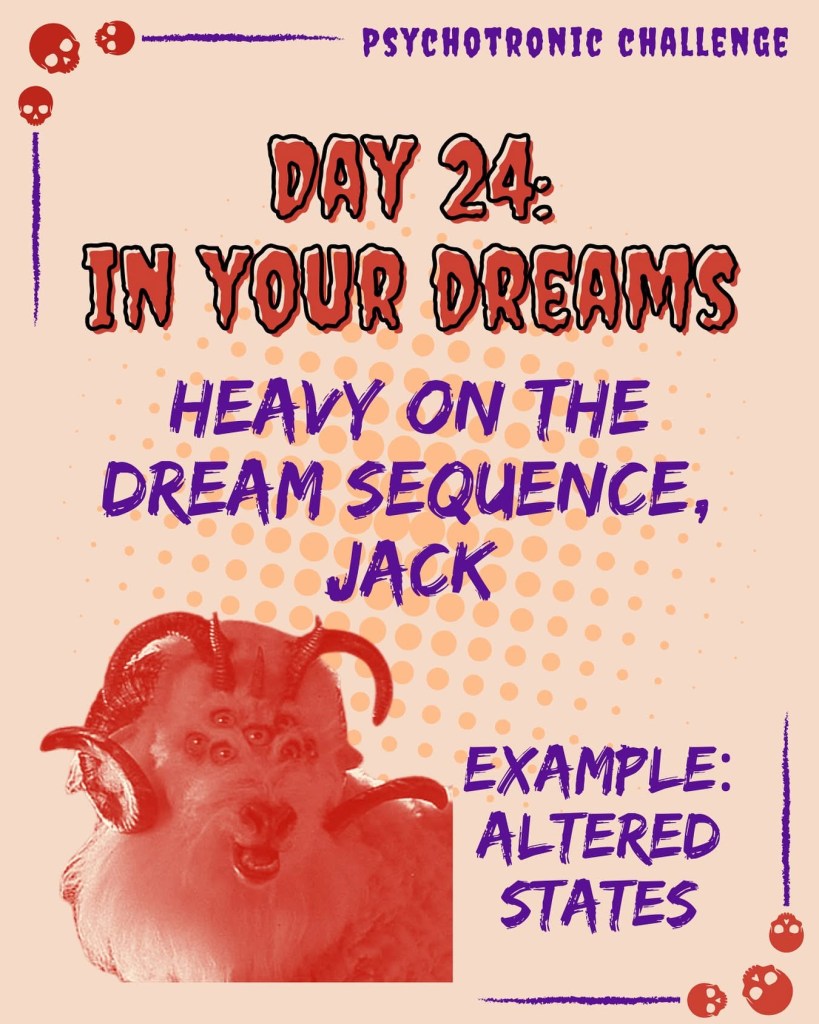
24. IN YOUR DREAMS: Heavy on the dream sequence, Jack.
After a 57-year slumber, Ripley (Sigourney Weaver) is abruptly awakened by the Weyland-Yutani Corporation. Her dream of alien impregnation and birth is shattered as she finds herself back on LV-426, now a mining colony.
Along with Carter Burke (Paul Reiser) and Colonial Marines Lieutenant Gorman (William Hope), Dwayne Hicks (Michael Biehn), Bishop (Lance Henriksen), Forst (Ricco Ross), Vasquez (Jenette Goldstein), Drake (Mark Rolston), Spunkmeyer (Daniel Kash), Crowe (Tip Tipping), Wierzbowski (Trevor Steedman), Dietrich (Cynthia Dale Scott), Ferro (Colette Hiller) and Apone (Al Matthews), she investigates what’s left. Despite Ripley’s warnings about the alien, no one listens. Newt (Carrie Hehn), a young girl, is the only survivor, and the bugs soon wipe out most of the Marines.
Ripley takes over and leads the survivors back to their ship. Sure, it’s simple, but it’s thrilling —a large-scale version of the first movie, now with big weapons and plenty of firepower. It’s hilarious that Fox thought a sequel would be a mistake and that the first movie wasn’t successful. I love this sentence: “Using Hollywood accounting methods, Fox had declared Alien a financial loss despite its earnings of over $100 million against a $9–$11 million budget.”
As for the next film, Cameron said, “I thought the decision to eliminate Newt, Hicks, and Bishop was dumb. I thought it was a huge slap in the face to the fans. I think it was a big mistake. Certainly, had we been involved, we would not have done that, because we felt we earned something with the audience for those characters.”
I walked out of the theater in minutes.
Aliens was a movie even more vital to me than the first movie. All of the promise hinted at in that movie is only increased and what emerges is a rollercoaster of a film, one in which quotable lines — “Get away from her, you bitch!” is excellent, but so is “What do you mean “they cut the power”? How could they cut the power, man?! They’re animals!” and ” Game over, man. Game over!” — and significant action moments come together in a way that only the 80s and Cameron could deliver. Sadly, no one was ever able to make this franchise work this hard again (outside of Kenner and Capcom).
23. SURVIVORS?: If anything walks away from a plane crash, the chances of it being healthy are pretty slim.
Directed and written by Tom Holland and based on the novella by Stephen King, this first aired on May 14 and 15, 1995 on ABC. Richard P. Rubinstein produced through his company Laurel Entertainment and King mainly stayed hands-off.
The effects for The Langoliers were provided by Image Design and you know, when King wrote beach balls with teeth, he may not have been thinking of a movie being made of his story.
On a red-eye flight from Los Angeles to Boston,pilot Brian Engle (David Morse), MI6 agent Nick Hopewell (Mark Lindsay Chapman). schoolteacher Laurel Stevenson (Patricia Wettig), tool and die worker Don Gaffney (Frankie Faison), violinist Albert Kaussner (Christopher Collet), Bethany Sims (Kimber Riddle), mystery author Bob Jenkins (Dean Stockwell), blind Dinah Bellman (Kate Maberly), businessman Rudy Warwick, (Baxter Harris) and bond trader Craig Toomy (Bronson Pinchot) wake up alone no pilots, no crew. Craig has a mental breakdown and Dinah — a telepath because she’s blind, you know how it works, enters his mond.
They land in Bangor and no one is there either. That’s when Craig tells them that the Langoliers are monsters that eat lazy children. Yes, beach balls that snack on kids, how do you do it U of M grad Steve King?
According to IMDB: “The Langoliers themselves were originally going to be portrayed by puppets, but were replaced with CGI instead. Unfortunately, the poorly rendered and animated monsters ended up looking laughably hokey, and are regarded as some of the worst CGI effects ever.”
Oh man are they ever.
Anyways, this was always considered a mess — at least by me — until I saw the remix of the film, Timekeepers of Eternity. Made with cut paper, it really works, remixing this film into something that is exciting and different.







 B&S About Movies
You must be logged in to post a comment.