April 7: Jackie Day — Celebrate Jackie Chan’s birthday!
ABOUT THE AUTHOR: Jennifer Upton is an American (non-werewolf) writer/editor in London. She currently works as a freelance ghostwriter of personal memoirs and writes for several blogs on topics as diverse as film history, punk rock, women’s issues, and international politics. For links to her work, please visit https://www.jennuptonwriter.com or send her a Tweet @Jennxldn
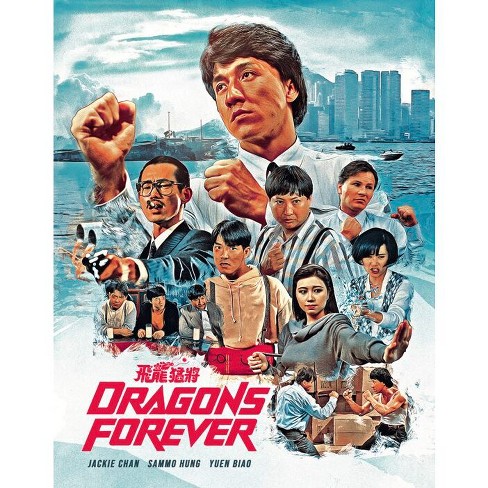
Dragons Forever was the last of the “three brothers” films, starring Jackie Chan, and his opera school brothers Sammo Hung and Yuen Biao. This makes the flimsy environment vs. greed storyline less interesting than the powerful themes of friendship and loyalty.
Jackie plays a horny self-serving lawyer who spends a lot of his time trying to keep Sammo and Yuen Biao from beating each other up. It is possible that much of the personality conflicts between the three leads reflected the real life disharmony between the three men at that time. Throughout the film they are constantly opposing each other only to later vow eternal friendship. It is well known that Jackie Chan and Sammo have had their falling outs in real life (there are many rumors as to why) but they have always remained loyal to each other. It appears that no difference of opinion, creative or otherwise, can break the bonds of growing up together in Yu Jim Yuen’s Peking Opera School.
As expected, the action is top-notch with Yuen Biao stealing the show as the loveable psycho. He wears bright yellow sweaters on covert operations and in the subtitled version, pontificates non-stop on modern society. Yuen Biao is the best acrobat and martial artist of the three by far. He should’ve been a bigger star.
Sammo Hung doesn’t get to do much fighting this time compared to the Project A films, but he serves up some of the best choreography of his career with the help of another of the Seven Little Fortunes opera group, Corey Yuen Kwai. Yuen Wah makes an appearance as the comedic villain, bringing the total number of “little fortunes” to five. This film features the famous re-match between Jackie and Benny “The Jet” Urquidez from Wheels on Meals which pales compared to the original bout, but is still great. Sammo was always a better director than Jackie. His versatility shines through superbly here, pivoting flawlessly between action and situational comedy. Overall, it’s very enjoyable viewing experience.
April 6: Viva Mexico — Pick a movie from Mexico and escribir acerca de por qué es tan increíble.
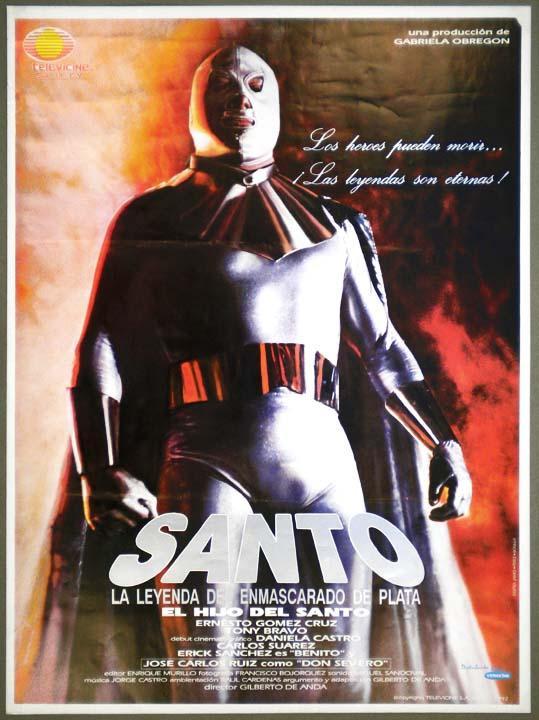
Directed and written by Gilberto de Anda, Santo: The Legend of the Silver Mask tells the origin of El Hijo del Santo and how he came to wear the mask of his father. It’s also about the issues a young kid obsessed with Santo has with growing up.
My wife said that if you want to die, you should play a drinking game where you do a shot every time someone says Santo. There’s no way you would survive.
Hijo Del Santo’s pro wrestling debut was under the name and mask of Korak. His father would not agree to this, as while he wanted one of his sons to carry on the name and legacy, he wanted them to graduate college first.
Months after he got his Communication Science degree, Hijo del Santo made his debut with the mask of his father as a team with Ringo Mendoza versus Coloso Colosetti and Sangre Chicana. While fans were skeptical of him at first — Santo cast a very big shadow — he soon showed that he was an even better wrestler than his father, if not as big of a cultural icon.
While all this is happening, Don Severo tries to steal the farm of Marcos Arriaga, a widower who lives with his young son Benito. Benito is such a fan of Santo that he even wears his mask when he takes test in school.
Then, when the elder Santo dies of a heart attack, Benito is left depressed and hoping that Santo will return. He goes to Mexico City to find him while El Hijo del Santo trains and learns from his father’s sidekick, Carlitos (Carlos Suarez, who really was Santo’s friend in his later movies). There’s an amazing moment when he takes El Hijo del Santo into the near-Batcave of Santo which is filled with inventions and cool cars. They open a locked box which contains the original mask of his father and fog comes out of it.
At the end, when Santo saves Benito and his father by deflecting bullets and blowing stuff up real good with his laser car — just after winning the mask of Espanto Jr. — I couldn’t help but get excited. This is nowhere as good as the movies of his father, but El Hijo del Santo really should have gone wild and fought slasher killers and demons.
Espanto Jr.’s real name is Jesús Andrade Salas. He was such a rival of Santo that he lost his mask and hair three times to him. When AAA formed, he jumped there and eventually became an evil Santo named Santo Negro and had a lot of heat. Santo’s family objected to the idea of a fighter coming from South America to destroy El Hijo del Santo and take his mask, so they forced AAA to stop using the name. Instead, Salas became the original Pentagon and did a similar angle with AAA star Octagon. He had to retire in 1996 after he collapsed in the ring and was replaced by the former Metalico as Pentagón Black. There’s also a Pentagon III who lost his mask and hair to Octagon and, if you watch AEW, the one-time Zairus and Dark Dragon is now known as Pentagón Jr. or Penta el Zero M. He’s the nephew of Blue Demon Jr., so if El Hijo del Santo was still wrestling full-time or if his son El Nieto del Santo ever gets started, he’d be a natural rival for him.
There’s also some great footage of Santo hitting some of his topes in this that make them seem really dangerous and in your face, as well as Blue Demon looking so smooth in the ring.
April 6: Viva Mexico — Pick a movie from Mexico and escribir acerca de por qué es tan increíble.
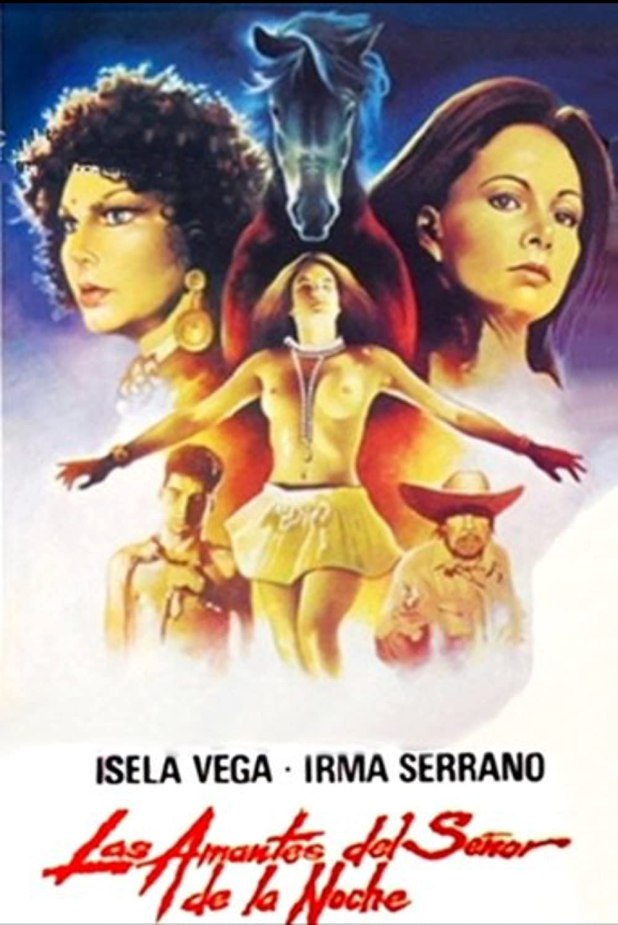
Lovers of the Lord of the Night was directed and written by one of its stars, Isela Vega. She’s probably best known for playing Elita in Sam Peckinpah’s Bring Me the Head of Alfredo Garcia. This was the only movie she directed, which is a shame, because this is the kind of movie that movie people should be celebrating, particularly with the reborn love for folk horror as of late. She wrote this movie with Hugo Argüelles.
Venusita (Elena de Haro) has fallen in love with the scion of a wealthy family of merchants named the Venustianos. Her lover’s mother and father want better for their son, so they decide to send him to the United States, far away from Venusita.
She turns to black magic, visiting a bruja named Saurina (Irma Serrano, known as La Tigresa de la Canción Ranchera (The Tigress of Ranchera Music) who once starred in a movie opposite El Santo, El Santo y La Tigresa). She casts a spell that brings her young man back to Mexico, but also kills his father.
April 6: Viva Mexico — Pick a movie from Mexico and escribir acerca de por qué es tan increíble.
Lucha libre movies were a big deal from the 1950s to 1980s, but kind of went away, ironically at the same time that lucha had a major boom by finally being on TV. Yes, unlike America, wrestling often stayed off TV in Mexico, instead using magazines and newspapers for promotion. That all changed when one of the largest promotions, CMLL, began appearing on the national Televisa network in the early 1990s.
Lucha is very conservative — despite the high flying ring style — and has only changed when renegades left their home promotions. For example, Francisco Flores, along with EMLL trainer Ray Mendoza, broke away from EMLL (the old name for CMLL, which you can consider very similar; it was formed in 1933 and is still around to this day) because they were too restrictive, taking many of the younger wrestlers and those that had not really been pushed — including Fishman, Perro Aguayo, El Canek, Dos Caras and Villano III — and forming the Universal Wrestling Association. While they were the main national competition to CMLL, by the late 80s, the companies were working together and many of their wrestlers left to work for CMLL.
The nail in the coffin of UWA was another renegade, Antonio Peña. The company remained stuck in the past and matchmaker Juan Herrera preferred heavyweight wrestlers who stuck to the traditions of lucha libre, while Peña — who wrestled as Espectro Jr., Dalia Negra, The Rose, Espectro de Ultratumba and Kahoz, a rudo who would invoke evil spirits before his match and release live pigeons before he fought, sometimes even appearing to have bitten the head off of one of them and being covered in blood — was a fan of faster-moving wrestlers like Konnan, Octagon, Mascara Sagrada and the mini-estrella division, in which wrestlers under 5’1″ were not in comedy matches but instead high action battles.
After Paco Alonso, the owner of CMLL, kept ignoring booking ideas, he began negotiations with Televisa. They paid for Asistencia Asesoría y Administración (AAA) and now owned their own lucha libre promotion, leading to an even bigger boom — despite the hardliners claiming TV would ruin their live gates — that only died out when the peso was devalued.
CMLL and AAA are still in business, but man, in the 90s, AAA boasted one of the most exciting rosters ever. In addition to Konnan and Octagon becoming gigantic stars, it was where Rey Mysterio Jr. got his first major fame, as well as having a roster that included Psicosis, El Hijo del Santo, Eddy Guerrero and his partner Love Machine Art Barr, Blue Panther, Cien Caras, Blue Panther, Heavy Metal, La Parka and so many more.
It’s funny — Konnan leaving AAA just followed the same formula — he returned — and CMLL is still considered way too conservative, thirty years after AAA was created.
El Luchador Implacable is a throwback to the other way that lucha libre was once promoted. Stars like El Santo, Blue Demon, Mil Mascaras and more often appeared in movies that were created to draw fans back to the arenas.
It’s about a motorcycle gang that is running wild until they make the mistake of attacking a pro wrestler: Dos Caras Jr.!
Dos Caras Jr. — the nephew of Mil Mascaras — would eventually lose his mask voluntarily when he left Mexico behind to find fame in America as part of the WWE. That said — he did do a few MMA matches with the mask on!
Known as Alberto Del Rio, he became the only man to hold the WWE, WWE World Heavyweight, Impact World, GFW Global, AAA Mega and CMLL World Heavyweight Championship titles. He’s been controversial — that’s putting it mildly — figure due to multiple scandals but is currently back in AAA.
At the time this was made, he was still in CMLL and while there, he would be one of the few of his family members — El Sicodélico Sr., his uncle, was also a rudo — to be a bad guy. He kind of struggled in CMLL as one way that the company changed was that heavyweights weren’t pushed as hard as they were in the pre-UWA days. Unlike most luchadors, Del Rio is 5’6″ and 239 pounds, so he has some size.
Other luchadors that show up in this include Silver King (who was Ramses in Nacho Libre), Rey Bucanero, Hector Garza, Olimpico and Ultimo Guerrero, as well as Rey Myserio Jr. I wonder if some of this movie was filmed while Rey wrestled just ten matches for CMLL in 2001-2002. Mysterio started the year this movie was made by winning the Royal Rumble, then the world title from Randy Orton, becoming a bigger superstar than he ever was before, even if he had to change his name, removing the Jr. as Vince McMahon hates the name as he suffered being called Junior most of his early life.
El Luchador Implacable isn’t bad, but when compared to the movies of lucha libre’s history, it kind of pales in comparison. There are no mummies, no aliens, no werewolves transforming in the middle of the ring.
April 6: Viva Mexico — Pick a movie from Mexico and escribir acerca de por qué es tan increíble.
One of my favorite sites is Luchablog. There’s nobody else in America that does a better job of keeping you up on lucha libre — Mexican pro wrestling — as The Cubs Fan. I was intrigued that he had an article about the magazine Lucha Libre that started publishing a series of articles about “La verdad de la lucha” or “The truth of lucha.”
With May 29, 166’s issue 136, magazine director Valente Perez broke kayfabe and revealed that all lucha libre fights were predetermined and why that was a good thing, as it was a unique Mexican art form and even theater. He came up with the word Los Maestros to explain the best wrestlers in the sport and how they could tell a story and make fights look violent yet safe.
Perez also claimed that the first falls of the traditional lucha three fall matches were competitive real matches to test the wrestlers while the rest was for the fans, as real matches aren’t as exciting. He felt that the primera caída, or first fall, was essential as it proved who was a real wrestler.
He also had no issue calling El Santo a paper idol who had too many injuries and who would be better off just sticking to making movies.
In these articles, Perez referred to Mil Mascaras as a pistolero or a strong guy — or speak the American language of wrestling, a hooker or shooter — who can do whatever he wants to anyone he wants to do it to in a match.
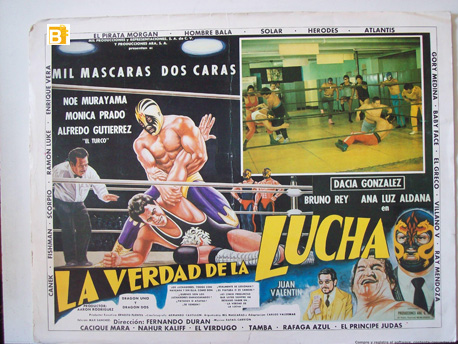
And Mil Mascaras is both the star and co-writer of this movie, which is filled with some of the biggest names in lucha as of 1990: Pirata Morgan, Scorpio, Fishman, Enrique Vera, Hombre Bala, Solar (a true maestro who is still wrestling today!), Atlantis (so young in this movie!), Herodes, Cacique Mara, Gory Medina, Baby Face, El Greco, Ray Mendoza and his son Villano V, Príncipe Judas, Rafaga Azul, Tamba the Flying Elephant, El Verdugo, Nahur Kaliff, Blue Panther, Andy Barrow and Piloto Suicida. Thanks Luchawiki!
It’s the story of two wrestlers — Sergio Roca (Dragón I) who is played by Eduardo Liñán in the acting scenes and Mascaras in the ring and Joel Aguilar (Dragón II) who Mascaras’ brother Dos Caras in action — as well as their sons Jorge Roca (Hijo de Dragón I) who is Dos Caras and Guido Aguilar (Guido el Magnífico or Hijo de Dragón II) who is El Hombre Bala and los rudos El Manotas (Cacique Mara) and El Indio Navajas (El Greco).
There’s also a heel role for Noé Murayama, an actor born in Japan who came to Mexico with his dentist father and the rest of his family. He was in more than 160 movies, including Blue Demon contra Cerebros Infernales and, perhaps most famously in the U.S. thanks to the recent Vinegar Syndrome release, El Violador Infernal.
Directed by Fernando Durán Rojas and written by Carlos Valdemar (Zindy the Swamp Boy, Guyana: Cult of the Damned) from a story by Mascaras, La verdad de lucha libre has a story of several generations off luchadors, as well as what it takes to get to the main event. It ends with Dos Caras watching from a wheelchair at ringside as his brother wins a match that’s more important than just a title.
This movie shows the very human side of being a pro wrestler (as well as the faces of several of the wrestlers, briefly, which is still a major thing in Mexico where wrestlers keep their identity a secret). Whether you love Mexican film or lucha — especially the history of the sport and art form — this is worth your time.
April 6: Viva Mexico — Pick a movie from Mexico and escribir acerca de por qué es tan increíble.
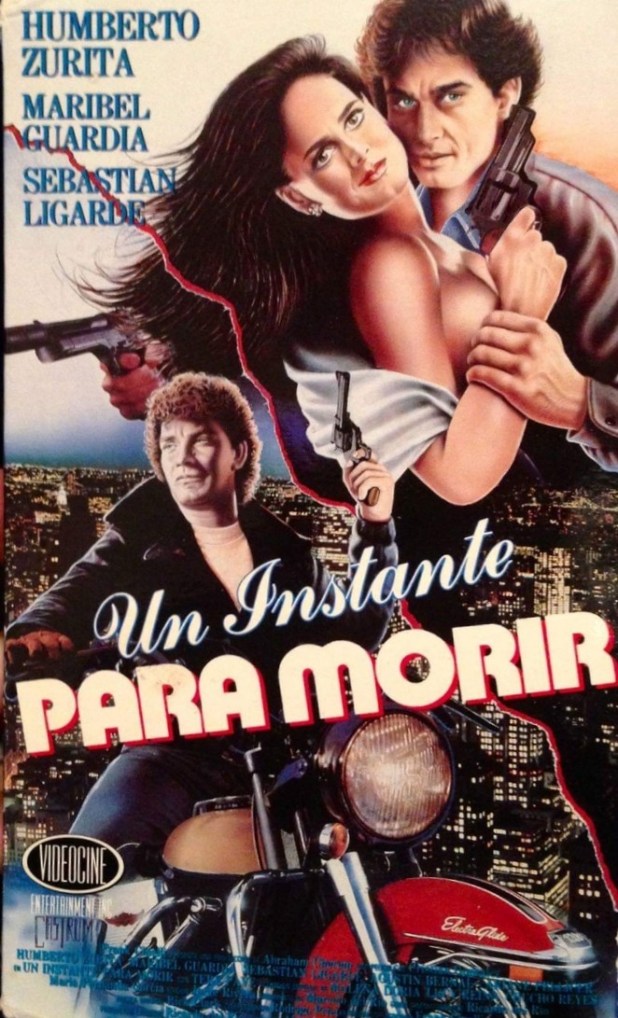
Released in theaters as El asesino del zodiaco (The Zodiac Killer), it was put out on video as Un instante para morir (An Instant to Die). It’s all about a police commander, a forensic scientist and a reporter all on the hunt for a killer who uses the zodiac to plan his murders. You know. A zodiac killer.
It’s directed by Christian González (Thanatos, Comando terrorista) and written by Marcelo Del Rio, who would go on to work in the art department for movies like the remake of Vantage Point and Limitless and Ricardo Del Río, who was a production coordinator on Kill Bill Volume 2 and was also a line producer on several big films made in Mexico.
It’s also a Mexico giallo and looks great, which is probably due to Rodrigo Prieto being the cinematographer. Since these somewhat humble beginnings — he also El jugador and Ratas nocturnas in this same time period — he went on to do the cinematography or direct the photography for some major movies such as 21 Grams, Brokeback Mountain, The Wolf of Wall Street and videos for Taylor Swift, Lana Del Ray and Travis Scott. He’s the director of photography on the upcoming Barbie as well.
I like how there are chapters for each segment using the zodiac signs and it looks and feels way better than a low budget Mexican genre picture — not that that’s a bad thing, because I love those too.
April 5: Roger Corman’s birthday — Whether he produced or directed the movie, share a movie for Corman’s birthday.
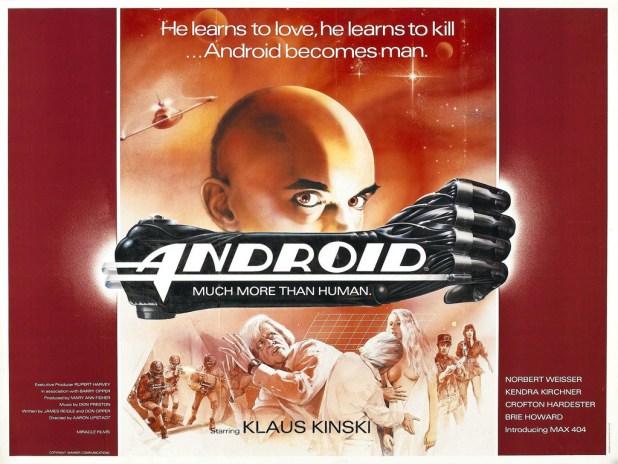
Using pieces of past Roger Corman-produced science fiction films, Android had a team that believed in it so much that even when Corman said that it wasn’t exploitable, Barry Opper (brother of writer and actor Don, who is in this as the android Max 404) and producer Rupert Harvey bought the rights. It still didn’t really break through, but there you go.
After the Munich Rebellion, all androids on Earth were outlawed. That’s why Dr. Daniel (Klaus Kinski) has goen to space to work on Max 404, his young male android who is already getting too curious and insubordinate. He’s already working on the next level of AI called Cassandra One (Kendra Kirchner). Meanwhile, Max has allowed a prison transport filled with criminals in disguise — Maggie (Brie Howard-Darling, who was in the all-female band Fanny, which predate The Runaways), Keller (Norbert Weisser) and Mendes (Crofton Hardester) — which upsets Dr. Daniel, but once he sees Maggie, he allows them to stay.
There’s a love triangle here kind of, because Max is showing signs of Munich Syndrome and becoming anti-human and Dr. Daniel needs to sexually stimulate Maggie and add the details of her love life into Cassandra One. When the cops show up, Max destroys their ship and tells Maggie that he saved her. They start to make love before Mendes interrupts and Cassandra reveals that Max is also an android. Before you know it, Maggie has been killed and it’s a mystery as to who did it as more cops start to arrive at the space station.
This gets very twist and turn at the end and has a pretty great reveal. It’s not necessarily a great movie, as it tells more than it shows and is quite talky, but any movie where Klaus Kinski is coming on too strong to both human and robotic women is one that I’m going to like.
Director Aaron Lipstadt is still working in streaming TV and podcasts. He also directed City Limitsand episodes of everything from Miami Vice to Law and Order: Special Victims Unit. This was written by Opper (Charlie from the Critters movies), James Regle (who was the set construction supervisor for Corman’s Forbidden World) and Will Regle.
April 5: Roger Corman’s birthday — Whether he produced or directed the movie, share a movie for Corman’s birthday.
It Conquered the World was released by American-International Pictures as a double feature with The She-Creature and has perhaps the goofiest monster ever, The Venusian. It was originally written by Lou Rusoff, who had to leave for Canada when he learned that his brother was dying. Charles Griffith did a rewrite two days before filming started and told Fangoria that the script “was incomprehensible which was strange because he was quite meticulous. Lou’s brother was dying at the time which most likely had something to do with it.” He also admitted that the final movie was terrible.
Paul Blaisdell created The Venusian and figured that is Venus was a big planet, it had heavy gravity so it needed to be bottom heavy and low to the ground. Beveraly Garland, who plays Claire Anderson in the film, said that when she first saw it, she said knocked it over, telling Fangoria, “I could bop that monster over the head with my handbag! This thing was no monster, it was a table ornament!”
Her husband in the movie, Dr. Tom Anderson (Lee Van Cleef!) has brought the creature to Earth to help humanity deal with its problems, except that it does what aliens in Roger Corman movies do and that’s enslave humanity. Anderson deals with that by using a blowtorch to the face of the monster, which temporarily earned it an X rating in the UK as they deemed it cruelty to animals until AIP producer Samuel Z. Arkoff explained that, well, it’s not an animal. It was an alien.
This was an early heroic role for Peter Graves and I’d like to think this comes from the same cinematic universe where his brother James Arness was The Thing from Another World.
April 5: Roger Corman’s birthday — Whether he produced or directed the movie, share a movie for Corman’s birthday.
PS: Thanks to Joe Sherlock for pointing out that — like always — I confused Bloody Mama with Crazy Mama.
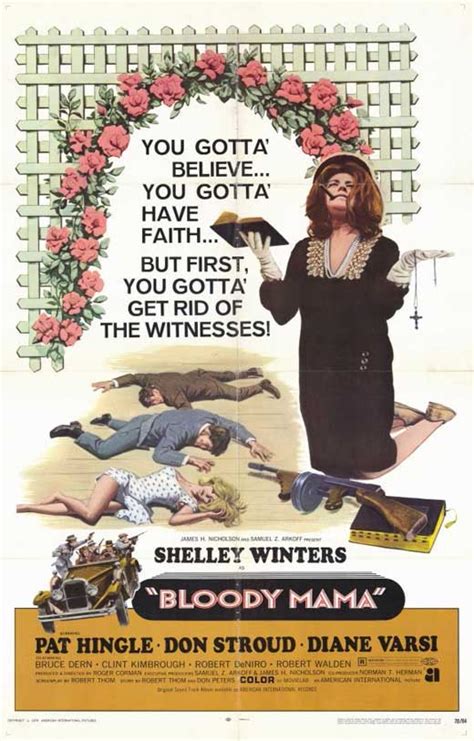
Gene Siskel gave Bloody Mama 1 star and said that it was “92 minutes of sado-masochism, incest, satyrism and voyeurism woven into a disgraceful screenplay. In fact, the whole treatment might be called embarrassed Bonnie and Clyde.”
Whatever.
As far as a hero in this movie, I guess it would be Ma Barker (Shelley Winters), a woman so damaged by the constant assaults of her brothers and father that she’s emerged as a woman constantly in demand of new lovers and attacking everyone around her. She leaves her husband George (Alex Nicol) and takes her sons Lloyd (Robert De Niro), Arthur (Clint Kimbrough), Herman (Don Stroud) and Fred (Robert Walden) on a murder-filled crime spree across America.
Herman and Fred get busted, so the gang adds gunman — and new lover for Ma — Kevin Dirkman (Bruce Dern) and prostitute Mona Gibson (Diane Varsi). But Kevin and Fred were once in a prison relationship, so this makes him resent his mom. Lloyd starts feeling the same way after a girl he’s fallen for — and by fallen for, I mean raped several times — named Rembrandt (Pamela Dunlap) gets drowned in a tub by Ma. Things get even worse when the boys see Sam Pendlebury (Pat Hingle) — a millionaire they’ve kidnapped — as their father figure and when they release him, Herman takes over, punching Ma in the face.
Stroud punched Winters so hard that he put her in the hospital for a day.
As the family makes its way to the Everglades, Lloyd overdoses, Mona runs and the remaining gang shoot an alligator with a tommy gun, which brings everyone and anyone the law has their way. Spoiler. No gang member makes it out alive, with Herman horrifyingly blowing his brains out with a machine gun and Ma dying on the porch, screaming and shooting and taking as many cops with her as she can.
The credits say that any similarity to anyone living or dead is coincidental, but the final title says that any similarity to Kate Barker is intentional. Was Ma Barker really in charge of her gang? J. Edgar Hoover stated that she was “the most vicious, dangerous, and resourceful criminal brain of the last decade.” Others claim that he said that because his agents went wild when capturing the gang and killed them all, even their innocent mother.
In the book John Dillinger Slept Here: A Crooks’ Tour of Crime and Corruption in St. Paul, 1920–1936, it’s stated that “Her age and apparent respectability permitted the gang to hide out disguised as a family. As Mrs. Hunter and Mrs. Anderson, she rented houses, paid bills, shopped and did household errands. Alvin Karpis was probably the real leader of the gang, and he later said that Ma was just “an old-fashioned homebody from the Ozarks.” She was superstitious, gullible, simple, cantankerous and, well, generally law-abiding.”
April 5: Roger Corman’s birthday — Whether he produced or directed the movie, share a movie for Corman’s birthday.
ABOUT THE AUTHOR: When Frederick Burdsall isn’t at work or watching movies while covered in cats, you can find Fred in the front seat of Knoebels’ Phoenix.
Earlier I offered a review of the Roger Corman-produced outer space shocker Galaxy of Terror, so for the final half of my salute to Roger I’m tackling my favorite Corman production: 1982’s Forbidden World, directed by Allan Holzman and starring Jesse Vint, June Chadwick and the spectacular Dawn Dunlap.
Bounty hunter Mike Colby (Vint) is called to Xarbia to check out Subject 20, which was created in hopes of curing a galaxy-wide food crisis. Too bad they didn’t explain that to Subject 20. After an opening segment with Colby awakening from cryo-sleep to fight off raiders, he receives orders to go to Xarbia where he is met by Doctor Hauser (Linden Chiles) and geneticist Barbara Glaser (Chadwick). They show him to the Biohazard chamber, where he sees the remains of various animals killed when Subject 20 got loose. It has now cocooned itself in the incubator and despite Colby’s insistence on destroying it, they convince him to sleep on it. While they go to dinner, Jimmy (Mike Bowen) is left to clean up the mess and after opening the incubator for a better look gets a face full of Subject 20 for his trouble (They never learn.).
At dinner it’s explained that their discovery, Proto B, can be spliced with anything to make it grow larger, but the scientists refuse to tell Colby what Subject 20 was before it got spliced. Meanwhile, Tracy Baxter (Dunlap) has now discovered what’s left of her boyfriend Jimmy. Doctor Cal Timbergen (played perfectly by Fox Harris) wheels off the body and everyone gets ready for bed (Apparently, they don’t care about the murderous creature running loose.).
While Barbara and Colby “get acquainted,” security chief Earl (Scott Paulin) has a close encounter with Subject 20. Early next morning, Tracy heads to the sauna (Thank You!) and is soon joined by Colby (She apparently wasn’t very bothered by the death of her boyfriend) and Subject 20, who escapes through the air shaft, forcing a search outside the ship. They discover an empty cocoon and head back to the research center, arriving in time to see the mutant head back into the shaft taking Hauser with him. Cal discovers that Jimmy is still alive, if only on a molecular level, and is being morphed into pure protein.
Once back inside, they learn the truth about Subject 20 and they figure out why they have been left alive until now. After a visit from a not quite dead Hauser, the girls hit the shower in a scene that would have gotten me through puberty if it had been made about 10 years earlier. They decide to communicate with it. Barbara has a nice quick chat via computer before being invited to dinner, and as the menfolk come running to the rescue, Cal discovers the solution to the problem. How many more have to die? Will ANYONE survive? Watch, enjoy and find out for yourself.
Not wanting to leave out anyone, I’ll also mention the film also starred Raymond Oliver as Brian. The opening sequence of the movie was shot just after Galaxy of Terror using that picture’s Quest set. The ever-thrifty Roger had rented the property until the weekend and still had a few days remaining, so he had the scene shot and added on to Forbidden World, even though the rest of it wasn’t filmed until about four months later. Gotta love it. They also used the skeleton of the giant maggot for the final shots of the film where you see the mutant barreling through the corridors chasing Tracy (Can’t say I blame him.).
In any event, this is pure cheesy sci-fi at it’s best. Chadwick was smoldering and Dunlap looks magnificent with or without clothes, but the star of this for me was Harris as Doctor Timbergen. He looked and sounded like the proverbial mad scientist and, even though I couldn’t name anything else he was in without looking it up, I will always remember him for this film. Great job. As for Dunlap, she would go on to make only a few more films before leaving the biz and heading back to Texas. Hope she’s doing well.
And as for the rest of you: watch out for missing test subjects and I’ll see you at Knoebels.





 B&S About Movies
You must be logged in to post a comment.