EDITOR’S NOTE: The Paperboy was on USA Up All Night on December 8, 1995 and January 16, 1998.
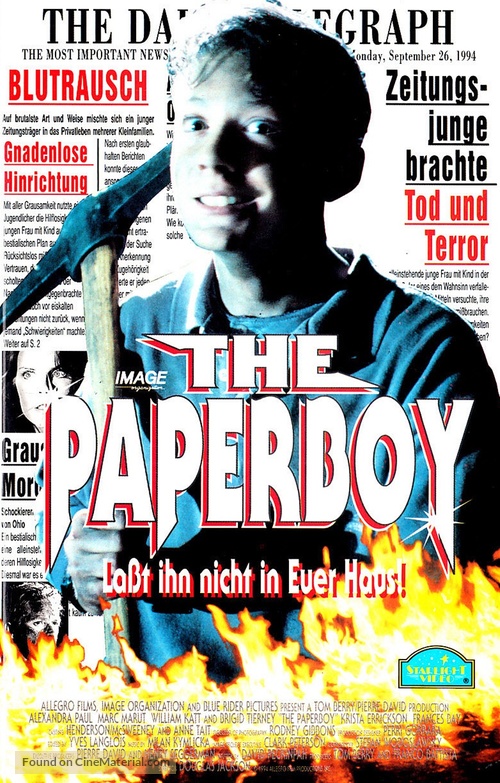
Canada may seem like our polite neighbor to the north, but they really export some amazingly bonkers movies. Under the surface, they’re boiling with films that challenge convention and embrace the weird. Take this movie, which starts with its 12-year-old antagonist, paperboy Johnny McFarley smothering an old woman with a plastic bag.
After that stunning open, we meet Melissa (Alexandra Paul, the virgin Connie Swail from Dragnet), a teacher who returns home to learn that her mother — yep, the old woman — is dead. She takes her daughter Cammie home with her for the funeral, where Johnny is way too excited to see her. He ingratiates himself into the funeral proceedings and then hides a baby monitor in a vent so he can keep up on what Melissa is doing. Yep. Our paperboy is in love.
What he can’t deal with is the fact that she has a boyfriend, Brian (William Katt). But he’s willing to do whatever it takes to win her over, from turning busybodies into paraplegics to killing his own father with a golf putter and giving another old lady a heart attack by faking the death of her dog. He even smacks Brian with a baseball bat and leaves him inside a burning boat.
Yes, this is a child who goes from sweet and approachable to pure menace in seconds. How dare you go on a date when he wanted to make you some barbecue, Melissa!
This is a sort of remake of 1992’s Mikey by way of another Canadian movie where all someone wants is a happy family, 1987’s The Stepfather.
Sadly, this is a movie that’s near impossible to find, as it’s never been released on DVD. You can, however, find it at the VHSPS.
BONUS: You can listen to us discuss this movie on our podcast.
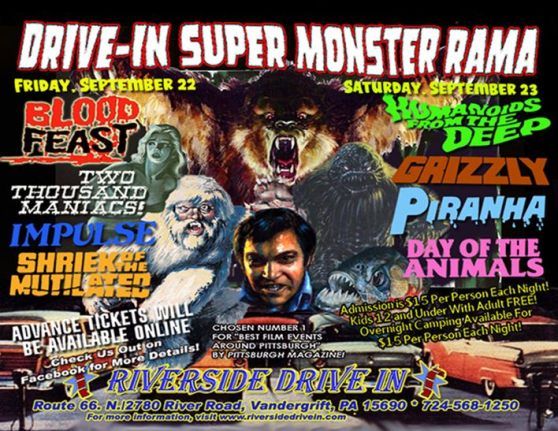
EDITOR’S NOTE: This weekend is the Drive-In Super Monster-Rama! Get more info at the official Drive-In Super Monster-Rama Facebook page and get your tickets at the Riverside Drive-In’s webpage.
There are tons of Bigfoot films to watch. Trust us, we know. We have an entire Letterboxd list packed with the ones we’ve made it through. And we know that Scarecrow has an even larger section in the store that’s all Yeti, skunkape and Sasquatch-based.
We decided to go back to the classics and rewatch this 1974 Michael Findlay film, in which Professor Ernst Prell takes four of his graduate students — Keith Henshaw, Karen Hunter, Tom Nash and Lynn Kelly — into the woods to discover if the Yeti really does exist.
Despite a mysterious dinner the night before — their dish of gin sung is broken up by a drunken former student and his wife who loudly proclaim that the last trip to see a Bigfoot got everyone killed — everyone decides that going into the brush to find the beast is a dandy idea.
As if that isn’t enough, that lout keeps drinking and decides to cut his wife’s throat with an electric turkey knife before she responds in kind by dumping a toaster into the bloody bathwater as he tries to clean himself up.
When the students get to Boot Island, they have more gin sung, meet a mute Native American named Laughing Crow and listen to Tom strum a little tune he wrote about the Yeti, who liked that song so much that he rips Tom apart, leaving only his leg as evidence.
The professor isn’t someone I’d like to have as a teacher, as he’s willing to use that leg and the body of another of the students, Lynn, as bait to catch his white whale. Or white Yeti, you get the allusion.
That said, the reveal of this all — spoiler warning for a 46-year-old movie — is that there’s no Bigfoot at all, but a big society of cannibals looking for either victims to be fresh meat or those willing to help them consume the flesh of their fellow man.
If you’re a big film geek like me — seeing as how you’re reading about a Sasquatch film from the last century when you could be doing something much more productive, I get the feeling that you are — you’ll wonder, did the print Sam saw have Hot Butter’s “Popcorn” in the soundtrack? Yes. It did. It sure did.
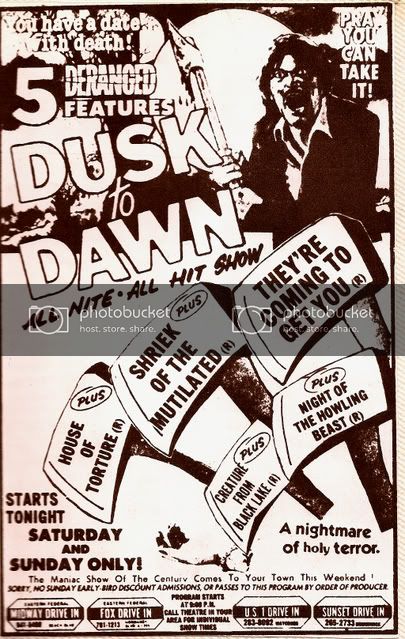
In 1982, if you were lucky enough to still have a drive-in around ou, chances are you could have seen this movie as part of an event named 5 Deranged Features. Don’t be fooled by some of these titles, as you may have seen them all before! They’re Coming to Get You is not All the Colors of the Dark, but instead Al Adamson’s Frankenstein vs. Dracula. House of Torture is The Wizard of Gore. Night of the Howling Beast is The Corpse Grinders. And Creature from Black Lake wasn’t so lucky as to get a name change.
Here’s a drink that I’ll be bringing to the drive-in.
Yeti
1 1/2 oz. gin
1/2 oz. blue Curaçao
3 oz. lemonade (you can make it yourself or just go off the shelf)
Club soda
Lemon wedges
Combine gin and the lemonade in a glass with ice.
Add blue Curaçao and top with club soda. Stir using a mixing spoon and garnish with lemon wedges.
EDITOR’S NOTE: This weekend is the Drive-In Super Monster-Rama! Get more info at the official Drive-In Super Monster-Rama Facebook page and get your tickets at the Riverside Drive-In’s webpage.
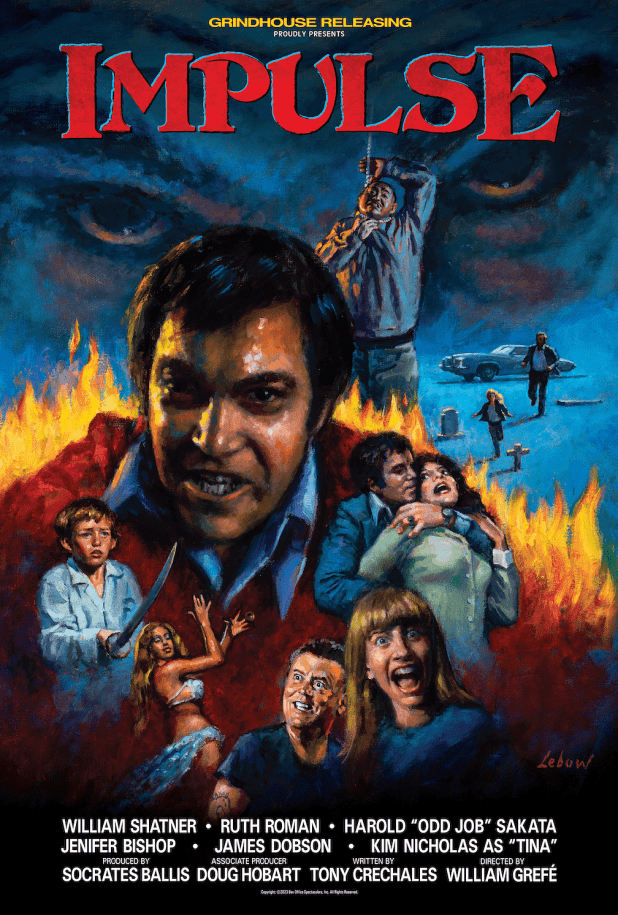
When a movie has the working title Want A Ride, Little Girl? you know it’s going to be scummy. What may surprise you is that William Shatner — who director William Gréfe met at an airport — is in the lead role.
Don’t be fooled by the supernatural looking poster. No, this is a slasher with Shatner’s Matt Stone as the bad guy picking up young women, freaking out Shat-style and getting rid of their bodies. He’s being trailed by a detective named Karate Pete (Harold “Oddjob” Sakata), which is, pardon the pun, pretty odd. He’s on the trail because Stone keeps bilking and killing old women for their money.
Jennifer Bishop (who is also in Gréfe’s Mako the Jaws of Death) plays the daughter of one of these older women who suspects that the leisure suit-wearing Stone is a shyster. And oh yeah — Ruth Roman is in this!
Sakata almost died making this, as the rig that was used for his hanging death failed and he was nearly hung for real. Shatner saved his life — breaking a finger in the process — and the entire accident can be seen on the He Came from the Swamps documentary.
This movie belongs to Shatner. As a child, his character kills William Kerwin with a sword in a kind of pre-Piecesopening, then murders a puppy and gets so worked up in one scene that he supposedly farts on camera. His assortment of 70’s fashions are pretty astounding and every single frame of this feels as sweaty and gross as a night in the Everglades.
Maybe I’m too old and it’s too loud, but the kids in this movie aren’t fun and rebellious. They’re actually annoying and that kind of makes me sad.
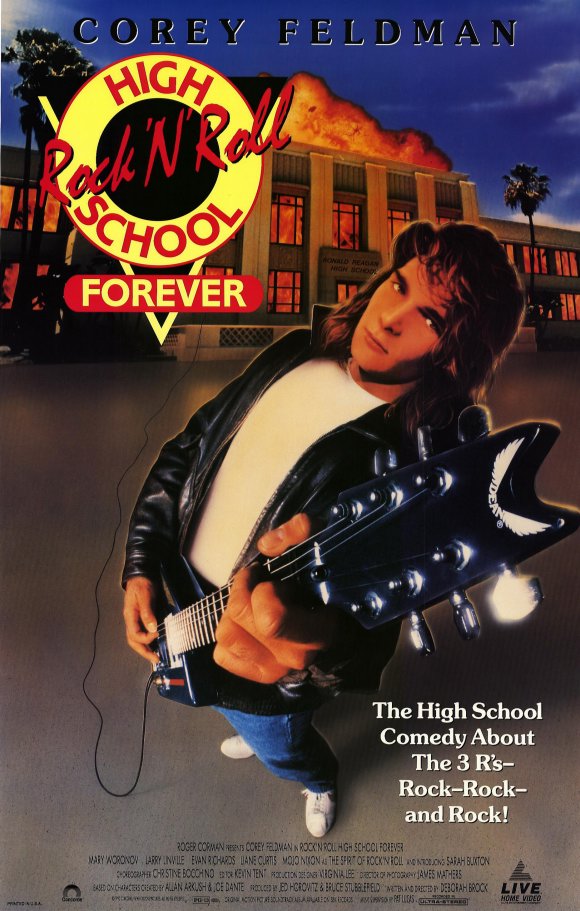
Blame is to be laid at the feet of Jesse Davis, the lead singer of the Eradicators and the leader of the rebellious kids who defy authority by blowing up toilets. He hangs with Mag (Evan Richards) and critiques his burps. Richards was hired because he looked like Corey Haim and, well, they could have just hired Corey Haim.
When he isn’t singing like Michael Jackson or opining like an expert on everything, Jesse is trying to pick up a new music teaching named Rita (Sarah G. Buxton) which doesn’t feel high school cool, it feels like pressure on his end and oh yeah, she’s an adult older than him and that’s illegal.
The rest of the band is sax player Jones (Patrick Malone) and really, I hate bands that have dedicated sax players. They also have a karate kicking bass player named narock (Steven Ho) and Stella, the only female member, guitarist and also only reason to watch this movie — with one upcoming exception — who is played by Liane Curtis, who always is the sidekick in these movies. For evidence, watch Sixteen Candles. Is it any surrpise she became a Girlfriend from Hell? Also: Her father is Jack Curtis, who directed, produced, shot and edited The Flesh Eaters and did the dubbing for everything from Speed Racer (he was Pops Racer and Inspector Detector), Gamera the Invincbleand Planet of the Vampiresto Prince of Space and Mothra vs. Godzilla. Sadly, he died at the age of 40 because he was allergic to penecillin and there was no other treatment for his pnuemonia.
The other reason to watch is, of course, Mary Woronov, who plays Dr. Vadar, the new Vice Principal who can remove her hand and replace it with a metal claw or a whip. Also: Rob Zombie had to have seen this movie, as the witch Tabatha is played by Brynn Horrocks. In The Lords of Salem, she plays one of the first witches of Salem, Mary Webster.
It’s directed and written by Deborah Bock, which is a disappointment, as I love her Slumber Party Massacre II. It starts on Rock ‘n’ Roll High School Day, which honours the day in the first film where the students blew up Vince Lombardi High. But there are no Ramones here — don’t your parents know that you’re Ramones? — just posters of them randomly. Principal McGee returns, but it’s not Paul Bartel. Instead it’s Larry Linville. Eaglebauer also comes back, but instead of Clint Howard, it’s Michael Cerveris.
Well, Dee Dee is on the soundtrack. And the part with Mojo Nixon as the Spirit of Rock ‘n Roll is kind of cute. It’s not Mojo’s best role — that would be Toad in Super Mario Brothers — but he does elevate the proceedings.
But Corey Feldman playing 50s classics as 90s versions is not Joey showing up in Riff Randell’s bedroom to sing “I Want You Around.” Speaking of music, the soundtrack is all over the place with The Pursuit of Happiness, Thompson Twins, The Divinyls, Eleven, Tackhead, The Ventures and, as you imagined, Corey Feldman & The Eradicators. SBK was going to release the soundtrack but supposedly Feldman’s rehab stint put them off, because all record labels are against rock stars getting off drugs.
In his book Coreyography — ugh — Feldman writes about how he was a heroin user during filming and came to set with heroin residue dripping from his nose. When a stage hand discretely brought it to his attention, Feldman and turned it into an angry scene, claiming the stuff under his nose was from an engine he was fixing.
EDITOR’S NOTE: Rambo III was on USA Up All Night on March 22 and July 4, 1997.
When I was a kid, I wasn’t allowed to have toy guns and military toys were not allowed in our house. I can remember thinking how strange it was that my grandfather loved war movies so much, hearing him listen to screaming and bullets and explosions in films late into the night when he’d get home from a double shift at the mill. And yet here I am, thirty years later or so, pretty much doing the same thing, watching Stallone movies at 6:12 AM while the rest of the world enjoys their last few minutes of sleep.
The first time I saw Rambo III was at a friend’s house unbeknownst to my parents. And this kid was obsessed with Rambo, right down to the necklace and knife that had a compass and opened up to hold tools. Yeah, 1988 was the kind of time when kids idolized war movies. We didn’t know that war was a funny thing and that the very Taliban soldiers that we cheered on in this film would one day change sides because global diplomacy is funny that way. It was simpler to just hate and fear Russia back then than it is today, where nothing at all seems sure and everything feels made up.
But I digress. Let’s talk about John Rambo.
Colonel Sam Trautman tracks down Rambo in Thailand, where he’s stick fighting for a monastery. He wants nothing of the war, even when shown how Russian troops in Afghanistan are killing civilians. Trautman goes on the mission and is captured, with all of his men killed. That’s when Rambo tells the man in charge of this op, government suit Robert Griggs, that he’ll rescue Trautman.
That leads me to one of my many rules of movies. This one is simple. Never trust a government spook. And my second rule: never, ever trust Kurtwood Smith.
Rambo soon meets arms dealer Mousa Ghani and asks him to bring him to Khost, where Trautman is being held. The Mujahideen in the village take to Rambo after he plays a game on horseback with them, but after a Russian helicopter attacks them, they refuse to help him. Instead, only Mousa and a young boy named Hamid are willing to help.
Rambo — of course — destroys everyone in his path to save his mentor. He uses everything from his bare hands to explosive arrows and even a tank to kill everyone in his path. And while the Russians almost take them out, the brave Afghani people rise up to rescue our heroes.
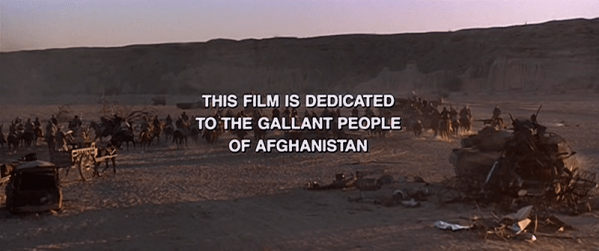
This movie used to end with a dedication to the brave Mujahideen, but now just thanks the gallant people of Afghanistan. That said, Masoud is based on Ahmad Shah Masoud, a real-life Afghan resistance who later became the minister of defense before leading the resistance against the Taliban. And in the original cut, Rambo felt so at home with the freedom fighters that he stayed here versus going back to America.
Up until Back to the Future Part II, this was the most expensive movie ever made. And, like many Stallone films, it was fraught with issues. Just a few weeks into filming, most of the crew including the director of photography and director Russell Mulcahy (Razorback, Highlander) were fired.
Stallone told Ain’t It Cool News that Mulcahy “went to Israel two weeks before me with the task of casting two dozen vicious-looking Russian troops. These men were supposed to make your blood run cold. When I arrived on the set, what I saw was two dozen blond, blue-eyed pretty boys who resembled rejects from a surfing contest. Needless to say, Rambo is not afraid of a little competition but being attacked by third-rate male models could be an enemy that could overwhelm him. I explained my disappointment to Russell and he totally disagreed, so I asked him and his chiffon army to move on.” Mulcahy was replaced by Peter MacDonald, a veteran second unit director.
The Guinness Book of World Records went on to label this the most violent film ever made, with 221 acts of violence, 70 explosions and over 108 on-screen deaths. They should have held on for the next one in the series, which goes way beyond this. Of course, this won Stallone another Razzie for Worst Actor, but I don’t think he was all that concerned. After all, he got paid a Gulfstream jet to be in this movie.
EDITOR’S NOTE: Rambo: First Blood Part II was on USA Up All Night on February 10 and 23, 1996.
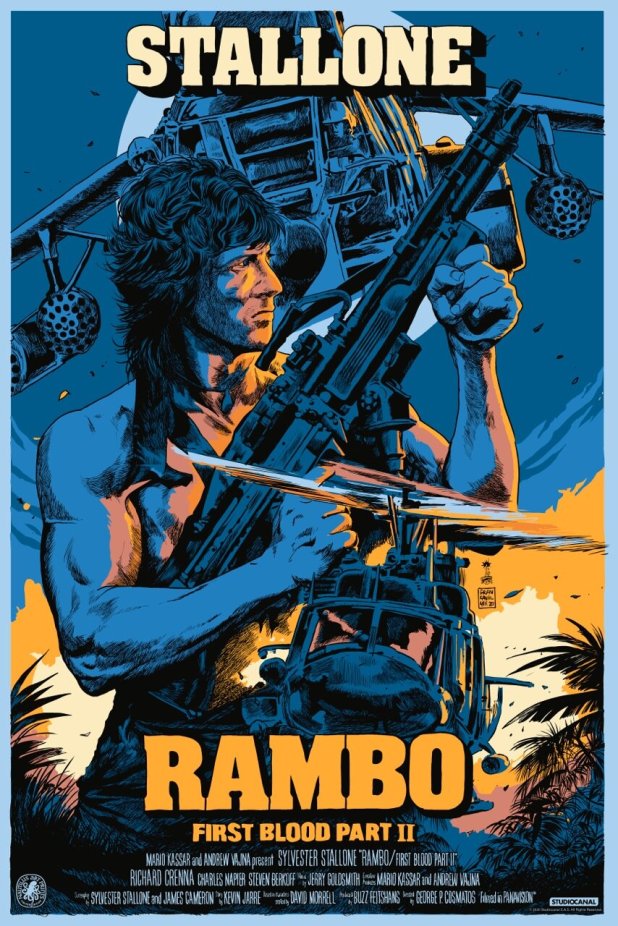
When it came time to do a sequel to First Blood, there was a thought that Rambo needed a partner.
Producers wanted John Travolta, but Stallone vetoed the idea. Lee Marvin (who almost played Colonel Trautman in the first film) was offered the role of Marshall Murdock, but declined.
In fact, that sidekick character is in the first draft James Cameron wrote for this film. Stallone said of what he wrote, “In his original draft it took nearly 30-40 pages to have any action initiated and Rambo was partnered with a tech-y sidekick.”
What ended up on screen was very different.
“Rambo, John J., born 7/6/47 Bowie, Arizona of Indian-German descent. Joined army 8/6/64. Accepted, Special Forces specialization, light weapons, cross-trained as medic. Helicopter and language qualified, 59 confirmed kills, two Silver Stars, four Bronze, four Purple Hearts, Distinguished Service Cross, Medal of Honor.”
Yep — that’s our hero. Given that he kills 74 people in just two days in this film, he’s somehow more successful in Vietnam the second time. But we’ll get to that.
For now, it’s been three years and Rambo is paying for his actions in the original movie when he’s visited by Colonel Sam Trautman. Even though the Vietnam War is over, people remain convinced that POWs have been left behind. The government has authorized a solo mission to confirm if any are alive and Rambo is one of only three men suited for such a mission (who the other two are, I leave up to you, dear viewer, but if one of them isn’t Thunder, I don’t want to know about it).
Marshall Murdock (Charles Napier) is the suit in charge that tells Rambo that all he has to do is take photos, not rescue anyone or engage the enemy. As Rambo drops into enemy territory, his parachute becomes tangled, leaving him with only a knife and a bow. He doesn’t need all those guns, trust me.
A young intelligence agent named Co-Bao (Julia Nickson) and some pirates take Rambo up river, where he saves an American POW who has been crucified and left to die. The Vietnamese troops attack and the pirates betray Rambo, so he kills everyone. Rambo’s extraction is canceled, as Murdock says that Rambo has violated his orders and tells Trautman that he never intended for there to be any rescue — it would be too expensive and no one wants another war.
Rambo is turned over to the Soviet troops who are training the Vietnamese, Lieutenant Colonel Podovsky and Sergeant Yushin. They demand that he read the US government a message to stay away from future missions. Instead, he warns Murdock that he’s coming for him. He escapes thanks to Co and they kiss, only for her to die seconds later.
Rambo then becomes a slasher villain that we cheer for as he wipes out every single enemy one by one. He even steals a helicopter and uses it to destroy Murdock’s office before demanding that the rest of the POWs get rescued.
Trautman then confronts Rambo and tries to convince him to return home, but our protagonist angrily replies that he only wants his country to love its soldiers as much as its soldiers love it.
James Cameron claims that he only wrote the first draft of the script and that Sylvester Stallone made many changes to it. He claims that the star didn’t like that the sidekick got all the cool dialogue and scrapped most of the POWs’ backstories.
When the film was released, the political content of the movie was controversial, with many critics not ready to see any heroism in the Vietnam War. For his part, Cameron commented that he wrote the action and Stallone the politics.
That said — at the time of the making of this film, there were 2,500 soldiers missing in action, so you can see where the sentiments were coming from. There were even reports that Delta Force operatives were in training to try and find those prisoners.
Stallone explained the ending of the film quite passionately: “I think that James Cameron is a brilliant talent, but I thought the politics were important, such as a right-wing stance coming from Trautman and his nemesis, Murdock, contrasted by Rambo’s obvious neutrality, which I believe is explained in Rambo’s final speech. I realize his speech at the end may have caused millions of viewers to burst veins in their eyeballs by rolling them excessively, but the sentiment stated was conveyed to me by many veterans.”
This film was beloved by audiences worldwide just as much as it was savaged by critics. It won Worst Picture, Worst Actor, Worst Screenplay and Worst Song (“Peace In Our Time” by Frank Stallone) in the Razzie Awards. It doesn’t matter — it started an entire genre of military revenge pictures.
Director George P. Cosmatos would go on to work with Stallone again on Cobra, as well as direct the films Leviathan and Tombstone. He was recommended for the film by Stallone’s son Sage, who liked his movie Of Unknown Origin. Of course, Cosmatos’ son Panos would grow up to be the director of Mandy and Beyond the Black Rainbow.
This movie marks a true change from the way American audiences would view Vietnam and its veterans. It could have only been made in 1985, to be honest, and exists within that time to remind us of a completely different era.
EDITOR’S NOTE: Hellraiser II: Hellbound was on USA Up All Night on October 26, 1996 and July 25, October 25 and November 8, 1997.
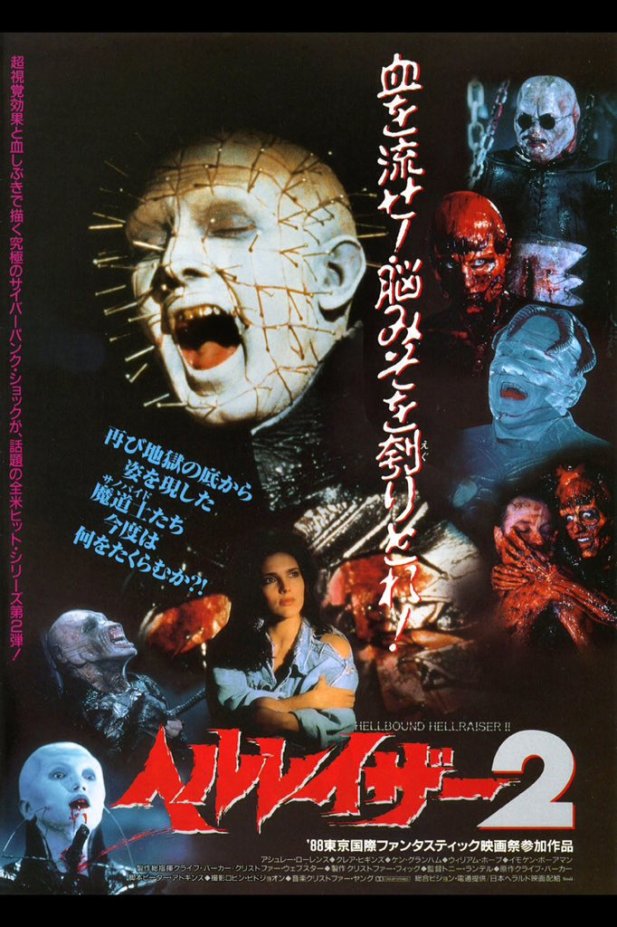
Most of the cast and crew of Hellraiser returned to make this movie and you know, despite the reduced budget, the dark tone of this movie and continuation of the themes from the original makes this one of the better horror sequels.
Kirsty Cotton (Ashley Laurence, returning from the first movie) is admitted to a psychiatric hospital where Doctor Channard and his assistant Kyle MacRae listen to her story. She begs them to destroy the bloody mattress her stepmother Julia Cotton (Clare Higgins) died on but Channard ends up being a man who has been obsessed with the Lament Configuration. After a patient slices himself open upon that cursed object, Julia comes back to our reality.
Channard and Julia have been luring mentally disturbed men to his home so that Julia can feed off of them. Meanwhile, Kirsty meets Tiffany, a girl skilled at solving puzzles who is forced by the doctor and his demented mistress to open the gates of Hell with the infernal box at the heart of this story.
Within the dimension of Leviathan, the humans are more duplicitous than the demonic Cenobites that carry out the orders of their master.
Barker had plans to show how each of the Cenobites had once been human and how their own vices lead to their becoming angels to some, demons to others. You’d think that with the success of the first film they could have had a little more money here.
Another intriguing notion is that Julia was originally supposed to rise from the mattress at the end of the movie as the queen of hell and be the recurring character. As the first movie gradually became a success, Pinhead ended up becoming the favorite.
Back in the video rental days, I may have brought this home more than twenty times. I was obsessed by the look of Leviathan’s dimension and the strange sound that it makes — Morse code for God — blew my teenage mind. It still holds up today, despite a litany of lesser sequels (which trust me, we’re getting to).
EDITOR’S NOTE: This weekend is the Drive-In Super Monster-Rama! Get more info at the official Drive-In Super Monster-Rama Facebook page and get your tickets at the Riverside Drive-In’s webpage.
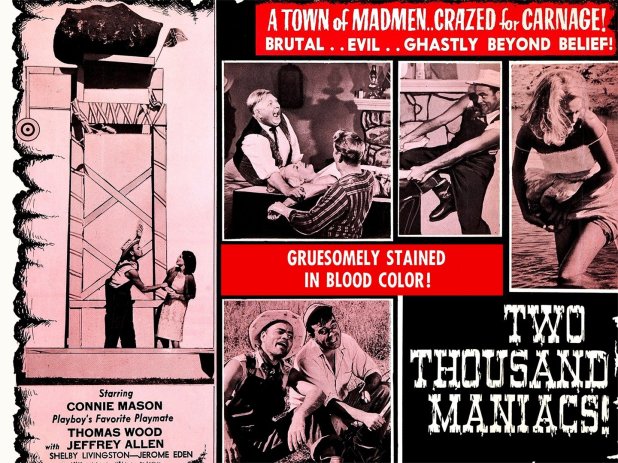
It takes a certain kind of genius — or maniac — to make a gore drenched version of Brigadoon. I was explaining this movie to someone and said that the main reason why I like it so much is the completely joyful way in which the townsfolk of Pleasant Valley go about their murderous rampage. This is the time of their lives — well, post-death lives — and it’s worth hollering and singing and shouting about.
Shot over two weeks in the small Florida town of St. Cloud — not yet a cog in the omnipotent wheel of the Disney vacation empire yet — and featuring the gleeful participation of nearly every citizen in that sleepy community, this movie established the danger of the South to North audiences, a theme that would reach its creative apex in Tobe Hooper’s The Texas Chainsaw Massacre.
Yankee tourists, made up of the Millers, the Wells and unmarried folks Tom White and Terry Adams (Lewis’ muse, if he ever had one and only because he never sliced off one of her limbs or cut out her tongue, Connie Mason) have followed the detours to Pleasant Valley where they’re the guests of honor for the centennial celebration.
Yes, a hundred years ago, the Union troops marched through the town and killed every man, woman and child. What a thing to celebrate!
The town’s mayor, Joseph Buckman (Taalkeus Blank, who used the name Jeffery Allen, could do such a Southern accent that Lewis would also use him in Moonshine Mountain, This Stuff’ll Kill Ya! and Year of the Yahoo!), and the townspeople show everyone great hospitality at first, but before you can say Mason-Dixon Line they’re slicing off their guests body parts, drawing and quartering them, getting rolled down the hill in a nail-filled barrel, having rocks dropped on them and all other manner of grisly crowd pleasing hijinks.
After kidnapping little Billy, Terry and Tom make it out of town and come back with the police, only to discover that the town never existed. When they leave, the townspeople return and wonder what the world will be like when they come back in 2065 before disappearing into the fog.
This was Lewis’ favorites of his films and he even published a tie-in paperback version of the story.
Yes, that’s Herschell Gordon Lewis singing the theme song, too. You have to admire his dedication to filmmaking. This was produced by David F. Friedman, who met up with Kroger Babb before a career that has everything from nudie cuties and roughies to gore and Naziploitation, which he produced under the name Herman Traeger.
More movies should be like Two Thousand Maniacs!, but so few have the gumption to even try.
Here’s the drink I’m bringing to the drive-in for this movie.
Pleasant Valley Dew
4 oz. Mountain Dew
2 oz. moonshine
,5 oz. triple sec
2 oz. pineapple juice
2 oz. orange juice
2 oz. pomegranate juice
Pour it all in a shaker with ice and shake it like it’s a Yankee in a barrel.
Pour and savor all that booze.
Can’t make it to the drive-in? You can watch Two Thousand Maniacs! on Tubi.
EDITOR’S NOTE: This weekend is the Drive-In Super Monster-Rama! Get more info at the official Drive-In Super Monster-Rama Facebook page and get your tickets at the Riverside Drive-In’s webpage.
I’m proud to say that Herschell Gordon Lewis was born in the same town as me, Pittsburgh, PA. He was lured from a career as an educator into being a radio station manager and then, well, advertising got him. I can relate. I’ve spent the better part of 25 years doing the same. But then Lewis got smart. He learned how to make money.
He began making movies with David F. Friedman, starting with Living Venus. Their nudie cuties would be innocent today, but showed way more skin than mainstream films. These weren’t high art. They were made to turn a profit and they sure did, from movies like Boin-n-g! and The Adventures of Lucky Pierre to the world’s first — and probably only — nudist camp musical, Goldilocks and the Three Bares.
Once nudie movies got boring, Lewis needed another tactic. He found it. Oh wow, did he find it. Gore. Blood everywhere, guts all over the screen and no limits to the depravity that he’d fester on drive-in screens nationwide. It all started with Blood Feast.
This is a pretty simple film: Faud Ramses wants to make sacrifices to the Egyptian goddess Ishtar to resurrect her, so he kills beautiful young socialites when he’s not catering their coming out parties. He’s also wiping out anyone who requests a copy of his book, Ancient Weird Religious Rites.
Shot in Miami, Florida — where life is cheap! — in just four days for just $24,000, Blood Feast used all local ingredients for the gore, except for a sheep’s tongue that came from Tampa Bay. Friedman was a genius at publicity, helping the film succeed, giving out vomit bags at screenings and even applying to get an injunction against his own movie in Sarasota so that it couldn’t be shown.
Lewis and Friedman didn’t stray too far from their sexy roots, bringing in June 1963 Playmate of the Month Connie Mason to star in the film. She would come back for Lewis’ even more astounding Two Thousand Maniacs!
As for Lewis, he left filmmaking in the 1970’s, served some jail time for fraud and then began copywriting his way to even greater success, a second — maybe even third or fourth career — later in life. He wrote and published over twenty books, including The Businessman’s Guide to Advertising and Sales Promotion, Direct Mail Copy That Sells! and The Advertising Age Handbook of Advertising. His books were all over the place at my first agency job and I was shocked to discover that the author of these books — one of the godfathers of direct mail and eblasts — was also the American godfather of gore. Sometimes. life makes sense.
In 2016, Arrow Video released a huge box set of his films and the man whose work was often in grimy drive-ins and Something Weird video cassettes finally began to be appreciated as an auteur. Funny, as he was the man who said, “I see filmmaking as a business and pity anyone who regards it as an art form.”
You know those movies that they warn you about and tell you that they’ll warp your mind and make you a maniac, how you’ll never be the same again? This is that movie. You should probably watch it right now.
Can’t make it this weekend? Blood Feast is available on Tubi or on Shudder with and without commentary from Joe Bob Briggs.
EDITOR’S NOTE: The Fly II was on USA Up All Night on September 8, 1995; July 26, 1996 and October 3, 1997.
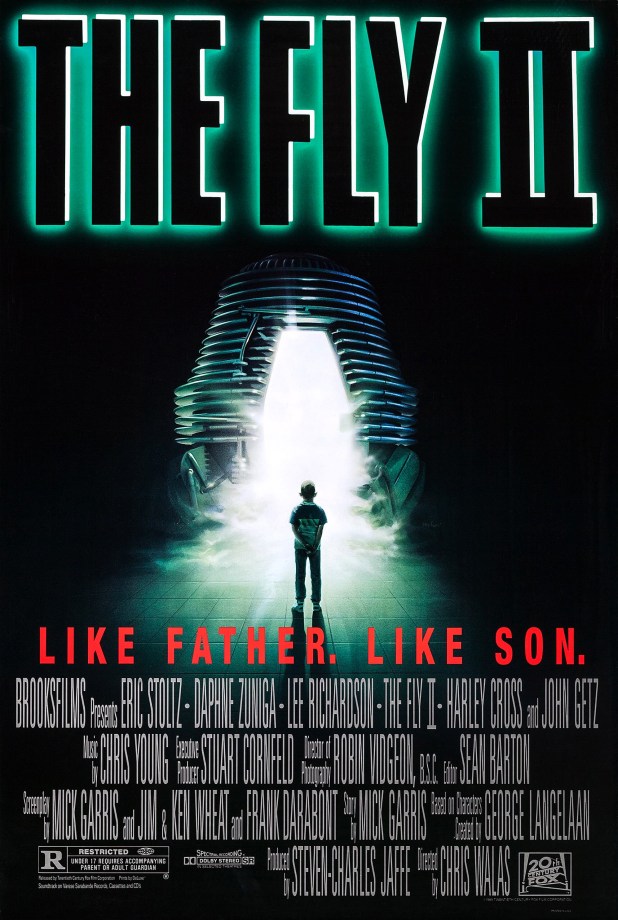
I hate when sequels instantly kill off the characters that you loved in the first movie, but Geena Davis wasn’t coming back for this movie. After giving birth to a larval sac, the son of the child that she had with Seth Brundle, Veronica Quaife dies. Their son grows up to be the normal-looking Martin Brundle (Eric Stoltz) whose physical and mental maturity is highly accelerated. He’s a genius, has amazing reflexes and never sleeps. He’s also aging faster than a normal human and is growing up inside the labs of Anton Bartok (Lee Richardson).
Bartok is trying to figure out the teleportation that caused Seth to become the Brundlefly. By the time that Martin is five, he has the mental and physical abilities needed to be part of this experiment. A dog he had befriended years before was mutated like his father and Martin figures out where it is and euthanizes it. He is showing signs of mutation himself, but know that he will need to hurt someone else to stop it from happening. He also falls in love with Beth Logan (Daphne Zuniga) but obviously that may not last long as he’s rapidly becoming the kind of monster that his father was.
Directed by special effects artist Chris Walas, who created the effects for the first movie. He’s only directed two other things, the Tales from the Crypt episode “‘Til Death” and The Vagrant. He created the Gremlins, the creature effects in House II: The Second Story and the effects in Naked Lunch.
The script had some big talent working on it. There’s Master of Horror Mick Garris, joined by Frank Darabont and Jim and Ken Wheat, the brother team who would go on to write The Birds II: Land’s End. Master of Horror Mick Garris’s original script was about Veronica being convinced not to abort her baby by a religious cult that adopted and raised Martin. As he rapidly ages, Martin learns that he can talk to bugs and would help a gang of kids escape the cult. Another idea had Seth being cloned and his son being the only one who could communicate with him, which became a family-friendly movie about a boy and his bug. Chris Walas hated these ideas and nearly quit because Fox hired Darabont. This is all IMDB conjecture, so it could be all kayfabe BS.
Also according to the always unreliable IMDB. they did an old 50s gimmick in some theaters where they had a nurse in each theater in case audiences were sickened by the movie.






 B&S About Movies
You must be logged in to post a comment.